Research Article
CODEN: IJPNL6
EVALUATION OF THE EFFECTS OF ATORVASTATIN ON LEARNING AND
MEMORY IN WISTAR RATS
Rahul P Nambiar, Mukta N. Chowta
*, Nishith RS, Priyanka Kamath, Sanjay Hadigal
Department of Pharmacology, Kasturba Medical College, Manipal University, Mangalore, India
*Corresponding author e-mail:
[email protected]
ABSTRACT
This study was conducted with the objective of evaluating the effect of atorvastatin on scopolamine-induced amnesia in animal models. Male Wistar rats of 6 weeks old randomly assigned to four groups of six mice each. Group I received 0.5%w/v CMC, 10 ml/kg, group II received donepezil 5mg/kg, group III is negative control group and group IV received atorvastatin 10mg/kg dose administered orally for 8 days, commencing on day 6. On day 13, amnesia was induced by administration of scopolamine (0.4 mg/kg i.p.) to groups II-IV. On the first day, all the rats were familiarized with the Hebb William maze for a period of ten minutes. From the 2nd to 5th day the rats received four consecutive trials of training per day in the maze. After 45 minutes of administration of amnestic agent, trials of learning and memory were taken on Hebb-William’s maze and the retention was observed 24 hours after. The learning score decreased significantly in donepezil and atorvastatin treated group when compared to baseline values. There was a significant difference in learning score of both donepezil and atorvastatin treated groups in comparison with scopolamine treated group, suggesting their significant effect on learning and memory in rodent models.
Key words: Atorvastatin, memory, Wistar rats, scopolamine, Hebb-William’s maze
INTRODUCTION
Dementia is a mental disorder characterized by loss of intellectual ability, sufficiently severe to interfere with one's occupational or social activities. Alzheimer's disease is the most common form of dementia, accounting for approximately 70% of the dementia cases in most industrialized countries. Alzheimer’s disease is an age-dependent, progressive, neurodegenerative disorder characterized by multiple cognitive deficits, which is often, accompanied by behavioral disorders and mood changes. The neuropathology of Alzheimer's disease is characterized by the deposition of abnormal protein aggregates. The main constituent of the deposition is beta-amyloid protein. A seminal role of this protein is supported by the discovery of point mutations in the gene of its precursor protein in certain forms of familial Alzheimer's disease.[1] Nootropic agents like anticholinesterases, piracetam, NMDA antagonists, and antioxidants are being used to improve memory in dementia. Adverse effects
associated with presently available drugs for dementia have limited their use. Therefore, it is desirable to explore other safer agents for the treatment of various cognitive disorders.
Cognitive deficits produced by cholinergic antagonism mimic the cognitive symptomatology of Alzheimer’s disease. Scopolamine, a muscarinic receptor antagonist, is reported to impair long term potentiation and frequently used as amnesic agent for evaluation of the antiamnesic effect of new drugs. Scopolamine is reported to impair cognitive performances, especially spatial learning and memory. It exerts amnesic effect equally in various behavioral models of memory. Therefore, scopolamine is considered as a reliable tool to study antiamnesic effects of candidate molecules.[2, 3] Statins, HMG-CoA reductase inhibitors, are widely prescribed drugs for dyslipidemias. Statins in additions to their cholesterol lowering action are known to possess many cholesterol independent actions including favorable effect on vascular endothelium.[4] Statins exert neuroprotective and
International Journal of Pharmacy
antioxidant actions.[5] Recent reports have indicated their beneficial effect in memory deficits associated with dementia of Alzheimer's type. Epidemiological studies have suggested that individuals above 50 years of age, who were receiving statins, had a substantially lowered risk of developing dementia, independent of the presence or absence of untreated hyperlipidemia, or exposure to non-statin lipid-lowering drugs.[6] However, the effect of statins on memory and psychomotor function has been controversial and needs further evaluation. There are conflicting observations regarding the effect of statins on cognitive functions. Although, there are a few studies showing cognitive decline,[7] some studies showing no effect on memory[8, 9] Some studies suggest improvement of cognitive functions with statin therapy. Statins have been shown to reduce the risk of ischemic stroke and related memory impairment by a variety of mechanisms.[10, 11] Research into the effects of chronic statin
treatment on cognitive function in animals has yielded conflicting results. The objective of the present study was to evaluate the effect of atorvastatin on scopolamine-induced amnesia using Hebb-Williams maze and to compare the effect of atorvastatin on learning and memory in Albino rats to that of standard drug, donepezil.
MATERIAL AND METHODS
This experimental study was conducted in male Wistar rats at Kasturba Medical college, Mangalore, India. The study was conducted after obtaining the approval from the Institutional Animals Ethics Committee (IAEC). Care of animals was taken as per guidelines of CPCSEA, Department of Animal Welfare, Government of India.
Drugs: Atorvastatin Donepezil
Scopolamine hydrobromide
Volume of administration was 1 ml per 100 g. All the drugs were administered in the morning session, i.e. 8 a. m. –9 a.m. on each day.
Animals: Male Wistar rats, 6 weeks old weighing 180-200gm were used. Animals were procured from the central animal house of Kasturba Medical College, Mangalore. A total of 24 animals was chosen. They were caged in groups of 3-4. Rats had free access to food and water and were maintained under 12 hour light/12 hour dark cycles. They were acclimatized to the laboratory conditions for 5 days before the studies. All the readings were taken during
the same time of the day, i.e. between 8 a.m. and 11 a.m.
Rats were randomized into 4 groups of 6 animals in each. Drugs were administered orally for 8 days. Tests were conducted 45 min after oral/ 20minutes after IP administration of drugs on the 13th day and again after 24 hour. Young male rats were employed in the present study, as it is reported that aging and consequent variation of estrogen in blood modulates the activity of endothelial nitric oxide synthase, which further affects the function of vascular endothelium and memory.[12, 13]
The groups were as follows:
Group I: Control group- Vehicle (0.5%w/v CMC, 10 ml/kg/p.o.) (positive control) Groups II: Donepizil (i.p 1.0 mg kg-1)
(standard)- Scopolamine (0.4 mg kg−1 i.p) - on day 13
Group III: Scopolamine (0.4 mg kg−1 i.p.) - on the day 13 (negative control)
Groups V: Atorvastatin 10mg/kg administered orally to young rats for 8 days+ Scopolamine (0.4 mg kg−1 i.p) - on the day 13
The dosing commenced on day 6 for a period of 7 days and on day-13, amnesia was induced by administration of scopolamine (0.4 mg/kg i.p.) to groups 2-4. The negative control group (group 3) received scopolamine on day-13 and 24 hours thereafter. After 45 minutes of administration of amnestic agent, trials were taken on Hebb-William’s maze and the retention was observed 24 hours after. Animal’s body weight was measuredat the beginning of the experiment and every week thereafter.
Assessment of learning and memory using Hebb’s Williams Maze:
open. Each rat received 5 consecutive trials of training per day. The mean of 5 trials was taken as learning score. A fall in time for subsequent maze exposure is an index of successful retention. [11] On the first day, all the rats were familiarized with the Hebb William maze for a period of ten minutes. From the 2nd to 5th day the rats received four consecutive trials of training per day in the maze. In each trial the rat was placed in the entry chamber and the timer was activated as soon as the rats left the chamber. The time taken by the rat to reach the award chamber was taken as the learning score of the trial. The average of four trials was taken as the learning score for the day. Lower scores of the assessment indicate efficient learning while higher scores indicate poor learning in animals. During learning assessment the animals were exposed to food and water ad libitum only for 1 hour after the maze exposure for the day is completed to ensure motivation towards the reward area.
Assessment of efficacy:
Efficacy was assessed based on the time to reach the reward chamber (TRC) on Hebb-Williams Maze. TRC is the time taken in seconds by the animal to reach the reward chamber from start box.
Statistical Analysis: All the data were expressed as mean ± standard deviation and analyzed by Kruskal– Wallis one-way ANOVA followed by multiple comparison test (Tukey HSD) was used for the analysis of non-normally distributed data. P < 0.05 was considered as significant.
RESULTS
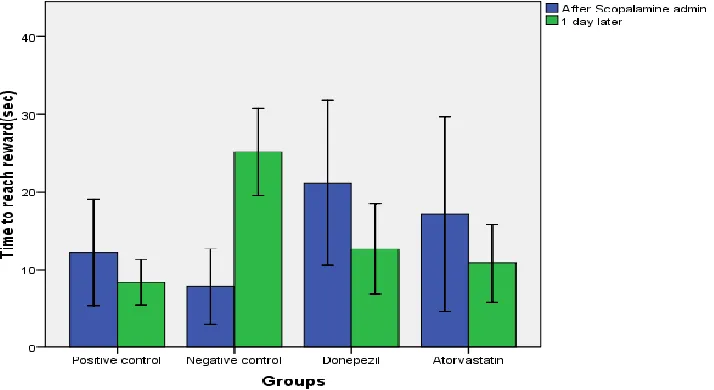
Time taken by animal (learning score) to reach the reward chamber from the entry chamber was significantly increased (day 14) in group 2 (scopolamine group) when compared to baseline learning score (day 5 & day 13) (Table 1). The learning scores decreased significantly in donepezil treated group (group 3) when compared to baseline values (21.17±10.59 vs 12.67±5.85 seconds, p<0.001) (Table 1). Similarly, in the atorvastatin treated group (group 4) learning score decreased from 17.17±12.53 seconds to 12.67±5.85 seconds (table 1). There were no significant changes in the learning score in the group 1 (positive control).
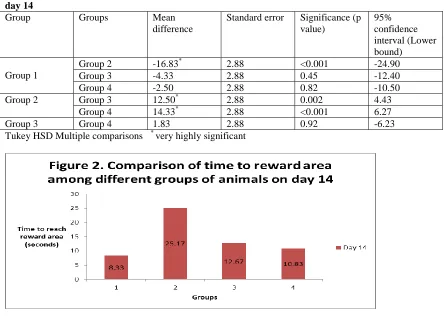
Table 2 shows the significance (p value) of comparison among different groups. There was a significant difference in learning score of both donepezil and atorvastatin treated groups in comparison with scopolamine treated group. This demonstrates that both donepezil and atorvastatin had a significant effect on learning and memory in rodent
models. Learning score was improved with both donepezil and atorvastatin. There was no significant difference in the learning score between donepezil and atorvastatin.
DISCUSSION
The findings from the present study demonstrated the positive effects of atorvastatin on learning and memory as proven in rodent models using Hebb willams maze. The study reveals that the effect of atorvastatin on learning and memory was comparable with the standard drug donepezil.
The clinical data demonstrated that statins might improve memory in AD. The cholesterol-lowering activity and anti-inflammatory ability of the statins has been considered to provide rationale for this hypothesis. [14] Our results demonstrated that the learning score, i.e. time taken by the animal to reach the reward chamber significantly shorter in atorvastatin-treated on 13th and 14th day of the experiment. The effect of statin was equal to donepezil, the standard drug used in AD. These findings strongly suggest that atorvastatin might improve learning and memory ability in rodent models of memory deficit.The findings our studies were similar to studies done by Abrahamson EE et al[15] and Wang et al[16] who also demonstrated that statins enhance learning and memory in animal models. Our findings were in contrast to the results of Baytan et al[17] which showed impairment of spatial memory in naïve rats with statins.
and partly inhibit the inflammatory responses in the hippocampus of the rat brain. Thus, atorvastatin could exert non-cholesterol-lowering activity in AD progression.[18]
Limitations of the present study also should be considered. We have used a single model of memory deficit. Testing in various models would have provided more authentic evidence for our hypothesis. Graded doses of atorvastatin may be required to see the dose dependent effects on learning and memory. Duration of therapy was also shorter in the present study. The effect of chronic treatment with statins should be done in future research. We have not conducted pathological studies of brain. Proinflammatory factors like IL-1β, IL-6, and TNF-α
were also not estimated which could have helped us to support the anti-inflammatory role of atorvastatin in improving learning and memory. These issues must be addressed in future research.
CONCLUSION
Our present study aimed to investigate the possible effects of atorvastatin on learning and memory in rodent models. Our results demonstrated improved learning and memory ability under the treatment of atorvastatin, using rat models of memory deficit. The potential therapeutic role of atorvastatin in the treatment of AD should be studied in future clinical research.
Table 1: Learning Scores of rats on Day 13 and Day 14
Group Drugs (dose) Learning
Scores (Time in seconds) Day 5
Learning Scores (Time in seconds) Day 13
Learning Scores (Time in seconds) Day 14
P value
1 Vehicle (Equivolume p.o) 7.17±1.94 12.17±6.85 8.33±2.94 0.16
2 Scopolamine (0.4 mg/kg i.p) 11.83±4.4 7.83±4.83 25.17±5.64* <0.0001 3 Donepezil + Scopolamine
(1mg/kg + 0.4 mg/kg i.p)
27.83±11.55 21.17±10.59 12.67±5.85* 0.049
4 Atorvastatin + Scopolamine (10mg/kg p.o., 0.4 mg/kg i.p)
22.67±14.77 17.17±12.53 10.83±4.99 0.239
P value 0.005 0.099 <0.0001
Values expressed as mean±SD ANOVA *statistically significant
Table 2 Comparative analysis of effect on learning score among different groups after inducing amnesia on day 14
Group Groups Mean
difference
Standard error Significance (p value)
95% confidence interval (Lower bound)
Group 1
Group 2 -16.83* 2.88 <0.001 -24.90
Group 3 -4.33 2.88 0.45 -12.40
Group 4 -2.50 2.88 0.82 -10.50
Group 2 Group 3 12.50* 2.88 0.002 4.43
Group 4 14.33* 2.88 <0.001 6.27
Group 3 Group 4 1.83 2.88 0.92 -6.23
Tukey HSD Multiple comparisons * very highly significant
REFERENCES
1.Basu S, Bhattacharya SK. Postgraduate Medicine, 2003;17: 543–51.
2.Jalkanen AJ, Puttonen KA, Venäläinen JI, Sinerva V, Mannila A, Ruotsalainen S et al., Basic Clin Pharmacol Toxicol 2007;100: 132–8.
3.Ovsepian SV, Anwyl R, Rowan MJ. Eur Neurosci, 2004;20: 1267–75. 4.Koladiya RU, Jaggi AS, Singh N, Sharma BK. BMC Pharmacol. 2008; 8:14. 5.Miida T, Takahashi A, Ikeuchi T. Pharmacol Ther, 2007;113:378-93.
6.Austen B, Christodoulou G, TE Terry TE. J Nutr Health Aging, 2002;6:377-82.
7.Wagstaff LR, Mitton MW, Arvik BM, Doraiswamy PM. Pharmacotherapy, 2003; 23:871-80.
8.Muldoon MF, Barger SD, Ryan CM, Flory JD, Lehoczky JP, Matthews KA, Manuck SB. Am J Med, 2000; 108:538-46.
9. Bayten SH, Alkant M, Ozeren M, Ekinci M, Akgun A. Tohoku J. Exp Med, 2006; 209:311-20. 10. Vaughan CJ. Am J Cardiol, 2003; 91(Suppl):23B-9B.
11. Qu C, Lu D, Goussev A, Schallert T, Mahmood A, Chopp. M. J Neurosurg, 2005;103(4):695-701. 12. Vanhoutte PM. European Heart J, 2004, 4:A8-A17.
13. Gingerich S, Krukoff TL. Endocrinology, 2005;146:2933-41.
14.Evans BA, Evans JE, Baker SP, Kane K, Swearer J, Hinerfeld D et al. Dement Geriatr Cogn Disord, 2009;27(6):519–24.
15. Abrahamson EE, Ikonomovic MD, Dixon CE, DeKosky ST. Ann Neurol, 2009; 66: 407-14. 16. Wang H, Lynch JR, Song P, Yang HJ, Yates RB, Mace B et al. Exp Neurol, 2007;206: 59-69.
17. Baytan SH, Alkanat M, Okuyan M, Ekinci M, Gedikli E, Ozeren M et al. Tohoku J Exp Med, 2008;214: 341-49.