Travel Safe
Logesh S Mohana Vigneshwar U
KCG College of Technology, Chennai, India KCG College of Technology, Chennai, India
Kalaiyarasan R Sharmila R N
KCG College of Technology, Chennai, India KCG College of Technology, Chennai, India
Abstract
An Android application that ensures safety of a person by sending location message to specified numbers at a regular time interval. The android application uses two main services namely GPS (Global Positioning System) and SMS (Short Messaging Service). GPS is used for get location data and SMS is used to send the got location. This application is developed in order to provide the location of the user and to ensure that the person is traveling in the correct direction. Initially the application will get the location of the user through the GPS and convert into a string which provides the location in address from, then the location will be composed as a message and sent to the receiver in a regular interval of time. With this application on your phone you can travel safely to places without a worry. Your loved will know your location at a regular interval which is a big relief for them as well as for you. This is mainly focused for women travelling alone to some place alone.
Keywords: Android, GPS (Global positioning system), SMS (Short message service)
________________________________________________________________________________________________________
I. INTRODUCTION
Travel safe is an android application which mainly ensures the safety. This app allows you to send your current location to the specified contacts. So that they can know the whereabouts of the user. This creates a secure feeling in the mind of the user as well as the person who receives the message. This process application uses GPS and SMS for getting the location of the user and send the location to receiver’s number entered.
II. APPLICATION ARCHITECTURE
The application is developed on android platform, it will be using the GPS for getting the location of the user through mobile phone, then the received latitude and longitude co-ordinates will be converted into string which contains the co-ordinates location name, finally the location will be composed in a message and sent to the receiver. Figure 1 provides the basic structure of travel safe.
III. WORKFLOW
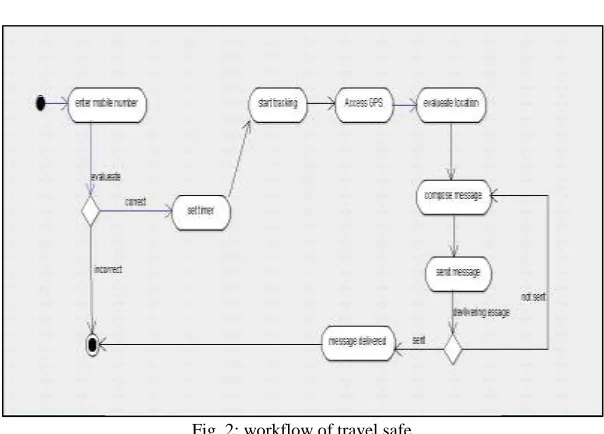
Fig. 2: workflow of travel safe
User will start the application, then the receiver number will be entered, user can enter mobile number of the receiver as many as possible. The application will evaluate whether the entered mobile number is valid or not, if not the process will be stopped else the user will be setting the time interval. GPS present in mobile phone will be turned on for getting the location of the user. Location will be received in the form of co-ordinates will be converted in to string which provides the name of the co-ordinates, finally the string will be composed into a message and sent to the number which is entered in the receiver’s number.
IV. PROCESS USED IN THE APPLICATION
GPS
GPS, which stands for Global Positioning System, in figure 3 is a radio navigation system that allows land, sea, and airborne users to determine their exact location, velocity, and time 24 hours a day, in all weather conditions, anywhere in the world. The Navigation System with Timing And Ranging (NAVSTAR) Global Positioning System (GPS) was conceived as a ranging system from known positions of satellites in space to unknown positions on land, sea, in air and space. The GPS constellation consists of 24 satellites in 6 orbital planes with 4 satellites in each plane. The ascending nodes of the orbital planes are separated by 60 degrees and the planes are inclined 55 degrees. Each GPS satellite is in an approximately circular, semi-synchronous (20,200 km altitude) orbit. The orbits of the GPS satellites are available by broadcast - superimposed on the GPS pseudorandom noise codes (PRN), or after post-processing to get precise ephemerides, they are available from organizations such as the Jet Propulsion Lab (JPL) or the International Geodetic Service (IGS) among others. The GPS receivers convert the satellite's signals into position, velocity, and time estimates for navigation, positioning, time dissemination, or geodesy.
SMS
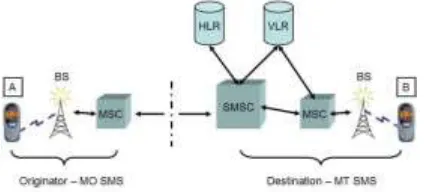
Short Message Service (SMS) figure 4 is the transmission of short text messages to and from a mobile phone, fax machine, and/or IP address. Messages must be no longer than 160 alphanumeric characters and contain no images or graphics. SMS is a relatively simple messaging system provided by the mobile phone networks. SMS messages are supported by GSM, TDMA and CDMA based mobile phone networks currently in use. Although services based on SMS have been feasible for many years, the recent mobile phone penetration and large scale adoption of the existing services by users, have made the SMS based services even more attractive to service providers.
Once a message is sent, it is received by a Short Message Service Center (SMSC), which must then direct it to the appropriate mobile device. To do this, the SMSC sends a SMS Request to the home location register (HLR) to find the roaming customer. Once the HLR receives the request, it will respond to the SMSC with the subscriber's status: 1) inactive or active 2) where subscriber is roaming. If the response is 'inactive', then the SMSC will hold onto the message for a period of time. When the subscriber accesses his device, the HLR sends a SMS Notification to the SMSC, and the SMSC will attempt delivery.
The SMSC transfers the message in a Short Message Delivery Point-to-Point format to the serving system. The system pages the device, and if it responds, the message gets delivered. The SMSC receives verification that the message was received by the end user, then categorizes the message as 'sent' and will not attempt to send again.
Although services enabled by WAP (Wireless Application Protocol) and UMTS (Universal Mobile Telecommunications System) will most probably replace SMS messages as the most popular media for wireless applications, there will still be a very large user base for a long time. The great market interest related to WAP and so-called turned on for getting the location of the user. Location will be received in the form of ordinates will be converted in to string which provides the name of the co-ordinates, finally the string will be composed into a message and sent to the number which is entered in the receivers number.
Although services enabled by WAP (Wireless Application Protocol) and UMTS (Universal Mobile Telecommunications System) will most probably replace SMS messages as the most popular media for wireless applications, there will still be a very large user base for a long time. The great market interest related to WAP and so-called mCommerce (mobile commerce) has made also SMS interesting as a service delivery channel. Operators and service providers are creating many new services. Wireless Application Service Provision (WASP) is a recent, interesting service architecture for providing SMS based services. The basic principle is that there is only one SMSC (SMS Center) that encodes the messages to be submitted through the GSM network. The basic difficulty in developing SMS based services is the variety of protocols used in SMS Centers. The European Telecommunication Standards Institute (ETSI) has approved four SMSC protocols: SMPP (by Logica), CIMD (by Nokia), UCP/EMI (by CMG) and SMS2000 (by SEMA). All these protocols have slightly different functionalities and largely different character conversions. Supporting all these protocols is a demanding task for a service provider. There are several SMS gateways able to interact with some or all of the SMS protocols. However, there is no standard way for service providers to interact with the SMS gateways. Also, only few of the SMS gateways support all the SMSC protocols. This draft proposes a solution by introducing an easily adoptable interface to SMS Centers or SMS gateways for service providers. Most countries use the GSM standard, the United States is one of the few countries to favor use of CDMA and TDMA standards over GSM (though there are GSM networks throughout the US). CDMA and TDMA allow extremely limited SMS capabilities.
Short messages can be sent and received simultaneously with GSM voice, Data and Fax calls. This is possible because whereas voice, Data and Fax calls take over a dedicated radio channel for the duration of the call, short messages travel over and above the radio channel using the signaling path. As such, users of SMS rarely, if ever, get a busy or engaged signal as they do during peak network usage times. Ways of sending multiple short messages are available. SMS concatenation (stringing several short messages together) and SMS compression (getting more than 160 characters of information within a single short message) have been defined and incorporated in the GSM SMS standards. To use the Short Message Service, users need the relevant subscriptions and hardware, specifically:
A subscription to a mobile telephone network that supports SMS A mobile phone that supports SMS.
The use of SMS must be enabled for the user. (automatic access to the SMS is given by some mobile network operators, others charge a monthly subscription and require a specific opt-in to use the service)
Knowledge of how to send or read a short message using the specific model of mobile phone.
A destination to send a short message to, or receive a message from. This is usually another mobile phone but may be a fax machine, PC or Internet address.
V. EXISTING SYSTEM
Circle of 6 App
Circle of 6 is a unique app that lets you connect to up to 6 close contacts.
The app has different notifications that the user can tap on to alert their circle. If you need a safe ride home or for a familiar face to turn up and take you away from a strange environment,
This app will help send an alert to any of your 6 chosen contacts.
The app can connect you to the proper authorities for an emergency, or even just for relationship advice.
Fig. 6: Circle of six I’m Shakti
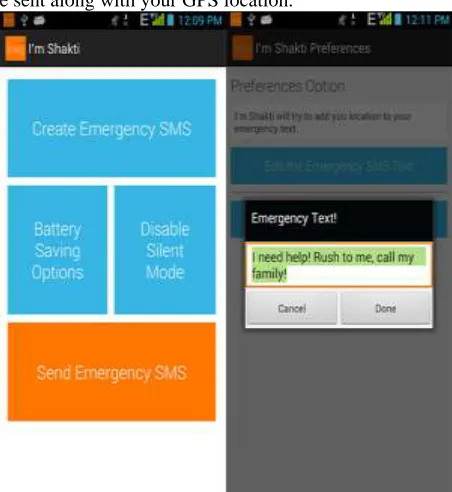
The I’m Shakti (IMS) app is one that aims to help keep you in control of your “Shakti” (power in Sanskrit). To reach your emergency contact, press the power button 5 times (in 2 seconds) to trigger the app.
A preset emergency SMS will be sent along with your GPS location.
Drawbacks Of Existing System
The user needs to access the application in case of crisis. The location of the user is not sent.
Tracking is not possible, the application only sends the SOS message to receiver. SOS message will be sent to only limited number of contacts.
SOS message won’t be sent periodically.
VI. BACKGROUND PROCESS
Connection to GPS
Accessing GPS in an android mobile is not an easy task. Each mobile has its own custom User Interface on top of the Android operating system. So while coding in java for accessing GPS the User Interface of different mobiles must be kept in mind.
Designing of User
Interface Designing of User Interface for the Android Application is a problem faced as the Application has to work in a range of mobiles and each mobile is different in size. So creating a User Interface that fits in all mobiles is a tedious task.
Coding for SMS
Coding to compose and send text message using SMS feature built in in every Android mobile is a problem faced as the custom User Interface on top of Android operating system has to be bypassed. Coding has to be done keeping User Interface of differe nt mobiles in mind.
VII. USER INTERFACE
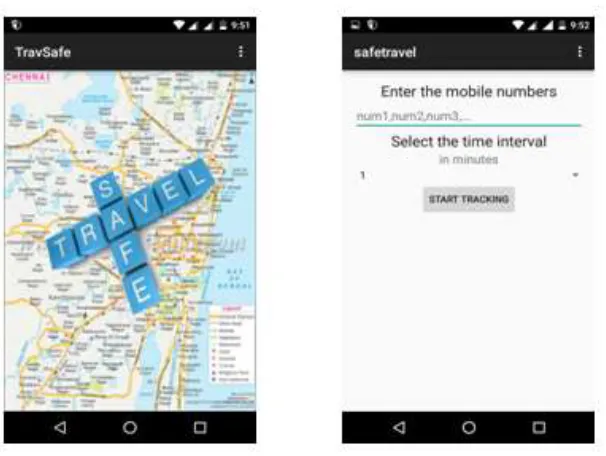
Fig. 5.1: travel safe start up screen and initial page000
Fig. 5.2: travel safe output screen
The figure 5.2 displays the screen after taping the “start tracking” button. The current location of the user will be displayed in the form of co-ordinates, then it will be composed into a message form and will be delivered to the receiver in the form of text message.
VIII. RESULT AND CONCLUSION
Android mobile applications are evolving at a meteor pace to give a rich and fast user experience. The maturity of the hardware and software platforms of mobile devices and the promotion of the Mobile Internet have brought a great opportunity to the migration of the web applications to mobile platforms and Location information gets used more and more often in people’s daily life and this paper focuses on communication related location-based services and GPS, With this application on your phone you can travel safely to places without a worry. Your loved will know your location at a regular interval which is a big relief for them as well as for you. This is mainly focused for women travelling alone to some place alone.
REFERENCES
[1] SuhasHolla, Mahima M Katti, Android based mobile application development and its security, International journal of computer trends and technology, vol.
3, 2012
[2] Priyanka Shah, RutaGadgil, NehaTamhankar, Location based reminder using gps for mobile (android), Arpn journal of science and technology, vol. 2, no. 4,
2012
[3] PetrosZerfos, XiaoqiaoMeng, Starsky H.Y Wong,VidyutSamanta , Songwu Lu, A study of the short message service of a nationwide cellular network,
Management insight, vol. 1, 2005
[4] Hyojong Kim, Hongyeol Lim, Dilan Manatunga, Hyesoon Kim, Accelerating application start-up with non-volatile memory in android system, IEEE
computer society 2015, vol-1
[5] Nikolai Samteladze, Ken Christensen, DELTA++: Reducing the Size of Android Application Updates, University of South Florida, IEEE computer society
2014, vol-1.
[6] Yigal Bejerano, Israel Cidon, Efficient Location Management Based on Moving Location Areas at ieee infocom 2001
[7] Kevin A. Li, Timothy Sohn, William G. Griswold, Evaluating Location-Based Reminders, ieee paper
[8] B. Campbell and R. Mahy and C. Jennings. The Message Session Relay Protocol. Internet Draft, draft-ietf-simple-message-sessions-15.txt (Work in Progress),