ISSN (Online) 2347-3207
Abstract — Many people are always on move. While many of those spend a many days away from their home but they don’t have any control over the home appliances in their homes. Some devices may be remains switched on or some other appliances have to be switched on at some interval of time e.g electric motor on well. If these devices cannot be controlled in good manner then they are responsible to create lot of energy crisis . So as to overcome from this scenario I proposed an internet based home automation system which will helps any end user to remotely manage their appliances from anywhere, anytime. In this paper we have developed a Home Automation system that employs the integration of multi-touch mobile devices, cloud networking, wireless communication, and power-line communication to provide the user with remote control of various lights and appliances within their home. This automation system differs from other systems by allowing the user to operate the system without the dependency of a mobile carrier or Internet connection via the in-home wireless remote.
Keyword- Mobile cloud computing, mobile services, Android development tool, Java.
I. INTRODUCTION
Nowadays advances in electronics and communications Technologies have lead to the miniaturization and improvement of the performance of computers, sensors and networking so these changes have given rise to the development of several home automation technologies and systems. As per, home automation can be useful to those who need to Access home appliances while away from their home and can incredibly improve the lives of the disabled. Many of the home automation systems that are commercially available can be separated into two categories: locally controlled systems and remotely controlled systems. Locally controlled systems use an in-home controller to achieve home
automation. This allows users complete use of their automation system from within their home via a stationary or wireless interface. Remotely controlled
systems use an Internet connection or integration with an existing home security system to allow the user completes control of their system from their mobile device, personal computer, or via telephone from their home security provider.
There are a number of issues involved when designing a home automation system. Piyare and Tazil [4] discussed that the system should be scalable so that new devices can easily be integrated into it. It should also provide a user- friendly interface on the host side, so that the devices can be easily setup, monitored, and controlled. Furthermore the overall system should be swift enough to realize the true power of wireless technology. Lastly the system should be cost Effective in order to justify its application in home Automation.[11] To minimize the shortcomings of each system and to overcome the design issues previously mentioned, this project integrates locally and remotely controlled systems with the use of Cloud data network.
II. PREVIOUS STUDY
Many of the home automation systems that are commercially available can be separated into two categories: locally controlled systems and remotely controlled systems. Locally controlled systems use an in-home controller to achieve home automation. This allows users complete use of their automation system from within their home via a stationary or wireless interface. Remotely controlled systems use an Internet connection or integration with an existing home security system to allow the user complete control of their system from their mobile device, personal computer, or via telephone from their home security provider[1].
Cloud Server Based Home Automation System
Using Android Phone
Prachi T. Deokar, Dr. Manoj S. Nagmode
Department of Electronics & Telecommunications,ISSN (Online) 2347-3207 There are a number of issues involved when designing a home automation system. It should provide a user- friendly interface on the host side, so that the devices can be easily setup, monitored, and controlled. Furthermore the overall system should be swift enough to realize the true power of wireless technology. Lastly the system should be cost effective in order to justify its application in home automation[2]. To minimize the shortcomings of each system and to overcome the design issues previously mentioned, this project integrates locally and remotely controlled systems with the use of Cloud data network[3][11][12]. This allows the system to operate without the dependence of a mobile provider, allows the system to be used with various mobile phone platforms, and allows the system to operate locally when phone or computer access is not available. Cloud networking and data infrastructure allow individuals to monitor, manage, and control their personal data points through the Internet [5-7]. One of the available services is Pachube [5].
The healthcare industry is in a period of accelerating change that requires continual innovation. The chronic disease epidemic, changing population demographics and advancements in medical technologies are key contributors to escalating costs[9]. All stakeholders expect more value for their money. And, patients are beginning to play greater roles in managing their care. Driven by economics, emerging care and business models aligned with personal values and well-being are signaling a major shift in how healthcare organizations will compete and operate in the years ahead. A recent CEO Study conducted by IBM revealed that only 34 percent of healthcare provider CEOs are focused on simplifying operations to manage complexity more effectively.
To do so, a transformation from institution-centered, data-poor systems to patient-centered, information-rich health systems is needed. A flexible and scalable approach to applications and infrastructure can help healthcare organizations support new business approaches and seamless patient experiences[10]. Emerging care delivery and business processes will drive transaction volumes and complex analytics-driven workloads to new levels never envisioned by healthcare organizations. These drivers require a larger IT footprint to enable new capabilities, yet growing IT complexity threatens to hold organizations back.
III. SYSTEM DESIGN
Pachube is the networking cloud used in this design. Each data stream is classified by a feed identification number and secured by a forty-seven character password. Pachube treats each unit in the house as a data point. These data points are manipulated to control the unit inside the home automation system. When a unit is turned on, a value of one is given to that action, and zero for turning off action. When a unit is brightened or dimmed a value between the range of zero and nine is given to that action. After each unit is set to its desired action, the values are placed in a networking package and sent to the cloud.
Pachube has an API (Application Programming Interface) editor that allows the user to create and design user interfaces and graphs for the user’s need. The graphical interface can be designed and created through Pachube’s API. For example, switches and knobs can be used on the applications interface to simulate on/off and dimming respectively for the units in the Home Automation System, as shown in Fig. 2b. The API also allows the programmer to dictate the color, pixel dimension, title, axis, and time span of the graph. Whenever the user chooses the option to monitor a specific unit in the system, the software is programmed to extract the data points of that corresponding unit and plot a graph of it over the options of the past twenty-four hours or thirty days.
ISSN (Online) 2347-3207
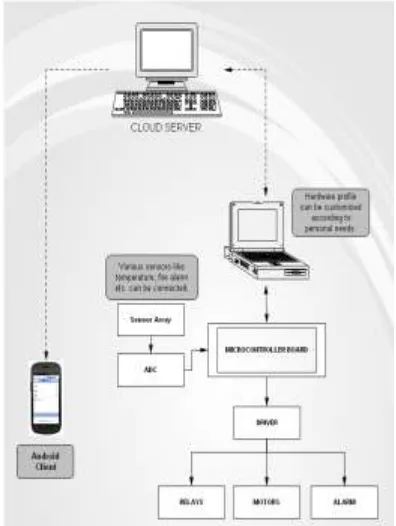
Figure 1: Block diagram of home cloude networking.
It is automation of the home, housework or household activity. Home automation may include centralized control of lighting, heating, ventilation and air conditioning, appliances, and other systems, to provide improved convenience, comfort, energy efficiency and security.
A home automation system integrates electrical devices in a house with each other. The techniques which are going to use in home automation include those in building automation as well as the control of domestic activities, such as TV, fan, electric tubes, refrigerator and washing machine[8].
The system allows the user to control appliances and lights in their home from an android and PC from anywhere in the world through an internet connection[13]. It also allows the user to control their units within their home from a wireless remote. The wireless remote has primary control over the system; therefore if the remote is active neither the android nor PC will be able to control the units in the home. This design prevents from the android, PC, and wireless remote all trying to control the system at the same time.
ISSN (Online) 2347-3207 IV. FLOWDIAGRAM:
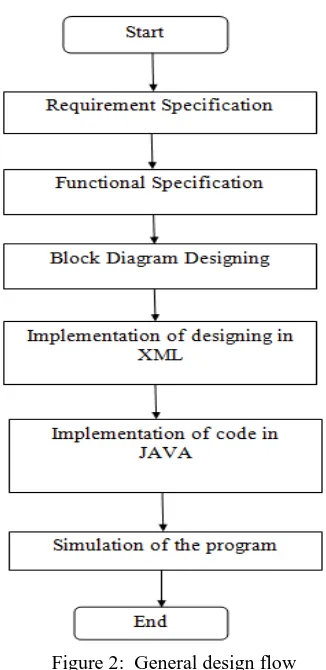
Figure 2: General design flow
After the design of block diagram implementation of designing in XML is necessery. After implementation of designing in XML implementation of code is necessary. Code is very mportant part because with the help of this code we can run all project.
Here to develop the code we have to use JAVA language with the help of NetBeans IDE. After the implementation of code simulation is very much important part in every software project. Because with the help of this simulation we can get the information about where project runs properly or not and if not then we can make the changes to get the proper output[15][16].
V. RESULTS
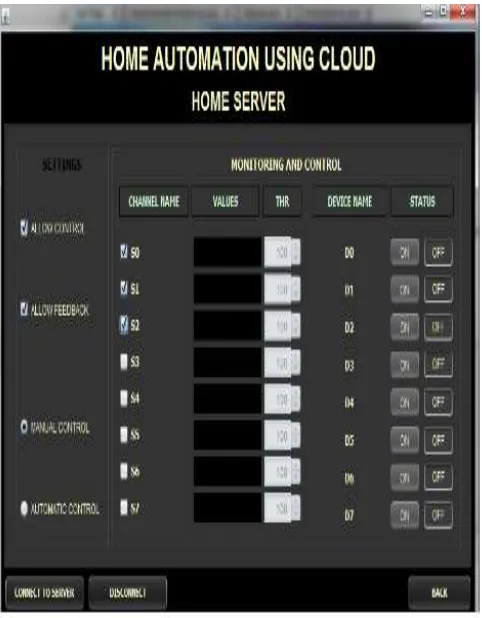
The system allows the user to control appliances and lights in their home from a smart phones and PC from anywhere in the world through an internet connection. It also allows the user to control their units within their home from a wireless remote. The wireless remote has primary control over the system; therefore if the remote is active neither the Smartphone nor PC will be able to control the units in the home. This design prevents from the Smartphone, PC, and wireless remote all trying to control the system at the same time.
Here when we want to connect the android phone to the home server then by using eclipse, this is android developer tool we can make this connection. When we are entering to android developer tool then we have to right click on Home Automation Android and click to run as android application.
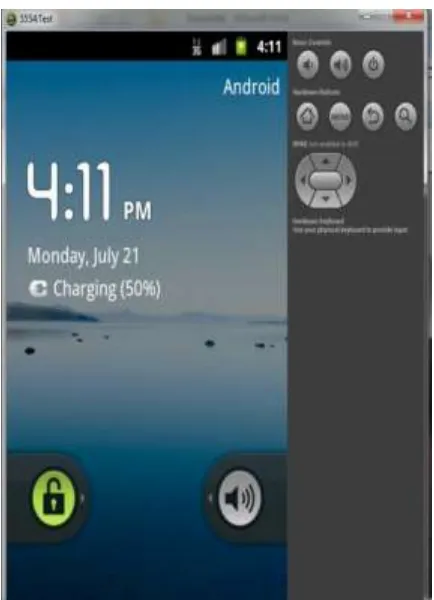
Then in figure 3 go to the main menu and we get another window as shown below.
ISSN (Online) 2347-3207
Figure 3: Snapshot of Android Phone Result
ISSN (Online) 2347-3207
Figure 5: Snapshot of Android Phone Result
Here we have to enter IP address of our home system to android phone and after that we have to click to ―Click To Proceed‖.
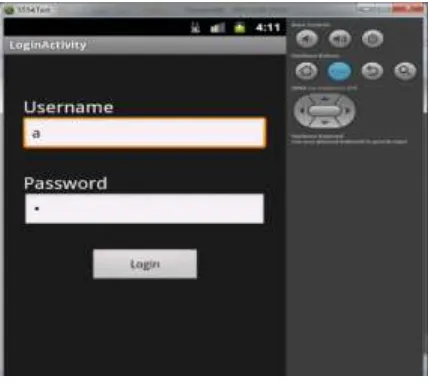
After that in figure 6 we get next window which is shown below. Here we have to enter username and password. I have chosen username as ―a‖then anter our password and click to login.
Figure 6: Snapshot of Android Phone Result
ISSN (Online) 2347-3207
Figure 7: Snapshot of Android Phone Result
Figure 8: Snapshot of Android Phone Result
ISSN (Online) 2347-3207 VI. SCOPE FOR FUTURE WORK
Using this system as framework, the system can be expanded to include various other options which could include home security feature such as open-door and motion detection, energy monitoring, or weather stations.
VII. CONCLUSION
By integrating multi-touch mobile devices, cloud networking, wireless communication, and power- line communication, we were able to design and build a fully functional home automation system. It allows the user to control various appliances and lights within their home from any location in the world through Pachube cloud network using 1) mobile devices, 2) PCs, or 3) in-home remote controller. Mobile cloud computing is one of mobile technology trends in the future since it combines the advantages of both mobile computing and cloud computing, thereby providing optimal services for mobile users. According to a recent study by ABI Research, a New York-based firm, more than 240 million business will use cloud services through mobile devices by 2015.
ACKNOWLEDGEMENTS
The authors would like to thank to the Department of Electronics and Telecommunication Engineering, MITCOE Pune for their infrastructure and lab facility and in particular Dr. Prof. M.S.Nagmode for him help and support.
REFERENCES
[1] Chan, M., Campo, E., Esteve, D., Fourniols, J.Y., ―Smart homes-current features and future perspectives,‖ Maturitas, vol. 64, issue 2, pp. 90-97, 2009.
[2] Das, S.R., Chita, S., Peterson, N., Shirazi, B.A., Bhadkamkar, M., ―Home automation and security for mobile devices,‖ IEEE PERCOM Workshops, pp. 141-146, 2011.
[3] Laur, I., ―Microcontroller based home automation system with security,‖ International Journal of Advanced Computer Science and Applications, vol. 1, no. 6, pp. 60-65, 2010.
[4] Piyare, R., Tazil, M., ―Bluetooth based home automation system using cell phone,‖ IEEE ISCE, pp. 192-195, 2011. [5] ―Glassfish Info‖ http://glassfish.java.net/ Communication of mobile and tablet devices‖ http://www.arkessa.com [6] ATmega32‖ http://www.atmel.com/devices/atmega32.aspx
[7] ULNDarlingtondriver‖http://www.onsemi.com/PowerSolutions/product.do?id=ULN2003 .
[8] Gomez, C., Para dells, J.,‖ Wireless home automation networks: A survey of architectures and technologies,‖ IEEE Communications
Magazine, vol. 48, issue 6, pp. 92 – 101, 2010.
[9] http://www.arkessa.com [10] http://www.idigi.com [11] http://www.arduino.cc/
[12] http://community.pachube.com/arduino/ethernet [13] http://www.x10.com/support/technology1.htm
[14] B. Koyuncu. "PC remote control of appliances by using telephone lines". IEEE Transaction on Consumer Electronics, Vol. 41, Issue 1, pp.201-209, 1995.
[15] S. Schneider, J. Swanson and Peng-Yung Woo. "Remote telephone control system". IEEE Transaction on Consumer Electronics, Vol.43, Issue 2, pp.103-111, 1997.
[16] N. Swamy, O. Kuljaca and F. Lewis. "Internet-Based Educational Control Systems Lab Using Net-meeting". IEEE Transaction on Education, Vol. 45, No. 2, pp.145-151, May 2002.