Recognizing Facial Images with Weight and Age
Variations using Different Classification
Algorithms
Anupama G. S Dhanya Mathew
P.G. Student Assistant Professor
Department of Electronics & Communication Engineering Department of Electronics & Communication Engineering Marian Engineering CollegeTrivandrum, India Marian Engineering CollegeTrivandrum, India
Abstract
As the age increases there may be changes in the weight of an individual and as a result there occurs changes in skeletal structure muscle mass and body fat. This reflects in the face of the person. The age variations can be recognized by generally focusing on the difference in skeletal structure and muscle mass. But the effect of change in body fat may not be a gradual one thus its study is however difficult in the case of face recognition. Here we are discussing about the recognition of facial images which is having weight variations along with the age to improve the performance of face recognition. The proposed algorithm utilizes neural network and Levenberg–Marquardt algorithm (LMA), also known as the damped least-squares (DLS) method to encode age variations across different weight categories. The results are obtained with the help of WhoIsIt database.
Keywords: Database, Face recognition, Facial aging, Feature points, neural network
________________________________________________________________________________________________________
I. INTRODUCTION
The major research covariates in the study of face recognition[2] is pose, expression, illumination, plastic surgery, Disguises like glasses, wig, make-up etc.[3] and aging. Among all, aging is one of the most important challenging and fascinating ones. As time progresses, we human, age, it leads to changes in our weight and facial appearances. This process is natural and it is caused by factors such as environment and life style changes. With age variations, the weight of an individual also varies and there is no direct relationship between the two, that is, within a limited period of time, there can be significant weight changes and may be within a long period of time, the weight may be constant.
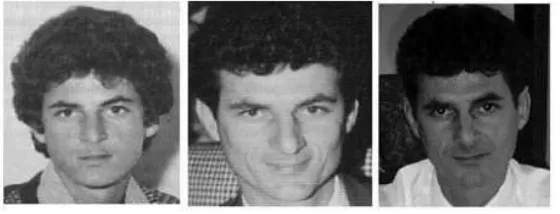
Now we consider face images of individuals with age and weight variations. In fig. 1 it shows face images with very little weight variation over a long period of time. Here even with large age variations, there is almost no change in weight. This can be analyzed by observing some facial images as shown
Fig. 1: Face images with very little weight variation over a long period of time
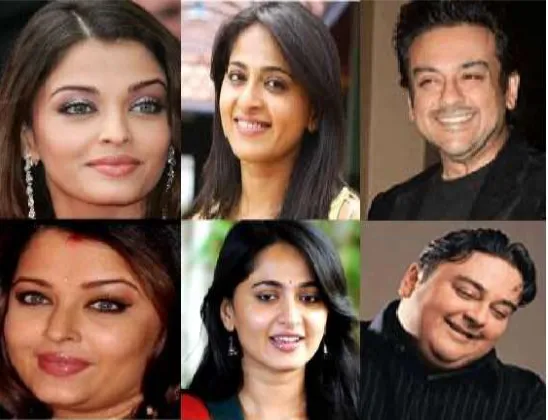
In fig. 2 it shows face images with large weight variation over a small period of time. Here over small age variation, weight change is large.
The algorithms for age invariant face recognition can be broadly categorized into discriminative and generative approaches. Discriminative approaches utilize the information available for matching whereas generative approaches use the information to model other variations.
Fig. 2: Face images with large weight variation over a small period of time.
II. LITERATUREREVIEW
The review of some of the recent papers is presented in Table I. The methods used are discussed below Table – 1
Literature review of recent papers on age invariant face recognition
Authors Title Publication
date Techniques used
U. Park Y. Tong
A. K. Jain[4] Age-invariant face recognition May 2010
3D shape and texture spaces from 2D images
G. Mahalingam and C. Kambhamettu[5]
Age invariant face recognition
using graph matching Sep. 2010
Gaussian mixture model and graph technique
Z. Li U. Park A. K. Jain [6]
A discriminative model for age invariant face
recognition Sep 2011 SIFT and LBP with MFDA
T. Xia, J. Lu, and Y.-P. Tan [7] Face recognition using an enhanced age
simulation method Nov. 2011 Age simulation: filling algorithm
3D Shape and Texture Spaces from 2D Images:
Facial aging is a complex process that affects both the 3D shape of the face and its texture (e.g., wrinkles). The shape and texture change degrades the performance of automatic face recognition systems. However, facial aging has not been considered substantially compared to other facial variations due to pose, lighting, and expression. A 3D aging modeling technique and can be used to compensate for the age variations to improve the performance of the face recognition system.
The modeling technique adapts view-invariant 3D face models to the given 2D face aging database. Here for the conversion of 2D to 3D image, the 2D facial feature points are detected then 3D model fitting is done.
Gaussian Mixture Model and Graph Technique:
In the paper, a graph based face representation for efficient age invariant face recognition. The graph contains information on the geometry and appearance of feature points on the facial images. An age model is learned for each individual and a graph space is created using the set of feature descriptors which are extracted from each facial image. A Gaussian mixture model (GMM) is created with the extracted feature descriptors. A simple deterministic algorithm which exploits the topology of the graphs is used for matching. This technique can be used to detect the age variations.
SIFT and LBP with MFDA:
fitting problem an algorithm called multi-feature discriminant analysis (MFDA) is considered to sum-up these two local feature spaces to a unified framework.
The MFDA is an extension and improvement of the LDA, which uses multiple features along with two different random sampling methods in feature and sample space. By sampling the training set as well as the feature space randomly, multiple LDA-based classifiers are constructed and then combined to generate a robust system.
Age Simulation: Filling Algorithm:
This is an enhanced age simulation method for face recognition across age differences. The paper proposes an age simulation method to reduce the difference in facial appearance of the same person across age variations. Since it is very difficult to get a sequence of facial images of the person at continuous ages, here a filling process to enlarge the limited training database is first implemented and then it is classified into different age groups. Then each age group is represented by a mean feature vector. With these vectors, typical vectors for different ages are generated. Lastly, a virtual facial image at a target age is synthesized by combining the training samples and typical feature vectors.
According to the recent papers, weight information has been incorporated with aging in face recognition only in WhoIsIt database.
The contribution of this research is:
A learning-based algorithm is proposed that uses neural network which uses lm classification algorithm to address the age and weight variations for improved recognition performance.
The classification is improved with the bag of words algorithm for larger databases
III. OVERVIEW
This paper discusses about recognizing face images based on weight and age variations. The proposed algorithm uses two different classification algorithms. One of them is the LM classification algorithm and the other one is the bag of words algorithm which is faster and used for larger databases. These algorithms classify the test image according to its weight variation along with its age.
IV. FACIALIMAGEDATABASES
Due to the non-existence of publicly available databases, until 2004 only a small number of researchers considered the problem of facial aging. Back in 2004 two face aging datasets were made publicly available: The MORPH and the FG-NET Aging Database (FG-NET-AD) [9]. When MORPH database was first released it contained a large number of images but only about three instances of one person. The FG-NET database contained a small number of images and subjects, but included about 12 images which are age separated for one subject. Despite the fact that neither of the two datasets was ideal, both datasets played an important role in initiating systematic research activities in the area of facial aging during the last few years.
The study of facial aging mainly focuses on the following topics:
1) Age Estimation of facial images: Estimating the age or the age range of a person based on the information from the extracted descriptors.
2) Age Invariant Face Recognition: The ability to recognize people despite significant age related modifications. 3) Age Progression: Predicting the future facial appearance of a person
FG-NET Database:
The FG-NET-AD (Face and Gesture Recognition Network-Aging Database). One of the major aims was to develop the area of face and gesture recognition by creating and supplying suitable image sets with specifications. The FG-NET-AD contains 1002 facial images from 82 different subjects with ages ranging between 0- 69 years old people. However, ages up to 40 years are the most populated in the database.
Fig. 3: Sample images from FGNET database with ages of 22, 38 and 45
image quality of images in FG-NET-AD depends on so many factors like the imaging equipment used, the photographic skills of the photographer, the photographic paper used and the overall photograph condition. The FG-NET-AD image shows considerable variability in image resolution, sharpness and illumination in combination with face viewpoint and expression variation.
MORPH Database (Craniofacial Longitudinal Morphological Face Database):
MORPH database is the largest freely available face image database. The MORPH data consists of thousands of facial images of individuals, collected in different conditions across time. Moreover, these images are available to the public for various research studies. MORPH is comprised of two datasets, or “albums,” Album1 and Album2.
Album 1 contains a total of 515 digitally scanned photographs of individuals taken between October 26, 1962 and April 7, 1998 which is referred to as acquisition dates. The dates of acquisition correspond to increasing ages for individuals in the database. The difference between acquisition dates range from 46 days to 29 years after the earliest photograph. Album 2 contains digital photographs collected over several years. Album2 is still improving. Both albums data including date of birth, race, gender, and date of acquisition. A subset of Album 2 is freely available for the studies involving facial images and it contains 55,134 images of 13,000 individuals collected for about four years. A larger commercial version of MORPH is also available which contains a significantly larger set images from Album 2 collected over a greater time span and includes full data with height and weight when available.
Fig. 4: Sample images from MORPH database with ages of 22, 31 and 43
Whoisit Database:
WhoIsIt Database is the database which includes both age and weight information along with face images. It uses public figures since the availability is easier and it captures weight variations over a period of time. The images are mainly frontal images with minor expression and pose variations.
The database consists of 1109 images which belong to 110 people. There is a minimum of 10 and maximum of 12 facial images of a person. The age of the person may vary from 1 to 81 years and the average age is 30.95 years. Since exact weights of all the subjects are not available, the facial images are classified into three weight groups. These groups are named thin, moderate, and heavy. These are manually categorized depending on the visual perception. For instance, face image associated with a thin body structure may be categorized as a thin image. There are 537 images are classified to thin, 448 images to moderate, and 124 images to heavy weight category. The mean ages are 28.03years for thin, 32.87years for moderate and 36.28 years for heavy images. The median ages are 27, 32 and 35 years respectively for thin, moderate and heavy weight categories.
V. PROPOSED FACE RECOGNITION ALGORITHM
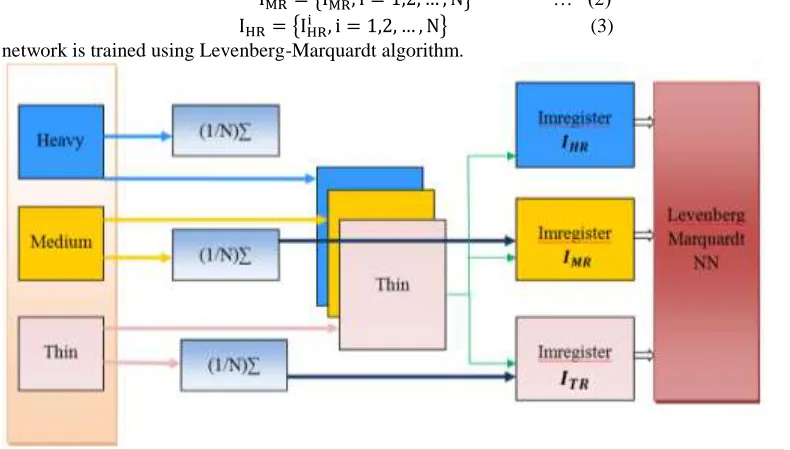
This paper presents an algorithm that attempts to recognize images with variations due to weight changes. Fig. 6 illustrates the block diagram of the proposed algorithm. Here a generative model that incorporates both weight and age variations is designed. It requires a large amount of training data with combinations of age and weight. The databases available for studying age and weight variations are rather limited. Here we use a discriminative algorithm. Since it is a learning-based algorithm, it consists of two phases: training and testing.
Training:
Let I = {Ii, i = 1,2, … , N} be the set of training images where N is the total number of images in the training database. The training data is divided into three classes: thin, moderate and heavy. Using all the thin images from the training database, a mean thin image (mT ) is created. Similarly, mean moderate, mM and mean heavy, mH weight images are also created from the training database. All the images in the training database are registered with the mean thin image, mT
ITR= {ITRi , i = 1,2, … , N} (1)
Then these mean weight images are then used to register Ii with respect to mT and ITRi is generated. The registration approach actually minimizes the variations between face images in I and the mean thin face. This can also be viewed as a preprocessing stage to reduce the spatial variations between the training images and the mean images. Thus, the proposed algorithm registers all the training images with respect to mean face of all three weight categories. Similar to thin category, the images with respect to mean moderate face image (mM ) and mean heavy weight face image (mH) are also used to generate the registered face images.
IMR= {IMRi , i = 1,2, … , N} … (2) IHR= {IHRi , i = 1,2, … , N} (3) Then the neural network is trained using Levenberg-Marquardt algorithm.
Fig. 6: Illustrating the steps involved in the proposed face recognition algorithm
Levenberg-Marquardt Algorithm:
The Levenberg–Marquardt algorithm was independently developed by Kenneth Levenberg and Donald Marquardt. It helps in minimizing a non- linear function. In the artificial neural-networks, this algorithm is suitable for training small and medium-sized problems. It has stable convergence and is faster The Levenberg–Marquardt algorithm combines the Gauss-Newton algorithm and the steepest descent method. It inherits the advantage of speed advantage of the Gauss-Newton algorithm and the advantage of stability from the steepest descent method. It is more robust than the Gauss-Newton algorithm, because it can converge well even if the error surface is complex than the quadratic situation.
The Levenberg-Marquardt algorithm was designed to achieve second-order training speed without computing the Hessian matrix. The Hessian matrix can be approximated as
H = JTJ (4) and the gradient can be computed as
g = JT e (5)
where J is the Jacobian matrix. J contains first derivatives of the network errors with respect to the weights. e is a vector of which contains network error elements. The Jacobian matrix can be computed through a standard back-propagation technique that is easier than computing the Hessian matrix.
When the scalar µ is zero, it becomes the Newton's method. When µ is large, this becomes gradient descent method with a small step size. Newton's method is more accurate and faster. The aim is to shift toward Newton's method as quickly as possible. Thus, µ is decreased after each successful step it causes reduction in performance function and µ is increased only when a uncertain step would increase the performance function. Thus the performance function is always reduced at each iteration of the algorithm..
Advantages
1) This algorithm is said to be the fastest method for training moderate-sized feed forward neural networks.
2) It has an efficient implementation in MATLAB software, since the solution of the matrix equation is a built-in function Disadvantage
This algorithm is suitable only for small and moderate sized problems. Larger database will take hours for training
Bag of Words Algorithm:
The bag-of-words (BOW) algorithm for image classification is done by treating image features as words. To represent an image, an image can also be treated as a document. Similarly, "words" in images are to be defined. It includes three steps which are feature detection, feature description, and codebook generation.
After feature detection, each image is preoccupied by local patches. Feature representation methods deal with the representation of the patches as numerical vectors which are called feature descriptors. A descriptor is said to be good if it has the ability to handle intensity, rotation and scale. One of the most useful descriptors is Scale-invariant feature transform (SIFT). SIFT converts each patch to N-dimensional vector (N=128). After this step, each image is a collection of vectors of the same dimension where the order of different vectors is not important.
The final step is to change vector represented patches into "codewords" which produces a "codebook". A codeword can be considered as a representation of several similar patches. One simple method is performing k-means clustering in all the vectors. Then the codewords are defined as the centers of the learned clusters. The number of the clusters is the codebook size. So each patch in an image is mapped to a certain codeword through the clustering process and then the the histogram of the codewords can be plotted. Here the confusion matrix can be used as an evaluation metric.
Testing:
At the probe level, an input face image is given as a test image and three registered images are created with respect to the three mean faces obtained during training. Then the images are given for classification. Then the final class of the image is obtained
VI. CONCLUSION
This research presents weight variations as a specific challenge for addressing face recognition with age variations. Even with small age difference, an individual can have significant weight variations and with large age variations, the weight variations can be small. We propose a neural network and random levenberg- maerquard classification algorithm that learns the age variations for different weight variations to recognize the identity of a given face image. Due to the unavailability of a public database containing both age and weight information, with WhoIsIt database. In future, we can extend the database and improve the algorithm with age and weight invariant feature extraction.
ACKNOWLEDGEMENT
The authors thank the reviewers for their constructive and useful feedback on the research.
REFERENCES
[1] Maneet Singh, Shruthi Nagpal, Richa Singh,, and Mayank Vatsa,, On Recognizing Face Images With Weight and Age Variations, Digital Object Identifier IEEE Spectrum 10.1109/ACCESS.2014.2344667
[2] S. Z. Li and A. K. Jain, Eds., Handbook of Face Recognition, 2nd ed. New York, NY, USA: Springer-Verlag, 2011.
[3] T. I. Dhamecha, R. Singh, M. Vatsa, and A. Kumar, ``Recognizing disguised faces: Human and machine evaluation,'' PLOS ONE, vol. 9, no. 7, p. e99212, 2014.
[4] U. Park, Y. Tong, and A. K. Jain, ``Age-invariant face recognition,'' IEEE Trans. Pattern Anal. Mach. Intell., vol. 32, no. 5, pp. 947_954, May 2010. [5] G. Mahalingam and C. Kambhamettu, ``Age invariant face recognition using graph matching'', in Proc. 4th IEEE Int. Conf. Biometrics: Theory Appl. Syst.,
Sep. 2010, pp. 1_7.
[6] Z. Li, U. Park, and A. K. Jain, ``A discriminative model for age invariant face recognition,'' IEEE Trans. Inf. Forensics Security, vol. 6, no. 3, pp. 1028_1037, Sep. 2011.