Abstract—Conceptualizing implementation of cloud platform in the project management context is still rudimentary. The primary objective of this study is to examine the moderating role of project team size in the relationship between innovation capabilities and project and market performance. This study empirically investigated a sample of projects in the Taiwanese industry. The structural equation modeling (SEM) approach was used to validate the research model. In testing the moderation effect, a multiple-group analysis was used. The results show that project team size has a moderating effect on the relationship between innovation capabilities and performance outcome.
Index Terms—Cloud platform, customer relationship management, innovation capability, project management.
I. INTRODUCTION
On the other hand, the literature supports IT adoption as a means to create competitive advantage for firms and IT application may positively relate to organizational performance [5]. However, while some researchers promoted the adoption of IT practice and argued that IT has improved firm’s performance significantly, others found that IT does not provide benefits for firms.
Several scholars have emphasized the need for better theoretical models that trace the path from IT investment to business value [6]. IT is not simply a tool for automating existing processes, but is more importantly an enabler of organizational changes, such as in communication and coordination, that can lead to improve firm’s performance [6].
Innovations in technology have changed the way new
Manuscript received October 12, 2013; revised December 18, 2013. Li-Ren Yang is with the Department of Business Administration, Tamkang University, Tamsui Dist., New Taipei City 251, Taiwan (e-mail: iry@ mail.tku.edu.tw).
product development activities are performed. Cloud computing is one of the most popular trends in information technology. It is the latest paradigm of information technology and substantially influences the IT landscape. In the wake of the economic slowdown, organizations are increasingly looking for ways to do more with the same resources; articulate differently - to make every penny, input and contribution count [7]. In such situations, cloud computing is becoming increasingly important in gaining and maintaining a competitive edge [7]. Thus, cloud-based information management platform is the new way to create new business processes, to enhance the base of knowledge available to a NPD team, and to improve coordination, communication, and cooperation among team members. Rather than implementing expensive and complex software on-site, the cloud-based information management platform runs in the cloud. Cloud platform enables convenient and on-demand network access to a shared pool of configurable computing resources (e.g., networks, servers, storage, applications, and services) that can be rapidly provisioned and released with minimal management effort or service provider interaction [8].
Previous studies implied that project team size plays an important role in the relationship between innovation capabilities and the outcomes of NPD [9]. Thus, the objective of the study is to assess the moderating role of project team size in the relationship between innovation capabilities and NPD performance.
II. LITERATURE REVIEW AND RESEARCH HYPOTHESES
Li-Ren Yang
Influence of Cloud Platform Utilization on Project Success:
Moderating Role of Project Team Size
Due to the increasing importance of IT in product development settings, a number of studies have paid attention to examine the effect of IT on the performance of new product development (NPD). Prior research suggested a positive relationship between the use of particular IT tools and time to market [1]. Some previous studies on the use of IT tools found that IT utilization may not contribute to time to market [2]. Moreover, Kessler and Chakrabarti [3] contended that IT tools have a negative effect on time to market. However, Barczak et al. [2] has shown that a positive relationship exists between IT adoption and market performance. This lack of clear evidence regarding the business value of IT may be why the usage of IT, particularly for business processes such as NPD, appears limited [4].
suggested that impact of IT can be measured only through the intermediate level contributions. In addition, Barua et al. [15] found that the impact of investment in IT is captured at lower organizational levels by intermediate variables and then, in turn, affects output measures.
Innovation capability is an intermediate process between IT and performance outcome. Innovation is defined as “any idea practice or object that is perceived to be new by an individual or other unit of adoption” [16]. Innovation capability refers to the implementation or creation of technology as applied to systems, policies, programs, products, processes, devices, or services that are new to an organization [17]. It is the ability of firms to assimilate and utilize external information for transfer into new knowledge [18]. Innovation is a multi-dimensional concept where manufacturers focus on product, process, and service to implement gradual modification [19]. Crossan and Apaydin [20] identified two dimensions of innovation: innovation as a process and innovation as an outcome. Innovation as a process considers where the innovation process takes place, what are the internal and external drivers of innovation, and what are the sources of innovation [21]. In addition, innovation as an outcome focuses on the type of innovation, the magnitude of innovation (radical or incremental), and the referent (firm, market, industry) used to assess the degree of novelty [21]. On the other hand, innovation capability is composed of technical innovation and administrative innovation [22]. Technical innovations refer to products, marketing, services, and the technology used to produce products, product sales, or render services directly related to the basic work activity of an organization [23]. Moreover, administrative innovation pertains to organizational structure and administrative processes, indirectly related to the basic work activity of the organization and is more directly related to its management [23].
While innovation capability is an intermediate process between IT and performance outcome, customer relationship management plays an important role in innovation capability. Customer relationship management (CRM) is defined as “activities that manufacturers practice for understanding customer demands and improving customer satisfaction” [24]. It is an enterprise approach to developing full knowledge about customer behavior and preferences and to developing programs and strategies that encourage customers to continually enhance their business relationship with the company [25]. CRM process can be divided into initiation, maintenance, and termination from the perspective of process [26]. On the other hand, CRM content pertains to various activities to improve customer relationships. Moreover, CRM involves activities that manufacturers practice to satisfy customer needs, identify customer preferences, resolve customer complaints, provide after-sale service, and establish long-term relationships with their customers [27].
The moderating effect of project size has been reported in the literature, in particular, the moderating effect of project size on the relationship between practice use and project performance. According to Pheng and Chuan [28], the size of a project affects the complexity of the project. In the literature, project complexity seems to have a direct and moderating impact to project success [9]. Evidence also
suggests that a large project usually involves multiple contracts, suppliers, outside agencies, and complex coordination systems and procedures. In addition, availability of facilities, expertise, resources, and management know-how are a few potential sources of risks associated with large projects [28]. In a large project, the complex coordination between the sub-projects is itself a potential risk, as a delay in one area can cause a ripple effect in other areas [28]. Large projects may have a different set of rules and guidelines from those of smaller and simpler projects [29]. In addition, resource constraints may increase the difficulty in managing large projects because the rescheduling and coordination of the resources could create potential problems in project success [28]. Hence, the size of a project affects the complexity of the project, which in turn, adversely affects project success. The literature also implied that the impact of innovation capability on new product performance becomes weaker for large projects [30]. This study extends previous research by addressing the moderating effect of project team size on the relationship between innovation capabilities and NPD performance. Therefore, it is hypothesized:
H: The association between innovation capabilities and NPD performance will be more strongly evident for small project teams.
III. METHODOLOGY
A. Research Instrument
The survey instrument was developed to measure implementation of cloud-based information management platform and new product development performance in the Taiwanese industry. Study participants were first asked to identify a recent project that they were familiar with for assessment. The survey was composed of five sections: 1) cloud platform implementation, 2) customer relationship management, 3) innovation capabilities, 4) project and market performance, and 5) project and personal information.
B. Sampling Method
Individuals interested in participating in the study were identified by a search from various industry associations. A survey of NPD projects was conducted in the Taiwanese industry. The data collection tool was developed to collect project-based data. The targeted respondents were identified as the senior individuals who were familiar with implementation of cloud platform, customer relationship management, innovation capabilities, and project performance. In order to obtain a truly representative sample, the geographic mix of projects was intentionally diverse. Additionally, a specified mix of project type was targeted in order to obtain a representative sample of the industry.
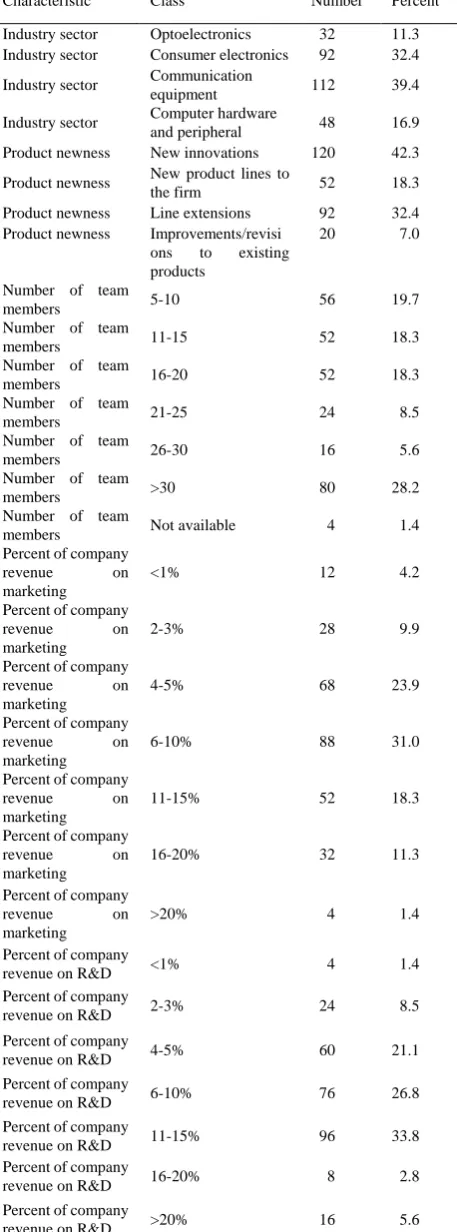
project and are capable of answering all of the survey questions. Project responses were collected via paper and online surveys. The projects were examined to ensure that no duplicate project information was collected.Table I presents characteristics of sampled projects. In addition, profile of respondents is shown in Table II.
TABLEI:CHARACTERISTICS OF SAMPLED PROJECTS
Characteristic Class Number Percent
Industry sector Optoelectronics 32 11.3 Industry sector Consumer electronics 92 32.4
Industry sector Communication
equipment 112 39.4
Industry sector Computer hardware
and peripheral 48 16.9 Product newness New innovations 120 42.3
Product newness New product lines to
the firm 52 18.3
Product newness Line extensions 92 32.4 Product newness Improvements/revisi
ons to existing products
20 7.0
Number of team
members 5-10 56 19.7
Number of team
members 11-15 52 18.3
Number of team
members 16-20 52 18.3
Number of team
members 21-25 24 8.5
Number of team
members 26-30 16 5.6
Number of team
members >30 80 28.2
Number of team
members Not available 4 1.4
Percent of company revenue on marketing
<1% 12 4.2
Percent of company revenue on marketing
2-3% 28 9.9
Percent of company revenue on marketing
4-5% 68 23.9
Percent of company revenue on marketing
6-10% 88 31.0
Percent of company revenue on marketing
11-15% 52 18.3
Percent of company revenue on marketing
16-20% 32 11.3
Percent of company revenue on marketing
>20% 4 1.4
Percent of company
revenue on R&D <1% 4 1.4 Percent of company
revenue on R&D 2-3% 24 8.5
Percent of company
revenue on R&D 4-5% 60 21.1 Percent of company
revenue on R&D 6-10% 76 26.8 Percent of company
revenue on R&D 11-15% 96 33.8 Percent of company
revenue on R&D 16-20% 8 2.8 Percent of company
revenue on R&D >20% 16 5.6
TABLEII:PROFILE OF RESPONDENTS
Variable Category Number Percent Role in NPD Marketing 76 26.8 Role in NPD R&D 120 42.3 Role in NPD Supervision 44 15.5 Role in NPD Analysis 44 15.5
Age 26-30 64 22.5
Age 31-35 76 26.8
Age 36-40 104 36.6
Age 41-45 32 11.3
Age >45 8 2.8
Education Associate's degree 40 14.1 Education Bachelor's degree 164 57.7 Education Master's degree 64 22.5 Education Ph.D. degree 8 2.8 Education Not available 8 2.8
Position Managers/deputy
manager 24 8.5
Position Assistant manager 12 4.2 Position Director 80 28.2 Position Specialist 76 26.8
Position Engineer 92 32.4
C. Survey Design and Measurement
D. Content Validity
Content validity refers to the extent to which a measure represents all facets of a given concept. The content validity of the survey used in this study was tested through a literature review and interviews with the five NPD practitioners. The refined assessment items were included in the final survey. Finally, copies of a draft survey were also sent to three professors in the NPD discipline to pre-test for the clarity of questions. Their insights were also incorporated into the final version of the survey.
IV. RESULTS AND ANALYSIS
A. Measurement Model Test Results
factor analysis (CFA) was conducted to verify the measurement model. Multiple fit criteria were used to assess the overall fit of the model. In the proposed model, implementation of cluster platform, customer relationship management, innovation capabilities, and NPD performance are a second order construct. The data were analyzed using the AMOS/SPSS statistical package. The model refinement was performed to improve the fit to its recommended levels. Based on several trials resulting in elimination of some of the items, all of the scales met the recommended levels. Furthermore, the composite reliability for all constructs was above the 0.7 level, indicating adequate reliability for each construct. Thus, the results provide evidence that the scales are reliable.
All of the factor loadings are statistically significant at the five percent level and exceed the 0.5 standard. In addition, all constructs have an average variance extracted (AVE) greater than 0.5. Thus, these constructs demonstrate adequate convergent validity. Discriminant validity evaluates whether the constructs are measuring different concepts. The procedure requires comparing the set of models where each pair of latent constructs has a constrained correlation of one with the correspondent models where such pairs of constructs are freely estimated. The results show that the chi-square values are significantly lower for the unconstrained models at the five percent level, which suggests that the constructs exhibit discriminant validity.
B. Testing the Moderating Effects of Project Team Size Hypothesis was concerned with the moderating effects of project team size on the relationship between innovation capabilities and NPD performance. In testing the moderation effect, a multiple-group analysis within AMOS was used. In order to evaluate the significant effect of the moderator, a two-stage procedure was undertaken. First, the parameter linking innovation capabilities and NPD performance was estimated simultaneously for the two subgroups (team members≦20 and team members>20). The resulting model is commonly referred to in the literature as the “baseline” or “unconstrained” model as the estimate of the direct path was allowed to differ across two subgroups [34]. In the second estimation, the parameters were constrained to be equal across groups [35]. The second model is referred to as “constrained” model in which subgroups was specified as invariant [35]. The goodness of fit statistics indicated an acceptable fit for the models (see Table III). To evaluate the chi-square difference between the “baseline” and the “constrained” models, comparison was made between the two models. Table IV indicated that project team size significantly moderates the relationship between innovation capabilities and NPD performance (p < 0.01).
Interestingly, the regression weight was significant and in the expected directions (β = 0.509, p < 0.001) for projects with more than 20 members (i.e., large project teams), whereas the link between innovation capabilities and NPD performance was also significant (β = 0.961, p < 0.001) for those with fewer than 20 members (i.e., small project teams). Although both the regression weights were significant, the regression weight for small project teams (β = 0.961) is substantially higher than that for large project teams (β
=0.509). This finding suggests that the link between innovation capabilities and NPD performance is moderated by project team size. Thus, it can be concluded that hypothesis was confirmed and accepted. It is evident that innovation capabilities have stronger effects on NPD performance for small project teams compared to large project teams.
TABLEIII:GOODNESS OF FIT STATISTICS FOR BASELINE AND CONSTRAINED MODELS
Model χ2 df NFI CFI RMSEA
Baseline 397.452 46 0.916 0.927 0.068 Constrained 407.267 47 0.908 0.919 0.071
TABLEIV:CHI-SQUARE DIFFERENCE TESTS FOR THE MODERATING EFFECT Baseline model Constrained model Chi-square difference test
χ2
df χ2 df △χ2 △df
p
397.452 46 407.267 47 9.815 1 < 0.01
V. CONCLUSIONS AND DISCUSSION
A. Major Findings and Research Implications
According to the data analysis results, the influence of innovation capabilities on NPD performance increases in small project teams, due to the moderating effect of project team size (the hypothesis is supported). The moderating relationship is in line with previous findings [30]. In other words, the influence of innovation capabilities on NPD performance, for small project teams, is more than the same effect in the case of large project teams.
B. Managerial Implications
customers and care about long-term development and successes with customers. To improve customer involvement, key customers should be involved with a project team in modifying products, evaluating market, and reviewing operations.
It is also clear that small project teams are more likely to be successful in NPD when they experience a high level of innovation capabilities than large project team. As mentioned previously, the size of a project team affects the complexity of the project. Evidence also suggests that a large project usually involves multiple suppliers, outside agencies, and complex coordination systems and procedures. In addition, availability of facilities, expertise, resources, and management know-how are a few potential sources of risks associated with large projects [28]. In a large project, the complex coordination between the sub-projects is itself a potential risk, as a delay in one area can cause a ripple effect in other areas [28]. Large projects may also have a different set of rules and guidelines from those of smaller and simpler projects [29]. Large projects usually involve diverse and complex information and knowledge. It is not easy to manage the knowledge for projects with high complexity and uncertainty. These may be the reasons why the impact of innovation capabilities on new product performance becomes weaker for large project teams.
C. Limitations and Suggestions for Future Research
While this study offers important insights into implementation of cloud platform, there are some limitations. First, results are obtained from only one industry (i.e., high-tech industry). Thus, generalizations should be drawn with care. It would be helpful to conduct similar studies in traditional manufacturing industry. Additionally, it would be interesting to reexamine the moderating relationship between innovation capabilities and NPD performance for other environmental factors such as salary, job satisfaction, working hours, information availability, time availability, team relationship, and project duration. Finally, this study focuses on external customer relationship management. The effect of internal CRM mechanisms, such as organization and knowledge management [32], need to be examined in the future.
REFERENCES
[1] S. Thomke, “Simulation, learning, and R&D performance: Evidence from automotive development,” Research Policy, vol. 27, no. 1, pp. 55-74, 1998.
[2] G. Barczak, F. Sultan, and E. J. Hultink, “Determinants of IT usage and new product performance,” Journal of Product Innovation Management, vol. 24, no. 6, pp. 600-613, 2007.
[3] E. Kessler and A. Chakrabarti, “Speeding up the pace of new product development,” Journal of Product Innovation Management, vol. 16, no. 3, pp. 231-247, 1999.
[4] G. Barczak, E. J. Hultink, and F. Sultan, “Antecedents and consequences of information technology usage in NPD: A comparison of Dutch and U.S. companies,” Journal of Product Innovation Management, vol. 25, no. 6, pp. 620-631, 2008.
[5] C. S. Lee, “Modeling the business value of information technology,” Information and Management, vol. 39, pp. 191-210, 2001.
[6] C. Chen, “Information technology, organizational structure, and new product development - the mediating effect of cross-functional team interaction,” IEEE Transactions on Engineering Management, vol. 54, no. 4, pp. 687-698, 2007.
[7] S. Ouf and M. Nasr, “The cloud computing: the future of BI in the cloud,” International Journal of Computer Theory and Engineering, vol. 3, no. 6, pp. 750-754, 2011.
[8] P. Achimugu, O. Oluwagbemi, and I. Gambo, “Solving web-based applications architectural problems in the cloud: the way forward,” International Journal of Information Technology and Computer Science, vol. 5, pp. 8-15, 2012.
[9] R. Müller and J. R. Turner, “Matching the project manager’s leadership style to project type,” International Journal of Project Management, vol. 25, no. 1, pp. 21-32, 2007.
[10] B. H. Boar, Strategic Thinking for Information Technology: How to Build the IT Organization for the Information Age, New York, NY: John Wiley and Sons, Inc., 1997.
[11] K. S. Tan, S. C. Chong, B. Lin, and U. C. Eze, “Internet-based ICT adoption: Evidence from Malaysian SMEs,” Industrial Management and Data Systems, vol. 109, no. 2, pp. 224-44, 2009.
[12] G. F. Farris, C. A. Hartz, K. Krishnamurthy, B. Mcllvaine, S. R. Postle, R. P. Taylor, and G. E. Whitwell, “Web-enabled innovation in new product development,” Research-Technology Management, vol. 46, no. 6, pp. 24-35, 2003.
[13] M. Hammer and J. Champy, Business Process Reengineering: A Manifesto for Business Revolution, New York, NY: Harper Business, 1993.
[14] G. Ray, W. A. Muhanna, and J. B. Barney, “Information technology and the performance of the customer service process: A resource-based analysis,” MIS Quarterly, vol. 29, no. 4, pp. 625-652, 2005.
[15] A. Barua, H. C. Kriebel, and T. Mukhopadhyay, “Information technologies and business value: an analytical and empirical investigation,” Information Systems Research, vol. 6, no. 1, pp. 3-23, 1995.
[16] E. M. Rogers, Diffusion of Innovations, New York, NY: Free Press, 1995.
[17] S. Chang and M. S. Lee, “The linkage between knowledge accumulation capability and organizational innovation,” Journal of Knowledge Management, vol. 12, no. 1, pp. 3-20, 2008.
[18] W. M. Cohen and D. A. Levinthal, “Absorptive capacity: A new perspective on learning and innovation,” Administrative Science Quarterly, vol. 35, no. 1, pp. 128-152, 1990.
[19] S. G. Green, M. B. Gavin, and L. Aiman-Smuth, “Assessing a multidimensional measure of radical technological innovation,” IEEE Transactions in Engineering Management, vol. 42, no. 3, pp. 203-214, 1995.
[20] M. M. Crossan and M. Apaydin, “A multi-dimensional framework of organizational innovation: A systematic review of the literature,” Journal of Management Studies, vol. 47, no. 6, pp. 1154-1191, 2010. [21] A. Mention, “Intellectual capital, innovation and performance: A
systematic review of the literature,” Business and Economic Research, vol. 2, no. 1, pp. 1-37, 2012.
[22] F. Damanpour, “Organizational innovation: A meta-analysis of effects of determinants and moderators,” Academy of Management Journal, vol. 34, no. 3, pp. 555-590, 1991.
[23] F. Damanpour and W. E. Evan, “Organizational innovation and performance: The problem of organizational lag,” Administrative Science Quarterly, vol. 29, no. 3, pp. 392-409, 1984.
[24] S. Aggarwal, “Flexibility management: The ultimate strategy,” Industrial Management, vol. 39, no. 1, pp. 5-14, 1997.
[25] A. Parvatiyar and J. N. Sheth, “Customer relationship management: emerging practice, process, and discipline,” Journal of Economic and Social Research, vol. 3, no. 2, pp. 1-34, 2002.
[26] W. Reinartz, M. Krafft, and W. D. Hoyer, “The customer relationship management processes: Its measurement and impact on performance,” Journal of Marketing Research, vol. 41, no. 3, pp. 293-305, 2004. [27] L. Y. M. Sin, A. C. B. Tse, and F. H. K. Yim, “CRM: Conceptualization
and scale development,” European Journal of Marketing, vol. 39, no. 11/12, pp. 1264-1290, 2005.
[28] L. S. Pheng and Q. T. Chuan, “Environmental factors and work performance of project managers in the construction industry,” International Journal of Project Management, vol. 24, no. 1, pp. 24-37, 2006.
[29] H. Kerzner, Project Management: A Systems Approach to Planning, Scheduling and Controlling, New York, NY: Van Nostrand Reinhold, 1992.
[31] R. G. Cooper and E. J. Kleinschmidt, “Uncover the keys to new product success,” Engineering Management Review, vol. 11, no. 4, pp. 5-18, 1993.
[32] R. Lin, R. Chen and K. K. Chiu, “Customer relationship management and innovation capability: an empirical study,” Industrial Management and Data Systems, vol. 110, no. 1, pp. 111-133, 2010.
[33] K. A. Gima, “An exploratory analysis of the impact of market orientation on new product performance - A contingency approach,” Journal of Product Innovation Management, vol. 12, no. 4, pp. 275-293, 1995.
[34] D. Zweig and J. Webster, “Personality as a moderator of monitoring acceptance,” Computers in Human Behavior, vol. 19, no. 4, pp. 479-493, 2003.
[35] N. H. Ahmad, T. Ramayah, C. Wilson, and L. Kummerow, “Is entrepreneurial competency and business success relationship contingent upon business environment? A study of Malaysian SMEs,” International Journal of Entrepreneurial Behaviour and Research, vol. 16, no. 3, pp. 182-203, 2010.
Li-Ren Yangis a professor of business administration