Training the Global Public Health Workforce
Through Applied Epidemiology Training Programs:
CDC’s Experience, 1951-2011
Dana Schneider, BS, MSPH,1 Michele Evering-Watley, MS,1
Henry Walke, MD, MPH,1 Peter B. Bloland, DVM, MPVM1
ABSTRACT
The strengthening of health systems is becoming increasingly recognized as necessary for the achievement of many objectives promoted or supported by global public health initiatives. Key within the effort to strengthen health systems is the development of a well-prepared, skilled, and knowledgeable public health work-force. Over 60 years ago, the United States Centers for Disease Control and Prevention (CDC) began the first training program in applied epidemiology, the Epidemic Intelligence Service (EIS), a two-year, in-service training program in epidemiology and public health practice. Since 1951, the EIS has produced well-trained and highly qualified applied or field epidemiologists, many of whom later became leaders within the US public health system. In 1980, the CDC began assisting other countries to develop their own field epidemiology training programs (FETPs), modeling them after the highly successful EIS program. FETPs differ from other training programs in epidemiology in that: (1) they are positioned within Ministries of Health and the activities of the residents are designed to address the priority health issues of the Ministry; (2) they stress the principle of training through service; and (3) they provide close supervision and mentoring by trained field epidemiologists. While FETPs are designed to be adaptable to the needs of any given country, there exist many fundamental similarities in the skills and knowledge required by public health workers. Recognizing this, CDC developed a standard core FETP curriculum that can be adapted to any country’s needs. Countries can further customize FETP trainings to meet their specific needs by adding specialized “tracks” or by targeting different audiences and levels of the health system. Although FETPs require substantial investments in time and resources as well as
1 U.S. Centers for Disease Control and Prevention, Division of Public Health Systems and
Workforce Development.
significant commitment from ministries, CDC’s vision is that every country will have access to an FETP to help build its public health workforce and strengthen its public health systems.
Key Words: Training, Field Epidemiology Training Programs, CDC, Epidemic Intelligence Service, public health education.
Recommended Citation:Schneider D, Evering-Watley M, Walke H, Bloland PB. Training the Global Public Health Workforce Through Applied Epidemiology Training Programs: CDC’s Experience, 1951-2011. Public Health Reviews. 2011;33:190-203.
INTRODUCTION
Strong public health systems are essential for providing the data needed to effectively assess burden of disease, detect and respond to infectious disease outbreaks and non-infectious disease events, monitor and evaluate public health programs, and formulate evidence-based policies. This infra-structure is also needed to implement public health initiatives and programs, including those for controlling important infectious diseases such as HIV/ AIDS, tuberculosis, malaria, and neglected tropical diseases; those that apply proven interventions, such as for vaccine-preventable diseases; and those that address non-communicable diseases, such as obesity, heart disease, diabetes, and cancer. Finally, this infrastructure is needed to conduct the operational research that will solve current problems with program implementation and identify future interventions.1
A key factor for the success of these public health systems is the availability of a trained, competent workforce. Epidemiologists are an essential component of the public health workforce, in addition to other cadres of staff, such as laboratorians, surveillance officers and technicians, hospital data clerks or other hospital staff responsible for collecting and transmitting health data, and community agents—all of whom need some degree of competency in field epidemiology.2-4
similar and often used interchangeably, the latter typically implies greater urgency, such as with investigations of outbreaks of an infectious disease. Koo and Thacker provide an excellent comparison of the characteristics of applied and academic epidemiology, as well as a discussion of field epidemiology.2
This paper describes the 60 plus years of experience gained by the United States Centers for Disease Control and Prevention (CDC) with developing training programs for field epidemiologists. It also describes its more recent efforts to strengthen the competencies of different cadres of public health staff and to support countries to strengthen their overall public health system infrastructures.
CDC’S EXPERIENCE
The Epidemic Intelligence Service
The CDC was established in 1946 as the US government’s Communicable Disease Center, and had its origins in an agency called the Malaria Control in War Areas (MCWA). The MCWA had been established a few years earlier to combat malaria, which was endemic in the American Southeast.7 Although its mandate continued to be malaria control, the agency quickly expanded and is now the US government’s leading agency addressing all aspects of public health, including prevention and control of infectious diseases; chronic illnesses; violence and injuries; occupational and environmental health; maternal and child health; and emergency pre-paredness. CDC is responsible for collecting and analyzing surveillance data for all reportable disease conditions, responding to national and international public health emergencies, conducting public health research, implementing evidence-based prevention strategies, and promoting health.8
Today, the EIS typically accepts 70-90 officers for training each year and, in its history, has produced over 3,000 epidemiologists.11 While the majority of EIS officers tend to be physicians, the program also includes other professionals, including veterinarians, nurses, sanitarians, dentists, PhD epidemiologists, and others. A number of graduates have gone on to fill leadership positions at CDC (including five CDC directors) and at other federal agencies, at state health departments (half of state epidemiologists are former EIS officers), in non-governmental organizations, academia, and multilateral health organizations (including the World Health Organization (WHO).2
FIELD EPIDEMIOLOGY TRAINING PROGRAMS (FETPS)
Using the successful model of the EIS, CDC began assisting countries to develop their own field epidemiology training programs (FETPs) in 1980. Like the EIS program, FETPs are two-year, typically post-doctoral, training programs that place an emphasis on on-the-job learning through mentorship and provision of essential services to Ministries of Health (MoH). The program typically consists of about 25 percent didactic training and 75 percent on-the-job training under the guidance and supervision of a carefully chosen mentor. Participants (“residents” or “fellows”) are most often full-time MoH employees (and, occasionally, other ministries, such as the Ministry of Agriculture) who are given time away from post to attend the didactic portion of the program and return to their posts for the practicum portion. Services provided to MoH include conducting epidemiologic investigations and field surveys; evaluating surveillance systems; per-forming disease control and prevention measures; reporting findings to decision and policy makers; and training other health workers.
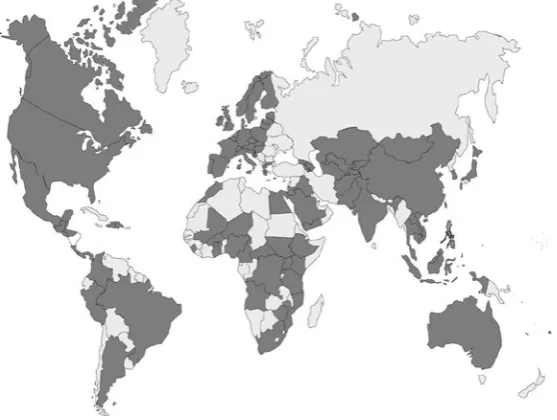
As of September 2011, there were 48 applied and field epidemiology training programs in operation or under development, covering 64 countries around the world (Figure 1). Since 1980, CDC has assisted in the establishment of 43 programs covering 58 countries; 21 of these programs now operate independent of CDC technical assistance and funding. An additional seven are under development. The (past and present CDC-supported) programs have graduated over 2,550 field epidemiologists.12
Fig 1. Map of countries that are participating in a Field Epidemiology Training Program or similar applied epidemiology training program (dark grey).
Source: Data adapted from Training Programs in Epidemiology and Public Health Interventions Network (TEPHINET) (http://www.tephinet.org/).
CHARACTERISTICS OF TRAINING WITHIN FETPS
A Standard Curriculum
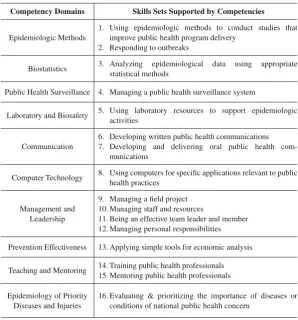
Table 1
FETP Core Competency: Use science to improve public health
Competency Domains Skills Sets Supported by Competencies
Epidemiologic Methods
1. Using epidemiologic methods to conduct studies that improve public health program delivery
2. Responding to outbreaks
Biostatistics 3. Analyzing epidemiological data using appropriate statistical methods
Public Health Surveillance 4. Managing a public health surveillance system
Laboratory and Biosafety 5. Using laboratory resources to support epidemiologic activities
Communication
6. Developing written public health communications 7. Developing and delivering oral public health
com-munications
Computer Technology 8. Using computers for specific applications relevant to public health practices
Management and Leadership
9. Managing a field project 10. Managing staff and resources
11. Being an effective team leader and member 12. Managing personal responsibilities
Prevention Effectiveness 13. Applying simple tools for economic analysis
Teaching and Mentoring 14. Training public health professionals 15. Mentoring public health professionals
Epidemiology of Priority Diseases and Injuries
16. Evaluating & prioritizing the importance of diseases or conditions of national public health concern
countries do have different public health needs, there are many fundamental similarities in the skills and knowledge needed by public health workers and a core set of competencies that all field epidemiologists ideally should possess. Furthermore, meeting country responsibilities to strengthen the national surveillance and response capacities outlined in the WHO International Health Regulations14 not only relies on a sound public health infrastructure, but a standard set of core competencies, supporting training curricula and/or training materials.
To address the growing demand from countries for standardized training materials and requests for CDC technical assistance to develop new FETPs, technical experts throughout CDC collaborated to develop a standard core FETP curriculum, with 16 suggested competencies that can be adapted and/or adopted for FETPs developed around the world (Table 1). Content review and input was received from FETP focal persons in India, Central America, Uganda and Ghana. A final version of the curriculum was released and posted on the CDC website in August 2005.15 The standard curriculum has enabled countries to reduce curriculum development time, allowing efforts to be focused instead on curriculum adaptation, which is a less labor-intensive process and releases resources that can be devoted to direct training and mentoring of students.13
Defined Competencies
The competencies on which a standard curriculum is based are “a com-bination of attributes such as knowledge, abilities, skills and attitudes which enable an individual to perform a set of tasks to an appropriate standard”.13 Competencies are used as a basis for developing training programs and serve as a baseline for identifying what trainees should be able to do when the training is complete. For example, the Association of Schools of Public Health developed competencies for graduating MPH students, which might become the basis of professional credentialing in the future.16 Competencies are also a resource and guide for maintaining standards, quality and accountability, as well as the foundation upon which training curricula and programs are developed.
16 competencies listed in the standard core curriculum as a guide to assist in developing its own FETP. Knowledge and skills in these com petencies equip the graduates to analyze and consider solutions to public health problems at the community, institutional, and societal levels.
FETPs, like the EIS, are established to enable fellows to perform core epidemiologic services, such as analysis of surveillance data and evaluations of surveillance systems, outbreak investigations, and training of other surveillance personnel. However, there does exist a need for trained epidemiologists who possess specialized skills and knowledge to address specific priority health problems in their country. Establishing specialized training tracks (e.g., laboratory, veterinary, malaria, non-communicable diseases, etc.) within existing FETPs will help to meet this need. The nature of the track is dependent upon the priorities of each country, how the relevant ministries choose to establish their FETPs, and the career path for FETP residents after graduation.
Mentorship
Mentorship is a key component of the training experience for FETP residents, and is often the limiting factor in terms of the size of the cohorts that can be enrolled (cohort sizes are typically in the range of 8-12 residents/ year). Mentors are experienced epidemiologists who guide the resident assigned to their health unit during their field placement, review their work, and ensure that the resident receives a well-rounded and complete training experience and has acquired the competencies of the program. Mentors serve as role models, providing professional advice, feedback, and general support and are a key determinant in the success of FETP residents.
BROADENING THE IMPACT
Given that FETP cohort sizes are often kept necessarily small to ensure adequate quality and availability of mentors, and recognizing that not all epidemiologists must go through a two-year FETP training and require different skill sets at different levels of the public health system, FETPs are starting to explore how to broaden their scope and impact. In Central America, a three-tiered training was developed to build capacity at local, district, and central levels of the health system.4 All levels of training are based on the same core competencies, but the depth and length of training differ for each tier. The most intensive training model is at the highest level (third tier), which is the two-year FETP. The second tier, conducted over a nine month period, enrolls district-level public health workers, while the first tier is targeted at local health workers who participate over a period of three to five months.4 All three tiers prioritize field-based, experiential learning with approximately 80 percent of time spent working on field projects that address priority public health problems of the MoH. The benefits of implementing a tiered approach in Central America were realized when Hurricane Stan hit Guatemala in 2005 and the areas with graduates of the tiered programs reported better quality surveillance data compared to other areas.4 The countries participating in the regional Central American program include Costa Rica, El Salvador, Guatemala, Honduras, and the Dominican Republic. Key partners of the program at that time included the University del Valle de Guatemala (UVG)-Guatemala City, the Pan American Health Organization, Council of Ministers of Health from Central America (COMISCA), and affiliated universities in participating countries.12
Another training approach used by the CDC, the Data for Decision Making (DDM) program, is a 12-18 month, on-the-job, interdisciplinary training program targeted at mid- to high-level decision makers in health ministries.17 The program is adaptable to each country’s specific needs and health priorities. Key components of the DDM include training in applied epidemiology, program management, leadership, and communications (approximately 240 hours of classroom contact); an in-service project that applies acquired skills to address significant health problems in participants’ area or district; and mentoring of participants by experienced subject matter experts. In Jordan, for example, from 2001 - 2006, a DDM project trained public health officers, MoH national program managers, and health directorate teams lead by a senior MoH official.
CHALLENGES
FETPs require substantial investments in time and resources, both from CDC and in-country partners, including the MoH. Their success is dependent on many factors, including a program’s ability to determine an appropriate career path for graduates, maintaining country and donor support, and having a stable political and security environment in which to work.
Career Path
In order to attract and retain the best and brightest candidates, participation in an FETP must be seen as a means of career advancement. A career path developed by the MoH, or other agencies in which the graduates will work, is an important predictor of the quality and sustainability of an FETP. Competitive salaries and benefits, along with a variety of job opportunities, and continuing professional education opportunities, will attract high quality applicants and will promote their retention within the MoH.
Funding
FETPs are often started using external funding. Donors include other US government agencies (e.g., the Department of State, Department of Defense, USAID), other governments, and foundations. CDC typically seeks to establish multi-year commitments from donors to support an FETP, with the expectation that the country will one day be capable of supporting the program both technically and financially. However, where MoH resources do not completely meet the needs of the FETP, or where there is opportunity to expand the program, additional outside resources may be required.
To maintain interest in funding the program, it is important for the program to maintain a high level of visibility within the MoH and among potential donors and to continually demonstrate its public health impact. This generates interest for sustaining the program and facilitates advocacy for continued financial support.
Sustainability
CDC has often defined a successful FETP as one in which, after a period of five to ten years, no external financial or technical support is required and the MoH of the host country has taken on full responsibility for the pro-gram’s funding and management. While a number of countries (e.g., Brazil, Thailand) have successfully taken over both the financial and technical management of their programs, others require either continued external financial support or periodic re-engagement with the CDC for technical expertise.
FUTURE OF FETPS
To address this obvious workforce gap, CDC’s vision for the future is that every low- to middle-income country has access to an FETP to help build its public health workforce and strengthen its critical public health systems, either via its own program or by sending trainees to a regional program hosted in a neighboring country. Even then, the overall workforce needs will be hard to fill with FETPs alone; these programs should be considered as integral to a larger effort which combines in-service training of staff currently responsible for dealing with a country’s public health needs as they exist now with expanded pre-service training that emphasizes field epidemiology in order to build an appropriately trained public health workforce for the future.
Clearly, a major challenge for FETPs in the future is to meet the training needs for skilled public health workers. For the workforce to be able to support the public health system and enable it to function effectively, ministries of health should assess their workforce needs and establish formal workforce development plans that detail the number of staff needed, where they are needed, their specific responsibilities, and the competencies required for them to perform effectively in their posts. This should be done for all cadres of staff, not just for those with a title of “epidemiologist.” From this, appropriate training programs could be devised that address the specific competencies needed by staff at all levels of the system.
However, those efforts that focus solely on strengthening the public health workforce are unlikely to be adequate for strengthening the public health system as a whole. Individual systems need to be strengthened, including systems for public health surveillance, vital registration, public health and reference laboratory networks, and the health informatics solutions that allow for timely analysis and sharing of essential information between these various systems. The training received in an FETP prepares graduates to fill key positions in staffing these systems and utilizing the data they produce effectively. The FETPs themselves are increasingly being looked upon as essential contributors to establishing or strengthening such systems. FETPs are also increasingly incorporating aspects of leadership and management training into their curricula in recognition that many graduates go on to take positions that involve substantial leadership and management responsibilities.
Acronyms List
CDC = Centers for Disease Control and Prevention DDM = Data for Decision Making program EIS = Epidemic Intelligence Service
FETP = Field Epidemiology Training Program MCWA = Agency of Malaria Control in War Areas MoH = Ministries of Health
MPH = Master of Public Health RA = Resident Advisor
Conflicts of Inerest: None declared.
REFERENCES
1. Centers for Disease Control and Prevention. Public health framework for health systems strengthening. Available from URL: http://www.cdc.gov/globalhealth/ pdf/HHS_one_pager_factsheet_press_quality.pdf (Accessed 19 August, 2011). 2. Koo D, Thacker SB. In Snow’s footsteps: commentary on shoe-leather and
applied epidemiology. Am J Epidemiol. 2010;172:737-9.
3. Nsubuga P, White M, Fontaine R, Simone P. Training programmes for field epidemiology. Lancet. 2008;371:630-1.
4. Lopez A, Caceres VM. Central America Field Epidemiology Training Program (CA FETP): a pathway to sustainable public health capacity development. Hum Resour Health. 2008;6:27.
5. Brownson R, Hoehner C. Epidemiology: a foundation of public health. In: Brownson R, Pettiti D, editors. Applied Epidemiology: Theory to Practice. New York, NY: Oxford University Press; 2006. p. 3-29.
6. Gregg M, editor. Field Epidemiology. 2nd ed. New York, NY: Oxford University Press; 2002.
7. Centers for Disease Control and Prevention. History of CDC. MMWR. 1996;45:526-30.
8. Centers for Disease Control and Prevention. Vision, Mission, Core Values, and Pledge: CDC Vision for the 21st Century: “Health Protection…Health Equity”. Atlanta: CDC; 2010 [updated 11 January, 2010]. Available from URL: http:// www.cdc.gov/about/organization/mission.htm (Accessed 19 August, 2011). 9. McKenna M. Beating Back the Devil: On the Front Lines with the Disease
Detectives of the Epidemic Intelligence Service. New York, NY: Free Press; 2004.
10. Thacker SB, Dannenberg AL, Hamilton DH. Epidemic intelligence service of the Centers for Disease Control and Prevention: 50 years of training and service in applied epidemiology. Am J Epidemiol. 2001;154:985-92. 11. Centers for Disease Control and Prevention. Epidemic Intelligence Service
12. Centers for Disease Control and Prevention. Division of Public Health Systems and Workforce Development 2010 Annual Report.
13. Traicoff DA, Walke HT, Jones DS, Gogstad EK, Imtiaz R, White ME. Replicating success: developing a standard FETP curriculum. Public Health Rep. 2008;123:S28-34.
14. World Health Assembly. Revision of the International Health Regulations. World Health Organization; 2005 [15 April, 2008]. Available from URL: http://www.who.int/csr/ihr/en/ (Accessed 19 August, 2011).
15. CDC. Field Epidemiology Training Program Standard Core Curriculum. 2006. Available from URL: http://www.cdc.gov/globalhealth/FETP/pdf/FETP_ standard_core_curriculum_508.pdf (Accessed 19 August, 2011).
16. Association of Schools of Public Health. MPH Core Competency Model. 2010 [updated 9 September, 2010]. Available from URL: http://www.asph.org/ document.cfm?page=851 (Accessed 19 August, 2011).
17. Pappaioanou M, Malison M, Wilkins K, Otto B, Goodman RA, Churchill RE, et al. Strengthening capacity in developing countries for evidence-based public health: the data for decision-making project. Soc Sci Med. 2003;57:1925-37.