32 http://rusc.uoc.edu
RUSC VOL. 11 No 1 | Universitat Oberta de Catalunya and University of New England | Barcelona, January 2014 | ISSN 1698-580X
Submitted in: December 2012 Accepted in: May 2013 Published in: January 2014
Recommended citation
Garcia, D. (2014). Learning networks to enhance reflectivity: key elements for the design of a reflective network. Revista de Universidad y Sociedad del Conocimiento (RUSC). Vol. 11, No 1. pp. 32-48. doi http:// dx.doi.org/10.7238/rusc.v11i1.1736
Abstract
The benefits of reflective practice for professionals who deal with complex settings have been widely reported. Similarly, different types of learning networks (LNs) are emerging as a promising alternative to support lifelong learning. This article addresses the topic of how LNs can be used to support reflective professional practice and, furthermore, contribute to the development of reflectivity in individuals and groups of learners. As the starting point of an ongoing research study, a provisional model for the design of a reflective network (RN) is presented here. An RN is a type of LN that in-cludes additional features to foster the development of reflective capabilities. This article inin-cludes a description of a reflective process model, a list of reflective capabilities, a group of key elements for the pedagogical support system for an RN, and some reflections on the challenges of implementing this model and investigating its effectiveness.
Keywords
33
http://rusc.uoc.edu Learning networks to enhance reflectivity...
RUSC VOL. 11 No 1 | Universitat Oberta de Catalunya and University of New England | Barcelona, January 2014 | ISSN 1698-580X
Redes de aprendizaje para mejorar la reflexión:
elementos clave para el diseño de una red reflexiva
Resumen
Los beneficios de la práctica reflexiva para profesionales que tratan con entornos complejos han sido am-pliamente documentados. Al mismo tiempo, están surgiendo diferentes tipos de redes de aprendizaje (RA) como una prometedora alternativa para apoyar el aprendizaje a lo largo de la vida. Este artículo analiza cómo pueden utilizarse las RA para apoyar la práctica profesional reflexiva y al mismo tiempo contribuir al desarrollo de la reflexión en individuos y grupos de alumnos. Como punto de partida para un estudio de investigación en curso, se presenta aquí un modelo provisional para el diseño de una red reflexiva (RR). Una red reflexiva es un tipo de red de aprendizaje que incluye características adicionales a fin de promover el desarrollo de aptitudes de reflexión. Este artículo incluye la descripción de un modelo de proceso reflexivo, una lista de aptitudes reflexivas, un grupo de elementos clave para el sistema de apoyo pedagógico de una red reflexiva y algunas consideraciones sobre los retos que hay que afrontar para aplicar este modelo e investigar su eficacia.
Palabras clave
práctica reflexiva, reflexión, redes de aprendizaje, aprendizaje a lo largo de la vida
Introduction
Lifelong learning has become an important activity for professionals who deal with complex practices.
However, complex practices are unpredictable and difficult to standardize (Reinhardt, Schmidt, Sloep,
& Drachsler, 2011). Such professionals have to perform flexibly in changing contexts where problems
are ill-structured and can be framed from multiple perspectives, in and out of disciplinary borders.
They must be capable of learning from their practice, from information resources and from others
in an independent way. A promising approach for this purpose is learning networks (LNs) (Koper &
Sloep, 2002; Sloep & Berlanga, 2010). They are aimed at enriching the learning experience in
non-formal education contexts (Hsiao, Brouns, Kester, & Sloep, 2011; Van Der Klink, Drachsler, & Sloep,
2012).
However, networked learning demands complex learning skills, attitudes and knowledge
(Rajagopal, Joosten-ten Brinke, Van Bruggen, & Sloep, 2012; Reinhardt et al., 2011; Van Der Klink et
al., 2012; Sie et al., 2012). Among these capabilities, one of the most complex yet promising is the
capacity to perform deep reflection. Reflective capabilities are supported by the metacognitive skills,
knowledge and attitudes that allow a person to build knowledge out of present and past experiences.
Learners have different reflective capacities (Chang, Chen, & Chen, 2012), and there is evidence that
such capacities can be developed with the proper support.
Recently there have been some attempts to explore the possibilities of information and
34
http://rusc.uoc.edu Learning networks to enhance reflectivity...
RUSC VOL. 11 No 1 | Universitat Oberta de Catalunya and University of New England | Barcelona, January 2014 | ISSN 1698-580X
a need to explore this further (Hsieh, Jang, Hwang, & Chen, 2011; Sie et al., 2012; Uzunboylu, Bicen, & Cavus, 2011). Thus, in a review of 24 published articles, Sim and Heww (2010) identified six major uses of students’ and instructors’ blogs. Several of them reported findings indicating the suitability of blogs for reflective practice. Recent studies have indicated the positive effects of metacognitive reflection upon metacognitive skills and control of the learning process by the learner (Bran & Balas, 2011; C.-C. Glava & Glava, 2011), the positive effect of online learning communities on students’ performance for reflective and active learning styles (Zhan, Xu, & Ye, 2011) and the suitability of blogs for metacognitive reflection to foster learning and learning skills (Cazan, 2012; Clipa, Ignat, & Stanciu, 2012; C.-C. Glava & Glava, 2011; Harris, 2008; Häkkinen & Hämäläinen, 2012; Robertson, 2011; Wopereis, Sloep, & Poortman, 2010), and that this effect is strengthened when it is combined with peer support (Cacciamani, Cesareni, Martini, Ferrini, & Fujita, 2012).
This article is the first report of a long-term research project that examines how to incorporate reflective capabilities for lifelong learning and complex professional practice into the design of any LN. In this report, a reflective process model is presented, including a list of reflective capabilities and some key elements that may be useful for designing and creating a reflective network (RN). These ideas were developed to direct the design of an ongoing experiment of an online learning community for professional health promoters, and it is influenced by the needs of their particular practice. However, the key elements presented here could be adapted and used in experiments involving other professionals dealing with practices that demand similar reflective capabilities. A group of studies will be carried out to test the suitability of the experimental model. It is hoped that this paper will contribute to a better understanding of what characteristics a collaborative online learning environment must have to enhance the development of reflectivity, how professionals can use LNs to develop their reflective capabilities, and how they can support each other to achieve this purpose.
Reflective process and reflective capabilities: a proposal
Presented in this section is a reflective process model that can encompass reflection on action (Schön, 1987, 1983), reflection on reflection and reflection in reflection. It also articulates those reflective layers with reflection in action (idem). This model is based on the pedagogical approaches of Paulo Freire (1970) and the experiential learning tradition of Kolb (1984), Schön (1983, 1987), Boud (1993) and Raelin (2000). Its general purpose is to transform experience into knowledge. It divides the reflective process into three moments: learning object construction, reflective analysis and outcome synthesis. Although such moments are sequentially related, the reflective process is not linear and can take multiple paths. This implies that the other two can take place at any moment, and also that the reflective process may focus on a different object at any moment. Even if the moments occur simultaneously, they will lead to different outcomes.
35
http://rusc.uoc.edu Learning networks to enhance reflectivity...
RUSC VOL. 11 No 1 | Universitat Oberta de Catalunya and University of New England | Barcelona, January 2014 | ISSN 1698-580X
Garrison, 2011; Jausovec, 2011). Some of them are specific to the reflective process. The whole group of reflective capabilities is labeled here under the term ‘reflectivity’. As with other metacognitive skills (Jausovec, 2011), it is assumed that they develop through practice. Then a description of the moments of the reflective process and the reflective capabilities required at each moment is presented.
The first moment consists of the construction of the object to be analyzed. According to Boud, Cohen, and Walker (1993), and Boud et al. (1993), experience is complex and every detail can be relevant for learning. It is impossible to analyze every detail, since part of experience is unconscious, although it is necessary to select what aspect of experience is to be analyzed. This aspect of experience may work as a learning object (LO) – a mind representation that is partially conscious – since much of its sense and meaning relies on hidden assumptions. It is important to identify an LO in order to frame the reflective process. During the reflective process, other LOs may be identified for further analysis. As the learner does not know what the learning outcome of the analysis of an LO is, he or she may select it intuitively. Not all the LOs selected are to be analyzed at once, but they are added to a list that the learner can retrieve later. Figure 1 shows the reflective capabilities needed at the first moment.
The second moment is the reflective analysis of the LO. During this moment, the learner invokes internal voices (for example, affective, cognitive, etc.) and evokes external voices (other people’s reflections, theories, etc.) and performs an internal dialogue (Penn & Frankfurt, 2005). The LO under analysis (understood as a mind construction) is then transformed, complemented or rebuilt with new understandings and meaning, that is to say, new knowledge. Figure 2 shows the reflective capabilities that are used at this reflective moment.
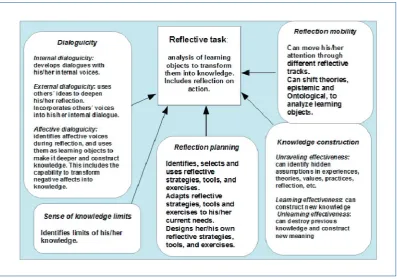
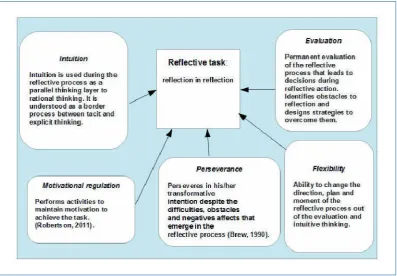
Once reflective analysis develops, it is necessary to announce and synthesize learning. It is also useful and necessary to identify the implications of the new findings in practice (Gore & Vazquez Manzini, 2004). These activities constitute the third moment, where the reflective process links to practice. This moment demands the use of other reflective capabilities (see Figure 3). Additionally, a set of reflective capabilities are used during the whole reflective process (see Figure 4).
36
http://rusc.uoc.edu Learning networks to enhance reflectivity...
RUSC VOL. 11 No 1 | Universitat Oberta de Catalunya and University of New England | Barcelona, January 2014 | ISSN 1698-580X Figure 1.Reflective capabilities during learning object construction (first moment).
Reflective capabilities are used to achieve the reflective task.
Figure 2.Reflective capabilities during reflective analysis (second moment).
37
http://rusc.uoc.edu Learning networks to enhance reflectivity...
RUSC VOL. 11 No 1 | Universitat Oberta de Catalunya and University of New England | Barcelona, January 2014 | ISSN 1698-580X
Figure 3.Reflective capabilities when drawing conclusions (third moment).
Reflective capabilities are used to achieve the reflective task.
38
http://rusc.uoc.edu Learningnetworkstoenhancereflectivity...
RUSCVOL. 11No1|UniversitatObertadeCatalunyaandUniversityofNewEngland|Barcelona, January2014|ISSN1698-580X
I. General characteristics of a reflective network
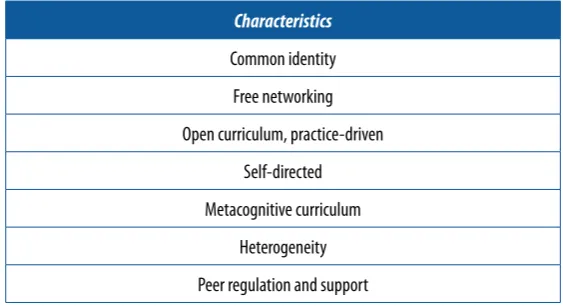
ThepurposeofanRNistoserveasacollaborativelearningenvironmentthatfostersthedevelopment ofthereflectivecapabilitiesofitsinhabitants. Secondarily, anRNisguidedbytwocomplementary purposes, whicharecontent-centeredandserveasvehiclesforachievingthemainpurpose:1)toact asacollaborativenetworktosupportlifelonglearningandpracticeimprovement, and2)tomake collectiveandindividualcontributionstogeneralknowledgeinthesubject field. Table1summarizes thegeneralcharacteristicsofanRN;manyofthemaretakenfromtheliteratureandarecommonto othertypesofLNs–especiallye-learningcommunitiesofpractice(Chikh & Berkani, 2010)–-while othersarespecifictoanRN.
Table 1.General characteristics of a reflective network. Most of these characteristics are shared with other types of learning networks
Characteristics
Common identity
Free networking
Open curriculum, practice-driven
Self-directed
Metacognitive curriculum
Heterogeneity
Peer regulation and support
II. Support system
The supportsystemis dividedintothree basic elements. These elementsaddress thecognitive,
socialandteachingpresencesdescribedforasuccessfullearningcommunity(Zydney, deNoyelles, & Kyeong-JuSeo, 2012), althoughteachingpresenceshouldonlybeanearlyelementofanRN, asit shouldeventuallybereplacedbypeersupport.
1. Support for written reflection
Written reflection facilitatesthe creation ofan external semantic representation of many ofthe thoughtsproducedduringthereflectiveprocess(Chang, Chen, & Chen, 2012; Harris, 2008). Written reflectiondemandsanddevelopsmetacognitiveskills todescribeinternalprocesses;therefore, it canactasthemediatorbetweenaninternalindividualprocessandcollaborativereflection(Akyol &
39
http://rusc.uoc.edu Learningnetworkstoenhancereflectivity...
RUSCVOL. 11No1|UniversitatObertadeCatalunyaandUniversityofNewEngland|Barcelona, January2014|ISSN1698-580X
filesandthefacilitiestoenhancecommunicationandinteractionwithpeersbyusingdifferentlevels ofprivacy(Wopereisetal., 2010;Robertson, 2011;Cazan, 2012).
2. Scaffolding for reflection
Scaffolding aims tosupportdeep reflection while reducingthe counterproductive risks of high cognitive-load tasks (Glava & Glava, 2011; Hsiao et al., 2011). As users develop theirreflectivity,
theymayparticipateinthescaffoldingprocessfornewerusers. Fourmodalitiesofscaffoldingare describedbelow. Thesemodalities arerelatedtoeachotherandmaycoexistinthesamevirtual learningenvironment.
a)
T
rack
-
oriented
re
fl
ection
Thereisevidencethataddingmetacognitivereflectiontoreflectiononcontenthasapositiveeffect onmetacognitiveskills(Bran & Balas, 2011;Cacciamanietal., 2012;Cazan, 2012;C.-C. Glava & Glava,
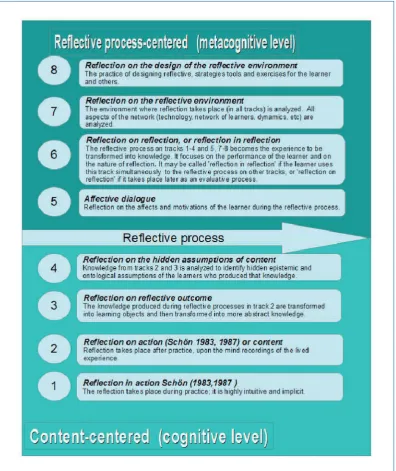
2011;Robertson, 2011). In thismodel, reflectionandmetacognitivereflection aresplitintoeight reflectivetracks. Track-orientedreflectionismeanttohelpusersdirectthefocusofreflectiveanalysis towardsdifferentlayersofexperience, andtheexperienceofreflectingonexperience. Eachofthese layersispresentedasadifferenttrackofreflection. Escalatingreflectiontomoremetacognitivetracks mayleadtohighercontrolof thereflective process. Indeed, thestudiesbyWopereis(2010)and Rajagopalet al. (2012) suggestincludingatracktomonitor affectsduring cognition(Robertson,
40
http://rusc.uoc.edu Learningnetworkstoenhancereflectivity...
RUSCVOL. 11No1|UniversitatObertadeCatalunyaandUniversityofNewEngland|Barcelona, January2014|ISSN1698-580X
Figure 5.Reflective levels and tracks. TheRNenvironmentmayprovidetheopportunitytosplitthereflectiveexperience intoeightdifferenttracks. Eachtrackfocusesonadifferentaspectofthereflectiveexperienceandyieldsadifferentlearning
outcome. Usersshoulddecidewhichtrackstofollowandwhen. Theabilitytodothisisinafactareflectivecapabilityto
developthatrequiresthelearnertokeepalevelofconsciousnessoftheprocessesthattakeplaceimplicity, inorderto
detectreflectingpathstofollowonadifferenttrack.
b)
Re
fl
ective
exercise
41
http://rusc.uoc.edu Learningnetworkstoenhancereflectivity...
RUSCVOL. 11No1|UniversitatObertadeCatalunyaandUniversityofNewEngland|Barcelona, January2014|ISSN1698-580X
mentionedpreviously. SomeofthetracksinanREmaybepublic, whileothersmayberegistered privately. Thisisespecially importantfor exercisesthat demandanalysisof affective aspectsand personalepisodesofpractice.
REsaremeanttoofferreflectiveexperiencesforusers. SimilarREshavebeenusedasalternative assessmentandformativetools(Sarivan, 2011). AnREisexpectedtohaveapositiveinfluenceon theirattitudestowardsreflection, andalsotodevelopreflectivecapabilitiesinanenvironmentthat reducesthecognitiveloadofthelearner, sinceheorshedoesnothavetodesignhisorherlearning strategies. Metacognitivetracksmaygivethelearnertheopportunitytolearnhowtodesignhisor herownREinthefuture. Thisisimportant, sinceREsareaprovisionalscaffolding, notasetofrulesto follow, astheymaynegativelyaffectmotivationandlearning(Wopereisetal., 2010).
c)
Re
fl
ective
tools
Reflectivetools(RTs)aregenerictechniquestosupportreflectiveanalysisofdifferentLOs. Portfolios andjournalshavebeenwidelyusedasRTs(see, forexample, Chang, Chen, & Chen, 2012;Raelin, 2000; Bran & Balas, 2011).TheyvaryintheirindependenceoftheLO, sincesomeofthemmaybeveryspecific or general. RTsmayinclude severalof thereflectivetracks describedabove. Advancedusersare expectedtodevelopthecapabilitytoadaptexistingandevencreatenewreflectivetoolsfortheirneeds.
d)
Blended
learning:
simulations
Forthoseuserswho havenoprofessional practice, suchas undergraduatestudents, simulations of professional practice maybe provided (Van Der Klink et al., 2012). Such simulations may be simplifiedorcomplexversionsofprofessionalproblemssimilartotheremoteinternshipsdescribed byLansuetal. (2010)orthecommunity-of-practiceexperimentreportedbyChang, Chen, andLi (2008). Simulationsmaybeintegratedintoblendedlearning, addingthedevelopmentofreflective capabilitiestoaconventionalcurriculum.
3. Peer support
Peersupportisoneofthemostimportantelementsthatcontributetosuccessfulnetworkedlearning (Berlangaetal., 2008). Theavailabilityoflearningtechnologyisnoguaranteethatitwillbesufficient tosupportlearning(Van DerKlink etal., 2012), especiallywithcomplex cognitivetasks(Hsiaoet al., 2011)suchas deepreflectionandthedevelopmentofmetacognitiveskills (Cacciamanietal.,
2012). Peersupportmaybevoluntaryorinvoluntaryandcanworkinseveralways, asshownbelow.
Mostofthelearningactivitiesandtoolsdescribedabovecanbeperformedindividually;however,
42
http://rusc.uoc.edu Learningnetworkstoenhancereflectivity...
RUSCVOL. 11No1|UniversitatObertadeCatalunyaandUniversityofNewEngland|Barcelona, January2014|ISSN1698-580X
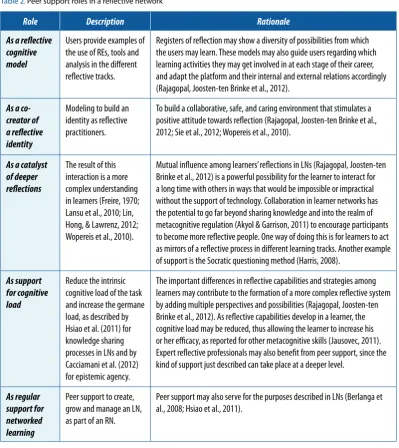
transientcommunities(Berlangaetal., 2008). Table2describesthedifferentrolesofpeerinteraction aspartofthesupportsystem:
Table 2.Peer support roles in a reflective network
Role Description Rationale
As a reflective cognitive model
Users provide examples of the use of REs, tools and analysis in the different reflective tracks.
Registers of reflection may show a diversity of possibilities from which the users may learn. These models may also guide users regarding which learning activities they may get involved in at each stage of their career, and adapt the platform and their internal and external relations accordingly (Rajagopal, Joosten-ten Brinke et al., 2012).
As a co-creator of a reflective identity
Modeling to build an identity as reflective practitioners.
To build a collaborative, safe, and caring environment that stimulates a positive attitude towards reflection (Rajagopal, Joosten-ten Brinke et al., 2012; Sie et al., 2012; Wopereis et al., 2010).
As a catalyst of deeper reflections
The result of this interaction is a more complex understanding in learners (Freire, 1970; Lansu et al., 2010; Lin, Hong, & Lawrenz, 2012; Wopereis et al., 2010).
Mutual influence among learners’ reflections in LNs (Rajagopal, Joosten-ten Brinke et al., 2012) is a powerful possibility for the learner to interact for a long time with others in ways that would be impossible or impractical without the support of technology. Collaboration in learner networks has the potential to go far beyond sharing knowledge and into the realm of metacognitive regulation (Akyol & Garrison, 2011) to encourage participants to become more reflective people. One way of doing this is for learners to act as mirrors of a reflective process in different learning tracks. Another example of support is the Socratic questioning method (Harris, 2008).
As support for cognitive load
Reduce the intrinsic cognitive load of the task and increase the germane load, as described by Hsiao et al. (2011) for knowledge sharing processes in LNs and by Cacciamani et al. (2012) for epistemic agency.
The important differences in reflective capabilities and strategies among learners may contribute to the formation of a more complex reflective system by adding multiple perspectives and possibilities (Rajagopal, Joosten-ten Brinke et al., 2012). As reflective capabilities develop in a learner, the cognitive load may be reduced, thus allowing the learner to increase his or her efficacy, as reported for other metacognitive skills (Jausovec, 2011). Expert reflective professionals may also benefit from peer support, since the kind of support just described can take place at a deeper level.
As regular support for networked learning
Peer support to create, grow and manage an LN, as part of an RN.
Peer support may also serve for the purposes described in LNs (Berlanga et al., 2008; Hsiao et al., 2011).
III. General architecture of a reflective network
43
http://rusc.uoc.edu Learningnetworkstoenhancereflectivity...
RUSCVOL. 11No1|UniversitatObertadeCatalunyaandUniversityofNewEngland|Barcelona, January2014|ISSN1698-580X
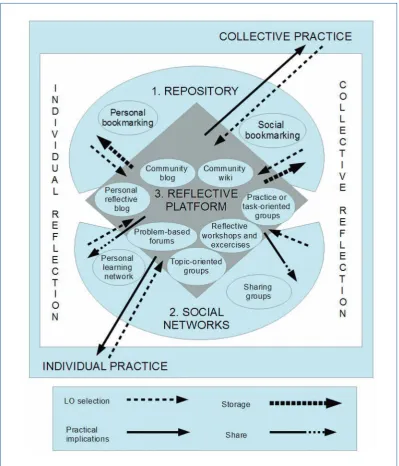
Figure 6.Technological platform for a RN. Thecaseofmanantialdenubes.org. Theplatformhasthreeconnectedelements:
1) arepositoryforlearningobjectsandrelevantinformation, 2) socialnetworkingservicesand3) areflectiveenvironment.
Arrowsshowthemainrelationsbetweenthethreeelementsandtoprofessionalpractice. Mostofthereflectiveprocess
takesplaceinthereflectiveplatformwerereflectivescaffoldingcanbebestsuportedbyenvironmentsdesignedadhoc.
From idea to reality: multiple obstacles
Implementingaprototypebaseduponthekeynotespresentedhereisapathstrewnwithdifficulties.
LikeanyLN, itmusthaveasetofcharacteristicsforeffectivecollaborativelearning(seeRajagopal,
44
http://rusc.uoc.edu Learningnetworkstoenhancereflectivity...
RUSCVOL. 11No1|UniversitatObertadeCatalunyaandUniversityofNewEngland|Barcelona, January2014|ISSN1698-580X
& Wishart, 2012). Learnersmayhavetodomorethandevelopnetworkingcapabilitiessuchasthose describedbyRajagopal, Joosten-tenBrinkeetal. (2012). Thismayimplythat, beforeanyevidence ontheresultsofanRNonreflectivecapabilitiesemerges, itwillbenecessaryforacriticalmassof userstoreachtheadequatelevelofinvolvement(Koper & Sloep, 2002), andforthemtomasterbasic networkingcapabilities first. Thiswillbenecessarynotonlytotestthefeaturesoftheprototype, but alsotocreatetheenvironmentfornewuserstoreachthisstage. Itislikelythatafoundernetwork–a groupofadvancedlearnerstosupportotherlearners(Robertson, 2011)–willbeneeded. Itispossible thatsuchagroupwillnotdevelopspontaneously, soitmaybenecessaryforthemtoreceivesupport inblendedenvironments, andforthemtotrainasfuturepeers-tutors(Hsiaoetal., 2011)ofother professionals. SpecialtutorsupportlikethecoachingandfeedbackdescribedbyStein, Wanstreet,
Slagle, Trinko, andLutz(2012)maybenecessary. However, foundersshouldnotbetrainedasexpert tutors, butasexpertlearners.
Itisveryimportantforuserstobeheterogeneousnotonlyintheirlevelsofexpertiseinthesubject matter, butalsointhelevelofdevelopmentoftheirreflectivecapabilities, andevenincharacteristics liketheprofilesfor metacognitivereflection(A.-E. Glava & Glava, 2011) andlearningstyles(Zhan etal., 2011), inordertoprovideapropermatchwiththeheterogeneityofnewusersandimprove reflectivity(Hsiehetal., 2011).
AnRNmaynotbeattractivetousersunlessiteffectivelyrespondstotheirpractice-relatedproblems andinterests, adequatelyadaptstotheircurrentlevelofexpertiseandenableseveryonetovisualize thebenefitsofjoiningandparticipatinginit(Sloep & Kester, 2009). Itisthereforeveryimportantto conductananalysisofpotentialusers(Sloep & Berlanga, 2010, 2011). Theproblemsusersfacein theirpracticearerarelyframedas ‘Ineedtobemorereflective’. Itisquiteimportanttodemonstrate tousersthatanRNisasusefulforsolvingproblemsasitisforbecomingmorereflective, andthat thelatterhas aneffectiveandpositiveinfluenceonpracticeimprovement, thoughthis maytake time(Harris, 2008). AlthoughanRNisdesignedforuserstoshareacommonreflectiveenvironment toimprovedistinctpractices, itmayalsobeadaptedforteamworktoreflectoncommonprojects anddevelopcommonreflectivitywiththebeneficialeffectsdescribedbyNederveenPieterse, Van Knippenberg, & VanGinkel(2011).
Someofthefeaturesofthemodelproposedherecannotbeproperlyenvisionedunlessspecific softwareisdevelopedforthereflectiveplatform.
45
http://rusc.uoc.edu Learningnetworkstoenhancereflectivity...
RUSCVOL. 11No1|UniversitatObertadeCatalunyaandUniversityofNewEngland|Barcelona, January2014|ISSN1698-580X
doesanRNhavetodevelopnewmethodologiesofknowledgecreation? Whatpotentialdoesan RNhavetocombineindividualreflectivecapabilitiesandstylesincollaborativetasksandprojects?
References
Akyol, Z., & Garrison, D. R. (2011). Assessingmetacognitioninanonlinecommunityofinquiry. The Internetand HigherEducation, 14(3), 183-190. doihttp://dx.doi.org/10.1016/j.iheduc.2011.01.005 Berlanga, A. J., Sloep, P. B., Kester, L., Brouns, F., Rosmalen, P. Van, & Koper, R. (2008). Adhoctransient communities:towardsfosteringknowledgesharinginlearningnetworks. InternationalJournalof Learning Technology, 3(4), 443-458. doihttp://dx.doi.org/10.1504/IJLT.2008.019378
Boud, D. (1993). Experienceasthebaseforlearning. HigherEducationResearchandDevelopment,
12(1), 33-44. doihttp://dx.doi.org/10.1080/0729436930120104
Boud, D., Cohen, R., & Walker, D. (1993). Usingexperienceforlearning. Bristol, PA:SRHEandOpen UniversityPress.
Bran, C.-N., & Balas, E.-C. (2011). Metacognitiveregulationandin-depthlearning. A studyonthestu
-dentspreparingtobecometeachers. Procedia - SocialandBehavioralSciences, 11, 107-111. doi http://dx.doi.org/10.1016/j.sbspro.2011.01.043
Cacciamani, S., Cesareni, D., Martini, F., Ferrini, T., & Fujita, N. (2012). Influenceofparticipation, facilitator styles, andmetacognitivereflectiononknowledgebuildinginonlineuniversitycourses. Compu
-ters & Education, 58(3), 874-884. doihttp://dx.doi.org/10.1016/j.compedu.2011.10.019
Cazan, A.-M. (2012). Enhancingselfregulatedlearningbylearning journals. Procedia - Socialand BehavioralSciences, 33, 413-417. doihttp://dx.doi.org/10.1016/j.sbspro.2012.01.154
Chang, C. K., Chen, G. D., & Li, L. Y. (2008). Constructingacommunityofpracticetoimprovecourseworkacti
-vity. Computers & Education, 50(1), 235-247. doihttp://dx.doi.org/10.1016/j.compedu.2006.05.003 Chang, C.-C., Chen, C.-C., & Chen, Y.-H. (2012). Reflectivebehaviorsunderaweb-basedportfolioas
-sessmentenvironmentforhighschoolstudentsinacomputercourse. Computers & Education,
58(1), 459-469. doihttp://dx.doi.org/10.1016/j.compedu.2011.08.023
Chikh, A., & Berkani, L. (2010). Communitiesofpracticeofe-learning, aninnovativelearningspace fore-learningactors. Procedia - SocialandBehavioralSciences, 2(2), 5022-5027. doihttp://dx.doi.
org/10.1016/j.sbspro.2010.03.814
Clipa, O., Ignat, A.-A., & Stanciu, M. (2012). Learningdiaryasatoolformetacognitivestrategiesdeve
-lopment. Procedia - SocialandBehavioralSciences, 33, 905-909. doihttp://dx.doi.org/10.1016/j.
sbspro.2012.01.253
Freire, P. (1970). PedagogíadelOprimido [PedagogyoftheOppressed]. Mexico:SigloXXIeditores.
Glava, A.-E., & Glava, C.-C. (2011). Profilesofmetacognitivereflectioninfutureteacheruniversitystudents. Pro
-cedia - SocialandBehavioralSciences, 15, 988-992. doihttp://dx.doi.org/10.1016/j.sbspro.2011.03.226 Glava, C.-C., & Glava, A.-E. (2011). Developmentofmetacognitivebehavioroffutureteacherstudents throughelectroniclearningdiariesasmeansofselfreflection. ProcediaComputerScience, 3, 649
46
http://rusc.uoc.edu Learningnetworkstoenhancereflectivity...
RUSCVOL. 11No1|UniversitatObertadeCatalunyaandUniversityofNewEngland|Barcelona, January2014|ISSN1698-580X
Gore, E., & VazquezManzini, M. (2004). Unaintroducciónalaformacióneneltrabajo. Hacervisible lo invisible [Anintroductiontoworkplacetraining. Makingtheinvisible visible]. Buenos Aires, Argentina:FondodeCulturaEconómica.
Harris, M. (2008). Scaffoldingreflectivejournalwriting - negotiatingpower, playandposition. Nurse educationtoday, 28(3), 314-26. doihttp://dx.doi.org/10.1016/j.nedt.2007.06.006
Hsiao, Y. P., Brouns, F., Kester, L., & Sloep, P. (2011). CognitiveloadandknowledgesharinginLearning Networks. InteractiveLearningEnvironments, 1-12. doihttp://dx.doi.org/10.1080/10494820.2010
.548068
Hsieh, S.-W., Jang, Y.-R., Hwang, G.-J., & Chen, N.-S. (2011). Effectsofteachingandlearningstyleson students’reflectionlevelsforubiquitouslearning. Computers & Education, 57(1), 1194-1201. doi http://dx.doi.org/10.1016/j.compedu.2011.01.004
Häkkinen, P., & Hämäläinen, R. (2012). Sharedandpersonallearningspaces:Challengesforpedago
-gicaldesign. TheInternetand HigherEducation, 15(4), 231-236. doihttp://dx.doi.org/10.1016/j.
iheduc.2011.09.001
Jausovec, N. (2011). Metacognition. InM. A. Runco & S. R. Pritzker(Eds.), Encyclopedia of Creativity (pp.
107-112). doihttp://dx.doi.org/10.1016/B978-0-12-375038-9.00146-1
Joubert, M., & Wishart, J. (2012). Participatorypractices:Lessonslearntfromtwoinitiativesusingon
-linedigitaltechnologiestobuildknowledge. Computers & Education, 59(1), 110-119. doihttp:// dx.doi.org/10.1016/j.compedu.2011.09.024
Kolb, D. A. (1984). ExperientialLearning:ExperienceastheSourceofLearning andDevelopment.
EnglewoodCliffs, NJ:Prentice-Hall, Inc.
Koper, R., & Sloep, P. (2002). Learning Networks: a first elaboration. Educational TechnologyExpertiseCen
-treOpenUniversityoftheNetherlands. Retrievedfromhttp://dspace.ou.nl/bitstream/1820/66/2/ framework-TDprogramme-internalUse.pdf
Lansu, A., Boon, J., & Sloep, P. (2010). LearninginNetworksforSustainableDevelopment. InL. Dirc
-kinck-Holmfeld, V. Hodgson, C. Jones, M. DeLaat, D. McConnell, & T. Ryberg(Eds.), Proceedingsof the7thInternationalConferenceonNetworkedLearningNLC2010(pp. 249-256). Retrievedfrom http://dspace.ou.nl/handle/1820/2344
Lin, H., Hong, Z.-R., & Lawrenz, F. (2012). Promotingandscaffoldingargumentationthroughreflective asynchronousdiscussions. Computers & Education, 59(2), 378-384. doihttp://dx.doi.org/10.1016/j.
compedu.2012.01.019
NederveenPieterse, A., VanKnippenberg, D., & VanGinkel, W. P. (2011). Diversityingoalorientation,
teamreflexivity, andteamperformance. OrganizationalBehaviorand HumanDecisionProcesses,
114(2), 153-164. doihttp://dx.doi.org/10.1016/j.obhdp.2010.11.003
Penn, P., & Frankfurt, M. (2005). Lacreacióndeuntextoparticipante:laescritura, lasvocesmúltiplesy lamultiplicidadnarrativa [CreatingaParticipant Text:Writing, MultipleVoices, NarrativeMultipli
-city]. InG. Limon Arce(Ed.)Terapias post modernas [Post Modern Therapies]. Mexico:EditorialPax (pp. 85-110).
Raelin, J. (2000). Work-basedLearning: TheNewFrontierofManagementDevelopment. UpperSadd
47
http://rusc.uoc.edu Learningnetworkstoenhancereflectivity...
RUSCVOL. 11No1|UniversitatObertadeCatalunyaandUniversityofNewEngland|Barcelona, January2014|ISSN1698-580X
Rajagopal, K., Joosten-tenBrinke, D., VanBruggen, J., & Sloep, P. B. (2012). Understandingpersonal learning networks:theirstructure, contentand thenetworkingskillsneeded tooptimallyuse them. First Monday, 17(1), 1-12. Retrievedfrom http://firstmonday.org/htbin/cgiwrap/bin/ojs/ index.php/fm/article/view/3559/3131
Rajagopal, K., Verjans, S., Sloep, P. B., & Costa, C. (2012). PeopleinPersonalLearningNetworks: Analy
-singtheirCharacteristicsandIdentifyingSuitable Tools. InV. Hodgson, C. Jones, M. DeLaat, D.
McConnell, T. Ryberg, & P. Sloep(Eds.), ProceedingsoftheEighthInternationalConferenceon NetworkedLearning2012(pp. 252-259). Retrievedfrom:http://hdl.handle.net/1820/4224 Reinhardt, W., Schmidt, B., Sloep, P., & Drachsler, H. (2011). KnowledgeWorkerRolesand Actions–Re
-sultsof TwoEmpiricalStudies. KnowledgeandProcessManagement, 18(3), 150-174. doihttp:// dx.doi.org/10.1002/kpm
Robertson, J. (2011). The educationalaffordancesofblogsforself-directedlearning. Computers &
Education, 57(2), 1628-1644. doihttp://dx.doi.org/10.1016/j.compedu.2011.03.003
Sarivan, L. (2011). TheReflective Teacher. Procedia - SocialandBehavioralSciences, 11, 195-199. doi http://dx.doi.org/10.1016/j.sbspro.2011.01.060
Schön, D. A. (1983). Thereflectivepractitioner:howprofessionalsthinkinaction. New York, NY:Basic Books.
Schön, D. A. (1987). Educatingthereflectivepractitioner. SanFrancisco, CA:Jossey-BassInc.
Sie, R. L. L., Berlanga, A. J., Rajagopal, K., Pannekeet, K., Fazeli, S., Sloep, P. B., & Heerlen, A. T. (2012). Social
ToolsforNetworkedLearning:CurrentandFutureResearchDirections. InV. Hodgson, C. Jones, M.
DeLaat, D. McConnell, T. Ryberg, & P. Sloep(Eds.), ProceedingsoftheEighthInternationalConferen
-ceonNetworkedLearning2012(pp. 312-319). Retrievedfrom:http://hdl.handle.net/1820/4218 Sloep, P. B., & BerlangaFlores, A. J. (2011). Redesdeaprendizaje, aprendizajeenred [Learningnet
-works, networked learning]. ComunicarRevista científica iberoamericana de comunicación y educación, (37), 55-63. Retrievedfromhttp://dialnet.unirioja.es/servlet/extart?codigo=3733909 Sloep, Peter, & Kester, L. (2009). FromLurkerto ActiveParticipant. InR. Koper(Ed.), Learning, 17-27.
Retrievedfromhttp://dspace.ou.nl/handle/1820/1938
Stein, D. S., Wanstreet, C. E., Slagle, P., Trinko, L. A., & Lutz, M. (2012). From “hello” tohigher-orderthin
-king: Theeffectofcoachingandfeedbackononlinechats. TheInternetand HigherEducation,
1-7. doihttp://dx.doi.org/10.1016/j.iheduc.2012.03.001
Uzunboylu, H., Bicen, H., & Cavus, N. (2011). Theefficientvirtuallearningenvironment: A casestudyof web2.0toolsandWindowslivespaces. Computers & Education, 56(3), 720-726. doihttp://dx.doi.
org/10.1016/j.compedu.2010.10.014
VanDerKlink, M., Drachsler, H., & Sloep, P. B. (2012). Technology-enhancedlearningintheworkplace. In D. Derks & A. B. Bakker(Eds.), Thepsychologyofdigitalmediawork. Hove, England:PsychologyPress.
Wopereis, I., Sloep, P., & Poortman, S. (2010). Weblogsasinstrumentsforreflectiononactionintea
-chereducation. InJ. Aebersold(Ed.), InteractiveLearningEnvironments, 18(3), 245-261. doihttp:// dx.doi.org/10.1080/10494820.2010.500530
Zhan, Z., Xu, F., & Ye, H. (2011). Effectsofanonlinelearningcommunityonactiveandreflectivelear
-ners’learningperformanceandattitudesinaface-to-faceundergraduatecourse. Computers &
48
http://rusc.uoc.edu Learningnetworkstoenhancereflectivity...
RUSCVOL. 11No1|UniversitatObertadeCatalunyaandUniversityofNewEngland|Barcelona, January2014|ISSN1698-580X
Zydney, J. M., deNoyelles, A., & Kyeong-JuSeo, K. (2012). Creatingacommunityofinquiryinonline
environments: Anexploratorystudyontheeffectofaprotocoloninteractionswithinasynchro
-nousdiscussions. Computers & Education, 58(1), 77-87. doihttp://dx.doi.org/10.1016/j.compe