R E S E A R C H
Open Access
An exploration of the determinants for
decision to migrate existing resources to
cloud computing using an integrated
TOE-DOI model
Adel Alkhalil
1*, Reza Sahandi
2and David John
2Abstract
Migrating existing resources to cloud computing is a strategic organisational decision that can be difficult. It requires the consideration and evaluation of a wide range of technical and organisational aspects. Although a significant amount of attention has been paid by many industrialists and academics to aid migration decisions, the procedure remains difficult. This is mainly due to underestimation of the range of factors and characteristics affecting the decision for cloud migration. Further research is needed to investigate the level of effect these factors have on migration decisions and the overall complexity. This paper aims to explore the level of complexity of the decision to migrate the cloud. A research model based on the diffusion of innovation (DOI) theory and the technology-organization-environment (TOE) framework was developed. The model was tested using exploratory and confirmatory factor analysis. The quantitative analysis shows the level of impact of the identified variables on the decision to migrate. Seven determinants that contribute to the complexity of the decisions are identified. They need to be taken into account to ensure successful migration. This result has expanded the collective knowledge about the complexity of the issues that have to be considered when making decisions to migrate to the cloud. It contributes to the literature that addresses the complex and multidimensional nature of migrating to the cloud.
Keywords: Cloud computing, Cloud migration, Decision-making process, Cloud migration factors, Cloud migration complexity, TOE, DOI
Introduction
Over the last decade, advances in computing have enabled cost-effective realisation of large-scale data centres [1]. It has led to computing being transformed to a model comprising services that are commoditised and delivered in a manner similar to traditional public
utilities which stimulates a new paradigm – Cloud
Computing. The emergence of this phenomenon funda-mentally changed the way information systems are developed, deployed, scaled, supported, and paid for [2]. It has attracted many companies to migrate existing systems due to their promised advantages, particularly
the reduction of capital expenses and the virtually
infin-ite resource capacity that enhances businesses’agility [3].
Although cloud computing promises great benefits, it has not yet reached the maturity level that allows computing resources to be treated like commodities such as electri-city as predicted by Buyya et al. [4]. Organisations are still reluctant to migrate their IT systems and services to the cloud due to concerns of losing control and other un-desired outcomes [5]. Further, organisations are typically interested in moving only some of their systems to the cloud due to the difficulty of migrating the related applica-tions, for example, safety-critical software [6]. Unlike start-up companies that develop systems from scratch, or-ganisations planning to migrate existing legacy services to cloud computing often need the new services to be inter-* Correspondence:[email protected]
1Faculty of Computer Science and Engineering, University of Hail, Hail, Saudi Arabia
Full list of author information is available at the end of the article
operated with the existing systems [7]. This requires care-ful planning to avoid integration problem issues.
Being an important area for IT and business innovation, the adoption of cloud computing has received increasing attention in both practice and research [8]. Cloud comput-ing is a fairly new provisioncomput-ing model and a trend that involves continuing development of next-generation architecture. Therefore, most of the existing cloud studies are exploratory, descriptive, or case-based research [9]. For example, studies from [10–12] focus on the general conceptualization and definition of cloud computing, as well as strengths, weaknesses, opportunities and threats to the cloud computing industry. Further, many previous studies explored the business benefits and barriers for adoption. They focused mostly on the cost benefits, scalability, agility and the security issues, for examples see [13–17]. While these studies identified some factors that influence the decisions to migrate to the cloud, they were developed at an early stage of the evolvement of cloud computing. Further, the majority of them explored the fac-tors affecting the adoption of cloud services while little attention was paid to the migration of legacy systems.
Many models and frameworks have been proposed to aid organisations with their decision to migrate to the cloud environment (e.g. [18–23]). Although significant contributions have been made by these works, there are still many aspects which require further support [24]. The main limitation in the proposed approaches is the separation of elements in the migration processes, that are connected and dependent on each other. Further, the existing support is usually limited to the selection of service providers such as [22] or to the adaption re-quired for migrating applications such as [6]. Although evaluation of providers and their appropriate selection are critical, making an informed decision to migrate re-quires the analysis of a wide range of factors at early stages of the decision process. While the existing literature provides a fundamental understanding of cloud computing architecture, benefits and some issues, models and frameworks to support the migration and managing cloud services, research on drivers and bar-riers of the broad organizational adoption is still in early stages [5] and [9]. Therefore, this paper explores the issues that have increased the difficulties in
organisa-tions’decisions to migrate to the cloud. A two-stage
sur-vey was implemented for the exploration. This resulted in the identification of seven factors that contributed to the complexity of the decisions for migration. The ana-lysis of the literature with regards to supporting the de-cision making process of companies when considering whether to migrate to the cloud shows that only some of those factors had been taken into account. The objective of this paper is to advance this further by empirically ex-ploring the factors influencing the decision to migrate to
the cloud. It proposes an integrated research model based on the Technology–Organization–Environment (TOE) framework and the Diffusion of Innovation theory (DOI).
Theoretical background Migration to cloud computing
Migration to the cloud, for the purpose of this paper, can be defined as the transition process of all or part of an organisation's legacy IT resources, including: hard-ware, softhard-ware, stored data, and business processes, from locally on-premises deployments behind its firewalls to the cloud environment where they can be managed remotely by a third party. The process also encompasses the shifting of IT resources between different cloud providers, which is known as cloud-to-cloud migration. The cloud migration process may involve retaining some IT infrastructure on-site [25].
Decision making process
Simon [26] developed a generic decision making process model. The model is divided into three major phases: Intelligence, Design, and Choice. The process starts with
the intelligence phase in which the ‘reality’ of an
organisation is examined. It involves problem identification and information gathering activities about the societal, the competitiveness, and the organisational environments. The
design phase simplifies an organisation’s“reality”and
iden-tifies relationships between variables, as well as setting the criteria for evaluating alternative courses of action. The choice phase is to select the most appropriate alternative course of action based on the criteria identified in the design phase. The model has been widely accepted and adopted for problem-solving [27]. Turban et al. [28] described the model as the most concise, yet complete characterisation of rational decision making. Decision Support Systems (DSSs) are an integral part of Simon’s model. The following section presents an analysis of the exiting DSSs, designed to support the decision making process for migrating to cloud
com-puting. We applied Simons’ [26] model on the
exist-ing DSSs to examine the level of support they offer in each of the three levels.
Current level of support for decisions to migrate to the cloud
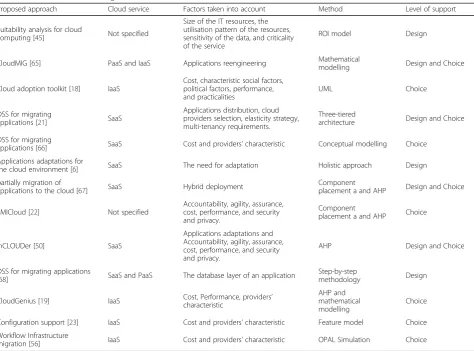
attempts have either been developed for marketing pur-poses or are not publicly available, due to them being based on closed proprietary technologies that usually re-quire consultancy contracts [32]. Nevertheless, a number of DSSs have been proposed to support migration, as il-lustrated in Table 1.
A review of the DSSs shows that the vast majority of them do not support the assessment of the current cloud environments and business processes. In other words, they focus on supporting migration at the choice level for selecting providers. Although evalu-ation of providers and their appropriate selection are critical, making an informed decision to migrate requires the analysis of a wide range of factors at early stages of a decision process. Companies should develop a good awareness of the cloud environment and its capabilities, regulations, potentials and threats, before coming to a decision. Almost none of the
reviewed work studied so far had considered “the
intelligence level” and only a few paid attention to
“the design level” for decision-making by considering the need for services adaptations in order to make them cloud enabled. For example, Andrikopoulos et al. [6]
considered the adaptation required to the applications for migrating to the cloud.
The review also shows a high level of interest for mi-gration for the IaaS model followed by the SaaS while there is very limited attention to the PaaS. Additionally, the existing approaches focus on migration from on-premises to the cloud while there is a lack of interest for migration from one provider to another. This is an im-portant aspect to be addressed to avoid the issue of vendor lock-in which is a concern for many [33].
Further, the majority of the existing DSSs are prototype-based, experimental or conceptual. Therefore, the provision of established DSSs to include relevant information can substantially aid the decision making process. Another problem is the dispersed information, which is required for decision making. Although the information is available, it is often time consuming to bring all the details together. Add-itionally, due to the development of the technology and the expansion of the services offered, the range of information that is required to be considered for migration is increasing. Further, the availability of a wide range of DSSs and tools may create uncertainty for decision makers, if they are used outside of a systematic process.
Table 1A review of the existing cloud DSSs
Proposed approach Cloud service Factors taken into account Method Level of support
Suitability analysis for cloud
computing [45] Not specified
Size of the IT resources, the utilisation pattern of the resources, sensitivity of the data, and criticality of the service
ROI model Design
CloudMIG [65] PaaS and IaaS Applications reengineering Mathematicalmodelling Design and Choice
Cloud adoption toolkit [18] IaaS
Cost, characteristic social factors, political factors, performance, and practicalities
UML Choice
DSS for migrating
applications [21] SaaS
Applications distribution, cloud providers selection, elasticity strategy, multi-tenancy requirements.
Three-tiered
architecture Design and Choice
DSS for migrating
applications [66] SaaS Cost and providers’characteristic Conceptual modelling Choice
Applications adaptations for
the cloud environment [6] SaaS The need for adaptation Holistic approach Design
partially migration of
applications to the cloud [67] SaaS Hybrid deployment
Component
placement a and AHP Design and Choice
SMICloud [22] Not specified
Accountability, agility, assurance, cost, performance, and security and privacy.
Component
placement a and AHP Choice
InCLOUDer [50] SaaS
Applications adaptations and Accountability, agility, assurance, cost, performance, and security and privacy.
AHP Design and Choice
DSS for migrating applications
[68] SaaS and PaaS The database layer of an application
Step-by-step
methodology Design
CloudGenius [19] IaaS Cost, Performance, providerscharacteristic ’
AHP and mathematical modelling
Choice
Configuration support [23] IaaS Cost and providers’characteristic Feature model Choice
Workflow Infrastructure
Organisational adoption of innovation
The theoretical foundation for the exploration in this study is based on the TOE framework and DOI theory developed by Tornatzky and Fleischer [34] and Rogers [35] respectively, which are discussed below.
The Technology-organisation-environment framework
Although several frameworks have been developed for the adoption of ICT, the TOE is argued to be an integrative framework that provides a holistic approach and guidance [36]. The TOE framework consists of three dimensions of technology, organisation and environment that influence the process by which innovations are adopted (see Fig. 1). It serves as taxonomy for factors that facilitate or inhibit the adoption of technology innovations [37]. The frame-work has been used in the context of cloud commuting adoption as described by [17, 38, 39].
The technological dimension relates to what is available to an organization and focuses on how a certain technol-ogy influences the adoption process [34]. The organisa-tional context looks at the structure and the processes in an organization that constrain or facilitate the adoption and implementation of innovations [34]. The external en-vironmental context is also supported by Tornatzky and Fleischer [34] such as the industry, competitors, regula-tions, and relationships with governments.
The diffusion of innovation model
The research on adoption of innovation continued in order to provide richer and possibly more explanatory models
[40]. A major contribution in this regard was the develop-ment of the Diffusion of Innovation model [35]. It has been widely used to explain IT adoptions. The model is con-cerned with the way that a new technological innovation progresses from creation to utilisation (see Fig. 2). It de-scribes the patterns of adoption and the mechanisms for dif-fusion, as well as assisting to predict whether and how a new invention will be successful [35]. It has three main categories of factors that influence decisions to adopt inno-vations: Innovation Characteristics, Organizational Charac-teristics, and Individuals Characteristics. The innovation characteristics comprise the perceived attributes of the innovation that either encourage or hinder. Rogers [35] in-dicated that the five attributes of an innovation are: relative advantage, compatibility, complexity, trialability, and observ-ability. Relative advantage refers to the level to which an ad-vantage is perceived as better than the current system. Compatibility is the degree to which an innovation is per-ceived as being consistent with the existing values, past ex-periences and needs of potential adopters. Complexity relates to the perceived difficulty of understanding and using the innovation while trialability refers to the degree to which the innovation can be easily tried and tested over time. Fi-nally, observability refers to the level to which the results of an innovation are visible to the technology adopter [35].
Research design
In order to answer the research questions, which fo-cused on the exploration and support required for deci-sion making for organisational migration to the cloud, a
literature review was carried out. A number of factors and characteristics that increase the complexity of deci-sions to migrate were explored. The findings of the literature were supplemented with the implementation of a two-stage survey. The nature of the phenomenon studied in this research is comparatively new and is still evolving. Therefore, a sequential exploratory strategy was found to be the most appropriate way for gathering the needed data to answer the research questions. This strategy was tested using a two-stage survey that firstly gathered qualitative and then quantitative data (see Fig. 3). Stage 1 was based on semi-structured interviews. Open ended questions were employed to ensure consistency, while it still allowed a degree of freedom and adaptability in obtaining the information from the interviewees. The interviews were conducted face-to-face and on average each lasted about an hour. There were 12 interviewees in total who included IT managers (4), security professionals (3), and technical leaders within cloud provider companies (5) who were selected based on their subject expertise. The choice of the interview tech-nique was based on the belief that real life practitioners, in particular service providers can offer a richer understanding of the benefits and challenges for adopting cloud comput-ing due to their related experience. The interviews were carried out to further gain insight into the factors, issues, and concerns about the migration decisions, as well as de-veloping a foundation for further analysis. The interviewees included decision makers of organisations in respect of
cloud services, as well as some security experts. Twelve in-terviewees is a relatively small number; however, the sample mainly targeted technical professionals who were working for cloud provider companies. The information they pro-vided was based on their experience of dealing with large number of customers, and during the interviews, they used examples of migration of some projects which raised the quality and reliability of the information they were able to share. Based on the analysis of stage 1, as well as related lit-erature, the research approach and hypotheses were formu-lated. In order to test the hypotheses, the stage 2 survey was implemented using an online survey questionnaire. Figure 3 shows the methodology adopted for this research.
Data analysis (the exploration phase)
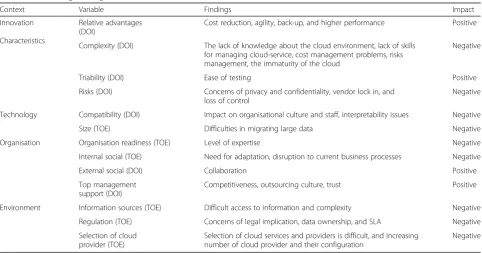
reduction (91.6%) and agility (75%) followed by back-up (41.6%) and higher performance (41.6%) as positive drivers for migration. Further, two-thirds of the participants highlighted, testing advantages provided by the cloud as a positive driver for migration. On the other hand, partici-pants reported a number of factors that increase risks and complexity (See Table 2). Lack of knowledge about the cloud environment was pointed out by all the cloud ser-vice providers interviewed in this study as a major issue
that negatively influence the decision to migrate. Further, almost all the interviewees indicated there is a high level of concern for privacy and confidentiality regarding the adoption of cloud-based services. Within the technology context, participants indicated issues with compatibility and the difficulties of migrating large volume of legacy data as a negative influence on migration decisions. The impact on organisational culture, staff and interpretability issues were pointed out by 58% and the difficulties in
Table 2The findings of stage 1 in the context of DOI and TOE
Context Variable Findings Impact
Innovation
Characteristics
Relative advantages (DOI)
Cost reduction, agility, back-up, and higher performance Positive
Complexity (DOI) The lack of knowledge about the cloud environment, lack of skills for managing cloud-service, cost management problems, risks management, the immaturity of the cloud
Negative
Triability (DOI) Ease of testing Positive
Risks (DOI) Concerns of privacy and confidentiality, vendor lock in, and loss of control
Negative
Technology Compatibility (DOI) Impact on organisational culture and staff, interpretability issues Negative
Size (TOE) Difficulties in migrating large data Negative
Organisation Organisation readiness (TOE) Level of expertise Negative
Internal social (TOE) Need for adaptation, disruption to current business processes Negative
External social (DOI) Collaboration Positive
Top management support (DOI)
Competitiveness, outsourcing culture, trust Positive
Environment Information sources (TOE) Difficult access to information and complexity Negative
Regulation (TOE) Concerns of legal implication, data ownership, and SLA Negative
Selection of cloud provider (TOE)
Selection of cloud services and providers is difficult, and Increasing number of cloud provider and their configuration
migrating large data were pointed out by half of partici-pants. The organisational context was divided into four variables (see Table 2) in which two were viewed as nega-tive and the other two were viewed as posinega-tive. The level of expertise was pointed out by two-thirds of participants as a negative factor of organisations readiness to migrate. The need for adaptation and disruption to current busi-ness processes were considered as negative internal factors by 66.6% and 50% of the interviewees respectively. Collab-oration and top management support were considered by half of the interviewees as positive factors encouraging for migration. In the context of environment, participants pointed out three elements that negatively influence the decision to migrate. Concerns about regulation were indi-cated by 75% followed by difficulty of access to informa-tion and complexity (58%), and selecinforma-tion of cloud providers (50%). Further analysis of the interviews can be found in [42] and [43]. Table 2 shows the main findings of stage1 in the context of the DOI and TOE.
Proposed model and hypotheses
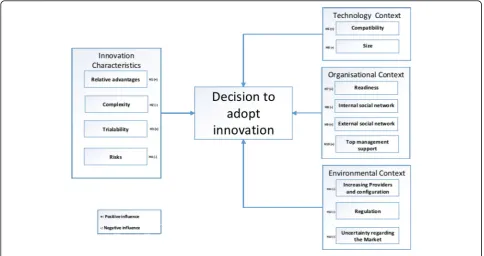
In this paper a model for identifying the determinants influencing the decision for cloud migration was devel-oped (See Fig. 4). It is based on the integration of the characteristics contexts (organisation, innovation, indi-vidual, technology and environment) identified in the DOI and TOE frameworks. Combining more than one theoretical perspective was argued to enhance the un-derstanding of adoption of innovative new technologies [44]. TOE and DOI have been widely accepted and
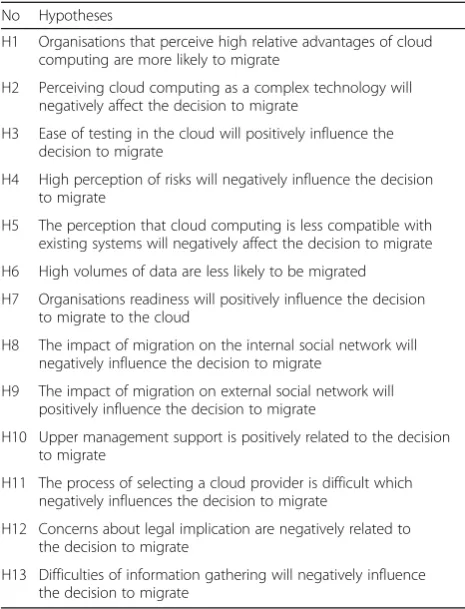
adopted in IT adoption of innovation. They share some similarities, for example the consideration of technology and organisation context are almost the same in TOE and DOI. However, there are some differences between the two frameworks. DOI does not consider the environment context while in TOE, it is considered as part of organisa-tional and technological context. In contrast, TOE does not consider individuals and some of the innovation char-acteristics, while DOI includes top management support in the organisational context and a wider range of the innovation characteristics. Generally, the TOE framework helps in identifying relevant categories for determinants while the DOI model helps in identifying specific variables within each category. Therefore, combining the two frameworks will complement each other and provide bet-ter understanding for the adoption. Further, in [41] it is argued that variables should be tailored to the characteris-tics of innovation. Therefore, the selection of variables is tailored to the context of migration to cloud computing. The variables were identified based on the analysis of the interviews in Stage 1, as well as the related literature. A hypothesis is created for each of the variables identified in the model, which are discussed in the following sections (Table 3 provides the list of the hypotheses).
Innovation characteristics
Relative advantages Migration to cloud computing can be a strategic decision for organisations to enhance the development of existing systems through improving
scalability, flexibility, and time to market. The analysis of Stage 1 shows that cost reduction appears to be the
strongest motivating factor from the participants’
per-spective for migration to cloud computing followed by agility. IT managers who participated in the survey believe that the need to implement a new service and finding cloud-based services to be the most economical choice are the main factors that drive cloud migration. It was also highlighted by participants in Stage 1 that for an organisation which wishes to set-up services more quickly, the cloud can offer what they cannot do intern-ally. A cloud provider stated:
“One of the other things about the cloud that is attractive, but seems to come secondary to cost, but actually, is probably more important, is around agility and the ability to get new services much quicker than they can do internally.”
Enterprises can add or remove services as their busi-nesses develop. In a technical sense, agile capabilities of-fered by the cloud enable enterprises to be much leaner. For example, a company in the UK decided to move to the cloud because they had a problem with agility, their internal processes and systems were too slow for what they wanted to do.
Cloud back-up was also highlighted by the participants as a perceived adavatage that can encourage organisa-tions to migrate existing systems to the cloud. Cloud computing capabilities can enhance the availability of organisations systems by storing their data in a secure off-site backup. In the survey, a Technical Leader within a cloud provider company indicated that:
“It doesn't really make any sense to have an on-site facility that need maintenance with hardware that may fail, while it can be deployed in the cloud at a very low cost, higher performance and easy disaster recovery.”
Cloud back-up can significantly reduce the risk of im-pact as the two versions would be running at the same time in different locations with the ability of moving data across the two environments.
The analysis of the information in this section led to the formulation of the following hypothesis:
H1:Organisations that perceive high relative advantages of cloud computing are more likely to migrate
ComplexityThe multi-user nature of cloud computing, as well as remote access, raises questions in respect of privacy and data confidentiality. Participants indicated that privacy and data confidentiality were their primary concerns in respect of the cloud environment. Further, interoperability was indicated by participants as the main perceived problem. Although cost reduction has been perceived as the main advatage that drives organi-sations to move to cloud computing, the analysis of stage 1 showed that the cost of cloud services emerged as an issue that some organisations faced when migrating to the cloud. Further, It was mentioned by the participants (cloud provider) that cost is the main reason for enterprises to back from the cloud. For example a
cloud provider pointed out that “Costs are interesting
because it’s an instant attraction, but actually, very often clouds tends to be more expensive than people think it’s
going to be”.
Cloud customers might need to pay for: data transfers in and out, storage of data in the cloud on a gigabyte per month basis, support, and additional availability. There-fore the combination of the charges a month actually become a considerable cost. A cloud provider pointed out that:
“I think one of the first things to remember with a cloud is that many clients look at cloud as being a cheap option because they see a few cents per hour price. But that few cents per hour is usually the base
Table 3List of hypotheses
No Hypotheses
H1 Organisations that perceive high relative advantages of cloud computing are more likely to migrate
H2 Perceiving cloud computing as a complex technology will negatively affect the decision to migrate
H3 Ease of testing in the cloud will positively influence the decision to migrate
H4 High perception of risks will negatively influence the decision to migrate
H5 The perception that cloud computing is less compatible with existing systems will negatively affect the decision to migrate
H6 High volumes of data are less likely to be migrated
H7 Organisations readiness will positively influence the decision to migrate to the cloud
H8 The impact of migration on the internal social network will negatively influence the decision to migrate
H9 The impact of migration on external social network will positively influence the decision to migrate
H10 Upper management support is positively related to the decision to migrate
H11 The process of selecting a cloud provider is difficult which negatively influences the decision to migrate
H12 Concerns about legal implication are negatively related to the decision to migrate
cost and then various additional services are added on, on top of it.”
Further, cloud-based services are not always more economical than in-house provisions [45]. This depends upon the size of organisations and also on how long data is held. Usually, cloud computing is more cost effective for start-up companies or newly started organisations. On the other hand, companies that have large legacy-data will find migration more difficult and costly. For these organisations, cloud services would be more bene-ficial for the provision of new services, but not to replace or migrate already deployed services. The Reasons that emerged for moving back to locally managed IT resources are: migration to the cloud without having full knowledge of the cost of cloud-services; the cost of sup-port; consultancy and other services which were ex-pected to be provided without additional cost; cloud services running beyond working time, Failure on ROI;
vendors’standards.
Participants also pointed out that the provision of cloud-based services is different from the traditional of-fering. The differences include the pricing and payment methods, performance monitoring, regulation and com-pliance, architecture, security, and service support. These differences require a certain expertise that enter-prises do not usually have.
One interviewee from a cloud engineering company pointed out:
“The reason that we exist, and there are a growing number of these businesses, is because customers do not have the expertise to migrate to the cloud.”
It also emerged from the interviews that cloud customers have high expections of the level of support. Many of the cloud services are self-administered whereas many customers are expecting 24/7 support.
A security analyst interviewed indicated that“a lack of
knowledge about the cloud environment is the riskest part of migrating to the cloud”. It was suggested by a number of interviewees that there is a need to develop an understanding about general security of the cloud environment. This will aid organisations to define their requirements and ensure a clear division of responsibil-ities with regard to Service Level Agreement (SLAs). It was noted that enterprises need to continually review the cloud market, due its dynamic costing nature and the services offered, for example, the cost of bandwidth will change, as will the cost of services. Therefore, it can be concluded that cloud computing has created more challenges for IT managers, because in the cloud IT management roles need to be shifted into technology implementation. The translation requires practical skills
and an understanding of how to securely implement cloud services.
H2:Perceiving cloud computing as a complex
technology will negatively affect the decision to migrate
Trialability Testing in the cloud environment emerged from the survey as an important advantage. Enterprises can use the virtual hardware for a period of time and then turn it off, whereas many organisations simply can-not afford to have, for example, ten spare physical servers available to be used for testing for a short time, and then turn them off.
H3:Ease of testing in the cloud will positively influence the decision to migrate
Risks The process of migration to the cloud may in-volve: a number of risks, loss of privacy, disruption to business processes, legal implications, problems with interoperability, data integrity, application portability, and security issues [20, 46–48]. The Cloud Security Alliance [49] identified 7 top threats in respect of cloud computing. These threats had led to wide concerns about the availability and accessibility of cloud based ser-vices. The IT managers and security professionals inter-viewed in this study expressed their concerns over security with regards to the migration of sensitive data. Further, the analysis showed concerns about potential risks to organisations that may include: loss of control, dependability, managing relationships with different cloud providers, liability, and business continuity and disaster recovery. For example, if an organisation is un-able to access cloud services at a critical time, when it is largely depending on the cloud provider’s customer ser-vice to provide information, this can lead to poor customer satisfaction. Therefore, it can be concluded that the possibility or even the perception of high risks can negatively affect the decision to migrate.
H4:High perception of risks will negatively influence the decision to migrate
Technology context
Compatibility Lack of standards in cloud computing usually raise interoperability, mobility, and manageability issues between cloud providers. This may increase the likelihood of vendor lock-in with possible economic impacts [33].
integrate the cloud solution with the in-house system−
so-called‘hybrid cloud computing’.
Enterprises also need to evaluate the impact of migration to the cloud on the organisational culture and staff, due to possible unfamiliarity with the system and the environment. If a company wishes to migrate an existing system that has been developed and tailored over time with members of staff becoming accustomed to it, training would be required.
H5:The perception that cloud computing is less compatible with existing systems will negatively affect the decision to migrate
Size Organisations may need to predict their data
vol-ume as it has a direct impact on cost calculations. Usually, cloud computing is more cost effective for start-ups or newly started organisations [45]. On the other hand, companies that have large legacy-data will find mi-gration more difficult and more expensive. For these organisations, cloud services, may be more beneficial for the provision of new services but not to replace, or migrate and deploy existing services.
H6:High volumes of data are less likely to be migrated
Organisation context
Readiness The heterogeneity of systems within organi-sations and their requirements have also affected the complexity of the decision making process when consid-ering migration to cloud based solutions. Andrikopoulos et al. [6] pointed out that the decision whether to migrate, which cloud services to use and at which level to outsource is not trivial and that it largely depends on multiple factors that are specific to the context of each enterprise. Further, organisations have different business processes and interdependent criteria and constraints to consider when moving their systems to cloud environments [50]. The analysis of the Stage 1 also revealed that organisations have different expectations and understanding about the cloud environment.
The management related functions will become more important; for example, supplier relationships, service planning, contracts, negotiations, pricing, and procure-ment. These functions are required because enterprises need to maintain relationships with one or more cloud service providers that they have not used before. Further, organisations still need IT departments to monitor the cloud-based services and liaise with cloud providers for an effective system integration. Migration to the cloud will free IT managers from the burden of worrying about hardware, and they can focus on delivering better services. For example, one of the interviewees stated:
“So actually, it does change their perspective, but they actually focus on,‘what do my users need? What would be a better quality of service? What’s a better performance time? And completely remove themselves from the hardware level.”
The transformation of IT services has raised the need for new skills to deal with cloud-based services. It shifted roles and responsibilities from the local building and the support of internal resources to managing companies’ systems in the cloud such as configuration, monitoring and integration of cloud services with the remaining on premise systems. These differences require a type of expertise that enterprises do not usually have.
H7:Organisations readiness will positively influence the decision to migrate to the cloud
Internal social network
The need for adapting existing services to be cloud enabled discussed in the interviews is a barrier against migrating existing systems to the cloud. According to [51] the system-atic and efficient modernisation of legacy applications to exploit current cloud-based technologies remains a major challenge. Applications consist of several components that are connected with each other to comply with the
applica-tion’s functional and non-functional requirements [50].
These components need to be correctly adapted according to the target cloud environment. Failure or incorrect adapta-tion might result in difficulties in meeting some quality or economic requirements [50]. Typical adaptation problems range from compatibility and interoperability issues to li-censing that may forbid organisations from moving regis-tered software components.
Service performance may also be affected due to the increase in latency. These kinds of issues usually occur when a service component is shifted to the cloud while another dependent component is kept on-premises to meet security requirements [50]. Zhao and Zhou [52] identified the need for a holistic methodology from re-design and adaptation to application for special migra-tion, architecture refactoring, integrated development environment and support migration of legacy applica-tions to the cloud environment.
Migrating an existing system may result in errors and significant costs to the changes involved. Organisations do not want to see disruptions to their business and many enterprises are anxious that system failure may affect their reputations. From the security analyst’s per-spective, the security experts interviewed in this study indicated that it is a risky move when a company that revolves around its central service, needs to give up what the entire business is anchored upon and move to a cloud solution. However, companies may use the migration as an opportunity to improve their systems and processes.
H8:The impact of migration on the internal social network will negatively influence the decision for migration
External social network
The cloud providers interviewed in this study indicated that cloud capabilities allow organisations to accomplish their business operations more effectively by sharing in-formation and work cooperatively. The cloud environ-ment offers platforms and tools in which information can be easily accessed internally and externally, thus enhancing collaboration with internal co-workers and external stakeholders.
Ferrer et al. [53] stated that economic factors are not sufficient for a highly dynamic environment in which relationships are created on an on-off basis with a pos-sible high degree of anonymity between stakeholders. A broader perspective is required that should incorporate quality factors such as trust, reputation management and green assessment.
H9:The impact of migration on the external social network will positively influence the decision for migration
Top management support
Top management support plays an important role for the decision to migrate to cloud computing. It guides the allocation of resources, the integration of services, and the re-engineering of processes. Top management that recognizes the benefits of cloud computing are likely to allocate the necessary resources for its adoption and influence the organization’s members to implement the change. When top management fails to recognize the benefits of cloud computing to the business, the management will be opposed to its adoption [54].
An outsourcing culture is a main factor for migration to cloud computing. Trust is a major factor that sup-ports the decision-making for cloud migration, and an outsourcing culture can develop trust of migration systems to a third party.
H10:Upper management support is positively related to the decision to migrate
Environmental factors
Expansion in the number of services, providers and configurations Another factor that influences the com-plexity of migration decisions is the availability of vast numbers of cloud-based services that have different models, functionality, quality of service, costs, and con-figurations. The range of cloud-based services offered is growing simultaneously with the emergence of varying cloud service providers. Enterprises can find cloud based models of possibly everything from general-purpose applications such as email, and collaboration technolo-gies to sales management and accounting software [55]. This rapid increase opens up new opportunities for de-signing new applications and enterprise architectures, new quality levels and capabilities. It increases the diffi-culty of choosing a provider and a service and renders the run-time adaptation and replacement of services almost impossible [20]. According to García-Galán et al. [56] there are over 100 public cloud providers associated with a considerable number of configura-tions, for example Amazon web services has 16,991 different configurations.
H11:The process of selecting a cloud provider is difficult which negatively influences the decision to migrate
RegulationThe increase in the number of rules to regu-late the adoption of cloud services, regulations and legal compliance violation has become a concern for many organisations.
Extensive concerns over regulation and legal compli-ance violations were indicated by the participants in Stage 1. Participants also registered concerns about the loss or misuse of data by others, SLA problems, data ownership and intellectual property rights. It was argued that enterprises need to ensure compliance with regula-tions. For example, one of the interviewees stated that:
“We have to be slightly careful with this when we’re accepting payments online, we just have to be careful not to fall foul of things like tax, VAT and so on.”
datacentres. If a company migrates to a multinational service provider, it may find some of its resources stored in other parts of the world, a situation that can create legal issues.
The simplicity of signing up new cloud based service contracts might result in SLA problems. SLA is a vital aspect in cloud computing. It includes agreements regarding the quality of service attributes, pricing, com-pliance to regulation, level of support, security and privacy guarantees, and others. Organisations need to review the general terms and conditions that providers usually include in SLAs.
H12:Concerns about legal implication are negatively related to the decision to migrate
Difficulties in information gathering about the cloud market Generally, information plays an important role in any decision making process, particularly during the intelligence and design phases of a decision making process. Participants perceived that there is a high level of availability of cloud related information. Although many organisations believe that cloud-related informa-tion can be easily obtained and is to some extent it is reliable, they do not find it easy to develop an under-standing about the cloud environment. It can be due to the diversity of information sources and their complex-ity. This has resulted in uncertainty about the cloud market. It could be the reason for the issue of limited knowledge of customers in respect of the cloud environment.
H13:Difficulties of information gathering will negatively influence the decision for migration
Stage 2: testing the proposed model
To evaluate the proposed model, a survey questionnaire was conducted using a wide range of industries and
organisations’ sizes. The questions were based on the
findings of Stage 1 (see Table 2) as well as the analysis of related literature. To ensure that the survey measured what was intended, a pilot survey was first conducted. Four participants were used for the pilot study. The feedback showed that the questions were understandable and the participants were able to provide the required answers, though a few amendments were suggested.
Zikmund [57] suggested that the target population is the entire group of subjects of interest who are defined by the research objectives. However, there is usually a considerable difference between the population that a researcher is attempting to study and their availably for sampling [58]. The sample population in this study are tar-geted professionals with experience in related disciplines and users. The sample in this study is convenient sampling
in which the researcher attempted, as far as possible, to find participants from the target audience by dis-tributing the questionnaire using various methods. The target audience were mainly invited by e-mails through personal contacts. The questionnaire was dis-tributed to more than 1,000 professionals and poten-tial users and 118 responses were received. Sixteen responses were incomplete, therefore they were elimi-nated from the analysis leaving 102 usable responses which is approximately ten per cent of the total population and consistent with what could be ex-pected for a survey of this kind.
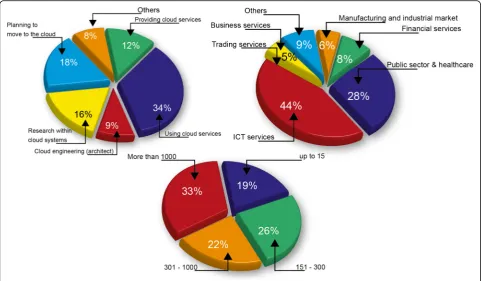
The population consisted of professionals who had been involved in cloud migration projects or they were researchers in the area. Participants were from organisa-tions of different sizes and from a divers industry sectors. They included IT managers, software engineers, system analysts, and executive managers; in addition to cloud systems researchers. The survey reflected the is-sues which had been raised in Stage 1 affecting migra-tion to cloud computing. Figure 5 shows demographic data of participants and their organisations.
The data was imported from the survey tool (survey Monkey) into an IBM SPSS sheet. The reliability of the questionnaire was calculated which was followed by ex-ploratory factor analysis and confirmatory factor ana-lysis. The constructs (relative advantages, complexity, testing, risks, compatibility, size, readiness, impact on in-ternal social network, exin-ternal social network, top man-agement support, increasing service providers and configuration, regulatory, and uncertainty about the market) were measured using a five-point Likert scale on an interval level ranging from 1 (very low import-ance) to 5 (very high importimport-ance). To investigate how the determinants vary across different industries, organ-isation sizes, and relation to the cloud, the data was analysed, based on these indicators. For example, lower scores indicate low influence of a variable on the deci-sion to migrate. However, the results show no major dif-ferences between different industries, therefore this paper discusses the overall results only.
Structural equation modelling
To test the research hypotheses, Structural Equation Modelling (SEM) [59] was used. SEM is a statistical
approach for exploring the relationships between
model and ensure that it has a satisfactory level of reliabil-ity and validreliabil-ity before exploring the significance of the re-lationships in the structural model.
Exploratory factor analysis
The result of applying the measurement model (reliabil-ity, convergent valid(reliabil-ity, discriminant valid(reliabil-ity, and de-scriptive statistics) are shown in Tables 4, 5, and 6. In order to test construct reliability for a set of two or more constructs (i.e. to examine internal consistency), the reli-ability of the scales was tested using composite relireli-ability (CR) (more details may be found in [59]). The Cron-bach’s alpha [58] is a widely adopted method for testing CR. It generates coefficient values ranging between 0
and 1 with higher values indicating higher reliability of the indicators. Fornell and Larcker [60] indicated that CR should have a value greater than 0.70 for a respect-able research quality. The calculation formula for CR is:
(Σstandardised loading)2 / (Σstandardised loading)2 +Σ ε)
whereε= error variance andΣis summation.
Composite reliability analysis shows a Cronbach’s “α”
value of 0.773 for the 13 variables in the research model, which indicates high reliability and internal consistency (see Table 4). Further, the scale was factor analysed using principal component analysis.
In order to analyse the strength of association among the variables, the constructs validity was tested using the Bartlett’s Test of Sphericity and the Kaiser-Mayer-Olkin (KMO) for the measure of sampling adequacy [61]. The result for Bartlett’s test of Sphericity and the KMO value was 0.000 and 0.688 respectively (see Table 4). The latter value is more than 0.5, which shows a high level of sam-pling adequacy.
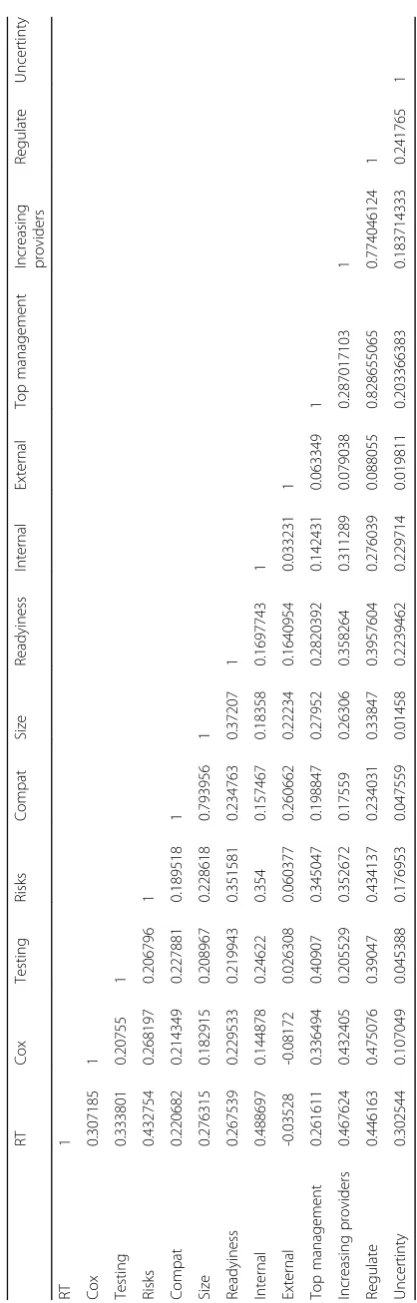
Examining the correlation (Table 5) shows the highest level of correlation between constructs regulation and top management (0.82). This is followed by correlation between compatibility and size of data (0.72) as well as regulation and increasing providers (0.77).
Discriminant validity refers to the extent to which a construct is truly distinct from other constructs [58]. A widely used statistical measure for discriminant validity Fig. 5Demographic of participants and their organisations
Table 4Reliability of reflective constructs and KMO and Bartlett’s Test
Reliability Statistics
Cronbach’s Alpha N of Items
0.773 13
Results of the KMO and Bartlett's Test
Kaiser-Meyer-Olkin Measure of Sampling Adequacy 0.688
Bartlett's Test of Sphericity Approx. Chi-Square 414.500
Degrees of freedom 78
is a comparison of the Average Variance Extracted (AVE) with correlation squared [62]. In order to ensure discriminant validity, the AVE of two constructs must be more than the square of the correlation between the same two constructs. Our results show that AVE mean square root of each value variable is significantly greater than its correlation coefficient with other variables (see Table 5), thus discriminant validity is supported. Overall, the results show acceptable reliability, convergent
validity and discriminant validity, which were appropri-ate for testing the research model.
Table 5 provides the correlation matrix for discrimin-ant validity, which indicates the degree to which the constructs diverge from each other.
Confirmatory factor analysis
To test the stability of the scale, confirmatory factor
ana-lysis was employed using SEM to examine the
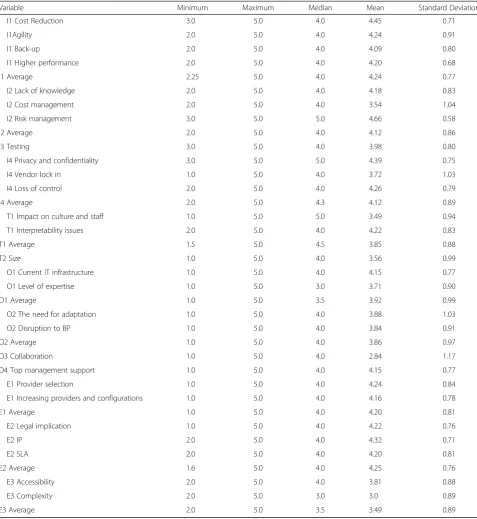
Table 6Descriptive statistical
Variable Minimum Maximum Median Mean Standard Deviation
I1 Cost Reduction 3.0 5.0 4.0 4.45 0.71
I1Agility 2.0 5.0 4.0 4.24 0.91
I1 Back-up 2.0 5.0 4.0 4.09 0.80
I1 Higher performance 2.0 5.0 4.0 4.20 0.68
I1 Average 2.25 5.0 4.0 4.24 0.77
I2 Lack of knowledge 2.0 5.0 4.0 4.18 0.83
I2 Cost management 2.0 5.0 4.0 3.54 1.04
I2 Risk management 3.0 5.0 5.0 4.66 0.58
I2 Average 2.0 5.0 4.0 4.12 0.86
I3 Testing 3.0 5.0 4.0 3.98 0.80
I4 Privacy and confidentiality 3.0 5.0 5.0 4.39 0.75
I4 Vendor lock in 1.0 5.0 4.0 3.72 1.03
I4 Loss of control 2.0 5.0 4.0 4.26 0.79
I4 Average 2.0 5.0 4.3 4.12 0.89
T1 Impact on culture and staff 1.0 5.0 5.0 3.49 0.94
T1 Interpretability issues 2.0 5.0 4.0 4.22 0.83
T1 Average 1.5 5.0 4.5 3.85 0.88
T2 Size 1.0 5.0 4.0 3.56 0.99
O1 Current IT infrastructure 1.0 5.0 4.0 4.15 0.77
O1 Level of expertise 1.0 5.0 3.0 3.71 0.90
O1 Average 1.0 5.0 3.5 3.92 0.99
O2 The need for adaptation 1.0 5.0 4.0 3.88 1.03
O2 Disruption to BP 1.0 5.0 4.0 3.84 0.91
O2 Average 1.0 5.0 4.0 3.86 0.97
O3 Collaboration 1.0 5.0 4.0 2.84 1.17
O4 Top management support 1.0 5.0 4.0 4.15 0.77
E1 Provider selection 1.0 5.0 4.0 4.24 0.84
E1 Increasing providers and configurations 1.0 5.0 4.0 4.16 0.78
E1 Average 1.0 5.0 4.0 4.20 0.81
E2 Legal implication 1.0 5.0 4.0 4.22 0.76
E2 IP 2.0 5.0 4.0 4.32 0.71
E2 SLA 2.0 5.0 4.0 4.20 0.81
E2 Average 1.6 5.0 4.0 4.25 0.76
E3 Accessibility 2.0 5.0 4.0 3.81 0.88
E3 Complexity 2.0 5.0 3.0 3.0 0.89
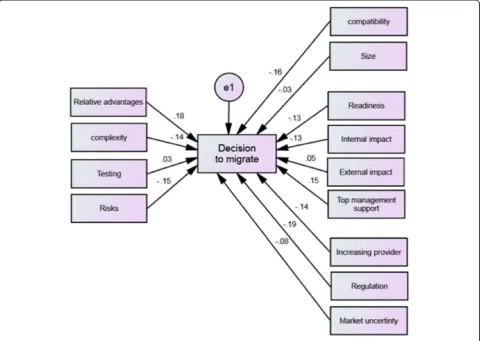
hypothesized research model by performing a simultan-eous test. A measurement model was developed using the AMOS tool and Maximum Likelihood Estimation (MLE) method was chosen for confirmatory factor analysis. MLE is a common estimation procedure used in SEM software. It does not require large sample size and the results of the method are reliable. Therefore, it is widely used in theoretical hypothesis testing. The structural model shows path coefficients results. It illus-trates the extent of the mutual influence among vari-ables. Path coefficient was calculated automatically by the tool. Figure 6 shows the standardized results for the structural model.
Results and discussion
The results of the analysis of Stage 2 reveal that 10 out of the 13 variables identified in the research model (see Fig. 4) significantly influenced the decision making for migrating to the cloud. Size of data volume, testing, and the impact on external network are not significant factors.
The Relative advantagesfactor is supported as a posi-tive influence on the decision to migrate existing
resources to the cloud. It has a significant (p< 0.05) and
positive coefficient of 0.18, when considering migrating to the cloud. Within this variable the cost benefits factor was rated the highest (4.45) followed by agility (4.24), higher performance (4.20), and the back-up advantages (4.09) as shown in Table 6. This finding confirms the results found in similar previous studies that identified perceived advantages as the most influential factor for adopting cloud services (see for example: [9, 37, 38, 62, 63]). The realisation of the relative advantages shows that organi-sations perceive the cloud environment as a platform for rationalising expenditure and improving efficiency. Organi-sations need to review the cloud offers and appreciate how the advantages of the cloud provisions can be exploited in improve their business performances. This can lead to improvements in customer service, cost management, relationship with customers and stakeholders, management structure and policies, and business objectives.
The complexityof the cloud environment factor is con-firmed in Stage 2 as a negative influence for the decision
to migrate to the cloud, with path coefficient of (−0.14).
Within this variable organisations, perceived conducting a risk management for the migration as very difficult with an average rating of 4.47. This is followed by lack of
knowledge about the cloud environment with an average rating of 4.03 and the complexity of managing costs (3.62). Pervious works showed different results regarding the perceived complexity of cloud environment. Oliveira et al. [63] presented results in line with these findings; however, other studies suggested the opposite that the cloud environment is not perceived as a complex technology [13] and [64]. Cloud computing is a disruptive model of provisioning IT services, therefore perceiving it as complex environment is expected. The complexity can be mitigated by taking advantage of the testing facilities in the cloud that can allow organisations to be more familiar with the new environment. Further, the cloud is still in a growing phase and its complexity and risks are expected to be reduced.
Although ease of testing in the cloud environment is perceived by many as an advantage encouraging organi-sations to migrate to the cloud, it is not supported by our findings as a critical influencing factor for the deci-sion to migrate. This may be due to the fact that the majority of the organisations who participated in this study are small and medium size (SME) and testing is not a critical factor for them. Further, testing would be more relevant to larger organisations such as universities and research centres which are not highly represented in this study.
The perception that migrating to the cloud is a risky
decision factor is found to negatively affect companies’
decisions to migrate to the cloud. This factor scored a path coefficient of - 0.15. Within this category privacy and confidentiality scored the highest with an average rate of 4.21 followed by the concerns of losing control rated at 4.09, and the concerns of vendor lock-in scored an average rating of 3.73. This result substantiates similar studies that conducted at the beginning of cloud adoption such as [13–15]. Therefore, security, fear of losing control, and vendor lock-in are still perceived by many as issues deterring migration.
Within the technology context, the compatibility
factor is confirmed to as a negatively influence on the decision to migrate with a path coefficient of - 0.16
while the sizeof data volume factor is not supported as
an important factor for the decision to migrate with a
path coefficient of−0.03. Within this variable, impact on
culture and staff scored an average rating of 3.49 and in-terpretability issues obtained 4.22. To manage the im-pact on staffing, organisations need to analyse the anticipated change to the staffing level, roles and expert-ise during the design phase, before commencing the process of migrating existing services to the cloud.
In respect of the organisational context, readiness,the
impact on internal networks, and top management real-isation of the business benefits factors have significant
effects, with path coefficients of - 0.13, − 0.13, 0.15
respectively, whilethe impact of external networkfactor
does not (0.05). This result shows that organisations that have higher levels of readiness require less adaptation, support from top management for cloud environment are more likely to migrate.
In the environment context, all variables have a
signifi-cant effect, in particular the regulation factor, with a
path coefficient of - 0.19 which is the highest influencing factor. The increasing service providers factor scored path coefficient of - 0.14 and the uncertainty about the market factor obtained - 0.08. Many organisations com-ply with regulators in their internal systems manage-ment, but by adopting cloud services, part of their service management can be shifted to the cloud service provider. In this scenario organisations need to know how to continue their compliance with the regulators which could be a challenge. Organisations need to review the general terms and conditions that providers usually include in SLAs. Companies need to review
ven-dors’standard contracts, to see if their basic terms are
sufficient for their organisational compliance
require-ments, and to ensure service providers’compliance with
their regulators. Table 7 shows the results of testing the research hypotheses.
In order to improve trust in the cloud services, providers need to ensure privacy and data confidentiality of their customers. Further, complying with relevant standards would help in reducing the risks of vendor lock-in. This issue is partly caused by the lack of stand-ardisation in cloud computing which was also indicated by participants as an issue that contributed to the com-plexity of cloud computing. In order to help organisa-tions to decide whether to migrate to the cloud, there is a need to inform them about general security; whether the security of the infrastructure is resilient. The project manager should then move to the performance aspects by providing information about the opportunities and
options which will meet the customer’s requirements.
The decision makers may not be interested in the tech-nical details but it is important for them to see the business benefit. These items of information will allow enterprises to build confidence in the cloud service man-agement. Based on this information, it should be pos-sible to advise enterprises which cloud solution will be most suitable for them. Therefore, providers need to
ensure the privacy and confidentiality of their customers’
data, employ comprehensive costing models, in addition to complying with relevant standards to reduce the risks of vendor lock-in. These could remedy the high level of perceiving the migration to the cloud as a risky decision.
Contribution
influencing the decision to migrate by designing a model, based on TOE and DOI frameworks. The find-ings of this research has expanded the collective know-ledge about the complexity of the issues that have to be considered when making decisions to migrate to the cloud. Seven determinants were identified that influence the complexity of decisions to migrate (see H2, H4, H5, H8, H11, H12, and H13 in Table 7). Some of the factors are similar to those which have been identified in previ-ous studies that were conducted at an early stage of the evolution of cloud computing. This paper confirms that those factors are still being perceived as deterrent for migration. They are: H4, H5, and H12 while the other four are novel contributions unique to this paper. Fur-ther, the findings in this research are quite different compared to similar studies in that the majority of them explored the factors affecting the adoption of cloud ser-vices while this research focused on the migration of leg-acy systems.
The analysis in this paper shows that cloud computing is perceived by many as a valuable opportunity for busi-ness benefits such as cost reduction, agility, back-ups, and higher business performance. However, it identified a number of factors that increased the complexity of decisions to migrate. It highlighted how enterprises perceived the level of complexity of the cloud environ-ment and the expertise required to design and manage cloud services. In particular, this research highlighted
the lack of knowledge about the cloud environment. It also identified lack of expertise within organisations for design and management of cloud services. Further, our results confirm that cloud computing is in its early stages, and is still evolving. It also showed that financial benefits of cloud services vary and cost is found to be the main reason for enterprises that moved back from the cloud. Further, this study sup-ported the view that since the emergence of cloud computing, security has been the main problem per-ceived by many organisations.
This study provides a better understanding of a wide range of factors that affect the decision making process for migration to the cloud. They can asset cloud DSS developers in the designing of systems that address their issue and
con-cerns. Specifically, the application of the Simon’s model for a
systematic decision process for the cloud DSS shows that there is limited support at the intelligence and design phases. The analysis of this research shows a number of fac-tors that require cloud DSS to provide support at intelligence (e.g. H2 in Table 7) and design (e.g. H5 in Table 7) levels. Therefore, this study contributes to the literature that addresses the complexity and multidimen-sional nature of migrating IT resources to the cloud.
Conclusion
Cloud computing is a new paradigm for emerging technologies. Migration to cloud computing is a strategic
Table 7Results of hypotheses testing
No Hypotheses Coefficient Result
H1 (+) Organisations that perceive high relative advantages of cloud computing are more likely to migrate
0.18 Supported (p< 0.05)
H2 (−) Perceiving cloud computing as a complex technology will negatively affect the decision to migrate
−0.14 Supported (p< 0.05)
H3 (+) Ease of testing in the cloud will positively influence the decision to migrate 0.03 Not supported
H4 (−) High perception of risks will negatively influence the decision to migrate −0.14 Supported (p< 0.05)
H5 (−) The perception that cloud computing is less compatible with existing
systems will negatively affect the decision to migrate −
0.16 Supported (p< 0.05)
H6 (−) High volumes of data are less likely to be migrated −0.03 Not Supported
H7 (+) Organisations readiness will positively influence the decision to migrate to the cloud
−0.13 Supported (p< 0.05)
H8 (−) The impact of migration on the internal social network will negatively
influence the decision to migrate −
0.13 Supported (p< 0.05)
H9 (+) The impact of migration on external social network will positively influence the decision to migrate
0.05 Not Supported
H10 (+) Upper management support is positively related to the decision to migrate 0.15 Supported (p< 0.05)
H11 (−) The process of selecting a cloud provider is difficult which negatively
influences the decision to migrate −
0.14 Supported (p< 0.05)
H12 (−) Concerns about legal implication are negatively related to the decision to migrate
−0.19 Supported (p< 0.05)
H13 (−) Difficulties of information gathering will negatively influence the decision
to migrate −
organisational decision that is complicated, dynamic, and highly unstructured. The cloud environment is still evolving; therefore, decision makers need to carefully evaluate the capabilities of cloud computing services to determine whether this style of computing will help them achieve their business goals. It requires the consid-eration and evaluation of a wide range of technical and organisational aspects. This research is aimed to support the decision making process for migrating existing resources to the cloud. It explored factors contributing to the complexity of the decision to migrate.
The review of current approaches for migration to the cloud revealed that, although many methods have been proposed to aid migration to it, the level of support offered by the existing DSS is not sufficient to enable decision makers to make informed decisions. Accord-ingly, many organisations are still finding it difficult to make decisions migrating existing resources to the cloud. This is mainly due to many complex factors that affect decision making to migrate to the cloud.
Understanding the level of complexity for making decisions to migrate aids the development of suitable resources and processes to simplify it. Accordingly, this paper extensively explored the factors affecting decision making. By integrating the innovation characteristics of the DOI and the TOE frameworks a model was devel-oped. The model was empirically evaluated using the exploratory and confirmatory analysis, which identified the factors that have a significant positive or negative effect on the decision to migrate. A future work to enhance the findings of this study can be further exam-ination of correlation between the identified variables. In addition, significant factors affecting migrations can be included in cloud DSSs.
Acknowledgements
The research leading to these results is supported by the faculty of science and Technology at Bournemouth University.
Authors’contributions
All listed authors worked closely throughout the development of this research and made major contributions. AA was responsible for literature review and data collection and analysis. Dr RS and Dr DJ contributed in the designing of the methodology including the design of the research instruments. All authors participated in drafting the manuscript, analysis and interpretation of study results. RS and DJ participated in the critical and technical revisions of the paper including editing the final version. They supervised the project related to the paper and also gave final approval of the version to be published. All authors read and approved final manuscript.
Authors’information
Adel Alkhalil is a recently PhD graduate from Bournemouth University, UK under supervision of Dr Reza Sahandi and Dr David John. In September 2016, Dr Alkhalil joined the faculty of computer science and engineering at the University of Hail, Saudi Arabia. His research interests include cloud computing, decision support systems, knowledge-based systems. Reza Sahandi completed his PhD at Bradford University in the United Kingdom in 1978. He has been a senior academic at various Universities in the United Kingdom for many years. He is currently Associate Professor at Bournemouth University. He has supervised many PhD students. His research
areas include multimedia and network systems, wireless remote patient monitoring and cloud computing.
David John completed his PhD at in the United Kingdom in 2002. Since then he has been an academic member in the faculty of computer science and engineering at Bournemouth University. His research interests include cloud computing, expressive Internet communication, assessing the effect cognitive style has on the perception of different modes of communication, and the evaluation of creative practice-based assessment methods.
Competing interests
The authors declare that they have no competing interests.
Author details
1Faculty of Computer Science and Engineering, University of Hail, Hail, Saudi Arabia.2Faculty of Science and Technology, Bournemouth University, Poole, UK.
Received: 24 May 2016 Accepted: 20 December 2016
References
1. Jennings B, Stadler R (2015) Resource management in clouds: Survey and research challenges. J Netw Syst Manag 23(3):567–619
2. Dhinesh Babu LD, Gunasekaran A, Krishna PV (2014) A decision-based pre-emptive fair scheduling strategy to process cloud computing work-flows for sustainable enterprise management. Int J Bus Inf Syst 16(4):409–430 3. Armbrust M, Fox A, Griffith R, Joseph AD, Katz R, Konwinski A, Zaharia M (2010)
A view of cloud computing. Communications of the ACM 53(4):50–58 4. Buyya R, Yeo CS, Venugopal S, Broberg J, Brandic I (2009) Cloud computing
and emerging IT platforms: Vision, hype, and reality for delivering computing as the 5th utility. Futur Gener Comput Syst 25(6):599–616 5. Phaphoom N, Wang X, Samuel S, Helmer S, Abrahamsson P (2015) A survey
study on major technical barriers affecting the decision to adopt cloud services. J Syst Softw 103:167–181
6. Andrikopoulos V, Binz T, Leymann F, Strauch S (2013) How to adapt applications for the Cloud environment. Computing 95(6):493–535 7. Rai R, Sahoo G, Mehfuz S (2013) Securing software as a service model of
cloud computing: Issues and solutions. International Journal on Cloud Computing: Services and Architecture (IJCCSA) 3(4):1–11
8. Oredo JO, Njihia JM (2015) Mindfulness and quality of innovation in cloud computing adoption, Int J Bus Manage, 10(1):144
9. Hsu PF, Ray S, Li-Hsieh YY (2014) Examining cloud computing adoption intention, pricing mechanism, and deployment model. Int J Inf Manag 34(4): 474–488
10. Buyya R (2009) Market-oriented cloud computing: Vision, hype, and reality of delivering computing as the 5th utility. In: 9Th IEEE/ACM International Symposium on Cluster Computing and the Grid, CCGRID
11. Mell P, Grance T (2009) The NIST Definition of Cloud Computing. Natl Inst Stand Technol 53(6):50
12. Leimeister S, Christoph R, Markus B, Helmut K (2010) The Business Perspective of Cloud Computing: Actors, Roles and Value Networks, European Conference on Information Systems
13. Low C, Chen Y, Wu M (2011) Understanding the determinants of cloud computing adoption. Ind Manag Data Syst 111(7):1006–1023 14. Wu WW (2011) Mining significant factors affecting the adoption of SaaS
using the rough set approach. J Syst Softw 84(3):435–441
15. Sahandi R, Alkhalil A, Opara-Martins J (2012) SMEs’Perception of Cloud Computing: Potential and Security. In: Collaborative Networks in the Internet of Services. PRO-VE 2012. IFIP Advances in Information and Communication Technology, 380, Springer, Berlin, pp 186-195 16. Lin A, Chen N (2012) Cloud computing as an innovation: Perception, attitude,
and adoption. Int J Inf Manag 32(6):533–540, Available from: http://www. sciencedirect.com/science/article/pii/S0268401212000539. Accessed 16 May 2016 17. Morgan L, Conboy K (2013) Factors affecting the adoption of cloud
computing: an exploratory study., pp 1–12
18. Khajeh-Hosseini A, Greenwood D, Smith J, Sommerville I (2012) The Cloud Adoption Toolkit: Supporting cloud adoption decisions in the enterprise. Software - Practice And Experience 42(4):447–465
![Fig. 1 The Technology-organisation-environment framework, Adapted from Tornatzky and Fleischer [34]](https://thumb-us.123doks.com/thumbv2/123dok_us/851675.1582811/4.595.55.538.462.711/fig-technology-organisation-environment-framework-adapted-tornatzky-fleischer.webp)
![Fig. 2 The Diffusion of Innovation model, adapted from Rogers [35]](https://thumb-us.123doks.com/thumbv2/123dok_us/851675.1582811/5.595.58.538.88.364/fig-diffusion-innovation-model-adapted-rogers.webp)