R E S E A R C H
Open Access
A prospective cohort study of game-based
learning by digital simulation of a pig farm
to train agriculture students to reduce
piglet mortality
Karl Johan Møller Klit
1*, Ken Steen Pedersen
2and Helle Stege
1Abstract
Background:Acquisition of knowledge and skills by agriculture students prior to real-life experience is a well-known educational challenge. Game-based learning has the advantage of being active, experiential, and problem-based, and provides immediate feedback. Simulation games are widely used in other fields to support traditional teaching methodology and actively engage students. This study investigates whether a digital pig farm game can assist agriculture students in acquiring knowledge and skills in farrowing management to reduce mortality in piglets prior to weaning.
Results:Overall the simulation group tended to score higher; however, at 5% confidence level, the difference was not significant. The simulation group had the lowest standard deviation which to some extent was due to reduced number of low-scoring students. Nevertheless, students requested more digital simulation for learning and practicing skills.
Conclusion:The use of game-based learning in agricultural education has a huge potential for building skills needed on a real pig farm. However, an increase in knowledge related to farrowing management was not documented. The integration of game-based learning into an educational setting needs further evaluation.
Keywords:Agriculture, Animal welfare, Digital simulation, Game-based learning, Piglet mortality
Background
With the use of highly prolific sows in swine production, high piglet mortality before weaning remains an un-solved problem. The annual report from selected EU countries shows that preweaning mortality rate in-creased from 12.9% in 2014 to 13.3% in 2015 [1]. Hypothermia, starvation, and crushing are the primary causes of mortality in piglets during the first 48 h after birth [2, 3]. Therefore, improved management skills are crucial to reduce the mortality rate [4]. Despite general agreement that these skills are vital, there is little oppor-tunity for students to practice them before being employed on a pig farm. At agricultural colleges novice
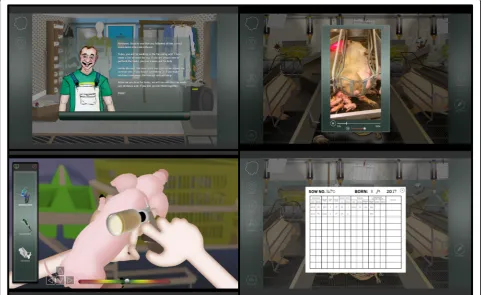
students are presented to skills they must master when working on pig farms, but training is when they are employed on farms. The training of international labour is primarily the responsibility of the individual farmer. International labour has often no experience from pig production and start from zero when they are employed in Denmark. However, it is mandatory that all employees who are going to inject livestock animals must complete an 8-h medication course. To achieve better training of new international employees and to offer Danish agricul-tural schools new learning tools, we have developed “Game of Piglets.” The game is a virtual pig farm that has as its objective to allow students to practice proce-dures involved in external biosecurity and farrowing management. “Game of Piglets” belongs to the genre of
simulation/ adventure games. Core competencies
highlighted in the game are farrowing aid, recognition of * Correspondence:[email protected]
1University of Copenhagen, Faculty of Health and Medical Sciences, Department of Veterinary and Animal Sciences, HERD, Grønnegårdsvej 2, 1870 Frederiksberg C, Denmark
Full list of author information is available at the end of the article
sick sows after farrowing, aseptic conditions in surgical interventions, and optimal piglet environment. These competencies are developed by a series of tasks that must be solved in a particular order, just as in a real pig herd. The game’s scoring system is a piglet survival bar-ometer. To see how the task of farrowing assistance are created please follow the link: https://www.youtube.-com/watch?v=ukmxfhVT-zQ
If a task is performed incorrectly or omitted, it results in decreased piglet survival. At any time in the game, students have the opportunity to ask the farm manager about how to solve the tasks. When all tasks are com-pleted and the student leaves the farm, an evaluation of tasks resolved correctly and/or a description of the mis-takes that were made will be given. Screenshots from the game is displayed in Fig.1.
Learning games are widely used in other disciplines such as health, business, military, and mathematics [5]. The most popular learning game genre by far is simulation, but other genres as action, adventure, strategy, and puzzle are also used [5]. Simulation training in health profession educations is associated with positive effects on know-ledge acquisition, skill, and behaviour [6]. Virtual patients are extensively used for skills training in undergraduate nursing educations [7]. Virtual patients allow nurses to
learn and practice in a safe, virtual environment where time can be paused. The pause allows time for self-analysis [8]. Thus far learning games for veterinary use is increasing, but only a few learning games have been developed specifically for agriculture education. In this paper we will introduce a learning game for agriculture students designed to help them improve their theoretical and practical skills in the field. The objective of the study is to measure knowledge acquisition in farrowing manage-ment among students only exposed to classroom instruc-tion, students whose education was supplemented by “Game of Piglets,” and students who also had hands-on instruction. Furthermore, students’ perceived self-efficacy surrounding the practical skills of farrowing management was also measured.
Methods
Study design
A three-arm cohort study with negative and positive control groups was conducted at four Danish Agricul-ture colleges. Requirements for conducting the study were to conflict minimal with the curriculum at the schools and implement the study into the schedule. Small changes in the schedule were necessary to en-sure teaching in farrowing management at the start of
the course. Students were divided into three groups at each school. Each group received instruction covering
farrowing management but with three different
didactic approaches. All groups received traditional classroom instruction. To ensure that classroom in-struction had the same content between schools, a list of learning goals were shared between responsible teachers. These learning goals were all about manage-ment around farrowing. The subject farrowing man-agement was for all schools integrated in a larger course about general husbandry. Farrowing manage-ment was taught in classroom between two lectures (90 min) to four lectures (180 min) between schools. Group one (classroom, negative control) did not re-ceive any further instruction. Group two (simulation, exposure group) used virtual simulation of farrowing management for two hours. Group three (hands-on, positive control) had a half-day expedition to a farm with hands-on instruction. The farm visits had the ob-jective to introduce students to see and try tasks in a farrowing unit. Teachers encourage students to train the skills on the visit, but this was not mandatory for the students. One week after exposure, students were given a multiple-choice test and a self-efficacy ques-tionnaire to test the hypothesis. To measure know-ledge acquisition in farrowing management amongst the groups, a multiple-choice test was conducted. The book “Developing and Validating Multiple-choice Items”[9] was used to construct the test. The test was a 20-question multiple-choice test with three possible answers per question. Two full-time swine veterinar-ians were chosen to peer-review the questions. Fur-thermore, 16 students from the Agriculture College with experience from swine production validated the test. To reduce guesswork, the scoring in the test awarded 2 points for a correct answer, −1 points for an incorrect answer and 0 points for no answer. The total score from all 20 questions was summarized in a final score as a continuous variable. If the respondent had given two answers for one question it was regis-tered as incorrect. A questionnaire was constructed to measure students’ perceived self-efficacy. Perceived self-efficacy evaluation is a method to measure how students judge their own competencies. The method-ology relies on the theory of Albert Bandura. To summarize, he claims that there is an association between the level of perceived self-efficacy and the performance of a certain skill [10]. Students were given statements about specific skills in farrowing management. They were asked to rate each statement on a scale from zero to seven. Zero was “cannot do at all” and seven was “highly confident can do.” Finally, the simulation group completed a satisfaction survey after the gaming session.
Setting
Danish agriculture colleges (17 in Denmark) are inde-pendent private institutions. Most of the Danish agri-culture colleges (13 represented) are organized under “Danske Landbrugsskoler” [11]. This organization takes care of the educational policy interests of agri-cultural schools, and strengthens networking and cooperation between schools in the educational, aca-demic, and institutional areas. However, teachers in swine husbandry are also organized under the so-called“Hyo-academy.”The Danish Agriculture & Food Council [12] facilitates this academy with 17 agricul-tural colleges represented. Four schools from the “Hyo-academy” volunteered to participate in this study. The study was conducted from January 2017 to March 2017. During this period, new students began the 20 weeks“Basic Course Two”in general husbandry at all colleges. All schools follow the same program over the year. For the majority of students, this was their first experience with farming animals and agri-culture in general.
Sampling
favourite digital game. The second module was the multiple-choice test, and the third module was the per-ceived self-efficacy evaluation.
Statistical analysis
The data was anonymized and entered into Microsoft® Excel® for Mac 2011 and exported into statistical soft-ware R-studio version 1.1.383. A descriptive analysis was initially performed using different plot and summary statistics. The summarized average test score from the multiple-choice test was tested for statistical differences between study-groups using a univariable ANOVA-test. Differences between standard deviation (SD) were tested using an F test. Next, a multivariable model was con-structed with the outcome test score and tested against
all predictive variables (school, study group, age, sex, experience, background, play behaviour, farm simulator). Backwards elimination was performed using Akaike’s Information Criterion (AIC) test. Each skill in the per-ceived self-efficacy questionnaire was tested for statis-tical difference between study groups using the Kruskal-Wallis test. This test has the limitation of being unable to distinguish between groups that differ. Therefore, if statistical differences were found, the Wilcoxon signed-rank test was used to identify which groups differed from others. If respondents had marked two numbers in the self-efficacy questionnaire, the score was rounded down to the closest whole number. The level of signifi-cance was set to 95% in all analyses.
Results
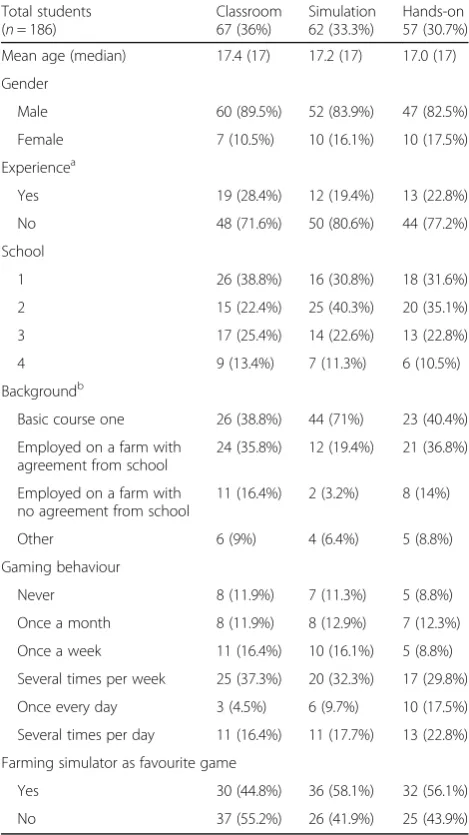
Usable multiple-choice test and perceived self-efficacy questionnaire results were obtained from 186 students. Students from the simulation group 49 out of 62 also responded to a satisfaction survey after the gaming ses-sion. One respondent was excluded because it was impossible to determine which group the respondent belonged to. In total, the gender distribution was 159 males (85.5%) and 27 females (14.5%). The average age was 17.2 years and the median was 17. Forty-four stu-dents (23.7%) had experience in pig production and 142 (76.3) had no experience. In the open question about favourite digital game, 52.3% answered“Farming Simula-tor 2017”. The demographical information of the students can be seen in Table1.
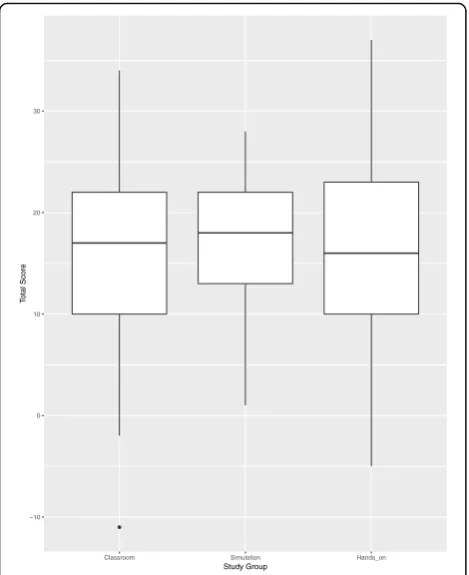
The summarised mean score from the multiple-choice test is displayed in Table 2 and the box plot in Fig. 2. The simulation group had the lowest SD at 6.76. A sig-nificant difference between the simulation group and the hands-on group was found at 28% (P= 0.01). Between the simulation group and the classroom group we found a difference of 19% (P= 0.1), but not significant.
On average, the simulation group had slightly higher scores than the negative control group (difference = 8.4%) and the hands-on group (5.6%). In addition, there was a significantly smaller standard deviation among students in the simulation group compared to the hands-on group, which to some extent was caused by a lower number of students with wrong answers. However, Table 1Demographical information of students
Total students (n= 186)
Classroom 67 (36%) Simulation 62 (33.3%) Hands-on 57 (30.7%)
Mean age (median) 17.4 (17) 17.2 (17) 17.0 (17)
Gender
Male 60 (89.5%) 52 (83.9%) 47 (82.5%)
Female 7 (10.5%) 10 (16.1%) 10 (17.5%)
Experiencea
Yes 19 (28.4%) 12 (19.4%) 13 (22.8%)
No 48 (71.6%) 50 (80.6%) 44 (77.2%)
School
1 26 (38.8%) 16 (30.8%) 18 (31.6%)
2 15 (22.4%) 25 (40.3%) 20 (35.1%)
3 17 (25.4%) 14 (22.6%) 13 (22.8%)
4 9 (13.4%) 7 (11.3%) 6 (10.5%)
Backgroundb
Basic course one 26 (38.8%) 44 (71%) 23 (40.4%)
Employed on a farm with agreement from school
24 (35.8%) 12 (19.4%) 21 (36.8%)
Employed on a farm with no agreement from school
11 (16.4%) 2 (3.2%) 8 (14%)
Other 6 (9%) 4 (6.4%) 5 (8.8%)
Gaming behaviour
Never 8 (11.9%) 7 (11.3%) 5 (8.8%)
Once a month 8 (11.9%) 8 (12.9%) 7 (12.3%)
Once a week 11 (16.4%) 10 (16.1%) 5 (8.8%)
Several times per week 25 (37.3%) 20 (32.3%) 17 (29.8%)
Once every day 3 (4.5%) 6 (9.7%) 10 (17.5%)
Several times per day 11 (16.4%) 11 (17.7%) 13 (22.8%)
Farming simulator as favourite game
Yes 30 (44.8%) 36 (58.1%) 32 (56.1%)
No 37 (55.2%) 26 (41.9%) 25 (43.9%)
a
Experienced students had earlier a paid job on a pig farm or born on a pig farm
b
Background: Employment on a farm is not only pig farms
Table 2Multiple-choice test values for students exposed to three different didactic approaches
Exposure n Mean* SD*
Classroom 67 15.9a 8.31a + b
Classroom + Simulation 62 17.4a 6.76a
Classroom + Hands-on 57 16.4a 9.35b
the differences in SD were not significant between the simulation and classroom groups.
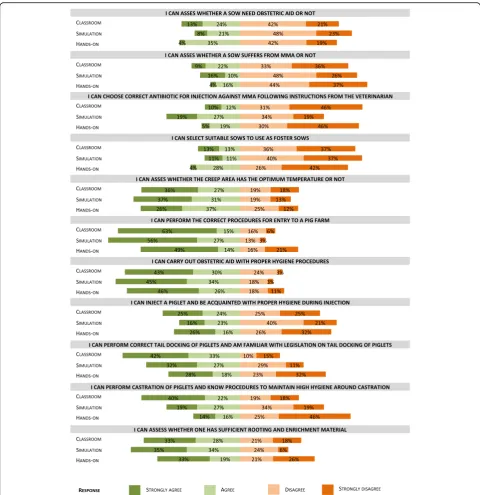
For the self-efficacy questionnaire, the distribution of answers is displayed in the diverged stacked bar charts in Fig.3.
In response to the statement“I can choose the correct antibiotic for injections against MMA following instruc-tions from the veterinarian,”the simulation group scored significantly higher (P-value 0.001) than both the
class-room and hands-on groups. For the statement “I can
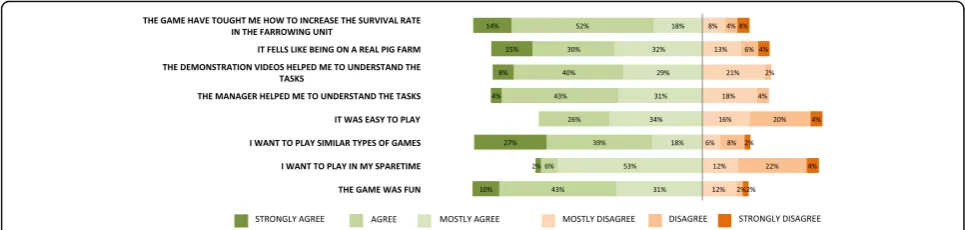
perform the correct procedures for entry to a pig farm”, the hands-on group scored significantly lower than both the classroom and simulation (P-value 0.04) groups. In responding to the statements dealing with tail docking and castration, the hands-on group scored significantly lower than both the classroom and simulation groups (P-value 0.03 andP< 0.001, respectively). Answers to the satisfaction survey are displayed in Fig.4.
After playing the simulation game, 84% of the students agreed that they had learned how to increase the sur-vival rate of piglets in the farrowing unit. 84% also agreed that they enjoyed playing and wanted to play
other learning games similar to“Game of Piglets.” How-ever, 38% answered that they did not want to play this game in their spare time, and 40% found it difficult to play“Game of Piglets.”The difficulties were due to navi-gation and the lack of immediate feedback in the game. The lack of feedback was a deliberate design choice to encourage cognitive thinking rather than trial and error.
Discussion
The present results indicate that students in Danish agriculture schools enjoy using digital learning games. The results of the multiple choice test were not signifi-cant, but indicated that using a simulation game in the curriculum had a positive effect on learning outcome and improved results in particular in the lower-perform-ing half of students. It was anticipated that both the simulation and hands-on groups would perform signifi-cantly better than the classroom group in the multiple choice test. The multiple choice test was chosen to evaluate many students with low amount of resources. The difficulty of the test was carefully designed to assess skills and knowledge about farrowing management. A pre-test before instruction could have verified if students were able to answer correct even without instruction. The exposure time for both the simulation and hands-on groups was set to two hours. Two hours were the time that was planned in the schedule for a farm visit in the course on all schools. Therefore the time for gaming was also set for two hours to unify the groups as much as possible. This is likely too short an exposure time to have a significant effect on memorizing and retaining knowledge of farrowing management. The real farm is not an optimal learning environment if time is sparse, as there are many distractions on a real life pig farm. Therefore, the intended learning objectives may often become secondary on a first-time pig farm visit. The pig farm is more optimized for learning when stu-dents are familiar with the smell, sound and the condi-tion in a pig farm. The simulator was easy to install, but it took some time and effort to become familiar with. Most of the students became competent at navigating and using the functions in the simulator during the ex-posure time. It is established that repetition and experi-ence have a positive effect on memory and learning [13]. From this perspective, more exposure time to either simulation or hands-on experience could have changed the outcome of the study. Additionally, agriculture stu-dents claim that they learn much more from practical training than from classroom instruction. This opinion was found through a qualitative study conducted on Danish agriculture colleges in 2016 in which students were asked about the relationship between school and practical training [14]. However, the results of the multi-ple-choice test did not support that finding. The perceived −10
0 10 20 30
Classroom Simulation Hands_on
Study Group
T
o
tal Score
self-efficacy questionnaire shows that the hands-on group scored significantly lower when it comes to procedures for entering a pig farm as well as for tail docking and castra-tion. It was expected that the hands-on group would score highest since they had experienced reality and thereby have the best prerequisite for doing these procedures.
Nevertheless, the low score could be attributed to the fact that these students experienced the complexity of reality. This may have increased their anxiety and reduced per-ceived self-efficacy because of exposure to reality without proper and thorough preparation. In surgical courses at veterinary schools, students have a high level of anxiety
prior to surgical procedures on live animals. But with sim-ulated skills lab training on models beforehand, anxiety levels before performing live surgery decreased signifi-cantly [15].
Assessment of the efficacy of educational interventions often includes Kirkpatrick’s Four-Level Model [16]. Level 1 is evaluation-reactions, Level 2 is evaluation-learning, Level 3 is evaluation-transfer, and Level Four is evaluation-results. The students’positive response (Level 1) to the satisfaction questionnaire indicates that they had a positive experience with “Game of Piglets.” Although these positive reactions are subjective and are not the sole determinant of learning, they play a key role in assessing student engagement that in turn enhances active learning and understanding. Still, such a survey data collection tool has the inherent limitations of subjectivity, that is, self-report bias. Evaluating progress in learning (Level 2) moves beyond learner satisfaction and at-tempts to assess whether students have advanced in skills and/or knowledge as a direct result of the educational inter-vention. To this end we developed the multiple-choice test as a tool for measuring knowledge acquisition, and the per-ceived self-efficacy questionnaire for assessing skills. Des-pite this, it is still difficult to attribute the improvements in knowledge and skills acquisition solely to the use of tailored educational games. Measuring Levels 3 and 4 is costly and time consuming, as the students’ acquired professional knowledge and skills must be evaluated through demon-stration and clinical examination. These are the recognized limitations of this study.
Conclusion
The results of this study show that custom designed digital educational game simulations of pig herds can be used as an additional training resource for undergradu-ate agricultural students. Though not significant, the results indicate that the simulation game had a positive effect on learning outcome and tended to improve results, especially among lower-performing students.
The students’commitment to game-based learning was
positive and they requested more game modules with which to practice their skills. Digital games offer the new generation of teachers an opportunity to mix traditional approaches with simulation training. More studies are needed to explore the pros and cons of game-based learning in agricultural education.
Acknowledgements
Thank you to Nordjyllands Landbrugsskole, Bygholm Landbrugsskole, Asmildkloster Landbrugsskole and Landbrugsskolen Sjælland for organizing the lectures to make division of students possible and for offering time for gaming and evaluate students.
Thank you to Leah Damgaard-Hansen, Freelance copy editor, for reviewing the manuscript.
Funding
The Danish Pig Levy Foundation funded the study.
Availability of data and materials
The datasets used and/or analysed during the current study are available from the corresponding author on reasonable request.
Authors’contributions
KJMK, KSP and HS designed the study. KJMK obtained the data. KJMK performed statistical analyses. KJMK was the main author of the manuscript. All co-authors read and approved the final manuscript.
Ethics approval and consent to participate
According to Danish legislation this type of study does not require ethical approval. A consent form was provided to the students prior to starting the study.
Consent for publication
Not applicable.
Competing interests
The authors declare that they have no competing interests.
Publisher’s Note
Springer Nature remains neutral with regard to jurisdictional claims in published maps and institutional affiliations.
Author details
1
University of Copenhagen, Faculty of Health and Medical Sciences, Department of Veterinary and Animal Sciences, HERD, Grønnegårdsvej 2, 1870 Frederiksberg C, Denmark.2Ø-Vet A/S, Køberupvej 33, 4700 Næstved, Denmark.
Received: 1 August 2018 Accepted: 31 October 2018
References
1. Agriculture and horticulture development board. 2016. 2015 Pig cost of
production in selected countries.https://pork.ahdb.org.uk/prices-stats/
published-reports/Accessed 23 Okt 2017.
2. Andersen IL, Tajet GM, Haukvik IA, Kongsrud S, Bøe KE. Relationship
between postnatal piglet mortality, environmental factors and management around farrowing in herds with loose-housed, lactating sows. Acta Agric
Scand Sect Anim Sci. 2007;57:38–45.
3. Ison SH, Jarvis S, Rutherford KMD. A survey of sow management at
farrowing in the UK. Anim Welf. 2016;25:309–17.
4. Vila RM, Tummaruk P. Management strategies in farrowing house to
improve piglet pre-weaning survival and growth. Thai J Vet Med. 2016;46: 347–54.
5. Connolly TM, Boyle EA, MacArthur E, Hainey T, Boyle JM. A systematic
literature review of empirical evidence on computer games and serious
games. Comput Educ. 2012;59:661–86.
6. Cook DA, et al. Technology-enhanced simulation for health professions
education a systematic review and meta-analysis. J Am Med Assoc. 2011; 306:978–88.
7. Friedman SA, Goldschmidt K. Let me introduce you to your first virtual
patient. J Pediatr Nurs-Nurs Care Child Fam. 2014;29:281–3.
8. Cook DA, Triola MM. Virtual patients: a critical literature review and
proposed next steps. Med Educ. 2009;43:303–11.
9. Haladyna TM. Developing and validating multiple-choice test items. 3rd ed.
New York: Routledge; 2012.
10. Bandura A. Self-efficacy: the exercise of control. 1st ed. New York: Worth
Publishers; 1997.
11. IN DANISH: Danske Landbrugsskoler
http://danskelandbrugsskoler.dk/om-foreningen/. Accessed 22 Nov 2017.
12. SEGEShttps://www.seges.dk/om-seges. Accessed 26 Jan 2018.
13. Illeris K. How we learn: learning and non-learning in school and beyond. 1st
ed. Oxon: Routledge; 2007.
14. Anneberg I, Sandøe P, Lassen J: Kommunikation om dyrevelfærd, DCA
-Nationalt Center for Fødevarer og Jordbrug. 2016.http://pure.au.dk/portal/
files/99220023/DCArapport072.pdf. Accessed 2 Jan 2018.
15. Langebaek R, et al. Anxiety in veterinary surgical students: a quantitative
study. J Vet Med Educ. 2012;39:331–40.
16. Kirkpatrick DL. Evaluating training programs: the four levels. 3rd ed. San