Graph‑based motor primitive generation
framework
UAV motor primitives by demonstration‑based learning
Yunsick Sung
1, Jeonghoon Kwak
2and Jong Hyuk Park
3*Background
Nowadays, unmanned aerial vehicles (UAVs) have diverse types of goals, as their per-formance and techniques have improved. Because making UAVs fly autonomously requires motor primitives, defining and generating motor primitives is the key approach to autonomous UAVs. Especially, the framework design of UAVs are further researched [1, 2].
Usually, motor primitives are defined and generated linearly [3, 4]. Therefore, while executing motor primitives, changes in the environment are not considered, which can prevent a UAV from achieving its goal. For example, motor primitives are defined by dividing the movements learned through demonstration-based learning, and are then executed by a planner [4].
One motor-primitive generation approach is based on a graph [5–8]. Graph-based
motor primitives have flexibility in dynamic environments because they consider the state of the environment while executing the motor primitives. A method that generates UAV motor primitives using demonstration-based learning [9] is suggested. The process of generating motor primitives is divided into three stages: Operation collection stage, time adjustment stage, and motor-primitive generation stage. The motor primitives,
Abstract
Unmanned aerial vehicles (UAVs) have many potential applications, such as delivery, leisure, and surveillance. To enable these applications, making the UAVs fly autono-mously is the key issue, and requires defining UAV motor primitives. Diverse attempts have been made to automatically generate motor primitives for UAVs and robots. However, given that UAVs usually do not fly as expected because of external environ-mental factors, a novel approach for UAVs needs to be designed. This paper proposes a demonstration-based method that generates a graph-based motor primitive. In the experiment, an AR.Drone 2.0 was utilized. By controlling the AR.Drone 2.0, four motor primitives are generated and combined as a graph-based motor primitive. The gener-ated motor primitives can be performed by a planner or a learner, such as a hierarchi-cal task network or Q-learning. By defining the executable conditions of the motor primitives based on measured properties, the movements of the graph-based motor primitive can be chosen depending on changes in the indoor environment.
Open Access
© 2015 Sung et al. This article is distributed under the terms of the Creative Commons Attribution 4.0 International License (http:// creativecommons.org/licenses/by/4.0/), which permits unrestricted use, distribution, and reproduction in any medium, provided you give appropriate credit to the original author(s) and the source, provide a link to the Creative Commons license, and indicate if changes were made.
RESEARCH
*Correspondence: [email protected]
3 Department of Computer
based on measured yaw, pitches and rolls, are divided into sub-motor primitives con-sidering pinpoints, where pinpoints are predefined spots where the UAV should arrive.
When UAVs fly, they are affected by diverse types of external factors, such as wind, building structures, etc. Therefore, motor primitives are not usually performed as well as expected, which makes it difficult to execute multiple motor primitives consecutively. For example, two motor primitives are planned to be executed, one right after the other. If the first executed motor primitive is not performed as defined, the next motor primi-tive cannot be executed, because the preconditions have changed. Therefore, devising a novel approach to improve graph-based motor primitives is required.
This paper proposes a method that generates graph-based UAV motor primitives using demonstration-based learning. By connecting multiple movements and executing one of the connected movements, UAVs can cope with changing environments. The proposed method can be applied not only to UAVs, but also to robots and virtual characters.
This paper proceeds as follows. “Related work” introduces the approaches used to
make UAVs fly autonomously. “Graph-based motor primitive generation process”
pro-poses a graph-based motor-primitive generation framework. “Experiments” shows the
performance of the generated graph-based motor primitives. “Conclusion” concludes
the paper.
Related work
In the beginning, UAVs were designed for military, but recently low-cost UAVs have been developed and sold to consumers. For example, even though the AR.Drone 2.0 contains two cameras and an infrared sensor, it is sold at low cost [10]. In addition, communica-tion protocols are also defined for developers to control the AR.Drone 2.0 by program-ming. The AR.Drone 2.0 provides algorithms for inertial sensor correction and altitude estimation to maintain an accurate and robust state. An algorithm to display captured images is also contained. Finally, the AR.Drone 2.0 is connected and controlled through Wi-Fi. Diverse types of control modes based on finite-state machines are utilized.
A variety of studies has been done on controlling a UAV automatically. For example, markers attached to walls are recognized by cameras on the UAV, and then the UAV is controlled autonomously by utilizing the recognized markers [11]. For autonomous flight, direction control and altitude control are required. By recognizing the markers by UAV cameras, the distances between markers and UAVs are measured. When the UAV comes within range of one of the markers, it responds by performing the signal corre-sponding to the marker.
Other research solves UAV path-finding problems: one conducts useless lines when vanishing points are revealed, and the other recognizes uncrossed lines as crossed lines [12]. A vanishing point is defined as a point where the path-propagation direction is and where the outer lines are crossed. An algorithm to improve the difference when vanish-ing points are calculated was proposed. UAVs fly autonomously based on the algorithm.
calculating vanishing points. The improved algorithm was applied to the AR.Drone in an indoor environment and allowed the AR.Drone to fly autonomously.
In addition, research on controlling multiple UAVs for indoor-based group flight has been conducted [13]. Controlling multiple UAVs concurrently not only requires a ground station that controls the UAVs, but also a motion-capture data server that obtains the indoor locations of the UAVs. The ground station controls the UAVs by utilizing a quali-tative control algorithm. Motion-capture devices take pictures of the markers attached to the UAVs and then the motion-capture data server recognizes their locations based on the taken pictures.
The shortest path is set to make UAVs fly autonomously in an indoor environment [14]. Given that GPS (global positioning system) signals cannot be received in an indoor environment, an algorithm to generate 3D maps utilizing a depth camera is proposed. The UAV’s current location is recognized based on the 2D images captured by UAV cameras and the generated 3D map of the UAV. An algorithm to reduce the complexity of 3D maps is proposed to calculate the UAV path for avoiding obstacles.
UAV locations are estimated based on crowd-sourced signals [15]. A local Wi-Fi fin-gerprint is collected and automatically updated through multiple users’ smart phones. The UAV locations are calculated utilizing the strength of the measured UAV Wi-Fi and the updated Wi-Fi fingerprint. In addition, the UAV’s path is estimated by utilizing the sensor values of accelerators and directions.
Traditional control research of autonomous UAVs focuses on recognizing the cur-rent location as described above. However, a novel approach is required, not to control UAVs according to a predefined path, but to make UAVs fly autonomously, depending on changes in the dynamic environment. This paper presents a method that applies and improves a motor-primitive generation technique for humanoid robots.
Graph‑based motor primitive generation process UAV motor‑primitive expression
In this paper, motor primitives are defined as follows. In Eq. (1), the ith observed and
measured motor primitive mi is defined in terms of its consecutive movements with
execution time ti’. We assume that all motor primitives have the same number of
move-ments. Therefore, p is the total number of measured motor primitives, and q is the num-ber of movements in a motor primitive.
where the jth movement of the ith motor primitive is mi,j. The movement mi,j is defined
as shown in Eq. (2). Each movement is expressed by x properties and y commands. pi,j,x
and ci,j,y is the xth property and yth command. A property can be not only UAV
val-ues, but also any external values. The motor primitive mi,j is executed by considering the
properties and then sending commands at execution time t’i.
The movement properties are utilized as the conditions required to send movement commands. When the difference between the movement properties and the UAV
(1)
mi= {mi,1,mi,2,...,mi,j,...,mi,q, t
′ i},
(2) mi,j=
properties is smaller than α, the command is sent by the UAV. A graph-based motor primitive G is defined as shown in Eq. (3).
where J is the joint-ordered set and M is the movement-ordered set. ji is the joint of the
ith movements and an element of joint-ordered set J. The movement-ordered set M con-tains the sets of movements. Each set of movements concon-tains movements that occur at the same time.
UAV motor‑primitive generation
The proposed method generates motor primitives in three stages: Operation-collection stage, time-adjustment stage, and motor-primitive generation stage. In the operation-collection stage, an operator uses a controller to make the UAV fly along a predefined path. Given that motor primitives are generated through demonstration-based learning, the UAV should fly the same path repeatedly. Therefore, the path should be defined in advance.
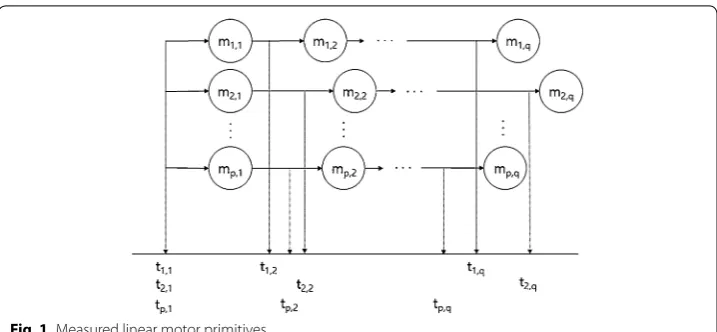
The operator usually guides the UAV on the same path three to five times. Flying fewer than three times cannot make motor primitives with the flexibility needed for a dynamic environment; more than five times results in complicated motor primitives. While the UAV is controlled, it measures and records its properties (such as pitch, roll, and yaw) and its command signals. Figure 1 shows the measured motor primitives. At this time, the properties of the UAV are measured and the commands of the UAV are obtained. The time ti,j is the measured time of mi,j.
Then, the movements and motor primitives of the UAV are defined, based on the properties and the commands. When a UAV faces an intermediate pinpoint to adjust its location, a new movement is defined and added to the motor primitive. The order of the visited pinpoints of motor primitives should be the same during the demonstration-based learning. A single motor primitive is generated demonstration-based on a single flight.
During the time-adjustment stage, the movement times of all the motor primitives are adjusted. In the proposed method, the executed movements need not depend on a certain motor primitive. For example, movement m2,2 in motor primitive m2 can be
(3) G = {J,M},
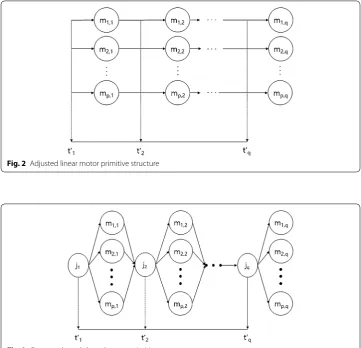
executed after executing m1,1 in m1, if movement m2,2 is more appropriate than move-ment m1,1, considering the current properties of the UAV. To execute the movements as above, the ordered movements should have the same time, as shown in Fig. 2.
t1′ is assigned by t1, which is 0. From t2′, the time of movements is calculated by Eq. (4).
where di,j is the duration of mi,j.
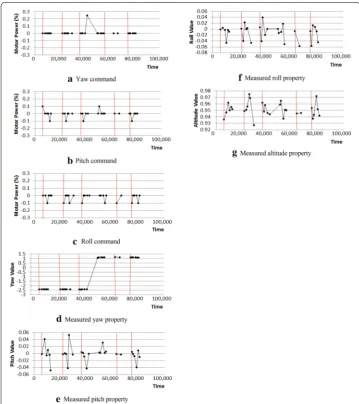
The motor-primitive generation stage merges all motor primitives into a single graph-based motor primitive by connecting the movements in order, as shown in Fig. 3. The graph-based motor primitive of Fig. 3 is defined as {{j1, j2, …, jj}, {{m1,1, m2,1,…, mp,i},
{m1,2, m2,2,…, mp,2},…, {m1,j, m2,j,…, mp,j}}}.
UAV motor‑primitive execution
If a graph-based motor primitive G is executed, all joins in the joint-ordered set J are selected in order. If the ith join ji is selected, then one of the corresponding linked
move-ments is selected, by considering the movement properties, and executed. Given that the
(4)
t′j= t′j−1+ MAX
d1,j, d2,j,..., dp,j
,
Fig. 2 Adjusted linear motor primitive structure
UAV selects its movements based on the changed properties, it can consider changes in the environment.
Experiments
In the experiments, AR.Drone 2.0 was utilized as a UAV, as shown in Fig. 4. In the
indoor environment, the AR.Drone 2.0 flew four times according to the predefined path—the black rectangle in Fig. 4—and collected the control signals and properties. The AR.Drone adjusts its position when it faces the vehicle number plates, which are defined as pinpoints.
The motor primitives of AR.Drone 2.0 were measured based on the control signals of the subject. A single movement command consists of a yaw, pitch, or roll, based on the motor power. The properties of a movement are yaw, pitch, roll, and altitude. Therefore, commands are sent by considering the yaw, pitch, roll, and altitude of the AR.Drone 2.0. When the AR.Drone 2.0 reaches each pinpoint, one movement is defined and added to the motor primitive. Figure 5 shows the yaw, pitch, and roll of the first measured motor primitive.
During the time-adjustment stage, the movement times are adjusted. Table 1 shows all the times of the measured movements.
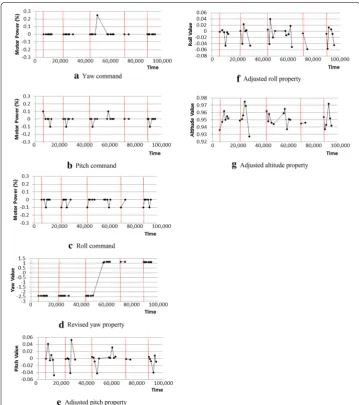
Therefore, the times from t1′ to t5′ were set to 0, 22,048, 43,333, 70,726, and 89,064
during the time-adjustment stage. After adjusting the time of the first measured motor primitive, Fig. 6 shows the first adjusted motor primitive.
Figure 7 shows the result of the graph-based motor primitive created by the pro-posed method, based on four motor primitives where each motor primitive has five movements.
Conclusion
This paper proposed a novel motor-primitive generation framework for UAVs. The measured movements were integrated into a single graph-based motor primitive, which makes it possible to execute the movements of the graph-based motor primitive con-secutively, considering changes in the environment.
Fig. 5 First measured motor primitive. (a) Yaw command, (b) Pitch command, (c) Roll command, (d) Meas-ured yaw property, (e) Measured pitch property, (f) Measured roll property, (g) Measured altitude property
Table 1 All measured movement times
m1 m2 m3 m4
t1 6079 6417 4577 5039
t2 22,048 17,093 21,117 20,050
t3 36,325 34,425 40,126 41,335
t4 63,118 59,023 67,519 68,519
t5 74,894 76,444 79,285 86,857
Fig. 6 First adjusted motor primitive. (a) Yaw command, (b) Pitch command, (c) Roll command, (d) Revised yaw property, (e) Adjusted pitch property, (f) Adjusted roll property, (g) Adjusted altitude property
that UAVs only fly according to the predefined path. However, because of dynamic envi-ronments, it is very hard to perform selected motor primitives completely. The motor primitives that reflect dynamic environments are demanded. In this paper, motor primi-tives are expressed by graph, which means that graph-based motor primiprimi-tives are per-formed completely more than linear motor primitives. Therefore, graph-based motor primitives are proper to dynamic environments. In the future, the way to perform graph-based motor primitives needs to be handled.
Authors’ contributions
All authors are participated in the experiment and the writing of this paper. All authors read and approved the final manuscript.
Author details
1 Faculty of Computer Engineering, Keimyung University, Daegu 704-701, South Korea. 2 Department of Computer
Engi-neering, Keimyung University, Daegu 704-701, South Korea. 3 Department of Computer Science and Engineering, Seoul
National University of Science and Technology, Seoul 139-743, South Korea. Acknowledgements
This research was supported by Basic Science Research Program through the National Research Foundation of Korea(NRF) funded by the Ministry of Science, ICT & Future Planning (NRF-2014R1A1A1005955).
Competing interests
The authors declare that they have no competing interests.
Received: 23 July 2015 Accepted: 26 October 2015
References
1. Sung Y, Kwak J, Yang D, Park Y (2015) Ground station design for the control of multi heterogeneous UAVs. In: Korean multimedia society spring conference, Andong, May 2015, vol 18, no 1, pp 828–829
2. Sung Y, Kwak J (2015) Tangible control interface design for drones of fire fighting and disaster prevention. In: KIPS fall conference, Jeju Island, October 2015, vol 22, no, 2, pp 1844–1845
3. Calinon S, Guenter F, and Billard A (2007) On learning, representing, and generalizing a task in a humanoid robot. In: SMC’07: proceedings of IEEE transactions on systems, man, and cybernetics, vol 37, no 2, pp 286–298
4. Koenig N, Matarić MJ (2006) Behavior-based segmentation of demonstrated task. In: ICDL: Proceedings of interna-tional conference on development and learning, Bloomington, May 2006
5. Nicolescu MN, Matarić MJ (2001) Experience-based representation construction: learning from human and robot teacher. In: IROS’01: Proceedings of IEEE/RSJ international conference on intelligent robots and systems, Wailea, October 2001, vol 2, pp 740–745
6. Nicolescu MN, Matarić MJ (2001) Learning and interacting in human-robot domains. In: SMC’01: Proceedings of IEEE transactions on systems, man, cybernetics, vol 31, no 5, pp 419–430
7. Nicolescu MN, Matarić MJ (2002) A hierarchical architecture for behavior-based robots. In: AAMAS’02: Proceedings of the first international joint conference on autonomous agents and multi-agent systems, July 2002, pp 227–233 8. Nicolescu MN, Matarić MJ (2003) Natural methods for robot task learning: instructive demonstrations, generalization
and practice. In: AAMAS’03: Proceedings of the second international joint conference on autonomous agents and multi-agent systems, Melbourne, July 2003, pp 241–248
9. Sung Y, Kwak J, Park JH (2015) Graph-based motor primitive generation method of UAVs based on demonstration-based learning. In: The 9th international conference on multimedia and ubiquitous engineering, Hanoi, Vietnam, 18–20 May 2015
10. Bristeau JP, Callou F, Vissière D, Petit N (2011) The navigation and control technology inside the AR.Drone micro. In: UAV IFAC’11: Proceeding of international federation of automatic control, Milano, Italy, 28 August–2 September 2011, vol 18, no 1, pp 1477–1484
11. Nitschke C, Minami Y, Hiromoto M, Ohshima H, Sato T (2014) A quadrocopter automatic control contest as an example of interdisciplinary design education ICCAS’14. In: Proceeding of 14th international conference on control, automation and systems, KINTEX, Gyeonggi-do, Korea, 2014, pp 678–685
12. Son BR, Kang SM, Lee H, Lee DH (2013) A real time quadrotor autonomous navigation and remote control method. IEMEK J Embed Syst Appl 8(4):205–212
13. Cho DH, Moon ST, Rew DY (2014) Development of AR.Drone’s controller for indoor swarm flight. KSAS Korean Soc Aeronaut Space Sci 13(1):153–165
14. Moo ST, Ha SH, Eom W, Kim WK (2014) 3D map generation system for indoor autonomous navigation. KSAS Korean Soc Aeronaut Space Sci 11(2):140–148