Optimization of sentiment analysis using
machine learning classifiers
Jaspreet Singh
*, Gurvinder Singh and Rajinder Singh
Introduction to sentiment analysis
The popularity of rapidly growing online social networks and electronic media based societies has influenced the young researchers to pursue their work on sentiment analy-sis. These days organizations quite keen assess their customers or public opinion about their products from social media text [1]. The online service providers are hooked on assessing social media data on blogs, online forums, comments, tweets and product reviews. This assessment is exploited for their decision making or amelioration of their services or quality of products. The applications of sentiment analysis encompass the areas like social event planning, election campaigning, healthcare monitoring, consumer products and awareness services. The immoderate use of internet by business organiza-tions all around the globe has noticed that opinionated web text has molded our business plays and socio-economic systems. The computational power is fueled by burgeon of machine learning techniques. This work focused on four text classifiers utilized for senti-ment analysis viz. Naïve Bayes, J48, BFTree and OneR algorithm. The “Machine learning techniques for sentiment analysis” section of this paper provides the intuition behind the task of sentiment classification by leveraging the modeling of aforementioned four clas-sifiers. The architecture of proposed model using four sentiment classifiers is disposed
Abstract
Words and phrases bespeak the perspectives of people about products, services, governments and events on social media. Extricating positive or negative polarities from social media text denominates task of sentiment analysis in the field of natural language processing. The exponential growth of demands for business organiza-tions and governments, impel researchers to accomplish their research in sentiment analysis. This paper leverages four state-of-the-art machine learning classifiers viz. Naïve Bayes, J48, BFTree and OneR for optimization of sentiment analysis. The experiments are performed using three manually compiled datasets; two of them are captured from Amazon and one dataset is assembled from IMDB movie reviews. The efficacies of these four classification techniques are examined and compared. The Naïve Bayes found to be quite fast in learning whereas OneR seems more promising in generating the accuracy of 91.3% in precision, 97% in F-measure and 92.34% in correctly classified instances.
Keywords: Sentiment analysis, Social media text, Movie reviews, Product reviews, Machine learning classifiers
Open Access
© The Author(s) 2017. This article is distributed under the terms of the Creative Commons Attribution 4.0 International License (http://creativecommons.org/licenses/by/4.0/), which permits unrestricted use, distribution, and reproduction in any medium, provided you give appropriate credit to the original author(s) and the source, provide a link to the Creative Commons license, and indicate if changes were made.
RESEARCH
*Correspondence: profjaspreetbatth@gmail. com
in “Proposed methodology for optimization of sentiment prediction using weka” sec-tion. The related work with recent contributions of machine learning in the field of senti-ment classification is described in “Related work” section. In “Datasets taken” section, the three manually annotated datasets are described along with their preprocessing. The experimental results and discussion of efficacies of classifiers are cataloged in “Results and discussions” section followed by the ending remarks along with a future direction in “Conclusion” section.
Levels of sentiment
Due to scarcity of opinion text available in digital form, very less research interest on computational linguistics in the last decade of twentieth century was witnessed [2–4]. The escalation of social media text on internet attracts young researchers to define the level of granularities of text. The web text is classified into three levels viz. document level, sentence level and word level. In [5], the fourth level granularity is defined by using deep convolution neural network. This fourth level is character level feature extrac-tion approach used for extracting features of each character window from given word (Table 1).
Machine learning techniques for sentiment analysis
The social networking sites dispense their data conveniently and freely on the web. This availability of data entices the interest of young researchers to plunge them in the field of sentiment analysis. People express their emotions and perspectives on the social media discussion forums [6]. The business organizations employ researchers to investigate the unrevealed facts about their products and services. Spontaneous and automatic deter-mination of sentiments from reviews is the main concern of multinational organizations [7–10]. The machine learning techniques have improved accuracy of sentiment analysis and expedite automatic evaluation of data these days. This work attempted to utilize four machine learning techniques for the task of sentiment analysis. The modeling of four techniques is briefly discussed below.
Naïve Bayes used for sentiment classification
The dichotomy of sentiment is generally decided by the mindset of an author of text whether he is positively or negatively oriented towards his saying [6, 11–13]. Naïve Bayes
Table 1 Levels of sentiment along with their attributes
Level Delimiter Depth
of Granu-larity Multiplicity of sen-timents Interpretation of sentiments
1. Document [15] ‘\n’ Newline
char-acter Overall opinion at upper level Single opinion of multiple entities Overall sentiment of one document 2. Sentence [16] ‘.’ Period character Factual polarity of
individual sen-tences
Multiple opinions of
multiple entities Subjectivity clas-sification
3. Entity or aspect
level [12] Space character or named entities At finest level words are the target entities
Single opinion of
single entity Two-tuple as <Senti-ment, target>
4. Character level [5] Special symbols and space characters are omitted
Micro level of
char-acter embedding Multiple opinions about single word entity
classifier is a popular supervised classifier, furnishes a way to express positive, negative and neutral feelings in the web text. Naïve Bayes classifier utilizes conditional probabil-ity to classify words into their respective categories. The benefit of using Naïve Bayes on text classification is that it needs small dataset for training. The raw data from web undergoes preprocessing, removal of numeric, foreign words, html tags and special symbols yielding the set of words. The tagging of words with labels of positive, negative and neutral tags is manually performed by human experts. This preprocessing produces word-category pairs for training set. Consider a word ‘y’ from test set (unlabeled word set) and a window of n-words (x1, x2, …… xn) from a document. The conditional
proba-bility of given data point ‘y’ to be in the category of n-words from training set is given by:
Consider an example of a movie review for movie “Exposed”. The experimentation with Naïve Bayes yields the following results.
J48 algorithm used for sentiment prediction
The hierarchical mechanism divides feature space into distinct regions followed by the categorization of sample into category labels. J48 is a decision tree based classifier used to generate rules for the prediction of target terms. It has an ability to deal with larger training datasets than other classifiers [14]. The word features for sentences of corpus taken from labeled arff file of training set are represented in the leaf nodes of decision tree. In the test set every time when a near feature qualifies the label condition of inter-nal feature node, its level is lifted up in the same branch of decision tree. The assignment of labels to the word features of test set gradually generates different two branches of decision tree. J48 algorithm uses entropy function for testing the classification of terms from the test set.
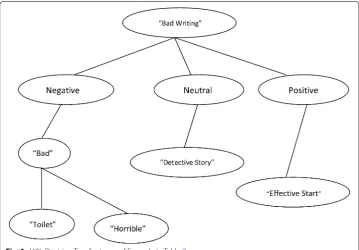
where (Term) can be unigram, bigram and trigram. In this study we have considered unigrams and bigrams. The example in the Table 2 contains bigrams like “Horrible act-ing”, “Bad writing” and “Very misleading” are labeled with negative sentiment whereas the term “More enjoyable” reflects positive sentiment towards the movie. The decision tree of J48 algorithm for obtaining sentiment form text is represented in the Fig. 1 below.
BFTREE algorithm used for sentiment prediction
Another classification approach outperforms J48, C4.5 and CART by expanding only best node in the depth first order. BFTree algorithm excavates the training file for locat-ing best supportlocat-ing matches of positive and negative terms in the test file. BFTree algo-rithm keeps heuristic information gain to identify best node by probing all collected word features. The only difference between J48 and BFTree classifier is the computation order in which decision tree is built. The decision tree disparate feature terms of plain (1) P(y/x1,x2,. . . .xn)=P
y
× n
i=1
P(xi/y)
P(x1,x2,. . . .xn)
(2) Entropy(Term)= −
n
j=1
|Termj| |Term| log2
text taken from movie reviews and classify them at document level by tagging appro-priate labels. BFTree extracts best node from labeled and trained binary tree nodes to reduce the error computed from information gain.
where S is word feature term of test set and A is the attribute of sampled term from training set. V(A) denotes set of all possible values of A. The binary tree stops growing when an attribute A captures single value or when value of information gain vanishes.
OneR algorithm used for sentiment prediction
OneR algorithm is a classification approach which restricts decision tree to level one thereby generating one rule. One rule makes prediction on word feature terms with min-imal error rate due to repetitive assessment of word occurrences. The classification of
(3) Infogain(S,A)=Entropy(S)−
i∈V(A) |Si|
S ×Entropy(Si) Table 2 Initial four reviews of training set and two reviews test set
Second review of test set is negative but Naïve Bayes is lacking in context based sentiment classification
Set Sentence Review Class
Train 1 Horrible acting and bad writing Neg
2 I never did work out what the dog death scene was all about! Neg
3 The trailer is exciting but very misleading Neg
4 The basic structure of storyline is good Pos
Test 1 The effective start and a very detective story Pos
2 An evening locked up in the toilet is more enjoyable Pos
most frequent terms of a particular sentence is made on the basis of class of featured terms from training set. The demonstration of OneR algorithm for sentiment prediction with smallest error of classification is given below:
Step 1 Select a featured term from training set. Step 2 Train a model using step 3 and step 4. Step 3 For each prediction term.
For each value of that predictor.
Count frequency of each value of target term. Find most frequent class.
Make a rule and assign that class to predictor. Step 4 Calculate total error of rules of each predictor. Step 5 Choose predictor with smallest error.
Proposed methodology for optimization of sentiment prediction using weka
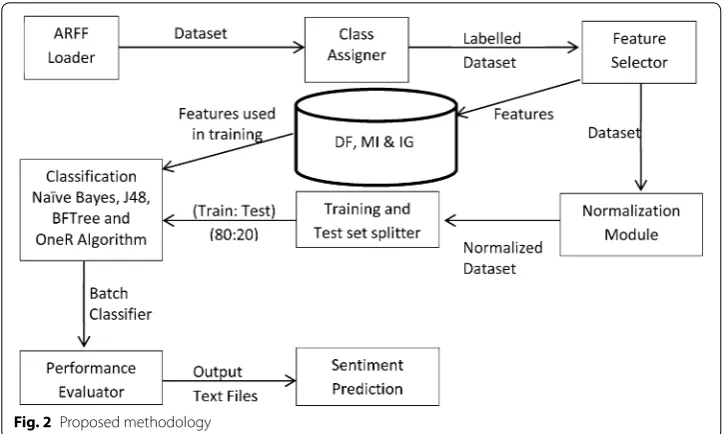
The preprocessing of raw text from web is done in python 3.5 using NLTK and bs4 libraries. Each review in the first dataset is parsed with NLTK’s parser and title of the review is considered as a feature. We have obtained 15 features from first dataset and 42 features from each of second and third dataset. The CSV files generated from Python are converted to ARFF files for WEKA 3.8. Only two sentiment labels namely Pos for posi-tive and Neg for negaposi-tive are used for assigning sentences. The working methodology of proposed work for optimization of sentiment prediction is given below in Fig. 2.
After loading files with ARFF loader, the class assigner picks up appropriate class labels from dataset and performs feature selection on the basis of frequently used head-ings and most frequent titles. The feature selector module is implemented using three feature selection methods namely Document Frequency (DF), Mutual Information (MI) and Information Gain (IG). The mathematical modeling of these feature selection meth-ods requires some probability distributions and statistical notations described below:
P(w): Probability that a document ‘d’ contains term ‘w’.
P(c’): Probability that document ‘d’ does not belongs to category ‘c’.
P(w, c): Joint probability that document ‘d’ contains word term ‘w’ of category ‘c’. P(c/w): Conditional probability that a document ‘d’ belongs to category ‘c’ under the condition that ‘d’ contains word term ‘w’.
Similarly other notations like P(w’), P(w/c), P(w/c’), P(c/w’) and P(c’/w) are taken and {c} is the set of categories.
N1: Number of documents that exhibit category ‘c’ and contain term ‘w’.
N2: Number of documents that do not belong to category ‘c’ but contains term ‘w’.
N3: Number of documents that belong to category ‘c’ and do not contain term ‘w’.
N4: Number of documents that neither belong to category ‘c’ nor contain term ‘w’.
N: Total number of document reviews.
DF method qualifies only those documents in which a higher frequency terms are considered.
The MI method measures features of text by computing similarity of word terms ‘w’ and category ‘c’.
The IG-construct measures similarity information for category by exploiting probabili-ties of absence or presence of terms in a document review.
The normalization module converts all letters into lowercase, removal of punctuation marks and special symbols, conversion of numbers into words, expansion of abbrevi-ation and limiting the average length of twenty words in a sentence. Each sentence is delimited by a newline character. The Python’s NLTK and bs4 libraries are used for this purpose. Data splitter take the ratio of (80:20) of (Train: Test) subsets. We have used manual splitting of dataset at the time of retrieval of data from web. The four classifi-ers are trained with training subsets followed by performance evaluation. The evaluation metrics taken in the experiment are precision, recall, accuracy and F-measure.
(4) DF =
m
i=1
N1i
(5)
SimInfo(w,c)=log
P(w/c)
P(w)
(6)
MI =log N1×N
(N1+N3)(N1+N2)
(7) IG(w)= −P(c)·logP(c)+P(w)P(c/w)·logP(c/w)
+ P
w′P
c/w′
·logP
c/w′
Related work
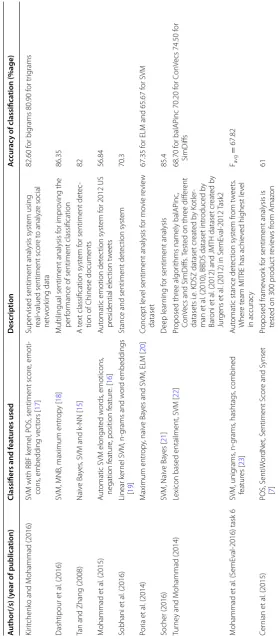
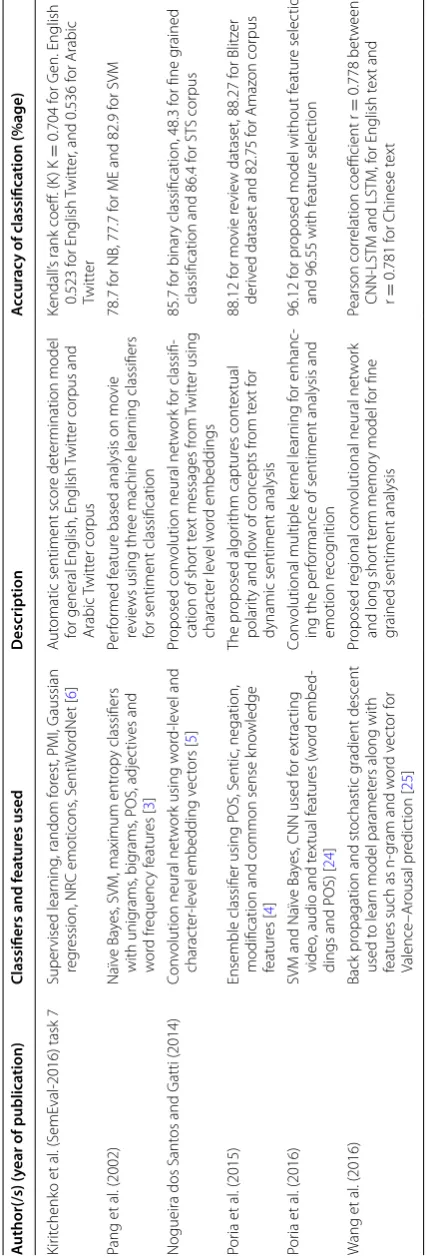
Existing approaches of sentiment prediction and optimization widely includes SVM and Naïve Bayes classifiers. Hierarchical machine learning approaches yields moderate per-formance in classification tasks whereas SVM and Multinomial Naïve Bayes are proved better in terms of accuracy and optimization. Sentiment analysis using neural network architectures has appeared in very few works. The sentiment prediction methods using recursive neural networks and deep convolution neural networks are bit complex in cap-turing compositionality of words. Extracting character level features and embeddings of complex words is found hard in many neural network architectures whereas extract-ing sentence level or word level features such as morphological tags and stems are more effectively achieved in convolutional neural networks. A very few researchers have used J48, BFTree and OneR for the task of sentiment prediction. These three classifiers are utilized for other classification tasks like emotion recognition from text and twitter’s text categorizations. The summary of benchmarks related to machine learning techniques in terms of accuracy of classification is listed in the Table 2. SVM and Naive Bayes are prov-ing better in terms of benchmarks than other machine learnprov-ing techniques (Table 3).
Datasets taken
Three Datasets are manually annotated from http://www.amazon.in. First dataset con-sists of product reviews of Woodland’s wallet are taken from 12th October 2016 to 25th October 2016 for training set containing 88 reviews and from 25th October 2016 to 30th October 2016 for testing set containing 12 randomly chosen product reviews with their sentiments prediction using four machine learning algorithms. Second dataset consists of 7465 Digital Camera reviews of Sony are taken from 01st October 2016 to 25th Octo-ber 2016 for training set and 1000 reviews are from 25th OctoOcto-ber 2016 to 30th OctoOcto-ber 2016 for test dataset. Third dataset consists of movie reviews taken from http://www. imdb.com. It contains 2421 reviews for training set and 500 reviews for test set.
Results and discussions
The experiment is carried out by using freeware WEKA software tool for classification of sentiments in the text. Standard implementations of Naïve Bayes, J48, BFTree and OneR algorithms are exploited from WEKA version 3.8. The classification accuracy of first dataset shows 100% classification accuracy with Naïve Bayes in some of the epochs because of small size of dataset. The average of 29 epochs for all four classifiers on sec-ond and third datasets is presented in Table 4 below. Naïve Bayes shows faster learning among four classifiers whereas J48 found to be slower. OneR classifier is leading from other three classifiers in percentage of correctly classified instances. The accuracy of J48 algorithm is promising in true positive and false positive rates.
Table 3 B enchmar ks of classifier ’s ac cur acies A uthor(/s) (y ear of publica tion) Classifiers and f ea tur es used Description A ccur ac y of classifica tion (%age) Kir itchenk
o and M
ohammad (2016)
SVM with RBF k
er
nel
, POS, sentiment scor
e, emoti
-cons
, embedding v
ec
tors [
17
]
Super
vised sentiment analysis syst
em using
real-valued sentiment scor
e t o analyz e social net w or king data 82.60 f or big
rams 80.90 f
or tr ig rams Dashtipour et al . (2016) SVM, MNB
, maximum entr
op
y [
18
]
M
ultilingual sentiment analysis f
or impr
oving the
per
for
mance of sentiment classification
86.35
Tan and Zhang (2008)
Naiv
e Ba
yes
, SVM and k
-NN [
15
]
A t
ex
t classification syst
em f
or sentiment det
ec
-tion of Chinese documents
82 M ohammad et al . (2015) A ut
omatic SVM elongat
ed w or ds , emoticons , negation f eatur
e, position f
eatur e. [ 16 ] A ut
omatic emotion det
ec
tion syst
em f
or 2012 US
pr esidential elec tion t w eets 56.84 Sobhani et al . (2016) Linear k er
nel SVM,
n-grams and w
or
d embeddings
[
19
]
Stance and sentiment det
ec tion syst em 70.3 Por ia et al . (2014) M aximum entr op y, naiv e Ba
yes and SVM, ELM [
20
]
Concept le
vel sentiment analysis f
or mo vie r evie w dataset 67.35 f
or ELM and 65.67 f
or SVM Socher (2016) SVM, Naiv e Ba yes [ 21 ] D eep lear ning f
or sentiment analysis
85.4
Tur
ne
y and M
ohammad (2014)
Lexicon based entailment, SVM [
22
]
Pr
oposed thr
ee algor
ithms namely balAP
inc
,
ConV
ecs and SimDiff
s.
Test
ed on thr
ee diff
er
ent
datasets i.e
. KDSZ dataset cr
eat ed b y K otler -man et al
. (2010), BBDS dataset intr
oduced b
y
Bar
oni et
al
. (2012) and JM
TH dataset cr
eat ed b y Jur gens et al
. (2012) in S
emE
val-2012
Task2
68.70 f
or balAP
inc 70.20 f
or C
onV
ecs 74.50 f
or SimDiff s M ohammad et al . (S emE
val-2016) task 6
SVM, unig rams , n-grams , hashtags , combined featur es [ 23 ] A ut
omatic stance det
ec tion syst em fr om t w eets . Wher e t
eam MITRE has achie
ved highest le
vel in accurac y Favg = 67.82 Cer nian et al . (2015) POS, S entiW or dNet, S entiment S cor
e and Synset
[ 7 ] Pr oposed frame w or k f
or sentiment analysis is
test
ed on 300 pr
Table 3 c on tinued A uthor(/s) (y ear of publica tion) Classifiers and f ea tur es used Description A ccur ac y of classifica tion (%age) Kir itchenk o et al . (S emE
val-2016) task 7
Super
vised lear
ning
, random f
or est, P MI, G aussian reg ression, NR C emoticons , S entiW or dNet [ 6 ] A ut
omatic sentiment scor
e det
er
mination model
for general English, English
Twitt er cor pus and Arabic T witt er cor pus Kendall
’s rank coeff
. (K ) K = 0.704 f or G en. English 0.523 f or English Twitt er
, and 0.536 f
or Arabic Twitt er Pang et al . (2002) Naïv e Ba yes
, SVM, maximum entr
op y classifiers with unig rams , big rams
, POS, adjec
tiv es and w or d fr equenc y f eatur es [ 3 ] Per for med f eatur
e based analysis on mo
vie
re
vie
ws using thr
ee machine lear
ning classifiers
for sentiment classification
78.7 f
or NB
, 77.7 f
or ME and 82.9 f
or SVM
Nogueira dos Sant
os and G
atti (2014)
Con
volution neural net
w
or
k using w
or d-le vel and charac ter -le
vel embedding v
ec tors [ 5 ] Pr oposed con
volution neural net
w
or
k f
or classifi
-cation of shor
t t
ex
t messages fr
om Twitt er using charac ter le vel w or d embeddings 85.7 f or binar
y classification, 48.3 f
or fine g
rained
classification and 86.4 f
or ST S cor pus Por ia et al . (2015)
Ensemble classifier using POS, S
entic
, negation,
modification and common sense k
no wledge featur es [ 4 ] The pr oposed algor ithm captur es cont ex tual polar
ity and flo
w of concepts fr
om t
ex
t f
or
dynamic sentiment analysis
88.12 f
or mo
vie r
evie
w dataset, 88.27 f
or Blitz
er
der
iv
ed dataset and 82.75 f
or Amaz on cor pus Por ia et al . (2016)
SVM and Naïv
e Ba
yes
, CNN used f
or ex
trac
ting
video
, audio and t
ex tual f eatur es (w or d embed
-dings and POS) [
24
]
Con
volutional multiple k
er
nel lear
ning f
or enhanc
-ing the per
for
mance of sentiment analysis and
emotion r
ecog
nition
96.12 f
or pr
oposed model without f
eatur
e selec
tion
and 96.55 with f
eatur e selec tion W ang et al . (2016) Back pr
opagation and st
ochastic g
radient descent
used t
o lear
n model paramet
ers along with
featur
es such as
n-gram and w
or d v ec tor f or Valence –Ar ousal pr edic tion [ 25 ] Pr oposed r eg ional con
volutional neural net
w
or
k
and long shor
t t
er
m memor
y model f
or fine
grained sentiment analysis
Pearson cor
relation coefficient r
=
0.778 bet
w
een
CNN-LSTM and LSTM, f
or English t
ex
t and
r
=
0.781 f
or Chinese t
ex
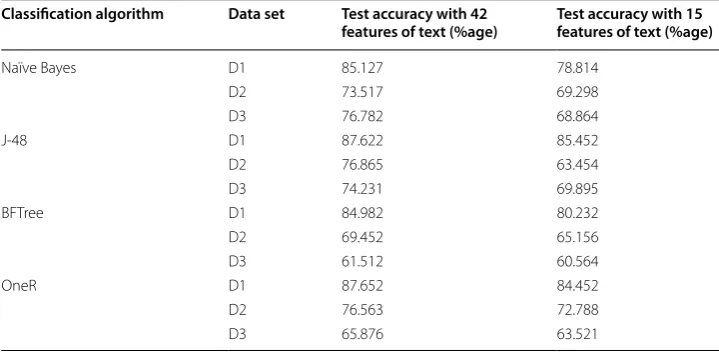
below. All four classifiers improved in accuracies with the increase of features from 15 to 42. This shows the direct proportionality of multiple features with learning capability for machine learning algorithms.
Conclusion
This paper exploits four machine learning classifiers for sentiment analysis using three manually annotated datasets. The mean of 29 epochs of experimentation recorded in Table 4 shows that OneR is more precise in terms of percentage of correctly classified instances. On the other hand, Naïve Bayes exhibits faster learning rate and J48 reveals adequacy in the true positive and false positive rates. Table 5 reveals the truth that J48 and OneR are better for smaller dataset of woodland’s wallet reviews. The preprocessing of proposed methodology is limited to extract foreign words, emoticons and elongated words with their appropriate sentiments. The future work in the task of sentiment analy-sis has scope to improve preprocessing with word embeddings using deep neural net-works and can also extend this study through convolution neural netnet-works.
Table 4 Performance evaluation of four classifiers Classifiers Time taken
(s) Correctly classified instances
Incorrectly classified instances
Accuracy
TP rate Accuracy FP rate Precision F-measure
Naïve Bayes 7.79 85.24 14.61 0.456 0.134 0.831 0.812
J-48 49.73 89.73 11.33 0.967 0.003 0.877 0.917
BFTree 21.12 90.07 9.03 0.892 0.025 0.883 0.721
OneR 24.45 92.34 8.66 0.9 0.061 0.913 0.97
Table 5 Test accuracies of classification algorithms for three datasets
D1: Woodland’s wallet reviews, D2: Sony digital camera reviews, D3: IMDB movie reviews Classification algorithm Data set Test accuracy with 42
features of text (%age) Test accuracy with 15 features of text (%age)
Naïve Bayes D1 85.127 78.814
D2 73.517 69.298
D3 76.782 68.864
J-48 D1 87.622 85.452
D2 76.865 63.454
D3 74.231 69.895
BFTree D1 84.982 80.232
D2 69.452 65.156
D3 61.512 60.564
OneR D1 87.652 84.452
D2 76.563 72.788
Authors’ contributions
JS made substantial contributions to conception and design, or acquisition of data, or analysis and interpretation of data. GS helped in revision and has given final approval of the version to be published. RS agreed to be accountable for all aspects of the work in ensuring that questions related to the accuracy or integrity of any part of the work are appropri-ately investigated and resolved. All authors read and approved the final manuscript.
Acknowledgements
This research was supported by Department of Computer Science, Guru Nanak Dev University, Amritsar. I thank Dr. Gurvinder Singh and Dr. Rajinder Singh for their participation in experimental work and their assistance to improve the manuscript.
Competing interests
This research work has non-financial Academic and intellectual competing interests.
Availability of data and materials
I submit that I can make the experimental data and materials available after the completion of my thesis.
Consent for publication
We hereby grant and assign all rights to Human-centric Computing and Information Sciences for publication.
Ethics approval and consent to participate
The article submitted is an original work and has neither been published in any other peer-reviewed journal nor under consideration for publication by any other journal.
Funding information
No funding was received from any funder.
Publisher’s Note
Springer Nature remains neutral with regard to jurisdictional claims in published maps and institutional affiliations.
Received: 24 December 2016 Accepted: 4 September 2017
References
1. Parvathy G, Bindhu JS (2016) A probabilistic generative model for mining cybercriminal network from online social
media: a review. Int J Comput Appl 134(14):1–4. doi:10.5120/ijca2016908121
2. Cambria E, White B (2014) Jumping NLP curves: a review of natural language processing research. IEEE Comput
Intell Mag 9(2):48–57. doi:10.1109/mci.2014.2307227
3. Pang B, Lee L, Vaithyanathan S (2002) Thumbs up? In: Proceedings of the ACL-02 conference on empirical methods
in natural language processing—EMNLP ‘02. doi:10.3115/1118693.1118704
4. Poria S, Cambria E, Gelbukh A, Bisio F, Hussain A (2015) Sentiment data flow analysis by means of dynamic linguistic
patterns. IEEE Comput Intell Mag 10(4):26–36. doi:10.1109/mci.2015.2471215
5. Nogueira dos Santos C, Gatti M (2014) Deep convolution neural networks for sentiment analysis of short texts. In: Proceedings of COLING 2014, the 25th international conference on computational linguistics. p 69–78 6. Kiritchenko S, Mohammad S, Salameh M (2016) SemEval-2016 task 7: determining sentiment intensity of English
and Arabic phrases. In: Proceedings of the 10th international workshop on semantic evaluation (SemEval-2016). doi:10.18653/v1/s16-1004
7. Cernian A, Sgarciu V, Martin B (2015) Sentiment analysis from product reviews using SentiWordNet as lexi-cal resource. In: 2015 7th international conference on electronics, computers and artificial intelligence (ECAI). doi:10.1109/ecai.2015.7301224
8. Hammer HL, Solberg PE, Øvrelid L (2014) Sentiment classification of online political discussions: a comparison of a word-based and dependency-based method. In: Proceedings of the 5th workshop on computational approaches
to subjectivity, sentiment and social media analysis. doi:10.3115/v1/w14-2616
9. Zadeh L (2006) Toward human-level machine intelligence. In: 2006 18th IEEE international conference on tools with
artificial intelligence (ICTAI’06). doi:10.1109/ictai.2006.114
10. Joachims T (2002) Text classification. Learning to classify text using support vector machines. p 7-33. doi:10.1007/978-1-4615-0907-3_2
11. Wanton TM, Porrata AP, Guijarro AM, Balahur A (2010) Opinion polarity detection—using word sense disambigua-tion to determine the polarity of opinions. In: Proceedings of the 2nd internadisambigua-tional conference on agents and
artificial intelligence. doi:10.5220/0002703504830486
12. Xia Y, Cambria E, Hussain A, Zhao H (2014) Word polarity disambiguation using bayesian model and opinion-level
features. Cogn Comput 7(3):369–380. doi:10.1007/s12559-014-9298-4
13. Dey L, Chakraborty S, Biswas A, Bose B, Tiwari S (2016) Sentiment analysis of review datasets using Naïve Bayes’ and
K-NN classifier. Int J Inform Eng Electron Bus 8(4):54–62. doi:10.5815/ijieeb.2016.04.07
14. Nie CY, Wang J, He F, Sato R (2015) Application of J48 decision tree classifier in emotion recognition based on chaos characteristics. In: Proceedings of the 2015 international conference on automation, mechanical control and
com-putational engineering. doi:10.2991/amcce-15.2015.330
15. Tan S, Zhang J (2008) An empirical study of sentiment analysis for Chinese documents. Expert Syst Appl 34(4):2622–
16. Mohammad SM, Zhu X, Kiritchenko S, Martin J (2015) Sentiment, emotion, purpose, and style in electoral tweets. Inf
Process Manage 51(4):480–499. doi:10.1016/j.ipm.2014.09.003
17. Kiritchenko S, Mohammad SM (2016) sentiment composition of words with opposing polarities. In: Proceedings of the 2016 conference of the north american chapter of the association for computational linguistics: human language technologies. doi:10.18653/v1/n16-1128
18. Dashtipour K, Poria S, Hussain A, Cambria E, Hawalah AY, Gelbukh A, Zhou Q (2016) Multilingual sentiment
analysis: state of the art and independent comparison of techniques. Cogn Comput 8(4):757–771. doi:10.1007/
s12559-016-9415-7
19. Sobhani P, Mohammad S, Kiritchenko S (2016) Detecting stance in tweets and analyzing its interaction with sentiment. In: Proceedings of the 5th joint conference on lexical and computational semantics. doi:10.18653/v1/ s16-2021
20. Poria S, Cambria E, Winterstein G, Huang G (2014) Sentic patterns: dependency-based rules for concept-level
senti-ment analysis. Knowl Based Syst 69:45–63. doi:10.1016/j.knosys.2014.05.005
21. Socher R (2016) deep learning for sentiment analysis—invited talk. In: Proceedings of the 7th workshop on compu-tational approaches to subjectivity, sentiment and social media analysis. doi:10.18653/v1/w16-0408
22. Turney PD, Mohammad SM (2014) Experiments with three approaches to recognizing lexical entailment. Nat Lang
Eng 21(03):437–476. doi:10.1017/s1351324913000387
23. Mohammad S, Kiritchenko S, Sobhani P, Zhu X, Cherry C (2016) SemEval-2016 task 6: detecting stance in tweets. In: Proceedings of the 10th international workshop on semantic evaluation (SemEval-2016). doi:10.18653/v1/s16-1003 24. Poria S, Chaturvedi I, Cambria E, Hussain A (2016) Convolutional MKL based multimodal emotion recognition and
sentiment analysis. In: 2016 IEEE 16th international conference on data mining (ICDM). doi:10.1109/icdm.2016.0055