DOI 10.1007/s13174-011-0032-0 S I : C L O U D C O M P U T I N G
HCOC: a cost optimization algorithm for workflow scheduling
in hybrid clouds
Luiz Fernando Bittencourt· Edmundo Roberto Mauro Madeira
Received: 11 November 2010 / Accepted: 30 June 2011 / Published online: 3 August 2011 © The Brazilian Computer Society 2011
Abstract Workflows have been used to represent a variety of applications involving high processing and storage de-mands. As a solution to supply this necessity, the cloud com-puting paradigm has emerged as an on-demand resources provider. While public clouds charge users in a per-use ba-sis, private clouds are owned by users and can be utilized with no charge. When a public cloud and a private cloud are merged, we have what we call ahybrid cloud. In a hy-brid cloud, the user has elasticity provided by public cloud resources that can be aggregated to the private resources pool as necessary. One question faced by the users in such systems is: Which are the best resources to request from a public cloud based on the current demand and on resources costs? In this paper we deal with this problem, presenting HCOC: The Hybrid Cloud Optimized Cost scheduling al-gorithm. HCOC decides which resources should be leased from the public cloud and aggregated to the private cloud to provide sufficient processing power to execute a workflow within a given execution time. We present extensive exper-imental and simulation results which show that HCOC can reduce costs while achieving the established desired execu-tion time.
Keywords Workflow·Scheduling·DAG·Cloud computing
L.F. Bittencourt (
)·E.R.M. MadeiraInstitute of Computing, University of Campinas, Av. Albert Einstein, 1251 Cidade Universitária, 13083-852 Campinas, São Paulo, Brazil
e-mail:[email protected] E.R.M. Madeira
e-mail:[email protected]
1 Introduction
Cloud computing is nowadays being used to deliver on-demand storage and processing power. This environment al-lows the leasing of resources to improve the locally avail-able computational capacity, supplying new computing re-sources when necessary. In a cloud, the user accesses com-puting resources as general utilities that can be leased and released [36]. The main benefits to the cloud users is the avoidance of up-front investment, the lowering of their op-erating cost, the maintenance cost reduction, and the scal-ability provided on demand. These cloud features provide elasticityto the user’s computing environment, being able to adapt the computer system to the user needs.
Virtualization [31] is the process of presenting a logical grouping or subset of computing resources so that they can be accessed in abstract ways with benefits over the original configuration. The virtualization software abstracts the hard-ware by creating an interface to virtual machines (VMs), which represents virtualized resources such as CPUs, phys-ical memory, network connections, and peripherals. Each virtual machine alone is an isolated execution environment independent from the others. Each VM can have its own operating system, applications, and network services. Vir-tualization allows server consolidation, hardware normal-ization, and application isolation in the same physical ma-chine. Virtualization technologies, such as Xen [2], are an important part of a cloud computing environment, since the cloud provider can dynamically offer different hardware and software configurations to the cloud user. With this, the user can select a machine configuration and manage this machine with full privileges without interfering in cloud machines available to the others.
in, or control over the technology infrastructure about the cloud they are using. It typically involves the provision of dynamically scalable and often virtualized resources as a service over the Internet [1]. The cloud computing charteristics are on-demand self-service, ubiquitous network ac-cess, independent resource location (reliability), rapid elas-ticity (scalability), and pay-per-use. The cloud computing allows the use of Service Oriented Computing (SOC) stan-dards, permitting users to establish links between services, organizing them as workflows instead of building only tra-ditional applications using programming languages.
Cloud computing delivers three defined models: software as a service (SaaS), platform as a service (PaaS), and infras-tructure as a service (IaaS). In SaaS the consumer uses an ap-plication but does not control the host environment. Google Apps1andSalesforce.com2are examples of this model. In PaaS, the consumers use a hosting environment for their ap-plications. The Google App Engine3and Amazon Web Ser-vices4are PaaS examples. In this model the platform is typ-ically an application framework. In IaaS the consumer uses computing resources such as processing power and storage. In this model the consumer can control the environment in-cluding deployment of applications. Amazon Elastic Com-pute Cloud,5Globus Nimbus,6and Eucalyptus [24] are good examples of this model.
In terms of resources availability, we can classify IaaS clouds in three different types:
• Public clouds: Resource providers offer computing re-sources as services in a pay-per-use basis, leasing the use of machines to the user during the requested time. • Private cloudsorinternal clouds: Clouds with resources
that can be accessed and used by individuals inside an or-ganization, having similarities with data farms or private grids.
• Hybrid clouds: Bring together public and private clouds, resulting in a combination of control over performance and security with elasticity.
The on-demand computing offered by the cloud allows the use of private systems (computers, clusters, and grids), aggregating the cloud resources as users need. However, this hybrid approach results in a system with new demands, no-tably in resource management.
Designing a hybrid cloud requires carefully determin-ing the best split between public and private cloud compo-nents [36]. One of the problems to face when determining
1http://www.google.com/apps/. 2http://www.salesforce.com/. 3http://code.google.com/intl/en/appengine/. 4http://aws.amazon.com/. 5http://aws.amazon.com/ec2/. 6http://workspace.globus.org/.
that is how to split a workflow, which is composed of de-pendent tasks, to execute in private resources and in public resources. This problem involves tasks execution times on heterogeneous resources, data transmission times over het-erogeneous links, as well as monetary costs in the use of charged resources from public clouds. In this paper we in-troduce HCOC: the Hybrid Cloud Optimized Cost schedul-ing algorithm. HCOC decides whether a task from a work-flow is to be executed in a private resource or in a public charged resource. We assume that the user stipulates a max-imum desired execution time (or deadline)Dfor the work-flow, and our proposed algorithm tries to optimize the mon-etary execution costs while maintaining the execution time lower thanD. Therefore, the objectives of our algorithm are: (i) minimize the monetary costs; (ii) minimize the sched-ule length (makespan); and (iii) reduce, over the time, the number of schedules with makespan higher than D. With this, this paper contributes in the aggregation of the schedul-ing algorithm with free/paid multicore processschedul-ing resources, monetary costs, and deadlines, which are characteristics that can be found in the emerging hybrid cloud systems, leverag-ing the discussion of the trade-off between local (free and slow) execution and remote (paid and fast) execution in hy-brid clouds.
This paper is organized as follows. Section2introduces a hybrid cloud infrastructure deployed to perform experi-ments. In Sect.3we present the scheduling problem, provid-ing notations, conceptual background, as well as describprovid-ing workflow applications used in the simulations. After that we present the HCOC algorithm, in Sect.4. Experimental and simulation results are discussed in Sect.5. Works related to the scheduling problem are presented in Sect.6, while the final remarks and conclusions are in Sect.7.
2 The hybrid cloud infrastructure
On-demand computing requires services scalability, flexi-bility, and availability. To supply these requirements, it is important to the infrastructure to offer reconfiguration with the possibility of the deployment of new resources or up-dating the existing ones without stopping processes in exe-cution. Our infrastructure combines a service-oriented grid, implemented using a dynamic service deployer that makes the underlying grid infrastructure to act as a private cloud, and public clouds.
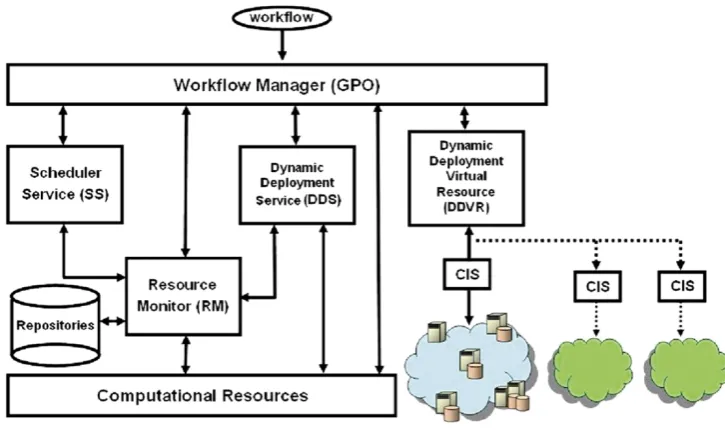
Fig. 1 The hybrid architecture
workflow manager must find the best resources available and, when necessary, it must make the dynamic deployment of services in these resources. On the other hand, inside the public cloud boundary, the infrastructure must be able to interact with the public cloud interfaces to obtain com-putational resources. After that, it must be able to prepare these resources according to workflow necessities, making the dynamic deployment of services in the resources inside the public cloud. This deployment can be made when lo-cal resources are not sufficient to the workflow necessities. This configuration increases the computational power of the private cloud without new infrastructure investment, using the on-demand computing advantages provided by the pub-lic cloud. By fulfilling these requirements, a hybrid cloud infrastructure can provide support to the decision making performed by the scheduling algorithm.
In this work we firstly present a small set of experiments using a real testbed, which was used to corroborate the re-sults obtained through simulations shown in Sect.5. 2.1 The testbed architecture
Similarities between private clouds and grids allow us to use a grid manager called Grid Process Orchestration inside our private cloud. To execute service workflows in hybrid sys-tems we use our hybrid infrastructure [8], which provides dynamic instantiation of services. Thus, the private cloud deployed is capable of executing workflows of tasks as well as workflows of services.
The software infrastructure is composed of a set of ser-vices and the Grid Process and Orchestration Language (GPOL) [30], a simple workflow description language. The infrastructure provides dynamic service instantiation and de-ployment, automatic reference coordination (endpoint refer-ence service). The set of services that compose our hybrid
cloud infrastructure architecture is shown in Fig.1. Its main components are a Workflow Manager (GPO), a Scheduler Service (SS), a service for publication of services (Dynamic Deployment Service—DDS), a service for dynamic publi-cation of virtual resources in the cloud (Dynamic Deploy-ment of Virtual Resources—DDVR), and repositories used by these components.
In a typical execution in our private cloud, the user sub-mits a task workflow or a service workflow to the Grid Pro-cess Orchestration (GPO) [30], the workflow manager in the system. The GPO allows the creation and management of application flows, tasks, and services in grids. Its architec-ture is based on concepts presented in the OGSA (Globus Toolkit 4 implementation—GT4). GPO analyzes the work-flow, consulting the scheduling service (SS), which identi-fies the best resource available for each service involved. If a new service needs to be published, the GPO makes the new service deployment through the Dynamic Deployment Service (DDS), which publishes the new service and returns its localization (endpoint reference) to GPO. Using the end-point reference, the GPO creates the necessary instances for executing the workflow. When the execution is terminated, the GPO can automatically eliminate the instances created and added to the DDS, or it can leave the services for fur-ther use when necessary. If the workflow execution needs more resources, the GPO starts the Dynamic Deployment Virtual Resource (DDVR), which searches for resources in public clouds. The DDVR requests resources to the cloud informing its localization to the GPO. Through the DDVR, the GPO uses the public cloud resources in a similar manner to the use of local resources in the private cloud. It dynam-ically publishes and instantiates services if necessary, and it monitors the resources through the infrastructure services.
in a distributed manner, maintaining one instance in each computational resource. The workflow manager uses the RM to gather knowledge about which resources are avail-able at a given time, and the scheduler uses it to obtain in-formation about the current state of the resources. Besides that, the services repository has information about services currently available in the resources, and it stores the neces-sary files to the dynamic publication made by the DDS.
2.2 Clouds interconnection
The DDVR is used by the infrastructure when resources from public clouds are needed. It is composed of two groups of services. The first group is the DDVR itself, which com-municates with the infrastructure, taking care of the func-tionalities. The second group, called Cloud Interface Service (CIS), makes the interface with public clouds. The CIS en-capsulates particularities of each cloud type (Nimbus, Ama-zon, Eucalyptus, etc.), allowing transparent access to the public cloud resources in the same way that private cloud re-sources are accessed. For each resource, one instance of the couple DDVR/CIS is responsible for the binding between the workflow manager and the cloud resource. To use cloud resources, GPO communicates with the DDVR, which com-municates with the cloud through CIS, and requests a re-source. The cloud returns the localization of the VM ob-tained and the DDVR can start using it by initiating the GT4 and creating a DDVR instance in the cloud resource.
The DDVR/CIS layout gives flexibility and scalability to the infrastructure, allowing the access to different clouds in an independent and simultaneous manner. Besides that, the transparent access to public cloud resources provided by DDVR/CIS allows, if necessary, the dynamic instantiation of services that are not available in the public cloud.
2.3 The hybrid cloud testbed configuration
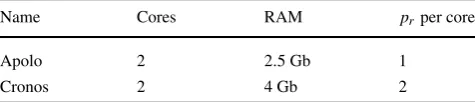
Our infrastructure was deployed in a small system as a proof of concept, and it was used to execute a set of experiments. The hybrid cloud deployed was composed of a private cloud (resources shown in Table1) and a public cloud (resources shown in Table2). These tables show the available resource on each cloud along with their processing capacities (pr) and cost of use per time unit. We assume that a private cloud already exists and is currently being used to process users jobs, thus the private cloud upkeep costs already ex-ist. With this, the private cloud is free of charge and opera-tion costs are not taken into consideraopera-tion, thus the cost for using its resources is considered to be non-significative. In addition, with the number of resources in the private cloud being smaller than the ones available from the public cloud, it is possible to evaluate the algorithm when the private re-sources are not sufficient to execute the application within the desired deadline.
Table 1 Resources in the private cloud and their capacities
Name Cores RAM prper core
Apolo 2 2.5 Gb 1
Cronos 2 4 Gb 2
Table 2 Resources in the public cloud, their capacities, and costs per time unit
Type Cores RAM prper core Price
Y 1 1 Gb 1.5 $0.25
Y 2 1 Gb 1.5 $0.36
Z 1 2 Gb 2 $0.3
Z 2 4 Gb 2 $0.4
Z 3 6 Gb 2 $0.5
Z 4 8 Gb 2 $0.6
Z 8 16 Gb 2 $0.9
3 Workflow scheduling
The Hybrid Cloud Optimized Cost (HCOC) scheduling al-gorithm has the objective of reducing the makespan to fit a desired execution time or deadline (D) maintaining a rea-sonable cost. As a consequence, a reduction of the number ofDviolations is to be observed over the time. While exe-cuting every task of the workflow locally may delay the ex-ecution, on the other hand, executing all tasks in the public cloud may result in prohibitive costs. Therefore, the algo-rithm tries to balance the use of private resources with the ones available from the public cloud in a pay-per-use basis.
3.1 Background and definitions
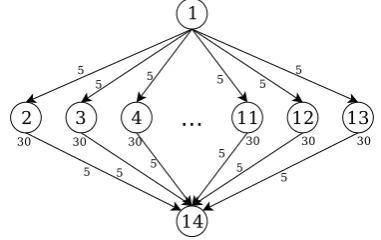
A workflow is commonly represented by a directed acyclic graph (DAG) G=(V,E) with n nodes (or tasks), where ta∈V is a workflow task with an associated computation costwta ∈R+, andea,b∈E,a=b, is a dependency between taandtbwith an associated communication costca,b∈R+. An example of workflow represented by a DAG is shown in Fig.2. It shows a 14-node DAG, where node 1 is the first task to be executed, nodes 2 to 13 can only start their exe-cution after task 1 finishes and sends the data, and node 14 is the last task and can only start its execution after all tasks before it finish and send their data. Nodes in the DAG are labeled with their computation cost (number of instructions, for instance), while edges are labeled with their communi-cation cost (bytes to transmit, for instance).
A private cloud is a set of heterogeneous resourcesR= {r1, r2, . . . , rk}, with associated processing capacities pri ∈ R+, connected by network links. Each resourcer
Fig. 2 Example of fork-join DAG with 14 nodes
resources ri and rj, with li,i = ∞. A public cloud is a set of charged virtualized resources U = {u1, u2, . . . , uw}, available on demand, with associated processing capacities puj∈R+, connected by network links. Each resourceuj∈ Uhas a set of linksLuj = {lj,u1, lj,u2, . . . , lj,uq}, 1≤q≤w, wherelj,k∈R+ is the available bandwidth in the link be-tween resources uj and uk, with lj,j = ∞. Additionally, each resource uj ∈U has a price per time unit priceuj. A setSut ⊆U is a set of resources leased from the public cloud U at a given timet.
A hybrid cloud is a set of resources
H=
b
a=1 Ra
∪
t
s=1 Ss
,
withb≥1 andt≥1. Each cloudCz∈Hhas a set of links LCz = {lz,1, lz,2, . . . , lz,y}, 1≤y≤ |H|, wherelz,x∈R+is the minimum available bandwidth in the path between Cz and Cx. Therefore, the bandwidth between two resources hi ∈Hand hj ∈H, i=j, is the minimum bandwidth in the path betweenhi andhj. Note that a public cloud has an unbounded number of resources. Consequently, the size of H(and S), as a result of the elasticity, is bounded by the number of resources requested by the scheduling algorithm. Task scheduling is a function scheduleDAG :V →H, where each taskt∈Vis mapped to a resourcer∈H.
3.2 Workflow applications
Nowadays many applications are represented by DAGs. Montage [13] is an example of workflow application that can have different sizes. It is an image application that makes mosaics from the sky for astronomy research. Its workflow size depends on the square degree size of the sky to be gener-ated. For example, for a 1 square degree of the sky, a work-flow with 232 jobs is executed. For 10 square degrees of the sky a 20,652 jobs workflow is executed, dealing with an amount of data near to 100GB. The full sky is around 400,000 square degrees [12]. Our infrastructure along with the proposed algorithm can handle this kind of application
by requesting resources to public clouds when the private resources are not sufficient to execute the workflow.
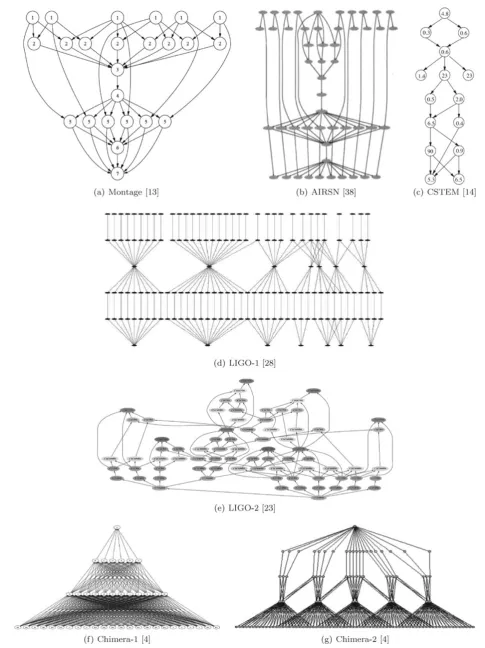
Our evaluation comprises experiments and simulations with eight DAGs of real world applications (Fig.3), namely Montage [13], AIRSN [38], CSTEM [14], LIGO-1 [28] and LIGO-2 [23], Chimera-1 and Chimera-2 [4], and the median filter image processing application, represented by the DAG in Fig.2.
3.3 Initial schedule
When submitting a DAG to be executed, the user may want to have it finished before a certain time. LetDGbe the dead-line (or a desired finish time) of a DAGG. The proposed al-gorithm makes an initial schedule using the Path Clustering Heuristic (PCH) algorithm [6]. This initial schedule consid-ers only the private resourcesri∈Rto check if they already satisfy the deadline. If the deadline is not satisfied, the algo-rithm starts the process of deciding which resources it will request to the public cloud. This decision is based on per-formance, cost, and the number of tasks to be scheduled in the public cloud. To make the initial schedule, the PCH al-gorithm uses some attributes computed for each DAG node:
•Computation cost:
wi,r=
instructions
pr
wi,rrepresents the computation cost (execution time) of the nodeiin the resourcer, andpr is the processing capacity of resourcerin instructions per second.
•Communication cost:
ci,j =datai,j lr,p
ci,j represents the communication cost (time to transfer data) between nodesni andnj using the linklbetween re-sourcesrandp. Ifr=p, thenci,j =0.
•suc(ni)is the set of immediate successors of nodeniin the DAG.
•pred(ni)is the set of immediate predecessors ofni in the DAG.
•Priority:
Pi=
wi,r, suc(ni)= ∅
wi,r+max∀nj∈suc(ni)(ci,j +Pj), otherwise Piis the priority level of nodeiat a given time instant during the scheduling process.
•Earliest start time:
EST(ni, rk)=
whereSTi =max∀nh∈pred(ni)(EST(nh, rk)+wh,k +ch,i).
EST(ni, rk) represents the earliest start time possible for nodeiin resourcekat a given scheduling instant.Time(rk) is the time when resourcekis available to execute nodei.
•Estimated finish time:
EFT(ni, rk)=EST(ni, rk)+wi,k
EFT(ni, rk)represents the estimated finish time of nodeiin resourcek.
After computing these attributes, the initial scheduling takes place by creating groups of nodes (clusters of tasks) that are in the same path in the DAG. Tasks in the same ter are scheduled in the same resource. To create such clus-ters, the algorithm uses the priority attribute to select the first task to be added to the first cluster (clustering phase). The first tasktiselected to compose a clusterclskis the unsched-uled node with the highest priority. It is added toclsk, then the algorithm starts a depth-first search on the DAG start-ing onti, selectingts∈succ(ti)with the highestPs+ESTs and adding it toclsk, untilts has a non-scheduled predeces-sor. The resource selected for a given cluster of tasks is the one that minimizes theEFTof the cluster. For more details about PCH, please refer to [6].
4 The HCOC scheduling algorithm
The HCOC algorithm is based on the following general steps:
1. Initial schedule: schedule the workflow in the private cloudR;
2. While the makespan is larger than the deadline: – Select tasks to reschedule;
– Select resources from the public clouds to compose the hybrid cloudH;
– Reschedule the selected tasks inH.
The two main steps of the algorithm are the selection of tasks to reschedule and the selection of resources from the public cloud to compose the hybrid cloud. While the former decides which tasks can have their execution time reduced by using more powerful resources from the public cloud, the latter determines the performance and costs involved in the new schedule.
In this paper we compare three policies to select which tasks will be rescheduled if the desired execution time is violated in the initial schedule:
– HighestPi: select the nodeni which has the highest pri-orityPi in the scheduled workflow. This selects tasks to reschedule from the beginning of the DAG to the end, and it is the main policy evaluated throughout the paper;
– Highest EFTi: select the nodeni which has the highest estimated finish time EFTi in the scheduled workflow. This policy selects tasks from the end to the beginning of the DAG;
– HighestPi+ESTi: select the nodeniwhich has the high-est priority plus its high-estimated start time,Pi+ESTi, in the scheduled workflow. This is the same policy used by PCH to create clusters of tasks [9].
With the definition of which tasks will be rescheduled, the algorithm decides how many resources to request from the public cloud considering their prices and performance. Such resources will be used to compose the hybrid cloud. Our algorithm takes into account the number of clusters of tasks being rescheduled to select these resources, as well as their cost, number of cores, and performance. The benefits of considering the number of resource cores are twofold: (i) task dependencies costs are suppressed, since commu-nication time between two tasks in the same processor is considered to be null; and (ii) in general, higher number of cores means lower cost per core. Note that this last benefit is only interesting when there are enough tasks to be exe-cuted in parallel, making use of most cores rented. This is why our algorithm considers the number of clusters of tasks being rescheduled.
After the initial schedule generated by PCH, the algo-rithm checks if resources from the public cloud are needed based on the deadlineD. If the makespan given by PCH is larger thanD, the algorithm selects the node i that is cur-rently scheduled in the private cloud and has the largestPi to be scheduled considering the public cloud as well. The al-gorithm repeats these steps until the deadline is met or a cer-tain number of iterations is reached. This strategy is shown in Algorithm1.
The second line of Algorithm1makes the initial schedule using the PCH and considering only resources in the private cloud. After that, whileDis violated, the algorithm iterates until the deadline is met or the number of iterations is equal to the number of nodes in the DAG (line 3). Inside this it-eration, the algorithm selects the node ni such that Pi is maximum andniis not in the current rescheduling groupT (line 5). Then, in line 7, nodeni is added to the setT, which is composed of all nodes being rescheduled from the private cloud to the public cloud. In line 8, the algorithm computes the number of clusters of nodes inT, which will determine how many resources (or cores) will be requested to the pub-lic cloud. After that, an iteration is repeated until the num-ber of selected cores reaches the numnum-ber of clusters inT, always selecting the public cloud resourceiwhich gives the smallest pricei
Algorithm 1 HCOC: the Hybrid Cloud Optimized Cost scheduling
1: R=all resources in the private cloud 2: ScheduleGin the private cloud using PCH
3: whilemakespan(G) >DANDiteration<size(G)do 4: iteration=iteration+1
5: select nodeni such thatPi is maximum andniT
6: H=R 7: T =T ∪ t
8: num_clusters=number of clusters of nodes inT 9: whilenum_clusters>0do
10: Select resourceri from the public clouds such that
pricei
num_coresi×pi is minimum and num_coresi <=
num_clusters 11: H=H∪ {ri}
12: num_clusters=num_clusters−num_coresi
13: end while 14: for allni ∈T do
15: Scheduleni inhj∈Hsuch thatEFTi is minimum
16: RecalculateESTsandEFTs 17: end for
18: end while
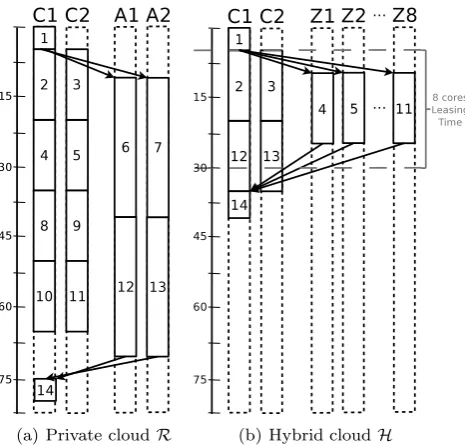
Figure4shows an example considering the DAG of Fig.2 and resources in Tables 1 and 2, with D=45. The ini-tial schedule considering only the private cloud resources is on the left-hand side of Fig.4. It allocates nodes in two cores of Cronos (C1 and C2) and two cores of Apolo (A1 and A2), resulting in makespan=80 and cost=0. The schedule in the hybrid system using HCOC is shown on the right-hand side. It uses two cores of Cronos and 8 cores of the public cloud (Z1 toZ8), withmakespan=40 and cost =25×0.9 =22.5, since the lease time is 25 time units and the leasing of 8 cores in Zeus costs $0.9 per time unit. This schedule is achieved starting with the schedule on the left-hand side, and then rescheduling nodes 1,2,3,4,5,6,7,8,9,10 and 11, in this order.
Besides the private-only and HCOC scheduling, we consider another approach as comparison. We call greedy scheduling the approach where both resources from private and public clouds are considered, but resources from the public cloud are selected based solely on their performance no matter their costs. This approach follows the same algo-rithm as the scheduling in the private cloud only, but con-sidering that any resource in any cloud can be used. For the example of Figure4, the greedy approach would result in a schedule withmakespan=35 andcost=(25×0.3)×10= 75, using 10 leased resources with 1 core each during 25 time units.
Note that HCOC can be easily adapted to deal with bud-gets instead of D. In this case, the user just has to stipu-late a budgetBto be obeyed, and the outer iteration can be adapted to be executed while the current execution cost is
Fig. 4 Example of scheduling in the private and hybrid clouds
smaller than B. This would also be useful in prepaid sys-tems, where the user pay for resources. Additionally, other heuristics might be used instead of PCH. In fact, in order to evaluate the robustness of the proposed strategies, we also executed simulations of the proposed algorithm with the Heterogeneous Earliest Finish Time algorithm [32].
5 Evaluation
The evaluation is separated in two parts: first, we present results for experiments conducted in our testbed [9], as de-scribed in Sect.2. After that, we show simulations covering more types of workflows and different resource configura-tions. The metrics used are the average makespan and aver-age cost of the schedules given by the algorithms, the per-centage of times the algorithm did not reach the deadline, and the number of rescheduled tasks. Results show 95% confidence intervals.
5.1 Experimental results
Fig. 5 The segmentation and merge operations
The median filter substitutes the value of a pixel by the median value from its neighborhood. It sorts the pixels in the neighborhood and picks the median pixel value as the new value for the pixel of interest. Thus, for a neighborhood of size 1 (3×3 filter), 9 elements of the matrix are sorted and the median value is selected. For a neighborhood of size 2 (5×5 filter), 25 elements are sorted, and so on. In our experiments we show results for 3×3 and 5×5 filters.
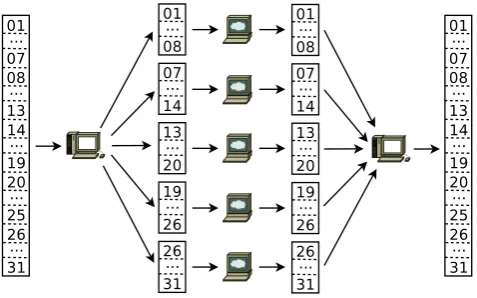
To apply the filter in a distributed way, we first split the image into smaller blocks, then applied the median filter on each block separately, and merged the blocks to generate the final image. Because the filter uses a median value of a neighborhood, there is data redundancy in the generated blocks. For instance, in the 3×3 filter the first and last lines on each block are duplicated, thus the first and last lines of the block can have the filter applied using their full neighbor-hood. Figure5illustrates the segmentation and merge oper-ations. Note that application is essentially a fork-join DAG, as the one shown in Fig.2. The execution and communica-tion costs for the DAG were estimated from historical data from other executions of the filter.
We developed a service to execute the application which applies the filter on the matrix file. This service is used by the workflows and it provides several operations, such as splitting the file into blocks according to the desired number of blocks, applying the median filter on a file, generating another file with the resulting block/matrix, and merging the blocks to generate the resulting image. A set of workflows was created in GPOL (introduced in Sect.2) to evaluate the scheduling performance.
We evaluated HCOC in the resources shown in Tables1 and2with the median filter workflow using a matrix of size 7500×7500 with different number of slices and filter sizes. We measured the execution time (makespan) and cost for executing the workflows, computing the average over 3 ex-ecutions. Note that the cost for executing workflows in the private cloud is 0, thus it is not shown in the graphs.
We consideredD=35 for 3×3 filter andD=50 for 5×5 filter. Figure6shows the average makespan and
aver-age cost for the median filter with 4, 8, and 12 slices. Us-ing only locally available resources from the private cloud cannot meet the deadline, resulting in the highest makespan among the three scenarios. The greedy scheduling can meet the deadline with a very low makespan; however, the cost for the execution is high. The execution in the hybrid system with HCOC can meet the deadline with costs 2 to 5 times lower than greedy average, as we can observe in Fig.6(b).
From this initial evaluation we observe that the proposed algorithm can reduce the makespan when compared to the private cloud execution, as well as the cost when compared to the execution in the public cloud. The HCOC algorithm is capable of decreasing the makespan achieved in a local exe-cution without prohibitively increasing the exeexe-cution cost, as well measures by which extent such variations occur. We can note that in the private cloud, the higher the number of slices, the higher the execution time. This is because the slice and merge operations take more time to split the files, but there are no parallel processors available to execute all the slices. On the other hand, executing most tasks of the workflow in the public cloud can reduce the execution time, since there are more processors available and more slices can be exe-cuted in parallel. In the hybrid execution, the algorithm stops requesting public cloud resources when the deadline is met, thus there are fewer slices executing in parallel than in the public cloud execution, but more than in the private cloud execution.
5.2 Simulation results
In the simulations we evaluate the algorithms using differ-ent cloud sizes, workflows, and deadlines. The evaluation of the proposed algorithm, the Hybrid Cloud Optimized Cost (labeled as HCOCin the graphs), is done using the three different task selection policies for rescheduling described in Sect.4(highestP, highestP +EST, and highestEFT). The proposed algorithm is compared with two different ap-proaches: Private Cloud and Greedy. The Private Cloud approach considers only resources available in the private cloud when scheduling, which actually is the initial sched-ule. TheGreedyapproach considers both resources from pri-vate and public clouds, but resources from the public cloud are selected based solely on their performance no matter their costs. In addition, we present results that compare the communication costs involved when using each scheduling algorithm.
5.2.1 Simulation scenarios and configurations
Fig. 6 Results for median filter DAGs
In each simulation we generated a private cloudRwith 2 to 10 resources. Each resource had its processing power randomly taken from the interval(10,100):∀ri∈R,pri=
random(10,100). Links between resources in the private cloud had their bandwidth randomly taken from the set {40,50,60,70,80}. The external link of the private cloud (i.e., the link that connects the private cloud to the pub-lic clouds) had its bandwidth randomly taken from the set {20,30,40,50}. These resource and link configurations aim to cover a wide range of processor capacities and bandwidth, combining high processing power with low bandwidth and vice versa. Additionally, the external bandwidth is usually lower than the internal bandwidth, which is a common con-figuration in real environments.
On the other hand, public cloud resources could be re-quested by the scheduler as it needed, without a limit in the number of resources that could be leased. The num-ber of cores and costs per time unit for using public cloud resources followed what is shown in Table 2. Processing power from public cloud’s virtualized resources were ran-domly taken from the interval (50,150): ∀ui ∈U, pui = random(50,150), while bandwidth between any two re-sources in the same public cloud was set to 100.
The main metrics evaluated are the average makespan and average cost of the schedules given throughout the sim-ulations, as well as the percentage of times each algorithm did not achieve a makespan lower thanD. To compute the cost of a given schedule, we considered all time intervals that each resource was being used for processing a task or transmitting data. Therefore, gaps in the schedule were not computed as resource usage time. In addition, for each sce-nario and each DAG, we present two graphs for each met-ric: one that averages over all simulations and another one that averages only over simulations where the private cloud scheduling did not achieve a makespan lower thanD.
We used the DAGs shown in Sect.3.2to run our sim-ulations. In particular, the Montage application was gener-alized, generating DAGs with size from 5 to 100. Besides that, random DAGs with size from 5 to 100 were gener-ated using the procedure described in [29]. Each task of the generated DAGs had its computing cost generated from the interval (500,4000). For each type of DAG, we per-formed simulations using different communication to com-putation ratios (CCRs): low communication (CCR=0.5); medium communication (CCR=1.0); high communica-tion (CCR=2.0). CCR is defined as the ratio between the amount of communication and the amount of computation in the workflow.
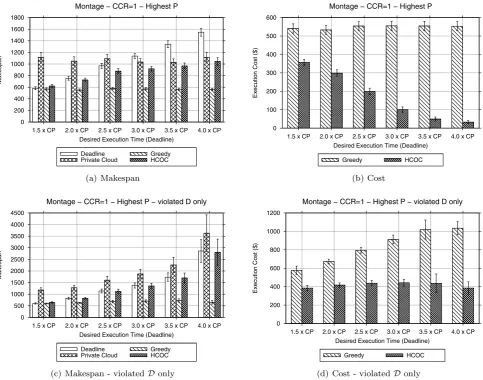
This first set of simulations used the HighestP policy for selecting tasks to reschedule and medium communica-tion. Thus, this set represents results for Algorithm1without any modification. Each result graph shows six sets of bars. Each set presents results for differentDvalues, varying from 1.5×CPto 4.0×CP, whereCPis the execution time in the best resource available of all tasks in critical path of the cur-rently scheduled DAG. For makespan results, there are four bars in each set: averageD, average makespan forprivate cloudscheduling, average makespan forgreedyscheduling, and average makespan for HCOC scheduling.
5.2.2 Highest priority
Fig. 7 Results for Montage DAGs with size from 5 to 100 with medium communication (CCR=1.0)
while the greedy and private cloud averages present negligi-ble changes. This is the desired behavior, and the efficiency of HCOC is corroborated by the average costs. Even pre-senting an average makespan really close to the greedy ap-proach when D=1.5×CP, HCOC generated makespans with an average cost 34% lower. The higher theD, the lower the cost from HCOC schedules. This cost efficiency when D=1.5×CP can be explained by the multicore and cost aware scheduling. While HCOC leases resources from the public cloud according to the number of clusters of tasks to be scheduled, the greedy approach tends to lease single core resources for each cluster, since it considers only one cluster of tasks at a time. Additionally, using multicore re-sources can minimize communication costs, contributing to the minimization of the makespan.
Observing the results for Montage considering only ex-ecutions where the private cloud approach did not achieve the desired makespanD, we can note that HCOC makespans closely follow the averageD. This means that the proposed
Table 3 Percentage of schedules that did not meet the deadline for Montage DAGs Algorithm Deadline
D=1.5×CP D=2.0×CP D=2.5×CP D=3.0×CP D=3.5×CP D=4.0×CP
Private cloud 92.7 71.2 45.1 22.6 11.1 8.5
Greedy 47.5 22.7 14.7 6.1 3.6 1.5
HCOC 31 12.9 4.8 1.5 0.3 0
Fig. 8 Results for random DAGs with size from 5 to 100 generated using the procedure described in [29] and medium communication (CCR=1.0)
resources can minimize communication costs, reducing the makespan.
Results for random DAGs with size from 5 to 100 and CCR=1.0 are shown in Fig. 8 and Table4. We can ob-serve a quite similar behavior to the Montage results. This behavior indicates that HCOC can maintain a good perfor-mance with DAGs with different topologies.
After Montage and random DAGs results, which repre-sent simulations using DAGs of varying sizes, hereon we present results for DAGs with fixed number of nodes. In the
gener-Table 4 Percentage of schedules that did not meet the deadline for random DAGs Algorithm Deadline
D=1.5×CP D=2.0×CP D=2.5×CP D=3.0×CP D=3.5×CP D=4.0×CP
Private cloud 95.2 80.1 66.8 52.1 36.1 26.1
Greedy 50.5 28.4 15.7 11.3 4.7 3.3
HCOC 33 24.5 10.5 5.3 2.3 1
Table 5 Percentage of schedules that did not meet the deadline for LIGO-1 DAGs Algorithm Deadline
D=1.5×CP D=2.0×CP D=2.5×CP D=3.0×CP D=3.5×CP D=4.0×CP
Private cloud 100 100 100 100 99.7 97.8
Greedy 75.9 44.7 28.9 16.8 12.4 6.7
HCOC 33.4 28.1 19 11.8 8.2 4.9
Fig. 9 Results for LIGO-1 DAGs (Fig.3(d)) and medium communication (CCR=1.0)
ates schedules with costs around 45% less than the greedy algorithm.
Considering only executions where the private cloud ap-proach did not achieve the desired makespan, LIGO results are very close to the ones achieved for the average over all simulations, therefore we omit such graphs. This hap-pens because nearly 100% of the simulations resulted in the private cloud scheduling do not achieving the desired makespanD, as shown in Table5. From this table we can also observe that HCOC can meet the deadline more often than greedy.
Figure 10 and Table 6 present results for the AIRSN workflow. These graphs are similar to Montage and ran-dom DAGs results. It is worth noting, however, that for D=1.5×CPthe proposed algorithm can reach an average makespan lower than the one given by the greedy algorithm. This happens because the greedy algorithm did not reach the
desired makespan on average, and HCOC takes advantage of its multicore policy to reduce the makespan to as low asD. Such policy, along with HCOC’s cost-awareness, is also re-sponsible for this achievement being possible even with a lower average cost than the one presented by the greedy.
For Chimera-1 simulations (Fig.11and Table7), results show an intermediate behavior between Montage and LIGO: while the makespan increases withD, the cost stills showing slight changes (as LIGO does) up toD=2.5×CP. Above this value, the average cost starts to get lower (as in Montage graphs). We observed that this change of behavior happens when the desired makespan reaches a value where an entire DAG level may be left in the private cloud, lowering the public cloud leasing costs.
Fig. 10 Results for AIRSN DAGs (Fig.3(b)) and medium communication (CCR=1.0)
Table 6 Percentage of schedules that did not meet the deadline for AIRSN DAGs Algorithm Deadline
D=1.5×CP D=2.0×CP D=2.5×CP D=3.0×CP D=3.5×CP D=4.0×CP
Private cloud 100 92.6 54.3 27.2 17.8 12.5
Greedy 60.4 35.4 17.6 10.7 5 2.3
HCOC 29.4 14.2 3.2 1.2 0.3 0
showed that the initial schedule was capable of satisfying D in nearly all simulations. LIGO-2 results are omitted, since they showed similar behavior to Montage and random DAGs, corroborating the results.
Table 8 presents how many tasks were rescheduled on average by HCOC, showing averages for simulations with CCR=1 and highest P rescheduling policy. Re-sults from this table also support the conclusions presented in Sect. 5.2.2. For example, we observe in Table 8 that Chimera-1 DAG has a sudden lowering in the number of
rescheduled tasks when D is increased from 3.0×CP to 3.5×CP. This behavior is one of the explanations for the pattern shown in Fig.11(b), where the average cost starts dropping whenD=3.0×CP.
Fig. 11 Results for Chimera-1 DAGs (Fig.3(f)) and medium communication (CCR=1.0)
Table 7 Percentage of schedules that did not meet the deadline for Chimera-1 DAGs Algorithm Deadline
D=1.5×CP D=2.0×CP D=2.5×CP D=3.0×CP D=3.5×CP D=4.0×CP
Private cloud 100 99.8 97.4 86.4 63.8 49
Greedy 63.4 38.5 31.2 21.7 16.7 14.4
HCOC 40.2 35.3 30.4 19.7 12 8.2
Communication overhead In order to measure the impact of distributing tasks among the hybrid cloud resources, we evaluate the communication costs in the schedules. Given a DAGG=(V,E), we define
C= ea,b∈E
ca,b
as the total communication costs at the end of the scheduling process. Table9shows the quotient ofCHCOCwithCPrivate
andCGreedy. We can note that, when compared to the
sched-Table 8 Average number of
tasks rescheduled by HCOC Deadline DAG (DAG size)
Montage Random LIGO-1 LIGO-2 AIRSN Chimera-1 Chimera-2
(5–100) (5–100) (168) (77) (53) (44) (124)
D=1.5×CP 43.72 52.45 164.7 73.66 45.23 43.47 122.88
D=2.0×CP 31.18 44.09 158.89 55.74 33.36 41.9 119.97
D=2.5×CP 17.28 35.9 150.17 35.45 15.59 37.5 114.72
D=3.0×CP 7.29 25.45 139.21 22.1 8 28.38 107.19
D=3.5×CP 3.15 15.28 128.96 13.5 5.21 18.73 96.13
D=4.0×CP 1.66 9.96 114.46 9.11 3.28 12.43 82.78
Table 9 Relation of total communication in schedules given by HCOC algorithm against private and greedy approaches
DAG CPrivateCHCOC CHCOCCGreedy
1.5XCP 2.0XCP 2.5XCP 3.0XCP 3.5XCP 4.0XCP 1.5XCP 2.0XCP 2.5XCP 3.0XCP 3.5XCP 4.0XCP
Montage 0.5498 0.6638 0.7764 0.9158 0.9445 0.9857 1.1598 1.4100 1.748 2.2210 2.2370 2.2100 Random 0.6030 0.8135 0.9387 1.0623 1.0397 1.0395 1.0084 1.2937 1.5473 1.7020 1.6673 1.7902 LIGO-1 0.3761 0.5054 0.6215 0.7090 0.8171 0.9386 1.0645 1.4387 1.7479 2.0202 2.3538 2.5385 LIGO-2 0.9225 0.9491 0.9777 1.0495 1.0474 1.0574 1.7700 1.7433 1.9067 2.0093 2.1221 2.1239 AIRSN 0.6653 0.8855 0.9748 0.9622 0.9888 0.9857 1.1833 1.6695 1.6068 1.8493 1.8968 1.7894 Chimera-1 0.6058 0.6828 0.8115 0.9559 1.0635 1.0761 0.8409 0.9601 1.2003 1.3634 1.5159 1.5300 Chimera-2 0.5644 0.6404 0.6257 0.7164 0.8073 0.9382 0.9908 1.0913 1.1354 1.2089 1.4780 1.6188
uled in the private cloud, approximating the relation to 1. Thus, we conclude that HCOC does not incur in commu-nication overheads when compared to the execution in the private cloud only, actually reducing the overall communi-cation costs in most cases.
In general terms, the same reasoning is valid for the re-lation with the greedy approach. However, since the greedy approach tends to send most tasks to the public cloud, con-centrating tasks on fewer resources, the relation becomes larger as higher is the deadline. For example, HCOC sched-ules for Montage DAGs can generate around twice commu-nication (quotient of 2.2370 forD=3.5) when compared to the greedy approach. Therefore, the greedy approach re-duces the overall communication costs, but it increases the execution costs.
5.2.3 Additional results
Hereon, in this second set of simulation results, we present additional graphs for Montage DAGs with number of nodes from 5 to 100 to corroborate the conclusions outlined hith-erto. We have chosen to present Montage results because many other DAGs results showed the same pattern.
HEFT To evaluate the robustness of the proposed algo-rithm, we have run simulations using another heuristic to make the initial schedule. The Heterogeneous Earliest Fin-ish Time (HEFT) [32] is a well-known heuristic to schedule
DAGs in heterogeneous systems. We observe no significant changes in the general behavior of the results for Montage DAGs, as shown in Figure12.
Different CCRs We also conducted simulations to evaluate the HCOC algorithm using PCH in DAGs with CCR=0.5 (Fig.13) and CCR=2.0 (Fig.14). These results show sim-ilar patterns to the ones found in simulations with CCR= 1.0.
Amazon EC2 Configuration We conducted simulations us-ing different resources configuration. This new configura-tion mimics some resources processing power and prices of-fered by Amazon Elastic Compute Cloud (Amazon EC2) for its on-demand instances, shown in Table10. Note that we generated a random processing capacity in the inter-val(10,70)to represent the small instance power, and the other instance types have their processing power derived from that. This follows the Amazon EC2 instance types,7 which are based inEC2 Compute Unitsand varying number of virtual cores. According to Amazon, “one EC2 Compute Unit provides the equivalent CPU capacity of a 1.0–1.2 GHz 2007 Opteron or 2007 Xeon processor”.8
Fig. 12 Results using HEFT for Montage DAGs (Fig.3(a)) with medium communication (CCR=1.0)
Fig. 13 Results for Montage DAGs with size from 5 to 100 with low communication (CCR=0.5)
Table 10 Resources configurations from the Amazon EC2 on-demand instances
Type Cores prper core Price
Small 1 random(10,70) $0.085
Large 2 2×pSmall $0.34
Extra Large 4 2×pSmall $0.68
Extra Large 8 2.5×pSmall $0.68
High CPU
Average makespan and average costs for Montage DAGs using the Amazon resources configuration shown in Ta-ble 10are presented in Fig.15. We observe no significant differences in the graph behavior, which indicates that the algorithm is robust enough to deal with changes in the re-sources capacities and pricing.
HighestP +EST Figure16shows graphs for results with the Montage DAGs but using the highestP+EST reschedu-ling policy. No significant changes are observed when com-pared to the highestP policy (Fig.7).
Highest EFT Figure17shows graphs for results with the Montage DAGs but using the highestEFTrescheduling pol-icy. Again, no significant changes to the highestP policy are observed.
Fig. 14 Results for Montage DAGs with size from 5 to 100 with high communication (CCR=2.0)
Fig. 16 Results for Montage DAGs with size from 5 to 100, medium communication (CCR=1.0) and highestP+ESTrescheduling policy
Fig. 17 Results for Montage DAGs with size from 5 to 100, medium communication (CCR=1.0) and highestEFTrescheduling policy
rescheduling provided by HCOC handles these differences by scheduling tasks on the public cloud until the deadlineD is met. With this, regardless which tasks are scheduled on the public cloud, the average makespan is close toD.
6 Related works
Due to its importance in reducing application execution times, the scheduling problem is well studied for a variety of problems. In particular, DAG scheduling studies comprise both homogeneous [3,20,21,33] and heterogeneous [7,27, 29,32] systems. Task scheduling is an NP-Complete prob-lem [26], thus its optimization version is NP-Hard. There-fore, most efforts in scheduling algorithms are concentrated on heuristics and meta-heuristics [11,17,18,29,32]. There are some works which use approximation algorithms [25,
16] and combinatoric approaches [5]. Extensive descriptions about scheduling in computational grids are presented in [15] and [19].
avoid resource load peaks that could affect the achievement of a deadline. These works do not consider multicore nor the dynamic provision/leasing of resources, available in a hybrid cloud. However, the rescheduling policy proposed could complement our work if used in the private cloud to manage unexpected loads on shared resources.
In [10], Van den Bossche et al. deal with the scheduling of independent tasks on hybrid clouds. They propose a binary integer program to decide which cloud provider to choose when outsourcing a task that cannot be currently executed in the private cloud. Workflow scheduling in conjunction with service composition in grids is discussed by Zhang et al. in [37]. An algorithm to schedule composed services is pro-posed. The composed services are modeled as a workflow, and then this workflow is scheduled using a technique called list scheduling. Fujimoto and Hagihara present an approxi-mation algorithm for task scheduling in [16]. The algorithm uses the resource utilization as the performance criterion, not focusing on makespan minimization, costs, or deadlines. Since approximation algorithms are hard to be developed, the authors make some assumptions to make the problem more specific, like considering that all tasks of the workflow have the same weight.
The scheduling of DAGs in hybrid clouds is a challenge that has been becoming important. As hybrid clouds become popular, aggregating public clouds and private clouds or grids, deciding where to execute tasks aiming performance and cost reduction turns highly relevant. This problem stills in its infancy and in this paper we investigate it proposing the HCOC algorithm.
7 Conclusion
Hybrid clouds are being used to execute different kinds of applications. Among them, workflows have an important role in processes of many fundamental science fields, such as physics, chemistry, biology, and computer science. To speed up science advancements, it is important to provide efficient resource utilization as well as to make application executions affordable.
In this paper we present HCOC: The Hybrid Cloud Op-timized Cost scheduling algorithm. HCOC is an algorithm to speed up the execution of workflows obeying a desired execution time, but also reducing costs when compared to the greedy approach. The extensive evaluation carried out in this work provides sufficient data to support the conclusion that the HCOC algorithm can provide efficient scheduling in a hybrid cloud scenario. Its multicore awareness, along with the cost knowledge, can provide makespans as low as the user needs. As a consequence, the user is able to con-trol costs by adjusting the desired workflow execution time Daccording to his willingness. In general, the proposed al-gorithm has the ability of reducing the execution costs in
the public cloud with the increase of the workflow desired execution time. Besides that, in some cases where the de-sired execution time is too low, HCOC finds better sched-ules than the greedy approach by taking advantage of mul-ticore resources, reducing the number of violations of D. HCOC had its robustness attested by simulations using dif-ferent rescheduling criteria and heuristics to produce the ini-tial schedule.
Furthermore, HCOC can be easily adapted to handle bud-gets instead of deadlines, what makes it flexible to the use with different requirements. As future work, to deal with multiple workflows is an important issue. Besides that, con-sidering the potential presence of external load in private resources could improve the scheduling decisions. Another important point to be approached is how to estimate the available bandwidth between two public clouds. Such es-timation is essential for the scheduling algorithm to de-cide when dependent tasks could be put in different public clouds.
Acknowledgements The authors would like to thank FAPESP (09/15008-1), and CNPq (142574/2007-4) for the financial support.
References
1. The NIST definition of cloud computing 15. Tech rep, Na-tional Institute of Standards and Technology (NIST) (2009). http://csrc.nist.gov/groups/SNS/cloud-computing/cloud-def-v15. doc
2. Abels T, Dhawan P, Chandrasekaran B An overview of xen vir-tualization (2009).http://www.dell.com/downloads/global/power/ ps3q05-20050191-Abels.pdf
3. Amir Y, Awerbuch B, Barak A, Borgstrom RS, Keren A (2000) An opportunity cost approach for job assignment in a scalable com-puting cluster. IEEE Trans Parallel Distrib Syst 11(7):760–768 4. Annis J, Zhao Y, Voeckler J, Wilde M, Kent S, Foster I (2002)
Applying Chimera virtual data concepts to cluster finding in the Sloan Sky Survey. In: Supercomputing ’02: Proceedings of the 2002 ACM/IEEE conference on supercomputing. IEEE Computer Society Press, Los Alamitos, pp 1–14
5. Batista DM, da Fonseca NLS, Miyazawa FK (2007) A set of schedulers for grid networks. In: SAC ’07: Proceedings of the ACM symposium on applied computing. ACM, Seoul pp 209– 213
6. Bittencourt LF, Madeira ERM (2008) A performance-oriented adaptive scheduler for dependent tasks on grids. Concurr Comput 20(9):1029–1049
7. Bittencourt LF, Madeira ERM (2010) Towards the scheduling of multiple workflows on computational grids. J Grid Comput 8:419– 441. doi:10.1007/s10723-009-9144-1
8. Bittencourt LF, Senna CR, Madeira ERM (2010) Enabling exe-cution of service workflows in grid/cloud hybrid systems. In: In-ternational workshop on cloud management (Cloudman). IEEE Computer Society Press, Osaka
10. Van den Bossche R, Vanmechelen K, Broeckhove J (2010) Cost-optimal scheduling in hybrid IaaS clouds for deadline constrained workloads. In: 3rd international conference on cloud computing, pp 228–235
11. Corrêa RC, Ferreira A, Rebreyend P (1996) Integrating list heuris-tics into genetic algorithms for multiprocessor scheduling. In: SPDP ’96: Proceedings of the 8th IEEE symposium on parallel and distributed processing (SPDP ’96). IEEE Computer Society, Washington, p 462
12. Deelman E (2008) Clouds: an opportunity for scientific applica-tions? (keynote in the 2008 Cracow Grid Workshops)
13. Deelman E, Singh G, Su MH, Blythe J, Gil Y, Kesselman C, Mehta G, Vahi K, Berriman GB, Good J, Laity A, Jacob JC, Katz DS (2005) Pegasus: a framework for mapping complex scientific workflows onto distributed systems. Sci Program 13(3):219–237 14. Dogan A, Özgüner F (2005) Biobjective scheduling algorithms
for execution time-reliability trade-off in heterogeneous comput-ing systems. Comput J 48(3):300–314
15. Dong F, Akl SG (2006) Scheduling algorithms for grid computing: state of the art and open problems. Tech rep, Queen’s University School of Computing, Kingston, Canada
16. Fujimoto N, Hagihara K (2003) Near-optimal dynamic task scheduling of precedence constrained coarse-grained tasks onto a computational grid. In: 2nd intl symp on parallel and distributed computing, Slovenia. IEEE Press, New York, pp 80–87
17. Grajcar M (1999) Genetic list scheduling algorithm for scheduling and allocation on a loosely coupled heterogeneous multiprocessor system. In: DAC ’99: Proceedings of the 36th ACM/IEEE confer-ence on design automation. ACM Press, New York, pp 280–285 18. Hou ESH, Ansari N, Ren H (1994) A genetic algorithm for
multi-processor scheduling. IEEE Trans Parallel Distrib Syst 5(2):113– 120
19. Yu J, Buyya R, Ramamohanarao K (2008) Workflow scheduling algorithms for grid computing. Stud Comput Intell 146:173–214 20. Kwok YK, Ahmad I (1996) Dynamic critical-path scheduling: an
effective technique for allocating task graphs to multiprocessors. IEEE Trans Parallel Distrib Syst 7(5):506–521
21. Kwok YK, Ahmad I (1999) Static scheduling algorithms for allo-cating directed task graphs to multiprocessors. ACM Comput Surv 31(4):406–471
22. Lindley CA (1991) Practical image processing in: C: acquisition, manipulation and storage: hardware, software, images and text. Wiley, New York
23. Mendell G (2008) Use of Condor by the LIGO scientific collabo-ration. In: Padaryn/Condor Week. Wisconsin, USA
24. Nurmi D, Wolski R, Grzegorczyk C, Obertelli G, Soman S, Yous-eff L, Zagorodnov D (2009) The Eucalyptus open-source cloud-computing system. In: 2009 9th IEEE/ACM international sympo-sium on cluster computing and the grid (CCGRID). IEEE Press, Washington, pp 124–131
25. Phillips C, Stein C, Wein J (1997) Task scheduling in networks. SIAM J Discrete Math 10(4):573–598
26. Pinedo ML (2008) Scheduling: theory, algorithms, and systems. Springer, Berlin
27. Rahman M, Venugopal S, Buyya R (2007) A dynamic critical path algorithm for scheduling scientific workflow applications on global grids. In: Third IEEE international conference on e-Science and grid computing. IEEE Computer Society, Washington, pp 35– 42
28. Ramakrishnan A, Singh G, Zhao H, Deelman E, Sakellariou R, Vahi K, Blackburn K, Meyers D, Samidi M (2007) Scheduling data-intensive workflows onto storage-constrained distributed re-sources. In: CCGRID ’07: Proceedings of the seventh IEEE in-ternational symposium on cluster computing and the grid. IEEE Computer Society, Washington, pp 401–409
29. Sakellariou R, Zhao H (2004) A hybrid heuristic for DAG schedul-ing on heterogeneous systems. In: 13th heterogeneous computschedul-ing workshop. IEEE Computer Society, Washington, pp 111–123 30. Senna CR, Bittencourt LF, Madeira ERM (2009) Execution of
ser-vice workflows in grid environments. In: International conference on testbeds and research infrastructures for the development of networks & communities (Tridentcom). IEEE Computer Society, Washington
31. Smith JE, Nair R (2005) The architecture of virtual machines. Computer 38(5):32–38
32. Topcuoglu H, Hariri S, Wu MY (2002) Performance-effective and low-complexity task scheduling for heterogeneous comput-ing. IEEE Trans Parallel Distrib Syst 13(3):260–274
33. Yang T, Gerasoulis A (1994) DSC: scheduling parallel tasks on an unbounded number of processors. IEEE Trans Parallel Distrib Syst 5(9):951–967
34. Yu J, Buyya R (2006) Scheduling scientific workflow applications with deadline and budget constraints using genetic algorithms. Sci Program 14(3–4), 217–230
35. Yu J, Buyya R, Tham CK (2005) Cost-based scheduling of sci-entific workflow application on utility grids. In: Proceedings of the first international conference on e-science and grid computing. IEEE Computer Society, Washington, pp 140–147
36. Zhang Q, Cheng L, Boutaba R (2010) Cloud computing: state-of-the-art and research challenges. J Internet Serv Appl 1(1):7–18 37. Zhang S, Zong Y, Ding Z, Liu J (2005) Workflow-oriented grid
service composition and scheduling. In: International symposium on information technology: coding and computing, v 2, April 2005, Las Vegas, Nevada, USA. IEEE Computer Society, Wash-ington, pp 214–219