ISSN: 2278-7461, www.ijeijournal.com
Volume 1, Issue 6 (October2012) PP: 13-20
A Survey on Medium Access Control in Wireless Sensor
Networks
Rasmi Ranjan Patra
1and Prashant Kumar Patra
21
Department of Computer Science and Application, Centre for Post Graduate Studies, Orissa University of Agriculture and Technology, Odisha, India
2
College of Engineering and Technology,Biju Patnaik University of Technology, Odisha,India
ABSTRACT––The purpose of this investigation was to perform a fair and thorough physical evaluation of recent medium
access control (MAC) protocols for wireless sensor networks (WSNs). WSNs are used to solve many real world problems, such as periodic monitoring, event detection and tracking. They are commonly deployed in medical, agricultural and military applications, among others. Wireless sensor ―motes‖—small embedded systems equipped with radios for wireless communication—are almost always expected to operate unattended for long periods of time, relying upon batteries as a power source. As the vast majority of energy consumed by motes can be attributed to radio usage, the development of MAC protocols which seek to minimize energy consumption is an important area of wireless sensor network research. This project involved the implementation of four energy-efficient WSN MAC protocols and a fair evaluation and analysis of their energy consumption. The scope of this research is as follows i)Describe the WSN taxonomy and survey the MAC protocols for WSN ii) Evaluate and compare the performance of MAC protocol. It states the requirements for MAC protocol in WSN, gives an overview of the proposed MAC protocol and its variants. This Paper presents analysis, and discussion of proposed MAC protocols and their efficiency taking various factors.
KEYWORDS––MACPROTOCOLS,WIRELESS NETWORK,CSMA,S-MAC,T-MAC,
I.
INTRODUCTION
Sensor networks differ from traditional wireless voice or data networks in several ways. First of all, most nodes in sensor networks are likely to be battery powered, and it is often very difficult to change batteries for all the nodes. Second, nodes are often deployed in an ad hoc fashion rather than with careful pre-planning; they must then organize themselves into a communication network. Third, many applications employ large numbers of nodes and node density will vary in different places and times. Finally, most traffic in the network is triggered by sensing events, and it can be extremely busty. Hence these Wireless Sensor Networks have severe resource constrains and energy conservation. It can operate in three or four different states: transmit, receive, idle and sleep. However, all the active states consume almost the same energy. Substantial research has been done on the design of low power electronic devices in order to reduce energy consumption of these sensor nodes. A MAC layer is the most suitable level to address the energy inefficiency. This layer is used to coordinate node access to the shared wireless medium. The MAC layer provides fine-grained control of the transceiver, and allows switching the wireless radio on and off. How frequent and when such switching have to be performed is the major goal of an energy saving mechanism of the MAC layer.
II.
RELATED
WORKST-MAC is an improvement to S-MAC to reduce energy consumption on idle listening. It introduces an adaptive duty cycle: all messages are transmitted in variable length bursts and the lengths of bursts are dynamically determined. Similar to S-MAC, there are active periods and sleep periods in a time-frame. An active period ends if there is no activity for a time period of Ta. Ta is the minimum listening time in the time-frame. T-MAC reduces the time in active state compared with S-MAC. However, T-MAC has one major defect: the early sleeping problem. Sending request aftertime and full buffer first are proposed for solving the problem while the result is not satisfactory. Frequency Division Multiple Access (FDMA); Time Division Multiple Access (TDMA) [6]; Code Division Multiple Access (CDMA) [7]. In addition to TDMA, FDMA and CDMA, various reservation based [8] or token based schemes [9,10] are proposed for distributed channel access control. Among these schemes, TDMA and its variants are most relevant to our work. Allocation of TDMA slots is well studied (e.g., in the context of packet radio networks) and there are many centralized [11, 12], and distributed [13, 14, 15] schemes for TDMA slot assignments. All these existing protocols are either centralized or rely on a global time reference. There is considerable recent work on integrated views of several layers in wireless networking. Power controlled MAC protocols have been considered by [16, 17, 18, 19, 20] in settings that are based on collision avoidance [13, 12, 20], transmission scheduling [16], and limited interference CDMA systems [14]. Some recent results suggest energy saving by powering off a subset of the nodes in an ad hoc wireless network [21, 22, 23, 24]. The common theme is to enable nodes to power off or go to low energy sleeping mode during idle time while ensuring connectivity.
III.
PROPOSED
MAC
LAYER
PROTOCOLS
In this section, a wide range of MAC protocols defined for sensor networks are described briefly by stating the essential behaviour of the protocols wherever possible. Moreover, the advantages and disadvantages of these protocols are presented.
A)SENSOR-MAC PROTOCOL
Sensor-MAC (S-MAC) protocol designed for wireless sensor networks. They identify the four following sources of energy wastage:
• Collisions: • Overhearing: • Idle listening
• Control packet overhead:
S-MAC tries to reduce the waste of energy from all four above sources and can accept reduction in both per hop fairness and latency. To do that, S-MAC uses following novel techniques in order to reduce the energy consumption and support self configuration as follow:
• Periodic listen and sleep: To reduce energy spent in idle listening S-MAC reduces the active period by putting nodes into periodic sleep state. The basic scheme is shown in Fig. 1. Each node sleeps for some time, and then wakes up and listens to see if any other node wants to talk to it. During sleeping, the node turns off its radio, and sets a timer to awake it-self later.
Fig-1: periodic listen & sleep in S-MAC
Collision Avoidance-The basic model of S-MAC is similar to CSMA protocol with RTS/CTS to avoid collisions. It also uses virtual carrier sense for collision avoidance
Virtual Carrier Sense: Each node maintains the NAV to indicate the activity in its neighborhood. When a node receives a packet destined to other nodes, it updates its NAV by the duration field in the packet. A nonzero NAV value indicates that there is an active transmission in its neighborhood. The NAV value decrements every time when the NAV timer fires. Thus, a node should sleep to avoid overhearing if its NAV is not zero. It can wake up when its NAV becomes zero.(fig-2)
Co-ordinate Sleeping: Periodic sleeping overcomes idle listening, but it causes for increased Latency which is maintained by coordinated sleeping. In which nodes coordinate their sleep schedules.
Choosing and Maintaining Schedules
o Each node maintains a schedule table that stores schedules of all neighbors. A node first listens for a certain amount of time i.e. for SP. These are the possibilities(fig-3)
o Case-1: If it does not hear a schedule from another node. It randomly chooses a schedule and broadcast a SYNC packet. This node is called aSYNCHRONIZER.
o Case-2: node receives a schedule from a neighbor before choosing its own schedule. It just follows this neighbor’s schedule. This node is called a FOLLOWER and it waits for a random delay and broadcasts its schedule.
o Case-3: If a node receives a neighbor’s schedule after it selects its own schedule. Here two cases happens
case1: If the node has no other neighbor it will discard its current schedule & follow new one.
Case-2: If it has one or more neighbors it adopts both schedules.
Fig-3: Node Synchronization in S-MAC
Neighboring nodes form virtual clusters to auto synchronize on sleep schedule. If two neighboring nodes reside in two different virtual clusters (fig-4), they wake up at listen periods of both clusters. A drawback of S-MAC algorithm is the possibility of following two different schedules, which results in more energy consumption via idle listening and overhearing.
Fig-4: Border nodes adapting two schedules
Maintaining Synchronization: Schedule exchanges are accomplished by periodic SYNC packet broadcasts to immediate neighbors. The period for each node to send a SYNC packet is called the synchronization period. The Figure represents a sample sender-receiver communication. Collision avoidance is achieved by a carrier sense (represented as CS in the figure-5). Furthermore, RTS/CTS packet exchanges are used for unicast-type data packets.
Adaptive listening: Since the nodes periodically sleep, when a sender gets a packet to transmit, it must wait until the receiver wakes up which then introduces the sleep delay. As the sleep time increases, S-MAC achieves higher energy efficient as well as suffers more delay. Even if the sleep time is zero (no sleeping) there is still a delay because contention only starts at the beginning of each listen interval. The sleep delay results in high overall latency, especially for multi-hop transmission, since all immediate nodes have their own sleep schedules. Adaptive listening technique is also proposed in to improve the sleep delay, and thus the overall latency. In that technique, the node who overhears its neighbor’s transmissions wakes up for a short time at the end of the transmission. Hence, if the node is the next-hop node, its neighbour could pass data immediately. However adaptive listening incurs overhearing and idle listening if the packet is not destined to the listening node.
Message Passing-Apply message passing model(fig-6), where long messages are divided into frames and sent in burst, in order to reduce the latency perceived by the applications (that require store-and-forward processing as data move through the network). This may result in unfairness in medium access. However, message-passing can achieve energy savings by reducing overhead and avoiding overhearing.
Fig-6: Message Passing used in S-MAC
Advantages — the energy waste caused by idle listening is reduced by sleep schedules. In addition to its implementation simplicity, time synchronization overhead may be prevented by sleep schedule announcements.
Disadvantages —Broadcast data packets do not use RTS/CTS, which increases collision probability. Adaptive listening incurs overhearing or idle listening if the packet is not destined to the listening node.
Sleep and listen periods are predefined and constant, which decreases the efficiency of the algorithm under variable traffic load.
B)TIMEOUT-MAC PROTOCOL
T. van Dam and K. Langendoen propose an adaptive energy efficient MAC protocol (T-MAC) which automatically adapts the duty cycle to the networktraffic. As with S-MAC, nodes form a virtual cluster to synchronize themselveson the beginning of a frame. But instead of using a fixed-length active period, TMACuses a time-out mechanism to dynamically determine the end of the activeperiod.
The novel idea of the T-MAC protocol is to reduce idle listening by transmitting all messages in bursts of variable length, and sleeping between bursts (fig-7). To maintain an optimal active time under variable load, we dynamically determine its length. The time-out value, TA, is set to span a small contention period and anRTS/CTS exchange. If a node does not detect any activity (an incoming message or a collision) within interval TA, it can safely assume that no neighbour wants to communicate with it and goes to sleep. On the other hand, if the node engages oroverhears a communication, it simply starts a new time-out after that communicationfinishes.
Fig-7: Adaptive Active times in T-MAC
RTS Retries-When a node sends an RTS & not receives the CTS back it should not sleep. It should resend at least for two times, if still no reply then it should go to sleep.
Determining TA
By receiving a RTS or CTS a node renewed its TA.The TA must be long enough to receive either RTS or CTS (Bcoz if it misses the RTS it might receive the CTS)
Fig-8 A basic data exchange. Node C overhears the CTS from node B and will not disturb the communication between A and B. TA must be long enough for C to hear the start of the CTS.
Ta > Tci + Trt + Tta + Tct
Where Tci is the length of the contention interval, Trt is the length of an RTS packet,
Tta is the turn-around time (time between the end of the RTS packet and the beginning of the CTS packet) and Tct is the length of the CTS packet.
Advantages
The adaptive duty-cycle allows T-MAC to adjust to fluctuations in network traffic, both in time and in space. S-MAC, on the other hand, operates with a single active-time for all nodes, which must be chosen conservatively to handle worst-case traffic. The energy consumption in the Timeout TMAC protocol is less than the Sensor S-MAC
Disadvantage
Early sleeping Problem: The down-side of T-MAC’s aggressive power-down policy, however, is that nodes often go to sleep too early: when a node S wants to send a message to R but loses contention to a third node N that is not a common neighbour, S must remain silent and S goes to sleep. After N finishes its transmission, S will send out an RTS to sleeping node R and receive no matching CTS. Hence, S must wait until the next frame to try again. T-MAC also protocol. But the Timeout T-MAC protocol has high latency as compared to the S-MAC protocol.
Fig-9: The early sleeping problem. Node D goes to sleep before C can send an RTS to it.
the blocking data communication (this information was in the CTS packet). For the FRTS solution to work, TA must be increased with the length of a control packet (CTS), as follows from Figure-10.
To prevent any other node from taking the channel during this time, the node that sent the initial RTS (node A in Figure) transmits a small Data-Send (DS) packet. After the DS packet, it must immediately send the normal data packet.
Fig-10: The future-request-to-send packet exchange keeps Node D awake.
C)DYNAMIC SENSOR-MAC(DSMAC)
It adds a dynamic duty-cycle feature to S-MAC. DSMAC is able to dynamically change the sleeping interval with fixed listen interval length and therefore the duty cycle of sensors is adjusted to adapt to the current traffic condition. Therefore, DSMAC alleviates the high latency problem presented in SMAC when the traffic load is high, while still keeping the energy efficiency when the traffic load is low. Moreover, DSMAC only introduces insignificant overhead than SMAC. First all nodes start with the same duty cycle.
Let TE value represent a threshold which indicates the upper bound on the energy consumption level. Only when the current power consumption level is below the TE value, doubling duty cycles is allowed.
A more detailed description of the MAC has been given in Algorithms 1- 3. In the algorithm descriptions, we assume that only the following duty cycles are used: 10%, 20% and 40%, which are empirically chosen.
ALGORITHMS 1:-HANDLE DATA
Upon the reception of a data packet, get the delay based on the timestamp information marked by the sender of the packet. Update its average packet delay, power consumption and packet counter for the current SYNC period.
ALGORITHMS 2:-SEND SYNC
Upon the SYNC packet initiating time, construct a SYNC packet. if ((My queue is empty || avg delay < Dmin) && duty cycle > 10% ) then Halve my current duty cycle and put my new duty cycle into the SYNC packet. end if
if (0 < current energy consumption level < TE && avg delay > Dmax && my duty cycle < 40% ) then Double my current duty cycle and put my new duty cycle into the SYNC packet.
end if
ALGORITHM 3:-HANDLE SYNC
Upon the reception of an SYNC packet time, construct a SYNC packet. if (find the schedule of the SYNC sender) then
if (My queue is not empty && the duty cycle in the SYNC packet > my duty cycle) then Set my duty cycle according to the duty cycle given in the SYNC packet
end if end if
if (the schedule of the SYNC sender is not found) then Add the schedule in the SYNC packet to my schedule list end if
Update the schedule table
Fig-11: Neighboring nodes which adopt different duty Cycles can still communicate with old schedule
Above Figure conceptually depicts DSMAC duty-cycle doubling. When a receiver node notices that the average one-hop latency value is high, it decides to shorten its sleep time and announces it within the SYNC period.
ADVANTAGES-The duty cycle is doubled so that the schedules of the neighbors will not be affected. The latency observed with DSMAC is better than that observed with S-MAC. Moreover, it is also shown to have better average power consumption per packet.
D)AC-MAC
AC-MAC introduces an energy efficient traffic adaptive duty cycle technique to adapt its behavior to the traffic loads. It is designed for real-time sensor application such as target tracking Bcoz. Here the amount of instantaneous traffic load depends on the speed of the moving target.
Here after synchronization among the nodes time is divided into listen & sleep intervals.
During sleep interval few nodes awake to continue data transmission negotiated in the previous listen interval until they finish.
Listen interval is divided into 2 parts. SYNC and RTS/CTS exchange According to the following diagram
Tlisten=TSYNC+TRTS/CTS
Tframe=Tlisten+Tsleep
Duty cycle=Tlisten/ Tframe
Fig-12: The periodic listen and sleep cycle for S-MAC
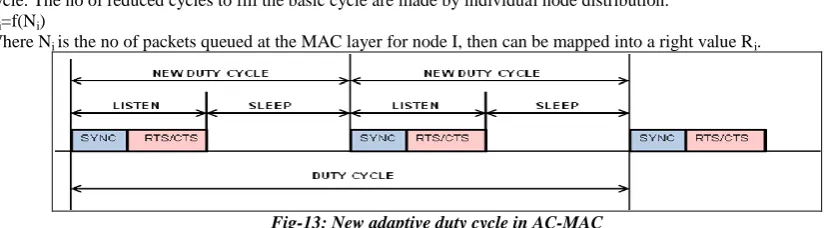
Adaptive duty cycle-It doesn’t violate the established listen & sleep schedule. Uses the number of packets queued at the MAC layer to know the traffic load. Based on this traffic it provides an adaptive no of new duty cycles within the basic cycle.The no of reduced cycles to fill the basic cycle are made by individual node distribution.
Ri=f(Ni)
Where Ni is the no of packets queued at the MAC layer for node I, then can be mapped into a right value Ri.
Fig-13: New adaptive duty cycle in AC-MAC
ADVANTAGES-It achieves considerably better latency and throughput in a wide range of traffic loads compared to S-MAC while maintaining the same level of energy-efficiency as S-S-MAC.
DISADVANTAGE-With the increase of the node density, the probability of collision in RTS/CTS interval will increase due to the fixed and small contention windows. Thus, all the performance metrics will be worsened in both S-MAC and AC-MAC
IV.
CONCLUSION
This paper reviews MAC protocols for wireless sensor networks. Large scale, battery powered wireless sensor networks put serious challenges to the MAC design. We have discussed important MAC attributes and possible design tradeoffs, with an emphasis on energy efficiency.
Protocol Real-time support
Energy Efficiency
Synchronization Needed
Adaptivity to Changes
Type
S-MAC No Partially Yes No Yes CSMA
T-MAC No Yes No Yes CSMA
DS-MAC Tradeoffs with latency
Tradeoffs with latency
No Yes CSMA
AC-MAC yes yes No Yes CSMA
Table 1 gives a comparison of the MAC protocols investigated. The column heading ―Time Synchronization Needed‖ indicates whether the protocol assumes that the time synchronization is achieved externally and ―Adaptivity to Changes‖ indicates the ability to handle topology changes.
for this is that the MAC protocol choice will, in general, be application dependent, which means that there will not be one
standard MAC for sensor networks. Another reason is the lack of standardization at lower layers (physical layer) and the (physical) sensor hardware.
REFERENCE
1. N. Abramson, ―The ALOHA system - another alternative for computer communications,‖ Proceedings of the AFIPS Conference, vol. 37, pp. 295-298, 1970.
2. L. G. Roberts, ―ALOHA packet system with and without slots and capture,‖ Computer Communications Review, vol. 5, no. 2, April 1975.
3. L. Kleinrock and F. A. Tobagi, ―Packet switching in radio channels: Part I - carrier sense multiple-access modes and their throughput-delay characteristics,‖ IEEE Transactions on Communications, vol. 23, no. 12, pp. 1400-1416, December 1975.
4. Wireless LAN Medium Access Control (MAC) and Physical Layer (PHY) Specifications, IEEE standards 802.11, January 1997
5. F. Tobagi and L. Kleinrock, ―Packet switching in radio channels: Part IV - Stability considerations and dynamic control in carrier sense multiple-access,‖ IEEE Transactions on Communications, vol. 25, no. 10, pp. 1103-1119, October 1977.
6. J. Martin, Communication Satellite systems, Prentice Hall, New Jersey, 1978.
7. A. J. Viterbi, CDMA: Principles of Spread Spectrum Communication, Addison-Wesley, Reading, MA, 1995. 8. L. Kleinrock and M. O. Scholl, ―Packet switching in radio channels: New conflict-free multiple
9. I. Chlamtac, W. R. Franta and K. Levin, ―BRAM: The broadcast recognizing access method,‖ IEEE Transactions on Communications, vol. 27, no. 8, August 1979.
10. D. Farber, J. Feldman, R. Heinrich, D. Hopwood, K. Larson, D. Loomis and L. Rowe, ―The distributed computing system,‖ Proceedings of IEEE COMPCON, pp. 31-34, San Francisco, CA, February 1973. access schemes,‖ IEEE Transactions on Communications, vol. 28, no. 7, pp. 1015-1029, July 1980.
11. T. V. Truong, ―TDMA in mobile radio networks: An pp. 504-507, Atlanta, GA, Nov, 1984.
12. R. Nelson and L. Kleinrock, ―Spatial TDMA: A collision free multihop channel access protocol,‖ IEEE Transactions on Communications, vol. 33, no. 9, pp. 934-944, September 1985.
13. M. H. Ammar and D. S. Stevens, ―A distributed TDMA rescheduling procedure for mobile packet radio networks,‖ Proceedings of IEEE ICC, pp. 1609-1613, Denver, CO, June 1991
14. I. Cidon and M. Sidi, ―Distributed assignment algorithms for multihop packet radio networks,‖ IEEE Transactions on Computers, vol. 38, no. 10, pp. 1353-1361, October 1989.
15. V. Rajendran, K. Obraczka, J.J. Garcia-Luna-Aceves. ―Energy-Efficient, Collision-Free Medium Access Control for Wireless Sensor Networks,‖ in Proc. SENSYS03, 2003.
16. T.ElBatt and A. Ephremides ―Joint Scheduling and Power Control for Wireless Ad hoc Networks,‖ IEEE Computer and Communications Conference (INFOCOM), June 2002.
17. A. Muqattash and M. Krunz, ―Power controlled dual channel (PCDC) medium access protocol for wireless ad hoc networks,‖ in Proceedings of the IEEE INFOCOM 2003 Conference, San Francisco, April 2003.
18. A. Muqattash and M. Krunz, ―CDMA-based MAC protocol for wireless ad hoc networks,‖ in 19. Proceedings of the ACM MobiHoc 2003 Conference, Annapolis, Maryland, June 2003.
20. J.P. Monks, V. Bharghavan, and W. Hwu, ―A Power Controlled Multiple Access Protocol for Wireless Packet Networks,‖ IEEE INFOCOM 2001, Anchorage, Alaska, April, 2001.
21. S.L. Wu, Y.C. Tseng, and J.P. Sheu, ―Intelligent medium access for mobile ad-hoc networks with busy tones and power control,‖ IEEE JSAC, 18(9):1647–1657, 2000.
22. S. Singh and C. S. Raghavendra,‖Power efficient MAC protocol for multihop radio networks,‖ in the Nineth IEEE ISPIMRC’98, pp: 153-157, 1998.
23. Y.Xu,J. Heidemann and D. Estrin,‖Geography-informed Energy conservation for ad hoc networks,‖ in Proc. MOBICOM’01, 2001.
24. B. Chen, et al,‖Span: An Energy-efficient Coordination Algorithm for topology maintenance in ad hoc wireless networks,‖ in Proc. MOBICOM’01, 2001
25. A. Cerpa and D. Estrin,‖ASCENT: Adaptive Self-configuring sensor network topologies,‖ in Proc. of INFOCOM’02, 2002
26. Ye Wei, Herdemann John, Estin Deborah. An Energy-Efficient MAC Protocol for Wireless Sensor Networks[C]// Proc. of the INFOCOM 2002, SanFrancisco: IEEE Computer Society, 2002, 3:1567-1576
27. Dam T, Langendoen K. An Adaptive Energy-Efficient MAC Protocol for Wireless Sensor Networks[C]// Proc. of the first ACM Conf. on Embedded Networked Sensor Systems (SenSys), New York: ACM press, 2003: 171-180 28. Yang Shih-Hsien, Tseng Hung-Wei, Wu Eric Hsiao- Kuang, et al. Utilization based duty cycle tuning MAC
protocol for wireless sensor networks[C]// GlobalCom’05. IEEE, Nov. 28- Dec. 2, 2005,6: 3258-3262
29. Barroso A, Roedig U, and Sreenan C. μ-MAC: an energy efficient medium access control for wireless sensor networks[C]//Proc. of the Second European Workshop on Wireless Sensor Networks, Istanbul, 2005:70 – 80 30. Cho Sungrae, Kanuri K, Cho Jin-Woong, et al.Dynamic Energy Efficient TDMA-based MAC Protocol for Wireless
Sensor Networks[C]//Autonomic and Autonomous Systems and International Conference on Networking and Services, Papeete, Tahiti, ICASICNS ICASICNS 2005, Joint International Conference on 23-28 Oct. 2005:48-48 31. Luca Campelli, Antonio Capone, Matteo Cesana. A Receiver Oriented MAC Protocol for Wireless Sensor