Fuzzy Control of Seat Vibrations for Semi-Active Quarter
Vehicle System Utilizing Magneto rheological Damper
Devdutt
1, M.L. Aggarwal
21Research Scholar, 2Professor,
Deptt. of Mechanical Engineering, YMCA University of Science & Technology, Faridabad, India
Abstract:–This paper presents an investigation into the effectiveness of controllable magnetorheological (MR) damper for a semi-acive vehicle model with passenger seat. Mathematical model has been experimentally developed for controller design using Choi et al. model. A quarter vehicle model has been employed for system performance evaluation via Matlab through numerical simulation. System behaviour related to passenger comfort and safety has been analysed without and with fuzzy logic control strategy in suspension system for passenger comfort and safety during on road varying driving conditions.
Keywords:–Magneto rheological damper,quarter vehicle model, semi-active suspension system,fuzzy controller
I.
INTRODUCTION
The main function of suspension system in vehicle is to minimize/isolate road surface induced disturbances or vibrations for passenger ride comfort, safety, good vehicle handling and long life of vehicle components during vehicle traveling over rough, harsh and irregular road profiles. There are three types of vehicle suspensions known as passive, semi-active and active suspension systems [1]. Normally, conventional passive suspensions provide limited performance i.e. shows effectiveness in certain frequency range due to uncontrollable parts such as spring and damper system. On the contrary, active suspension system can deliver better performance over a wide range of frequency due to presence of electronically controlled parts in suspension, providing desired output based on closed loop feedback data.However, active suspensions have certain drawbacks such as high power requirement, huge setup cost and a large number of assembled electronic components which makes this technology restricted to be used in all vehicles.
Since 1970s, a promising technology known as semi-active suspension system in this field have attracted vehicle manufacturers due to deliverance of better results than passive suspension, less costly and reliable compared to active suspension system.Semi-active suspension based technology is dependent on controllable damper systems known as electro-rheological (ER) dampers and magneto-rheological dampers.But recent developments in the field of MR fluids have generated the logical reasons to choose it in controllable damper technology as compared to ER fluids [2-6].
The practical application of MR dampers in semi-active systems is hindered due to certain drawbacks such as inherent hysteretic and unpredictable non-linear dynamic behavior. Therefore, MR damper modeling is very crucial before its application in particular required field. In past, several models related to the performance and behavior of MR dampers have been put forward by researchers. These models include Bouc-Wen hysteresis model developed by Spencer et al. [7], neural network model put forward by Chang and Roschke [8],fuzzy model [9],nonlinear black box model [10],polynomial model [11], NARX model [12], and other approaches [13].
A lot of work has been done on semi-active quarter vehicle system using two degrees of freedom but present work is related to three degrees of freedom for vibration reduction of concerned system taking passenger seat into account. In present paper (a) a polynomial model based on Choi et al. technique is used (b) fuzzy logic controller is designed working on feedback data of quarter vehicle model.
II.
MAGNETO-RHEOLOGICAL
DAMPER
MODELING
Where v is the damper piston velocity and ai, i= 0,1…..,6 are coefficients to be determined from the
curve fitting technique. The selection of mathematical value of n for hysteresis curve fitting is dependent on the experimental test results of MR damper. The coefficients ai are linearly approximated with input current I as:
Finally, the damping force can be presented as:
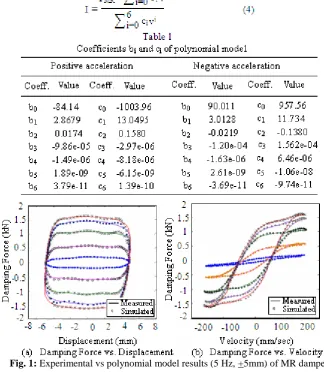
The values of coefficients bi and ci are shown in Table 1 and obtained from the fitness of the
experimental data. The polynomial curve fitting technique generated curve as well as experimental hysteresis curve shows good agreement with each other as shown in Fig. 1. The control current (I) for MR damper is determined when the piston travelling velocity (v) and the desired damping force (FMR) is known by the
proposed control strategy as follows [Eqn. (4)]:
Fig. 1: Experimental vs polynomial model results (5 Hz, +5mm) of MR damper
III.
QUARTER
VEHICLE
MODEL
WITH
PASSENGER
SEAT
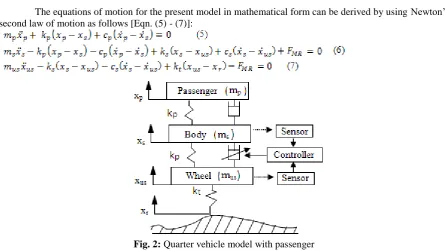
Fig. 2: Quarter vehicle model with passenger
Where quarter vehicle sprung mass, unsprung mass and seat mass including passenger mass are represented by ms, mus and mp respectively, whereas kp and cp are the stiffness and damping values of the spring
and damper parts under the passenger seat while ks and kt are the suspension spring constant and stiffness of
wheel part; cs is suspension basal damping coefficient; the vertical displacement of passenger seat xp, vertical
displacement of sprung mass xs,vertical displacement of the wheel base xus and xr represents variation in road
profile.
IV.
FORMULATION
OF
FUZZY
LOGIC
CONTROLLER
Fuzzy controllers are widely used in many industries such as automotive, automatic transmissions, ABS and cruise control systems. Fuzzy control system operates on the human readable rules in the form of fuzzy logic implications, representing a human’s heuristic knowledge. Fuzzy Logic Control (FLC) systems have been successfully used and practically implemented to many industrial and research work [17]. Fuzzy control systems are suitable for semi-active suspension systems having complicated nonlinear dynamics including tires, MR damper (as it is nearly impossible to set-up an accurate and acceptable mathematical model related to MR damper performance due to complex behavior of the magneto-rheological fluid in MR damper) and spring etc. and many control criteria for suspension operation with two criteria on top priority: vehicle handling and passengers comfort. Fig. 3 shows the application of Fuzzy Logic Controller in semi-active quarter vehicle model with MR damper.
Fig. 3: Block diagram of Semi-active FLC control for vehicle system with MR damper
Fig. 4: Fuzzy membership functions
V.
SIMULATION
WORK
AND
RESULTS
In this section, performance evaluation of the passive system and semi-active quarter vehicle model with MR damper assembled between sprung and unsprung mass and working on the feedback data provided by FLC is done. The selected values for quarter vehicle model for simulation work are as follows:
mp=50 kg , cp=1000 N-s/m, kp=40 kN/m, ms=350 kg,
cs=1000 N-s/m, ks=60 kN/m, mu=40 kg, kt= 180 kN/m
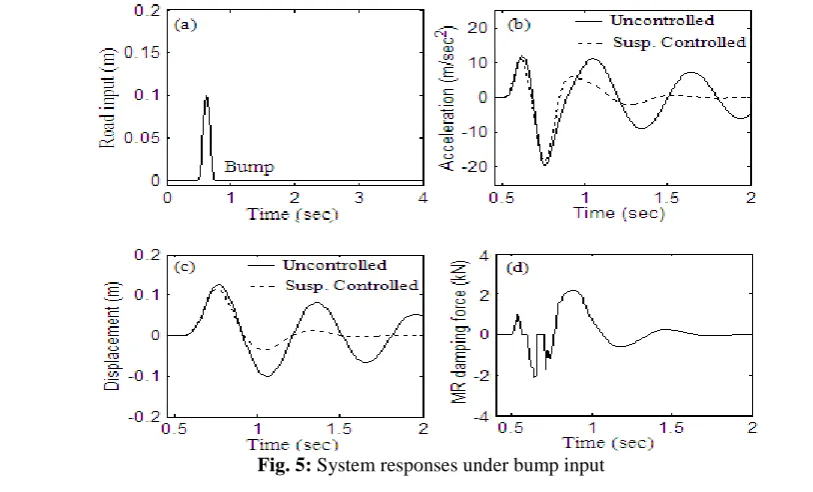
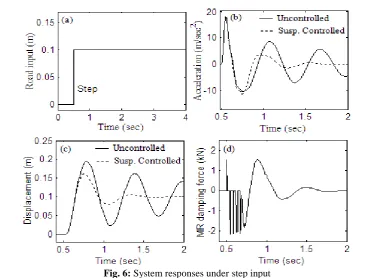
The performance of the designed system is evaluated under two types of road conditions i.e. bump input and step input. The road input signals and the responses of the passenger system for both the road excitations with passive and semi-active quarter vehicle model are shown in Fig. 5 and Fig. 6. Here, Fig. 5(b) and Fig. 6(b) provide simulation results for driver seat acceleration while Fig. 5(c) and Fig. 6(c) provide simulation results for driver seat displacement in time domain for both passive as well as semi-active system.
Fig. 6: System responses under step input
The following criterion was applied for performance index calculation in terms of acceleration and displacement parameters to evaluate & compare the output responses of semi-active and passive vehicle system using root mean square (RMS) percentage reduction value, defined by:
The root-mean-square (RMS) values of the simulation results for step road input are calculated for ride comfort evaluation and presented in Table 3. It can be observed that the suspension controlled semi-active system with MR damper provides good performance in terms of passenger seat acceleration, sprung mass acceleration, passenger seat displacement and relative passenger seat displacement as compared to uncontrolled passive system.
VI.
CONCLUSIONS
system can be improved by application of MR damper in combination with Fuzzy Logic Controller in terms of passenger’s ride comfort, safety and vehicle handling during on road varying driving conditions.
REFERENCES
1) Hassan, S.A., Sharp, R.S.: The relative performance capability of passive, active and semi-active car suspension systems.SAE technical paper series 864901, 1986.
2) Rabinow J ,Proceedings of the AIEE trans. 67: 1308-1315, 1948
3) Carlson J.D, Weiss K.D, A growing attraction to magnetic fluids. J. machine design 66(15): 61-64,1994.
4) S.J Dyke, Spencer B.F. Jr, Sain M.K, Carlson J.D, Modelling and control of magneto-rheological fluid dampers for seismic response reduction. Smart material and structures 5: 565-575,1996.
5) Boelter R., Janocha H, Performance of long-stroke and low-stroke MR fluid damper. Proc. of SPIE, smart structures and materials: passive damping and isolation, San Diego, CA: 303-313,1998.
6) Carlson J.D, Jolly M.R, MR fluid, foam and elastomer devices. Mechatronics 10: 555-569,2000. 7) B.F. Spencer Jr., S.J. Dyke, M.K. Sain, J.D. Carlson, Phenomenological model for magnetorheological
dampers,Journal of Engineering Mechanics 123 (3), 230–238,1997.
8) C.C. Chang, P. Roschke, Neural network modeling of a magnetorheological damper, Journal of Intelligent Material Systems and Structures 9 (9), 755–764,1998.
9) K.C. Schurter, P.N. Roschke, Fuzzy modeling of a magnetorheological damper using ANFIS, in: Proceedings of the IEEE International Conference on Fuzzy Systems, pp. 122–127,2000.
10) G. Jin, M.K. Sain, K.D. Pham, B.F. Spencer Jr., J.C. Ramallo, Modeling MR-dampers: a nonlinear blackbox approach, in: Proceedings of the American Control Conference,pp. 429–434,2001.
11) S.B. Choi, S.K. Lee, Y.P. Park, A hysteresis model for the field-dependent damping force of a magnetorheological damper, Journal of Sound and Vibration 245 (2), 375–383, 2001.
12) Leva, L. Piroddi, NARX-based technique for the modelling of magneto- rheological damping devices, Smart Materials and Structures 11 (1),79–88,2002.
13) L. Alvarez, R. Jimenez, Real-time indentification of magneto-rheological dampers, in: Proceedings of 15th IFAC, pp. 2252–2258,2002.
14) Y.Q. Ni and Z.H. Chen, “A Magnetorheological Damper with Embedded Piezoelectric Force Sensor: Experiment and Modeling”, Vibration Control, Mickael Lallart (Ed.), ISBN: 978-953-307-117-6, 2010. 15) Nguyen Q H, Choi S B, Wereley N M. Optimal design of magnetorheological valves via a finite element method considering control energy and a time constant [J]. Smart Material and Structure, 17: 1−12, 2008.
16) Unsal M, Nieareck C, Crane C D., Multi-axis semi-active vibration control using magnetorheological technology [J]. Journal of Intelligent Material Systems and Structures, 19(12):1463−1470, 2008. 17) C. Lee, "Fuzzy Logic in Control Systems: Fuzzy Logic Controller-Part I", IEEE Transactions on