e-ISSN: 2278-7461, p-ISSN: 2319-6491
Volume 5, Issue 06 [June 2016] PP: 40-46
Color Image segmentation using Similarity based Region merging
and Flood Fill Algorithm
K. Muthukumar
1, S. Poorani
2, S. Sindhu
31&3
Department of Electrical and Electronics, Sri Krishna College of Engg & Tech. 2
Department of Electrical and Electronics, Karpagam Academy of Higher Education. Coimbatore, Tamilnadu, India.
Abstract:
Image segmentation is an important task in image processing and computer vision. Image Segmentation is a technique that partitioned the digital image into many number of homogeneous regions or sets of homogeneous pixels. In this paper corporate frameworks for object retrieval using semi-automatic method for object detection because fully automatic segmentation is very hard for natural images. To improve the effectiveness of object retrieval a maximal similarity based region merging and flood fill technique is used. The users only need to roughly indicate the position and main features of the object and background, then any region will belong to non-label region or label region i.e. object or background then after which steps desired objects contour is obtained during the automatic merging of similar regions. A similarity based region merging mechanism is to guide the merging process with the help of mean shift technique. Any two or more regions are merged with its adjacent regions on the basis of maximal similarity method. The method automatically merges the regions that are initially segmented through initial segmentation technique, and then effectively extracts the object contour by merging regions.Keywords: Image segmentation, maximal similarity based region merging, flood fill and mean shift.
I.
INTRODUCTION
Image segmentation is typically used to find objects and boundaries in images. More precisely, image segmentation is the process of assigning a label to every pixel in an image such that pixels with the same label share certain visual features. Image Segmentation is a process of partitioning digital image into multiple unique regions, where region is set of similar pixels. Image segmentation is the preprocessing of pattern detection and recognition. If R is set of all image pixels, then by applying segmentation get different-different unique regions like {R1,R2,R3,..,Rn} which when combined formed the image R.Pal and Pal [1] provided a review on various
image segmentation techniques. From that there is no single standard procedure for image segmentation. Selection of an appropriate image segmentation technique depends on the type of images and applications used. Image segmentation techniques can be classified into four types. They are thresholding, edge based, region-based, and hybrid techniques. Thresholding techniqueto set two thresholds on the histogram of the image, and classify between the two thresholds in the histogram as the same region and classify the others as the second region. Edge-based methods undertake that the pixel properties or image features, such as intensity, color, and texture should change suddenly between different regions. Region-based methods assume that neighboring pixels within the same region should have similar values. Hybrid methods is combination of edge detection and region based together to achieve better image segmentation.
The color and texture features in a natural image are very complex and it is very difficult to get the fully segmented image out of the natural and therefore semi-automatic or interactive segmentation methods are used. Which supply user with means to incorporate his knowledge into the segmentation process. Therefore, semi-automatic or interactive segmentation methods incorporating user interactions have been proposed [2,3,4,6]and are becoming more popular. For instance, in the active contour model (ACM), i.e. snake algorithm [2], a proper selection of the initial curve by the user could lead to a good convergence to the true object contour. Similarly, in the graph cut algorithm [4], the prior information obtained by the users is critical to the segmentation performance.
In this paper, similarity region merging method based on initial segmentation of mean shift. The method will calculate the similarity of different regions and merge them based on largest similarity. The object will then extract from the background when merging process ends. Although the idea of region merging is first introduced by [11] this paper uses the region merging for obtaining the contour for object and then extracting desired object from image. The key contribution of the method is a novel similarity based region merging technique, which is adaptive to image content and does not requires a present threshold. With the region merging algorithm, the segmented region will be automatically merged and labeled, when the desired object contour is identified and avoided from background, the object contour can be readily extracted from background. This algorithm is very simple but it can successfully extract the objects from complex scenes.
The rest of the paper is organized as follows; Section 2 presents the literature survey. Section 3 performs region merging algorithm. Section 4 experimental results and analysis. Section 5 concludes the paper.
II.
LITERATURE SURVEY
Li Zhang and Qiang Ji [12] have proposed a Bayesian Network (BN) Model for both Automatic (Unsupervised) and Interactive (Supervised) image segmentation. They Constructed a Multilayer BN from the over segmentation of an image, which find object boundaries according to the measurements of regions, edges and vertices formed in the over segmentation of the image and model the relationships among the superpixel regions, edge segment, vertices, angles and their measurements. For Automatic Image Segmentation after the construction of BN model and belief propagation segmented image is produced. For Interactive Image Segmentation if segmentation results are not satisfactory then by the human intervention active input selection are again carried out for segmentation. Costas Panagiotakis, Ilias Grinias, and Georgios Tziritas [13] proposed a framework for image segmentation which uses feature extraction and clustering in the feature space followed by flooding and region merging techniques in the spatial domain, based on the computed features of classes. A new block-based unsupervised clustering method is introduced which ensures spatial coherence using an efficient hierarchical tree equip attrition algorithm. They divide the image into different-different blocks based on the feature description computation. The image is partitioned using minimum spanning tree relationship and mallows distance. Then they apply K-centroid clustering algorithm and Bhattacharya distance and compute the posteriori distributions and distances and perform initial labelling. Priority multiclass flooding algorithm is applied and in the end regions are merged so that segmented image is produced. Jifeng Ning, LeiZhang, David Zhang and Chengke Wu [14] develop a image segmentation model based on maximal similar interactive image segmentation method. The users only need to roughly indicate the location and region of the object and background by using strokes, which are called markers. A novel maximal-similarity based region merging mechanism is to guide the merging process with the help of markers. A region R is merged with its adjacent region Q if Q has the highest similarity with Q among all Q's adjacent regions. The method automatically merges the regions that are initially segmented by mean shift segmentation, and then effectively extracts the object contour by labeling all the non-marker regions as either background or object. The region merging process is adaptive to the image content and it does not need to set the similarity threshold in advance.
III.
SIMILARITY REGION MERGING
An initial segmentation is required to partition the image into homogeneous region for merging. For this use any existing low level image segmentation methods e.g. watershed [6], super-pixel [8], level set [7] and mean-shift [5] can be used for this step. In this paper mean-shift method for initial segmentation is used because it has less over segmentation and well preserve the object boundaries. For the initial segmentation use the mean shift segmentation software the EDISON system [15] to obtain the initial segmentation map Fig. 1. Shows an example of mean shift initial segmentation. .In this paper only focus on the object retrieval based on similarity region merging and flood fill method.
Fig. 1. (a) Initial mean shift segmentation. (b) Initial Segmentation result by the mean-shift algorithm.
Similarity Measure Using Metric Descriptor
very useful to represents the object color features. In the context of region merging based segmentation, color descriptor is more robust than other feature descriptors because shape and size feature is vary lots while the colors of different regions from the same object will have high similarity. Therefore use color histogram that represent each region in this paper. The RGB color space is used to compute the color histogram of each region, uniformly quantize each color channels into 16 levels and then the histogram is calculated in the feature space of 4096 bins.
Merging Rule Using Bhattacharyya Descriptor
Merging the region based on their color histograms so that the desired object can be extracted. The key issue in region merging is how to determine the similarity between different segmented regions of image so that the similar regions can be merged by some logic control. Therefore need to define a similarity measure formula between two regions R and Q to accommodate the comparison between various regions, for this there are some well-known statistical metrics. Here use Bhattacharyya coefficient [16] to measure the similarity between two regions say R and Q is:
4 0 9 6
1
( , ) u u
R Q
u
R Q H is t H is t
Where HistR and HistQ are the normalized histograms of R and Q, respectively, and the superscript u represents
the uth element of them. Bhattacharyya coefficient is a divergence-type measure which has a straight forward geometric interpretation. It is the cosine of the angle between the unit vectors.
cos
1, , 4 0 9 6
T
R R
H is t H is t &
1, , 4 0 9 6
T
Q Q
H is t H is t
The higher the Bhattacharyya coefficient between R and Q is, the higher the similarity between them i.e. similar the angle . The geometric explanation of the Bhattacharyya coefficient actually reflects the perceptual similarity between regions. If two regions have similar contents, their histograms will be very similar, and hence their Bhattacharyya coefficient will be very high, i.e. the angle between the two histogram vectors is very small. Certainly, it is possible that two perceptually very different regions may have very similar histograms.
Object and background marking
In the interactive image segmentation, the users need to specify the object and background conceptually. The users can input interactive information by drawing markers, which could be lines, curves and strokes on the image. The regions that have pixels inside the object markers are thus called object marker regions, while the regions that have pixels inside the background markers are called background marker regions. Fig. 1b shows examples of the object and background markers by using simple lines. The use of green markers to mark the object while using blue markers to represent the background. Please note that usually only a small portion of the object regions and background regions will be marked by the user. Actually, the less the required inputs by the users, the more convenient and more robust the interactive algorithm is.
After object marking, each region will be labeled as one of three kinds of regions: the marker object region, the marker background region and the non-marker region. To completely extract the object contour, need to automatically assign each non-marker region with a correct label of either object region or background region. For theconvenience of the following development, denote by Mo and MB the sets of marker object regions and
marker background regions, respectively, and denote by N the set of non-marker regions.
Similarity based merging rule
After object/background marking, it is still a challenging problem to extract accurately the object contour from the background. The region merging method will start from any random segment part and start automatic region merging process. The entire region will be gradually labeled as either object region or background region. The lazy snapping cutout method proposed in [10], which combine graph cut with watershed based initial segmentation, is actually a region merging method. In this paper present an adaptive similarity based merging technique of regions either in foreground or in background.
Let Q be an adjacent region of R and denote by
i1,2.... Q iQ S
S q the set of Q's adjacent regions. The similarity
between Q and all its adjacent regions, i.e. (Q, Si Q
), i = 1,2, ... ,q, are calculated. Obviously, R is a member of S¯Q. If the similarity between R and Q is the maximal one among all the similarities (Q, SiQ), yhen merge R and Q. The following merging rule is defined:
1 , 2 , ,
, m a x , Q .
i
i q
R Q Q S
The merging process
The whole object retrieval process is working in two stages. In first stage similar region merging process is as follows, our strategy to merge the small segmented image which is start with any randomly selected and merge this with any of its adjacent regions with high similarity. Then merge segmented image regions with their
(1)
adjacent regions as: if for each region Q set its adjacent regions SB .If the similarity between any
j
R for any i =
j is maximum i.e.
P(R j,Q) Max i1,2..kP(R j.SjQ)
Then Q and Rj are merged into one region and new region (4) is same leveled by
Q Q
Rj (5)The above procedure is implemented iteratively. Note that to each and every iterative step see whether the desired object is retrieve or not. Specifically the segmented region is shrinking; stop iteration when desired object is found. After the first stage i.e. when full part of object boundaries or likely to appear which is seems in every step apply second stage of algorithm for this select a input point on the object and expand this using four connectivity of pixels by using well known Flood Fill method.
Object Retrieval Flood Fill Algorithm
Input: (1)the image(2)the initial mean shift segmentation of input image Output: desired multiple objects
While there is a merging up to extraction of object contour from input image: 1. Input is image I and initial segmentation
2. After step (1) stage of merging of initial segmented image using similar merging rule.
3. After step one number of regions are minimized and again apply similar region merging rule, this is and iterative procedure.
4. After retrieving object contour go to step (5).
5. Apply Region Labeling and after that Flood Fill method on the image after step (4). Region Labeling (I)
% I: binary Image; I (u, v) =0: background, I (u, v) =1: foreground %
5.1. Let m←2
5.2. for all image coordinates (u, v) do
5.3. if I (u, v) =1 then
5.4. Flood Fill (I, u, v, m)
5.5. m← m+1
5.6. return the labeled image I.
% After region labeling we apply Flood Fill method using DFS % 6. Flood Fill (I, u, v, label)
6.1. Create an empty Stack S
6.2. Push (S, (u, v))
6.3. While S is not empty do
6.4. (x, y)← Pop (Q)
6.5. If (x, y) is inside image and I (x, y) =1 then
6.6. Set I (x, y)= label
6.7. Push (Q, (x+1, y))
6.8. Push (Q, (x, y+1))
6.9. Push (Q, (x-1, y)) 6.9.1. Push (Q, (x, y-1))
6.10. return
IV.
EXPERIMENTAL ANALYSIS
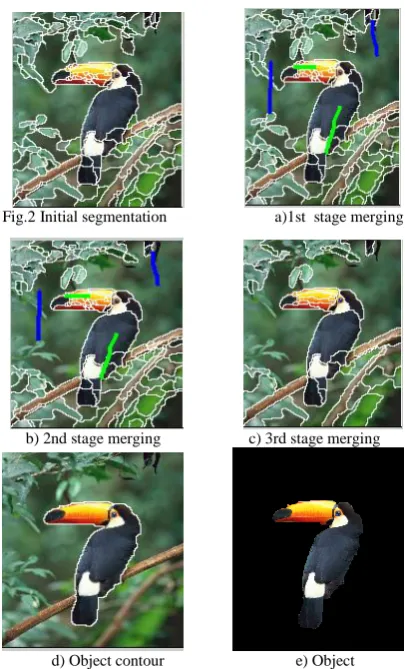
Fig. 2. Shows an example of how similarity region merging method extract object contour in complex scene. After initial segmentation by mean shift, automatic segmentation merging starts and after every step test our merging results and also after which stage of merging to use flood fill method. Fig. 2(a) is the initial segmented regions cover only small part but representative features of object and background regions. As shown in figure 2 the similar region merging steps via iterative implementation.
Fig.2 Initial segmentation a)1st stage merging
b) 2nd stage merging c) 3rd stage merging
d) Object contour e) Object
Fig. 2(a), 2(b), 2(c) and 2(d) shows that different steps of well extract object contour from the image and Fig. 2(e) shows the extracted object using the two steps object retrieval method
Comparison with MSRM Method
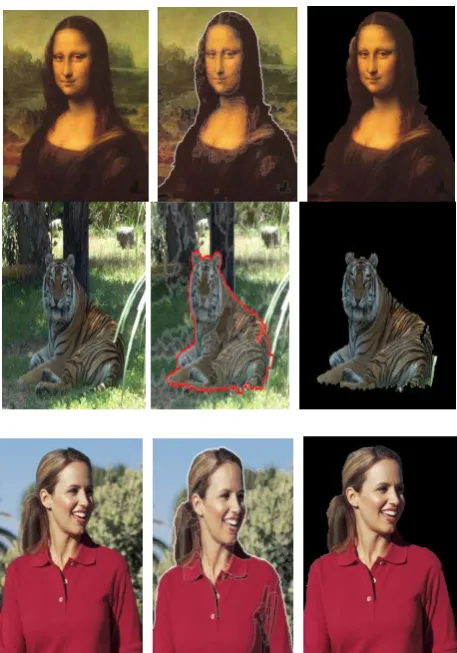
In this section, compare our method of segmentation with the MSRM segmentation method. In the MSRM method of segmentation first has to select the region of interest by capturing the object in a contour by dragging the mouse on the object and giving some objects boundaries. Since the MSRM segmentation is a pixel based method, selection of region of interest makes the MSRM method a region based method. Figure 3 shows the segmentation results of the two methods on four test images. The first column shows the input image; the second column shows the results by MSRM method; the third column shows the results produced by our method.
Figure 3: Comparisons between the MSRM Method and MSRM linked flood fill method.
V.
CONCLUSION
In this paper a class specific object segmentation method using maximal similar region merging and flood fill algorithm. The image is initially segmented using mean shift segmentation and the users only need to roughly indicate the main features of the object and background by using some strokes. Since the object regions will have high similarity are merged after applying region merging based on Bhattacharyya rule. The similarity based merging rule, a two stage iterative merging algorithm was presented to gradually label each non-marker region as either object or background. An automatic start of merging with any random segmented region and after each merging check whether the object contour is obtained or not, if at any particular stage of merging object contour is obtained then use flood fill algorithm and click with mouse which object want to extract. This method is simple yet powerful and it is image content adaptive.
In future extract multiple objects from input image by using unsupervised method as well as supervised method by merging similar regions using some metric. Extensive experiments were conducted to validate the method of extracting single object from complex scenes. This method is efficiently exploits the color similarity of the target. This method provides a general region merging framework, it does not depend initially mean shift segmentation method or other color image segmentation methods can also be used for segmentation. Also use appending the different object part to obtaining complete object from complex scene, and also use some supervised technique also.
REFERENCES
[1] N.R. Pal, S.K. Pal, “A review on image segmentation techniques”, Pattern Recognition, vol. 26 no.09, pp. 1277–1294, 1993.
[2] M. Kass, A. Witkin, and D. Terzopoulos, “Snake: active contour models”, International Journal of Computer Vision, vol.1, pp.321–331, 1987.
[3] P. Felzenszwalb, and D. Huttenlocher, “Efficient graph-based image segmentation”, International Journal of Computer Vision, vol.59 no.2, pp.167–181, 2004.
[4] V. Kolmogorov,and R. Zabih, “What energy functions can be minimized via graph cuts”,IEEE Transactions on Pattern Analysis and Machine Intelligence, vol.26 no.2, pp.147–159, 2004.
[6] L. Vincent, and P. Soille, “Watersheds in digital spaces: an efficient algorithm based on immersion simulations”, IEEE Transactions on Pattern Analysis and Machine Intelligence, vol.13 no.6, pp.583–598, 1991.
[7] B. Sumengen, “Variational image segmentation and curve evolution on natural images”, Ph.D. Thesis, University of California.
[8] X. Ren, and J.Malik,“Learning a Classification Model for Segmentation,” ICCV03, vol.1, pp. 10-17, Nice, 2003.
[9] Y. Li, J. Sun, and H. Shum, “Video object cut and paste”, SIGGRAPH 24 (2005) 595–600.
[10] Y. Li, J. Sun, C. Tang, and H. Shum, “Lazy snapping”, SIGGRAPH 23 (2004) 303–308.
[11] Lei Zhang and Qiang Ji, “A Bayesian Network Model for Automatic and Interactive Image
Segmentation”, IEEE Transaction on Im.age Processing, vol. 20, no. 9, September 2011.
[12] Costas Panagiotakis, Ilias Grinias, and Georgeios Tziritas “Natural Image Segmentaion Based on Tree Equipartition, Bayesian Flooding and Region Merging”, IEEE Transactions on Image Processing, vol. 20, no. 8, August 2011.
[13] J.Ning, Lei Zhang, David Zhang and Chengke Wu, “Interactive image segmentation by maximal similarity based region merging”, Elsevier Journal of Pattern Recognition, vol. 43, pp 445–456,2010. [14] EDISON software http://www.caip.rutgers.edu/riul/research/code.html.