e-ISSN: 2278-7461, p-ISSN: 2319-6491 Volume 7, Issue 8 [August 2018] PP: 22-28
Control System Design for Rat Pest Repellent in the Rice Field
Using a Modified ATMega328 Microcontroller Modified with
Ultrasonic Sound Wave
Mareli Telaumbanua
1, Rita Anggraini
1, Ferdi Indra Sasongko
1, Angelia Fitri
2,
Risca F.M. Sari
2, Sri Waluyo
11
Department of Agricultural Engineering, Faculty of Agriculture, University of Lampung, Jl. Soemantri Brojonegoro, No 1, Bandar Lampung 35141
2
Department of Agrotechnology, Faculty of Agriculture, University of Lampung, Jl. Soemantri Brojonegoro, No 1, Bandar Lampung 35141
3
Department of Agribisnis, Faculty of Agriculture, University of Lampung, Jl. Soemantri Brojonegoro, No 1, Bandar Lampung 35141
Correspondence email : [email protected] and [email protected]
ABSTRACT : The population increase in Indonesia is comparable to the increase in basic needs of the community. One of the staple foods of the Indonesian people is rice originating from rice plants. Disruption to the growth of rice plants can reduce the production of rice plants, which has an impact on the scarcity of rice in Indonesia. One of the obstacles to rice production is the attack of rat pests. Rat pest control is the biggest challenge for farmers in Lampung province, especially Pringsewu Regency. Rat pest attack can reduce rice production up to 80%.In this study, a control system was designed to reduce the population of rat pests in the rice fields. The working principle of this control system is to interfere with the hearing system of rat pests in the area of the tool range. This system used an ATMEGA 328 microcontroller equipped with Arduino Uno board. The installed actuator consisted of four ultrasonic tweeters while the sensor installed consisted of four passive infrared sensors (PIR) sensors. The Actuators and sensors were installed around the control system framework and a 50 Watt solar panel was installed to collect independent electrical energy. The control system actuator was able to reach 1200 m2, while the sensor was able to detect the presence of interference in the range of 78.53 m2. The maximum distance of the sensor with the interference source was 5 meters. The control system was able to recognize interference and turn on the actuator by 100%. The response of the control system to activate the actuator when the ratwas in the PIR sensor area was 0.12 seconds. The average time of the rat to shied away the bait to the effect of ultrasonic sound waves was 4 seconds. These results indicated that the control system was able to detect and disrupt rat pests while in the range of the control system.
KEYWORDS : Control system, PIR sensor, rat pests, rice plants, ultrasonic.
--- --- Date of Submission: 25-08-2018 Date of acceptance: 08-09-2018 --- ---
I. INTRODUCTION
The availability of staple foods such as rice is an important need for people in Indonesia. This is because rice is the main foodstuff for Indonesian people. For this reason, the government has sought various ways through expansion of planting land, improvement of irrigation networks, use of superior seeds, and studies that lead to increased production of rice.In recent years, the Indonesian government, through the Ministry of Agriculture, stated that the State of Indonesia has been designated as a rice self-sufficient country. However, the biggest challenge in ensuring the title of rice self-sufficiency is consistency (Sulaiman, et al., 2017).
Consistency towards rice self-sufficiency tends to be more difficult to do. This is caused by various factors including climate factors in Indonesia in some areas that do not support such as long dry season. Furthermore, the attack of pests and diseases of rice plants that can reduce rice production up to 80%. Rat pests tend to be unable to be controlled by pesticides such as other insect pests. Land affected by rat pests tends to be damaged up to 80%.During the process of cultivating rice plants, rats attack young roots, stems and leaves of plants. This causes disruption of the metabolic process of rice plants, which affects plant growth. Rat pest attacks affect the productivity of rice plants.
uses of poisons to control rat pests also have harmful effects on the environment and human health (Sengupta and A. Chowdhury, 2009). For this reason, it is necessary to design a tool that is able to repel rats using ultrasonic waves to disturb the hearing of rats. Rat hearing is in the frequency range between 5 Khz-90 Khz. However, the rats were disturbed when they heard sounds in the ultrasonic frequency range> 20 Khz to 60 Khz.The weakness of these rats is used by researchers to design a rat repellent device utilizing speakers that are capable of removing ultrasonic sound waves. This tool is designed using a microcontroller as an information processing center that is connected to solar panel modules as a producer of independent electrical energy.
Several studies on control systems were carried out by Sisodiya and Singh (2016), namely the design and development of ultrasound and insect detection for oil-producing plants. Nankinov, et al., (2007) conducted a study of the effect of using ultrasonic sounds to expel birds in public places in the Bulgarian city. The results showed that the number of birds had decreased significantly on the 10th day after installation of the equipment. Thangalakshmi and Ramanujan (2015) conducted a study to design a tool that is able to automatically monitor and capture disturbing pests on agricultural land.
Yusianto and Sudibyo (2016) also carried out the brown planthopper pest control design for rice plants. Other studies on control systems using microntrollers that have been carried out to support this research are about control systems for crop cultivation (Telaumbanua, 2014). The continuation of this research is modeling plant growth patterns to predict the best growth rate (Telaumbanua, 2016).
The effectiveness of ultrasonic control system design has been tested by Yturralde and Hofstetter (2012), which is a study of flea pest traps on mattresses using several types of pest repellent in the market. However, some of the ultrasonic devices that are marketed do not work well due to frequency discrepancies that can interfere with flea pests on the mattress. Another study was conducted by Andrade and Cabrini (2010), namely testing the use of commercial mosquito repellent devices. However, from the results of the study produced data that the use of ultrasonic devices is able to invite mosquitoes as much as 50% higher. Some pest control devices have an unrealistic effect which creates a dilemma for users for society (Ibrahim, et al., 2013). For this reason, it is necessary to first test the exact amount of frequency to repel pests.
II. MATERIALS and METHODOLOGY 2.1 Tools and Materials
This research was conducted at the Laboratory of Agricultural Equipment and Machinery, Department of Agricultural Engineering, University of Lampung and applied in the rice fields of Tulung Agung Village, Gadingrejo sub-district, Pringsewu Regency, Lampung, Indonesia. Tools and materials used for design were tweeters with a maximum frequency of 50 Khz, 50 WP solar panels, solar panel regulators, charger controlers, hollow iron, microcontrollers with Arduino Atmega 328 boards, PIR sensors, LCD, relay, solder, lead, red LED , resistors, capacitors, Travo, Real Time Clock (RTC), Micro SD card Module, and 4 GB SD Memory. An oscilloscope was also installed to measure frequency oscillations and amplitude (Figure 1).
Figure 1. Frequency test of of ultrasonic sound waves
2.2. Tool Making Process
The process of making this tool began by making the design criteria for the pest control system in paddy fields. The design criteria achieved in making this control system should be able to repel rats that are more than 80%. In addition, the control system was also expected to have a system response of less than 5 seconds to detect and repel rats.
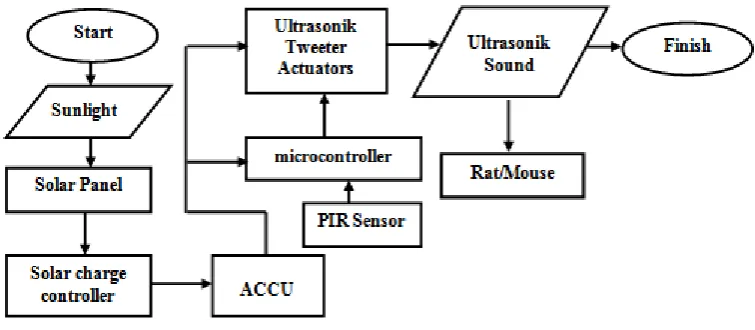
The next step was the functional design of the supporting components of the control system, including tweeters that functioned sound wave-producing actuators, 50 WP solar panels as a modifier of sunlight energy waves into electrical energy. Solar panel regulator to regulate the power and voltage that enter the battery, the microcontroller with the Arduino Atmega 328 board as the information processing center. PIR sensor as a sensor to detect the presence of rats, LCD as data viewer and condition of the control system, relay as a switch and connecting between the microcontroller and the actuator. Travo as a lowering and modifying AC 220 voltage to 12 volts, Real Time Clock (RTC) as a timer module, micro SD card Module as a SD card storage module, and 4 GB SD Memory as a storage media for control system performance data. Each component wasset according to each function thus forming a control system that had a fast and accurate response (Figure 2).
Figure 2. Flow Diagram of Circuit Schematic
The PIR sensor used in this study consisted of 4 sensors. Each PIR sensor was connected to digital pins (pin 3,4,5 and 6). LDC was connected to the digital pin 12 and 13. The relay was connected to the digital pin 7. The relay was connected to the 220 AC AC twetter actuator. All supporting components for the control system board were attached to an iron panel box to ensure that the components were not adversely affected by the external environment such as rain and direct interferences. Actuators and solar panels wereinstalled on top of the design. Solar panels were designed to cover twetter actuators.
2.3. Data Analysis
Testing in this studymeasured several things including: 1. System response to the presence of rats
2. Duration of rat response time away from the sound source location 3. Distance between sensor activation with rats
4. Bait conditions
III. RESULT and DISCUSSION
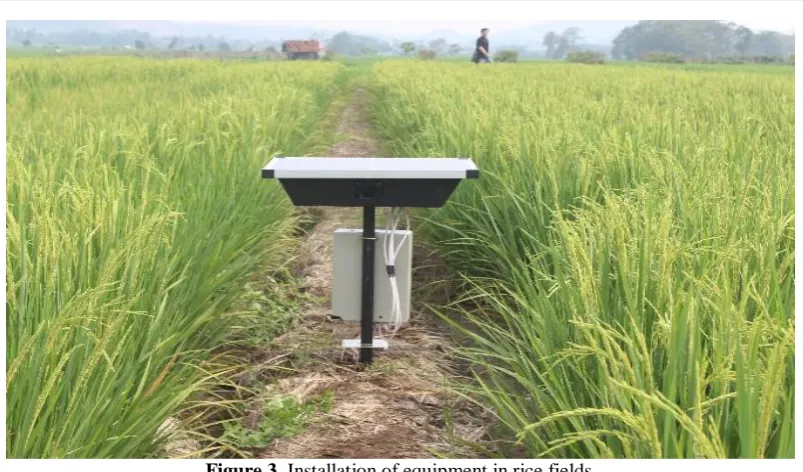
Figure 3. Installation of equipment in rice fields
The testing process was carried out on the PIR sensor on the detection level and the response of the control system to the interference. The tests were carried out on interference from a distance of 50 cm with 4 sensors mounted on the control system. The first stage of the test was conducted to test the feasibility of detection and response of the system on the LCD before testing in the field. From the resultof the design stage in Table 1, the average detection is 100% of the 7 tests. The result shows that the sensoris able to detect the presence of interference around it. Furthermore, the average result of the system response to 4 PIR sensors is less than 1 second. The length of the PIR sensor range was tested as well.
Table 1.Detection & system respond test during calibration
Test Detection (%) Response system (s)
1 100 0,01
2 100 0,01
3 100 0,01
4 100 0,01
5 100 0,01
6 100 0,01
7 100 0,01
Average 100 0,01
Based on Table 2, the farthest distance that can be detected by the sensor is 5 meters, so the area that can be detected by the control system is 78.53 m2. This shows that the control system was suitable for testing
Table 2.The distance between the sensor and interference No The distance between the
sensor and interference LCD display
LCD condition (H=1 Detected ; H=0 Undetected)
1. 1 meter Detected H=1
2. 2 meters Detected H=1
3. 3 meters Detected H=1
4. 4 meters Detected H=1
5. 5 meters Detected H=1
6. 6 meters Undetected H=0
Table 3. Interference distance test towards sensors
No Rats Approaching Tool response (s)
The response time of
rats evaded (s) Bait conditions
Distance from the tool (cm)
1 Test 1 0,48 3 Not eaten 60
2 Test 2 0,05 4 Not eaten 180
3 Test 3 0,05 2 Not eaten 160
4 Test 4 0,04 2 Not eaten 80
5 Test 5 0,06 4 Not eaten 155
6 Test 6 0,08 7 Not eaten 175
7 Test 7 0,08 6 Not eaten 175
Average 0,12 4 140,71
Based on the results of testing the presence of rats to turn on the tweeter actuator in the control system, the average sensor response was 0.12 seconds. This shows that the control system is able to show a system response of less than 1 second at the location of the study of the presence of rats detected. System response less than 1 second shows that the control system has a good response to the presence of rats (Table 3).
Figure 4. Rats approaching baits
Figure 5. Rats exposed to ultrasonic sound waves
Figure 6. Rats moved away from the ultrasonic sound source
The average time needed by the control system to drive rats due to the effect of the ultasonic sound produced by the tweeter is 4 seconds. The duration of rat removal from the control system sensor coverage is quite fast. From the results of the study, the bait used for 7 times of data collection was not eaten by rats. The 4 second expulsion time shows that the control system successfully repels rats before the rats eat the feed provided at the study site (Figure 4-6).
Based on the results of 7 replications, the mean distance of rats with bait is 140.17 cm. The control system is able to stop rats at a distance of 140.17 cm to approach salted fish bait. This shows that the control system is able to disturb the auditory system of rats, so that the rats move away from the sound source. This is in accordance with the 2017 anonymous study that the right ultrasonic sound waves can interfere with the auditory system and the appetite of rat pests.
IV. CONCLUSION
Based on the results of the study, the response of the system to ignite the twetter against interference when the system calibration process is 0.01 seconds. The accuracy of the control system turning on the twetter is 100%. The farthest distance per 1 PIR sensor detects the presence of rats is 5 meters with an area of 78.53 m2. From the results of testing using rats in the laboratory, the system response to turn on the twetter actuator is 0.12 seconds. The average time needed for the control system to drive rats is 4 seconds. The distance of rats with bait before avoiding rats was 140.17 cm. The area of the control system coverage area is 1200 m2. In applications in the field, solar panels have also been able to supply electric current that is used by the control system to be active for 24 hours. Test results have shown that the control system is able to repel rat pests well.
BIBLIOGRAPHY
[1]. Andrade, C. F., and I. Cabrini. 2010. Electronic mosquito repellers induce increased biting rates in Aedes aegypti mosquitoes (Diptera: Culicidae). Journal of Vector Ecology35 (1) : 75-78.
[2]. Arrington LR. 1972. Introduction to Laboratory Animal Science: The Breeding, Care and Management of Experimental Animals. Danville (US): The Interstate Printers and Publishers Inc.
[3]. Ibrahim, A.G., Oyedum, O.D., Awojoyogbe, O.B., Okeke, S.S.N . 2013. Electronic Pest Control Devices: A Review of their Necessity, Controversies and a submission of Design Considerations. The International Journal Of Engineering And Science (IJES)
2 (9) : 26-30.
[4]. Priyambodo, S. 2003. Integrated Agrate Pest Control. Penebar Swadaya. Jakarta. Vol : 6.
[5]. Robinson. 1979. Taxonomi and genetic. in Beker HJ, LindsayJR, and WeisbrothS, editor. The Laboratory Rat. London (GB): Academic Pr.
[6]. Nankinov. D, Ivanon N, Nikolov B, Dalakchieva S, Gluhchev G and Trifonov D (2007). “Electro-Acoustic Influence on Birds” Bularian Academy of Sciences ( Cybernetics and Information Technologies) 7:106-111.
[12]. Thangalakshmi, S., Ramanujan, R. 2015. Electronic Trap and Insect Pests Monitoring in Agricultural Fields. International Journal of Emerging Engineering Research and Technology, Vol. 3, Issue 8, pp. 206-213, August 2015.
[13]. Yturralde, K. M., and R. W. Hofstetter. 2012. Efficacy of commercially available ultrasonic pest repellent devices to affect behavior of bed bugs (Hemiptera: Cimicidae). Journal of Economic Entomology 105 (6) : 2107-2114.
[14]. Yusianto, R., Sudibyo, U. 2016. Development of a non-pesticide brown planthopper pest control powered by environmentally friendly windmills. Teknoin 22 (8): 602-608.