Mobile Cloud Computing: Issues and Applications
1
Shadab Ahmed,
2Manoj Singh,
3Dr. Arvind K Sharma
1,2Dept. of CSE, Gurukul College of Engineering & Technology Kota, India 3Dept. of CSI, University of Kota, Rajasthan, India
Abstract
Now day’s Mobile Cloud Computing (MCC) is becoming a hot
research field due to access use of mobile devices by large amount of information of data of individuals through cloud computing
techniques. It is a hybrid technology that combines with two techniques together mobile computing and cloud computing.
Mobile computing encloses numerous technologies and devices
such as wireless LAN’s, Notebook computers, tablets, laptops, cell
phones and smart phones. Usually any electronic device that helps to organize our life, interact with friends and doing daily jobs more efficiently is a part of mobile computing. In this paper, various techniques, issues and applications of mobile cloud computing
are presented.
Keywords
Cloud Computing, Mobile Cloud Computing (MCC), Mobile
Devices, Issues, Applications
I. Introduction
Today, due to explosive growth with computer operation and mobile device technologies expending to a great extent, cloud computing has been shaping up as the future of web based communications over World Wide Web. Mobile platform are depending mostly on
cloud computing in the days to come. As we aware that the mobile
devices have limited storage capacity and mobile cloud computing (MCC) helps in storing and processing the large amount of data outside mobile devices. In the year 2013, it was found that there were 4 billion mobile phone users. By 2017, the number of mobile phone users is forecast to reach 4.77 billion. In 2016, an estimated 62.9% of the population worldwide already using a mobile phone and the mobile phone penetration is forecasted to continue to grow rounding up to 67% by the year 2019. India was predicted to have just one billion mobile connections in 2017. By 2019 India is expected to reach 1.1 billion mobile connections. Most of the mobile market growth can be attributed to the increasing popularity of smart phones. By 2014 around 38% of all mobile users having smart phones. By 2018, this number is expected to reach over 50%. The number of smart phone users worldwide is expected to grow by 1 billion during five years; it means the number of smart phone users in the world is expected to reach 2.7 billion by 2019. Samsung and Apple are leading vendors of smart phones owned by users. The number of mobile phone users in billion is graphically shown in a fig. 1.
The idea of mobile computing is coined in 1990’s. Mobile computing is a generic term that refers to a variety of devices that allows people to access data and information from wherever they are. Mobile devices are connected to a local area network and they can take advantage of WiFi or wireless technology. In mobile computing we find that the need to be confined within one physical location has been eradicated. The advent of portable computers, laptops, PDA’s, tablets and smart phones have in turn made mobile computing very convenient. This new technology enables the users to update documents, netsurfing, send receive emails, stream live video files, video and voice conferencing,
and take photographs. Over the recent years, advancements in the domain of network based computing and applications have been shown that there is a great demand for mobile computing applications [3].
Fig. 1: Total Number of Mobile Phone Users in the World from 2013 to 2019 (Billions)
However, some of the common problems arise to all those devices share, still needs to be addressed: the limited capabilities of the devices regarding available resources like processor speed, available storage and energy consumption. Usually, cloud computing gives us a range of services which are provided by an Internet-based cluster system. A technology of Cloud computing gives its users the possibility to host and deliver services over the internet by dynamically providing computing resources [4] on demand basis in mobile nature from any remote distance.
The paper is organized into different sections as follows: Section II provides a background where the cloud technology is presented along with the general architecture of mobile cloud computing (MCC), Section III presents literature review, Section IV presents issues of cloud computing, Section V discusses applications of
mobile cloud computing (MCC). The conclusion is drawn in
Section VI and references are mentioned in the last.
II. Cloud Technology – Background
As so far development and extension of cloud computing and mobile computing and a novel term Mobile Cloud Computing (MCC) is coined in 2009. Which are two techniques Cloud
Computing (MC) and mobile computing (CC) is discussed in this section.
A. Cloud Computing
Cloud computing has been recognized as the next generation’s
computing power. Particularly, resources can be dynamically
added and released depending on service demand and with minimal management effort.
The cloud has always been a metaphor for the internet infects cloud
symbols are usually used to portray the internet on diagrams. As
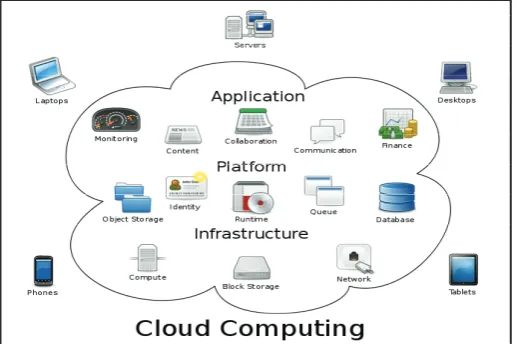
a virtual space that connects users from all over the globe, the internet is like a cloud, sharing information by way of satellite networks. In simple words cloud computing means sharing of computing resources on the internet rather than on personal devices or servers. The technology permits organization and companies to store, manage access and process their data using a network of remote server hosted over the internet. The architecture of cloud computing is shown in fig. 2.
Fig. 2: Architecture of Cloud Computing
1. Types of Cloud Computing
Cloud computing comes in the form of Public, Private, Hybrid,
Community, Distributed, Inter and Multi cloud etc.
(i). Public Cloud
It provides on–demand services like business, government,
organizational and academic. In Public Cloud, single administrator
provides services to the multiple users. The only disadvantage of
Public cloud is it is less secure in nature.
(ii). Private Cloud
The system and services is accessible only within an organization. The advantages of Private Cloud is high privacy, improve reliability, more security, cost and energy efficient in nature.
(iii). Hybrid Cloud
It generally includes the critical and non-critical activities of public and private cloud both. In hybrid cloud, some network issues are faced. Hybrid cloud is also composition of public, private and
community cloud.
(iv). Community Cloud
The system and services are accessible by a group of organizations
in community cloud.
(v). Distributed Cloud
In distributed cloud different set of machines are located at different
location but all are connected to a single network.
(vi). Inter Cloud
It shows the inter-connectivity between cloud and cloud globally. It focuses on the direct inter-operability between public cloud
service providers and consumers.
(vii). Multi Cloud
In multi cloud, no. of computing services lies in a single heterogeneous architecture to increase flexibility through choice and reduce reliance of single vendor[1].
2. Cloud Computing Service Models
A brief description of the various types of service models is shown in fig. 3 below. All these models are deployed over the internet
as a pay-per-use policy.
Fig. 2: Cloud Computing Service Models
(i). Software as a Service (SaaS)
The cloud service providers give various software applications
to the users, who can use them without installing them on their computer.
(ii). Platform as a Service (PaaS)
The cloud service providers give platforms, tools and other services to the users.
(iii). Infrastructure as a Service (IaaS)
The cloud service providers give infrastructure like storage, computing power etc. to the users through virtualization [2].
B. Mobile Computing
Mobility has become a very popular word and rapidly increasing
part in today’s computing area. An incredible growth has appeared
in the development of mobile devices such as, smart phone, PDA, GPS Navigation and laptops with a variety of mobile computing,
networking and security technologies. In addition, with the
development of wireless technology like WiMax, Ad Hoc Network and WIFI, users may be surfing the Internet much easier but not limited by the cables as before.
1. Features of Mobile Computing
The important features of mobile computing are as follows:
(i). Mobility
Mobile nodes in mobile computing network can establish
connection with others, even fixed nodes in wired network through Mobile Support Station (MSS) during their moving.
(ii). Diversity of Network Conditions
Usually the networks using by mobile nodes are not unique, such networks can be a wired network with high-bandwidth, or
(iii). Frequent Disconnection and Consistency
As the limitation of battery power, charge of wireless
communication, network conditions and so on, mobile nodes will not always keep the connection, but disconnect and consistent
with the wireless network passively or actively.
(iv). Dissymmetrical Network Communication
Servers and access points and other MSS enable a strong send/ receive ability, while such ability in mobile nodes is quite weak comparatively. Thus, the communication bandwidth and overhead
between downlink and uplink are discrepancy.
(v). Low Reliability
Due to signals is susceptible to interference and snooping, a mobile computing network system has to be considered from terminals, networks, database platforms, as well as applications development to address the security issue[3].
C. Mobile Cloud Computing (MCC)
Mobile cloud computing refers an infrastructure where both the data storage and the data processing happen outside of the mobile device [4].
Mobile Cloud Computing (MCC) could be a similarly new
origination that uses the blend of cloud innovation, versatile
registering, and remote systems administration to contradiction
the ease of use encounters of portable clients. A few field of uses like portable well being, versatile learning, portable trade and
portable delight are at present exploiting Mobile Cloud Computing
(MCC) innovations. Since Mobile distributed computing (MCC)
is new, there’s must be constrained to propel examination in MCC in order to extend hone.
Conveying cloud benefits in a portable domain brings various difficulties and issues. Cell phones can’t deal with convoluted applications because of their inborn characters. Likewise, it
is outlandish that a cell phone is constantly on the web, the
disconnected arrangement of the gadget require be considered too. The nonappearance of principles, security and protection, flexible portable applications prerequisite may hinder the advancement of Mobile Cloud Computing. Keeping in mind the end goal to comprehend the difficulties and give promote degree to explore, a comprehension of this novel approach is fundamental. As a result, the availability of cloud computing services in a mobile environment, also called mobile cloud computing [5]. The basic architecture of mobile cloud computing (MCC) is shown in fig. 3 below.
Fig. 3: Architecture of Mobile Cloud Computing (MCC)
III. Literature Review
This section presents forecasting of various research works carried out by several researchers in the area of cloud computing and
mobile cloud computing as under
-Weiguang Song et. al. [6] summarizes the core concepts of Mobile Cloud Computing [MCC] by developing a basic idea model of Mobile Cloud Computing. Major problems faced by MCC are discussed such as stability of wireless connectivity, tackling the unnecessary battery usage etc. Also, few possible solutions are
suggested.
Qureshi et. al. [7] discusses about the mobile cloud computing technology and proposes the implementation methods for Mobile
Cloud Computing solutions such as General Purpose Mobile
Cloud Computing (GPMCC) and Application Specific Mobile Cloud Computing (ASMCC). Certain barriers such as network availability and bandwidth are focused. Two aspects of security issues such as mobile device security and cloud security are
addressed.
Le Guan et. al [8] addresses the challenges in Mobile Cloud
Computing design such as network latency, limited bandwidth
and availability. In order to analyze Mobile Cloud Computing
technology, a concept model is proposed which includes context management, resource scheduling, client and transmission channel.
Application partition and offloading and various context aware services are also explained in their paper.
Dejan et. al [9] addresses several mobile cloud approaches. An overview of various possibilities of Mobile Cloud Computing is given. Native and web applications are too extremes of mobile applications. The cost model of elastic mobile cloud applications
is described.
Hung et. al [10] analyzes the performance of many mobile applications which are weak due to lack of computation resources, storage, and bandwidth and battery capacity. To overcome this, application is rebuilt using the cloud services. The proposed system explains a framework to execute the mobile application in cloud based virtualized environment with encryption, and isolation to protect against unauthenticated cloud providers. Results show the execution of mobile application by offloading the workload with efficient application level migration method via mobile networks. The migration of application form one device to another is easy
and quick in the proposed system.
Marston et al. in [11], identified the strengths, weaknesses, opportunities and threats for the cloud computing industry. According to authors, the biggest factor that impedes the adoption of the cloud computing paradigm is regulation at the local, national and international level. Cloud computing demands a coordinated response from governmental agencies.
IV. Issues in Cloud Computing
There are so many important issues in the cloud computing. Some of them are as
follows-A. Privacy Issues
In G-mail and Google, different kinds of privacy problems are faced in cloud computing.
B. Security Issues
C. Sustainability
A few primary environmental problems are also associated with
cloud like energy use. i.e. Owing to the limited resources such as
battery life, available network bandwidth, storage capacity and processor performance, on the mobile devices, researchers are always on the lookout for solutions that result in optimal utilization of available resources.
D. Portability
The ability to move application and its data between private and public cloud environment.
E. Task Division
Researchers are always on the lookout for strategies and algorithms to offload computation tasks from mobile devices to cloud. However, due to differences in computational requirement of numerous applications available to the users and the variety of handsets available in the market, an optimal strategy is an area
to be explored.
F. Better Service
The original motivation behind mobile cloud computing (MCC) is to provide PC-like services to mobile devices. However, owing to the varied differences in features between fixed and mobile devices, transformation of services from one to the other may
not be as direct.
V. Applications of Mobile Cloud Computing (MCC) Today a mobile user requires a lot of services which he can perform while moving. Use of cloud computing in mobile devices can fulfill these requirements of mobile users. Now MCC is emerging
day by day, there are many areas where MCC is used. MCC can
be used in performing mobile accounting, mobile payment or
in mobile healthcare. It can also be use to listen music anytime
from anywhere. Some of the applications of MCC are described
here.
A. Cloud e-mail
Today all mobile users are using Gmail (a free email service provided by Google) on their mobile devices. This is a live example of MCC because all emails of a user are store on a server (outside the mobile phone) and all processing is performed on the cloud.
B. Mobile Commerce
Mobile commerce (m commerce) applications can be mobile
shopping, finance, accounting, advertising etc. All these require
mobility like mobile transactions, payments, mobile ticketing
etc. Using mobile commerce on mobile devices has to face a lot of challenges (like low network bandwidth, security etc) but the emergence of CC to mobile reduces these challenges. In [12] a 3G platform based on cloud computing is proposed which has advantages of both 3G and cloud computing.
C. Cloud Music
Providing facility of “Music Anywhere” to customers on their mobile device is an example where Mobile cloud computing is
used.
D. Mobile Gaming
MCC provides the facility of game playing on mobile devices to
mobile users. Mobile gaming requires large computing resources
but with help of MCC all computations are performed on clouds
so mobile devices do not need to have these high computing resources (example graphic rendering). The concept of offloading
is used in mobile gaming.
E. Mobile Learning
Mobile learning (M-learning) provides the facility to learn anything from anywhere. It is combination of both e-learning and mobility. M-learning also has some challenges in terms of high cost of devices and network, low storage capacity, low network transmission rate. The use of cloud computing in m-learning has solved these challenges. Like now all data storage and processing is happened on the cloud so it provides learners a number of services at low cost, at faster processing speed on on-demand
basis.
F. Voice-based Searching
User can search anything without typing it through speech
recognition. [13] Introduces AT & T speech mashup model that combine web service with cloud computing environment to fulfill the speech recognition demand of users.
G. Sharing GPS/Internet Data
Through local-area or peer-to-peer networks data can be share
among a group of mobile devices that are near each other. It is faster as well as cheaper [14].
H. Sensor Data Applications
Now-a-days almost every mobile device is built with sensors which are used to read data. Some sensors such as GPS, accelerometer,
thermo sensor, light sensor, clock and compass may be time stamped and associated with other phone readings. In order to
gather precious information in different situation different queries
can be executed.
I. Social Networking
Since sharing different user content is a popular way and we can interact with friends on social networks such as Face book.
J. Image Processing
In [17], the authors try to experiment with running GOCR and an optical character recognition (OCR) program on a collection of different mobile devices. A similar scenario is given in [15]. If user/subscriber visit foreign museum, he can’t perceive the language written in each object of the museum. He can take picture of the object and using mobile cloud computing can understand the language written over the object.
K. Natural Language Processing
Language translation is one possible application for mobile cloud computing. Translation is a viable candidate for language processing since different sentences and paragraphs can be
translated independently, and this is experimentally explored in
[14] using Pangloss-Lite [16].
VI. Conclusion
Mobile Cloud Computing (MCC) that incorporates engineering,
key difficulties, introduce research issues and many applications. This paper presents the fundamental model of Mobile Cloud Computing (MCC), its experience, key innovation, challenges and flow which would be required about future research points of view. In our future work, we will propose we propose a lightweight data sharing scheme for mobile cloud computing.
References
[1] Kusum Lata, Sugandha Sharma,"A Survey on Cloud Computing and Mobile Cloud Computing", International Journal of Scientific Research in Computer Science, Engineering and Information Technology (IJSRCSEIT) Vol. 2, Issue 4, 2017.
[2] Zissis, Dimitrios, Dimitrios Lekkas,“Addressing Cloud Computing Security Issues”, Future Generation Computer Systems 28.3 (2012): 583-92. Web.
[3] Mandeep Kaur Saggi, Amandeep Singh Bhatia,"A Review on Mobile Cloud Computing: Issues, Challenges and Solutions, International Journal of Advanced Research in Computer and Communication Engineering Vol. 4, Issue 6, June 2015. [4] Le Guan, Xu Ke, Meina Song, Junde Song, “A Survey of
Research on Mobile Cloud Computing”, 10th IEEE/ACIS International Conference on Computer and Information Science (ICIS), Sanya, China, 6-18 May 2011, pp 387-392.
[5] Shahryar Shafique Qureshi, Toufeeq Ahmad, Khalid Rafique, Shuja-ul-islam,“Mobile cloud Computing as future for Mobile Applications: implementation methods and challenging issues”, IEEE International Conference on Cloud Computing and Intelligence Systems (CCIS), Beijing, 15-17 Sept. 2011, pp 467-471.
[6] Weiguang Song, Xiaolong Su,“Review of Mobile cloud computing”, IEEE 3rd International Conference on Communication Software and Networks (ICCSN), Xi’an, 27-29 May 2011, pp 1- 4.
[7] Zissis, Dimitrios, Dimitrios Lekkas,“Addressing Cloud Computing Security Issues”, Future Generation Computer Systems 28.3 (2012): 583-92.
[8] Mandeep Kaur Saggi, Amandeep Singh Bhatia,"A Review on Mobile Cloud Computing: Issues, Challenges and Solutions", International Journal of Advanced Research in Computer and Communication Engineering Vol. 4, Issue 6, June 2015. [9] DejanKovachev, Yiwei Cao, Ralf Klamma,“Mobile
Cloud Computing: A Comparison of Application Models, Information Systems and Database Technologies”, RWTH Aachen University.
[10] Shih-Hao Hung, Chi-Sheng Shih, Jeng-Peng Shieh, Chen-Pang Lee, Yi-Hsiang Huang,“An Online Migration Environment for Executing Mobile Applications on the Cloud”, 5th International Conference on Innovative Mobile and Internet Services in Ubiquitous Computing, Seoul, June 30 2011-July 2 2011, pp 20-27.
[11] S. Marston, Z. Li, S. Bandyopadhyay, J. Zhang, A. Ghalsasi,“Cloud computing– The business perspective,” Decision Support Systems, vol. 51, no.1, pp.176–189, 2011.
[12] X. Yang, T. Pan, J. Shen,“On 3G Mobile E-commerce Platform Based on Cloud Computing,” In Proceedings of the 3rd IEEE International Conference on UbiMedia Computing (U-Media), pp. 198 - 201, August. 2010.
[13] G. D. Fabbrizio, T. Okken, J. G. Wilpon,“A speech mashup
framework for multimodal mobile services,” In Proceedings of the 2009 international conference on Multimodal interfaces (ICMI-MLMI), pp. 71-78, November 2009.
[14] Marinelli, E. E. 2009. Hyrax: cloud computing on mobile devices using MapReduce (No. CMU-CS-09-164). Carnegie-mellonuniv Pittsburgh PA school of computer science, 2009.
[15] Satyanarayanan, M.,"Mobile computing: the next decade. ACM SIGMOBILE Mobile Computing and Communications Review, 15(2), pp. 2-10, 2011.
[16] Vallina-Rodriguez, N., Crowcroft, J.,"ErdOS: Achieving energy savings in mobile OS. In Proceedings of the sixth international workshop on MobiArch (pp. 37-42). ACM, 2011.