VOLUME 8 | ISSUE 4 | 2013 | 1054
Effects of adaptogen supplementation on sport
performance. A recent review of published
studies
ALVARO MOLINOS DOMENE 1
Spanish Olympic Committee
ABSTRACT
Molinos, A. (2013). Effects of adaptogen supplementation on sport performance. A recent review of published studies. J. Hum. Sport Exerc., 8(4), pp.1054-1066. Objective: Adaptogens are a new class of metabolic regulators (plants from natural origin) which have been shown to increase the ability of organism to adapt environmental factors and to avoid body damage. These properties offer the possibility to utilize them to increase the performance in situations of mental and physical stress, and thus used it to improve sport performance. Methods: A literature search was conducted for articles published until December 2012 in major databases. Publications were searched without language restrictions, using combination of Keywords. Results: Latest research show that Rhodiola rosea, Eleutherococcus senticosus, Schisandra chinensis, Panax ginseng and Erkang offer some physical and mental benefits to use in sport nutrition. Conclusion: This review demonstrate Adaptogen supplementation can improve the sport performance, however there are not enough reliable studies to conclude this assertion as absolute in all sports, therefore we suggest further researches with any of these Adaptogens in order to ascertain this results. Key words: ADAPTOGENS, SPORT, SUPPLEMENTATION, EXERCISE, RHODIOLA ROSEA, ELEUTHEROCOCCUS SENTICOSUS, SCHISANDRA CHINENSIS, PANAX GINSENG.
1 Corresponding autho. Erlengrund 54. 68789 St. Leon-Rot, Germany.
E-mail: [email protected] Submitted for publication September 2013 Accepted for publication November 2013
JOURNAL OF HUMAN SPORT & EXERCISE ISSN 1988-5202 © Faculty of Education. University of Alicante
1055 | 2013 | ISSUE 4 | VOLUME 8 © 2013 University of Alicante INTRODUCTION
Adaptogens were initially studied by the Russians during World War II, with the aim to get organic oils and acids (Lebedev, 1967). These same Researchers were the first to officially recognize the effects of these plants to develop Physical abilities and recovery (Lupandin, 1990; Panossian & Wikman, 2009) also homeostatic functions to regulate and balance the physiological mechanisms (Panossian, 2003). The term Adaptogen was originally named by N.V. Lazarev in 1947, a USSR pharmacologist, who described the unexpected effects of Dibazol (2-benzylbenzimidazol) (Panossian et al., 1999), an arterial dilator developed in France. Dibazol was found to improve the body resistance to stress (Lazarer, 1962). Brekhman and Dardimov showed in 1969 some basic principles which every adaptogen plant must follow (lupandin, 1990); 1) Adaptogens must reduce stress-induced damage, thus presenting stress-protective effects such as anti-fatigue, anti-infectious, anti-depressant and restorative activities, 2) Adaptogens must exhibit stimulating effects, both after single and multiple administration, leading to increased working capacity and mental performance against a back-ground of fatigue and stress, 3) the stimulating effect of Adaptogens must be different from those of conventional stimulants and anabolics that deplete the energetic and plastic resources of the organism and give rise to negative side effects such as drug withdrawal syndrome, 4) Adaptogens must be innocuous and must not perturb body functions from their normal levels but rather exert a normalizing influence on a pathological state, independent of the nature of that state.
Many Adaptogens have been studied with the aims to improve the Physical performance, but only some of them have been defined to use as stimulant to recover after intense efforts and with anti-fatigue effects (Morihara, 2007). The Adaptogens which have shown positive results in scientific studies, with the purpose of improving Physical performance, were: Rhodiola rosea (Brekhman & Dardymov, 1969; Perfumi & Mattioli, 2007; Saratikov et al., 1968; Saratikov & Krasnov, 2004, Qian et al., 2012; Parisi, 2010; De Bock et al, 2004; Lee et al, 2009), Eleutherococcus senticosus (Brekhman & Dardymov, 1969; Kimura & Sumiyoshi, 2004; Huan & Rose, 2001) Schizandra chinensis (Hurynovicz et al., 1960; Panossian & Wikman, 2008), Panax ginseng (Brekhman & Dardymov, 1969;Saito et al., 1974; Ferrando et al., 1999; Pieralisi et al., 1991).
Other plants with similar effects and which could be included in a sub-group of Adaptogens are Rubus coreanus (Jung et al., 2007), Pseudosasa japónica (You et al., 2006; You et al., 2010), Chines bamboo (Zhang et al., 2006), Anoectochilus formosanus ( Ikeuchi et al., 2005), Camelli sinensis (Murase et al., 2006) y Allium sativum (Morihara et al., 2007; Marihara et al., 2006).
Extracts from these plants and several Adaptogens Complexes, as Erkang (Wu et al., 1998), also showed improvements in mental resistance and greater concentration and physical development (Panossian & Wikman, 2008; Olsson et al., 2009; Panossian, 2003).
Nowadays there are not enough studies with trained humans and Adaptogens supplementation, so is opened a new way to possible and future researches, which analyzed the real possibilities to improve the physical and mental sport performance in different sports.
VOLUME 8 | ISSUE 4 | 2013 | 1056 MATERIAL AND METHODS
We conducted a literature search in major databases of health sciences (PubMed, Food Sciences & Technology Abstracts (FSTA), Medline, IME, Biomedicine (CSCI), Cochrane Library Plus, Gale Virtual Library Referent, Informa Healthcare, PsycArticle (CSA) and SpringerLink), of all published articles about Adaptogens to December 2012, which provide us valid information and results to improve the physical and mental sport performance. The terms on which we focused our search were “Adaptogens”, “sport”, “supplementation”, “exercise”, “performance”, “Rhodiola rosea”, “Eleutherococcus senticosus”, “Schisandra chinensis” and “Panax ginseng”.
Publications were searched without language restrictions.
RESULTS
Adaptogen concept
The Adaptogens, thus defined, constitute a new class of metabolic regulators (of a natural origin) which have been shown to increase ability of the organism to adapt to environmental factors and to avoid damage from such factors. The concept has developed since early researches, when drugs and methods to stimulate the body were found to maintain Physical and mental abilities as stable as possible (Lazarev, 1962).
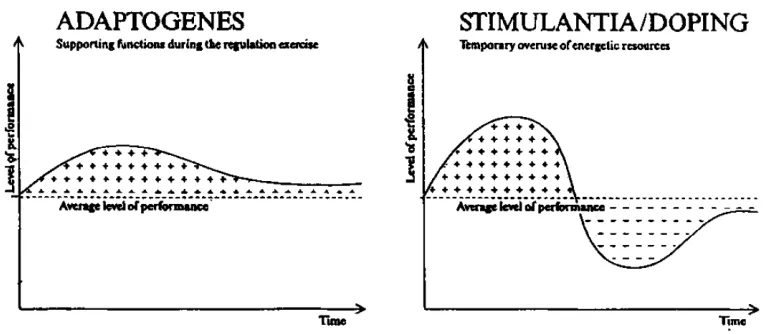
Based on what we previously discussed, we would do the following question, what are the differences between Adaptogens and other metabolic regulators, such as the stimulants? As Hancke (1994 y 1996) shows, in studies with racehorses, supplementation with stimulants, such as amphetamines, improves the strength capacity in a short time. However, after this initial period of high boost, comes a decrease work capacity. Adaptogens as Acathopanax (also called Eleutherococcus senticosus or Siberian Ginseng) and Rhodiola rosea show a constant performance, and after reaching its maximum is not followed by a corresponding minimum of the average work capacity (Hancke et al., 1996; Hancke et al., 1994).
Figure 1. Difference between Adaptogens and stimulants (qualitative pictures). Panossian A, Wikman G, Wagner H.
1057 | 2013 | ISSUE 4 | VOLUME 8 © 2013 University of Alicante In order to classify these plants, Brekhman y Dardimov made these postulates about what they called new substances with increased nonspecific resistance (Brekhman, 1969).
• Adaptogens must reduce stress-induced damage, thus presenting stress-protective effects such as anti-fatigue, anti-infectious, anti-depressant and restorative activities;
• Adaptogens must exhibit stimulating effects, both after single and multiple administration, leading to increased working capacity and mental performance against a background of fatigue and stress;
• The stimulating effect of Adaptogens must be different from conventional stimulants and anabolics that deplete the energetic and plastic resources of the organism and give rise to negative side effects such as drug withdrawal syndrome;
• Adaptogens must be innocuous and must not perturb body functions from their normal levels but rather exert a normalizing influence on a pathological state, independent of the nature of that state.
About this last postulate, the dose will be really important for greater performance (Huang et al., 2011).
Mechanisms of action
The ability to increase work capacity with Adaptogen supplementation, has been studied both human and animals.
These plants allow us to reduce fatigue and increase mental and Physical resistance, thus increasing attention, precision, hard work and stress resistance (Brekhman & Dardymov, 1969). Theses anti-fatigue abilities from Adaptogens are associated with its effect on:
- Mediators of stress and particularly cortisol, nitric oxide (NO), protein kinase (p-SAPK), c-Jun N-Terminal protein kinase (p-JNK) and Forkhead Box O proteins, such as DAF-16 (Panossian et al., 1996 & Wiegant et al., 2009).
- Adaptogens activate formation of NO and cortisone in the plasma and saliva, in order to adapt the body to heavy workloads (Panossian et al., 1999).
- The expression of Heat Shock proteins Hsp70 y Hsp16 (Wiegant, 2008).
In addition, other studies have shown Adaptogens actions of these plants on energy mechanisms:
- The biosynthesis of ATP, thus inducing an alternation in energy source (Panossian et al., 1999).
- Energy regulation during stress, increasing the formation of glucose-6-phosphate and thus affecting the metabolism of carbohydrates and energy supplies, as well as DNA and protein synthesis (Panossian et al., 1999).
- Potent antioxidant properties (especially with Schisandra chinensis) (Panossian et al., 1999).
VOLUME 8 | ISSUE 4 | 2013 | 1058 Possible applications of adaptogens on sport performance
From all Adaptogens researched and evaluated in recent years, just four of them have given results that may be apply and transferable to sport to improve the physical performance (Panossian & Wikman, 2009) (Rhodiola rosea, Eleutherococcus senticosus, Schisandra chinensis and Panax ginseng) and one formula created with several of these plants (called Erkang), are which we focused our review.
Rhodiola rosea (RR)
Unfortunately, most of the scientific evidence in the current literature have shown using animals, only a few studies, with conflicting results (Panossian et al., 2010; Walker & Robergs, 2006; Walker et al., 2007), were developed on human. Parisi et al, in 2010, showed one of the few studies published with trained humans. This study evaluated physical performance parameters such as heart rate max, Borg Scale, maximal oxygen uptake (VO2 max), duration of the test and blood glucose levels, without improvement between Placebo and RR group. On the other hand interesting results were obtained, as the reduction in muscle damage and lower levels of lactate. Furthermore, this supplementation shows increase fatty acid consumption. These data confirm that the intake of this plant could improve the adaptogen ability to physical exercise resistance (Parisi et al., 2010).
De Bock et al got an improvement in the resistance with young people who had taken daily RR, during 4 weeks (De Bock et al., 2004). Similarly, Lee et al observed in mice, supplemented with RR, an increment in the swimming time, with a later exhaustion (Lee et al., 2009).
Qian et al in 2012 studied the active ingredient of RR, salidroside (2 (hydroxyphenyl) ethyl β -D-glucopyranoside). This is a protective agent of human red blood cells against oxidative stress and may be a good Adaptogen for stress resistance and fatigue (Qian et al., 2012).
In 2007 Perfumi and Mattioli, researched about the effects of supplementation with RR in a single oral dose in rats. The results showed antidepressant, adaptogen ability, anxiolytics and stimulants effects, without differences between amount of doses (10, 15 y 20 mg/Kg). This study proved for the first time the anxiolytic and antidepressant potential of this plant (Perfumi & Mattioli, 2007).
All these studies showed an improvement in physical and mental performance on resistance efforts, but RR has also demonstrated anti-inflammatory effects, reducing levels of C-reactive protein and protecting the muscle tissue during exercise, reducing the among of Creatinine Kinase (CK) [1]. Zhu et al (2004) showed that RR could reduce the activity of CK in mice exposed to stress (Zhu et al., 2004).
1059 | 2013 | ISSUE 4 | VOLUME 8 © 2013 University of Alicante
Figure 2. The effect of ES on locomotor activity before and after sleep deprivation (SD) in mice. Mice were treated
with ES (70 and 280 mg/kg, i.g.), during 9 days, and, on the seventh day of treatment, were submitted to 72 h of sleep deprivation or maintained in home cages as control. Values are expressed as mean S.E.M. *P < 0.05, **P < 0.01 represent the difference between SD and control. ¢ÓP < 0.05, ¢ÔP < 0.01 represent the difference between ES
and SD group. Huanga LZ, Huanga BK, Yea Q, Qina LP. (2011). Bioactivity-guided fractionation for anti-fatigue property of Acanthopanax senticosus Journal of Ethnopharmacology 133, pp.213–219.
Eleutherococcus senticosus (ES)
Eleutherococcus senticosus, also called Acanthopanax or Siberian ginseng, has been named in recent years in a number of scientific researches with interesting results to take into account for the sport community.
Kimura y Sumiyoshi (2004) used types of ES root to demonstrate that supplementation in rats got prolong swimming. They suggested that ES had anti-fatigue action, reducing recovery of NK cells (immune system) and inhibition of cortisol rise, induced by stress (Kimura & Sumiyoshi, 2004). Previously Nishibe et al. (1990) reported that the ES bark extract prolonged time in rats forced with a swimming test (Nishibe et al., 1990).
VOLUME 8 | ISSUE 4 | 2013 | 1060
Figure 3. Effects of the fractions of n-butanol on the swimming time to exhaustion of weight-loaded mice. A: low dose
of water eluate, B: high dose of water eluate, C: low dose of 20% ethanol eluate, D: high dose of 20% ethanol eluate, E: low dose of 60% ethanol eluate, F: high dose of 60% ethanol eluate, G: low dose of 100% ethanol eluate, H: high
dose of 100% ethanol eluate. Those fractions were collected from D101 macroporous resin. Low dose means 70 mg/kg, high dose means 280 mg/kg for every mouse. EE 10 and EE 50 mean that animals were treated with eleutheroside E 10 mg/kg and 50 mg/kg. Values are means±S.E.M. of mice per group. (*) Significantly different from
control group (P < 0.05). Huanga LZ, Huanga BK, Yea Q, Qina LP. (2011). Bioactivity-guided fractionation for anti-fatigue property of Acanthopanax senticosus Journal of Ethnopharmacology 133, pp.213–219
Schisandra Chinensis (SC)
During World War II, USSR began studying Schisandra chinensis with purpose to obtain organic acids, ether oils and tonic substances. Extensive research revealed, however, that extracts of SC had significant stimulatory effects. Although Chinese folklore previously used this plant as a sexual stimulant, anti-pollution, gonorrhea, dysentery, sweating, cough, asthma, fatigue, diabetes, etc. (Panossian & Wikman, 2008).
Panossian y Wikman (2008) showed a review of studies with SC of Russian origin. The most of them have been tested, both animal and human, improved endurance, precision of movement, higher physical work capacity and mental development. Short exercise, like gymnastic and sprint racers showed a decrease in workability and ever worse coordination of movements, after supplementation with SC (Panossian & Wikman, 2008).
Adaptogenic capacity of SC has been demonstrated by Panossian et al (1999) with elite athletes and untrained subjects. These plants have the ability to suppress (NO) or activate (cortisone) neuroendocrine system as the stress level of the subjects. Thus, with SC supplementation before competition, the values of NO are raised, in order to adapt the body to high physical intensities (Panossian et al., 1999).
Panax Ginseng (PG)
The tonic effect of Ginseng root was described in an ancient test, of the 1st century BC in China. PG has been used for over 2000 years in China to increase qi and vital energy (Huan & Rose, 2001).
1061 | 2013 | ISSUE 4 | VOLUME 8 © 2013 University of Alicante humans (Scaglione et al., 2005). Fernando et al (1999) showed in their research a raise in capillary density and muscle mitochondrial content of mice, suggesting that prolonged treatment with G115 (50mg/kg for 12 weeks) improve the aerobic output and therefore the physical performance (Ferrando et al., 1999). Research such as Engels et al (2001), executed with double-blind trials (placebo group and G115 group) with active women, showed no significant changes in peak anaerobic power, anaerobic power average, fatigue and post-exercise recovery after supplementation (Engels et al., 2001).
Other studies differ from these results, Pieralisi et al (1991) noted that a supplementation with Ginseng, as well as Dimetiletanilamina, minerals and vitamins, increased workload and oxygen consumption. In contrast, plasma lactate levels, ventilation, carbon dioxide production and heart rate decreased after supplementation with Ginseng. These results were greatest in subjects with Maximal oxygen consumptions levels under 60 ml/kg/min than those with levels over 60 ml/kg/min (Pieralisi et al., 1991).
Erkang
Special mention deserve the traditional Chinese herbal medicine formula Shi-Quan-Da-Bu-Tang (also known as Juzentaiho-to, YJ-48), which has traditionally been used to increase vital energy, and strengthen health and immunity. Erkang capsule, introduced by the Harbin Medical University, China, is a modified formula of Shi-Quan-Da-Bu-Tang, with the addition of four other herbs. Although Erkang only have two of the Adaptogens, above mentioned, this formula has been shown to increase the adaptogenic and ergogenic skills.
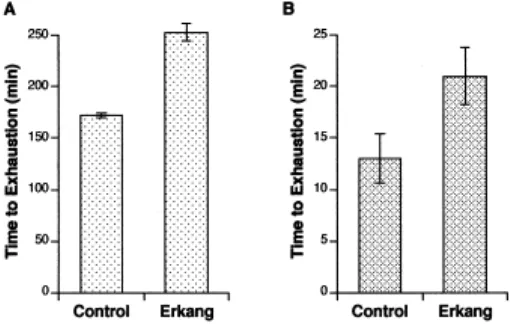
In 1998, Wu et al, conducted a study supplementing mice with Erkang. The swimming test was performed in which animal were forced to swim until exhaustion. There were two groups; the control group ate chow pellets without any herbal medicine and the treatment group ate chow pellets containing 0,5% Erkang compound. This research indicated how mice with this formula supplementation could swim for a longer time to exhaustion, in warm water (25,5 ± 0,5ºC) and cold water (9,5 ± 0,5ºC) (Wu et al., 1998).
Figure 5. Time to exhaustion in swimming tests in two different water temperatures (n = 10 per group). (A) Time to
exhaustion during room temperature (25.5 ± 0.5°C) water swimming test. (B) Time to exhaustion during cold (9.5 ± 0.5°C) water swimming test. There were significant differences in the time to exhaustion between the control groups
and Erkang treatment groups in both temperature swimming tests. Brackets indicate the mean ± S.E.M. Note different time scales in (A) and (B). Wu Y, Zhang Y, Wu JA, Lowell T, Gu M, Yuan CS. Effects of Erkang, a modified
VOLUME 8 | ISSUE 4 | 2013 | 1062 The same research proved as the treatment group (supplementation with 300mg/kg Erkang for 7 consecutive days), had a significant weight increase, compared with the control group. In addition, at 11 months after the start of the experiment, the mortality for the control group was 94,4% and average median mortality of 297 ± 22,9 days, and that for the treatment group was 50% and 387 ± 32,1 days (Wu et al., 1998).
DISCUSSION
The mode of action of Adaptogens is mainly associated with stress and can regulate the body in different directions (inhibition or activation, as required). During intense physical activity, our body must make continuous adjustments in order to maintain a good health and to continue with the physical processes which are required during exercise. Therefore, Adaptogens regulate the internal environment and tend to maintain the body stable, what is called as Homeostasis, and thus, achieve greater athletic performance to physical and mental stress.
Adaptogens Plants; Rhodiola rosea, Eleutherococcus senticosus, Schizandra chinensis, Panax ginseng and Erkang formula, have shown, in most of studies, encouraging results in improved physical performance, to be applied to sportsmen. In the latest research with these plants, remarkable physiological improvements were found (Figure 5), but we must keep in mind that due to the lack of research with different supplementation doses, physical test, Adaptogenic extracts and also different study subjects, as we have seen, there are results and scientific articles that have not found any improvement in athletic performance.
Therefore, for future studies on Adaptogens, we recommend make researches supplementing trained athletes, with different types and doses of these plants, in order to check what kind of supplementation is achieved to maximize results. In addition, it would also be interesting to note which physical and mental abilities can get most benefit and athletic performance, and get to know the most interesting sports to perform such supplementations techniques.
Thus, we suggest further research with any of these Adaptogens, as well as formulas and compounds with Erkang or several of these plants, in order to test if the combination enhances athletic performance. Sporting test used by the international scientific community would also be interesting to give more reliability and to compare results between Adaptogens and other sports supplements.
CONCLUSIONS
The mode of action of Adaptogens is mainly associated with stress and can regulate the body in different directions (inhibition or activation, as required). During intense physical activity, our body must make continuous adjustments in order to maintain a good health and to continue with the physical processes which are required during exercise. Therefore, Adaptogens regulate the internal environment and tend to maintain the body stable, what is called as Homeostasis, and thus, achieve greater athletic performance to physical and mental stress.
1063 | 2013 | ISSUE 4 | VOLUME 8 © 2013 University of Alicante different supplementation doses, physical test, adaptogenic extracts and also different study subjects, as we have seen, there are results and scientific articles that have not found any improvement in athletic performance.
Table 1. A summary of all actions shown in the latest research with Adaptogens and formulas from these plants
*There are researches showing opposite data
VOLUME 8 | ISSUE 4 | 2013 | 1064 abilities can get most benefit and athletic performance, and get to know the most interesting sports to perform such supplementations techniques.
Thus, we suggest further research with any of these Adaptogens, as well as formulas and compounds with Erkang or several of these plants, in order to test if the combination enhances athletic performance. Sporting test used by the international scientific community would also be interesting to give more reliability and to compare results between Adaptogens and other sports supplements.
REFERENCES
1. Abidov, M., Grachev, S., Seifulla, R.D. & Ziegenfuss, T.N. (2004). Extract of Rhodiola rosea Radix Reduces the Level of C-Reactive Protein and Creatinine Kinase in the Blood. Bull Exp Biol Med., 138(1), pp.63-4
2. Brekhman, I.I. & Dardymov, I.V. (1969). New substances of plant origin which increase nonspecific resistance. Annu Rev Pharmacol, 9, pp.419-30
3. Brekhman, I.I. & Dardymov, I.V. (1969). Pharmacological investigation of glycosides from Ginseng and Eleutherococcus. Lloydia, 32, pp.46-51
4. De Bock, K., Eijnde, B.O., Ramaekers, M. & Hespel, P. (2004). Acute Rhodiola rosea intake can improve endurance exercise performance. Int J Sport Nutr Exerc Metab., 14(3), pp.298-307
5. Earnest, C.P., Morss, G.M., Wyatt, F., Jordan, A.N., Colson, S., Church, T.S. Fitzgerald, Y., Lance, A., Radim, J. & Lucia, A. (2004). Effects of a commercial herbal-based formula on exercise performance in cyclist. Med Sci Sport Exerc, 36, pp.504-9
6. Engels, H.J., Kolokouri, I. & Wirth, J.C. (2001). Effects of ginseng supplementation on supramaximal exercise performance and short-term recovery. J Strength Cond Res., 15(3), pp.290-5
7. Ferrando, A., Vila, L., Voces, J.A., Cabral, A.C., Alvarez, A.I. & Prieto, J.G. (1999). Effects of a standardized Panax Ginseng extracto n the skeletal muscle of the rat: a comparative study in animals at rest and under exercise. Planta Med., 65(3), pp.239-44
8. Hancke, J., Burgos, R., Caceres, D., Brunetti, F., Durigon, A. & Wikman, G. (1996). Reduction of serum hepatic transaminases and CPK in sport horses with poor performance treated with a standardized Schizandra chinensis fruit extract. Phytomedicine, 3(2), pp.237–240,
9. Hancke, J., Burgos, R., Wikman, G., Ewertz, E. & Ahumada, F. (1994). Schizandra chinensis, a potential phytodrug for recovery of sport horses. Fitoterapia, 65(2), pp.113–118
10. Huan, Z.Y. & Rose, K. (2001). A brief history of qi. Brookline: Paradigm Publications.
11. Huang, L.Z., Huang, B.K., Yea, Q. & Qina, L.P. (2011). Bioactivity-guided fractionation for anti-fatigue property of Acanthopanax senticosus. Journal of Ethnopharmacology, 133(1), pp.213-219
12. Hurynovicz, J., Nowicka, H. & Bargel, Z. (1960). Effect of Schizandra chinensis Baill on the EEG of the rabbit in acute fatigue. J Physiol, 52, pp.122-4
13. Ikeuchi, M., Yamaguchi, K., Nishimura, T. & Yazawa, K. (2005). Effects of Anoectochilus formosanus on endurance capacity in mice. J Nutr Sci Vitaminol, 51(1), pp.40-4
14. Jung, K.A., Han, D., Kwon, E.K., Lee C.H. & Kim, Y.E. (2007). Antifatigue effect of Rubus coreanus Miquel extract in mice. J Med Food, 10(4), pp.689-93
15. Kimura, Y. & Sumiyoshi, M. (2004). Effects of various Eleutherococcus senticosus cortex on swimming time, natural killer activity and corticosterone level in forced swimming stressed mice. J Ethnopharmacol, 95(2-3), pp.447-53
1065 | 2013 | ISSUE 4 | VOLUME 8 © 2013 University of Alicante 17. Lebedev, A.A. (1967). Schizandrin - a new stimulant from Schizandra chinensis fruits. Dissertation for a
Degree in Medicine. Tashkent University, Tashkent
18. Lee, F.T., Kuo, T.Y., Liou, S.Y. & Chien, C.T. (2009). Chronic Rhodiola rosea extract supplementation enforces exhaustive swimming tolerance. Am J Chin Med., 37(3), pp.557-72
19. Lupandin, A.V. (1990). Proceedings of the 24th All-Union Conference on Sport Medicine. The use of adaptogens in sports. Modern problems of sport medicine. Ministry of Health of USSR, Moscow
20. Murase, T., Haramizu, S., Shimotoyodome, A., Tokimitsu, I. & Hase, T. (2006). Green tea extract improves running endurance in mice by stimulating lipid utilization during exercise. Am J Physiol Regul Integr Comp Physiol, 290, pp.1550-6
21. Morihara, N., Nishihama, T., Ushijima, M., Ide, N., Takeda, H. & Hayama, M. (2007). Garlic as an anti-fatigue agent. Mol Nutr Food Res, 51(11), pp.1329-34
22. Morihara, N., Ushijima, M. & Kashimoto, N., Sumioka, I., Nishihama, T., Minoru, H. & Takeda, H. (2006). Aged garlic extract ameliorates physical fatigue. Biol Pharm Bull, 29(5), pp.962-6
23. Nishibe, S., Kinoshita, H., Takeda, H. & Okano, G. (1990). Phenolic compounds from stem bark of Acanthopanax senticosus and their pharmacological effect in chronic swimming stressed rats. Chemical and Pharmaceutical Bulletin, 38(6), pp.1763-1765
24. Olsson, E.M.G., Von Schéele B. & Panossian, A.G. (2009). A randomized double- blind placebo controlled parallel group study of SHR-5 extract of Rhodiola rosea roots as treatment for patients with stress related fatigue. Planta Med, 75, pp.105-12
25. Panossian, A. (2003). Adaptogens: a historical overview and perspective. Natural Pharmacy, 7(4), pp.19- 20
26. Panossian, A. (2003). Adaptogens: Tonic herbs for fatigue and stress. Alt Comp Ther, 9(6), pp.327-32 27. Panossian, A., Oganessian, A., Ambartsumian, M., Gabrielian, E., Wagner, H. & Wikman, G. (1999).
Effects of heavy physical exercise and adaptogens on nitric oxide content in human saliva. Phytomedicine, 6(1), pp.17-26
28. Panossian, A. & Wagner, H. (2005). Stimulating effects of adaptogens: An overview of clinical trials of adaptogens with particular reference to their efficacy on single dose administration. Phytother Res, 19(10), pp.819-38
29. Panossian, A. & Wikman, G. (2005). Effect of adaptogens on the central nervous system. Arq Bras Fitomed Cient, 3(1), pp.108-30
30. Panossian, A. & Wikman, G. (2009). Evidence-Based Efficacy of Adaptogens in Fatigue, and Molecular Mechanisms Related to their Stress-Protective Activity. Curr Clin Pharmacol, Sep;4(3), pp.198-219 31. Panossian, A. & Wikman, G. (2008). Pharmacology of Schisandra chinensis Bail: An overview of
Russian research and uses in medicine. J Ethnopharmacol, 118(2), pp.183-212
32. Panossian, A., Wikman, G. & Sarris, J. (2010). Rosenroot (Rhodiolarosea): Traditional use, chemical composition, pharmacology and clinicale fficacy. Phytomedicine, 17(7), pp.481-493
33. Panossian, A., Wikman, G. & Wagner, H. (1999). Plant adaptogens III. Earlier and more recent aspects and concepts on their mode of action. Phytomedicine, 6(4), pp.287– 300
34. Parisi, A., Tranchita, E., Duranti, G., Ciminelli, E., Quaranta, F. & Ceci, R., Cerulli, C., Borrione, P. & Sabatini, S. (2010). Effects of chronic Rhodiola Rosea supplementation on sport performance and antioxidant capacity in trained male: preliminary results. J Sports Med Phys Fitness, 50(1), pp.57-63 35. Perfumi, M. & Mattioli, L. (2007). Adaptogenic and central nervous system effects of single doses of 3%
rosavin and 1% salidroside Rhodiola rosea L. extract in mice. Phytother Res, 21(1), pp.37-43
VOLUME 8 | ISSUE 4 | 2013 | 1066 37. Qian, E.W., Ge, D.T. & Kong, S.K. (2012). Salidroside Protects Human Erythrocytes against Hydrogen
Peroxide-Induced Apoptosis. J Nat Prod, 75(4), pp.531-7
38. Saito, H., Yoshida, Y. & Takagi, K. (1974). Effect of Panax ginseng root on exhaustive exercise in mice. Jpn J Pharmacol, 24(1), pp.19-27
39. Saratikov, A.S. & Krasnov, E.A. (2004). Rhodiola rosea (Golden root): a valuable medicinal plant. Tomsk, Tomsk University Press; pp. 1- 205.
40. Saratikov, A.S., Krasnov, E.A., Chnikina, L.A., et al. (1968). Rhodiolosid ein neues glykosid aus Rhodiola rosea und seine pharmakologischen eigenschaften. Pharmazie, 23, pp.392-5
41. Scaglione, F., Pannacci, M. & Petrini, O. (2005). Evidence-Based Integrative Medicine. The Standardized G115® Panax ginseng C.A. Meyer Extract, 2(4), pp.195-206
42. Walker, T.B., Altobelli, S.A., Caprihan, A. & Robergs, R.A. (2007). Failure of Rhodiola Rosea to alter skeletal muscle phosphate kinetics in trained men. Metab Clin exp, 56(8), pp.1111-7
43. Walker, T.B. & Robergs, R.A. (2006). Does Rhodiola rosea possess a ergogenic proprieties? Int J Sport Nutr Exerc Metab, 16(3), pp.305-11
44. Wiegant, F.A.C., Limandjaja, G., De Poot, S.A.H., Bayda, L.A., Vorontsova, O.N. & Zenina, T.A. (2008). Plant adaptogens activate cellular adaptive mechanisms by causing mild damage. Lukyanova L, Takeda N , Singal PK, Eds. Adaptation biology and medicine: health potentials, vol. 5. New Delhi, Narosa Publishers; pp. 319-32
45. Wiegant, F.A.C., Surinova, S., Ytsma, E., Langelaar-Makkinje, M., Wikman, G. & Post, J.A. (1998). Plant adaptogens increase life span and stress resistance in C. elegans. Biogerontology,10(1), pp.27-42
46. Wu, Y., Zhang, Y., Wu, J.A., Lowell, T., Gu, M. & Yuan, C.S. (1998) Effects of Erkang, a modified formulation of Chinese folk medicine Shi-Quan-Da-Bu-Tang, on mice. Journal of Ethnopharmacology, 61(2), pp.153-159
47. You, Y., Kim, K., Heo, H., Lee, K., Lee, J., Shim, S. & Jun, W. (2006). Stimulatory effects of Pseudosasa japonica leaves on exercise performance. Biosci Biotechnol Biochem, 70(10), pp.2532-5 48. You, Y., Kim, K., Yoon, H.G., Lee, K.W., Lee, J., Chun, J. Chun, J., Shin, D-H., Park, J. & Jun W.
(2010). Chronic effect of ferulic acid from Pseudosasa japonica leaves on enhancing exercise activity in mice. Phytother Res., 24(10), pp.1508-13
49. Zhang, Y., Yao, X., Bao, B. & Zhang, Y. (2006). Anti-fatigue activity of a triterpenoid- rich extract from Chinese bamboo shavings (Caulis bamfusae in taeniam). Phytother Res, 20(10), pp.872-6