An Efficient Secured Storage using Randomized
Key Protocol in Cloud Computing
1
Malla Bhagyam,
2Praveena P
1, 2Dept. of Computer Science and Systems Engineering, Andhra University Autonomous
College of Engineering, Visakhapatnam, AP, India
Abstract
Cloud computing opens new era in IT as it can give different
flexible and adaptable IT services in a compensation as-you-go
mold, where its clients can diminish the colossal capital interests
in their very own IT foundation. In this theory, clients of cloud storage services never again physically keep up direct command over their data, which makes data security one of the real worries of utilizing cloud. Existing exploration work as of now enables data honesty to be checked without ownership of the genuine data record. Albeit a portion of the ongoing work based on BLS mark would already be able to help completely powerful data refreshes over settled size data squares, they just help refreshes
with settled measured squares as essential unit, which we call
coarse-grained refreshes. Accordingly, every little refresh will cause re-calculation and refreshing of the authenticator for a whole document square, which thusly causes higher storage and correspondence overheads. In this paper, we give a formal investigation to conceivable sorts of fine-grained data refreshes and propose a plan that can completely bolster approved inspecting and fine-grained refresh demands. Based on our plan, we likewise propose an upgrade that can drastically decrease correspondence overheads for checking little updates. Hypothetical examination and exploratory outcomes show that our plan can offer upgraded security and adaptability, as well as altogether bring down overhead
for enormous data applications with countless little updates, for
example, applications in online life and business exchanges
Keywords
Cloud Computing, Deniable Encryption, Attribute Based Encryption, Data security and Privacy.
I. Introduction
Cloud storage is a type of data storage where the digital data is stored in consistent pools, the physical storage range numerous servers (and frequently areas), and the physical condition is normally claimed and taken care of by a facilitating association. These cloud storage suppliers are responsible for keeping the data accessible and open, and the physical condition secured and running. Diverse
associations purchase or rent storage limit from the suppliers to
store client application data. Cloud storage services might be gotten to through a co-found cloud PC service, a web service Application Programming Interface (API) or by applications that use the API, for example, cloud work area storage, a portal or Web-based substance administration frameworks. In the cloud storage
condition clients can store their data on the cloud and access their
data from anyplace whenever by interfacing with a system. On account of client security, the data stored on the cloud is typically scrambled and safe monitored from access by different clients. Thinking about the shared property of the cloud data, attribute-based encryption (ABE) is viewed as a standout amongst the most reasonable encryption schemes for cloud storage. Attribute-based encryption is a sort of open key encryption in which the mystery key of a client and the ciphertext are dependent upon attributes.
In such a structure, the decoding of a ciphertext is achievable just if the arrangement of attributes of the client key equivalents the attributes of the ciphertext. A focal security highlight of Attribute-Based Encryption is arrangement opposition: A challenger that grips different keys guessed just be skilled to get to data if no less than one individual key stipends get to. The point picking this attribute-based encryption is that as more responsive, data is shared and stored by outsider destinations on the Internet, there will be a need to scramble data stored at these locales. One inconvenience of scrambling data is that it very well may be specifically shared just at a coarse-grained level (i.e., giving another gathering your private key). To conquer this drawback we utilized another cryptosystem for fine-grained sharing of encoded data that we call Key Policy Attribute-Based Encryption (KP-ABE). In this cryptosystem, ciphertext are marked with sets of attributes and private keys are related with access structures that control which ciphertext by this the client can without much of a stretch ready to unscramble the data which was encoded. The materialness of
this development is to share the review log data and communicate
encryption and furthermore bolsters assignment of private keys which incorporates the Hierarchical Identity-Based Encryption. These Encryption schemes guaranteeing that cloud.
II. Related Work
Hohenberger execute the first key-strategy ABE framework where figure writings can be decoded with a constant digit of pairings. They demonstrate that GPSW figure writings can be unscrambled with essentially 2 pairings by developing the private key size by a reason of |T|, where T is the arrangement of various attributes that show up in the private key. At that point they present a general development that enables all framework client to in rivalry tune different productivity tradeoffs to their loving on a field where the limits are GPSW on single end and our quick plan on the other. This tuning requires no progressions to general society parameter or the encryption calculation. Procedures for pick an individualized client enhancement plan are talk about. At long last, we examine how these thoughts can be convert into the figure content approach ABE setting at a higher expense [6]. Tysowski presents novel adjustments to attribute based encryption are utilized to permit affirmed clients access to cloud data based on the assention of required attributes with the end goal that the higher computational load from cryptographic activity is appoint to the cloud provider and the aggregate explanation cost is brought down for the versatile client. Moreover, data re-encryption might be alternatively entire by the cloud supplier to decrease the cost of client repudiation
in a versatile client setting while at the same time protecting the
theoretic contention to adjust the double framework encryption strategy to the more confused structure of ABE frameworks. The develop our framework in complex requests bilinear gatherings, where the request is a thing for utilization of three primes. They demonstrate the security of their framework from three static suspicions. ABE conspire bolsters irregular monotone access equation. Their second last is a completely secure predicate encryption (PE) conspire for inward arrangement predicates. With respect to ABE, past development of such plan was just affirmed to be specifically secure. Security is demonstrated under a non-intuitive explanation whose size does not rely upon the digit of question. The plan is equivalently able to existing specifically secure schemes and furthermore there a completely secure various leveled PE technique under the comparative supposition. The key strategy used to get these outcomes is a mind boggling gathering of the double framework encryption technique (adjusted to the structure of inward deliver PE frameworks) and another move toward on bilinear pairings utilizing the possibility of double matching vector spaces (DPVS) actualize [7]. Kappes grow another cryptosystem for fine-grained sharing of encoded data to we call KeyPolicy Attribute-Based Encryption (KPABE). In this crypto framework, figure writings are name with sets of attributes and mystery keys are sincerely ensnared with passage structure that arrange which figure messages a client can decode. The present
use of development is to dissemination of review log data and
show encryption. Their development chains assignment of private keys which subsume Hierarchical Identity-Based Encryption (HIBE) [1]. RikkeBendli presents Non-intuitive collector deniable cryptosystem with more beneficial than polynomial security. This additionally clarifies it isn’t conceivable to make a non-intelligent bi-deniable publickey encryption conspire with enhanced polynomial security. Exceptionally, give an express bound relating the security of the plan to how antiquated the plan is as far as key size. Their inconceivability result builds up a lower bound on the security. As butt-centric commitment gives developments of deniable open key encryption schemes which makes upper limits on the security as far as key length. There is a break between our lower and upper limits, which leaves the intriguing fix issue irritating the tight limits [10].
III. Methodology
Most deniable public key schemes are bitwise, which means these schemes are able to process one bit a time. Hence, bitwise deniable encryption schemes are incompetent for real use, especially in the cloud storage service case. To resolve this problem, considered a hybrid encryption scheme that concurrently uses symmetric and asymmetric encryption they use a deniably encrypted plan ahead symmetric data encryption key, while real data are encrypted by a symmetric key encryption mechanism. Mainly deniable encryption schemes have decryption error problems. These errors come from the considered decryption mechanisms. Uses the subset decision mechanism for decryption the receiver decides the decrypted message according to the subset decision result. If the sender desires an element from the universal set but unluckily the element is located in the specific subset, then an error occurs. The identical error occurs in all transparent set- based deniable encryption schemes. Scope the policy of a file might be unused to under the request by the customer, when concluding the time of the agreement or totally move the files starting with one cloud then onto the next cloud nature’s domain. The position when any of the above criteria exists the policy will be rejecting and the key director will totally withdraw from the public key of the associated
file. So no one can pick up the control key of a repudiated file in future. Due to this reason we can say the file is certainly erased. To get well the file, the user must ask for the key controller to fabricate the public key. For that the user must be verified. The key policy attribute based encryption standard is utilized for file access which is confirmed by means of an attribute connected with the file.
A. Deniable Encryption Process
Deniable encryption involves senders and receivers creating believable fake proof of fake data in cipher texts such that outside coercers are pleased. Note that deniability comes from the truth that coercers cannot confirm the proposed facts is incorrect and as a result no reason to decline the given evidence. This approach tries to overall block coercion efforts since coercers know that their efforts will be useless. We make use of this idea such that cloud storage providers can give audit-free storage services. In the cloud
storage situation, data owners who store their data on the cloud
are just like senders in the deniable encryption scheme. Those who can access the encrypted data play the role of receiver in the deniable encryption scheme, including the cloud storage providers themselves, who have system wide secrets and must be able to decrypt all encrypted data. We make use of ABE characteristics for securing stored data with a fine-grained access control mechanism and deniable encryption to prevent outside auditing.
B. Composite Order Bilinear Group
Design a deniable CPABE scheme with Composite order bilinear groups for building audit-free cloud storage services. Composite order bilinear groups contain two attractive properties, namely projecting and cancelling. We make use of the cancelling property for building a consistent environment; on the other hand, Freeman also pointed out the important problem of computational cost in regard to the Composite order bilinear group. The bilinear map operation of a Composite order bilinear group is much slower than the operation of a prime order bilinear group with the same security level. That is, in this scheme, a user will pay out too much time in decryption when accessing files from the cloud. To make Composite order bilinear group schemes more realistic, into prime order schemes. Both projecting and cancelling cannot be simultaneously achieved in prime order groups in. For the same reason, we use a simulating tool projected to convert our Composite order bilinear group scheme to a prime order bilinear group scheme. This tool is based on dual orthonormal bases and the subspace assumption. Unlike subgroups are simulated as different orthonormal bases and therefore, by the orthogonal property, the bilinear operation will be cancelled between different subgroups. Our formal deniable CP-ABE construction method uses only the cancelling property of the Composite order group.
C. Attribute-Based Encryption
Cloud storage services have rapidly become increasingly popular. Users can store their data on the cloud and access their data anywhere at any time. For the reason of user privacy, the data stored on the cloud is typically encrypted and protected from access by other users. Considering the mutual property of the cloud data, Attributebased Encryption (ABE) is regarded as one of the most suitable encryption schemes for cloud storage. There are several ABE schemes that have been proposed, including. Most
of the proposed schemes assume cloud storage service providers
communications between users and cloud storage providers and then compel storage providers to release user secrets by using government power or other means. In this case, encrypted data are understood to be known and storage providers are requested to release user secrets.
D. Cloud Storage
Cloud storage services have grown popularly. For the reason of the importance of privacy, many cloud storage encryption schemes have been projected to protect data from those who do not have access. All such schemes assumed that cloud storage providers are safe and cannot be hacked. Still, in practice, some authorities (i.e., coercers) may force cloud storage providers to expose user secrets or confidential data on the cloud, thus in total circumventing storage encryption schemes. Here we present a design for a new cloud storage encryption scheme that enables cloud storage providers to generate realistic fake user secrets to protect user privacy. As coercers cannot tell if obtained secrets are correct or not, the cloud storage providers make sure that user privacy is still firmly protected. Most of the projected schemes
guess cloud storage service providers or trusted third parties
managing key management are trusted and cannot be hacked;
E. Distributed Key Policy Attribute Based Encryption
KP-ABE is a public key cryptography primitive for one-tomany correspondences. In KP-ABE, information is associated with attributes for each of which a public key part is described. The encrypt or acquaintances the set of attributes to the message by scrambling it with the comparing public key parts. Each client is assigned an access arrangement which is normally characterized as an access tree over information attributes. Client secret key is
characterized to reproduce the access structure so the client has
the skill to decipher a cipher-text if and just if the information attributes fulfill his access structure.
IV. Security Issues in Cloud
The security will be analyzed in terms of two aspects, that is, the confidentiality of data and the authorization of duplicate check. We suppose that all the files are sensitive and needed to be fully protected against both public cloud and private cloud. Under this assumption, two kinds of adversaries are considered, that is, adversaries which aim to extract secret information as much as possible from both public cloud and private cloud, and internal adversaries who aim to obtain more information on the file from the public cloud and duplicate-check token information from the private cloud outside of their scopes. The data will be encrypted in our deduplication system before outsourcing to the storage cloud to maintain the confidentiality of data. The data is encrypted with the traditional encryption scheme and the data encrypted with such encryption method which guarantees the security of data. System address the problem of privacy preserving deduplication in cloud computing and propose a new deduplication system supporting for Differential Authorization and Authorized Duplicate Check. Each authorized user is able to get his/her individual token of his file to perform duplicate check based on his privileges. Under this assumption, any unauthorized user cannot generate a token for duplicate check out of his privileges or without the aid from the private cloud server. Authorized user is able to use his/her individual private keys to generate query for certain file and the privileges he/she owned with the help of private cloud, while the public cloud performs the duplicate check directly and tells the user if there is any duplicate. The security requirements considered
in two folds, including the security of data files and security of file token. For the security of file token. Unauthorized users without appropriate privileges or file prevented from getting or generating the file tokens for duplicate check of any file stored at the Storage cloud. The users are not allowed to collude with the public cloud server. It requires that any user without querying the private cloud server for some file token, he cannot able to get any useful information from the token, which includes the privilege or the file information and to maintain the data confidentiality unauthorized users without appropriate privileges or files, prevented from access to the underlying plaintext stored at Storage cloud.
V. Proposed Methodology
The proposed schemes assume cloud storage service providers
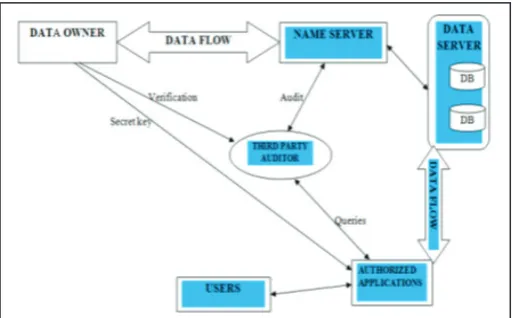
or trusted third parties handling key management are trusted and cannot be hacked; however, in practice, some entities may intercept communications between users and cloud storage providers and then compel storage providers to release user secrets by using government power or other means. In this case, encrypted data are assumed to be known and storage providers are requested to release user secrets. We proposed a deniable CP-ABE scheme to build an audit-free cloud storage service. The deniability feature makes coercion invalid, and the ABE property ensures secure cloud data sharing with a fine-grained access control mechanism.
Fig. 1: Proposed Architecture Diagram
A. Secure Information Retrieval
In this study, an efficient encryption scheme based on layered model of the access structure is proposed in Social network, which is named file hierarchy CP-ABE scheme (or FH-CP-ABE, for short). FH-CP-ABE extends typical CP-ABE with a hierarchical structure of access policy, so as to achieve simple, flexible and fine-grained access control. The contributions of our scheme are three aspects.
Firstly, we propose the layered model of access structure to •
solve the problem of multiple hierarchical files sharing. The files are encrypted with one integrated access structure. Secondly, we tend additionally formally prove the security •
of FH-CP-ABE scheme that can successfully resist Chosen Plaintext Attacks (CPA) underneath the Decisional Bilinear Diffie-Hellman (DBDH) assumption.
Thirdly, we conduct and implement comprehensive experiment •
and lighten the burden of key authority center.
B. Attribute-based Encryption (ABE)
Attribute-based encryption (ABE) may be a comparatively recent approach that reconsiders the idea of public-key cryptography. In ancient public-key cryptography, a message is encrypted for a particular receiver exploiting the receiver’s public-key. Identity-based cryptography associated above all and in particular identity-based encryption
(IBE) modify the standard understanding of public-key cryptography by permitting the public-key to be an arbitrary string, e.g., the email address of the receiver. ABE goes one step additional and defines the identity not atomic but as a collection of attributes, e.g., roles, and messages will be encrypted with relation to subsets of attributes (key-policy ABE - KP-ABE) or policies outlined over a collection of attributes (ciphertext-policy ABE - CP-ABE). The key issue is, that somebody ought to solely be ready to decipher a ciphertext if the person holds a key for “matching attributes” (more below) wherever user keys square measure continuously issued by some trustworthy party.
C. Key-Policy ABE
An important property that should be achieved by both, CP- and KP-ABE is named collusion resistance. This essentially implies that it mustn’t be potential for distinct users to “pool” their secret keys along rewrite a cipher text that neither of them could rewrite on their own (which is achieved by independently randomizing users’ secret keys)
D. Blowfish
Blowfish was designed in 1993 by Bruce Scheier as a quick, different to existing encoding algorithms such AES,
DES and three DES etc.
Blowfish may be a isosceles block encoding formula designed
in thought with, Fast:
• It encrypts information on massive 32-bit microprocessors at a rate of twenty six clock cycles per computer memory unit.
Compact:
• It will run in but 5K of memory.
Simple:
• It uses addition, XOR, search table with 32-bit
operands.
Secure:
• The key length is variable, it is within the vary of 32~448 bits: default 128 bits key length.
It is appropriate for applications where the key doesn’t amendment usually, like communication link or associate automatic file encryptor.
E. Description of Algorithm
Blowfish trigonal block cipher algorithm program encrypts block knowledge of 64-bits at a time. It will follow the feistel network.
F. Key-expansion
It will convert a key of at most 448 bits into many sub key arrays totaling 4168 bytes. Blowfish uses sizable quantity of sub keys. These keys ar generating earlier to any secret writing or cryptography. The p-array consists of eighteen, 32-bit sub keys:
P1,P2,………….,P18
Four thirty two-bit S-Boxes consists of 256 entries each: S1,0, S1,1,…. S1,255
S2,0, S2,1,…..S2,255 S3,0, S3,1,…..S3,255 S4,0, S4,1,...S4,255
VI. Conclusion
We proposed a deniable CP-ABE procedure to build an audit free cloud storage service. The deniability feature makes coercion invalid, and the ABE property ensures the secrecy of secure cloud data sharing with a fine-grained access control mechanism. Our proposed scheme provides a possible way to fight against immoral interference with the right of privacy. We hope more schemes can be created to protect cloud user privacy.The cloud reliability model and local auditing, global auditing that helps user to confirm the Cloud Service Provider (CSP) provide the promised constancy or not and count the severity of the violations. Therefore system monitor consistency service model as well as level of data uploads which helps the user to get the data in updated version. User can recognize various sub servers in CSP. It is a considered to provide regular update mechanism to confirm fragments simply and provide the data to users after updating only.
References
[1] V. Goyal, O. Pandey, A. Sahai, B. Waters,“Attribute-based encryption for fine-grained access control of encrypted data,” In ACM Conference on Computer and Communications Security, pp. 89–98, 2006.
[2] J. Bethencourt, A. Sahai, B. Waters,“Ciphertext-policy attribute based encryption”, In IEEE Symposium on Security and Privacy, pp. 321–334, 2007.
[3] B. Waters,“Ciphertext-policy attribute-based encryption: An expressive, efficient, and provably secure realization”, In Public Key Cryptography, pp. 53–70, 2011.
[4] A. Sahai, H. Seyalioglu, B. Waters,“Dynamic credentials and ciphertext delegation for attributebased encryption”, In Crypto, pp. 199–217, 2012.
[5] P. K. Tysowski, M. A. Hasan,“Hybrid attribute- and reencryption- based key management for secure and scalable mobile applications in clouds”, IEEE T. Cloud Computing, pp. 172–186, 2013.
[6] S. Rosenberger, B. Waters,“Attribute-based encryption with fast decryption,” in Public Key Cryptography, pp. 162–179, 2013.
[8] N. Attrapadung, J. Herranz, F. Laguillaumie, B. Libert, E. de Panafieu, C. R`afols,“Attributebased encryption schemes with constant-size ciphertexts”, Theor. Comput. Sci., Vol. 422, pp. 15–38, 2012.
[9] M. D¨urmuth, D. M. Freeman,“Deniable encryption with negligible detection probability: An interactive construction”, In Eurocrypt, pp. 610–626, 2011.
[10] P. Gasti, G. Ateniese, M. Blanton,“Deniable cloud storage: sharing files via public-key deniability”, In WPES, pp. 31–42, 2010.
Malla Bhagyam is presently pursuing M.tech(IT)in computer science and systems engineering in Andhra university college of engineering Visakhapatnam, Andhra Pradesh, India.