
Abstract— Even though 92% of the total area of Turkey lies
within seismic zones, earthen construction is very common and widespread throughout the country. Ever since construction materials are industrially manufactured, earthen construction technology is not in the scope of curriculums and research fields. Therefore, earthen buildings are often constructed by people with little technical knowledge of the material and existing earthen buildings are often insufficiently maintained. However, when used as a building material, the contribution that earth makes to a healthy environment is undeniable.
Istanbul Technical University, which has been carrying out research projects on earthen construction material since 1978, has determined that earth can be stabilized with gypsum and lime resulting in improved durability, physical and mechanical properties with a compressive strength of 2-4 N/mm 2. This combination is referred to as “Alker.” There are Alker Case-Study buidings in use, with the experience since 1983.
This paper examines conformity of 2nd Case-Study Building, consructed with alker at 1995, with Disaster Code’97 issued by the Turkish Ministry of Public Works and Settlements.
Index Term— Alker; Disaster Code; Earthen Construction; Gypsum stabilisation
I. INTRODUCTION
When a region experiences a damaging earthquake, people begin to seek alternative structural systems and construction materials. In the Kocaeli earthquake (1999) in Turkey most of the damage was to reinforced concrete buildings, while the Afyon earthquake (2002) affected a region dominated by earthen construction. In fact, each type of construction functions well in terms of load- bearing and stability if it is carried out with the appropriate technology for the particular material in use.
Manufacturers of new construction materials and systems, together with schools of engineering and materials science have instituted massive changes in building construction in a relatively short historical time [1]. Particularly in Turkey reinforced concrete construction has rapidly displaced traditional building, evolving over generations and throughout
the history. Traditional materials cannot keep pace with current legal requirements and market demands, without
Conformity of Alker (Gypsum Stabilized Earth) Construction with
‘Disaster Code 97’ in Turkey, Bilge ISIK, Dr., was with Istanbul Technical
University, Istanbul-TURKEY. She is now with the Department of Architecture, Cyprus International University, N-Cyprus (phone:
+90-532-767-5356; fax: +90-212-266-0279; e-mail: [email protected]).
research or training support. Earthen construction technology requires efforts in terms of seismic reliability. With adequate interest in research, it is possible to improve the performance of unfired clay as a building material so that it can be accepted by the building industry as a modern material. Research carried out by the Architectural Department of Istanbul Technical University on stabilizing earthen construction material with gypsum: known as ‘alker’[2], and has succeeded in producing an improved construction.
II. RESEARCH METHODOLOGY
Because of the unpredictable nature of earthquakes it is impossible to protect buildings completely from the seismic risk [3]. The aim of the study is to examine the earthquake resistance of alker building and to show how alker building technology can meet the requirements of Turkish Disaster Code’97 [4] in relation to housing projects in seismic zones. Using the improved mechanical and physical properties of “alker”, three separate case-study buildings have been constructed over different time periods. In this study seismic reliability, which has been investigated with “Micro Tremor Test” [5] applied on the 2nd Case-Study Building, will be summarized. Then, design features of Case-Study Building will be presented and evaluated according to specific details of ‘Disaster Code’97 – Guidelines for Construction in Disaster Zones’ as prepared by the Turkish Ministry of Public Works and Settlements.
III. ALKER TECHNOLOGY
Lack of training and experience in earthen construction is one of the main reasons for the poor quality of earthen buildings. Due to poor traditional skilled workmanship the quality of earthen construction has decreased both in terms of comfort and safety. As a result of the research conducted by Istanbul Technical University (ITU) since 1978 it has been found that the mechanical and physical properties of earthen material are enhanced by stabilizing with gypsum. In particular, heat resistance and durability are relatively high in gypsum-stabilized earthen material, especially in conditions where water is present.
TABLEI
PHYSICAL, MECHANICAL PROPERTIES OF ALKER [1]
Unit weight 1.6-1.7 kg/lt Shrinkage 1.0-1.5 %
Conformity of Gypsum Stabilized Earth- Alker
Construction with ‘Disaster Code 97’ in Turkey
Compressive strength 2.0-4.0 N/mm2 [5] Shear strength 0.9-1.3 N/mm2 Water absorption very low Long term water exposure no erosion (except direct rainfall)
Heat transfer value 0.4 - 0.5 kcal/mhC Specific calorific value 1.0 kJ/kgK
Compressive strength also by 2.0-4.0 N/mm2
SIA DO 111 [4] and [5]
A. Proportioning and Properties of Alker
Alker Construction Material is composed of 10% gypsum, 2%lime and 20-22% water in respect to the dry weight of soil. To delay setting time, lime is added to the water before the gypsum. The resulting liquid is poured into the soil and mixed manually or by machine. The alker mixture is then placed into brick size moulds and compacted or injected directly into a wall form.
TABLEII
PRACTICAL MEASURES OF INGREDIENT OF ALKER BY WEIGHT OF SOIL
_____________________________________________________
Soil 100 kg 2 full wheel barrow Water 20% 18-20 kg 1 bucket full
Lime 2 % 2 kg 1 shovel full Gypsum 10% 10 kg 4 shovel full
Earth used for alker is different from the earth used for traditional earthen building material. Clay is the binding component of traditional earthen construction. The required binding property can only be achieved if earth has 30-50% clay content. However, the addition of gypsum makes a significant contribution to binding, so earth with 8-10% clay content is sufficient for alker composite. Excessive clay content increases shrinkage, while insufficient clay content reduces binding.
Owing to its lower clay content, the earth used in alker technology is much more readily available than the earth required for traditional earthen construction. In fact, it is often the case that earth obtained in excavation for the foundations of a building can be used as construction material. The presence of lime and gypsum in the mixture dramatically reduces the time spent for mixing, molding, compacting, and turning out from moulds. Gypsum reduces the level of shrinkage in the building material while alker possesses durability required for load-bearing wall construction. Additionally, alker is more porous and lighter than unstabilized earthen materials because the gypsum sets before the clay dries (Table I). This porousness in turn provides better heat insulation. The compressive strength of alker is 2-4N/mm2.
B. Producing and Design in Alker Technology
Alker is a earthen construction material used in bearing wall buildings. Alker walls can be built with blocks, or the material can be compressed, rammed or injected into a wall form. The moulds and machinery used in concrete technology can be
used for alker, which is an appropriate building system for both ‘owner-built’ residential housing and mass housing operations as well.
The 2nd Alker Case-Study Building was designed to demonstrate the applicability of alker to mass housing projects. Alker mixture is poured directly into a PERI mould (an industrial product used in concrete construction) and the walls are compacted using a Wacker Compressor, Hilti Hammer, or ram. A layer of welded galvanized steel mesh is located horizontally through the walls at 60cm intervals. The mesh has 8x3 cm holes and steel bars are 3 mm thick. Reinforcement of the alker wall reduces shrinkage as the wall dries out after construction and responses to tensile forces occurring due to seismic loads.
The top and bottom of an alker wall should be bounded with a reinforced tie-beam. Load-bearing walls should stand on continuous foundations. A one-storey house should have load-bearing walls of at least 30 cm thickness. The external walls should be 45 cm thick to postpone heat transfer. The flooring can be constructed as a rigid diaphragm out of wood or steel, or reinforced concrete. The roof can be flat or pitched.
IV.
S
EISMICM
EASURESFORL
OAD-B
EARINGS
YSTEMOFA
LKERC
ONSTRUCTIONLoad-bearing walls should be able to sustain forces caused by horizontal acceleration during an earthquake. As vertical loads increase, the momentum caused by horizontal forces is reduced, thereby contributing to stability. This behavior of load-bearing walls is an advantage for construction with earthen material.
The vertical load of a building compounds horizontal forces on bearing walls. Horizontal forces applied to load-bearing walls cause diagonal shear cracking. The horizontal forces caused by an earthquake can be calculated using the load of the building itself and the load carried by the building. According to the SIA (Swiss Construction Engineers and Architects Association) [6] the horizontal force is 6.9% of the vertical load (this figure is 10% according to New Mexico Code) [7]. Typically, 18-25% of the plan of a load-bearing wall building is covered by wall thickness. In brief, during an earthquake 6.9-10% of building load acts upon 18-25% area of the total building plan in the form of horizontal forces. This clearly illustrates the advantage of thick load-bearing wall earthen constructions during earthquakes. The ratio of external wall thickness to wall height in alker construction has been applied as 1/5 and internal 1/10 [7]. Usage of horizontal reinforced tie beams and diaphragm slabs contribute to the stability of the system.
Fig. 1.Construction of 2nd Alker Case-Study Building, 1995, ITU Ayazaga Campus, Istanbul TR
V.
A
LKER 2ND CASE STUDY BUILDING,1995Within the “Alker Case-Study Project TUBITAK, INTAG and TOKI 622” (The Scientific and Technological Research Council of Turkey; Construction Research Group; the Housing Development Administration of Turkey, respectively) the Case-Study Building. II (Fig. 1) was constructed in 1995 [8], 12 years after the first alker case-study project. It involved the study of mechanization and standardization possibilities in alker construction.
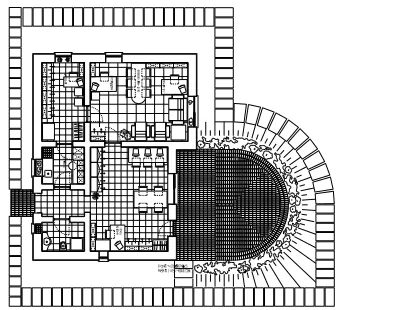
The Case-Study Building. II project consists of an entrance hall, a bathroom, a kitchen and 3 other rooms (Fig. 2). The reinforced concrete tie-beam running round the tops of the alker walls is connected with reinforced concrete slab. Inclined roof is covered with corrugated Ondulin and ceramic tiles.
.
A. Seismic Risk Studies for the 2nd Case-Study Building
Earthen buildings are widespread throughout the world and face seismic risks. Similarly, earthen construction is commonly used for buildings in Turkey although 92% of the total area of Turkey lies within seismic zones.
There are 3 main factors, which determine the behavior of buildings during earthquakes:
a) Ground effect b) Construction material
c) Structural system (design specifications)
Disaster Code 97 dwells mainly upon structural system and construction material.
Fig. 2.Plan of 2nd Alker Case-Study Building, 1995, ITU Ayazaga
Campus, Istanbul, TR
B. Micro-Tremor Test on the 2nd Case-Study Building
Studies continue to understand and improve the earthquake behavior of load-bearing alker constructions. One of these studies is the measurement of “Micro Tremors” performed in 1999 on the Case-Study Building. II (Fig.1, 2). Microtremors studies can give useful information on dynamic properties such as existed place, building type, dimensional scale or number of stories etc. According to these studies both fundamental periods in these two directions are found to be 1.56 Hz. These results are given in Fig. 3. With this period the spectrum coefficients on normalized spectral curves are calculated as 1.36 and 1.71 for soil conditions Type I and Type II respectively which is shown in Fig. 4. The suitability of construction-ground interaction has been tested [5]. The equivalent seismic load is calculated as 51% of the total weight of the building. A simple calculation for shear average stress in the walls is obtained as
average = 0.005 MPa. This value is less than material = 0.175 MPa.
C. Conformity of Case-Study Building with Disaster Code’97
1.56
0.00 0.05 0.10 0.15 0.20 0.25 0.30 0.35
0 5 10 15 20 25 30
SHORT DIRECTION LONG DIRECTION
Frequency, Hz
F
o
u
ri
e
r
a
m
p
lit
u
d
e
s
p
e
ct
ru
m
, (
V
/ V
)/
se
c
Fig. 3. Fourier amplitude spectrums for two directions [5]
0.64
0 0.5 1 1.5 2 2.5 3
0 0.2 0.4 0.6 0.8 1 1.2 1.4 1.6
PERIOD T (sec)
S
P
E
C
T
R
U
M
C
O
E
F
F
IC
E
N
T
S
(T
)
Soil Condition TYPE I
Soil Condition TYPE II
Fig. 4.Calculated spectrum coefficients on normalized spectral curves
recommended for use in current seismic code of Turkey [5].
Turkish Ministry of Public Works and Settlements published the “Guidelines for Construction in Disaster Zones” in Official Paper 23098 on September 2, 1997. Disaster Code’97 covers guidelines for reinforced concrete and steel buildings, burned brick and unburned brick masonry building as well as earthen buildings. "Earthquake and Design Rules for Load-Bearing Earthen Masonry Buildings in Chapter.11" include guidelines such as number of floors, basement and floor construction, height of each storey, wall openings and intersections of walls in building plan, positioning of walls on top of each other, load-bearing walls, lintels and tie-beams, flooring, roofing, non-load-bearing walls (Table III).
TABLE. III
LIMITATIONS BY [Disaster TR-Code’97,Chapter11] OFFICIAL PAPER Nr23098, SEPTEMBER 2, 1997 [4]
________________________________________________ Max. story number Basement +1
Max. story height <2.7≤2.4m (if basement available) Plan Rectangular
Foundation width ≥50cm≥60cm (if basement available) Adobe dimensions 120x300x400 mm or
120x180x300 mm (mother size)
120x190x400 mm or
120x250x300 mm (baby size) load bearing wall 60cm (ext-wall) - 30cm (int- wall)
wall length 4,5 m between corner- window ≥ 1m between door- window ≥ 1m door space 100 x 210 m window space 90 x 120 m
Flat earthen roof Restricted in 1st and 2nd earthquake zones Max. thickness must not be greater than 150 mm in 3rd and 4th earthquake zones
Tie beams Tie beams must be constructed between wall and roof
C.1 Earthquake resistant design requirements for adobe buildings [Disaster Code’97,§.11]
C.1.1 Scope [§ 11.1],
Design and dimensioning of earthen Case-Study Building. II has been performed along in accordance with Disaster
Code’97 to resist both vertical and lateral loads.
C.1.2 General Rules [§ 11.2.]
Due to seismic zone considerations, the Case-Study Building. II located at ITUniversity Maslak campus-Istanbul has been constructed with single floor. Since the Case-Study Building.II is in compliance with the Structural dimensioning Rules, mathematical verification based on "Chapter.6" was not be required. The height of walls, which is 260 cm (measured from the flooring of one level to the next), complies with the value recommended in the article." Plan of the Case-Study Building (Figure.1) is symmetrical, the load-bearing walls are perpendicular to each other and the building has a reinforced concrete foundation but has no basement.
C.1.3 Foundation and Load-Bearing Walls [§ 11.3] Reinforced concrete foundations beneath load-bearing walls are 70 cm deep from the floor, 30 cm wide and are continuous. As it is defined at Code TS 2514 compressive strength of adobe brick is expected to be over 1 N/mm2. Production of the blocks and erection of the wall are time consuming. Therefore earthen wall of the Case-Study Building was produced by ramming and the strength was between 2,0- 4,0 N/mm2. External load-bearing walls are 45cm thick considering energy savings and internal load-bearing walls are 30 cm thick.
The dimensions of the span are small and wall length is not less than 0.25 m/m2 when the total length of load-bearing walls is considered.
Maximum length between the supports of load-bearing walls is approximately 4.5 m.
As seen in Figure.1, the distance between corner and wall opening is not less than 1.0m.
The load-bearing wall segments between window or door openings are nearly 1.0 m (Fig. 1).
ties have not been considered.
The wall segment from axes of intersections to wall openings complies with the value above.
Door openings are not more than 100 cm wide but can extend up to the concrete tie-beam giving a height of up to 240 cm. Therefore no lintels are needed. Window openings are 90x140 cm on average.
VI. CONCLUTION
Earth, the most commonly used construction material in the world, has undergone a revival in the industrialized world due to its benefits for human health and ecology. Despite its low strength, if appropriate techniques are applied, earthen material maintains its load-bearing capacity during earthquakes and loss of life can be prevented even when cracking does occur. Istanbul Technical University (ITU) has been working on this appropriate technique since 1978. The following criteria have been considered in case-study buildings constructed by ITU since 1983 with alker, which has a compressive strength of 2-4 N/ mm2:
a) During an earthquake horizontal force affects bearing walls with 6.9%-10% of vertical loads.
b) Earthen load-bearing walls account for 15%-25% of the total plan area of an earthen construction and respond to horizontal forces during an earthquake. c) As vertical load increases, the horizontal vector of the
forces is reduced, decreasing collapse risk.
d) When the ratio of wall thickness to wall height is between 1/5 and 1/10, stability of the building can be achieved.
The Case-Study Building.II constructed in 1995 aimed to determine the seismic reliability of alker buildings when subjected to horizontal forces. This reliability and its consequent conformity with Disaster Code97 were established on the basis of the following structural requirements:
a) T and L wall junctions
b) Ratio of wall thickness to load carried c) Ratio of wall thickness to wall height d) Ratio of continuous wall to wall openings e) Tie-beams above and below the walls
Studies on the earthquake reliability of alker load-bearing wall construction are continuing and their progress can be followed at www.kerpic.org
The Alker Case-Study Building. II, constructed in 1995, showed good performance in the 1999 Kocaeli Earthquake. While buildings in the University campus cracked slightly, the alker construction sustained without damage.
ACKNOWLEDGMENT
Gypsum Manufacturers Association members provide
sponsorship in kind. All materials used for construction of the building were supplied by the manufacturer and applied on site. Experimental studies were carried out at the Civil Engineering Faculty Laboratories of Istanbul Technical University.
R
EFERENCES[1] Blondet M., Torrealva D., Villa García, G., Ginocchio F.,
Madueño I., (Catholic University of Peru) (2005), “Using
Industrial Materials for the Construction of Safe Adobe Houses in Seismic Areas” Earth Build Conference, Australia, January16,
[2] Kafesçioğlu R., Toydemir, N., Gürdal E., & Özüer B. (1980)
Stabilization of earth with gypsum as a contruction material,
TUBITAK MAG 505.
[3] Houben H., Guillaud H., 1994, Earth Construction, A
Comprehensive Guide, CRATerre, Intermediate Technology, pp.314
[4] Disaster Code (1997) achievement of the adobe construction in earthquake area, Turkish Republic, Ministy of Public Works and Settlements.
[5] Işık B, Özdemir P., & Boduroğlu H. (1999) Earthquakes
aspects of proposing gypsum stabilized earth (alker) construction
for housing in the southeast (GAP) area of Turkey, Workshop
on Recent Earthquakes and Disaster Prevention Management, Earthquake Disaster Prevention Research Center Project (JICA), General Directorate of Disaster Affairs (GDDA), Disaster Management Implementation and Research Center (METU).
Ankara, March 10-12,1999
http://nisee.berkeley.edu/cgi-bin/texhtml
[6] SIA DO 111 (1994) Regeln zum bauen mit lehm,
Schweizerischer Ingenieur und Architekten.
[7] New Mexico Building Code (1991)
http://www.earthbuilding.com/nm-adobe-code.htlm
[8] Işık B., Akın A., Göçer C., Kuş H., Çetiner I., & Arıoğlu N.,
(1996) “TUBITAK INTAG TOKI 622”, Determination of
appropriate construction technology and standards for gypsum added construction materials, Research Report, [The Scientific and Technological Research Council of Turkey;
Construction Research Group; the Housing Development
![Fig. 3. Fourier amplitude spectrums for two directions [5]](https://thumb-us.123doks.com/thumbv2/123dok_us/1389445.1650081/4.612.60.299.247.388/fig-fourier-amplitude-spectrums-directions.webp)