Voltage and Current harmonics caused by Power
Factor Correction: Case Study
in TL Lamp Load
Maun Budiyanto*) Daroto*)
*) Electrical Engineering of Vocational Collage UGM Jalan Yacaranda Sekip Unit IV Yogyakarta Email: [email protected]@ugm.ac.id
Abstract--
Lamp tube (TL) lamp with conventional ballast has a low power factor, so it is necessary to increase the power factor by adding a capacitor. Capacitors including non-linear load, so that the addition of the capacitor causing an increase in nonlinear loads. Nonlinear load provides output waveform that is not linear, causing the current waveform and the output voltage is not the same as the input waveform (distorted). The phenomenon of distorted voltages / currents causes the appearance of harmonics. The objective of the research is to show harmonic of currents and voltages before and after the addition of the capacitor. This research conducted was in the laboratory of Electrical Engineering of Vocational School UGM. The research used TL 36W lamps with conventional ballasts and capacitors F 3.2 and 4.5 F. The results show that fluorescent lamp with a conventional ballast has a power factor = 0.514, = 11.1% harmonic current and voltage harmonics 3.7%. The addition of 3.25 F obtained capacitor power factor = 0.876, = 16.3% harmonic current and voltage harmonic = 3.6%. While the addition of 4.5 F obtained capacitor power factor = 0.957, = 21.5% harmonic currents and harmonic voltage = 3.7%
Index Term–
voltage harmonic, current harmonic, total apparent power.
1. INTRODUCTION
The use of fluorescent lamp load with conventional ballast has a low power factor, and can be enhanced with the addition of a capacitor. The addition of the capacitor causes the addition of a nonlinear load. The existence of linear loads causing harmonic in electric power system.
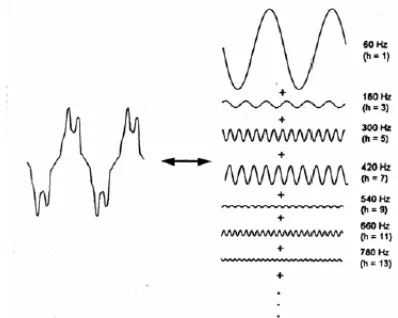
Harmonics according to IEEE std 519-1992 is a sinusoidal component of a periodic wave having a frequency integer multiples of the fundamental frequency of the periodic waveform. If the fundamental frequency is fo, then the frequency of the harmonic order to-h is HFO. Usually used to define harmonic distortion sine wave currents and voltages in amplitude and different frequency. Based on Standard IEC (International Electrotechnical Commission) 1000.4-11, harmonic disturbances belong to the waveform distortion (Dugan, 1996). Figure 1 illustrates the condition.
Fig. 1. The relationship between voltage and current to nonlinear the load
Periodic wave can be expressed as the sum of a pure sine wave having a frequency, amplitude, and phase respectively. Each component has a frequency which is a sine integer multiples of the fundamental frequency. Components that have frequencies integer multiples of the fundamental frequency is called as harmonics.
Fig. 2. Composition of the waves against the constituent components
1 00 sin( )
) (
h
h
h h t
c c t
f (1)
where 2
0 0
a
c , ch ah2bh2 ,
and tan 1( ) h h h b a
2. Voltage and Current harmonics 2.1. Voltage Harmonic
Voltage waveforms containing harmonics are represented using Fourier series, namely:
1 1 ) ( sin 2 ) ( ) ( n n n nn t v n t
v t
v (2)
where:
n = 1, 2, 3,...
Vn = the coefficient of current harmonic components n
= the angular velocity of source
n = the phase angle of the harmonic components-n
2.2. Current Harmonic
Current harmonic is written in the form of the following equation:
10 sin( )
) (
n
n n n t
I I t
i (4)
where:
n = 1, 2, 3,...
In = the coefficient of current harmonic components n n = the phase angle of the harmonic components-n
2.3. Harmonic Index
In harmonic analysis, an important index that is used to describe the effects of harmonics on power systems, namely the Total Harmonic Distortion (THD).
𝑇𝐻𝐷voltage ∶𝑇𝐻𝐷𝑣 100%
1
2 2
x V h Vh
(5)
𝑇𝐻𝐷current∶𝑇𝐻𝐷I 100%
1 2
2
x I h Ih
(6)
I1 = fundamental value
Power on the electrical load is illustrated in the power triangle as in Figure 3. The power P (watts) declared real power, power Q (Var) said reactive power and power S (VA) stating the apparent power. Reactive power reduction is done by adding a capacitor.
Figure 3. Power Triangle
The emergence of harmonic effects on the power factor. The relationship between the power factor to total harmonic distortion (THD) is formulated:
) 7 ( 2 1 cos THD pf
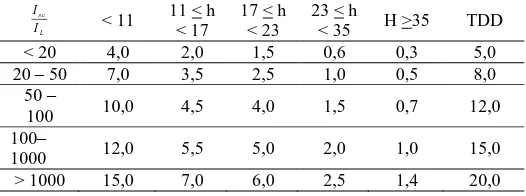
Davis et al (2000) suggest there is a close relationship between the harmonics with total savings of power (apparent power). Major limitation of current and voltage harmonic distortion in the power system as in Tables I and II.
Table I
Limit current distortion (in% IL) for the distribution system (120-69 kV)
L sc
I I
< 11 11 < h < 17
17 < h < 23
23 < h
< 35 H >35 TDD
< 20 4,0 2,0 1,5 0,6 0,3 5,0
20 – 50 7,0 3,5 2,5 1,0 0,5 8,0
50 –
100 10,0 4,5 4,0 1,5 0,7 12,0
100–
1000 12,0 5,5 5,0 2,0 1,0 15,0
> 1000 15,0 7,0 6,0 2,5 1,4 20,0
Table II
Limit voltage distortion (% V1)
Voltage PCC Individial
Harmonics(%) THDV (%)
Vn < 69 kV 3,0 2,0
69 kV < Vn < 161 kV 1,5 3,5
Vn > 1,0 4,5
Aim of research
The purpose of this is to show the magnitude of the harmonic content of the conventional fluorescent lamp ballasts TL 36W before and after the improvement of the power factor. Repairs are carried out with the addition of power factor capacitors.
Research methods
Materials and Equipment Research
Universal Power Analyzer is set according to the voltage source and coupled with a personal computer, and then proceed the following steps:
1) Measurement of the waveform without load
2) Measurement of power factor, harmonic voltage and load harmonic current conventional fluorescent lamp ballast = 36W
3) Measurement of power factor, harmonic voltage and load harmonic current conventional fluorescent lamp ballast = TL 36W with addition of 3.25 F capacitor and 4.5 F.
4) Use of software to create simulations.
3.DISCUSSION
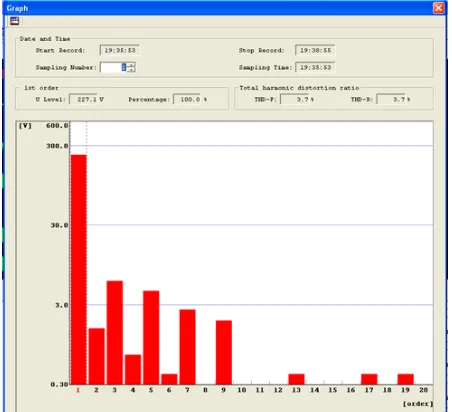
Results of the study are shown in figures 4-9. Before the addition of the capacitor voltage and current harmonics spectrum is shown in Figures 4 and 5.
Fig. 4. The spectrum of harmonic voltage TL 36W without capacitor
Fig. 5. The spectrum of harmonic current TL 36W without C The addition of capacitor 3.2F
The addition of a capacitor of 3.2 F obtains voltage and current harmonics spectrum as in figure 6 and 7.
Fig. 7. The Spectrum of harmonic current TL 36W with C = 3.2 F
The addition of capacitor 4.5 F
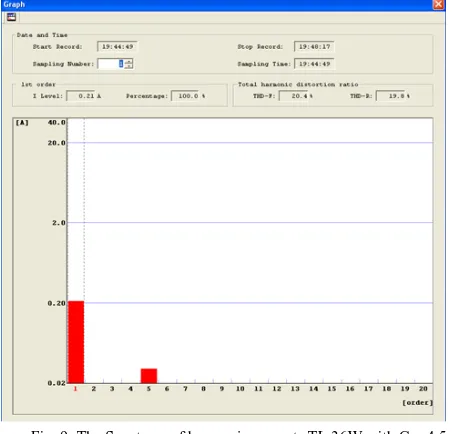
The addition of a capacitor of 4.5 F obtains voltage and current harmonics spectrum as in figure 8 and 9.
Fig. 8. The Spectrum of Harmonics Voltage TL 36 W with C = 4.5 F
Fig. 9. The Spectrum of harmonic currents TL 36W with C = 4.5 F
Before and after the addition of the capacitor changes the amount of power factor, load power, harmonic currents and voltages, as shown in table III.
Table III
Before and after the addition of capacitors
No Discription Power
factor P S Q
Current Harmonik
Voltage Harmonic
1 No
capasitor 0,514 47 W
92 VA
79
Var 11,1 % 3,7%
2 C = 3,2 F 0,87 47 W
54 VA
26
Var 16,3% 3,6%
3 C = 4,5 F 0,957 40 W
50 VA
14
Var 21,5 % 3.7%
Discussion Research
Table III showing the harmonic voltage of electric power system before and after the addition of the capacitor THD is still relatively small, namely 3.7%. The value of the voltage THD is still below 5% IEEE 519 standard.
harmonic currents rise to 16.3%. Harmonic current increases to 21.5% when the addition of the capacitor 4.5 F. The addition of capacitors increases the effect of power factor.
C. Conclusions
1. The addition of capacitor harmonic current increasesfrom 11.1% to 16.3% without the capacitor when the capacitor adding 3.2 F and to 21.5% while the addition of capacitor 4.5 F.
2. The addition of capacitor does not have much effect on the harmonic voltage value is relatively fixed. 3. The addition of capacitor effects on increasing the
power factor
4. Addition of capacitors affects the apparent power has decreased
REFERENCES
[1] Arrillaga, 1985, Power System Harmonics, John Wiley & Son Ltd. New Delhi.
[2] Budiyanto, Maun, 1997, Studi pengurangan arus harmonik Triplen dengan menggunakan tapis seri dan transformator Zero Passing, Thesis S-2 UGM.
[3] Davis, Pileggi, 2000, Harmonic Pollution Metering: Theoretical Consedirations” IEEE Transaction on Power Delivery, New York.
[4] Dugan Roger C., 2012, Electrical Power Quality, 3theditionMcGraw-Hill
Professional;