Abstract- In the past decade provision for preparing notes were in single copy for all subjects and finally writes notes in different subjects copy. Now in the advance age of technology and viewing the future aspects of students, it is well demanded to prepare their notes digitally and distribute them automatically in their respective subjects and no need to prepare separate notes manually. For better distribution process we need a reliable and efficient distribution approach by which one note automatically distributed in their respective subjects. In our approach part „cue word‟ are those relative words of a prescribed subject that helps to distribute a single note into its respective folders on the basis of frequency of cue words. Proposed approach will announced in different sectors like letter writing, student‟s notes making, script managing, news reporting and many more criteria related to writing work and managing prepared notes.
Keywords: Data mining, data warehouse, artificial intelligence, SSA, Digital Notes.
I.
INTRODUCTION
An approach to introduce the essential research area of the data mining, algorithm implementation presented in the paper, where, analyses of one subject note and bifurcate it into its respective subject on the basis
of „cue words‟ were made.Looking the future aspects, the algorithms of Source Separation Algorithm (SSA) are
implemented. Key to algorithms are exploiting detailed source models, using different filtering ideas to distribute the single file, and employing explicit models for background and file division. An attempt to demonstrate strong performance which is robust to distribution of single note file presented [8].Good scaling properties are obtained using Artificial Intelligence Technique.
An artificial intelligent approach fetches the page from the notes and store in suitable folder on the basis of special type of survey after collecting the subject name. This method is based on artificial intelligence (AI) techniques and implemented to improve the interpretation accuracy in separation of notes according to subject using implementation of SSA (Source Separation Algorithm) with faster manner [8], [11].
AI techniques are applied to establish classification features for Subject verification based on the collected data known as cue word. The features are applied as input data to fuzzy logic, artificial intelligence, data warehouse, data mining to diagnose accurate subject of notes. The experimental data of stop word is used to evaluate the performance of proposed method as in the form of separation. The results of the various evaluating methods are classified using AI techniques and compared with the extraction of stop words and frequency of cue word within the paragraph.
II.
THE ASPECTS OF AUTO ARRANGER
Analysis of actual note is based on data research of subject. All research is nothing but it is the huge collections of combine experience of cue words that is already taken earlier in the form of frequency of best suitable words which are really actual words for that relevant subject [2], [12], [10].
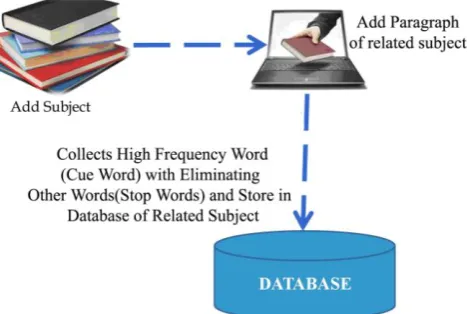
Fig. 1: Process of Auto Arranger
A. Artificial Intelligence Approach
This technology is based on fuzzy logic in which artificial intelligence tool also works. Here artificial intelligence helps to maintain the discipline calculation of percentage which signifies the actual subject percentage. While, fuzzy logic helps in percentage frequency calculation [10], [13]. In combination of both approaches a unique formula for the word prepared, which, helps the user to identify more correctly without wasting time and money.
B. Data Warehouse Approach
It is a central repository of data which is created by integrating data from one or more disparate sources. Data warehouses store current as well as historical data and are used for creating trending reports for senior management reporting such as annual and quarterly comparisons. By this approach, proposed tool collect the cue words and store high frequency word in respective subject at the time of adding paragraph of new subject. This process is going on for future reference when these words will match by auto arranger for final distribution of single note into different subject‟s collection.
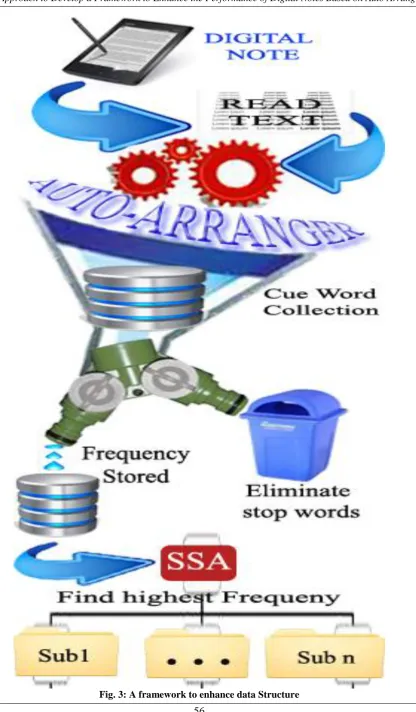
Collection or summarization of cue words after removing the stop words, worked as a Data ware house are presented in present piece of work (Fig. 2).
Fig. 2: Data warehouse of Digital Notes
C. Data Mining Approach
The goal of the data mining process is to extract information from a data set and transform into an understandable structure for further use.
Impact of Proposed technique:
If auto arranger is not used, then also data still store in data structure but it is difficult to separate the data in single area as it is stored in bulk and further separating the data is time talking as well as difficult too. Whereas if auto arranger is used it will automatically separate the data as per user choice in their specific area. Hence we can say that our proposed work is a beneficial for user to have
Ease of use
Effective information retrieval
Reduce time complexity
Handy for arrangement of more storage of data
A. SSA Algorithm Approach
Source Separation is a tempting appliance for several audio applications. This appliance is used as a pre-processing technique as well as post -processing technique. Pre-processing technique is used for hearing aids on the other hand post-processing technique is used for de mixing of stereo recording. An early approach which uses implementation of source separation algorithm is EM Model [8], [14]. EM model is a sound model which is used to separate the signal into two different estimates. This is a concept by which SSA algorithm bifurcate the original voice into male voice and female voice [14].
Now in this area, a new model is implemented by using SSA Algorithm i.e., Auto arranger a text model. It is based on extracting a single note text into different subject folder automatically. It distributes single file into respective folder on the basis of frequency of cue words.
This investigation described a multitude of methods for source separation, employing a wide range of mining learning techniques as well as knowledge of separation of digital notes by which one can save the notes. This algorithm first selects the text in the form of digital notes which works as input for the auto arranger. Auto arranger divides or separates the notes with respect to the desired subject with the help of the cue words [1], [10], [13]. An important lesson to note that, although the source separation problem can be formulated in very general terms, the solution cannot. The formula to implementation of SSA algorithm is given below.
SNj = (ON – Swk) + ∑ (Fw1+w2+…wi)/n
Where
SNj- After separation of digital note, it is divided into different notes according to their respective subject as
output form and j is number of division.
ON- It is that digital note that takes as input form. Here the cardinality is “one too many” where one digital note
can be broken down into different notes according to their respective subjects without wasting time and reliable to convert notes automatically arrange in their proper place that like Artificial Intelligence Technology.
Swk- Itis number of “Stop Words” that are hard coded in database. K represents number of stop word store in
our database. Example- is, the, go … etc.
∑ (Fwi) - Here ‘w’ represents Cue Words that is important word of relative subject. Here „i‟ is number of cue
words. ‘F’ shows frequency means number of time a particular word has come in the original text. ∑ is addition
of all frequency of all cue words situated in text.
Proposed model is more efficient and more reliable to arrange a single file into different folders according to their subjects than manual system. This model is very helpful for those students who prepare notes in a single document and want to arrange in different folder according to their subject. It also enhances the performance of data Structure. Whole model is depending on the cue word.
Presented cue word is a key of whole implementation that can reduce the maintaining effort and increase efficiency of data marinating capabilities. Due to the use of cue word present tool is more efficient in aspects of data structure. It is also speculated that these current capabilities can grow to support future notes making strategies, where human intelligence stops and utilized their valuable time more efficiently in this age of fast growing era.
ACKNOWLEDGEMENT
This study was a part of my M.Tech. Final year dissertation conducted at the Faculty of Computer Science and Engineering, Shri Ramswaroop Memoial University, Lucknow Deva Road, Uttar Pradesh, India
REFERENCES
[1] J. Anemuller, “Convolutive Blind Source Separation”, Ph.D. thesis, University of Oldenburg,
Germany, 2001.
[2] Araki S., “Limitation of frequency domain blind source separation for convolutive mixture of speech”,
proc IEEE HSC-01, pp. 91-94, 2001.
[3] H. Attias, “Independent Factor Analysis Neural Computation”, 11, pp. 803-851, 2009.
[4] M. Baeak, and U. Zolzer, “Performance Analysis of a Source Separation Algorithm”, DAFx-02,
Hamburg, Germany, pp. 207-210, 2002.
[5] J.A. Bell, and J.T. Sejnowski, “An information maximization approach to blind separation and blind
deconvolution. Neural Computation 7”, pp. 1129-1159, 1995.
[6] Y.Ephraim, “Statistical model based speech enhancement system”, proc IEEE 80(10), 1526-1555,
1992.
[7] B.Gupta, and md. Hussain, “Algorithm to Evaluate the Rank of Research Papers Using Citation Graph”
in CiiT International Journal of Data Mining Knowledge Engineering, ISSN NO 0974, April Issue 2012 Paper ID 3033
[8] A. Hagai, “New EM algorithms for source separation and deconvolution with a microphone array”,
IEEE Transaction, 2008.
[9] R.K. Olsson. And L.K. Hansen,“Blind Separation of More Sources than Sensors in Convolutive
Mixtures, International Conference on Acoustics on Speech and Signal Processing”, vol. 5, pp. 657-660, 2006.
[10] B. Sharef, N. Omar, and Sharef Zeyad., “Automated Arabic Text Categorization based on the
frequency ratio accumulation”, The international arab Journal of Information Technology,11(2),2014.
[11] H.N. Thi, and C. Jutter, “Blind source separation for convolutive mixtures”, Signal processing,
45:209-229, 1995.
[12] T. Virtanen, “Sound Source Separation in Monaural Music Signals”, 2006.
[13] O. Yilmaz, and S. Rickard, “Blind Separation of Speech Mixtures via Time-Frequency Masking”,
IEEE Transactions on Signal, 2002.
[14] Matthias Baeck, and Udo Zolzer, “Real-Time Implementation of a Source Separation Algorithm”, 6th