A Novel Preprocessing System using Evolutionary Neuro Fuzzy System
Dr.N.Alamelumangai
Associate Professor, Department of Electronics and Computer Systems, K.G.College of Arts and Science, Coimbatore, India.
Article Received: 11 August 2017 Article Accepted: 30 September 2017 Article Published: 25 October 2017
1. INTRODUCTION
1.1 Ultrasound Images
The non-persistent nature, low cost, portability and real-time image formation make ultrasound images and
essential tool for medical diagnosis [1]. The common applications are image registration, preprocessing,
enhancement, segmentation, classifications. The US images allow high acquisition rates and provide real-time
images but are corrupted with speckle noise. Speckle noise degrades the quality of the images for identifying the
edges, patterns in the images [9]. Speckle noise produces artificial edges, echoes the patterns in the image and etc,
this corrupts the images for easy diagnosis. In such cases evolutionary algorithms do not perform well to identify
edges and patterns. Hence, preprocessing the artifacts in US images is mandatory [3].
1.2 Neuro-Fuzzy Models
Neural networks and fuzzy systems are dynamical, parallel processing systems that approximation input-output
functions [12]. Fuzzy logic is capable of modeling ambiguity, handling vagueness and supporting human-type
reasoning. Whereas, neural-networks are capable of learning from scratch, without needing any a priori
involvement provided that sufficient data are available or measurable. The neuro-fuzzy systems are the most
prominent legislature of hybridizations in terms of the number of practical implementations. In NFS, the fuzzy
inference system is the main subject of the hybridization; neural-network adds learning to an inference engine [5].
1.3 Neuro-Fuzzy Evolutionary Models
An evolutionary neuro-fuzzy system (ENFS) is the result of adding evolutionary hunt procedures to systems,
integrating fuzzy logic computing and neural learning. With these techniques we can overcome some the
boundaries of the existing hybrid systems. The main problem with NFS, is that, the learning algorithm is based on
a steepest plunge optimization technique minimizing the error function [6]. That is, in back-propagation training is
not guaranteed to converge. The algorithm may be trapped in a local minimum. It can never find the global A B S T R A C T
Memetic Algorithm (MA) is inspired by Dawkins‟ notion of a meme [2]. MAs are similar to GAs but the elements that form a chromosome are called “memes”. The unique aspect of the MAs algorithm is that all chromosomes
and off-springs are allowed to gain some experience, through a local search, before being involved in the
evolutionary process. Similar to the GAs, an initial population is created at random. Afterwards, a global search is
performed on each population member to improve its experience and thus obtain a population of local optimum
solutions. Then, crossover and mutation operators are applied, similar to GAs, to produce off-springs. These
off-springs are then subjected to the local search so that local optimality is always maintained.
In this paper, have proposed a method using Hyrid Memetic Algorithms based Neuro-Fuzzy system to harness the
power of the fuzzy reasoning and the learning capabilities of neural networks.
2. PROPOSED METHOD
The problem with the existing Neuro-Fuzzy or Fuzzy-Neuro methods is that it fails to determine the number of
rules or the membership functions (MSF) [11]. While integrating evolutionary approach into these systems it
optimizes the structure and parameters of the fuzzy rules. This paper discusses about optimizing the parameters.
2.1.Structure of the System
In the system NFS the capabilities are added to Evolutionary Algorithm: Hybrid Memetic Algorithm. Hybrid
Memetic algorithm is used to optimize and set the neuro-fuzzy parameters. This acts as a filter to despeckle the
ultrasound image. The filter which is suggested is a self-organized adaptive neuro-fuzzy filter which is based on
neuro-fuzzy and memetic learning. The system uses the neural network ability to learn and knowledge in the
system is in fuzzy form.
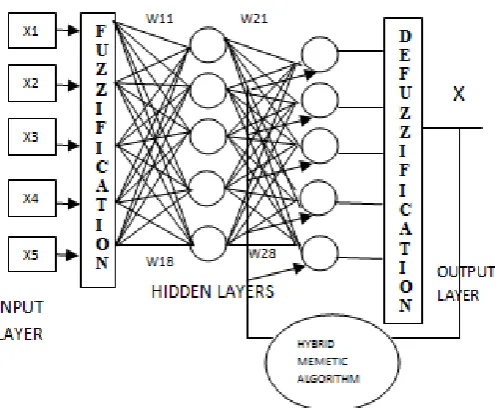
The network used is a feed-forward 5 layered network Fig.1 [10], where the first layer executes a fuzzification
process, the second layer executes the fuzzy AND of the antecedent part of the fuzzy rules, the third layer
normalizes the membership functions (MFs), the fourth layer executes the consequent part of the fuzzy rules, and
finally the last layer computes the output of fuzzy system by summing up the outputs of fourth layer [7]. The noise
is detected based on local statistical features and uses the fuzzy knowledge. Here, the hybrid memetic algorithm is
used to decide and optimize the parameters to the network [13].
The basic Sugeno_type fuzzy model is used which is a single network to filter the speckle noises [11]. The input
parameters are the fuzzy values based on the difference between the main pixel and its neighboring window
pixels. The window size is number of input layers nodes in the system. This system uses a 5×5 window sizes
hence five input nodes. Each node of the input layer is coupled with its neighboring window pixel and therefore
the data used in this layer are fuzzy data. The hidden layers in the system provide knowledge to the system based
on the fuzzy rules and their implications [14]. The inferences to the system are based on the fuzzy IF-THEN rules,
which involve the parameters of the system. The weights are added to the network between the input layers and
the hidden layers which are binary values. To improve the efficiency of the encoding system a set of five binary
weights which identify the pattern of pixels is used. With this encoding mechanism a five bit substring is evolved.
These 5-bit substrings result in three patterns of 90, 180 and 270 degree rotations. Optimization is done to the
non-zero elements in weight-sets which identify a pattern in the neighboring window [15]. Binary weights in the
genetic string are optimized in training steps. Estimation of the noise amplitude in the neighboring patterns is
applied the same manner as applying the local statistics [17].
2.2.Optimized Parameter Learning
MA is chosen, as it is a class of algorithm for maximization of functions [8]. It exploits the features of the error
functions and does not rely on the parameter space. MA applies the mechanism of natural selection and genetics to
its population of solutions. Hence, it is more suitable to train the NFS than the GAs. The features of MA which
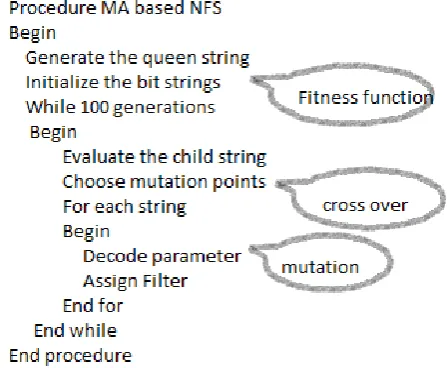
make it suitable for the probability of selection of operators are given in Fig. 2:
Global optimization,
Stochastic and
Selection is based on good features.
An algorithm with one individual string which is defined as the „queen‟ string is chosen. The generation is
generated by performing mutation on this string. This string contains the msf width parameter P and the weights
which have to be applied between the input and hidden layers. The steps of the algorithm are:
1. Randomly generate the individual string (queen string).
2. Initialize it to the bit string of 0‟s and 1‟s.
5. For each string,
a. Decode the parameter values.
b. Assign to the neuro-fuzzy filter.
6. Stop the process after 100 generations.
Figure 2. Application of HMA Parameters
3. EXPERIMENTAL RESULTS
A 5 layered NFS which is trained individually is used. The system output, which is the noise-value is filtered from
the neighbor pixel window. Speckle noise reduction is a low pass filtering operation [18]. Our system reduces the
noise and makes it available for preprocessing.
The experiment is conducted on 50 Breast Sonogram images which are trained in the neural network based on
fuzzy values for 100 epochs [19]. The input parameters are adjusted accordingly. System performance is tested of
its error value based on Mean Square Error (MSE) [16]. The results are compared with the adaptive mean filter [4]
and adaptive weighted mean filters. It is observed that the noise reduction system is a dynamic system when
compared to the standard systems. Ultrasound images used are 2d gray images which have 256 levels and are best
compared based on visual observation [20].
The experiment is simulated using Matlab 7.5 on Athol processor based system with 1 GB RAM. In Fig.4.(a) the
typical diagnostic image, in Fig.4.(b) noisy image corrupted by speckle noise, in Fig.4.(c) proposed MA based
Neuro-fuzzy system after speckle reduction, compared with the standard adaptive mean filter in Fig.4.(d) and
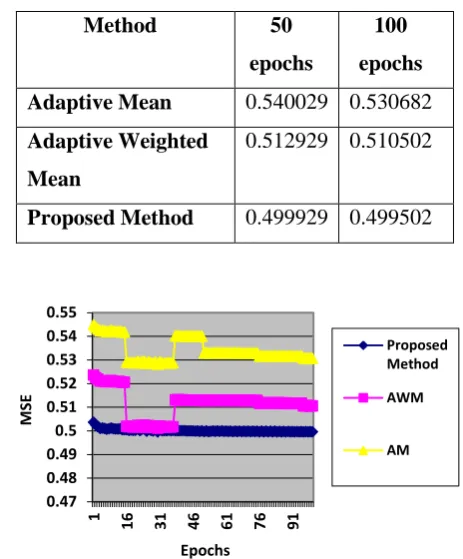
Table 1 Comparison of the Noise Mean Square Error (MSE)
Method 50
epochs
100
epochs
Adaptive Mean 0.540029 0.530682
Adaptive Weighted
Mean
0.512929 0.510502
Proposed Method 0.499929 0.499502
Figure 3. Comparison of Three Methods
Figure.4.(a) Original Image
Figure.4.(b) Noisy Image Corrupted by Speckle Noise
0.47 0.48 0.49 0.5 0.51 0.52 0.53 0.54 0.55
1 16 31 46 61 76 91
MS
E
Epochs
Proposed Method
AWM
Figure.4.(c) Proposed Method
Figure.4.(d) Adaptive Mean Filter
Figure.4.(e) Adaptive Weighted Mean Filter
4. CONCLUSION
This paper discusses about three dynamic soft computing tools namely, neural networks, fuzzy logic, and memetic
algorithms. The intention of this paper was to harness the power of the individual system by substituting its
drawbacks with the power of other system. This type of system is evolutionary neuro fuzzy system.
The proposed system suggests a Hybrid Memetic based approach to optimize neuro-fuzzy system for speckle
reduction in breast sonograms. Neural networks for learning and fuzzy parameter for knowledge development are
used. The inputs to the system are fuzzy parameters optimizes the output. Based on these parameters MA learning
is performed. The system outperforms the traditional systems by 34.5 % in terms of MSE ratio and the
ACKNOWLEDGEMENT
My sincere thanks to Parents, Friends, Colleagues, Management for providing the facilities which are required
and all others, who have directly and indirectly helped in achieving this task.
REFERENCES
[1] American Cancer Society (2010). www.cancer.org
[2] S. Areibi, “Effective exploration and exploitation of the solution space via memetic algorithms” Book Chapter
on Recent Advances in Memetic algorithms and Related Search Technologies (2005), pp.161–82.
[3] Benecchi, L., Neuro-fuzzy system for prostate cancer diagnosis. Urology. v68 i2 (2009), pp.357-361.
[4] H.L. Eng, K.K. Ma, Noise adaptive soft-switching median filter, IEEE Trans. Image Process. 10 (2) (2001)
pp.242–251.
[5] Elif Derya Ubeyli, Noise cancellation in ultrasound signals with adaptive neuro fuzzy inference system, Digital
signal processing, vol 10 (1) (2010), pp. 63-76.
[6] Elif Derya Ubeyli, Inan Guler, Adaptive neuro fuzzy systems for analysis of internal carotid arterial Doppler
signals, Computers in Biology and Medicine, Vol 35 (8) (2004), pp. 687- 702.
[7] Elif Derya Ubeyli, Inan Guler, Teaching Automated Diagnostic systems for Doppler ultrasound blood flow
signals to biomedical engineering students using Matlab, International Journal of Engineering Education, Vol
21 (4) (2005),pp.649-667.
[8] D.E. Goldberg, “Genetic Algorithms in Search, Optimization and Machine Learning” Addison-Wesley,
Reading, MA, (1989).
[9] R.C. Gonzalez, R.E.Woods, Digital image processing, second ed., Prentice-Hall, Upper Saddle River, NJ,
(2001).
[10]S. Haykin, Neural Networks, Prentice-Hall, Englewood Cliffs, NJ, (1998).
[11]J.-S.R. Jang, ANFIS: adaptive network-based fuzzy inference system, IEEE Trans. Systems, Man, Cybern. 23
(03) (1993) pp.665–685.
[12]J.-S.R. Jang, C.-T. Sun, E. Mizutani, Neuro-fuzzy and Soft Computing: A Computational Approach to
(Eds.), Fuzzy Filters for Image Processing, Springer, Berlin, Heidelberg, NewYork, (2003), pp. 54–71.
[14]B. Kosko, Neural Networks and Fuzzy System, Prentice-Hall, Englewood Cliffs, NJ, 1992.
[15]Y.S. Ong, M.H. Lim, N. Zhu, K.W. Wong, “Classification of adaptive memetic algorithms: a comparative
study”, IEEE Trans. Syst. Man Cybern. Part B 36 (1) (2006) 141–152.
[16]G. Qiu, Functional optimization properties of median filter, IEEE Trans. Signal Process. Lett. 1 (4) (1994)
pp.64–65.
[17]A. Rafiee Kerachi, M.H. Moradi, M.R. Farzaneh, “Speckle noise reduction in sonography images by using
online genetic neuro fuzzy filters”, Proceedings of the 4th
Seminars on Fuzzy Sets and its Applications- Iran,
(2003), pp. 70-77.
[18]Russo. F. Evolutionary Neuro-Fuzzy Systems for noise cancellation in image data, IEEE Transactions on
Instrumentation and Measurement, Vol.48 (5), (1999), pp.915-920.
[19]Suhail M. Odeh, Using An Adaptive Neuro-Fuzzy Inference System (ANFIS) Algorithm For Automatic
Diagnosis Of Cancer, Proceedings of European, Mediterranean & Middle Eastern Conference on Information
Systems (2010).
[20]Yanhui Guo H.D. Cheng Jiawei Tian , Yingtao Zhang, A Novel Approach to Breast Ultrasound Image
Segmentation Based on the characteristics of Breast Tissue and Particle Swarm Optimization, Proceedings of