Analysis of Project Management Tools for
Implementation of Research and Development
Infrastructure
Fabricio da Costa Dias
1, Carlos Alberto Pereira Soares
2, Marcone Freitas dos Reis
3, Marcos dos Santos
4, Bruna
Russo Bahiana
41, 2,3Civil Engineering Graduate Program, Fluminense Federal University, Passo da Pátria Street, 156, Niterói, Brazil, 24210-240 4
Production Engineering Graduate Program, Fluminense Federal University, Passo da Pátria Street, 156, Niterói, Brazil, 24210-240
3Production Engineering Undergraduate Program, SENAI/CETIQT, Magalhães Castro Street, 174, Rio de Janeiro, Brazil,
20961-020
Abstract-- This paper analyzes the usage process of project management tools in the context of R&D infrastructure implementation projects on the campus of Brazilian universities, from the perspective of best project management practices described in the PMBOK, understanding as implementation infrastructure the construction of buildings, laboratories, research rooms, control rooms, pilot plant and availability of any features related to the construction industry. The relevance of the study is to contribute to the adaptation of the best monitoring practices of infrastructure implementation projects destined to R&D developed in partnership with universities. Adopting as a case those from partnerships between Brazilian universities and the company PETRO X, it was made a field research and a comparative study between the practice and the literature on project management tools, concluding that in the vast majority of the surveyed universities it has not been steadily developed the concept of project management and there is a lack of technical content for project managers on both sides of the Terms of Cooperation. The studies also suggest that project management tools should be centered in a support group (Project Office) in universities.
Index Term-- Project Management, Infrastructure Projects, Partnership Project, Company-University Partnership, Construction in University.
1. INTRODUCTION
To effectively meet the demands of an increasingly demanding market in an environment characterized by fast changes and in order to provide products, services and processes that satisfy consumers, a management model that focus in priorities and objectives is essential. For that reason, project management has been sharply achieving outstanding levels in all parts of the world in recent decades. (CASTRO, 2013, VARGAS, 2009 and SLACK, 2008).
Projects can be classified, by its type, as: Investment; Research and Development (R&D); Organizational Change Generation; Information Systems Development; New Product or Service Generation. (ORTH 2009)
Regarding to Research & Development (R&D) projects, it has similar characteristics to other projects: they are temporary, which means having a finite beginning and
end; they are a way to introduce changes; they involve researchers, analysts and other employees with different skills working together to introduce a change to external impact; they are unique, i.e., a search unit may perform similar
designs, however, each design meets factors and
characteristics that make it unique; and, finally, they have uncertainty that must be managed.
An important way of enabling R&D projects is the one taking place through a partnership in which the private sector cooperates with public organizations. One type of important partnership is the Company/University partnership.
Among the existing Alliance projects, there is the Cooperation Agreement between Brazilian universities and a major Brazilian oil company (Company PETRO X) designed specifically for the construction of infrastructure designed to R & D projects within the universities. It is understood as infrastructure construction of buildings, laboratories, research rooms, control rooms, pilot plant and availability of any features of the building industry for conducting R & D in universities.
As exposed, the focus of this research is to verify that on the systematic of project management for the implementation of research and development infrastructure
has been adopted the best management practices
recommended by the Project Management Institute - PMI, through the Project Management Body of Knowledge - PMBOK, adopting as a case the project from the Cooperation Agreement between PETRO X and Brazilian Universities.
PMBOK brings together the knowledge and best practices of the project management universe, gathering the management actions in processes and techniques organized into ten knowledge areas: Project Integration Management, Project Scope Management, Project Time Management, Project Cost Management, Project Quality Management,
Project Human Resource Management, Project
Communications Management, Project Risk Management, Project Procurement Management, Project Stakeholder Management.
converge and indicate that projects are geared to generate results and benefits. Therefore, clear goals with specific results are needed because their temporary nature should meet the explicit negotiated requirements by those involved or by interested parties. Thus, the project management is critical to the success of the project because it is associated with the constant use of methodologies, best practices, application indicators, processes and technologies that enable to achieve a better project performance. (Barcaui, 2012)
2. MATERIALS AND METHODS
The literature review was conducted in two regular basis: a periodic basis of Higher Education of Personnel Improvement Coordination (CAPES), and Elsevier, through Illumin8, solution designed for professionals involved with technology foresight and innovation. Through this tool it was possible to make intelligent semantic search in 40 million scientific records from Elsevier and more than 5,000 publishers, over 24 million patents from major patent offices around the world, billions of web pages and more than a thousand online business supplies, business news and technical issues.
Regarding CAPES database, the research was carried out through the Periodical Portal, which is a virtual library that collects and offers the best of national and international scientific production. It has more than 35 thousand titles with full text collections, 130 reference bases, 11 bases exclusively dedicated to patents, as well as books, encyclopedias,
reference works, technical standards, statistics and
audiovisual content. The Periodical Portal meets the demands of academic, productive and government sectors and promotes the increase of national scientific production and the growth of Brazilian scientific insertion abroad.
The researched papers were the basis for the critical review of the state of the art on project infrastructure project came from from public - private partnership and the formulation of the questionnaire used in the field research.
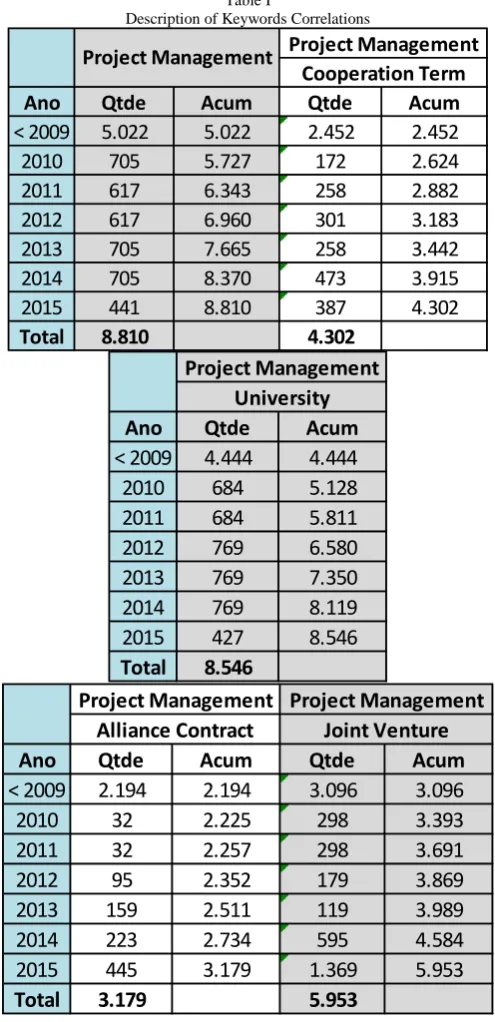
Analyzing each group of keywords it is possible to get the following quantitative and their respective accumulated described in Table I below:
Table I
Description of Keywords Correlations
Analyzing the databases it is possible to conclude that in the past five years, the number of publications in the Project Management area related to Cooperation Agreement, the subject of this study, have been oscillating. Therefore, the publication of this issue for the scientific community is relevant, given its importance. That is, research in this field of expertise is relevant to all stakeholders, such as the scientific community, companies, universities, government and society as a whole as one can benefit from improvements in project management, resulting in quality improvements and financial returns for the population.
Ano
Qtde
Acum
Qtde
Acum
< 2009
5.022
5.022
2.452
2.452
2010
705
5.727
172
2.624
2011
617
6.343
258
2.882
2012
617
6.960
301
3.183
2013
705
7.665
258
3.442
2014
705
8.370
473
3.915
2015
441
8.810
387
4.302
Total
8.810
4.302
Project Management
Project Management
Cooperation Term
Ano
Qtde
Acum
< 2009
4.444
4.444
2010
684
5.128
2011
684
5.811
2012
769
6.580
2013
769
7.350
2014
769
8.119
2015
427
8.546
Total
8.546
Project Management
University
Ano
Qtde
Acum
Qtde
Acum
< 2009
2.194
2.194
3.096
3.096
2010
32
2.225
298
3.393
2011
32
2.257
298
3.691
2012
95
2.352
179
3.869
2013
159
2.511
119
3.989
2014
223
2.734
595
4.584
2015
445
3.179
1.369
5.953
Total
3.179
5.953
Project Management
Alliance Contract
2.1. Methods
The Project Management field has greatly expanded since the end of World War II. Many tools have been developed to meet the diverse areas of knowledge that covers Project Management and a lot of papers and research had been presented in various meetings around the world. There is a great confusion among the new projects users, including the tools and methodologies of Project Management process. The methodology, in the origin of the term, means the study of means and instruments used to do science; and a process consists of a series of actions that generate a product. The Project Management processes describe, organize and complete the project activities (PMBOK, 2013). The tools help to solve specific problems, since they are the instruments used by the methodology to achieve their goals. In the Management field, there is a best practices guide recognized and widely publicized, presented by the Project Management Institute (PMI - USA), which is a global nonprofit organization that serves the interests of its members, project management professionals. Its mission is to promote professionalism and develop state-of-the art management, providing its members with services and world-class products and establishing the acceptance of the project management as a discipline and a profession.
The Project Management Body of Knowledge (PMBOK) is a guide to professionals about the knowledge in Project Management, developed by PMI, covering already sedimented good practices, whose purpose is to identify and describe concepts and practices in project management in terms of processes that comprise it. Therefore, this work has centered its methodology in the areas of knowledge of PMBOK, which are divided into 10 areas: integration, scope, time, cost, quality, human resources, communications, risk, procurement and stakeholders management. However, this paper will only cover the first four areas of knowledge, respectively.
Aiming to reduce research, studies and technological development costs, and to better exploit the technological potential available, industrialized countries created the model of cooperative research through cooperative networks; multi-client projects; joint ventures; cooperative centers; consortia, etc. (MOTA; VASCONCELOS, 2004). Cooperative research is characterized by the development of a thematic area to be explored or a specific project aimed at producing an innovation or solving a technological problem that requires labeled activities as basic research; applied research; experimental development or engineering. The aim is to produce new knowledge, performing collectively, bringing together research institutions and companies participating in financial or technical resources, funding or running parts of the tasks, in contrast, having access to all the generated information.
Therefore, this article analyzed the process of project infrastructure management implementation aimed at R&D on the campus of Brazilian universities, from the perspective of the best project management practices described in the
PMBOK, adopting a its case those from partnerships between Brazilian universities and PETRO X.
2.2 Survey
This paper can be defined as an applied research because it has the practical commitment, looking forward to solving the problem effectively and in a participatory way in the business context, which used documentary research, bibliographic and field research, being represented by a case study of the company PETRO X, fictitious name for reasons of confidentiality of information, and Brazilian universities, the latter with the actual names described.
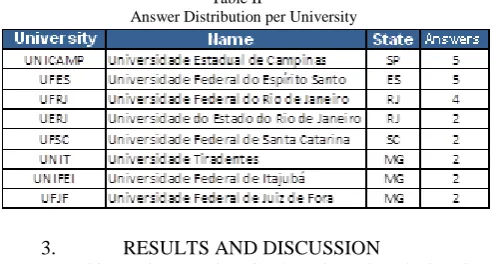
The sample was representative, non probabilistic, being selected by typicality (MARCONI and LAKATOS, 2009). It was considered as the universe of this study: a) public or private universities linked by Cooperation Agreement to PETRO X, aiming at the implementation of R&D infrastructure, totaling 10 universities, of which 8 have decided to participate, in addition to the company itself.
The research subjects can be divided into two groups: coming from universities and coming from PETRO X. The ones related to universities were project managers of the Terms of Cooperation and its responsible staff, mostly researchers, who gave technical and administrative support to the project manager. Regarding to PETRO X, the selected subjects were its own employees, including contractors, who participated in the projects.A obtenção de dados deu-se em duas frentes, de acordo com Vergara (2009):
Through documentary collection
Data were collected from technical texts, technical standards, procedures, patents, press releases and internal reports of PETRO X, both in print and digital.
Through questionnaire
A semistructured questionnaire was prepared based on information obtained during the literature during the bibliographic research. It is considered semistructured because besides the closed questions, the last question of each topic dealt allows the respondent to discuss the theme, openly, without preset conditions.
The questionnaire consists of four questions that permeate four knowledge areas (Scope, Time, Cost and Quality) in project management contained in the PMBOK. For each area of the PMBOK it was formulated a question related to the tools used that have served to guide and manage the project execution.
For each response it was necessary to quantify the degree of importance of each of the items addressed as follows: (5) - Indispensable; (4) - Important; (3) - Relevant; (2) - Irrelevant; (1) - I do not know the application; (0) - Not applicable.
Therefore, each respondent contributed with their own perception on project management attended.
institution depends on the number of professionals involved in the management of the Cooperation Project.
Table II
Answer Distribution per University
3. RESULTS AND DISCUSSION
In this topic are described and analyzed the data collected through a questionnaire, and the descriptive results of the survey were organized and translated as tables for better representation and interpretation of the data addressed. For better understanding the information generated it will be shown the processing of data per knowledge area, separately.
Regarding the degree of importance of the Project Scope Management Tools for managing R&D projects from PETRO X/University, the results were:
In this topic are described and analyzed the data collected through a questionnaire, and the descriptive results of the survey were organized and translated as tables for better representation and interpretation of data addressed. Foe better understanding the information generated it will be shown the processing of data per knowledge area, separately.
Regarding the degree of importance of the Project Scope Management Tools for managing R&D projects from PETRO X/University, the results were:
The data confirm the concern of PETRO X at runtime control of their projects, but the level of relevance focuses more to the relevant level than important, that is, although it considers important to its control, the usage of specific management tools become less important. A point to note is the low relevance in D item (software), which does not enforce company policy that established the MS Project and SAP/R3 as its basic tools of control of their research and development projects. This resistance is latent because of the complexity of these tools and their application in everyday life, a permeate researchers environment. The Table also shows an alignment of the University with PETRO X in this parameter, and also shows a very low relevance in item D. This low level would be expected by the difficulty of the University to obtain and maintain robust softwares such as SAP/R3, more restricted than Primavera, but MS Project should raise this level, because it is a more common and usual software in a project management environment.
Data shows that PETRO X bases its cost control in expert opinion, usage of previous projects and spreadsheets, but even having a wide range of existing control tools on the market it still relies on the perception of people and its history of previous projects, and such control uses simple tools. This perception shows that PETRO X gives much value to human capital, and especially the learned knowledge to prepare their costs in R&D. The University also converges to the expert opinion and simple tools, but gives high relevance to supplier proposals, i.e., the third parties indicator is very strong for making the project costs. Probably this is due to the low historical of similar projects per University's each practice area, and a small amount of professionals dedicated to R&D projects, i.e., the staff is restricted to collect information for the composition of the project costs.
Regarding the degree of importance of the Project Quality Management Tools for project management of R&D projects from PETRO X/University, the results were:
Analysing the data it can be seen that both PETRO X and the University point the high relevance of the simplest tools on the quality control (cost-benefit analysis, benchmarking and inspection/auditing), a lot on the fact that the coordinators are extremely technicians in engineering and many have little knowledge in the quality management area. This is clearly visible in the PETRO X when classifying the item as irrelevant to not applicable, through their lack of knowledge and this level reached 63% (adding option 2, 1 and 0 for the item E). Therefore, this shows a lack of training for these managers in quality management area as well as better knowledge tools for quality control. Another important point would be as own strategy to put aside quality to achieve other parameters, such as scope, cost and schedule.
4. CONCLUSIONS
not perceived at the University where the teacher works as a fundamental pillar of the project's path.
Analyzing the data it can be seen the differences between the University and the Company, which does not mean that there is a misalignment between the parties and a disconnection with the Cooperation Agreement. In the perception of the University, an effective management brings a formalism to evaluate the cooperation agreement context, requiring specific teams to do so, something that the University does not have in abundance, on the contrary, it has lack of people in its technical staff with the project manager profile. However, expect that monitoring from universities
charging from biologists, physicists, chemists and
mathematicians that qualification in project is still premature and unfair.
Another important point to emphasize is that the tools of the knowledge areas studied there were responses not aware of such an application, which shows that while the project management concepts are disseminated between the University and PETRO X, and based on the PMBOK or conventional literature, some basic requirements are essential to the project manager, being from the university or from the company. Therefore, a conclusion that can be drawn of the questionnaire application results is that there is lack of technical content for project managers to both sides of the Cooperation Agreement.
Therefore, the search for quality improvement in project management needs to be an effective, procedural and constant concern, using the techniques and more effective and modern tools so there is a greater ease and flexibility in the process.
Management processes described in the PMBOK should serve as a basis for project management, providing the basis for the work of companies and universities who wish not only their mere maintenance in the market, but seeks to provide excellence and reach new levels of satisfaction and production.
The main purpose of this paper was to understand which tools are used in practice on project infrastructure management, implemented in universities in Brazil through Cooperation Agreement and compare it with the PMBOK's best practices. The main conclusion that can be obtained from this study is that both the company and the University need to step up the use of more elaborate tools that brings more effective and efficient control to the management process. However it is clear that these improvements should be linked to the learning process in project management for managers of the Cooperation Agreement.
The Company shows how to assist and support its project managers, investing and improving their Project Office, however it is important that the training of employees is also contemplated. In the case of universities, the creation of a Project Office to support the teacher in conducting the cooperation agreement would be interesting. Specific training in project management would also be important, but it can not compete in training for engineering and teaching, which
is the main function that the teacher plays within the University.
The proposed changes need to be analyzed in the light of climate and organizational culture, respecting regional, size, complexity and vocation of educational institutions and businesses aspects, their needs and development of the business sector, but above it all it is important to note that the process only succeed if there is an unrestricted participation from everyone involved.
REFERENCES
[1] BARCAUÍ, André Baptista. Perfil dos Escritórios de Projetos em Organizações Atuantes no Brasil. Dissertação de Mestrado em Sistema de Gestão pela Qualidade Total. Universidade Federal Fluminense. Rio de Janeiro. 2003.
[2] CASTRO, Maria Isabel S. M. C.. Gerenciamento de Projetos – Cursos de Administração de Empresas (CADEMP) – Fundação Getúlio Vargas (FGV) – Rio de Janeiro. 2013.
[3] DINSMORE, Paul C.; CABANIS-BREWIN, Jeannette. AMA – Manual de Gerenciamento de Projetos. Rio de Janeiro: Brasport, 2009.
[4] KERZNER, Harold. Gestão de Projetos. As Melhores Práticas. 2ª Edição. Ed. Bookman. São Paulo. 2004
[5] MOTTA, F. C. P.; VASCONCELOS, I. F. G. Teoria Geral da Administração. São Paulo: Pioneira Thomson Learning, 2004. [6] ORTH, Afonso Inácio; PRIKLADNICKI, Rafael. Planejamento e
Gerência de Projetos. Porto Alegre: EDIPUCRS, 2009.
[7] PROJECT MANAGEMENT INSTITUTE (PMI). Um Guia do Conhecimento em Gerenciamento de Projetos (Guia PMBOK) – Quinta Edição. 2013.
[8] XAVIER, Carlos Magno da Silva; CHUERI, Luciana de Oliveira Vilanova. Metodologia de Gerenciamento de Projetos no Terceiro Setor: Uma Estratégia para Condução de Projetos. Rio de Janeiro: Brasport, 2008.
[9] MARCONI, Marina de Andrade; LAKATOS, Eva Maria. Fundamentos de Metodologia Científica. 6ª edição – 7ª reimpressão. São Paulo: Atlas, 2009.
[10] SLACK, Nigel; CHAMBERS, Stuart; JOHNSTON, Robert. Administração da Produção. São Paulo: Atlas, 2008.
[11] VARGAS, Ricardo Viana. Gerenciamento de Projetos: Estabelecendo Diferenciais Competitivos. 7. ed. – Rio de Janeiro: Brasport. 2009.