GLOBALIZATION EFFECT ON INDIAN RETAILING: AN EMPIRICAL
STUDY ON RETAIL CONSUMERS
A R T I C L E I N F O
INTRODUCTION
Globalization, being the part of India’s new economic reform (popularly known as, Liberalization, Privatization and Globalization or LPG) has many a fold impact on Indian economy. Globalization is one of the major contributors to make the country’s economy growing and globally competitive (Malik). In spite of all such positive impact it has created various challenges to the country’s economy. The effect of globalization is evident on countries economic, social, cultural, commercial system etc.
Since the early 1990’s, the services sector of India has started to internationalize due to globalization and the impact
of Globalization is seen on countries retail sector as well. Globalization has connected the entire retail market of the world. Global competition forces the retailers to source their brand abroad. In order to survive or to grab the opportunities of the unsaturated markets, the global retail giants are unceasingly expanding their business in various countries around the world. Most of the global giants from the developed nations are moving towards the untouched market of the developing countries. As in such nations, many retailers find a great price and quality to spread their global business
International Journal of Current Advanced Research
ISSN: O: 23196475, ISSN: P: 2319
-Available Online at www.journalijcar.org
Volume 6; Issue 6; June 2017; Page No.
DOI: http://dx.doi.org/10.24327/ijcar.2017.
Article History:
Received 13th March, 2017 Received in revised form 8th April, 2017
Accepted 10th May, 2017 Published online 28th June, 2017
Key words:
Organized Retail, Unorganized Retail, Globalization, Customer Satisfaction
Copyright©2017 Kishore Bhattacharjee. This is an open access article distributed under the Creative Commons Attribution License, which permits
unrestricted use, distribution, and reproduction in any medium, provided the original work is properly cited.
*Corresponding author: Kishore Bhattacharjee AMITY, Patna Bihar, India
GLOBALIZATION EFFECT ON INDIAN RETAILING: AN EMPIRICAL
STUDY ON RETAIL CONSUMERS
Kishore Bhattacharjee*
AMITY, Patna Bihar, India
A B S T R A C T
Globalization has created many–a–fold impact on countries economy over the last few years. The impact of globalization can be seen on countries retail sector as well. Organized retailing is one of the flourishing sectors in India’s economy and showing huge potential to flourish in the future. At the same time the organized retailing is generating some challenges for the traditional unorganized retail sector of the country.
In the light of the current scenario the purpose of this study is to identify and compare the current satisfaction level of the customers and to focus light on the emerging challenges for the traditional unorganized retailing. The study has been carried out in the city of Patna, Bihar.
A cross- sectional descriptive design has been opted to conduct the study and a survey has been conducted among 272 retail consumers from various areas of Patna by applying quota sampling technique. The view (perceived value, attitude & perceived service quality) of such respondents have been measured to check their satisfaction level. Then satisfaction towards both organized and unorganized retailing has also been compared. Impact factors against consumer responses have also been measured to identify the factors con
the emerging challenges for unorganized retailing in India.
lobalization, being the part of India’s new economic reform Liberalization, Privatization and ) has many a fold impact on Indian economy. Globalization is one of the major contributors to growing and globally In spite of all such positive impact it has created various challenges to the country’s economy. The effect of globalization is evident on countries economic,
ly 1990’s, the services sector of India has started to internationalize due to globalization and the impact of such of Globalization is seen on countries retail sector as well. Globalization has connected the entire retail market of the tition forces the retailers to source their In order to survive or to grab the opportunities of the unsaturated markets, the global retail giants are unceasingly expanding their business in various countries al giants from the developed nations are moving towards the untouched market of the developing countries. As in such nations, many retailers find a great price and quality to spread their global business
(Hong & Mcgoldrick, 1996). markets.
In post liberalization era, retail can be considered as one of the flourishing sectors of the Indian economy. Retail giants from around the world are penetrating into the country to grab the opportunities of enormous profit. Although the organized retailing has covered only 4 to 5 % of the countries retail market, consumers are unceasingly getting attracted towards this sector. This sector is also showing huge potential to flourish in the future. At the same time the organized retailing is generating some challenges for the traditional unorganized retail sector of the country. The future of unorganized retail sector in India is suffering as, at the one hand organized retail is congregating into the life of urban consumers; at the other side the unorganized retail is gradually facing huge threat day by-day. Gradually the organized retailing becomes the place of attraction for the customers. Modern day retail outlets are very much focused on maintaining customer supportive facilities and attractive tangibles around the store. These amenities such as; prominent merchandising, facilities of elevators, attractive lighting, air
aisle placement and width, carpeting and architecture also contributes to the overall image of the store
Blackwell, & Miniard, 1995).
International Journal of Current Advanced Research
- 6505, Impact Factor: SJIF: 5.995
www.journalijcar.org
2017; Page No. 4141-4147
http://dx.doi.org/10.24327/ijcar.2017.4147.0449
This is an open access article distributed under the Creative Commons Attribution License, which permits unrestricted use, distribution, and reproduction in any medium, provided the original work is properly cited.
Kishore Bhattacharjee
GLOBALIZATION EFFECT ON INDIAN RETAILING: AN EMPIRICAL
countries economy over the last few years. The impact of globalization can be seen on countries retail sector as well. Organized retailing is one of the flourishing sectors in India’s economy and showing huge potential to e time the organized retailing is generating some challenges for the traditional unorganized retail sector of the country.
purpose of this study is to identify and compare the current satisfaction level of the customers and to focus light on the emerging challenges for the traditional unorganized retailing. The study has been carried out in the city of Patna,
ectional descriptive design has been opted to conduct the study and a survey has been conducted among 272 retail consumers from various areas of Patna by applying quota sampling technique. The view (perceived value, attitude & perceived service quality) of such respondents have been measured to check their satisfaction level. Then satisfaction towards both organized and unorganized retailing has also been compared. Impact factors against consumer responses have also been measured to identify the factors contributing as the emerging challenges for unorganized retailing in India.
. India is one of such potential
In post liberalization era, retail can be considered as one of the flourishing sectors of the Indian economy. Retail giants around the world are penetrating into the country to grab the opportunities of enormous profit. Although the organized retailing has covered only 4 to 5 % of the countries retail market, consumers are unceasingly getting attracted towards sector is also showing huge potential to flourish in the future. At the same time the organized retailing is generating some challenges for the traditional unorganized retail sector of the country. The future of unorganized retail ring as, at the one hand organized retail is congregating into the life of urban consumers; at the other side the unorganized retail is gradually facing huge threat
day-day. Gradually the organized retailing becomes the place mers. Modern day retail outlets are very much focused on maintaining customer supportive facilities and attractive tangibles around the store. These prominent merchandising, facilities of elevators, attractive lighting, air-conditioning, washroom, aisle placement and width, carpeting and architecture also contributes to the overall image of the store (Engel,
Research Article
Globalization Effect On Indian Retailing: An Empirical Study On Retail Consumers
The Concept of Globalization
The term globalization has formerly emerged from English. Since the origination the concept; globalization has inspired plentiful interpretations and meanings. The Swedish journalist Thomas Larsson (2001), in his book “The Race to the Top: The Real Story of Globalization”, states that globalization “is the process of the shrinking of the world, the shortening of distances, and the closeness of things. It allows the increased interaction of any person on one part of the world to someone found on the other side of the world, to benefit".
The Concept of Retailing
Retailing is the final stage of the supply chain of any business activity. By virtue of this fact, retailing holds a crucial place in the world’s economy. Various definitions have been examined to understand the scope or the concept of the term retail.
Philip Kotler opined that retailing is the process of selling goods or services to the final consumer for their personal, non-business use. A retailer or retail store is any business enterprise, the sales volume of which comes mainly from retailing. It is the last stage in the physical distribution chain. Retailing is simply the selling of products to the final consumers for their household consumption (Berman & Evans, 2009).
Retail Sector can basically be classified in to two segments. One is organized segment and the other one is unorganized segment. As far as India is concerned, this organized segment contributes only about 4 to 5% of the retail trade and the unorganized segment contributes to remaining 95 to 96% of the retail trade.
Major Retail formats in India
The major retail formats in India have depicted as bellow (Prafulla & Brijesh, 2013)-
Retail trade in India: Current Status
In post liberalization era retail industry is undergoing a revolutionary change. Retailing in India is one of the pillars of its economy and accounts for about 22 percent of its GDP (McKinsey & Company, 2007; Anand, 2011). Country’s retail market is projected to be US$ 500 billion and one of the top five retail markets in the world by its economic value in near future. With more than 1.2 billion people, India is one of the fastest growing and potential retail markets in the world (Bharadwaj, Swaroop, & Vittal, 2005). India has the highest
shop density in the world, with 11 outlets per 1000 people. India's retail and logistics industry employs about 40 million Indians (3.3% of Indian population) (Kalyanasundaram, 2012).
Retail density of the country is 6 percent, which is highest in the world (Parvathamma, 2014).
The organized retailing in the country is growing at a swift speed and is expected to account for 24 per cent of the overall retail market by 2020.
As far as Bihar is concerned (as the study population consists of the retail consumers of Patna) the retail scenario has been changed dramatically in the state over the last few years. Most of the retail giants are operating in the city these days. Few among them are like; Reliance retail stores, Big bazar, Pantaloons, Café Coffee Day, KFC, McDonalds, Pizza Hut, Vishal mega Mart etc. All these major retail operators have added dramatically to the states GDP in last few years.
Smith (1989) & Sellers (1990)have opined that today’s retail environment is changing more rapidly than ever before. Modern day retailing is escalating competition and attracting more classy and demanding customers who have great expectations related to their consumption experiences. Such sophisticated demands of the customers are influencing them towards the modern day organized retailing.
Although the unorganized retail is covering the major part of the countries/states retail Industry, the organized retailing has shown tremendous growth in the size and market dominance over the last few years. The attractive and pioneering features of modern retailing are gradually become a great source of attraction for the customers these days. These innovative and attractive features are adding to their satisfaction level as well. On the other hand increasing rate of customer attraction and satisfaction towards organized retailing is throwing challenges for the traditional retailers of the country. In the light of the current scenario this study is an effort to measure the current satisfaction level of the customers for both the organized and unorganized retailing in Patna. The purpose was also to compare the current satisfaction level and to focus light on the factors emerging as the challenges for the traditional unorganized retailing. The ultimate purpose was to generalize
How Globalization is affecting the Unorganized Retailing in India?
On the basis of extensive literature review three variables (Perceived Value, Customer Attitude, and Perceived Service Quality) have been identified as the major determinant of customer satisfaction in retailing. The following part of the
Figure 1 Retail Formats of India
Unorganized
-Mom-and-Pop stores -Kirana Stores -Paan Shops -Street Vendors
Organized
-Hyper
markets/supermarkets -Departmental stores -Shopping malls -E-trailers -Discount stores -Vending -Category killers -Specialty stores Retail Formats in India
paper will deal with the factors (Independent and dependent variables):
Perceived Value
Zeithaml (1988) opined that it is “the consumer’s overall assessment of the utility of a product (or service) based on perceptions of what is received and what is given”. By this definition, Zeithaml (1988) identified four different connotations of the term ‘value’:
1. Value is price effectiveness.
2. Value is consumer’s expectation from the product. 3. Value is the quality of the product.
4. Value is what consumer gets for the price they pay.
Consumer Attitude
Attitudes are always reflected to customers’ favorable or unfavorable assessments, feelings, and inclinations towards object or idea. It can affect the consumers’ buying willingness. Attitude is, a person’s evaluation of a specified behavior involving an object or outcome (Ajzen & Fishbein, 1980) and consumer loyalty is the relationship between the relative attitude towards an entity (Dick & Basu, 1994). Yi and Jeon (2003) argued that favorable attitude may lead to customer loyalty.
Perceived Service Quality
Service quality is more difficult to measure as compared to measurement of quality of goods (Parasuraman, Zeithaml, & Berry, 1985). One of the prominent definitions of the concept embraces it as ‘conformance to requirements’ (Cowles, Evans, & Crosby, 1990). Service quality can be conceptualized as the difference between consumer expectations of ‘what they want’ and their perceptions of ‘what they get.’ Based on this conceptualization they proposed a service quality measurement scale called ‘SERVQUAL’ (Zeithaml & Leonard, 1988).
Customer satisfaction
The concept of customer satisfaction is an extremely popular subject in management literature. Higher satisfaction of the customers leads to higher loyalty rates and increased economic returns that drive strategic business valuation (Anderson, Fornell, & Lehmannn, 1994). Attainment of high level customer satisfaction is very essential for any business. Satisfied customers are most likely to be loyal and to make repeat purchase for a longer period of time (Jeevananda, 2011).
Literature reveals that the determinants mentioned above have their effect on customer satisfaction in retail industry. By considering these facts the following objectives have been fixed to be revealed during the study.
Objectives of the Study
The major objectives of this study are-
1. To measure the effect of perceived value, attitude & perceived service quality on consumers satisfaction towards organized and unorganized retailing. 2. To compare the satisfaction level of consumers for
both organized and unorganized retailing.
3. To identify the major challenges for unorganized retailing, due to organized retailing in the era of globalization.
Scope of the Study
This study has been carried out in the city of Patna. The study is basically focused on the consumers of both organized and unorganized retailing of the city. Data have been collected from various age group retail consumers, with different educational backgrounds, from various areas of the city. The study is not limited to any specific retail segment. Later on, on the basis of empirical findings of the study the result has been generalized for similar geographic and demographic settings.
Limitations of the Research
The geographical area chosen is limited to the city of Patna only.
The number of variables chosen for the study might not be exhaustive.
The sample size considered may not be sufficient to generalize the findings.
Hypotheses of the Study
The effect of perceived value, attitude & perceived service quality on satisfaction has been measured for both organized and unorganized retailing. Later on, the satisfaction levels of the same group of respondents have also been compared.
To reach the above mentioned purpose the following hypotheses have been formulated:
H01: There is no significant relationship between perceived values of unorganized retail consumers with their satisfaction.
H02: There is no significant relationship between attitudes of unorganized retail consumers with their satisfaction. H03: There is no significant relationship between perceived
service qualities of unorganized retail consumers with their satisfaction.
H04: There is no significant relationship between perceived values of organized retail consumers with their satisfaction.
H05: There is no significant relationship between attitudes of organized retail consumers with their satisfaction. H06: There is no significant relationship between perceived
service qualities of organized retail consumers with their satisfaction.
H07: There is no significant difference of consumer’s satisfaction in unorganized and organized retailing.
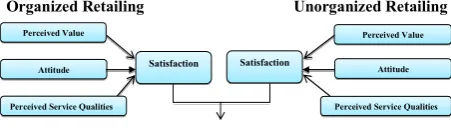
The hypothetical relationships among the variables have been shown as under:
RESEARCH METHODOLOGY
This study is the application of a cross-sectional descriptive design by using survey as a method of data collection. A questionnaire based on five-point Likert’s scale has been used as a tool for data collection. The choices of the variables and
Organized Retailing Unorganized Retailing
Comparison of Satisfaction Level
Figure 3 Conceptual Model of the Study
Perceived Value
Attitude
Perceived Value Attitude
Satisfaction Satisfaction
Globalization Effect On Indian Retailing: An Empirical Study On Retail Consumers
the items in the questionnaire have been done with the help of extensive literature review. The samples have been selected by using a quota sampling by considering gender as a base. In the literature of consumer behavior; it has been found that gender has a major influence on consumer buying decision. By considering the fact, gender has been taken as a criterion for sampling. As per details from Census 2011, Patna had population of 5,838,465 of which male and female were 3,078,512 (53%) and 2,759,953 (47%) respectively (Census Report 2011). Sample size represents the number of respondents selected from the overall population that are used in the research (Newman, 1998).To fix the sample size and the quality of the questionnaire, a pilot study has been conducted. For this purpose, data has been collected from 50 retail customers. Standard deviation estimated from the pilot study has been used to determine the sample size. As the population is infinite, the formula for infinite population has been used for the purpose (Hoelter, 1983; Hair et al., 2008; Hoe, 2008). The sample size found to be appropriate was, 272 (Male-144, Female-128). These 272 are the respondents who purchase both from organized as well as unorganized retail outlets.
Sample size determination
n = s2* z2/ e2 Where,
s = sample standard deviation 0.421 (from pilot test) z = 1.96 (95% confidence)
e = expressed in terms of units we are estimating (0.05 scaling units)
n = (0.421)2 * (1.96)2/ (0.05)2 n = 276
To achieve the required sample size, initially 400 questionnaires were distributed. 272 perfectly filled questionnaires have been opted for the purpose (Male-144, Female-128) and rest were discarded due to some response error and non-response of the respondents. Cronbach’s Alpha value has been calculated to measure the internal consistency of the constructs. With the help of extensive literature review, content validity of the questionnaire has been ensured. Multiple Regression and paired sample t-test have been used to test the hypotheses of the study.
Analysis and Findings
Reliability of the Scales
The cronbach’s alpha value calculated for each of the scales developed for organized and unorganized retail consumers are more than 6 (as given in Table 1:), it can be said that, all the scales developed for the purpose are reliable (George & Mallery, 2003). The alpha values for each of the scales (for both organized & unorganized retailing) developed are listed below-
Results of Multiple Regression
To identify the factors contributing most towards customer satisfaction for both organized and unorganized retailing, the multiple regression has been applied in both the cases. The results are as follows:
Organized Retailing
As with the simple regression, we look to the p-value of the F-test to see if the overall model is significant. With a p-value of zero to three decimal places, it can be considered as statistically significant. Since, the p-value for this model is less than 0.05; the model developed can be considered as good.
The above table explains that the p-values for the t-tests of ATC (Customer Attitude) and PSQC (Perceived Service Quality) are less than 0.05. So, for both the cases the null hypotheses can be rejected and it means all the independent variables are significant to explain the dependent variables. For PVC (Perceived Value) it is more than 0.05. It means in this case the null hypothesis is accepted and it can be said that the independent variable in this case has no effect on the dependent variable.
Based on the above table, the equation for the regression line developed is-
CSC= 5.780 + 0.530*ATC + 0.140*PSQC
Using this equation we can come up with a prediction for customer satisfaction in organized retailing.
Unorganized retailing
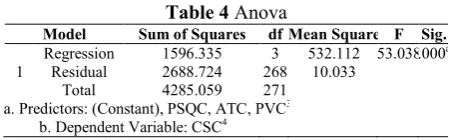
Since, the p-value for this model (in case of unorganized retailing) is also less than 0.05; the model developed can be considered as good.
Table 1 Cronbach’s Alpha Values
Scales Alpha Values
Organized Retailing
Perceived value .854
Attitude .877
Perceived Service Quality .868
Customer Satisfaction .884
Unorganized Retailing
Perceived value .731
Attitude .793
Perceived Service Quality .694
Customer Satisfaction .609
Table 2 ANOVA
Model Sum of Squares Df Mean Square F Sig.
1
Regression 4891.329 3 1630.443 87.142.000a
Residual 5014.344 268 18.710
Total 9905.673 271
a. Predictors: (Constant), PSQC, PVC, ATC1
b. Dependent Variable: CSC2
1 PSQC=Perceived service Quality Composite
PVC= Perceived value Composite
ATC= Attitude Composite2CSC= Customer Satisfaction composite
Table 3 t- Statistics Coefficients
Model
Unstandardized Coefficients
Standardized
Coefficients T Sig.
B Std. Error Beta
1
(Constant) 5.780 1.439 4.017 .000
PVC .027 .036 .033 .763 .446
ATC .530 .051 .563 10.358 .000
PSQC .140 .038 .200 3.668 .000
a. Dependent Variable: CSC
Table 4 Anova
Model Sum of Squares df Mean Square F Sig.
1
Regression 1596.335 3 532.112 53.038.000a
Residual 2688.724 268 10.033
Total 4285.059 271
a. Predictors: (Constant), PSQC, ATC, PVC3
b. Dependent Variable: CSC4
3 PSQC=Perceived service Quality Composite
PVC= Perceived value Composite ATC= Attitude Composite
The above table explains that the p-values for the t-tests are less than 0.05. So, all the null hypotheses have been rejected and it means all the independent variables are significant to explain the dependent variables, i.e. they have all predictive abilities for the dependent variables.
The table also shows the unstandardized and standardized coefficients. Based on the above table, the equation for the regression line developed is-
CSC= 9.405 + 0.300*PVC + 0.172*ATC + 0.268*PSQC
Using this equation we can come up with a prediction for customer satisfaction in unorganized retailing
Result of Paired t-test
To compare the satisfaction level of the customers for both the organized and unorganized retailing, a paired t-test has been performed. The result is as given bellow-
The above table shows that the mean difference calculated for customer satisfaction of both organized and unorganized retailing is positive and the p-value for t-statistics is also significant. So, it can be said that customer satisfaction for organized retailing is more than that for unorganized retailing.
Result of Impact factor Analysis
The attitude and the perceived service quality has been found common in both the cases (i.e. both these factors are contributing in customers satisfaction for both organized and unorganized retailing). So, to compare both these independent variables, the impact factors of consumer’s response against each of the items developed under each of the scales (i.e. attitude and perceived service quality) have been compared. The basic purpose was to identify the items for which consumers are more positive.
The impact factor with value less than 3 (neutral value) denotes that the corresponding items have less influence on the consumer satisfaction; whereas value more than 3 denotes that the corresponding items have more influence on consumer satisfaction. A value equal to 3 means people are neutral on that particular item. The impact factor corresponding to total for a factor denotes its importance. For attitude, a total value greater than 21 (the neutral value) means that consumer satisfaction is affected considerably by consumer’s attitude towards the particular sector of retailing; whereas value less than 21 means no such effect. For perceived service quality the neutral value is 30.
The following table demonstrates the calculated impact factors-
The findings from the above table shows that for most of the items developed, the impact factors for organized retailing are more than the neutral value and for all the items the impact factors for unorganized retailing, are less than the neutral value. All such items can be considered as effective contributors for customer’s satisfaction in organized retailing. Total values also suggest that positive attitude and better service quality can be considered as essential contributor for customer’s satisfaction in organized retailing.
DISCUSSION
The basic purpose of this study was to identify the major challenges associated with unorganized retailing in this globalized era of business. On the basis of extensive literature review three factors have been identified, which can be considered as the major determinant of customer satisfaction in retailing (for both organized and unorganized retailing). These factors are- Perceived Value, Customer Attitude and Perceived Service Quality.
The result of multiple regressions shows attitude and perceived service quality is contributing in customer satisfaction in case of organized retailing.
But, perceived value has no effect in this case, which contradicts some of the earlier research works as well. On the other hand it has been found that all three variables have Table 6 Paired Samples t-Test
*CSCORG- Customer Satisfaction Composite score in Organized Retailing
CSCUNO- Customer Satisfaction Composite score in Unorganized Retailing
Table 5 t-Statistics Coefficients
Model
Unstandardized Coefficients
Standardized Coefficients
T Sig.
B Std.
Error Beta
1
(Constant) 9.405 .981 9.591 .000
PVC .300 .048 .402 6.299 .000
ATC .172 .082 .133 2.092 .037
PSQC .268 .060 .342 4.500 .000
a. Dependent Variable: CSC
Table 7 Impact Factors
Item- Attitude
Impact Factor Organized
Retailing
Unorganized Retailing
1. Popularity of the shop 3.37 2.03
2. Positive reference from others 3.16 1.93
3. A place of enjoyment 2.89 1.54
4. Environment is brighter and
attractive 3.30 1.68
5. Products are classified properly 3.56 2.06
6. Computerized billing & various
payment options 3.59 1.82
7. Prices are clearly visible 3.27 2.05
Mean of Total 23.18 13.13
Item- Perceived Service Quality
1. Promptness in services offered 3.26 2.85
2. More than one counter for
checkout 3.29 2.48
3. Long working hours of the shop 3.21 2.56
4. Employees are polite and helpful 3.36 2.55
5. Handling of customer complaints
are prompt 3.08 2.39
6. Stock out situation never exist 3.26 1.87
7. Ambience is good and attractive 3.41 1.83
8. Parking facility is available 3.02 1.92
9. Products are available under one
umbrella 3.39 2.01
10. Enjoyment facilities for children 3.26 2.07
Mean of Total 32.48 22.57
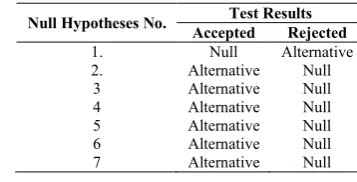
Table 8 Summary of Hypothesis testing
Null Hypotheses No. Test Results
Accepted Rejected
1. Null Alternative
2. Alternative Null
3 Alternative Null
4 Alternative Null
5 Alternative Null
6 Alternative Null
Globalization Effect On Indian Retailing: An Empirical Study On Retail Consumers
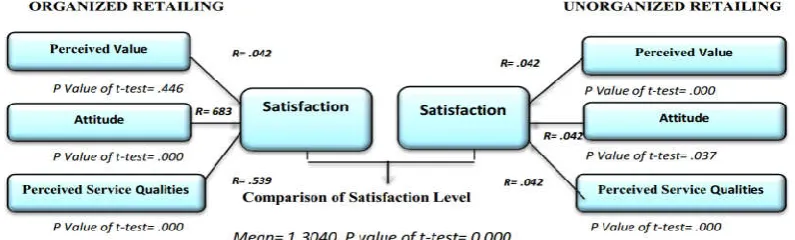
profound effect on customer satisfaction in unorganized retailing. The regression result shows that two variables (attitude and perceived service quality) are common in terms of their contribution for customer satisfaction for organized and unorganized retailing.
There after a paired t-test has been performed to compare the satisfaction level of customers for both the types of retailing. It has been found that, customers of organized retailing are more satisfied in comparison to unorganized retailing.
On the basis of the above findings the conceptual model developed in the study has been tested and the accepted model can be illustrated as bellow
To identify the effectiveness of the items developed in the scale, a comparison of impact factors in terms consumers response against each of the items have been done. For this purpose the two common contributors (independent variables), attitude and perceived service quality have taken into consideration. Customer’s perceived value has not been considered in this case, as it has no effect on satisfaction in case of organized retailing.
It has been found that in case of organized retailing customers are more positive and they have respondent favorably. On the basis of such empirical findings it can be said that the items for which customers are more positive can be considered as the major emerging challenges for unorganized retailing. These challenges are mainly related to customer’s attitude towards unorganized retailing and the service quality offered by unorganized retail sector. So, the major challenges associated with unorganized retailing in India in this globalized era of business are related to lack of better and attractive services in terms of-
Better and attractive environment
Recreational facilities
Computerized billing system
Proper assortment of products
Availability of various items under one roof
Prompt and efficient services from the side of the retail employees
Promptness in customers problem solving
Convenient checkout points
Parking facilities
Long working hours
Effective promotional activities to create maximum awareness
CONCLUSION
The progression of Indian organized retailing (after globalization) is mainly due to the changes in the consumer’s behavioral pattern over the years. These changes in this globalized era have come into existence due to increased income, changing, lifestyles, and patterns of demography which are favorable for organized retailing. Now the customer desires to shop at a place where they can get food, entertainment and shopping all under one roof with better and attractive facilities. This has given Indian organized retail market a major boost.
To survive in this global competition, the unorganized retailer’s needs to take care of all the challenges as mentioned above. They need to provide better and attractive services with good quality products, which in turn can create a positive attitude and more satisfaction among the customers of unorganized retailing. They need to be dynamic with their strategies in this changing business environment. The findings of the study suggests that, in this globalized era of competition, the traditional retailers in the country need to have a serious thought over their existing method of operations to survive and to compete effectively.
Avenues for Future research
To generalize the concept more empirically, further research is required in wider geographic areas on large number of samples. Various other variables should also be taken into consideration, to measure the effect of such on retail customer satisfaction.
Finally, it can be concluded that, although a major part of Indian retail sector is covered by traditional unorganized retailing, the modern day retailing is continuously generating some challenges for the traditional retail system in the country.
References
Ajzen, I., & Fishbein, M. (1980). Understanding attitudes and predicting social behavior. Englewood Cliffs: NJ: Prentice-Hall.
Anand, D. (2011). The Uneasy Compromise - Indian Retail. The Wall Street Journal.
Anderson, E., Fornell, C., & Lehmannn, D. (1994). Customer Satisfaction, Market Share, and Profitability: Findings from Sweden. Journal of Marketing, 58, 53-66.
Berman, B., & Evans, J. (2009). Retail Management (4 ed.). India: Pearson Education.
Bharadwaj, V. T., Swaroop, G. M., & Vittal, I. (2005). Winning the Indian consumer. New York.
Cowles, D., Evans, K. R., & Crosby, L. A. (1990). Relationship quality in services selling: An interpersonal influence perspective. Journal of Marketing, 54(1), 68-81.
Dick, A., & Basu, K. (1994). Customer loyalty: towards an integrated framework. Journal of the Academy of Marketing Science, 22(2), 99-113.
Engel, J. F., Blackwell, R. D., & Miniard, P. W. (1995). Consumer behavior. (8, Ed.) Forth Worth: TX: The Dryden Press.
George, D., & Mallery, P. (2003). SPSS for Windows step by step: A simple guide and reference (4 ed.). Boston: Allyn & Bacon.
Globalization. (n.d.). Retrieved January 13, 2017, from Online Etymology Dictionary: www.etymonline.com/ index.php?term=globalizati
Hair, J. F., Andersen, R., Tatham, R., & Black, W. (2008). Multivariate Data Analysis (2 ed.). Upper Saddle Rive: NJ: Prentice Hall.
Hoe, S. L. (2008). Issues and procedures in adopting SEM technique. Journal of Applied Quantitative Methods, 3(1), 76-83.
Hoelter, D. R. (1983). The analysis of covariance structures: Goodness-of-fit indices. Sociological Methods and Research, 11, 325-344.
Hong, L., & Mcgoldrick, P. J. (1996). International Retail Sourcing: Trend, Nature, and Process. Journal of International Marketing, 4(4), 9-33.
Jeevananda, D. (2011). A study on customer satisfaction level at hypermarkets in Indian retail industry. Research Journal of Social Science & Management, 1. Jeon, Y. a. (2003). Effects of Loyalty Programs on Value
Perception, Progrtam Loyalty and Brand Loyalty. Journal Academy of Marketing Science, 31(3), 229-240.
Kalyanasundaram. (2012). The changing face of Indian retailing. Integral review- A journal of management, 5(1), 42-51.
Larsson, T. (2001). The Race to the Top: The Real Story of Globalization. 9.
Malik, T. (n.d.). Impact of globalization on Indian economy- An overview. Retrieved January 17, 2017, from http://www. fibre2fashion.com/industry-
article/2993/impact-ofglobalization-on-indian-economy-an-overview#sthash.nSL1cCV8.dpuf
McKinsey, & Company. (2007). The Bird of Gold - The Rise of India's Consumer Market.
Newman. (1998). Research Onion-Explanation of the
Concept. Retrieved January 20, 2017, from
www.ukessays.com:http://www.ukessays.com/essays/p sychology/explanation-of-the-concept-of-research-onion-psychology-essay.php
Parasuraman, A., Zeithaml, V., & Berry. (1985). A conceptual model of service quality and its implications for future research. Journal of Marketing, 49(4), 41-50.
Parvathamma, G. (2014). FDI in Retail Sector in India-Conceptual, Descriptive and Analytical Study. IOSR Journal of Economics and Finance, 5(4), 63-69. Philip, K. (2003). Marketing Management (11 ed.).
Singapore: Pearson Limited.
Prafulla, S., & Brijesh, S. (2013). Challenges Affecting the Organized Retail Sector. APJEM, 2(8).
Retail Industry. (n.d.). Retrieved from shine.com: http://info.shine.com/industry/retail/7.html
Sellers, P. (1990). What Customers Really Want. Fortune, 121(13), 58-68.
Smith, T. (1989). Nurturing a Customer Service Culture. Retail Control, 15-18.
Zeithaml, A. V., & Leonard, L. B. (1988). SERVQUAL: A multiple-item scale for measuring consumer perceptions of service quality. Journal of Retailing, 12-40.
Zeithaml, V. (1988). Consumer Perceptions of Price, Quality and Value: A Means-End Model and Synthesis of Evidence. Journal of Marketing.
How to cite this article:
Kishore Bhattacharjee (2017) ' Globalization Effect On Indian Retailing: An Empirical Study On Retail Consumers', International Journal of Current Advanced Research, 06(06), pp. 4141-4147.
DOI: http://dx.doi.org/10.24327/ijcar.2017.4147.0449