Abstract—In the last few decades, many studies have been conducted on the flexural strengthening of reinforced concrete (RC) beams using different strengthening techniques such as concrete, steel and artificial fiber reinforced polymer composites (FRP). Among artificial FRPs, mainly glass, carbon and aramid fibers have been considered extensively. This study presents an experimental investigation on the flexural strengthening of small scale RC beams using natural fibers such as jute fiber reinforced polymer composites (JFRP) and basalt fiber reinforced polymer (BFRP) composites. A total number of five RC beams were constructed and tested under three point bending loading scheme to investigate the flexural response of both un-strengthened and FRP strengthened RC beams. Two types of strengthening techniques were adopted to strengthen RC beams. In strengthening technique A, the fiber was applied only at the tension side of the RC beams whereas in strengthening technique B, the fiber was applied both at sides and at the bottom in the form of U shape. The results indicate that use of both strengthening materials such as JFRP and BFRP is very effective to enhance ultimate load carrying capacity of RC beams. Further it was found that strengthening technique B is more efficient as compared with the strengthening technique A.
Index Terms—Fiber reinforced polymer, artificial fibers, jute, basalt, epoxy resin, reinforced concrete, and Ultimate load.
I. INTRODUCTION
In the last few decades, many studies have been conducted on the flexural strengthening of reinforced concrete (RC) beams using different strengthening techniques such as concrete, steel and artificial fiber reinforced polymer composites (FRP) [1]-[6]. Among artificial FRPs, mainly glass, carbon and aramid fibers have been considered extensively [7]-[9]. Attari et al., 2012 conducted strengthening of concrete beams using glass FRP sheets, carbon FRP sheets and hybrid FRP sheets. In their study, a total of seven RC beams were constructed and tested in simply supported manner. All the beams have the same dimensions and the same flexural and shear reinforcements. Two 10-mm diameter steel bars, with a steel ratio of 1.6%, are used for flexural reinforcement at the bottom. Two 8-mm bars are used at the top. Transverse steel consisting of 6-mm diameter stirrups spaced out every 120 mm is used as shear reinforcement. The testing rig is limited to a length of 1500 mm, which imposes to make rectangular beam specimens 160 mm in height and 100 mm in width. The specimen overall
Manuscript received October 31, 2018; revised April 1, 2019.
The authors are with the Department of Civil and Environmental Engineering, Srinakharinwirot University, Thailand (e-mail: [email protected], [email protected], [email protected]).
length is 1500 mm with a span length of 1300 mm. The results indicated that the use of a twin layer Glass–Carbon fibres composite material for strengthening reinforced concrete beams is very efficient. A strength capacity increase of 114% is obtained for the strengthened beam specimens in comparison with the reference control specimen. This increase does not come with brutal ductility loss. On the contrary, an appreciable deformation of the hybrid strengthening configuration is observed with an energy ductility ratio of 0.9 in relation to the reference specimen. The U-anchorage strengthening configuration improves the flexural strength and contributes to the redistribution of the internal forces through greater deformations of the beam specimens. This configuration gives the best results [5]. Michael et al., 1994 experimentally investigated fourteen reinforced concrete beams. The author examined three control beams having same steel reinforcement. They evaluated the strength behaviour by casting beams strengthened with aramid fabric (1 layer), E-glass fabric (3 layers) and graphite fibre fabric (2 layers) and their thickness of 1.04, 1.42 and 1.22 mm, respectively. They found that use of external composite fabric reinforcement increased the flexural capacity by 36 to 57% and 45 to 53% increase in flexural stiffness [10]. Grace et al., 2002 investigated thirteen rectangular beams. Two strengthening configurations were used such as strengthening material only on the bottom face beam and strengthening material on the bottom face and extending upto 150mm on both side face of beams. Out of nine beams one beam were used as a control beam and four beams were strengthened with three carbon fibre strengthening material such as a uniaxial carbon fibre sheet, carbon fibre fabric and pultred carbon fibre plate. Remaining eight beams were strengthened with two different thickness of hybrid fabric. The thickness of hybrid fabric was 1.0 mm and 1.5 mm. The author investigated that the beam strengthened using carbon fibre strengthening system showed lower in yield load than those strengthened with hybrid fabric. The beam strengthened with hybrid fabric system showed no significant loss in beam ductility [11].
In contrast to the artificial fibers, now-a-days natural fibers such as jute and basalt fibers are getting popularity in the structural strengthening and repair. [12]. Alam et al. investigated the possibility to use the kenaf fibre reinforced polymer laminate for shear strengthening of reinforced concrete structures. For strengthening of RC beam, KFRP laminate shear strips were fabricated with 25 % fibre content. Three reinforced concrete beam specimens with the dimension of 150 mm × 300 mm × 2,300 mm were prepared for experimental investigations. One was prepared as control specimen and another two were strengthened for shear using
Flexural Response of JFRP and BFRP Strengthened RC
Beams
KFRP and CFRP laminates respectively. The results indicate that tensile strength of KFRP laminate increased with the increasing of fibre content. 25 % fibre content showed the highest tensile strength of KFRP laminate as compared to other mix ratios without showing honeycombs and air voids. The tensile strength of KFRP laminate with 25 % fibre content was found to be 119.6 MPa which was 2.7 times higher as compared to epoxy laminate without kenaf fibre [12], [13].
The current study is planned to investigate flexural response of reinforced concrete beams strengthened using natural jute fiber and basalt fibers.
II. EXPERIMENTAL PROGRAM A. Test Matrix
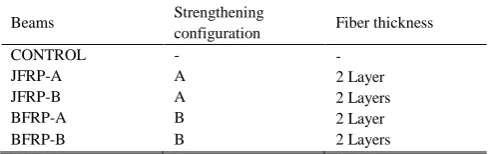
In this research study, it was planned to construct a total number of five flexure dominated reinforced concrete beams and test in simply supported manner. One beam was tested as unstrengthen to serve as control beam whereas remaining four beams were strengthened using jute fiber reinforced polymer (JFRP) composites and basalt fiber reinforced polymer (BFRP) composites prior to the test. The research parameters included were fiber type (jute and basalt) and strengthening techniques (strengthening techniques A and B). In this study the thickness of fiber was kept constant. A summary of test matrix is summarized in Table I. The RC beam specimens were designated in such a way to represent research parameters.
TABLE I: EXPERIMENTAL TEST MATRIX
Beams Strengthening
configuration Fiber thickness
CONTROL - -
JFRP-A A 2 Layer
JFRP-B A 2 Layers
BFRP-A B 2 Layer
BFRP-B B 2 Layers
B. RC Beam Specimen Details.
In this experimental study, Flexure dominated RC beams were cost and tested under three point bending scheme. A schematic diagram of RC beam is shown in Fig. 1. Two round steel bars of diameter 9 mm were provided at the top and two deformed steel bars of diameter 12 mm were provided at the tension face. Steel stirrups of round bar with dimeter 6 mm were provided along the full length of the beam as shown in Fig. 1.
Fig. 1. Details of RC beam (units in mm)
C. Strengthening Configurations
In this experimental study, two types of strengthening techniques were investigated. The strengthening techniques are shown in figure 2. In the strengthening technique A, the FRP composite was applied only at the bottom side of the RC beams whereas in strengthening technique B, the FRP composite was applied both at bottom and side faces in the form of U shape as shown in Fig. 2.
(a)
(b)
Fig. 2. Details of strengthening techniques; a) strengthening technique A, b) strengthening technique B.
D. Material Properties
In this experimental program, ordinary Portland cement (OPC) was used to construct RC beam specimens. The concrete was prepared using natural course and fine aggregated with 28 days target compressive strength of 25 MPa. The yielding and ultimate tensile strength values of steel bars are provided in the table II. Natural fibers such as jute and basalt fibers were used to strengthen RC beams. The ultimate tensile strength of both fibers is given in table. The JFRP and BFRP strengthening was performed using epoxy resin. Epoxy resin is comprised of two parts i.e., part A and part B. The mix ratio of epoxy resin is 1:2 (A:B). The strength properties of epoxy resin are given in table II. The RC beam specimens were cast using plywood sheets as shown in Fig. 3.
TABLE II: MATERIAL PROPERTIES
Material details Yield strength (Mpa) Ultimate strength (Mpa)
RB6 250 360
RB9 300 400
DB10 340 420
Jute - 35
Basalt - 46
Epoxy resin - 25
E. Strengthening of RC Beams
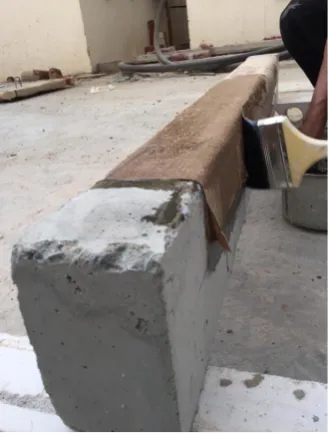
brush as shown in Fig. 5.
Fig. 3. Construction of RC beams.
Fig. 4. Applying epoxy resin to concrete surface.
Fig. 5. Strengthening process.
F. Loading Setup
In this study, both un-strengthened and FRP strengthened RC beams were tested under static axial loading as shown in figure 6. The load was applied in four point bending scheme at the rate of 1kN/minute. During the test crack initiation and propagation were observed continuously. Steel plates of thickness 10 mm were placed at the loading region and
supports to avoid local crushing of the concrete. Calibrated load cell and liner variable differential transducers were used to record load intensity and mid span deflections, respectively.
Fig. 6. Schematic diagram of loading setup (units in mm).
III. EXPERIMENTAL TEST RESULTS A. Load Carrying Capacity of RC Beams
The experimental results in terms of load and mid span deflections are graphically shown in Fig. 7 and summarized in Table III. It can be seen that ultimate load carrying capacity of un-strengthened RC beam is very low as compared with the JFRP and BFRP strengthened RC beams.
0 5 10 15 20 25 30 35
0 50 100 150 200 250 300 350 400 450
Lo
a
d
(k
N
)
Deflection (mm)
BFRP-B BFRP-A JFRP-B JFRP-A CONTROL
Fig. 7. Experimental results.
TABLE III: EXPERIMENTAL TEST RESULTS
Beams Ultimate load (kN)
Deflection (mm)
% Increase in ultimate load
1-CON 22.6 125.0 -
2-A-1L 28.0 94.5 24.0
3-A-3L 29.0 118.0 28.0
4-B-1L 31.0 141.5 37.0
5-B-3L 33.0 82.0 46.0
specimen JFRP-A is found 94.5 mm against ultimate load. The RC beams specimen JFRP-B, in which two layers of JFRP was applied using strength technique B, was failed at an ultimate load of the 29.0 kN. The ultimate load of this beam specimen is found 28% and 4% higher than the RC beams CONTROL and JFRP-A, respectively. The mid span deflection of RC beam specimen JFRP-B is found 118.0 mm against the ultimate load. The RC beams specimen BFRP-A, in which two layers of BFRP was applied using strength technique A, was failed at an ultimate load of the 31.0 kN. The ultimate load of this beam specimen is found 37% higher than the control beam specimen. The mid span deflection of RC beam specimen BFRP-A is found 141.5 mm against the ultimate load. The RC beams specimen BFRP-B, in which two layers of BFRP was applied using strength technique B, was failed at an ultimate load of the 33 kN. The ultimate load of this beam specimen is found 46% and 9% higher than the RC beams CONTROL and BFRP-A, respectively. The mid span deflection of RC beam specimen BFRP-A is found 82.0 mm against ultimate load. As it can be seen that ultimate load carrying capacity of RC beams strengthened using strengthening technique B is higher than that of strengthening technique A. Further, it is also noticeable use of BFRP composite is more effective to enhance ultimate load as compared with the use of JFRP. This is mainly due to the higher ultimate tensile strength of BFRP as compared with JFRP.
B. Failure Modes of RC Beams
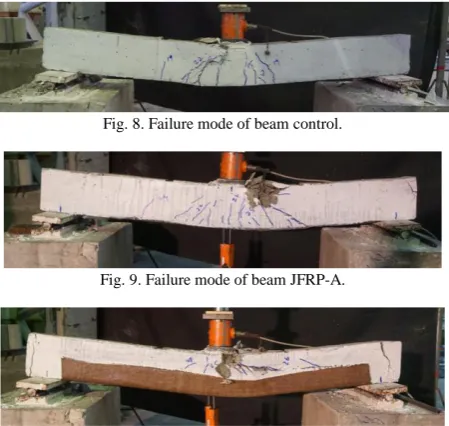
The ultimate failure modes of RC beam specimens are shown in Fig. 8-12. It can be seen that un-strengthened RC beam specimens (CONTROL) is mainly fail due to the vertical and inclined flexural cracks in the middle region as shown in figure 7. This kind of failure is very common in flexure dominated RC beams and also observed in the past literature. The final failure modes of RC beam specimens strengthened using JFRP were also similar to the control beam with large deflections (Fig. 9 and 10). In these beams, JFRP de-bonding and rupture was not observed. Whereas in case of RC beams JFRP-A and JFRP-B, the final failure of the RC beams was mainly due to the rupture of BFRP composite at the middle region as shown in Fig. 11 and 12.
Fig. 8. Failure mode of beam control.
Fig. 9. Failure mode of beam JFRP-A.
Fig. 10. Failure mode of beam JFRP-B.
Fig. 11. Failure mode of beam BFRP-A.
Fig. 12. Failure mode of beam BFRP-B.
IV. CONCLUSION
This study presents an experimental investigation on the use of JFRP and BFRP composites for the flexural strengthening of RC beams. Based on experimental results following conclusions could be drawn;
1) The use of JFRP and BFRP is very effective to enhance the ultimate load carrying capacity of flexure dominated RC beams.
2) The performance of the BFRP to enhance ultimate load carrying capacity of RC beams is found better than JFRP composites.
3) Both kinds of investigated strengthening techniques are found effective to alter the load carrying capacity of RC beams, however in comparison, the strengthening technique B is found superior to the strengthening technique A.
V. FUTURE RESEARCH
This study has shown that use of both JFRP and BFRP is every effective to alter the flexural response of RC beams with an increase in the ultimate load carrying capacity. However the failure modes of FRP strengthened beams indicate that there is de-bonding of the FRP from the concrete surface. The de-bonding mechanism of FRP and techniques to avoid this de-bonding should be considered in the future studies.
ACKNOWLEDGMENT
The authors would like to thanks Asian Institute of Technology Thailand, for providing test facilities and necessary equipment to carry out this research.
REFERENCES
[1] A. A. Bashandy, “Flexural strengthening of reinforced concrete beams using valid strengthening techniques,” Archives of Civil Engineering, vol. 59, no. 3, pp. 275-293, 2013.
[2] R. Jones, R. N. Swamy, and T. H. Ang, “Under- and over-reinforced concrete beams with glued steel plates,” The International Journal of
Cement Composites and Lightweight Concrete, vol. 4, no. 1, pp.
19–32, 1982.
[3] S. Aykac, I. Kalkan, B. Aykac, S. Karahan, and S. Kayar, “Strengthening and repair of reinforced concrete beams using external steel plates,” Journal of Structural Engineering, pp. 929 –939, 2013. [4] R. N. Swamy, R. Jones, and J. W. Bloxham, “Structural behaviour of
reinforced concrete beams strengthened by epoxy-bonded steel plates,”
[5] N. Attari, S. Amziane, and M. Chemrouk, “Flexural strengthening of concrete beams using CFRP, GFRP and hybrid FRP sheets,”
Construction and Building Materials, vol. 37, pp. 746-757, 2012.
[6] J. Panuwat and S. Suniti, “Experimental responses of jacketed RC beams,” International Journal of Structural and Civil Engineering
Research, vol. 6, no. 4, pp. 245-251, 2017.
[7] A. El-Nemr, E. A. Ahmed, and B. Benmokrane, “Flexural behavior and serviceability of normal-and high-strength concrete beams reinforced with glass fiber-reinforced polymer bars,” ACI Structural Journal, vol. 110, no. 6, 2013.
[8] F. Ceroni, “Experimental performances of RC beams strengthened with FRP materials,” Construction and Building Materials, vol. 24, no. 9, pp. 1547-1559, 2010.
[9] M. A. Rashid, M. A. Mansur, and P. Paramasivam, “Behavior of aramid fiber-reinforced polymer reinforced high strength concrete beams under bending,” Journal of Composites for Construction, vol. 9, no. 2, pp. 117-127, 2005.
[10] M. J. Chajes, T. A. J. R. Thomson, T. F. Januszka, and W. F. J. R. William, “Flexural strengthening of concrete beams using externally bonded composite materials,” Construction and Building Materials, vol. 8, pp. 191-201, 1994.
[11] N. F. Grace, G, A. Sayed, and W. F. Ragheb, “Strengthening of concrete beams using innovative ductile fiber-reinforced polymer fabric,” ACI Structural Journal, pp. 692-700, 2002.
[12] M. A. Alam, A. Hassan, and Z. C. Muda, “Development of kenaf fibre reinforced polymer laminate for shear strengthening of reinforced concrete beam,” Materials and Structures, vol. 49, no. 3, pp. 795-811, 2016.
[13] M. A. Alam and K. A. Riyami, “Shear strengthening of reinforced concrete beam using natural fibre reinforced polymer laminates,”
Construction and Building Materials, vol. 162, pp. 683-696, 2018.
Panuwat Joyklad is with the Department of Civil and Environmental Engineering, Srinakharinwirot University, Thailand.
Suniti Suparp is with the Department of Civil and Environmental Engineering, Srinakharinwirot University, Thailand.
Qudeer Hussain is with Research Faculty at the