IMAGE STEGANOGRAPHY: REVIEW STUDY
Haval Muhammed Sidqi1, MuzhirShaban Al-Ani21. INTRODUCTION
The idea of data hiding is early technique which is traced back to a thousand years ago. It is merely based on dimming messages content by a process called encryption, which is sometimes not practically effective. In many competitive cases, it is highly demanded to suppress the initial existence of a communication in order to avoid suspicion from adversaries [3].Steganography is the art and science of hidden communication by embedding a message into an safe looking cover media such as text, image, and video. In steganography, hidden writing is established for two main reasons: safety against detection (data hiding) and safety against removal. In these review papers, information is hidden within a host data set and is to be reliably communicated to a receiver.
Mainly, steganography considers methods and techniques that can create covert communication channels for unobtrusive transmission for military purposes. Steganography is also used for automatic monitoring of radio advertisements, indexing of video mail (to embed comments) and medical imaging (to embed information like patient and physician names, DNA sequences and other particulars)[3]. Other applications include: smart video-audio synchronization, secure and invisible storage of confidential information, identity cards (to embed individuals details) and checksum embedding [12].
Recently, the information hiding methods have become main practice in a wide areas and applications, including digital audio, video, and pictures which are equipped dramaticallywith imperceptible marks that possibly contain a hidden copyright notice, and a serial number, or even have the ability to directly assist in preventing an unauthorized copying process. The military communications systems employ a high level of traffic security techniques which instead of just hiding the message content by the encryption process; it findsto conceal the message sender, and its receiver, or even its very existence [14]. The "information hiding" term is linked to both steganography and digital watermarking. The steganographyis defined as the attempt to hide the fact that informationis being transmitted at the first place, while watermarkingis usually referred to the involved methods by which an identified information is being hidden in a data object, and accordingly, the information will be kept robust against modification[15]. Steganography is considered as a kind of a hidden communication which means literally the “covered writing”. Originally, it has been derived from the two Greek words stegano which refers to “covered” and secret massage which refers to “to write”. The goal of applying the steganography is to hide the information message inside a harmless cover medium by a certain way that makes it impossible to detect the secret information and even its existence in the cover medium [16]. Data hiding is a form of steganography that works by embedding data into digital media for the purpose ofidentification, annotation, and copyrighting. In fact, severalmanacles affect such a process and this is
1 University ofSulaimani Polytechnic, Institute of Computer, Department of Database, KRG Iraq
2 University of Human Development, College of Science and Technology, Department of Information
Technology,Sulaimania,KRG Iraq
DOI: http://dx.doi.org/10.21172/1.132.05
e-ISSN:2278-621X
Abstract- The evolving of Internet technology has achieved to the need of high level of data safety during its spread. For this purpose steganography shows a main role in society. Steganography is mostly the art of secretly hiding data or message in any cover media such as an image, audio or video. Hence it allows secret communiqué to take place without the information of any unintended user. This article gives a brief overview of image steganography and the techniques used for hiding data in the original image to get stego-image. The estimate of performance is based on the PSNR value.The aim of Steganography is to maintain secret communication between two events. This paper shows how Steganography is used in a new situation while providing a practical understanding of what Steganography is and how to complete it. In this research there exists a large change of steganographic techniques some are more complex than others and all of them have respective strong and weak points. Different techniques have different requirements of the steganography method used. After studying and analyzing of the research papers, the following gaps are identified:1)theessential of multi-level key security with random key generation is arises so that the data security will become more robust.2)The length of the key should be maximized up to 256 to 512 bytes. 3)The grouping of cryptography with steganography is a stronger way to enhance the security.4)The uses of steganography ways with the help of image encryption enhance the retrieval complexity.This paperpresents a relative study of many procedure steganalysis techniques. It investigated and compared the performances of each technique in the detection of embedding methods considered. Based on the results of our analysis, this paper provides information as to which specific steganalysis technique needs to be used for a particular steganography method. Finally, we suggest a procedure which may help a legal examiner to agree an order in which different steganalysis methods need to be measured in the detection process to complete the best finding results in terms of together time and accuracy.
including,the quantity ofthe proposed data to be hidden,the need for invariance of these data under conditions where a“host” signal is subjectedto distortions, e.g., lossy compression, in addition to the degree to which the data must be immuneto an interception,modification, or a removal by a thirdparty[17].The three main aspects regarding information hiding systems are capacity, securityand robustnessas represented in figure1.1. Generally, steganographyrequires ahigh securityand capacitylevels, i.e. hidden information are usually a fragile oneswhich can be destroyed by even slightmodifications.On the other hand, watermarking mostly relies on achievinga robustnessstatus whereit is impossible to remove thewatermark without causing severecover contentquality degradation [18].
2. BACKGROUND
2.1 Steganography and Cryptography
Cryptography and Steganography are members of the detective skill family, both aiming at providing secret communication. Cryptography secretes only the meaning or fillings of a message from an attics dropper, but the encrypted message still exists and can be seen. Steganography, on the other hand, deals more secrecy than cryptography, since it hides the meagre existence of secret message rather than only trust the message contents [11]. A Cryptography system is jeopardized. If a malicious attacker can read the insides of a secret message, while a steganography system is risked if the existence of the message is detect by an attacker. In other words, a stegonagraphic system is considered exposed even without decoding the message, if an attacker suspects the file carrying the secret message or the steganography method used for encoding the secret message. Hence, steganography can complement cryptography to avoid educating the feeling of system attackers and not to substitute cryptography.Steganography is a subdivision of information hiding technology which includes applications for protection against discovery and protection against removal such as copyright protection for digital media, watermarking, fingerprinting and data embedding. In these applications, information is hidden within a host data set, which is purposely corrupted in a covert way, so that it could be sent secretly to an intended receiver.
Cryptography is one of the old-styleways used to surety the privacy of communiqué between parties. This method is the skill of secret text, which is used to encrypt the plaintext with a key into cipher-text to be transferred between parties on an insecure channel. Using a valid key, the cipher-text can be decrypted to the original plaintext. Deprived of the information of the key, nobody can recover the plaintext. Cryptography shows an important role in many aspectsessential for secure communication across an insecure channel, like: secrecy, isolation, non-repudiation, key exchange, and authentication. Figure 1 shows the cryptography system [10].
There are two types of cryptographic schemes for securing the data. These schemes are often used to extent the objective: public-key cryptography, secret key cryptography, and hash functions. The length and type of the keys used depend on the kind of encryption algorithm [10]. Cryptography system is associated with the process of converting ordinary plain text into unintelligible text and vice-versa. It is a process of keeping and spreading data in a particular form so that only those for whom it is proposed can read and method it. Cryptography not only keeps data from robbery or alteration, but can also be used for user validation.
Figure. 1Cryptography System [11]
2.2 Steganography and Watermarking
Steganography and watermarking are a way of data hiding and share common features. The aim of watermarking is to embed a single signature to indicate the origin or rights of a digital media for the purpose of copyright protection, while the aim of steganography is to protection the existence of the communication taking place within a digital media. Watermarking is a mechanism used to show that illegal copying or any minor modification of the watermarked file is done. One of the main features of watermarking is knownas„„robustness‟‟, if somebody knows that a digital mark happens (i.e. visible watermarking) and attempts to remove the watermark from the watermarked media, he/she should consequently cause distortions or destroys the original watermarked media [13].
Watermarking classify into two group; visible and invisible.
Visible : visible watermarking refers to the information can be seen on the image or video or picture. Visible watermarks are typically logos or text. For example, in a TV show, the symbol of the broadcaster is visible at the right side of the screen. [14] Invisible :Invisible watermarking refers to embedding information in a video or picture or audio as digital data. It is not show or visible, but it can be noticed by different means. It can be a type of steganography and is has been used for widespread use. It can be retrieved easily.[14]
Watermarking is used in many1pplications such as: copyright protection, source tracing, and annotation of photographs. In summary we can say Watermarking is a process in which the information which verifies the owner is embedded into the digital image or signal. These signals could be either videos or pictures or audios; steganography is changing the image in a way that only the sender and the intended recipient are able to detect the message sent through it.
2.3 Steganography Terminology
Steganography contains of two terms that is message and original image.Message is the secret data that needs to hide and original image is the carrier that hides the message in it, the below figure illustrate it.[16]
Figure.2 Steganography Diagram
2.4 Steganography Techniques
Steganography techniques can be classified as below:
a. Spatial DomainTechniques:in this method the secret data is embedded directly in the intensity of pixels. Spatial Domain ways means some pixel values of the image are changed directly thru hiding data. Spatial domain techniques are classified into following categories:[17]
Least significant bit (LSB) Pixel value differencing (PVD)
Edges based data embedding method (EBE) Random pixel embedding method (RPE) Mapping pixel to hidden data method Labeling connectivity method Pixel intensity based
b. LSB Method:this method is most commonly used for hiding data. In this technique the inserting is done by swapping the least significant bits of image pixels with the bits of hiding data.The image obtained after embedding is almost similar to original image because the change in the LSB of image pixel does not bring too much differences in the image.[18]
c. BPCP Method: In this segmentation of image are used by measuring its complexity.
Complexity is used to determine the noisy block.In this methodnoisy blocks of bit plan are replaced bythe binary patterns mapped from a secret data.[18]
d. PVD Method:In this method, two consecutive pixels areselected for embedding the data. Payload isdetermined by checking the difference between two consecutive pixels and it serves as basis for identifyingwhether the two pixels belongs to an edge area or smooth area.[18]
e. Spread Spectrum Method:The idea of spread spectrumis used in this method.In this technique the hidingdatais spread over a wide frequency bandwidth. Theratio ofsignal to noise in every frequency band must be sosmall thatit become hardto find the presence of data. Even if parts of dataare deleted from several bands, there would be still enoughinformation is existing in other bands to detect thedata. Thus it is difficultto remove the data completely without entirely destroying the cover .It is a very robust technique mostly usedin military communication.[18]
f. Statistical Method:In the methodmessage is inserted byaltering several properties of the cover. It involves the splitting of cover into blocks and then embedding one message bit in each block. The cover block is modified only when the size of message bit is oneotherwise no modification is required.[18]
Discrete cosine transformation technique (DCT). Discrete Wavelet transformation technique (DWT).
Lossless or reversible method (DCT)Embedding in coefficient bits.[18]
h. DistortionMethod:In this method the secret message is kept by changing the signal. Aorder ofmodification is applied to the cover by theencoder. The decoder processes the differences between the original image and the extracted cover to detect the sequence of modifications and consequently recover the secret message.
i. Maskingand Filtering:These techniques hide information by marking an image. Steganography only hides the information whereaswatermarks become a Portionof the image. These methodsinsert the data in the more importantareas ratherthanhiding it into the noise level. Watermarking methods can be executeddeprived of the fear of image destruction due to loss compression as they are more integrated into the image. This method isbasicallyused for 24-bit and grey scale images.[18]
2.5 Adaptive Steganography
Adaptive steganography is a special case of the two earlier discussed methods. It is also known as “Statistics - aware embedding” []20 .This method takes statistical global features of the image before trying to interact with its LSB/DCT coefficients. It is described by a random adaptive selection of pixels depending on the cover image and the selection of pixels in a block with large local STD, standard deviation. Adaptive steganography try to find images with existing or deliberately added noise and images that establish color complexity, avoiding areas of uniform color. However, in order to maintain the image‟s quality, it is necessary to take the human visual system(HVS) into consideration and ensure that the distortion introduced by embedding is imperceptible to the human eye.
One of the embedding strategies in the spatial and frequency domain trusts on image thresholding. Thresholding is one of the methods used in image segmentation where a binary image is created from a grayscale image. One of its main functions is to separate objects from the background such as printed characters, graphical content and map processing where lines, legends and characters are to be detected.[20],thresholding methods are categorized according to the information they obtain from the data into:
Histogram-shaped-based: these analyses the form and shape of image histogram such as the peaks, valleys and curvatures. Grouping-based: these rely on making two cluster objects (background and foreground) from grey-level information. Entropy-based: these use the entropy of the distribution of grey levels in the picture.
Object attribute-based: these are methods that extract a threshold value based on similarities between the original image and the binaries one using some attribute quality or similarity measure.
Spatial methods: these use higher-order chance distribution and/or correlation between pixels.
Nearby adaptive ways: these analyze a threshold value for each point, depending on some local parameters same as range, variance or surface-fitting in the neighborhood.
Between the first adaptive thresholding methods was the algorithm evolving by Nakagawa and Rosenfeld[22] , who planned a variation on the original method of variable thresholding by Chow and Kaneko [22]. In their method, the image is shared into several windows of the original image with the locality property. Those windows with histograms are selected and a threshold is calculated. Then the edge from altered windows is incorporated to calculate a final threshold for the whole image. Their results were successfully applied to the TV images of machine components with substantially better results than those that applied a fixed threshold to the whole image. [23]established an algorithm that adapts threshold selection from a local window by calculating a local mean and standard deviation. This method was later enhanced [23] to recognize letters in stained documents or documents with bad clarification by adjusting the impact of the standard deviation in the algorithm. Such methods are known as local variance methods method of variable thresholding [23]. In their technique, the image is shared into several windows of the original image with the locality property. Those windows with histograms are selected and a threshold is calculated. Then the threshold from different windows is incorporated to calculate a final threshold for the whole image. Their results were successfully realistic to the TV images of machine components with substantially better results than those that applied a fixed threshold to the whole image.
3. ANALYSIS AND DISCUSSION
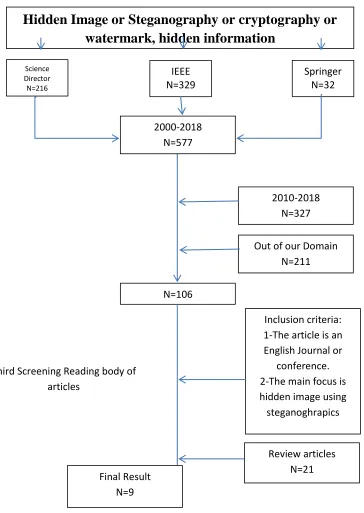
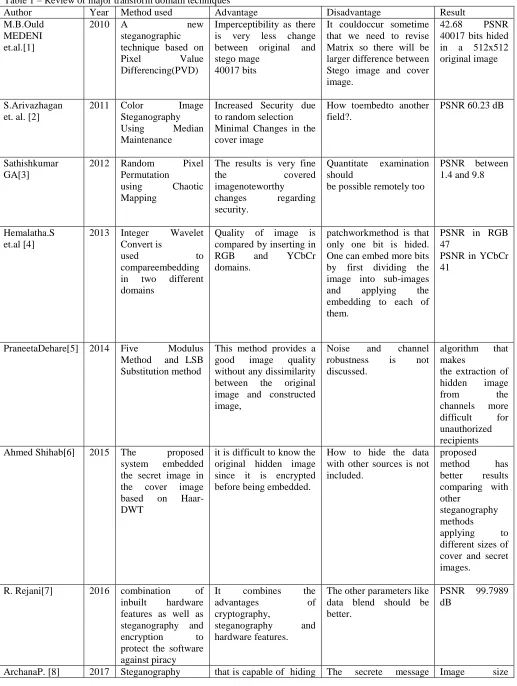
types would be used, but digital images are big enough used due to the frequency and huge users on the worldwide Internet. To hide the secret data in images, there are large ranges of steganography methodologies exist some are complex in used than others method. Every method has respective strong and weak points, has been showed in table 1. The diagram below collected many research‟s from 2009 to 2018.First step found 216 article in Science Director, 329 article in IEEE and 32 article in Springer all of them under title “Hidden Image or Steganography or cryptography or watermark, hidden information.” From 2000 until 2018.Second step selected 327 articles of 512 articles from 2010 until 2018.Third step deleted 211 articles out of domain and chose 106 articles in domain.Fourth step after reading body of articles, 9 articles has been selected and mentioned in this review paper.
Figure. 3 Steps of survey papers
Hidden Image or Steganography or cryptography or
watermark, hidden information
Science Director N=216
IEEE
N=329
Springer
N=32
2010-2018
N=327
Out of our Domain
N=211
N=106
Review articles
N=21
Inclusion criteria:
1-The article is an
English Journal or
conference.
2-The main focus is
hidden image using
steganoghrapics
Final Result
N=9
Third Screening Reading body of
articles
Table 1 – Review of major transform domain techniques
Author Year Method used Advantage Disadvantage Result
M.B.Ould MEDENI et.al.[1]
2010 A new
steganographic technique based on
Pixel Value
Differencing(PVD)
Imperceptibility as there is very less change between original and stego mage
40017 bits
It couldoccur sometime that we need to revise Matrix so there will be larger difference between Stego image and cover image.
42.68 PSNR 40017 bits hided in a 512x512 original image
S.Arivazhagan et. al. [2]
2011 Color Image
Steganography
Using Median
Maintenance
Increased Security due to random selection Minimal Changes in the cover image
How toembedto another field?.
PSNR 60.23 dB
Sathishkumar GA[3]
2012 Random Pixel
Permutation using Chaotic Mapping
The results is very fine
the covered
imagenoteworthy changes regarding security.
Quantitate examination should
be possible remotely too
PSNR between 1.4 and 9.8
Hemalatha.S et.al [4]
2013 Integer Wavelet Convert is
used to
compareembedding in two different domains
Quality of image is compared by inserting in
RGB and YCbCr
domains.
patchworkmethod is that only one bit is hided. One can embed more bits by first dividing the image into sub-images and applying the embedding to each of them.
PSNR in RGB 47
PSNR in YCbCr 41
PraneetaDehare[5] 2014 Five Modulus Method and LSB Substitution method
This method provides a good image quality without any dissimilarity between the original image and constructed image,
Noise and channel robustness is not discussed.
algorithm that makes
the extraction of hidden image
from the
channels more difficult for unauthorized recipients Ahmed Shihab[6] 2015 The proposed
system embedded the secret image in the cover image based on Haar-DWT
it is difficult to know the original hidden image since it is encrypted before being embedded.
How to hide the data with other sources is not included.
proposed
method has
better results comparing with other
steganography methods
applying to different sizes of cover and secret images.
R. Rejani[7] 2016 combination of inbuilt hardware features as well as steganography and encryption to protect the software against piracy
It combines the
advantages of
cryptography,
steganography and hardware features.
The other parameters like data blend should be better.
PSNR 99.7989 dB
method based on Quick response (QR-code) and Block based Haar Discrete Wavelet Transform (DWT)
various data of different size has been presented.
should not be detected by the standard QR code reader.
256*256 psnr=88.809
Image size
840*840 psnr=135.760
Govind R[9] 2018 image will be
divided into smaller blocks for better
results of
Steganalysis. Hiding information in such area which has high energy blocks
useful for analysis of
spatial domain
steganography and its effect on DCT domain through which novel spatial algorithm can be innovated which will not leave an artifact behind to trace the embedding technique
the relevant size of the images are not discussed
PSNR 75 db
4. CONCLUSION
This paper debates several parts of cryptography and steganography with their works and improvements based on the analysis and observations. Powerful results are obtained byhybridizing different encryption technique. The increasing in key size with random attribute leading to better and powerful security improvement. Steganography becomes an interested field of data hiding techniques. This paper provides an overview of different steganography methods that satisfy the most important features of steganography design.Haar wavelet transform algorithm has a high-capacity image steganography that is capable of hiding various data of different size has been presented. All these of secretivesecrete image are concealed in stego-images. The stego-image is formed to be always equal to the cover image. In this paper, we reviewed some of the fundamental concepts,performance measures and other significant parameters that impact image steganography. With the survey papers pre-sented earlier, some of the important aspects that contribute to steganography system such as cover image selection, image quality metrics etc. are relatively less investigated. Hence, we have focused on such issues. Different ways to embed secret bits with various types, their merits and demerits are discussed. There are three different approaches to design secure, high capacity image steganography system: (a) Choosesuitable cover image form the database. (b) Select appropriate embedding locations (c) Use encrypted version of secret data for embedding.
5. REFERENCES
[1] M.B.Ould MEDENI and El Mamoun SOUIDI, (2010) “A Generalization of the PVD Steganographic Method”, International Journal of Computer
Science and Information Security, Vol.8.No.8, pp156-159
[2] S.Arivazhagan, W.Sylvia Lilly Jebarani, and S.Bagavath (2011) “Colour Image Steganography Using Median Maintenance”, ICTACT Journal on
Image and Video Processing, Vol. 2, Iss:01, pp.246-253.
[3] SathishkumarGA,Ramachandran S, Bagan KB. (2012) Encrypt Image using random pixel permutation by chaotic mapping. In IEEE symposium on
computers & informatics (pp. 247-51).
[4] Hemalatha.S, U.DineshAcharya , (2013) “Comparison of Secure and High Capacity Color Image Steganography Techniques in RGB and YCBCR
domains”, International Journal of Advanced Information Technology, Vol.3, No.3, pp.1-9.
[5] PraneetaDehare, Padma Bonde(2014) “Hiding Image in Image by using FMM with LSB Substitution in Image Steganography “, International Journal
on Recent and Innovation Trends in Computing and Communication ISSN: 2321-8169 Volume: 2 Issue: 11,pp 3663 – 3667.
[6] Ahmed Shihab, (2015) “Image Steganography Based on Discrete Wavelet Transform and Enhancing Resilient Backpropogation Neural Network”,
master thesis 2015 Department of Computer Science Faculty of Information Technology Middle East University Amman-Jordan.
[7] R. Rejani,D.Murugan and Deepu.(2016) “DIGITAL DATA PROTECTION USING STEGANOGRAPHY “ICTACT JOURNAL ON
COMMUNICATION TECHNOLOGY, MARCH 2016, VOLUME: 07, ISSUE: 01 ISSN: 2229-6948(ONLINE) DOI: 10.21917/ijct.2016.0183.
[8] Ashwini W, Archana Patankar(2017)“QR Code Based Image Steganography” International Journal of Advance Research, Ideas and Innovations in
Technology. ISSN: 2454-132XImpact factor: 4.295(Volume3, Issue3).
[9] Govind R. Suryawanshi, Suresh N. (2018) “Analysis of Effect of Spatial Domain Steganography Technique on DCT Domain ” international Journal of
Applied Engineering Research ISSN 0973-4562 Volume 13, pp. 634-640.
[10] N. F. Johnson, (1998) “Exploring Steganography”, IEEE Computer vol. 31, issue 2, pp. 26-34.
[11] J. C. Judge (2001) “Steganography: Past, Present, Future”, SANS Publications.
[12] D.Artz. (2001) “Digital Image Steganography, Hiding Information withinInformation”,ieee vol. 5, issue 3, pp. 75-80,.
[13] Jar no Mielikainen (2006) “LSBMatching Revisited”, Signal Processing letters, ieee, vol. 13, issue 5, pp. 285-287, May 2006.
[14] L-C. Lin (2009) “Hiding Data in Spatial Domain with Distortion Tolerance”, Computer Standard & Interfaces, 2009, 31, pp. 458-464.
[15] C-C. Chan (2007) “Reversible Hiding in DCT based Compressed Images”, Information Sciences, 2007, 177, pp. 2768-2786.
[16] Anjali A. Shejul, Prof. U. L. Kulkarn (2010) “A DWT based Approach for Steganography using Biometric”International Conference On Data Storage
and Data Engineering, IEEE,2010, pp. 39-43.
[17] ProvosandHoneyman (2003) “An Introduction to Steganography”, IEEE Security and Privacy, vol. 01, issue 3, pp. 32-44.
[18] Shaveta Mahajan, Arpinder Singh (2012) “A Review of Methods and Approach for Secure Steganography”, International Journal of Advanced
Research Computer Science and Software Engineering, October 2012, vol.2, issue 10, pp. 67-70.
[19] K. Gopalan. (2003) “Audio steganography using bit modification”, IEEE International Conference on Acoustics, Speech, and Signal Processing,
(ICASSP ‟03),April 2003, vol2 , pp. 6-10.
[20] D. Kirovski and H. Malvar (2003) “Spread spectrum Watermarking of Audio Signals,” IEEE Transactions on Signal Processing, April 2003, vol. 51,
[21] TomášPevný, Jessica Fridrich, And Andrew D. Ker (2012) “From Blind To Quantitative Steganalysis,” IEEE Transactions On Information Forensics And Security, 2012, Vol. 7, No. 2, pp. no 445-454.
[22] Jan Kodovský, Jessica Fridrich (2012) “Ensemble Classifiers For Steganalysis Of Digital Media,” IEEE Transactions On Information Forensics And
Security,2012, Vol. 7, No. 2, pp no. 432-444.
[23] I. Avcibas, M. Nasir, and B. Sankur (2001) “Steganalysis Based on Image Quality Metrics,” IEEE 4th Workshop on Multimedia Signal Processing,
2001, pages 517–522.
[24] K. Sullivan, U. Madhow, S. Chandrasekaran, and B. Manjunath (2006) “Steganalysis for Markov Cover Data With Applications to Images,” IEEE
Transactions on Information Forensics and Security,2006, 1(2):275–287.
[25] R.J. Anderson (1996) “Stretching the Limits of Steganography,” 1st International Workshop on Information Hiding, 1996 1174:39–48.
[26] R. J. Anderson and F. A. P. Petitcolas (1998) “On the limits of Steganography,” IEEE Journal of Selected Areas in Communications, 1998, 16(4):474–
481.
[27] S. Badura and S. Rymaszewski (2007) “Transform Domain Steganography in DVD Video and Audio Content,” IEEE International Workshop on
Imaging Systems and Techniques, 2007, pp. 1–5.
[28] X.Chen, Y. Wang, T. Tan, and L. Guo (2006) “Blind Image Steganalysis Based on Statistical Analysis of Empirical Matrix,” International Conference
on Pattern Recognition, 2006, 3:1107–1110.
[29] G. Xuan, Y. Q. Shi and W. Chen (2005) “Steganalyzis Based onMultiple Features Formed by Statistical Moments of Wavelet Characteristic
Functions,” International Workshop pages:262–277.
[30] Y. Q. Shi, and C. Chen (2005) “Image Steganalyzis Based on Moments of Characteristic Functions Using Wavelet Decomposition, ” IEEE
![Figure. 1Cryptography System [11]](https://thumb-us.123doks.com/thumbv2/123dok_us/1410017.1653634/2.612.202.408.465.585/figure-cryptography-system.webp)