Assessing the Effects of Collaborative
Professional Learning: Efficacy Shifts in a
Three-Year Mathematics Study
Catherine D. Bruce, Tara Flynn
Trent UniversityResearchers examine the outcomes of professional collaborative inquiry in mathematics on teacher efficacy in a three-year study of teacher professional learning in Canada. The study applies a mixed methods approach involving over 200 teachers and 1000 students as well as case study sites in English and French. The collaborative inquiry-based professional learning program (called CIL-M) focuses on teacher collaboration, mathematics knowledge for teaching, and student mathematical thinking. The program, which was refined annually based on research report recommendations, was found to increase teacher efficacy, student achievement and positive student beliefs.
Les chercheurs ont étudié les résultats d’une enquête collaborative professionnelle en mathématiques portant sur l’efficacité des enseignants et l’apprentissage professionnel du personnel enseignant au Canada. La recherche s’est déroulée sur trois ans, a reposé sur une approche de méthodes mixtes, et a impliqué plus de 200 enseignants, 1 000 étudiants et des sites d’études de cas en anglais et en français. Le programme d’apprentissage professionnel par investigation vise la collaboration entre enseignants, les connaissances de l’enseignement des mathématiques et le raisonnement mathématique chez les élèves. Ce programme a été affiné à chaque année en fonction des recommandations découlant du rapport de recherche. On a trouvé qu’il augmentait l’efficacité des enseignants et améliorait les croyances et le rendement des élèves.
Background
The Ministry of Education of Ontario, Canada, recently launched a program to strengthen capacity within district school boards to improve teaching and learning in K-6 mathematics. Key elements of the Collaborative Inquiry for Learning in Mathematics (CIL-M) initiative included peer coaching, mathematics content learning, classroom-embedded mathematics professional learning, facilitation of school and district-level professional learning networks, and increased leadership capacity in math education. External researchers were commissioned to assess the effects of the professional learning program beginning in 2008 and collected three years of data. Researchers gathered quantitative and qualitative evidence of teacher efficacy and student achievement.
principals in district school boards across Ontario. Trained facilitators worked with teams of participants in pairs of co-terminus districts, in both English and French language schools. Although the participants were different in each year of implementation, the PL was relatively consistent from year one through to year three, and focused on: (i) mathematics communication in the classroom; (ii) teaching and learning mathematics through problem solving; (iii) enactment in classrooms (where participants implement a range of instructional strategies in classrooms); (iv) teacher selection of learning goals and development of high quality lessons (with facilitators) that elicit student communication and inquiry; (v) shared analysis of student work samples from lessons; and, (vi) facilitated collaborations (both structural and pedagogical) within classrooms, schools, district school boards, and paired district school boards. The major activities of the participants involved co-planning, co-teaching and debriefing as a form of collaborative inquiry.
Objectives
Two central research questions for this study were: (i) what is the impact of the CIL-M Professional Learning model on teachers’ professional beliefs and instructional practices? and; (ii) what is the impact of teachers’ beliefs and practices on student achievement and beliefs about mathematics learning?
Theoretical Framing
Teacher Efficacy
Teacher efficacy is the teacher’s belief that he or she has the ability to influence student learning (Bandura, 1997). Thirty years of research related to teacher efficacy (Bruce & Ross 2008; Ross & Bruce 2007; Goddard, Hoy & Woolfolk Hoy, 2004; Tschannen-Moran, & Woolfolk Hoy, 2001; Tschannen-Moran, Woolfolk Hoy & Hoy, 1998; Ross, 1998; Bandura, 1997; Gibson & Dembo, 1984) indicates that teachers who believe they are capable of supporting student learning persist longer with challenging teaching strategies even when faced with obstacles (such as child poverty or student learning disabilities). They are more likely to experiment with high-yield instructional strategies including student-centred learning approaches (Riggs & Enochs, 1990) and problem-based lessons in mathematics (Bruce, Esmonde, Ross, Gookie, & Beatty, 2010). Importantly, high efficacy teachers produce high student achievement (Bruce, et al., 2010; Herman, Meece, & McCombs, 2000; Mascall, 2003; Moore & Esselman, 1994; Muijs & Reynolds, 2001; Ross, 1992; Watson, 1991), use effective classroom management strategies that support self-regulation, and build student confidence (see review in Ross, 1998).
self-appraisals: “[I]n making an efficacy judgment, consideration of the teaching task (and its context) is required” (Tschannen-Moran & Gareis, 2004, p. 574). Teacher efficacy is relatively stable once established. It takes a strong disruption of current practice norms for a teacher’s sense of efficacy to shift (Tschannen-Moran, et al., 1998). One way to disrupt efficacy levels is to provide meaningful and powerful professional learning experiences (Bruce et al., 2010).
What do we mean by “meaningful and powerful professional learning experiences”?
There are extensive lists and descriptions of important characteristics for professional learning. In reviewing 13 such lists, Guskey (2003) found there was little agreement among them. In contrast, Hill’s (2004) review found eight features that consistently distinguished effective PL in mathematics education. Hill’s standards, which were adopted for this study, are listed here in a non-hierarchical order: (i) active inquiry in which teachers develop their understanding of mathematical concepts by solving problems for themselves; (ii) analysis of examples of classroom practice delivered through video, examples of student work or curriculum materials; (iii) collaboration among teachers while they are engaged in professional learning; (iv) PL presenter or facilitator modeling of exemplary practice; (v) in-school application of PL ideas by teachers followed by reflection and feedback during the PL session; (vi) a focus on appropriate math content and how to teach it; (vii) a focus on student learning, including how to present content to students, understanding of student misconceptions, and understanding of how math thinking develops in learners; and, (viii) teacher choice in identifying the professional learning needs to be addressed in the PL and the mode of PL delivery. Of the eight standards Hill identified, six were implemented in the CIL-M with a high degree of consistency and commitment, while the following two were less strong: (iv) PL presenter modeling of exemplary practice, and; (viii) teacher choice in determining the mode of PL delivery.
Why is teacher collaboration (including co-planning and co-teaching) important?
Hill’s (2004) third criterion for effective professional learning is teacher collaboration. Teacher collaboration, within and among schools, contributes to student achievement in mathematics because of the opportunities it provides for joint professional learning (Goddard, Goddard, & Tschannen-Moran, 2007). Collaborative learning has additional benefits, such as an increased willingness of teachers to share control of math discourse with students, greater use of challenging math tasks, careful listening to students’ mathematical ideas, and the development of higher expectations for student performance (Borko, Davinroy, Bliem, & Cumbo, 2000). The impact of PL is magnified when teachers participate with colleagues from the same school or region (Garet, Porter, Desimone, Birman, & Yoon, 2001; Penuel, Fishman, Yamaguchi, & Gallagher, 2007) to increase shared ownership and accountability (Bruce et al., 2010).
Method
The research reported here was an effectiveness study, i.e., one that provided in-service to typical teachers working in typical conditions, rather than an efficacy study that provided training to a specially selected cadre of outstanding teachers working in ideal circumstances. (For more information about the differences between effectiveness and efficacy studies, see Seligman, 1995.)
In all three years of the study, the research team used a mixed methods design (Creswell, 2008; Creswell & Plano-Clarke, 2007). The third year focused on testing the previously positive results in achievement and efficacy for teachers and students, gaining greater insight and depth of understanding of the phenomena that were taking place, and identifying how the program contributed to the learning of both teachers and students. In this way, the grain size of the research was continually refined to examine how teacher professional learning in mathematics can influence the quality of mathematics education. (See methods overview in Table 1.)
Data Analysis
The research team used a concurrent mixed methods approach (Creswell, 2009) in order to gain: (i) quantitative evidence of both student achievement and efficacy and teacher efficacy shifts (effects data); and, (ii) qualitative evidence of the nature of the PL program and how it influenced teacher practice and understanding (explanatory data).
Table 1
Overview of Methods: Research Questions, Methodology, and Data Sources
Yr Research Questions Research Methods, Populations, Data Sources
1 What are the effects of CIL-M on student achievement, teacher efficacy, and student efficacy?
Mixed methods (pre and post surveys and achievement tests, classroom and PL observations, interviews)
Treatment group only
Participants: 15 school districts, 86 teachers, over 500 students
2 What are the effects of CIL-M on student achievement, teacher efficacy, and student efficacy in two situations:
a. Replication (can effects be replicated in a second year?)
b. Sustainability (can effects be sustained beyond formal PL year?)
Mixed methods (pre and post surveys and achievement tests, classroom and PL observations, interviews)
Treatment group and control group
Participants: 18 school districts and 4 case study sites, 110 teachers, just under 1000 students
3 Why is it working? Fine-grained view in case study sites (English and French)
And, what are the effects of explicit attention to student beliefs?
Quantitative analysis. For quantitative data sources, we began the analysis by merging files from the three years, re-coding survey items and searching for missing values and outliers. We calculated the inter-rater reliability of the open-ended achievement items for student pre/post measures and the internal consistency of all scales. We measured teacher efficacy change with a reliable survey developed over several years including 12 items from Tschannen-Moran and Woolfolk Hoy (2001) (see survey posted at www.tmerc.ca/publications). For efficacy survey data, we conducted a repeated measures analysis of variance in which the within-subjects variables were the teacher variables: mathematics teaching practices and three teacher efficacy variables (classroom management, engagement, and instructional strategies). We measured student achievement and motivation with the repeated measure being pre- and post-scores on mathematics achievement and student attitude variables. Additional details of quantitative analyses are provided in the results section of this paper as it relates to each data set.
Qualitative analysis. In order to ensure consistency of qualitative analysis across the sites, researchers met to collaboratively generate a series of start codes (a priori themes). These codes were based on findings from previous reports and key ideas flagged by researchers through observations. The codes were then applied to a small sample of the data independently by each researcher in order to ensure that the codes were: (i) similarly understood by researchers (researcher triangulation); (ii) functioning well in representing the activity of the participants; and, (iii) accounting for all possible themes (saturation of codes). The data were reviewed and amplified in order to account for emergent codes using open coding, which identifies keywords and phrases directly from transcripts and other data sources that were not previously accounted for. For example, the Teacher Belief code, TB-EXP, was applied to instances when a teacher expressed a shift in their own expectations of student abilities, such as:
I think this type of learning lets us see that kids actually have more potential than what people give them credit for. It shows, kids can do this …we need to teach them, to guide them, but we don’t give them enough credit, that they are able to come up with these ideas on their own. (Teacher interview, 2009)
Results
The Professional Learning Program
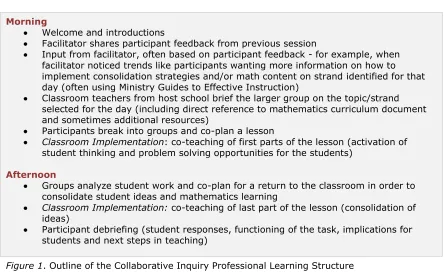
Researchers documented the professional learning program activity to develop a clear understanding of what was involved for participants. With very minor variations, each session with the collaborative inquiry team maintained a consistent daily structure in years one, two, and three (see Figure 1).
Although the structure of the PL program was consistent, the collaborative inquiry facilitators did make modifications to areas of emphasis from year to year in response to the results presented in research reports. In year one, the research team found positive effects of the CIL-M program on teacher efficacy and student efficacy with modest accompanying achievement gains. Because increased efficacy is a predictor and precursor to increased achievement (Bandura, 1993), the research team correctly predicted that gains in year two would be further elevated in the area of achievement data. A particularly important finding in year two was that the school districts that sustained their inquiry-based professional learning into a second year had even greater efficacy and achievement gains. Researchers recommended that districts continue to be supported in sustaining their efforts with inquiry-based professional learning in mathematics with less direct Ministry of Education support, and that the year three program provide even greater attention to strategies for strengthening student beliefs. Following these recommendations, professional learning activities in the CIL-M program in year three focused attention on how to positively influence student beliefs. Corresponding research activities examined the impact of the PL program on teacher beliefs and related instructional approaches in mathematics, and, further, examined how these affected student beliefs about math learning. The effects of year-three implementation were also positive.
Morning
Welcome and introductions
Facilitator shares participant feedback from previous session
Input from facilitator, often based on participant feedback - for example, when facilitator noticed trends like participants wanting more information on how to implement consolidation strategies and/or math content on strand identified for that day (often using Ministry Guides to Effective Instruction)
Classroom teachers from host school brief the larger group on the topic/strand selected for the day (including direct reference to mathematics curriculum document and sometimes additional resources)
Participants break into groups and co-plan a lesson
Classroom Implementation: co-teaching of first parts of the lesson (activation of student thinking and problem solving opportunities for the students)
Afternoon
Groups analyze student work and co-plan for a return to the classroom in order to consolidate student ideas and mathematics learning
Classroom Implementation: co-teaching of last part of the lesson (consolidation of ideas)
Participant debriefing (student responses, functioning of the task, implications for students and next steps in teaching)
The results reported in this paper focus mostly on teacher efficacy over the three years because they are a precursor and predictor of student mathematics achievement and functional beliefs about mathematics.
Quantitative Findings: Teacher Efficacy Shifts
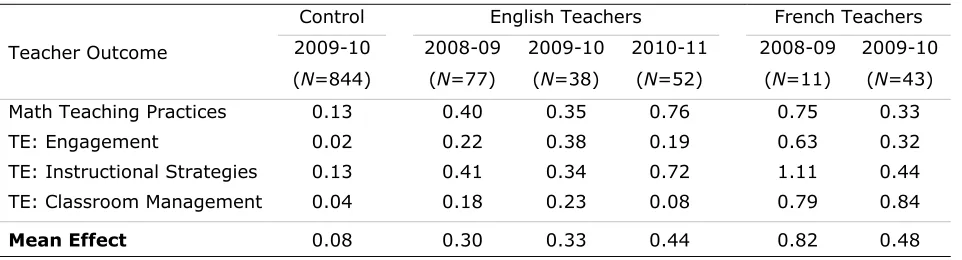
Table 2 summarizes the teacher efficacy results of the CIL-M program over three years. The first column identifies the features of teacher efficacy measured. Column two provides control group data (provided by sites who were slated to receive CIL-M training in the subsequent year). Columns three, four, and five show the data for English language teachers across the three years. The final two columns show French teacher data in the first two years (French teacher data was not collected in year three). The cells of the table show the effect sizes (Cohen’s d) for each group in each year. The effect size is the difference between pre- and post-test scores, divided by the pooled standard deviation. An effect size of zero indicates that a program had no effect on participants. The final row of the table shows the mean effect averaged over the four outcome measures.
Table 2 illustrates how teachers in each year of the CIL-M program learned more than teachers in the control condition (tested in year 2). Program outcomes were four to ten times greater than the outcomes of the control population. The table also shows that the program became more effective over time for the English teachers. The opposite was the case for the French teachers, but the French teacher data may be misleading as it involved a very small number of teachers (n = 11) in year one of data collection. This is an obvious limitation of the data set.
In Figure 2, the results for English and French teachers in each year of CIL-M were combined and compared to the results of the control group data. The figure shows the distinct advantage of CIL-M over the control group in each of the three years, and provides evidence that the impact of the PL program increased annually as the program was further refined. The greatest effects on teacher efficacy were noticeable in the area of instructional strategies in mathematics. Teachers reported that they believed they were more capable of providing Table 2
CIL-M Effect Sizes* by Year and Language
Teacher Outcome
Control English Teachers French Teachers
2009-10 2008-09 2009-10 2010-11 2008-09 2009-10
(N=844) (N=77) (N=38) (N=52) (N=11) (N=43)
Math Teaching Practices 0.13 0.40 0.35 0.76 0.75 0.33
TE: Engagement 0.02 0.22 0.38 0.19 0.63 0.32
TE: Instructional Strategies 0.13 0.41 0.34 0.72 1.11 0.44
TE: Classroom Management 0.04 0.18 0.23 0.08 0.79 0.84
Mean Effect 0.08 0.30 0.33 0.44 0.82 0.48
Note. TE = Teacher Efficacy
students with appropriate and varied instruction to support their mathematics learning at the end of the PL program than they were in the beginning. The effect size in year three of the program was medium to large (Cohen’s d = 0.72). This is an interesting finding in relation to qualitative teacher reports that “instructional strategies” are the most difficult dimension of mathematics teaching to accomplish and that both classroom management and student engagement are relatively easier to orchestrate. We theorize that gains in efficacy for instructional strategies in mathematics education is particularly important because it suggests that teacher mathematics knowledge for teaching (Ball, Sleep, Boerst, Bass, 2009) has increased. The teachers in this study reported that they felt more capable of supporting students in their mathematics understanding because they had developed the pedagogical and content knowledge required for more precise and varied instruction.
Related student outcomes. Although the main focus of CIL-M was the professional renewal of teachers and related efficacy, data was also collected on student outcomes during each year of the study. The general pattern was a gradual increase from years one to three of the program. For example, the impact of CIL-M on students’ confidence in their math ability increased from d = 0.29 in year one to d = 0.55 in year three. Students’ fear of failure declined more in year three than in year two (d = -0.15 in 2009-10 and d = -0.39 in 2010-11), while the positive impact of CIL-M on students’ self-reported efforts was the same in the first and last year of the evaluation (d = 0.28). Students who were taught by participating teachers also improved from pre- to post-achievement tests on virtually all measures in all grades. The gains were especially large on the open-ended measures in grades three, four, and five, and on the multiple-choice items in grade six. The student achievement impacts were much larger in year three than in year two. When aggregated across all classes taught by CIL-M teachers, the impact on open-ended combined with multiple-choice assessments was quite small, but positive (d = .02 to .08).
Qualitative Case Study Findings
Overall data sets and explanatory diagram. Researchers collected field note data of PL sessions, classroom teaching, and co-teaching opportunities, as well as audio and video data of focus group interviews, individual formal interviews, informal discussions, and lesson artifacts. Table 3 provides a summary of the types and quantity of data collected. In the case study research (Yin, 2009) and cross-case analyses, the research team was able to document teacher and student learning, and identify the favourable conditions that enabled the process of developing positive beliefs and practices.
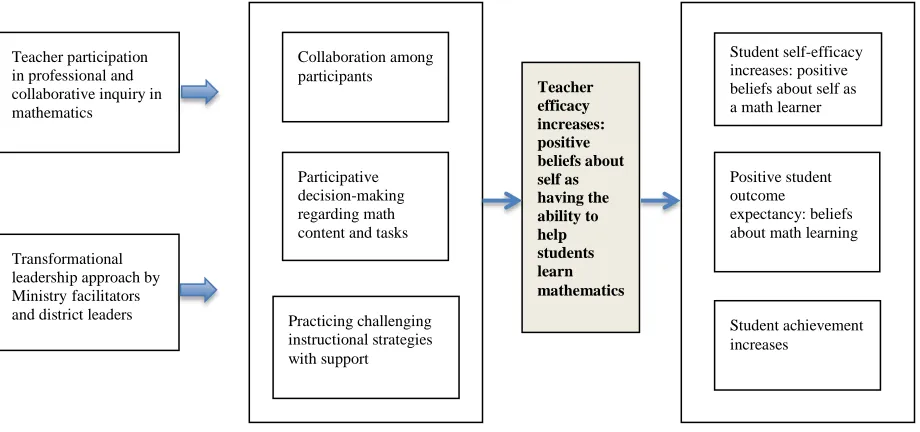
The qualitative data helped researchers capture the overall phenomenon of the CIL-M program and its impact on efficacy in a thicker descriptive manner. As part of the member-checking and reliability process, researchers generated the following explanatory diagram based on the findings from years one and two (2008-2010) (see Figure 2). This diagram was presented for validation to some participants, observers, and facilitators to ensure it reflected experiences of participants. The model was then tested in year three and found to be consistent and accurate.
Table 3
Number of Documents Across 3-Year Study (with + indicating “more than”)
Type Number of documents Pages
Field notes of PL sessions 130 1000+
Co-teaching observations 75 260
Interview transcripts 320 1440
Artifacts, photos, video* 1000+ from CIL-M and
co-teaching sessions 770
1525+ 3470+
* Note. Not all video artifacts were transcribed, but were viewed and annotated
Collaboration among participants
Participative decision-making regarding math content and tasks
Practicing challenging instructional strategies with support Student achievement increases Positive student outcome expectancy: beliefs about math learning Student self-efficacy increases: positive beliefs about self as a math learner
Teacher efficacy increases: positive beliefs about self as having the ability to help students learn mathematics Teacher participation in professional and collaborative inquiry in mathematics
Transformational leadership approach by Ministryfacilitators and district leaders
Teacher participants in the collaborative inquiry program were empowered to make instructional decisions together and to explore mathematics content more deeply. As teachers took risks implementing instructional practices that focused on student inquiry in mathematics and the communication of ideas (where non-routine problems were presented through the activation of student thinking, sustained time for open-ended problem solving, and opportunities to consolidate mathematics ideas), there were shifts in teacher perspectives about how students learn mathematics. These shifts led to more functional beliefs about student learning (that students can learn challenging mathematics), higher expectations for all students, and greater emphasis on communication by and for students to build and share mathematics knowledge. This led to increases in student efficacy, confidence, and engagement in mathematics. When students had mastery experiences in mathematics where they succeeded with challenging problems, the participating teachers who observed these successes had mastery experiences themselves. Observations of colleagues co-teaching in the classroom also supported vicarious experiences that contributed to efficacy information for participants. In these situations, teachers observed colleagues who, much like themselves, take risks with challenging instructional strategies and achieve success in terms of student learning and “aha moments.” The increased efficacy of these teachers led them to incorporate high-yield but challenging instructional strategies on a regular basis between professional learning sessions. Participating teachers were also observed co-planning and co-teaching as a more habitual practice when they were supported by their principals and given blocks of shared planning time. As a result of this sustained professional learning process for teachers, students increased their self-efficacy and positive beliefs about mathematics, which began to translate into increases in student achievement.
Important activities and characteristics of the PL program identified by participants. The most influential, positive aspects of the professional learning activity identified through coded interviews, observation data, and survey data were (in order of teacher-reported importance) opportunities to: (i) implement problem-based lessons with support; (ii) engage in live classroom observations and listen to students talk; (iii) develop content knowledge in mathematics; and, (iv) practice high-yield strategies such as using manipulatives, anticipating student problems, and identifying strategies for relieving misconceptions.
Participating teachers described specific characteristics of the professional learning program that supported their efficacy development. The two most powerful were: (i) the classroom-embedded nature of the PL program where participants spent time together in classrooms and with students both during formal PL sessions and between sessions in smaller working groups; and, (ii) the high level of collaboration amongst participants, including productive norms for co-planning lessons and co-teaching activity in order to carefully consider instructional strategies and the mathematics content. This aligns clearly with previous research on the importance of efficacy information in the forms of mastery experiences and vicarious experiences.
Changing perceptions of the role of the teacher. “I really felt that it changed my whole way of thinking about how to teach math” (Participant, Year 2).
The most prominent theme throughout the three years of case study data was a shift in how participants understood their role as a teacher of mathematics. Teachers reported and were observed to be re-evaluating and reconstructing their role in the classroom. Participants identified four ways that their understanding of their role in the classroom changed through the PL program. These involved a deeper understanding of the role of the teacher: (i) as a co-learner in the classroom; (ii) as an influential adult for building student confidence; (iii) as a listener and observer of students; and, (iv) as a teacher of all students, including those with special needs, due to an expanding awareness of student capabilities in mathematics combined with a wider repertoire of instructional strategies.
As an illustrative example, we can consider the case study site of year three participants. This team inquired about the following key questions throughout the PL program: “How do we, as educators, evaluate student thinking given our new understanding that it is not all ‘laid out on the paper,’ and how do we create learning situations that facilitate student communication so that they are increasingly capable of expressing and communicating their ideas mathematically?” This team investigated problem-based tasks and assessment strategies that provided windows into “seeing student thinking”:
The other big thing I think I learned is that so much of their math thinking is never making the paper in any way, shape, or form. But it doesn’t mean they don’t have it. And I think that we are now asking the question, “What does assessment now look like when it’s not the paper?” Because we are missing the boat. (Participant, Year 3)
Participants wrestled with how to engage in observations of students so that they could “see” the thinking that was “off the paper.” This team developed detailed observation strategies by first having students work on rich problems that required communication and then recording what they heard and saw during implementation of these tasks. The team debriefed their observations together in order to increase their understanding of how students were thinking about the mathematics they were being asked to do.
The big “a-ha moment” for me was, let the kids talk more, let them talk about their thinking, learn about what they know and build on that. I never did that before. (Participant, Year 3)
Another teacher participant with considerable experience in teaching through problem solving noted refinements in her skills as a facilitator of this process:
So a lot of times I stand and I listen and my anecdotal notes are perhaps better than they once were as well. But just valuing the process of listening and of course open questions, so if they are stuck, it’s not, “Here, I’ll show you the next step.” So I think my questioning has definitely changed, and the ability to listen. (Participant, Year 3)
Researchers observed 16 mathematics lessons in this case study (10 of which were “regular mathematics lessons” between the formal professional learning sessions) in year three, and found teacher self-reports of change in practice and related student gains to be accurate. Excerpts from field notes of a between-session observation and interview data are included here as evidence:
The teacher made a conscious decision to begin the consolidation by sharing the solution of one struggling girl (Annie), who was reported by the teacher to have low confidence in mathematics and to
be frequently disengaged. When Annie’s solution was presented on the Elmo projector, all of the girls
in the classroom turned to look at her in excitement. In this lesson, males were volunteering answers far more frequently than females (in approximately a 6:1 ratio). (Field note of classroom observation, Year 3)
The researcher shared this gender count with the classroom teacher at the end of the day (along with the observations about the reaction of the girls in the class upon seeing Annie’s solution and how the teacher’s commendation of her thinking was a solid mathematical strategy). The sharing of these observations seemed to have a profound impact on the teacher. At the final interview, the teacher’s enthusiasm about the change in her students and her ability to affect this change was clear:
And with the example of Annie who’s on an IEP. Being able to have her work up there on the SMARTboard, that more students are recognized for their thinking… If you’re feeling like you are good in math, you’re going to take more risks because the focus isn’t, “Oh I made a mistake,” the focus is, “How can I learn from my mistake, let’s talk about my thinking”… so I like that … because then I see those kids contributing more and getting feedback. Whereas before they always seemed to be the ones at the back of the class trying to hide, not making eye contact because they don’t want you to ask a question because they think they have nothing to offer. And I don’t see that… They’re all wanting to put their hand up. (Participant, Year 3)
Discussion
This three-year study found that professional learning delivered through a mathematics collaborative inquiry program had a positive effect on teacher efficacy, and on student beliefs and achievement. The benefits of participating in the CIL-M program in year one was more than maintained with new populations of teachers and students into year two, and then further improved with new populations of teachers and students in year three. The additional gains for new populations from year-to-year may be attributed to refinements that were implemented in the professional learning program each year, based on recommendations made in comprehensive annual reports to the Ministry of Education. One limitation of the study is effects were measured on new populations of Ontario teachers and students each year, rather than examining effects of one population over three years. This could also possibly be linked to a second limitation, the issue of unintended spread. The PL program was very positively received by school districts and features of the PL program were adopted by local school district consultants for other PL opportunities. Elements of the collaborative inquiry PL method (co-planning, co-teaching, and debriefing in particular) were implemented in locally developed PL programs throughout the province. The unintended spread of the PL activity beyond Ministry initiated sites may have given the years two and three participants some additional “readiness” in their inquiry approach to professional learning, and similar readiness for increasing their levels of teaching efficacy. A third limitation of the study was the low n of the French teacher population, as mentioned above.
Table 4
Shifts from Professional Development to Professional Learning
Traditional PD experiences Toward a PL model that is inquiry-based
“Expert” directed projects where teacher
participants cooperate with facilitators Teacher-directed and research-supported inquiry where educators and facilitators work collaboratively to engage in areas of mutual interest
Learning environments for participants that are outside the classroom and require translation by teachers to the classroom
Classroom-embedded learning where the primary site of inquiry and professional learning is within the classroom context (this also requires an opening of the classroom to “guests” and collaborators); this model embeds opportunities to practice with support
Punctuated, linear, short workshops or PD sessions with limited or no follow-up or between-session implementation
Cyclical, iterative and sustained inquiry over one year or more with implementation occurring formally and informally
Deficit models of teachers and students (assumes that teachers and students need to be “fixed-up”)
Asset models of teachers and students (learning model where all participants bring insights and strengths that help build shared knowledge)
Emphasis on teaching and the teacher Emphasis on students and student learning
External resources and expertise for the PD are required indefinitely, or the long-term supports are not considered after the PD ends
Program features such as co-teaching, engaging teachers in the collaborative lesson development, and collective reflection focusing on deep student understanding of important mathematical ideas can be incorporated into a range of professional learning activities, including those that are completed over shorter periods. It is important, however, to underline that teacher learning takes time. A key reason why the CIL-M program was successful is that substantial PL time (10-12 full day sessions including between-session implementation) was allocated to the program. Previous research (summarized in Desimone, 2009) suggests that teachers need at least 20 hours of contact time to develop and maintain new instructional strategies in their regular practice. Of course it is possible to have a profound professional learning experience in a shorter time frame provided there is a sense of constructive urgency (Bruce, 2013), but the efforts required to implement this learning in the classroom context are very often underestimated (Jaworski, 2004). It is therefore worth considering the nature of the PL program with efforts to ensure that co-created strategies and refinements in teaching practice are both supported and sustained, to build teacher efficacy and teaching effectiveness.
The quality of the inquiry-based PL program in this study was distinct from typical models of professional learning. Based on observations, the research team summarized the nature of the PL program by comparing traditional professional development opportunities (summarized on the left side of Table 4) to the CIL-M model (on the right side of the table).
Contributions of the Study
References
Ball, D., Sleep, L, Boerst, T. & Bass, H. (2009). Development of practice and the practice of development
in teacher education. The Elementary School Journal, 109(5), 458-474.
Bandura, A. (1997). Self-efficacy: The exercise of control. New York: W. H. Freeman.
Bandura, A. (1993). Perceived self-efficacy in cognitive development and functioning. Educational
Psychologist, 28(2), 117-148.
Bonner, P. J. (2006). Transformation of teacher attitude and approach to math instruction through
collaborative action research. Teacher Education Quarterly, 33(3), 27-44.
Borko, H., Davinroy, K.H., Bliem, C.L., & Cumbo, K.B. (2000). Exploring and supporting teacher change: Two third grade teachers’ experiences in a mathematics and literacy staff development project. The Elementary School Journal, 100, 273-306.
Bruce, C., Esmonde, I., Ross, J., & Gookie, L., Beatty, R. (2010). The effects of sustained classroom-embedded teacher professional learning on teacher efficacy and related student achievement. Teaching and Teacher Education, 26(8), 1598-1608.
Bruce, C. (2013). The relationship between collaborative action research and leadership. In Collaborative
Action Research: Effects of teacher-directed research in Ontario schools. Monograph: Elementary
Teachers’ Federation of Ontario Press: Toronto.
Bruce, C. & Ross, J. (2009). Conditions for effective use of interactive on-line learning objects: The case of
a fractions computer-based learning sequence. Electronic Journal of Mathematics and Technology
[online serial] 3(1). Retrieved from http://www.radford.edu/ejmt
Bruce, C. & Ross, J. (2008). A model for increasing reform implementation and teacher efficacy: Teacher
peer coaching in grade 3 and 6 mathematics. Canadian Journal of Education, 31(2), 346-370.
Buck, G. A., Latta, M. A., & Leslie-Pelecky, D. L. (2007). Learning how to make inquiry into electricity and
magnetism discernible to middle level teachers. Journal of Science Teacher Education, 18(3),
377-397.
Capobianco, B. M. (2007). Science teachers' attempts at integrating feminist pedagogy through
collaborative action research. Journal of Research in Science Teaching, 44(1), 1-32.
Charmaz, K. (2003). Grounded theory: Objectivist and constructivist models. In N. Denzin & Y. Lincoln
(Eds.), Strategies of Qualitative Inquiry (2nd Edition). Thousand Oaks, Ca.; Sage.
Creswell, J. (2009). Research Design: Qualitative, quantitative and mixed methods approaches. Thousand Oaks: Sage.
Creswell, J. (2008). Educational Research: Planning, conducting and evaluating quantitative and qualitative research. Pearson: Upper Saddle River: New Jersey.
Creswell, J. W., & Plano-Clark, V. (2007). Designing and conducting mixed methods research. Thousand Oaks: Sage.
Cousins, J., & Walker, C. (2000). Predictors of educators' valuing of systematic inquiry in schools. Canadian Journal of Program Evaluation, 15(Special Issue), 25-52.
Desimone, L. M. (2009). Improving impact studies of teachers’ professional development: Toward better
conceptualizations and measures. Educational Researcher, 38(2), 181-199.
Garet, M.S., Porter, A.C., Desimone, L., Birman, B.F. & Yoon K.S. (2001). What makes professional
development effective? Results from a national sample of teachers. American Educational Research
Journal, 38, 915-945.
Gibson, S., & Dembo, M. (1984). Teacher efficacy: a construct validation. Journal of Educational
Psychology, 76(4), 569-582.
Goddard, Y. L., Goddard, R. D., & Tschannen-Moran, M. (2007). A theoretical and empirical investigation of teacher collaboration for school improvement and student achievement in public elementary
Goddard, R. D., Hoy, W. K., & Woolfolk Hoy, A. (2004). Collective efficacy beliefs: theoretical
developments, empirical evidence, and future directions. Educational Researcher, 33(3), 479-508.
Greene, J. C., Caracelli, V. J., & Graham, W. F. (1989) Toward a conceptual framework for mixed-method
evaluation designs. Educational Evaluation and Policy Analysis, 11(3), 255-274.
Guskey, T. R. (2003). What makes professional development effective? Phi Delta Kappan, 84(10),
748-750.
Herman, P., Meece, J. L., & McCombs, B. (2000, April). Teacher experience and teacher efficacy: Relations to student motivation and achievement. Paper presented at the annual meeting of the American Educational Research Association, New Orleans.
Henson, R. K. (2001). The effects of participation in teacher research on teacher efficacy. Teaching and
Teacher Education, 17(7), 819-836.
Hill, H. C. (2004). Professional development standards and practices in elementary school mathematics. Elementary School Journal, 104(3), 215-231.
Jaworski, B. (2004). Grappling with complexity: co-learning in inquiry communities in mathematics
teaching development. Proceedings of the 28th Conference of the International Group for the
Psychology of Mathematics Education, 1, 17-36.
Lytle, S., & Cochran-Smith, M. (1990). Learning from teacher research: A working typology. Teachers
College Record, 92(1), 83-103.
Mascall, B. (2003). Leaders helping teachers helping students: The role of transformational leaders in building teacher efficacy to improve student achievement. Unpublished doctoral dissertation, University of Toronto, Toronto.
McDonough, K. (2006). Action research and the professional development of graduate teaching
assistants. The Modern Languages Journal, 90(1), 33-47.
Moore, W. P., & Esselman, M. E. (1994, April). Exploring the context of teacher efficacy: The role of achievement and climate. Paper presented at the annual meeting of the American, Educational Research Association, New Orleans.
Muijs, D., & Reynolds, D. (2001). Being or doing: The role of teacher behaviors and beliefs in school and teacher effectiveness in mathematics, a SEM analysis. Paper presented at the annual meeting of the American Educational Research Association, Seattle: US.
Penuel, W. R., Fishman, B. J., Yamaguchi, R., & Gallagher, L. P. (2007). What makes professional
development effective? Strategies that foster curriculum implementation. American Educational
Research Journal, 44(4), 921-958.
Riggs, I. M., & Enochs, L. G. (1990). Toward the development of an elementary teacher's science teaching
efficacy belief instrument. Science Education, 74(6), 625-637.
Ross, J. A. (1998). Antecedents and consequences of teacher efficacy. In J. Brophy (Ed), Advances in
research on teaching, 7, (pp. 49-74). Greenwich, CT: JAI Press.
Ross, J. A. (1992). Teacher efficacy and the effect of coaching on student achievement. Canadian Journal
of Education, 17(1), 51-65.
Ross, J.A., & Bruce, C. (2007). Professional development effects on teacher efficacy: Results of a
randomized experiment. Journal of Educational Research, 101(1), 50-60.
Ross, J. A. & Bruce, C. (2012). Quantitative inquiry into collaborative action research: Measuring teacher
benefits. Teacher Development, 16(4), 537-561.
Ross, J. A., Rolheiser, C., & Hogaboam-Gray, A. (1998). Skills training versus action research in-service:
Impact on student attitudes to self-evaluation. Teaching and Teacher Education, 14(5), 463-477.
Rowe, S. (2004). Discourse in activity and activity in discourse. In R. Rogers (Ed.), An introduction to critical discourse analysis in education (pp. 79–96). Mahwah, NJ: Lawrence Erlbaum.
Seligman, M. E. P. (1995). The effectiveness of psychotherapy: the Consumer Reports study. American
Tschannen-Moran, M. & Gareis, C. (2004). Principals’ sense of efficacy: Assessing a promising construct, Journal of Educational Administration, 42(4/5), 573-585.
Tschannen-Moran, M., & Woolfolk Hoy, A. (2001). Teacher efficacy: Capturing an elusive construct. Teaching and Teacher Education, 17, 783-805.
Tschannen-Moran, M., Woolfolk Hoy, A., & Hoy, W. K. (1998). Teacher efficacy: its meaning and
measure. Review of Educational Research, 68(2), 202-248.
Wagner, J. (1999). The pragmatics of practitioner research: Linking new knowledge with power in an
urban elementary school. Elementary School Journal, 100(2), 151-180.
Watson, S. (1991). A study of the effects of teacher efficacy on the academic achievement of third-grade students in selected elementary schools in South Carolina. Unpublished doctoral dissertation, South Carolina State College, Orangebury, SC. UMI 9230552.
Yin, R. K. (2009). Case study research: Design and methods (4th ed.). California: Sage.
As Associate Professor at Trent University, Dr. Bruce conducts research on teaching and learning
mathematics, and coordinates for the mathematics methods courses. Her research interests include teacher efficacy, models of professional learning, technology use in the classroom and student thinking in mathematics. You can see her work featured at www.tmerc.ca.
Appendix
Code Summary
Teacher Beliefs about Mathematics Learning
TB ROLE Role of teacher in the classroom; including listening to students; teacher shift in belief paradigm (shared learning, student oriented) TB EXP Shift in expectations of student capability
TB MIS Teacher belief about the importance of mistakes as a positive site of learning
TB PS Teacher belief that problem solving is a way to see what students can do/not do, make instructional decisions, purpose and function of ps (e.g., Too time consuming vs embedded)
Development of Student Beliefs
SB CONF Confidence to solve problems SB PERS Persistence
SB AGEN Agency (the right to share ideas)
SB DIS Disfunctional or negative utterances about math
Evolution of instructional Practice
IP EVID Evidence of increased focus on math (time spent in class, content depth, challenge for students)
IP PS Use of 3-part lessons; openness, different solution strategies IP MIS How teachers take up mistakes/ partial ideas
IP LQ Teacher listening/ observing students w/o immediately intervening; teacher questions and evolving nature
IP RES Emphasis on curriculum expectations, guides to effective instruction (curriculum resources)
IP ST Student focus, discovery, not saving the student
Favourable Conditions
FC EXP Expertise present in group
FC LEAD Leadership positive (admin, consultant, but also teachers) FC LIVE Live observations (and student artefacts brought to group) FC CONT Content; time spent doing math in PL setting
FC COLL Collaboration of team members FC LEAR Learning stance of participants
FC SUPP Consultant/admin support of inquiry process FC VOICE Has voice at table (who is contributing?) FC PD
CONT/STR Content/structure of PD itself helped teachers to change beliefs and practices FC BS Implementation of between session having influence on teacher growth
Challenges
CH LOG Logistical challenges (human, material, time, money for release time etc.) CH LEAD Unclear leadership roles, no one taking leadership; little plan for
transfer of authority which threatens sustainability CH VOICE Who has voice? / Lack of teacher voice
CH STRUC Structure of PD, how it is run
CH IMP Implementation; includes challenges understanding problem solving model, resistance, reluctance to “do” math in pd sessions
CH FACIL Challenges the facilitator faces CH TEACH Challenges the teachers face
CH ADMIN Challenges the administration faces CH CONTENT
FOCUS Challenges understanding content (no prior selection of content)
Additional Outcomes
OUT COLL Increased collaboration/ learning community (observed) OUT CONT Participant self-reported math content knowledge increase
OUT SPR Spread, from teacher to teacher, principal to principal, school to school (observed and reported)
OUT TC Teacher reported confidence teaching mathematics
OUT TE Teacher efficacy: expression of belief teacher has ability to help students learn math
OUT STC Student confidence learning mathematics (observed)