Teachers as Rural Educators
Andrew Kristiansen
University of TromsøIn the article, education is seen as a hierarchical cultural encounter between urban and rural values and ways of life. Good teachers do not only deliver curriculum, they also consider the needs and values of their students, as well as those of the local community. The article discusses how teachers’ competence, knowledge and attitudes can affect their teaching, and how attitudes may influence teachers’ approaches towards educational matters in rural settings. It examines some of the challenges teachers are up against if they are to integrate local culture, values and norms in national educational programs, in order to enhance a shared understanding of goals and intentions. I argue that rural schools need to develop pedagogical approaches to teaching and learning that consider rural settings.
Cet article présente l’éducation comme une rencontre culturelle hiérarchique entre les valeurs et les modes de vie urbains et ruraux. Les bons enseignants ne font pas que livrer un curriculum, ils tiennent compte des besoins et des valeurs de leurs élèves et de la communauté locale. L’article traite de la façon dont la compétence, les connaissances et les attitudes des enseignants peuvent affecter leur enseignement, ainsi que la mesure dans laquelle les attitudes peuvent influencer les approches qu’ont les enseignants face aux enjeux éducatifs dans les milieux ruraux. L’article examine quelques uns des défis qu’affrontent les enseignants en voulant intégrer la culture, les valeurs et les normes locales dans les programmes pédagogiques nationaux pour appuyer une vision commune des objectifs et des intentions. Je maintiens que les écoles rurales doivent développer des approches à l’enseignement et l’apprentissage qui tiennent compte des milieux ruraux.
Introduction
Teachers and parents are key factors influencing student achievement. Other factors, like neighborhoods, peers, economy, curriculum, leadership, educational assets and resources, are all elements of importance, but it is who and how your parents and teachers are that matters most. In the wake of international tests like Programme for International Student Assessment (PISA), Trends in International Mathematics and Science Studies (TIMMS) and Progress in International Reading Literacy Study (PIRLS), politicians have a growing understanding of just how important teachers are for students’ learning outcomes. A country’s ranking on these international tests has an important impact on domestic educational policies (Grek, 2009; Kamens & McNeely, 2009; Sahlberg, 2004).
Assessing Teachers
parents, students as well as researchers. It is not easy to establish consensus on what a good teacher is. When you see a good teacher in action, it is a work of art—not easily measured or described in full. Various programs are developed and implemented in order to assess teachers. Researchers generally use three approaches (or a combination thereof) in order to distinguish between poor, average, good and excellent teachers. The most straightforward way is to use indicators such as credentials, qualifications and other teacher characteristics. A second approach is to collect data on teacher quality through observation programs and by collecting samples of teachers’ work, thus enabling comparisons of teachers. The third approach, generally referred to as teacher effectiveness studies, are investigations with an outcome-based perspective. They study the impact of teacher behaviours on student achievement. This latter approach seems to be the most common today, perhaps because these studies link up nicely with economic factors. Such an approach seems to provide answers to at least some of the challenges raised by international tests like PISA, TIMMS and PIRLS. Erik Hanushek (2014) demonstrates the need to boost teacher effectiveness, by calculating how good teachers increase the future earnings of their students. Achievement translates into bigger incomes. Poor teachers, on the other hand, have a negative impact.
From research on teacher effectiveness, one may deduct standards for ideal effective teachers: they are well-trained and experienced, subject specialized, authoritative and they exercise leadership in the classroom. These standards are obviously useful for schools, especially well functioning urban schools. Research does, however, show that many schools in deprived inner cities and rural areas, have trouble recruiting and retaining such ideal teachers (Cambell & Yates, 2011; Eppley, 2009; Guin, 2004; Miller, 2012). I suggest that this presupposes that the Organisation for Economic Co-operation and Development (OECD) standards for effective teachers are valid and sufficient for teachers in rural communities.
This article discusses teacher qualifications, attitudes and strategies in rural communities. The two main questions addressed are: 1) How may teachers’ didactical knowledge and thinking situate their teaching in a rural context; and, 2) How may teachers’ conceptions of rural, influence their relations with rural students and communities?
Rural Versus Urban
There are some things participants in discourses on teacher qualifications in rural schools must have in mind. Rural schools differ in several ways from average urban schools: They are generally smaller and relative geographically isolated compared with urban schools. In addition rural areas differ demographically and economically from urban areas. All these objective and easily observed differences represent possibilities and challenges for rural schools, which teacher effectiveness surveys do not address. In addition, some differences between rural and urban schools are partly consequences of the objectively observed differences, and partly results of historical, cultural, social and economic development. These differences represent intersubjective conditions for education, and affect relations, motivation, participation, self-determination and respect.
culture and heritage, but also cultural differences within the local community. Whose common knowledge, culture and heritage is it that schools are supposed to pass on to students? A standardized national curriculum may well pass on knowledge, culture and values of the hegemonic group in society, privileging particular discourses at the expense of minorities (Bernstein, 1996; Pring, 2013). Standardization of curriculum, teaching and assessment defines what education is about, and standards emanate from somewhere. “This ethereal somewhere is always, it seems, an urban place, and its abstract, standardized knowledge is necessarily divorced from the multiplicity of rural contexts” (Corbett, 2007, p. 273). Urban biases can lead to uncertainty about the role of the local school and they highlight the complexity of decision making concerning rural schools. Is the community school a local governmental presence, and an instrument for adapting and qualifying young people for life in modern urban societies? To what degree may the local school also take into consideration the needs and values of the local community it is supposed to serve, in order to secure the existence and prosperity of that community? Michael Corbett (2007; 2013) argues there is the mobility imperative in rural communities, affecting individual young persons as well as teachers and rural education at large. Young people must decide whether to stay or leave their rural home-places. Consciously or not, many teachers prepare their students for life elsewhere, especially those students who demonstrate academic capabilities. Educators concerned with rural education ought to address these questions more actively because education is increasingly streamlined and adjusted towards national and global (economic) needs and requirements issued by organizations like OECD. Accountability, transparency, evaluation and assessment are key words in this development (Grek, 2009; Kamens & McNeely, 2009; Kristiansen, 2014; Sahlberg, 2004).
As national educational systems are reformed in order to meet OECD standards, local schools must not only implement the imposed reforms, but must see how they may implement local culture, heritage and knowledge in the curriculum. The latter is necessary if students are to identify with educational requirements and feel that what education offers is of concern and value to them.
Discourses must not be limited to “the rural school,” because there are great differences between rural schools, which should be taken into consideration, as is the case with rural communities as a whole. There are multiple rural schools, just as there are multiple rurals (Bell & Sigsworth, 1987; Cambell, Bell, & Finney, 2006; Dowling, 2008; Hargreaves, 2009; Kalaoja & Pietarinen, 2009). Rural schools differ greatly between themselves in enrolment numbers, geographical position relative to urban areas, as well as organisation and composition of staff. In addition, schools are situated in areas with diverse economic and social infrastructures. Such factors are of great importance, but they cannot be generalized, and must be elaborated for each individual school and community. These differences pose rural teachers with challenges that they may not be sufficiently prepared for through their formal qualifications as teachers. This is partly because their preparation and education generally takes place in educational institutions designed for urban schools.
Teachers as Superman, Superwoman or “Good Enough”?
teacher may have excellent learning results with one group of students or one class without obtaining equivalent results in other groups or classes. Moreover, teaching is not necessarily a profession that is mastered just by acquiring formal credentials. Good teachers develop through experience, in-service training and collegial co-operation. Focusing solely on teacher credentials may only tell us part of the story. Even excellent and experienced teachers do not always succeed in the classroom.
Charles Bingham (2008) points out that students may flourish and succeed academically, even though their teachers are not regarded as excellent. He claims that teachers, who are good-enough, manage to facilitate the students’ learning and meet the needs of their students by giving them space and time so that they can be active partners in their own learning processes. According to Bingham’s (2008) insights, it is the student who decides whether he or she will be inspired and flourish by the teacher’s efforts at facilitating learning and development.
A teacher who knows how to help students flourish, will know that student flourishing is ultimately something that must be enacted by the student. Once again this is a paradoxical concept: in order to help a student flourish, the teacher must know that the student must help herself to the help of the teacher, and that is better perfected by the student than by the teacher. (Bingham, 2008, p. 97)
If students are to take an active part in their own learning, I believe education must become more negotiable. The good and confident teacher will let her or his students engage in dialogues on what and how to learn. This said, there is admittedly some poor teaching going on in schools:
Teachers may, for instance, choose to regard their teaching as simply a “nine-to-five job” requiring the routine application of standard classroom techniques which are acquired through practice. In such cases the aims of education are seen as given and their task is simply to meet the requirements. (Helsby, 1999, p. 150)
In my view, these teachers have not taken satisfactory care of their professional development. In this situation, established ways of thinking are regarded as good, whilst new ideas and development are regarded as bad, and are seen as a threat to established and presumably, well-functioning practices. At their best, such teachers lecture, but forget to teach.
Teachers and Rural Schools
In North America and Western Europe, rural schools have problems recruiting and retaining certified teachers. This tends to be the case whether a country has a lack or a surplus of qualified teachers. Taking a post in an urban school is more attractive to the majority of teachers, if they have a choice. Research shows that there are several reasons for this, for example, enrolment numbers, career opportunities and geographical isolation (Cambell & Yates, 2011; Eppley, 2009; Kristiansen, 2000, 2001; Miller, 2012; Monk, 2007).
Long-serving rural teachers are in short supply, and some rural students face new teachers almost every year through their primary and lower-secondary education. The question of qualified teachers has therefore received a great deal of attention by national, regional and local governments in the affected countries. Various programs have been initiated in order not only to recruit the necessary number of teachers, but also to retain them. Teachers, who come from rural communities or are oriented towards rural life and values, tend to settle in for longer periods than teachers with an urban background and metro-centric attitudes (Boylan & McSwan, 1998; Cambell & Yates, 2011; Hammer, Hughes, McClure, Reeves, & Salgado, 2005; Miller, 2012). In Norway, the government has promoted decentralised models of teacher education, enabling students to study where they live, and this has improved the situation for some communities (Skjelmo, 2012). Strategies for recruiting local teacher education students are also developed elsewhere, for instance in the USA (Hammer et al., 2005) and in Iceland (Jóhannsdóttir, 2015).
However, while resources and efforts have been invested in recruiting qualified teachers, questions have arisen about which qualifications and qualities, in addition to formal teaching credentials, are needed for good teachers in rural schools. The fact that a teacher comes from a rural background or seems to be a potential long-serving teacher ought not to be the only qualifications considered if schools want to secure equal educational opportunities for young people, independent of their place of residence.
Facilitating, Conducting and Leading Teaching and Learning Activities
The framing (environment, structure and organization) in a small rural primary school is different from that of a larger urban school. In addition, the relative low numbers of teachers at each school means that teachers must act as generalists—teaching a wide range of subjects. The situation in rural schools calls for teachers who are capable of operating professionally on multiple levels of competence in order to minimize the probable “disadvantages” of rural school settings, and transform these alleged disadvantages into advantages that promote learning. Merely copying solutions developed for large urban schools cannot solve the challenges rural teachers face in their daily work. Some of these challenges can seem overwhelming, especially for beginning teachers who encounter, for instance, multi-age classes (Kristiansen, 2000). Instead of regarding this as an opportunity for new approaches, teachers may try to adapt their multi-age classes into groups resembling the age-homogenous groups they were trained to master during their teacher education.
way, where elder siblings and other relatives were sources of knowledge and inspiration for the young. This applies to cognitive as well as social learning. In a multi-age group students experience that in the first year they are among the youngest, in the following year they are in the middle, and by the final year they become senior students. Instead of regarding multi-age as an obstacle for unity and uniformity, teachers could decide to see this scenario of diversity as an opportunity to flourish. Organisations inside and outside the educational system have recognised the value of learning and developing in multi-age groups. In kindergartens, children of different ages are placed together in groups for pedagogical reasons, and personnel regard that as the natural and right way to group them. In the arts, young people develop their individual talents by participating in children and youth choirs and orchestras and theatre groups where differences in age and experience are regarded as valuable assets. Another good example is the Boy Scouts and Girl Guides movement, where from the first day boys and girls are included in groups of different ages and with variable interests and experiences. A critical observer may be tempted to post the following rhetorical question: If a patrol-leader for 13-15 year olds can master a multi-age group, why should society not expect the same from a teacher, provided he or she gets the necessary support?
If challenges, like multi-age classes, are met with approaches developed for large schools, then small rural schools will always come second when compared to the larger urban schools. Therefore, rural schools need to develop pedagogical approaches to teaching and learning that consider rural settings. Success depends on the overall competence of the staff.
The basis of teacher qualifications is teacher education and professional experience. Teachers who enter the profession without a teacher education lack all, or part, of the advantages/outcomes of formal teacher certification. Novice teachers lack professional experience. An experienced teacher has both. Pedagogical practices in the classroom are conducted on different levels comprising skills, competence and knowledge. One may see didactical competence operating on three levels (Dale, 1999; Kristiansen, 2012). Level one concerns the conduct of teaching in order to reach pre-set learning goals. The main question is what to do during lessons. Teachers, who mainly follow the textbooks or readymade teaching material and/or plans, function on this level. In order to function they must possess certain skills and abilities; administer and distribute teaching material and tasks, uphold the necessary level of discipline in order to carry out tasks, etc. They follow what Henry Giroux (1988) describes as technocratic and instrumental rationalities by “simply carrying out predetermined content and instructional procedures” (p. 124).
Level two concerns how to teach. This includes planning and construction of learning programmes, and requires an ability to adapt textbooks, teaching material and plans to students’ abilities and interests, as well as the local context and culture. On this level, teachers master planning, preparing and assessing teaching and learning activities carried out on level one. This includes setting up goals based on the current standards given by curriculum, established practises and instructions, and making the necessary priorities in order to accomplish those goals. Teachers functioning on level two, may appear to function on a higher professional level. Nevertheless, they are still what Giroux (1988) would call technicians, because they are merely implementing what has been decided by experts and decision makers elsewhere.
teaching, in order to enhance the teacher’s and the student’s personal development, as well as development of the school as a learning community. The latter makes it necessary for teachers to cooperate, communicate and challenge each other as professionals. Professional communication demands the mastering of an adequate vocabulary and an understanding of theories. On level three, the teacher raises the question of why when confronting his or her pedagogical practice, and generates theoretical insights concerning teaching and curricular work. Competence on level three enables the teacher to develop an understanding of the links between the three levels, which in turn is a premise for autonomy and professionalism (Dale, 1999). In order to become autonomous professionals, teachers must connect the “conceptualization, planning and design of the curricula to processes of implementation and execution” (Giroux, 1988, p. 126).
The responsibility for developing and communicating theory and insights concerning rural schools is not solely the teacher’s. Researchers and research programs devoted to the field are equally important. Perhaps the efforts made by researchers so far have been too small and inadequate in terms of rural geographies, given that most educational research tends to focus on urban schools and general educational questions. Raising standards in rural education is not only about teachers, it also requires policy-makers to invest in research and development concerning rural contexts.
Teachers as Deliverers and Thinkers
The individual teacher needs someone with whom to interact on a reflective and analytic basis, and participate in pedagogic discourses promoting insights in the pedagogical processes in a school. Here we see the importance of the kind of committed, connected, relational leaders that Wallin and Newton (2014) describe in this issue. Participation in discourses as equals requires that teachers have developed a shared theoretical basis and understanding of concepts (Bernstein, 1990; Fullan, 1991). Richard Pring (2013) makes a distinction between teachers as deliverers and teachers as curriculum thinkers. Teachers as deliverers are teachers mainly functioning on levels one and two, as they, according to Pring (2013) are “deliverer[s] of improved outcomes, or trainers of those who have to hit targets—not the thinker[s] of what those outcomes might be” (p. 116). They are experts in delivering outcomes decided elsewhere— and probably regarded as effective teachers by OECD standards. Paulo Freire (1972) characterizes this type of teaching as the banking concept of education:
Education thus becomes an act of deposition, in which the students are the depositories and the teacher is the depositor. Instead of communicating, the teacher issues communiqués and “makes deposits” which the students patiently receive, memorize, and repeat. (pp. 45–46)
As curriculum thinkers, teachers are aware that discourses in schools may enhance and legitimate certain perspectives, ways of life, values and norms. These, in turn, must be balanced against other and alternative discourses, for instance those prevailing in local communities. This affects power relations within education, and will have a direct impact on teacher-student relations.
teacher-student practice. The value of this approach is that it refuses to remain trapped in modes of analysis that examine student voice and pedagogical experience from the perspective of the reproductive thesis. (Giroux, 1989, p. 50)
Pedagogic discourses cannot be limited to didactical and learning-oriented questions. Teaching also includes values and norms that affect life in school and student learning. These values and norms affecting teaching are perhaps more challenging to teachers in rural areas than in urban areas because communities in urban areas may be more at ease with the hegemonic culture, norms and values in a country. If rural norms and values deviate from those represented by the hegemonic culture, rural may stand out as secondary and/or “other” compared to urban. In a hierarchy of cultures, urban is valued as “high culture” representing prosperity and future.
School in rural areas may well be regarded as representing a different and “higher” culture from that of the student. Such cultural encounters may result in feelings of inferiority on behalf of the student and his/her community. The result can be an unhealthy effort by the student to adapt to school requirements, or a rejection of what school has to offer. Unn-Doris Bæck (2004) argues that there exists an urban ethos giving cities and urbanity a great cultural hegemony. Emphasis on job opportunities, leisure and cultural activities in the city leave rural youth with negative opinions of their home place and rural life in general. She finds that in rural areas where job opportunities are few or undesirable, youth are more inclined to leave. There seems to be a gender difference concerning leisure activities, because rural conditions favor male leisure interests. Girls, who emphasize leisure activities, are consequently more inclined to move to urban areas.
Students’ behaviors and attitudes are, at least partly, results of subjective interpretations of what they experience. Educators need to develop a pedagogy “that is attentive to the histories, dreams, and experiences that such students bring to school” (Giroux, 1989, p. 64). Karen Eppley (2009) asks for rural teachers who want to learn from “students who value their sense of place and their connections with the people who live there more than their ability to compete on the global job market” (p. 8).
Hierarchy, Asymmetry and Respect
Education is by nature a hierarchical system, with asymmetric relations between teachers and learners. Teachers have, for instance, the privilege to teach and assess their students, and have powers to sanction students who do not meet requirements and expectations. There are asymmetric relations elsewhere in society where expertise in knowledge or superior power leaves one group in a privileged position; for instance in the health system the relationship between doctor and patient, and in the judicial system the relationship between law enforcement agents and the public. Going back in history it is not difficult to find other examples of asymmetric relationships. Some of these asymmetries still prevail today as in the case of: indigenous populations and colonialists, people of color and white people, women and men, religious minorities and religious majorities, poor and rich, workers and owners of capital, lay people and gentry. There are however important distinctions in how asymmetry is justified and grounded in the given examples, which in turn enables me to distinguish between illegitimate and legitimate asymmetry (Kristiansen, 2014).
tradition, culture, religion, prejudice, ignorance, neglect, superstition and/or evil. The aim of illegitimate asymmetry is to uphold the privileges of the privileged part and maintain status quo. Reasons given for asymmetry are impossible to discuss, because they are not grounded in reality, but in people’s imaginations and beliefs. Consequences of these imaginary beliefs are however real.
Legitimate asymmetry is authority-based and justified through superiority in knowledge, abilities, experience or maturity on the part of the privileged. For the underprivileged, legitimate asymmetry is a way of empowerment and a steppingstone towards independence. In a legitimate asymmetric relationship, the aim of the privileged participant is to make oneself redundant; the doctor wants the patient to recover his or her health, agents of justice rehabilitate offenders, and teachers prepare and qualify students for independent and free lives. The legitimate teacher-student relationship is an asymmetric intersubjective encounter, where the teacher is an agent for enhancing the development of the student. The teacher is the student’s object of learning and development (but the student should not be the object of teaching or the teacher). Briefly, the best chance of an intersubjective relation is a meeting concerning or treating a shared third element, which may be a shared aim, a shared matter of subject or theme. The teacher and student can then investigate and cooperate as partners in order to pursue shared interests (Freire, 1972). The structural asymmetry of the teacher-student relationship transforms into a relation of analytic symmetry. It is a practical intersubjectivity, where teacher and student “play an active role and in which meaning is not transferred but produced” (Biesta, 1994, p. 312).
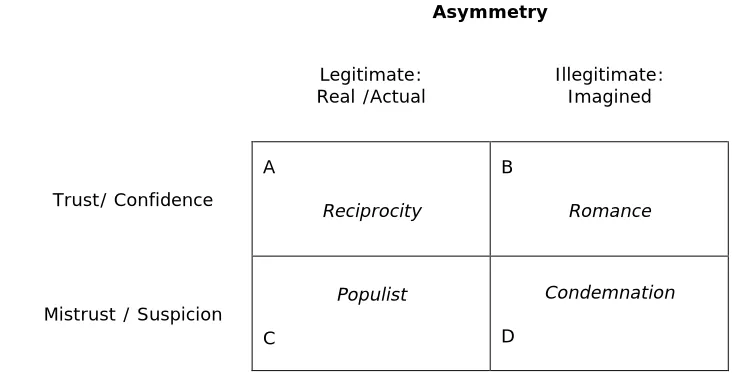
Asymmetric relationships are challenging, even if asymmetry is legitimate. How may the privileged avoid dominating the encounter, and how may the underprivileged avoid domination? Such relations resemble hierarchical cultural encounters, where the privileged part becomes a perpetrator if, when facing the unknown and unfamiliar, he or she defines the situation according to his or her sole discretion. One must bear in mind that my Other is an I to him- or herself, and I am his or her Other (Edvardsen, 2013). Our attitude towards Other can be that of trust and confidence, or mistrust and suspicion. Amalgamated with legitimate and illegitimate asymmetry I propose a model, which allows me to analyse (cultural) encounters in rural teaching; involving schools, teachers, students, families and local communities (Kristiansen, 2014).
Figure 1 describes how individuals or groups may position themselves when facing unfamiliar cultures, ways of living, behaviors or ideas. If one can meet in the A-room, one has the best chance of successful meetings. The A-room is a room where parties have the opportunity, through dialogue, to develop mutual cultural understanding and respect. Potential asymmetry is founded in real and actual circumstances, and may be dealt with in an atmosphere of reciprocity, trust and confidence. Parties may disagree on matters, but are open to develop their own understandings and opinions of Other. The result may be change, but may also be a mutual recognition and respect for differences. Cultural assumptions concerning education are not taken for granted, but can be questioned and challenged, thus making education negotiable. Students’ needs are not restricted to intellectual and physical needs, but include emotional and social needs. Learning is therefore more than a matter of intellect and abstract theory—it is also a matter of experience connected to place and time (Theobald & Nachtigal, 1995).
naïve and premature thinking. From the perspective of room B, rural is pictured as utopia—a place of beauty and peace. Rural and rural people represent the heartland of the nation, promoting desirable values and ways of life. Advertising uses images of rural utopia to promote tourism as well as a range of various products. Rural settings are for instance favored when car manufacturers want to demonstrate the quality, power and versatility of their cars. Politicians too, draw on rural examples, if it is beneficial to their cause. When Sarah Palin was running for the US vice-presidency in 2008, she addressed the Republican National Convention speaking of how the nation grows “good people in our small towns with honesty, sincerity and dignity” (Pedersen, 2009, p. 25).
Room C is the room for populists. Members here may possess experience and knowledge concerning matters in question, but they have absolute perceptions, which are not easily changed. The perspective of Other is not apprehended, and they may find it hard to engage in dialogues where they risk having their perceptions of the world challenged. In room C, you can only agree to disagree, no matter what the other says or does. You may talk to but not with the other, and listening is not a well-developed capacity. You can be sure that you are in the C-room if it is more important to win the argument, than to be right. Action is oriented towards reaching pre-set goals applying instrumental strategies. Here teachers become deliverers and depositors of skills and knowledge (Freire, 1972; Pring, 2013).
D-room, condemnation, is the gloomy room of the model, where no one should wish to be. Nevertheless, the gloom seems to intrigue people if they watch it from a safe place, where bystanders can witness and pass judgments without getting involved. Take for instance how literature, TV-series and films present dystopian stereotypes of rural: isolated, backward, dangerous, underdeveloped and full of people existing beneath society’s civilized veneer. If education approaches rural from perspectives rooted in D-room, rural stands out as culturally deprived, and teachers are remediators who set out on a mission to enrich, correct, convert and ultimately save young people from their gloomy rural destiny.
The model is a dynamic model, because the relative size of rooms may vary. Ideally, the A-room should be the larger and dominating A-room, in order to promote good intersubjective
A
tt
it
u
d
e t
o
w
ar
d
s O
th
er
Asymmetry
Legitimate:
Real /Actual Illegitimate: Imagined
Trust/ Confidence A
Reciprocity
B
Romance
Mistrust / Suspicion Populist
C
Condemnation
D
relations. In situations with tension and conflicting interests, the other rooms may dominate, reducing chances of positive outcomes. In these rooms (B, C and D), attitudes towards Other are informed by narrow, stereotypical images. If education is to function as an asset in rural areas, there are two premises teachers must attend to: First, teachers must themselves be in the A-room. Second, they must have knowledge and insights that enable them to communicate with those who are in the other rooms, in order to promote dialogue.
It is the teacher’s responsibility to maintain legitimacy in the relationship to the student. In a hierarchical encounter, the teacher defines the situation, and the teacher’s comprehension can be based on a lack of understanding and respect for local culture, skills and intelligences. Teachers in the A-room have the opportunity to transform an initially problematic hierarchical encounter, into an analytic encounter enhancing respect for differences and variations, in order to understand unfamiliar cultures on their own terms (Edvardsen, 2013, Kristiansen, 2014). In such an analytic encounter a shared or common culture does not mean uniformity and adaption without flexibility, “but a framework of common understanding—the product of generations of thinking, enquiry, criticism and creativity—within which society, and individuals within society, might function coherently and attain fulfillment” (Pring, 2013, p. 43). This requires teachers that function on the third level didactically, in order to develop teaching practices that enable them to implement local culture and knowledge in the curriculum, thus making education negotiable by letting the rural student prosper on his or her own terms. Teachers cannot prepare in full for these analytic encounters prior to taking up teaching. Teacher education of today can perhaps only fully prepare their students to function on level one—mastering subject knowledge and developing teaching skills. What works in one context may be inappropriate in another context. Generalizations of characteristics and experience do not consider the multiple realities of rural schools.
Conclusion
When education engages with rural communities and students, there are cultural encounters taking place. These encounters are not between equals; teachers are backed up by a system empowered by traditions, science, legislation and political support. Attitudes towards Other play an important part in deciding outcomes of such encounters. The model for analysing hierarchical cultural encounters demonstrates how attitudes promote or obstruct possibilities for positive and viable outcomes. Educators should contribute towards creating a framework of shared understanding, recognizing students’ and local communities’ rights to participate in educational matters. The A-room is the best place for attending to such conditions.
Knowledge, competence, skills, “education” and attitude are necessary if teachers are to develop as educators. However, these are not qualities restricted to individual teachers. Professional development takes place within a combination of practical experience, theoretical knowledge and collegial reflection, thereby enabling rural teachers to become rural educators. A teacher education is necessary to develop a theoretical basis for the profession, and is the starting point of a life-long process of personal and professional development in schools and societies that are in a state of constant change, and where teacher competence is more than a matter of competence in subjects, didactics and other teaching skills.
References
Bell, A., & Sigsworth, A. (1987). The small rural primary school—a matter of quality. London, England: Falmer Press.
Bernstein, B. (1990). The structuring of pedagogic discourse: Class, codes and control (Volume 4). London, England: Routledge.
Bernstein, B. (1996). Pedagogy, symbolic control and identity: Theory, research, critique. London, England: Taylor & Francis.
Biesta, G. J. J. (1994). Education as intersubjectivity: Towards a critical-pragmatic understanding of education. Educational Theory, 44(3), 299–317.
Bingham, C. (2008). Authority is relational: Rethinking educational empowerment. Albany, NY: State University of New York Press.
Boylan, C. & McSwan, D. (1998). Long-staying rural teachers: Who are they? Australian Journal of
Education, 42(1), 49–65.
Bæck, U. D. (2004). The urban ethos: Locality and youth in north Norway. Young-Nordic Journal of
Youth Research, 12(2), 99–05.
Cambell, A. M., & Yates, G. C. R. (2011). Want to be a country teacher? No, I am too metro-centric. Journal of Research in Rural Education, 26(4), 1–12. Retrieved February 17, 2015 from http://jrre.psu.edu/articles/26-4.pdf
Cambell, H., Bell, M. M., & Finney, M. (2006). Masculinity and rural life: An introduction. In H. Cambell, M. M. Bell, & M. Finney (Eds.), Country boys: Masculinity and rural life (pp. 1-24). University Park, PA: Pennsylvania State University Press.
Corbett, M. (2007). Learning to leave, the irony of schooling in a coastal community. Black Point, NS: Fernwood.
Corbett, M. (2013). I’m going to make sure I’m ready before I leave: The complexity of educational and mobility decision-making in a Canadian coastal community. Journal of Rural Studies, 32, 275–282. Dale, E. L. (1999). Utdanning med pedagogisk profesjonalitet. [Education with pedagogical
professionalism.] Oslo, Norway: Ad Notam Gyldendal.
Dowling, J. (2008). Changes and challenges: Key issues for Scottish rural schools and communities.
Edvardsen, E. (2013). Den innbilte Andre. [The imagined Other.] In E. Edvardsen, H. Holthe, (Eds),
Klientens stemme—hjelperens blikk [Client’s voice—Assistant’s glance] Oslo, Norway:
Universitetsforlaget.
Eppley, K., (2009). Rural schools and the Highly Qualified Teacher Provision of ‘No Child Left Behind’: A critical policy analysis. Journal of Research in Rural Education, 24(4), (pp. 1-11)
Freire, P. (1972). Pedagogy of the oppressed. London, England: Penguin Books. Fullan, M. (1991). The new meaning of educational change. London, England: Cassell.
Giroux, H. A. (1988). Teachers as transformative Intellectuals. In H. A. Giroux (Ed.), Teachers as
intellectuals: Toward a critical pedagogy of learning (pp. 125–129). New York, NY: Bergin & Garvin.
Giroux, H. A. (1989). Radical pedagogy and the politics of student voice. Interchange, 7(1), 48–49 Grek, S. (2009). Governing by numbers: The PISA ‘effect’ in Europe. Journal of Education Policy, 24(1),
23–37. doi:10.1080/02680930802412669
Guin, K. (2004). Chronic teacher turnover in urban elementary schools. Education Policy Analysis Archives 12(42), 1-30. Retrieved from 29.08.14 from http://epaa, asu.edu/epaa/v12n42.
Hammer, P. C., Hughes, G., McClure, C., Reeves, C., & Salgado, D. (2005). Rural teacher recruitment and
retention practices: A review of the research literature. National Survey of Rural Superintendents;
and Case Studies of Programs in Virginia. Charleston, Virginia: Appalachia Educational Laboratory at Edvantia.
Hargreaves, L. (2009). Respect and responsibility: Review of research on small rural schools in England.
International Journal of Educational Research, 48, 117–128.
Hanushek, E. A. (2014). Boosting teacher effectiveness. In E. F. Chester Jr., & R. Sousa (Eds), What lies
ahead for America’s children and their schools? (pp. 23–35). Stanford, CA: Hover Institution Press.
Helsby, G. (1999). Changing teachers’ work: The reform of secondary schooling. Philadelphia: Open University Press.
Jóhannsdóttir, T. (2015). Responsive practices in online teacher education. In T. Hansson (Ed.),
Contemporary approaches to activity theory: Interdisciplinary perspectives on human behavior.
Hershey, Pennsylvania: Information Science Reference. Doi: 10.4018/978-1-4666-6603-0.ch001 Kalaoja, E., Pietarinen, J. (2009). Small rural primary schools in Finland: A pedagogically valuable part of
school network. International Journal of Educational Research, 48, 109–116.
Kamens, D. H., & McNeely, C. L. (2009). Globalization and the growth of international educational testing and national assessment. Comparative Education Review, 54(1), 5-25. Retrieved December 22, 2015 from http://www.jstor.org/stable/10.1086/648471
Kristiansen, A. (2000). Fådeltskolen i Troms i et lærerperspektiv [Multigrade schools in Troms County in a teacher perspective] Report, Tromsø, Norway; Tromsø University College / Council of Education, Troms County.
Kristiansen, A. (2001). Læreplan og lærerkompetanse i et distriktskoleperspektiv [Curriculum and teacher competence in the perspective of rural schools] In S. Hovdenak (Ed.), Perspektiver på Reform 97 [Perspectives on the 1997 educational reform]. Oslo, Norway: Gyldendal.
Kristiansen, A.(2012). Utdanning og sosial utjevning: Om tilpassing, seleksjon og reproduksjon [Education and social equity: On adaption, selection and reproduction], Oslo, Norway: Unipub. Kristiansen, A. (2014). Rom for anerkjennelse i utdanningssystemet [Room for recognition in the
educational system]. Bergen, Norway: Fagbokforlaget.
Little, A. (Ed.) (2006). Education for all and multigrade teaching: Challenges and opportunities. Dordrecht, Netherlands: Springer.
Miller, L. C. (2012). Situating the rural teacher labor market in the broader context: A descriptive analysis of the market dynamics in New York State. Journal of Research in Rural Education 27(13), 1–31. Retrieved February 7, 2015 from http://jrre.psu.edu/articles/27-13.pdf
Monk, D. H. (2007). Recruiting and retaining high-quality teachers in rural areas. The Future of Children,
Opdal, P. (2000). Danning som initiering: R.S. Peters pedagogiske filosofi [Education as initiation: R.S. Peters’ pedagogical philosophy] Vallset, Norway: Oplandske bokforlag,
Pedersen, C. (2009). Obama’s America. Edinburgh, Scotland: Edinburgh University Press. Pring, R. (2013). The life and death of secondary education for all. London, England: Routledge. Sahlberg, P. (2004). Teaching and globalization. Managing Global Transitions, 2(1),65–83. Retrieved
February 15, 2015 from http://www.fm-kp.si/zalozba/ISSN/1581-6311/2_065-083.pdf Skjelmo, R. (2012). Fleksibilisering og feminisering høyere utdanning: eksemplet desentralisert
lærerutdanning [Flexibilisation and feminisation: The example decentralised teacher education].
Uniped, 35(3), 32–24. Retrieved February 16, 2015 from
http://www.idunn.no/uniped/2012/03/fleksibilisering_og_femininisering_i_hoeyere_utdanning_e kse
Strømnes, M. (1982). Kristvikskolen—reformpedagogikk og praktisk problemløysing [The Kristvik-school: Reform-pedagogies and practical problem-solving]. Oslo, Norway: Aschehaug.
Sundell, K. (1995). Åldersindelat eller åldersblandat: Forskning om åldersammensättningens betydelse i
förskola och grundskola [Age divided or multigrade: Research on the significance of age composition
in kindergartens and primary schools]. Lund, Sweden; Studentlitteratur.
Theobald, P., & Nachtigal, P. (1995). Culture, community and the promise of rural education. Education, Resources Information Canter (ERIC) ED 388 464
Unesco. (2013). Practical tips for teaching multigrade classes. Bangkok, Thailand: Unesco. Retrieved 03.10.2014 from http://unesdoc.unesco.org/images/0022/002201/220101e.pdf
Veenman, S. (1996). Effects of multigrade and multi-age classes reconsidered. Review of Educational
Research, 66(3), 323–340
Wallin, D. & Newton, P. (2014). Article in this special issue of AJER.
Dr. Andrew Kristiansen is a former teacher and head master in rural Norwegian schools. He is now