International Journal of Engineering Research and Development
e-ISSN: 2278-067X, p-ISSN: 2278-800X, www.ijerd.com
Volume 12, Issue 12 (December 2016), PP.17-23
Load Balancing Approaches Evaluation in Cloud Environment
Ahmed E karadawy
1, Prof. Dr. Hany Harb
21Master Student, El Azhar University, Cairo, Egypt
2Misr University for Science & Technology Faculty of Information Technology Cairo, Egypt
Abstract:-
Cloud computing is an assortment of IT assets, technologies and diverse range of services, which have been presented to customers in a very skilled way through the web. Based on business necessities, these assets and services have to be supplied or released expeditiously and automatically to or from consumers at the specified time. Load balancing is the most significant method employed in cloud environments to boost the system performance and at the same time to confirm that all resources are competently utilized. In load balancing, the load is apportioned over all participated resources in the virtualized data center to maximize the system throughput, minimize the data Center response and execution time for user requests, and/or avoid surplus and scarcity resources. For assigning user requests to the prime nodes and reducing the total cost, investigators have established several load-balancing algorithms, which are often divided into two classifications, static algorithms, as well as dynamic algorithms. In this study, our emphasis concentrates on the behavior of the three load balancing techniques round robin, throttled and active monitoring load balancing Algorithms including numerous service broker methodologies in cloud computing virtualized Data Centers using the cloud Analyst simulator.Keywords:-
Service broker, User base, VDC, VM Load balancer, VM ration.
I.
INTRODUCTION
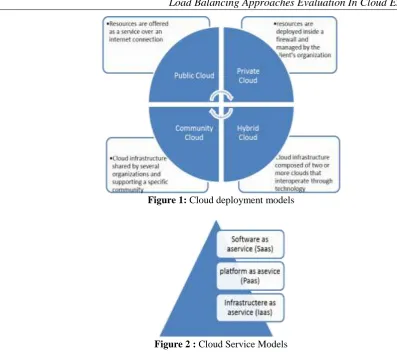
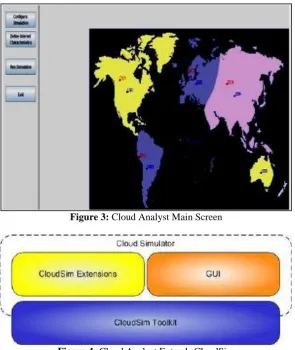
The quick growing area and the most interested area in computing analysis, business, and industry these days are cloud computing. It‟s outlined as the most recent style of computing in which versatile and frequently virtualized assets have been supplied as services across the internet. The cloud has several definitions, one of them issued by “The National Institute of Standards and Technology”, that is, “Cloud Computing is a model for enabling convenient, on-demand network access to a shared pool of configurable computing resources, that can be provisioned and released with minimal management effort or provider interaction” [1]. A simple brief about Cloud deployment models [14] is illustrated in Figure (1) while some of the Cloud computing service models [3] [4] are delineated in Figure (2).
In Infrastructure-as-a-Service (IaaS), Infrastructure instrumentations such as Servers, Storage, Network components, CPU, and Memory are offered as a service by the cloud suppliers to be employed by customers who use their own operating systems and applications. In Platform-as-a-Service (PaaS), the cloud providers own infrastructure equipment‟s and operating systems whereas the customers apply their applications. In Software-as-a-Service (SaaS), the suppliers possess Infrastructure hardware, operating systems, and applications, whereas the clients access the applications from various client devices and pay a subscription fee for their usage.
A. Load Balancing Algorithms
Load Balancing is an apparatus used to enhance the system functioning, to have another scenario in case the system fails even partially and to guarantee that all assets are effectively utilized and similarly stacked. According to the system state Load Balancing Algorithms are halved into two models, Static and Dynamic [2]. In Static Load Balancing Algorithm, the traffic has been apportioned evenly among all participated hosts without considering the state of hosts. Previous data of the system is mandatory for picking the VMs, and there is no significance whatsoever of the existing state or activities of the nodes. Nowadays this kind of algorithms renowned as Round Robin algorithms [2].
In Dynamic Load Balancing Algorithms, existing state of the systems is used to originate verdicts and no crave for previous knowledge [2]. If any node of the system went down for any reason, the system would complete its job ordinarily and the influence would be on the system functioning [8]. In distributing environments, the Dynamic Algorithms are segregated into distributed or non-distributed.
Figure 1: Cloud deployment models
Figure 2 : Cloud Service Models
The Round Robin formula uses the traditional Round Robin gadgets where an inventory of the virtual machines (VM) within the Data Center (DC) is obtainable. Immediately upon the initial request rolls in, consequently the DC controller picks up a virtual machine haphazardly from the panel to fulfill the request. Accordingly, the data Center controller picks out the VMs in an orbicular sequence of impending tasks and the selected VM is repositioned to the rear of the panel promptly. As a result of each task is overhauled by attainable VM in an orbicular rule, some nodes turn into laden and others turn into run out, which sways the system performance [9].
Throttled load balancer [5] is a dynamic load-balancing algorithm shaped for VMs where each virtual machine can cope with only one process at a time and be ready to cope with another process once the first one is finalized [6]. In this Algorithm, Client inquires the VM load balancer for Virtual Machine ration to fulfill the desired task. The balancer is accountable for caching all VMs and their statuses in an index table to speed up the inquiry operation. At the first moment, all VMs standing are obtainable. When the DC controller got a new request, it requested the balancer to nominate VM for the new request manipulation. Then the balancer looks over the index table from the start until it detects the fitting VM and emits the VM id to the DC Controller or the table is accomplished without detecting VMs. Then the DC Controller sends the request to that VM and messages the balancer to update the table after a new allotment has occurred. In case of no virtual machines available in the allocation table, then the VM load balancer sends busy to the DC controller and the DC moves the request to the queue. When the VM finalizes the request and the DC Controller captures the response, it sends a notification to the Throttled VM Load Balancer of the VM de-allocation to update the table [1].
The main purpose of the active tracing load balancing algorithm is to make all VMs in the DC are similarly stacked that will reflect on the system performance. During this rule, the balancer doles out the minimum stacked Virtual Machine from the list to handle the requests arrived from the DC Controller. The active monitoring load balancing technique stores all necessary information such as VM id and number of tasks assigned to each VM in a table to facilitate the search operation. At the start, all VMs status=0. When asking to allot a new VM from the Data Center Controller arrives, the balancer gets appropriate least loaded virtual machine from the table, and sends the VM id to the data center controller.
demand, it sends the reaction cloudlet to the DC Controller and thus the controller sends a VM de-assignment warning to the balancer to update the VM record among the allotment table by diminishing the allocation range for that VM [1].
B. Service Broker Algorithms
The service broker algorithms are employed to minimize the latency for user requests and to blame for choosing which DC ought to handle these requests. The DC controller deals with the virtual machines inside the DC. There are a few of such algorithms employed in cloud computing, namely Service Proximity based routing, Performance Optimized Routing, Dynamically Reconfiguring Routing[11].
The Service Proximity based routing rule is easy to implement where it uses the nearest DC based on network latency for user requests execution. This rule uses an associate index table to store all available virtualized DCs and their regions furthermore, the region could have more than one data Center at the same time, then the balancer selects one haphazardly. The inconvenience of this rule is that some virtualized DCs may be overburdened while the others are useless because it uses the quickest path to the data Center. In Performance Optimized Routing algorithm, the Service Broker observes the performance of all the data Centers and sends the request to the data Center, which will provide the optimum latency to the user at the time it is being chosen. In Dynamically Reconfiguring Router, the service broker is liable for an extra job of scaling cloud applications depending on the load it‟s facing. This Algorithm is an extension of any other service broker policy specially the service proximity based routing by adding to them increasing and decreasing the amount of VMs running on every Virtualized DC. Adding and removing virtual machines to/from the DC conforms to the current processing time against the best interval ever accomplished [7].
II.
THE
RELATED
WORKS
Some of the Organizations moved to one of the cloud computing models or used one of the cloud services while others about to move soon or moved partially. Therefore, the amount of cloud users is increasing every day. The cloud suppliers should be ready for that increase. VDCs need an effective load-balancing rule to achieve optimal use of resources, moreover to accommodate future modification in the system. Several static and dynamic algorithms introduced to solve this issue. The goal of these algorithms is to boost the method of distributing the load between all participating nodes in the system, to accommodate future modification in the system and try to achieve optimal resource utilization. Therefore, not implementing the proper load-balancing rule and service broker policy in the cloud environment will cause the resources to become not properly used. Moreover, this will result in the decrease of the customer satisfaction, maintaining the system stability and raising the running cost.
The following are some of the papers related to our subject that were reviewed which focused on the cloud computing and its central issue of load balancing or distribution:
Veerawali Behal et al. [1] introduced a paper explained by examples the comparative analysis of 2 VM load balancing techniques and a combination of each policy with the service broker policies. Pradeep Singh Rawat et al. [10] used simulation scenario of Internet banking to compare the results of using different service broker policies with round robin algorithm and simulation environment was cloud analyst tool. Bhathiya Wickremasinghe et al. [11] explained cloud analyst simulation tool in detail. Ram Prasad Padhy et al. [12] discussed a lot of topics related to cloud computing such as the three components for cloud systems ,types of cloud, virtualization technique , virtualization types, services provided by cloud, the goal of load balancing, types of load balancing and distributed load balancing algorithms for cloud. In [13], “load balancing under Bursty Environment in Cloud Computing”. A dynamic load-balancing algorithm that stores the state of all virtual machine resources was proposed during that paper additionally, the algorithm nominated the less stacked VM to process the demand in case the balancer selected it. In [4], “A Comparative Study of Load Balancing Algorithms in Cloud Computing” authors targeted to explain the cloud services, models, and classification of load balancing Algorithms also introduced an introduction to the cloud analyst tool and the performance of two algorithms have mentioned during that paper.
III.
THECLOUDANALYSTSIMULATIONA. The Cloud Analyst Architecture
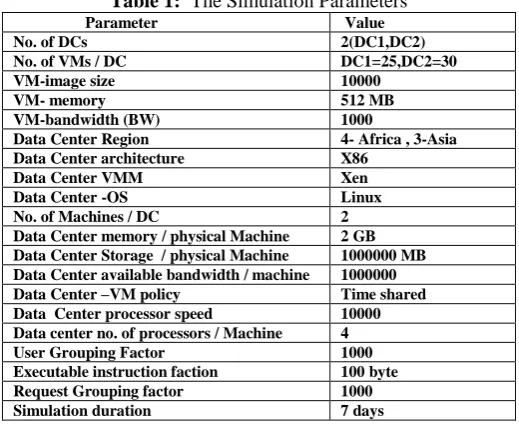
The cloud Analyst is composed of main elements such as GUI Package, User base, Region, Internet, DC Controller, VM load balancer, and Cloud Application Service Broker[11].
1) GUI Package: It is liable for the graphical Interface [13]. These interface grants the users to configure, repeat, load pervious configurations, and run the simulation experiments in a simple way by a set of simple screens.
2) User base: it models a gaggle of users (up to millions of users) to be considered as one unit within the simulation moreover generate traffic for simulation experiments.
3) Region presenter: The world in the package is split into six „Regions‟ representing the six main continents on the globe and this geographical grouping is used to maintain a level of reality for the simulation experiments.
4) Internet Simulator: it is a deliberation of the physical Internet. It models the web traffic routing around the globe by presenting transmission delay and data transfer delays between countries.
5) DC Controller: It is the heart of the cloud analyst tool and generally deals with the data center exercises such as VM creation and devastation furthermore, it courses the demands got from User Bases via the web to the selected VMs.
6) VM load balancer: The DC Controller employs the VM Load balancer to come to a decision, which VM
designated for processing ensuing cloudlet based on the assigned algorithm.
7) Cloud Application Service Broker: It‟s chargeable for directing the requests between User Bases and DCs
wherever it decides which DC should deal with the requests from every user base.
Figure 3: Cloud Analyst Main Screen
Figure 4: Cloud Analyst Extends CloudSim
IV.
THE
CASE
STUDY
A. Simulating The Scenario Of “Electronic Application For Universities”
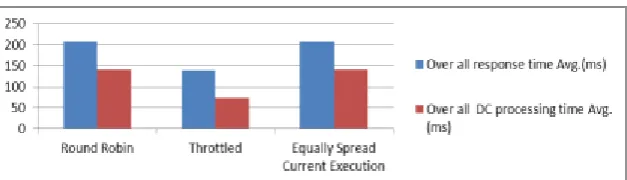
30 VMs for DC2 in addition the other simulation parameters such as memory, storage, available bandwidth, User Grouping Factor are available in Table (1).
Table 1: The Simulation Parameters
Parameter Value
No. of DCs 2(DC1,DC2)
No. of VMs / DC DC1=25,DC2=30
VM-image size 10000
VM- memory 512 MB
VM-bandwidth (BW) 1000
Data Center Region 4- Africa , 3-Asia
Data Center architecture X86
Data Center VMM Xen
Data Center -OS Linux
No. of Machines / DC 2
Data Center memory / physical Machine 2 GB Data Center Storage / physical Machine 1000000 MB Data Center available bandwidth / machine 1000000
Data Center –VM policy Time shared
Data Center processor speed 10000
Data center no. of processors / Machine 4
User Grouping Factor 1000
Executable instruction faction 100 byte
Request Grouping factor 1000
Simulation duration 7 days
In this scenario, the input parameters utilized as a part of the main configuration are considered as a data set for electronic application system for university as well as the Table (2) portrays the main configurations of the simulated application.
Table 2: Main Configuration
User Base Region
Peak hours start Peak hours End Average users during peak hours Average off-Peak users
UB1 4-Africa 9 18 350000 50000
UB2 3-Asia 7 16 18000 1500
B. The Simulation Results
The results juxtapose the three load balancing algorithms: round robin, throttled, and active monitoring load balancing in addition to the three service broker policies: closest data center, Optimize response time, and dynamically reconfiguring router. The results presented in Tables 3, 4, and 5 incorporate the overall average DC response time and the overall average DC execution time for each policy including one of the service broker algorithms.
Table 3: Simulation results for closest Data Center
Service Broker Policy Load Balancing Policy
Across VM’s in DC Overall response time Avg.(ms)
Overall DC processing time Avg. (ms)
Closest DC
Round Robin 207.58 140.72
Throttled 138.76 73.41
Equally Spread Current Execution
207.67 140.82
Table 4: Simulation results for Optimize Response Time
Service Broker Policy Load Balancing Policy
Across VM’s in DC Over all response time Avg.(ms)
Over all DC processing time Avg. (ms)
Optimize response time
Round Robin 207.94 139.32
Throttled 139.49 72.91
Equally Spread Current Execution
Table 5: Simulation results for Dynamically Reconfiguring Router
Service Broker Policy Load Balancing Policy Across VM’s in DC
Over all response time Avg.(ms)
Over all DC processing time Avg. (ms)
Dynamically reconfiguring router
Round Robin 207.58 140.72
Throttled 138.76 73.40
Equally Spread Current Execution
207.67 140.82
As shown in Figure (5), the overall response time as well as the data center processing time resulted from the Round Robin policy and Equally Spread Current Execution policy are almost the same, while the output derived from the Throttled policy is lower than them. In Figure (6), the overall response time and Average data center processing time ensued from the Throttled policy with the service broker optimize response time are better than the other two policies. As shown in Figure (7) the overall response time and average data center processing time stemmed from Round Robin policy, Equally Spread Current Execution policy and Throttled policy with the Dynamically reconfiguring service broker policy is almost the same output as the closest data center service broker policy.
Figure 5: Comparison between Average response time and DC processing time for three load-balancing Algorithms with Closest DC service broker policy
Figure 6: Comparison between Average response time and Dc processing time for three load-balancing Algorithms with the Optimize response time service broker policy
Figure 7: Comparison between Average response time and DC processing time for three load-balancing Algorithms with Dynamically reconfiguring service broker policy
V.
THE
CONCLUSIONS
REFERENCES
[1]. V. Behal and A. Kumar, “Comparative study of load balancing Algorithms in cloud Environment using cloud Analyst”, International Journal Of computer Application, 2014.
[2]. S. Issawi, A. Al Halees and M. Radi,” An Efficient Adaptive Load Balancing Algorithm for Cloud Computing Under Bursty Workloads”, Engineering, Technology & Applied Science Research, Vol. 5, No. 3, 2015.
[3]. S. Ray and A. De Sarkar,” Execution Analysis Of Load Balancing Algorithms In Cloud Computingenvironment,” International Journal on Cloud Computing: Services and Architecture (IJCCSA), Vol.2, No.5, October 2012.
[4]. R. Panwar, B. Mallick, "A Comparative Study of Load Balancing Algorithms in Cloud Computing", International Journal of Computer Applications (0975 – 8887) Volume 117 – No. 24, May 2015.
[5]. Divya Garg Urvashi Saxena ,” Dynamic Queue Based Enhanced HTV Dynamic Load Balancing Algorithm in Cloud Computing”, International Journal of Innovative Research in Science, Engineering and Technology, Vol. 5, Issue 1, January 2016
[6]. Mohamed Radi “Efficient Service Broker Policy For Large-Scale Cloud Environments” Computer Science Department, Faculty of Applied Science, Al-Aqsa university ,Gaza Palestine
[7]. Gamal I. Selim, Rowayda A. Sadek, Hend Taha, ” An Efficient Cloud Service Broker Algorithm ” International Journal of Advancements in Computing Technology(IJACT)2014
[8]. Komal Purba1, Nitin Bhagat2,” A Review on Load Balancing Algorithm in Cloud Computing” SSRG International Journal of Computer Science and Engineering (SSRG-IJCSE) – volume1 issue10 Dec 2014 [9]. MR.Manan D. Shah, MR.Amit A. Kariyani, MR.Dipak L. Agrawal “ Allocation Of Virtual Machines In
Cloud Computing Using Load Balancing Algorithm” International Journal of Computer Science and Information Technology & Security (IJCSITS), ISSN: 2249-9555 Vol. 3, No.1, February 2013
[10]. Pradeep Singh Rawat and Priti Dimri , G.P. Saroha and Varun Barthwal ,” A Load Balancing Analysis of Cloud Base Application with different Service Broker Policies ”, International Journal of Computer Applications (0975 – 8887) Volume 135 – No.10, February 2016
[11]. Bhathiya Wickremasinghe, Prof. Rajkumar Buyya,”Cloud Analyst: A Cloud Sim-based Tool for Modelling and Analysis of Large Scale Cloud Computing Environments”, MEDC Project Report, June 2009.
[12]. Ram Prasad Padhy and PGoutam Prasad Rao ,”Load balancing in cloud computing system”, Department of Computer Science and Engineering National Institute of Technology, Rourkela Rourkela-769 008, Orissa, India May, 2011.
[13]. N. D. Naik, A. R. Patel, "Load Balancing Under Bursty Environment For Cloud Computing", International Journal of Engineering Research and Technology, Vol. 2, No. 6, pp. 17-26, 2013.