The Effect of Teacher Candidates’
Perceptions of Their Initial Teacher
Education Program on Teaching Anxiety,
Efficacy, and Commitment
Lia M. Daniels
1, David Mandzuk
2, Raymond P. Perry
2, Ceri Moore
1University of Alberta1, University of Manitoba2
In a novel approach to initial teacher education, we combined a program review perspective and a psychological perspective. First, we assessed the extent to which student teachers (n=137) felt that components of their BEd program prepared them for teaching and whether these components represented meaningful program dimensions. Through content analysis, exploratory factor analysis, and teacher candidates’ own words, five dimensions emerged: classroom dynamics; curriculum, instruction, and assessment; intrapersonal reflection; ethics of teaching; and professional learning community. Second, we tested how each of these dimensions predicted teaching anxiety,efficacy, and commitment. The results from regression analyses showed that ethics of teaching was the most influential dimension by decreasing anxiety and increasing efficacy and commitment. Results are discussed in terms of the effect of initial teacher education program dimensions on the psychosocial development of teacher candidates.
Adoptant une approche novatrice à la formation initiale des enseignants, nous avons combiné une perspective visant l'examen des programmes avec une perspective psychologique. Nous avons d'abord évalué la mesure dans laquelle les stagiaires (n=137) estimaient que des composantes de leur programme d'études (B.Ed.) les avaient préparés pour l'enseignement et à quel point ces composantes représentaient des dimensions significatives de leurs programmes. Cinq dimensions ont découlé des analyses du contenu, des facteurs exploratoires et des propres paroles des stagiaires : la dynamique en salle de classe; le programme d’étude, l’enseignement et l’évaluation; la réflexion intrapersonnelle; l’éthique et l’enseignement; et les communautés professionnelles d’enseignement. Nous avons ensuite évalué dans quelle mesure chacune de ces dimensions constituait une variable explicative de l’anxiété, l’efficacité et l’engagement en enseignement. Les résultats sont présentés en fonction de l’effet des dimensions du programme de formation initiale des enseignants sur le développement psychosocial des stagiaires.
agree that most initial teacher education programs are deficient (Crocker & Dibbon, 2008), “there is a lack of consensus on how to improve programs since there is no one universal approach to preparing teachers” (p. 37; Korthagen et al.; Levine, 2006).
Although this lack of consensus on initial teacher education may be true, a general consensus does exist regarding certain psychosocial variables that are believed to be beneficial for practicing teachers. For example, teachers who have less anxiety, more efficacy, and more commitment to teaching tend to be more effective and resilient teachers than those who are weaker in these areas (Coates & Thoresen, 1976; Darling-Hammond, 1990; Howard & Johnson, 2004; Lewis, 1999; Skaalvik & Skaalvik, 2007; Tschannen-Moran & Woolfolk Hoy, 2001). Clark et al. (2007) have speculated that the lack of research connecting components of initial teacher education to effective teaching has prevented those who are interested in improving the quality of teachers from reaching consensus on what really counts. Therefore, in this article, we argue that understanding how various components of initial teacher education relate to psychosocial variables may help identify the programmatic aspects that most effectively prepare teacher candidates for the realities of the profession.
The purpose of the current study was to combine a programmatic perspective with a psychological perspective. Specifically, we assessed teacher candidates’ perceptions of how well various components of their BEd program helped prepare them for their first years of teaching and tested how preparation in these areas predicted their teaching anxiety, efficacy, and commitment. Because psychosocial variables such as these have been shown to be important for practicing teachers, we argue that program revisions should be considered in relation to their influence on such psychosocial variables in addition to more traditional outcomes.
Reducing Teaching Anxiety
Anxiety can be a debilitating emotion (Zeidner, 2007) and is one that both preservice and practicing teachers experience fairly regularly (Capel, 1997; Morton, Vesco, Williams and Awender, 1997; Sinclair & Ryan, 1987). Although women and elementary school teachers have higher levels of anxiety than men and high school teachers (Thompson, 1983), all teacher candidates worry to some extent about having their teaching observed and evaluated during a practicum. They also feel anxious about being adequately prepared, their relationships with school staff, and keeping classroom control (Capel; Mandzuk & Hasinoff, 2010). Anxious teachers often score lower on student evaluations than non-anxious teachers, suggesting that anxiety has a negative effect on their teaching performance (Sinclair & Ryan, 1987).
It follows that if teacher candidates graduate with high levels of anxiety, they are more likely to pass this anxiety on to their students. As Kaplan (1959) argued 50 years ago, “on the basis of minimum incidence statistics and pupil-teacher ratios … anxiety may affect as many as 200,000 teachers and through them, five million pupils!” (Coates & Thoresen, 1976, p. 161). Given the increased demands on new graduates to cover new curriculum, deal with demanding parents, and respond to much more diverse classrooms than was the case in the 1950s, it is likely that anxiety levels are higher than they were in the past. Thus initial teacher education programs have an obligation to look for ways to reduce teacher candidates’ anxiety levels.
concerned. By addressing teacher candidates’ most pressing concerns up front, programs should be better able to present content when students are most ready to learn it (Capel, 1997). Although direct instruction in anxiety-reduction may be part of these strategies, they may be more broadly characterized as being part of reflective practice where teacher candidates think back on their own experiences with teaching and learning (Adler, 1991). Although one intention of the reflective process is to reduce anxiety, it may inadvertently contribute to new teachers’ anxieties if it becomes a ruminative process (Nolen-Hoeksema, 1998).
Another suggestion is that anxiety may be reduced if programs enable students to develop professional learning communities with peers. By relying on peers for feedback about performance, the power dynamic between supervisor and supervisee is transcended, thus perhaps reducing students’ anxiety (Capel, 1997; Galesloot, Koetsier, & Wubbels, 1997; Korthagen et al., 2006). The idea of professional learning communities and “horizontal rather than vertical relationships” such as those provided by cohort-based programs (Mandzuk, Hasinoff & Seifert, 2003; Hasinoff & Mandzuk, 2005; Seifert & Mandzuk, 2006) are at least in part designed to help teacher candidates feel like equal members in the teaching profession, and thus may be a viable means to reduce anxiety. Furthermore, it appears that on a general level, aspects of initial teacher education such as membership in professional organizations that increase teacher candidates’ connection to the profession may be particularly helpful in reducing anxiety.
Developing Teaching Efficacy
As outlined in Bandura’s (1986) social cognitive theory, self-efficacy beliefs refer to personal beliefs about one’s ability to complete a specific set of tasks successfully. In teaching, efficacy more specifically refers to teachers’ beliefs that they can have a positive effect on student outcomes (Klassen et al., 2009; Tschannen-Moran & Woolfolk Hoy, 2001). Recently Klassen at al. demonstrated that teaching efficacy was an important variable in job satisfaction across five cultural settings. In addition, research shows that teachers possessing high teaching efficacy implement a wide range of adaptive teaching practices, engage in classroom discussions, and respond to students differently than those with low teaching efficacy (Tschannen-Moran, Woolfolk Hoy, & Hoy, 1998). By extension, teaching efficacy has been shown to predict important student outcomes, including motivation and achievement (Ashton & Webb, 1986; Midgley, Feldlaufer, & Eccles, 1989; Moore & Esselman, 1992; Ross, 1992; Skaalvik & Skaalvik, 2007).
Although teacher candidates and novice teachers tend to have lower levels of teaching efficacy than experienced teachers, the effects within the group still favor those with higher rather than lower levels of efficacy. For example, among teacher candidates, high efficacy has been associated with greater use of autonomy practices, higher content knowledge, less use of controlling behaviors, and fewer instances of burnout (Fives, Hamman, & Olivarez, 2007; Guthrie, Wigfield, & Von Secker, 2000; Schoon & Boone, 1998; Wolfolk & Hoy, 1990). The literature so strongly suggests that teaching efficacy positively affects teachers and their students that it is one psychosocial construct that has been directly considered in the success of educational reform (DeMesquita & Drake, 1994; Sarason, 1990).
imparting knowledge about teaching (i.e., curriculum, instruction, assessment, development, diversity, etc.) as well as reflecting on current practices and experiences are likely to enhance teacher candidates’ sense of efficacy.
Maximizing Commitment to Teaching
Commitment to teaching refers to a teacher candidate’s psychological attachment to the profession (Coladarci, 1992). Given the high rate of attrition from the teaching profession, especially in the early years, maximizing teacher candidates’ commitment to teaching may be an important goal of education programs. In other professions like medicine or law, students report strong allegiance to their chosen careers, and this early commitment translates into a lifetime of practice for almost all doctors and lawyers (Cavenagh, Dewberry, & Jones, 2000). In contrast, from the outset of their training, a greater proportion of teacher candidates report some uncertainty about their career choice, and nearly 50% state outright that they do not expect to teach for their entire working lives (Guarino, Santibañez, & Daley, 2006; Su, 1993). This is especially true for men and high school teachers, who appear to be less committed to teaching than women and elementary school teachers (Coladarci; Evans & Tribble, 2001).
Although the most obvious outcome associated with lack of commitment is departure from the profession, commitment to teaching also tends to correlate positively and strongly with teacher efficacy (Coladarci, 1992; Evans & Tribble, 2001; Kushman, 1992) and thus shares in its adaptive outcomes. For example, high levels of commitment have been associated with lower rates of teacher absenteeism, increased job satisfaction, high expectations of students, and slight increases in student performance (Kushman; Rosenholtz, 1989).
Empirically, commitment to teaching has been hindered by lingering career anxiety and bolstered by efficacy (Coladarci, 1992; Daniels, Clifton, Perry, Mandzuk, & Hall, 2006; Evans & Tribble, 2001; Kushman, 1992). Thus one way to increase commitment to teaching may be through program components that reduce anxiety and increase efficacy. As mentioned above, anxiety may be reduced through program components that help teacher candidates feel linked to the profession such as professional learning communities or reflection. Efficacy may be increased by curricular knowledge and opportunities to reflect on one’s own experiences and practices. Finally, although ethical issues in teaching generally receive fairly light treatment in initial teacher education programs, we believe that ethical considerations may be especially important in developing teacher candidates’ commitment to the profession. As Chubbuck, Burant, and Whipp (2007) suggest, “the moral sensibility that pre-service teachers bring to their teacher education programs will very likely interact with their learning experiences in significant ways” (p. 113) and thus may influence their overall commitment to the profession.
Method
Participants and Procedure
Data were collected from teacher candidates (n=140) nearing completion of a two-year post-degree teacher education program in a mid-western research-intensive Canadian university. Three teacher candidates were excluded based on outlier analyses. Examination of their responses suggested a response set (i.e., all questions answered at the bottom of the scale, etc.) and thus they were considered invalid. Therefore, the final sample consisted of 137 participants. Participation was voluntary, and as compensation, all names were entered into a draw for a $100 gift certificate at the university bookstore. We obtained informed consent from participants and administered the questionnaire, including the free-response section, during 30 minutes of class time.
Measures
Demographic and professional stream variables. Teacher candidates indicated their gender (79 female, 47 male, 11 missing) and age (M=24 years, SD=4.19, range 20-44). Participants belonged to one of three professional streams: Early Years (kindergarten-grade 4), Middle Years (grades 5-8), or Senior Years (grades 9-12). The Senior Years, or what we call the Secondary Stream, consisted of 72 teacher candidates. Because teacher candidates in the Early and Middle Years share somewhat similar educational and instructional philosophies1 and in order to maintain similar sample sizes between professional streams, we collapsed the Early and Middle Years teacher candidates into one group called the Elementary Stream (coded 1; n=65).
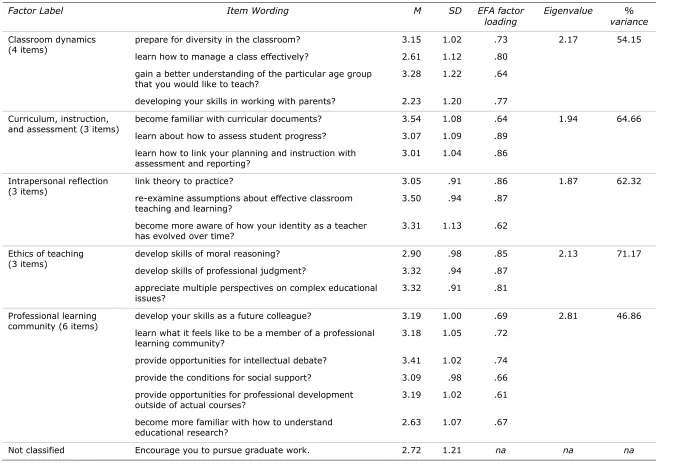
Program components. Participants in the study were asked to rate the extent to which 20 program components helped them become prepared to teach (1=didn’t help me at all, 5=helped me a lot). These program component items were developed directly in relation to the specific BEd program and reflected recent changes to, and emphasis in, the curriculum. Although specific to this institution, the program components reflect the typical kinds of changes that many initial teacher education programs are currently trying to implement (see Table 1 for the exact wording of the 20 items).
Free-response. Directly after rating the 20 program components, participants were given the opportunity to provide any additional thoughts or feelings. They were asked to follow these exact instructions: “Reflecting on the 20 program items, what else can you tell us about how you feel your BEd program prepared you for the professional demands of teaching? In particular, what sort of connections do you see between the program and the profession?” Teacher candidates were allowed as much time as they needed to respond. Of the 137 participants, 87 (63%) chose to respond to the open-ended item.
Table 1
Item Wording, Descriptive Statistics, and EFA Results
Factor Label Item Wording M SD EFA factor
loading Eigenvalue variance %
Classroom dynamics (4 items)
prepare for diversity in the classroom? 3.15 1.02 .73 2.17 54.15
learn how to manage a class effectively? 2.61 1.12 .80
gain a better understanding of the particular age group
that you would like to teach? 3.28 1.22 .64
developing your skills in working with parents? 2.23 1.20 .77
Curriculum, instruction, and assessment (3 items)
become familiar with curricular documents? 3.54 1.08 .64 1.94 64.66
learn about how to assess student progress? 3.07 1.09 .89
learn how to link your planning and instruction with
assessment and reporting? 3.01 1.04 .86
Intrapersonal reflection
(3 items) link theory to practice? 3.05 .91 .86 1.87 62.32
re-examine assumptions about effective classroom
teaching and learning? 3.50 .94 .87
become more aware of how your identity as a teacher
has evolved over time? 3.31 1.13 .62
Ethics of teaching
(3 items) develop skills of moral reasoning? 2.90 .98 .85 2.13 71.17
develop skills of professional judgment? 3.32 .94 .87
appreciate multiple perspectives on complex educational issues?
3.32 .91 .81
Professional learning community (6 items)
develop your skills as a future colleague? 3.19 1.00 .69 2.81 46.86
learn what it feels like to be a member of a professional
learning community? 3.18 1.05 .72
provide opportunities for intellectual debate? 3.41 1.02 .74
provide the conditions for social support? 3.09 .98 .66
provide opportunities for professional development outside of actual courses?
3.19 1.02 .61
become more familiar with how to understand educational research?
2.63 1.07 .67
Table 2
Descriptive Statistics for Study Variables
Variables No.
items Anchors Actual Range M SD α Skewness Kurtosis
Professional stream 1 1 = early; 2 = middle; 3 = senior 1-3 1.31 .81 -- -.62 -1.20
Gender 1 1 = female; 2 = male 1-2 1.37 .48 -- .53 -1.74
Age 1 reported as exact years 20-44 24.12 4.19 -- 2.72 8.88
Classroom dynamics 4 1 = didn’t prepare me; 5 = helped me a lot 5-20 11.27 3.34 .71 -.05 -.66
C&I, Assessment 3 1 = didn’t prepare me; 5 = helped me a lot 3-15 9.62 2.56 .72 -.28 .01
Intrapersonal reflection 3 1 = didn’t prepare me; 5 = helped me a lot 3-15 9.86 2.33 .67 -.15 -.05
Ethics of teaching 3 1 = didn’t prepare me; 5 = helped me a lot 3-15 9.54 2.38 .80 -.06 .03
Prf. learning community 6 1 = didn’t prepare me; 5 = helped me a lot 8-29 18.65 4.19 .77 -.17 .02
Anxiety 4 1 = strongly disagree; 5 = strongly agree 4-20 11.74 3.36 .77 -.26 -.37
Teaching efficacy 5 1 = nothing; 9 = a great deal 18-45 33.39 4.88 .81 -.27 .10
Results
Rationale for Analyses
Although the students’ own words are quoted throughout this article, quantitative analyses were primarily used to address the following three research questions. First, what underlying program dimensions can be identified from the discrete program components and students’ reflective comments about the components? In answering this question, we grouped the 20 items into five dimensions on the basis of face validity and students’ comments and tested the cohesion of each dimension through exploratory factor analysis with a principal component rotation2 and reliability analyses (Wegener & Fabrigar, 2000). The five program components were: classroom dynamics; curriculum, instruction, and assessment; intrapersonal reflection; ethics of teaching; and professional learning community. The second research question was: Do professional streams differ on their endorsement of each program dimension? This was tested with five t-tests, one for each program component. The third research question was: How do the program dimensions relate to the professional outcomes of efficacy, anxiety, and commitment? After correlating all variables, the main quantitative analyses consisted of three separate regressions in which each criterion variable was regressed on demographic variables (age, gender, and professional stream) and the five program dimensions.
Regression hypotheses.Based on the literature reviewed above, we acknowledge that it may be possible for each program component to contribute meaningfully to a reduction in anxiety and increase in efficacy and commitment. However, we hypothesized that certain program components might be more closely related to each outcome. Specifically, we hypothesized that:
1. anxiety would be negatively predicted by program components that allow students to feel connected to the profession, specifically, intrapersonal reflection and professional learning community.
2. efficacy would be positively predicted by program components that provide teacher candidates with specific knowledge about teaching, specifically, classroom dynamics; curriculum, instruction, and assessment; and intrapersonal reflection.
3. commitment would be positively predicted by all five program components, thus maximizing both feelings of connectedness and profession specific knowledge.
Identification of Program Dimensions
consultations then led to five interpretative dimensions that were organized differently (i.e., consisted of slightly different program components) than the initial dimensions, but which both authors felt better captured the richness of the data and the candidates’ personal comments. The sixth dimension, labeled educational research, was not retained after examining the students’ open-ended responses. One item from this original category was added to the professional learning community dimension. The coherence of each of these five categories was then tested with exploratory factor analysis and reliability analysis.3
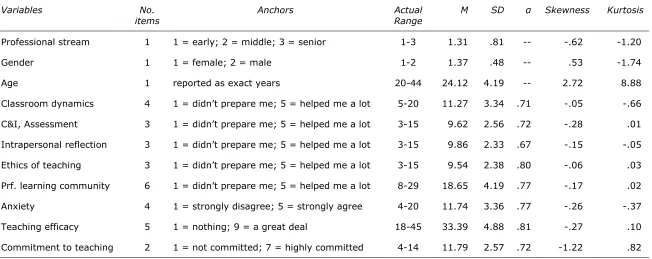
The first dimension was labeled classroom dynamics and consisted of four items (see Table 1). In our original grouping of the items for this dimension, we did not include “dealing with parents.” However, after analyzing the teacher candidates’ personal reflections, it seemed that parents were often viewed as a part of classroom dynamics. For example, one student directly stated: “I felt there was little discussion on classroom management, as well as dealing with parents” (secondary, female, 24 years old). The results of exploratory factor analysis (EFA)with a principal components extraction revealed a one-factor solution with each item loading above .60, thus also suggesting that the parenting item was well suited to this dimension. The alpha reliability for the proposed scale was adequate (α=.71). Other descriptive statistics for the summed scale are presented in Table 2.
Other responses to the open-ended question reinforced the empirical cohesion of the items. For example, one student commented, “I found the university education program was not able to incorporate realistic education perspectives, such as what do you do with the student who never comes to school, is failing every class, and the parents don’t care” (elementary, female, 21 years old). Another student reported, “Classroom management is a huge deciding factor with effectiveness of a teacher” (elementary, female, 20 years old). This comment also foreshadows our hypothesis that feelings of preparedness in the area of classroom dynamics might be a strong predictor of teaching efficacy and commitment.
The second dimension was labeled curriculum, instruction, and assessment and consisted of three items (Table 1). Curriculum and instruction have always been central to initial teacher education programs; however, recent changes suggest that assessment is as important as these two traditional components (Darling-Hammond, 2006). Moreover, students’ comments seem to tie these areas together. For example, one student said, “I think courses in effective assessment strategies and classroom management need to be required courses” (secondary, female, age unknown). Similarly, another teacher candidate said,
I feel that many of the elective courses in the faculty are very helpful, but that the core courses do not cover this material. For example, there is only one [class] on assessment. I found many of the ideas and activities I learnt in my curriculum and instruction courses to be helpful” (secondary, female, 21 years old).
The results of an EFA with a principle component extraction revealed a one-factor solution with each item loading above .60. The alpha reliability for the proposed scale was adequate (α=.72). Other descriptive statistics for the summed scale are presented in Table 2.
While tensions between the academic world of education and the “reality” of teaching were apparent, I believe the faculty of education prepared us for this tension and provided us with tools to reflect on this. Through reflection and varied experiences teacher candidates learned to be individuals and to use the tensions of society and knowledge to re-negotiate learning and relationships in education” (elementary, female, 27 years old).
Her comments about tension foreshadow our hypothesis that reflection would negatively predict anxiety. The results of an EFA with a principal component extraction revealed a one-factor solution with each item loading above .60. The alpha reliability for the proposed scale was adequate (α=.67). Other descriptive statistics for the summed scale are presented in Table 2.
The fourth dimension was labeled ethics of teaching and consisted of three items (Table 1). Although not as common as the other dimensions, the idea of moral deliberation has been incorporated into critical inquiry traditions of reflective practice (Liston & Zeichner, 1987). Very little in students’ open-ended responses could be considered as relating to this dimension. We present the only comment that made any mention of “moral development” even though it is fairly convoluted: “Fitting into the school culture is more important than doing right by our students … but it is not a moral answer made by a professional” (secondary, male, 25 years old). We wish this student had elaborated on his perspective. It is possible that students do not spontaneously discuss the ethics of teaching as they might discuss dealing with students, parents, curriculum, or assessment. Perhaps for this reason, students also did not write about this specific dimension. Nonetheless, from a quantitative perspective, the dimension was robust and the items were meaningfully clustered, so the dimension was retained. The results of an EFA with a principal component extraction revealed a one-factor solution with each item loading above .80. The alpha reliability for the proposed scale was good (α=.80).
The final dimension was labeled professional learning community and consisted of six items. The intention of a professional learning community is to contextualize district-specific knowledge in the light of day-to-day practices (Dooner, Mandzuk, & Clifton, 2008; McLaughlin & Talbert, 2006). In this program, the teacher candidates are placed in cohorts that are explicitly intended to increase feelings of membership in a professional learning community, a design component seemingly reflected in their responses. Specifically, a student commented: “I think the BEd Program was great for building personal relationships and developing myself as a learner” (elementary, female, 23 years). Similarly, “I really appreciated the cohort set-up to begin to practice as a collaborative professional community. The theory was necessary, but the practicum is where it really started to come together” (elementary, female, 23 years). The results of an EFA with a principal component extraction revealed a one-factor solution with each item loading above .60. The alpha reliability for the proposed scale was adequate (α=.77).
Psychological Perspective
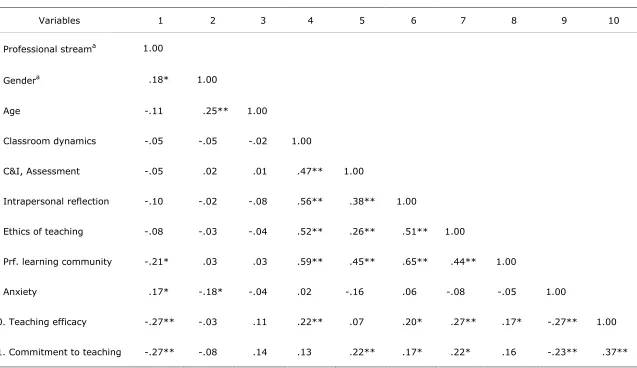
Correlations. The full correlation matrix is provided in Table 3. A few patterns are mentioned. First, among the demographic variables, positive correlations between gender, stream, and age suggest that men are more likely to teach high school and to be older than women. In addition, it is important to note that professional stream correlated significantly with anxiety, efficacy, and commitment, suggesting that teacher candidates in the secondary stream had more anxiety and less efficacy and commitment than their elementary-stream counterparts. Second, the five program dimensions were all positively interrelated with correlation coefficients ranging from .26 to .65. Third, as would be expected, commitment and efficacy were positively correlated, and both were negatively correlated with anxiety. These patterns provide some evidence of convergent validity of the measures. Finally, classroom dynamics, intrapersonal reflection, ethics of teaching, and professional learning community correlated positively with efficacy, whereas for commitment, significant and positive correlations emerged with intrapersonal reflection, ethics of teaching, and curriculum, instruction, and assessment. No program components were significantly correlated with anxiety.
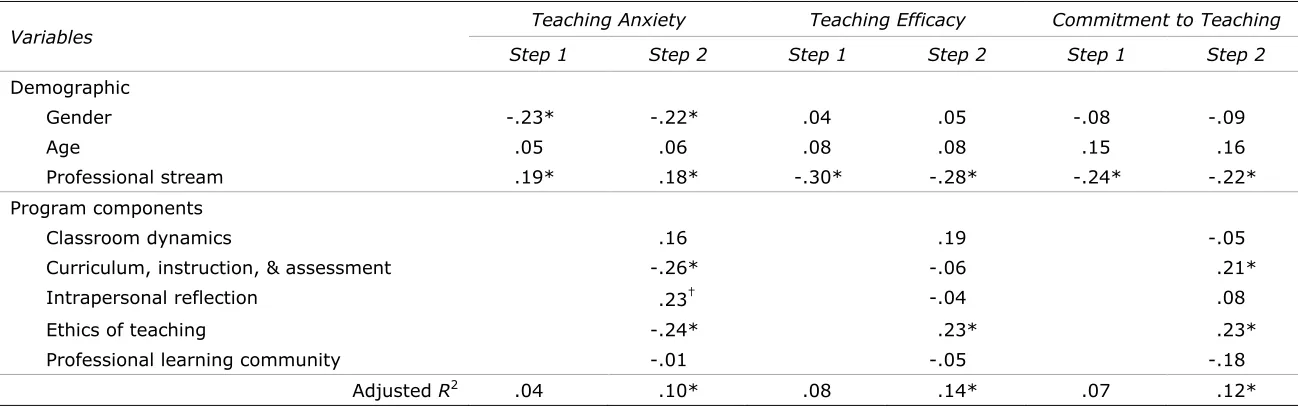
Regression Analyses.The regression analyses qualify the zero-order correlational results by taking into account the simultaneous effects of each program component in predicting each professional outcome. Teaching anxiety was negatively predicted by gender and professional stream in Step 1 (Table 4). These effects persisted in Step 2, suggesting that independent of the program components, female teacher candidates had more anxiety than males, and secondary stream teacher candidates had more anxiety than elementary. Three program components significantly predicted anxiety, although they did not align with our hypotheses. Specifically, professional learning community was not a significant predictor; instead, feelings of preparation in curriculum, instruction, and assessment and ethics of teaching negatively predicted anxiety. The effect of intrapersonal reflection approached significance as a positive predictor of anxiety when we had hypothesized that it would have a negative effect.
Of the three demographic variables, only professional stream significantly predicted efficacy, indicating that elementary-stream teacher candidates had greater efficacy than their secondary-stream peers. Again, this effect persisted in Step 2. We hypothesized that preparation in classroom dynamics and curriculum, instruction, and assessment would contribute to efficacy; however, our results did not show this. Instead, only ethics of teaching significantly and positively predicted efficacy.
For commitment, professional stream was a significant negative predictor in Step 1 and Step 2, reinforcing differences between elementary- and secondary-stream teacher candidates that appeared in the zero-order correlations. Two of the five expected program components predicted commitment to teaching. Ethics of teaching and preparation in curriculum, instruction, and assessment both positively predicted teacher candidates’ reported commitment to teaching. The other three components were nonsignificant.
Discussion
Table 3
Correlation Matrix for all Study Variables
Variables 1 2 3 4 5 6 7 8 9 10
1. Professional streama 1.00
2. Gendera .18* 1.00
3. Age -.11 .25** 1.00
4. Classroom dynamics -.05 -.05 -.02 1.00
5. C&I, Assessment -.05 .02 .01 .47** 1.00
6. Intrapersonal reflection -.10 -.02 -.08 .56** .38** 1.00
7. Ethics of teaching -.08 -.03 -.04 .52** .26** .51** 1.00
8. Prf. learning community -.21* .03 .03 .59** .45** .65** .44** 1.00
9. Anxiety .17* -.18* -.04 .02 -.16 .06 -.08 -.05 1.00
10. Teaching efficacy -.27** -.03 .11 .22** .07 .20* .27** .17* -.27** 1.00
11. Commitment to teaching -.27** -.08 .14 .13 .22** .17* .22* .16 -.23** .37**
aDichotomousvariables: professional stream 1 = elementary, 2 = senior; gender 1 = female, 2 = male.
Table 4
Regression Analyses
Variables Teaching Anxiety Teaching Efficacy Commitment to Teaching
Step 1 Step 2 Step 1 Step 2 Step 1 Step 2
Demographic
Gender -.23* -.22* .04 .05 -.08 -.09
Age .05 .06 .08 .08 .15 .16
Professional stream .19* .18* -.30* -.28* -.24* -.22*
Program components
Classroom dynamics .16 .19 -.05
Curriculum, instruction, & assessment -.26* -.06 .21*
Intrapersonal reflection .23† -.04 .08
Ethics of teaching -.24* .23* .23*
Professional learning community -.01 -.05 -.18
Adjusted R2 .04 .10* .08 .14* .07 .12*
and more efficacy and commitment tend to have more positive outcomes than their colleagues who lack these psychosocial characteristics. Thus one logical way to examine the effectiveness of program changes is to investigate their effectiveness in reducing anxiety and maximizing efficacy and commitment.
Three findings from this study are particularly important. First, we were able to classify 19 individual program components into five overarching program dimensions that were supported through factor analysis, reliability analysis, and teacher candidates’ own descriptions of the program. Second, elementary and secondary streams differed significantly on all outcomes (i.e., anxiety, efficacy, and commitment), although they reported feeling equally prepared for teaching on all program dimensions except professional learning community. Third, only the ethics of teaching dimension predicted all three outcomes: decreased anxiety, increased efficacy, and increased commitment. These findings, as well as the effects of the other program dimensions, are discussed below and considered in the light of implications for initial teacher education reform.
Program Dimensions
In designing this study, we brainstormed a list of 20 individual components that our faculty has been trying intentionally to incorporate into the BEd program. As in many initial teacher education programs, we undertook these changes to try to help our graduates feel more prepared for the realities of the teaching profession. The teacher candidates’ ratings suggest that they felt that the components moderately contributed to their feelings of preparedness for teaching. No single item stood out as having a very high score, but preparation in dealing with parents was scored noticeably lower than the other items.
We were pleased that 19 of the 20 discrete program components could be classified into five program dimensions supported by teacher candidates’ own comments and quantitative tests of cohesion. It suggests that our specific revisions cluster together in meaningful categories. Although many of the items aligned as we had expected from the outset, there were a few surprises based on participants’ comments. For example, we find it interesting that teacher candidates seem to view parents as part of classroom dynamics. This finding suggests that during initial teacher education, parental issues may be best addressed in conjunction with other classroom management issues. Similarly, the fact that teacher candidates tied curriculum and instruction to assessment may reflect an agenda that both the faculty and empirical research have been trying to forward, namely, that instruction and assessment should be a reciprocal and mutually informing process (Stiggins, 1999). Finally, we were surprised by the inclusion of “intellectual debate” and “educational research” as part of the professional learning community dimension. These items challenge us to remember that teacher candidates may think of professional learning communities as involving more than personal relationships.
Elementary Compared With Secondary Stream Teacher Candidates
contrast, secondary-stream teacher candidates have to take courses in their major and minor areas, resulting in greater mixing of the cohorts.
Another important difference between the professional streams is that elementary stream teacher candidates reported less anxiety, more efficacy, and more commitment than their secondary stream counterparts. This finding reinforces the existing literature (Coladarci, 1992; Daniels et al., 2006; Evans & Tribble, 2001) and extends it by showing that program dimensions do not appear to reduce these effects. In other words, the program dimensions tested in this study were not sufficient to compensate for or override differences between the professional streams. Although all teacher candidates in this research were in the process of completing at least their second degree, it may be that those preparing to teach high school are more focused on their discipline and less on teaching children (Evans & Tribble, 2001), making them feel more anxious and less efficacious and committed to the profession. Indeed, some research suggests that senior school English, chemistry, and physics teachers are most likely to leave teaching (Murnane, Singer, & Willett, 1988), perhaps because they have the academic credentials necessary to pursue other careers. Nonetheless, it seems that we should not expect these initial teacher education program dimensions to undo differences between the groups’ anxiety, efficacy, and commitment.
Specific Program Dimensions
Although no consensus exists on the best way to educate teacher candidates, certainly some dimensions are currently popular. For example, many initial teacher education programs are gently treading around classroom management issues, many instructors burden themselves with marking teacher candidates’ reflective journals, and faculty administrators go to great lengths to find schools to which teacher candidates will feel professionally connected. Although each of these is theorized to prepare teacher candidates better for their careers, the evidence does not always support these assumptions. The evidence presented here actually suggests that preparation in classroom dynamics, engaging in intrapersonal reflection, and belonging to professional learning communities has little effect on reducing teacher candidates’ anxiety and enhancing their teaching efficacy and commitment. In fact, intrapersonal reflection had a small positive effect on anxiety, suggesting that the more reflection these teacher candidates engaged in, the more anxiety they reported feeling. One reason for this may be that because teacher candidates’ reflections are highly introspective, they may function more like rumination (Nolen-Hoeksema, 1998) than an adaptive mechanism for improvement. This notion, however, is speculative and should be tested empirically in future research.
Although feelings of preparedness in curriculum, instruction, and assessment did not improve efficacy, they did help reduce anxiety and increase commitment. In the light of the major challenges that new teachers face in terms of ensuring that their assessments of students both accurately measure their achievement and support their learning, this may be one area of preparation that can significantly help new teachers effectively transition into their careers.
candidates for managing unpredictability by increasing their understanding of the ethical dimensions of the profession and thus reducing anxiety and increasing efficacy and commitment.
Limitations and Directions for Future Research
The results of this study should be interpreted in the light of the following limitations. First, the discrete program components were based on changes at one Canadian university. Although these specific components may reflect those being discussed and implemented in many programs, they by no means represent an exhaustive list of revisions to other initial teacher education programs across the country. Thus the generalizability of these results should be considered tentatively. Similarly, although the scales demonstrated adequate reliability, they were modified versions of the preexisting surveys, which may have implications for the validity of our interpretations. Finally, the outcomes measured in this study were self-reported anxiety, efficacy, and intended commitment to teaching. There were no measures of the actual anxiety, efficacy, or commitment of these participants once they started teaching. In the future, longitudinal research is needed to test the effect of program components on practicing teachers’ actual behavior, emotions, and cognitions.
Conclusions
The purpose of this study was to show that there are advantages to considering program revisions in the light of their effects on teacher candidates’ psychosocial well-being as measured by anxiety, efficacy, and commitment. Although consensus on how best to prepare teacher candidates for the teaching profession may still be elusive, we believe that our results reinforce that initial teacher education is a complicated process and that program dimensions certainly do influence how prepared teacher candidates feel at the end of their education programs. Specifically, we recommend that programs consider how their teacher candidates are receiving instruction in and opportunities to explore the ethics of teaching. It appears that this dimension is particularly valuable in reducing teacher candidates’ anxiety and increasing their efficacy and commitment, all of which have been shown to be beneficial for practicing teachers and thus should be supported by all initial teacher education programs.
Notes
1Elementary and middle school programs tend to be more student-centered, inquiry-focused, and
interdisciplinary in their approach than the secondary stream.
2Confirmatory factor analysis (CFA) would have been preferable over principal component analyses (i.e.,
exploratory factor analyses) to confirm the structure of the scales that we extracted. However, several of the scales consisted on only three items, which results in a just-identified model in CFA. A just-identified model cannot be rejected and so is not meaningful (Byrne, 2001). Moreover, we did not have a theoretical reason to assume that all factors could be validated in a single CFA because it is unlikely that these dimensions represented all possible program dimensions. Thus we relied on EFAs to test the structure of the separate dimensions.
3Many of the students’ comments addressed two well-known issues in education programs, namely, the
neither do our analyses. However, we felt it was important to recognize the students’ voicing of concerns in these two areas.
References
Adler, S. (1991). The reflective practitioner and the curriculum of teacher education. Journal of Education for Teaching, 17, 139-150.
Ashton, P.T., & Webb, R.B. (1986). Making a difference: Teachers’ sense of efficacy and student achievement. New York: Longman.
Bandura, A. (1986). Social foundations of thought and action: A social cognitive theory. Englewood Cliffs, NJ: Prentice Hall.
Byrne, B.M. (2001). Structural equation modeling with AMOS: Basic concepts, applications, and programming. Mahwah, NJ: Erlbaum.
Capel, S.A. (1997). Changes in students’ anxieties and concerns after their first and second teaching practices. Educational Research, 39, 211-228.
Cavenagh, P., Dewberry, C., & Jones, P. (2000). Becoming professional: When and how does it start? A comparative study of first-year medical and law students in the UK. Medical Education, 34, 897-902. Chubbuck, S.M., Burant, T.J., & Whipp, J.L. (2007). The presence and possibility of moral sensibility in
beginning pre-service teachers. Ethics and Education, 2, 109-130.
Clark, C.M., Eslinger, E., Gorowara, C., Jansen, A., Mouza, C., Raths, J. & Ritchey, K.D. (2007). Unanswered questions about studying teacher education. A review of M. Cochran-Smith & K. Zeichner (Eds.) (2005). Studying teacher education: The report of the AERA panel on research and teacher education. Teachers College Record, 109. Available:
http://www.tcrecord.org/Content.asp?ContentId=12914
Coates, T.J., & Thoresen, C.E. (1976). Teacher anxiety: A review with recommendations. Review of Educational Research, 46, 159-184.
Coladarci, T. (1992). Teachers’ sense of efficacy and commitment to teaching. Journal of Experimental Education, 60, 323-337.
Crocker, R., & Dibbon, D. (2008). Teacher education in Canada. Kelowna, BC: Society for the Advancement of Excellence in Education.
Daniels, L.M., Clifton, R.A., Perry, R.P., Mandzuk, D., & Hall, N.C. (2006). Student teachers’ competence and career certainty: The effects of career anxiety and perceived control. Social Psychology of Education, 9, 405-423.
Darling-Hammond, L. (2006). Constructing 21st-century teacher education. Journal of Teacher Education, 57, 300-314.
Darling-Hammond, L. (1990). Teachers and teaching: Signs of a changing profession. In W.R. Houston (Ed.), Handbook of research on teacher education (pp. 267-290). New York: Macmillan.
Darling-Hammond, L., Chung, R., & Frelow, F. (2002). Variation in teacher preparation: How well do different pathways prepare teachers to teach? Journal of Teacher Education, 53, 286-302. DeMesquita, P.B., & Drake, J.C. (1994). Educational reform and the self-efficacy beliefs of teachers
implementing nongraded primary school programs. Teaching and Teacher Education, 10(3), 291– 302.
Dooner, A., Mandzuk, D., & Clifton, R.A. (2008). Stages of collaboration and the realities of professional learning communities. Science Direct, 24, 564-574.
Evans, E.D., & Tribble, M. (2001). Perceived teaching problems, self-efficacy, and commitment to teaching among preservice teachers. Journal of Educational Research, 80, 81-85.
Galesloot, L.J., Koetsier, C.P., & Wubbels, T.H. (1997). Handelingsaspecten bij wederzijds leren van ervaren docenten [Aspects of acting in reciprocal learning of experienced teachers]. Pedagogische Studien, 74, 249-260.
Guarino, C.M., Santibañez, L., & Daley, G.A. (2006). Teacher recruitment and retention: A review of the recent empirical literature. Review of Educational Research, 76, 173-208.
Guthrie, J.T., Wigfield, A., & VonSecker, C. (2000). Effects of integrated instruction on motivation and strategy use in reading. Journal of Educational Psychology, 92(2), 331–341.
Hasinoff, S., & Mandzuk, D. (2005). Bonding, bridging, and becoming a teacher: Student cohorts and teacher identity. Alberta Journal of Educational Research, 51, 231-245.
Howard, S., & Johnson, B. (2004). Resilient teachers: Resisting stress and burnout. Social Psychology of Education, 7, 399-420.
Kaplan, C. (1959). Mental health and human relations in education. New York: Harper & Row. Klassen, R.M., Bong, M., Usher, E.L., Chong, W.H., Huan, V.S., Wong, I.Y.F., & Georgiou, T. (2009).
Exploring the validity of a teachers’ self-efficacy scale in five countries. Contemporary Educational Psychology, 24, 67-76.
Korthagen, F., Loughran, J., & Russell, T. (2006). Developing fundamental principles for teacher education programs and practices. Teaching and Teacher Education, 22, 1020-1041.
Kushman, J.W. (1992). The organizational dynamics of teacher workplace commitment: A study of urban elementary and middle schools. Educational Administration Quarterly, 28(1), 5-42.
Levine, A. (2006). Educating school teachers. Washington, DC: Education Schools Project.
Lewis, R. (1999). Teachers coping with the stress of classroom discipline. Social Psychology of Education, 3, 155-171.
Liston, D.P., & Zeichner, K.M. (1987). Reflective teacher education and moral deliberation. Journal of Teacher Education, 38, 2-8.
Liu, F. (2008). Impact of online discussion on elementary teacher candidates’ anxiety towards teaching mathematics. Education, 128, 614-629.
Lortie, D.C. (1975). Schoolteacher: A sociological study. Chicago, IL: University of Chicago Press.
Mandzuk, D., & Hasinoff, A. (2010). Slices of Life: Managing dilemmas in middle grades teaching. Case studies for professional development. Westerville, OH: National Middle School Association
Mandzuk, D., Hasinoff, S., & Seifert, K. (2003). Inside a Student Cohort: Teacher Education from a Social Capital Perspective. Canadian Journal of Education, 28, 168-184.
McLaughlin, M.W., & Talbert, J. (2006). Building school-based teacher learning communities: Professional strategies to improve student achievement. New York: Teachers College Press. Metzler, M.W. (1990). Instructional Supervision for Physical Education. Champaign, IL: Human
Kinetics.
Midgley, C., Feldlaufer, H., & Eccles, J. (1989). Change in teacher efficacy and student self- and task-related beliefs in mathematics during the transition to junior high school. Journal of Educational Psychology, 81, 247-258.
Moore, W., & Esselman, M. (1992, April). Teacher efficacy, power, school climate and achievement: A desegregating district’s experience. Paper presented at the annual meeting of the American Educational Research Association, San Francisco.
Morton, L.L., Vesco, R., Williams, N.H., & Awender, M.A. (1997). Student teacher anxieties related to class management, pedagogy, evaluation, and staff relations. British Journal of Educational Psychology, 67, 69-89.
Murnane, R.J., Singer, J.D., & Willett, J.B. (1988). The career paths of teachers: Implications for teacher supply and methodological lessons for research. Educational Researcher, 17, 22-30.
Pekrun, R., Goetz, T., & Perry, R. P. (2005) Achievement Emotions Questionnaire (AEQ). Users’ manual.
Munich: University of Munich, Department of Psychology.
Rosenholtz, S.J. (1989). Teachers' workplace: The social organization of schools. New York: Teachers College Press.
Ross, J.A. (1992). Teacher efficacy and the effect of coaching on student achievement. Canadian Journal of Education, 17, 51-65.
Sarason, S.B. (1990). The predictable failure of educational reform. San Francisco, CA: Jossey-Bass. Schoon, K.J., & Boone, W.J. (1998). Self-efficacy and alternative conceptions of science of preservice
elementary teachers. Science Education, 82, 553–568.
Seifert, K., & Mandzuk, D. (2006). Student cohorts in teacher education: Support groups or intellectual communities? Teachers College Record, 108, 1296-1320.
Sinclair, K.E., & Ryan, G. (1987). Teacher anxiety, teacher effectiveness, and student anxiety. Teaching and Teacher Education, 3, 249-253.
Skaalvik, E.M., & Skaalvik, S. (2007). Dimensions of teacher self-efficacy and relations with strain factors, perceived collective teacher efficacy, and teacher burnout. Journal of Educational Psychology, 99,
611-625.
Stiggins, R.J. (1999). Evaluating classroom assessment training in teacher education. Educational Measurement: Issues and Practice, 18, 23-27.
Su, J.Z.X. (1993). The study of the education of educators: A profile of teacher education students.
Journal of Research and Development in Education, 26, 125-132.
Thompson, M.L. (1983). Identifying anxieties experienced by student teachers: A twenty year follow-up.
Journal of the Association for the Study of Perception, 18, 13-21.
Tschannen-Moran, M., & Woolfolk Hoy, A. (2001). Teacher efficacy: Capturing an elusive construct.
Teaching and Teacher Education, 17, 783-805.
Tschannen-Moran, M., Woolfolk Hoy, A., & Hoy, W.K. (1998). Teacher efficacy: Its meaning and measure.
Review of Educational Research, 68, 202-208.
Wegener, D.T., & Fabrigar, L.R. (2000). Analysis and design for nonexperimental data: Addressing causal and noncausal hypotheses. In H.T. Reis & C.M. Judd (Eds.), Handbook of research methods in social and personality psychology (pp. 412-450). New York: Cambridge University Press.
Woolfolk, A.E., & Hoy, W.K. (1990). Prospective teachers’ sense of efficacy and beliefs about control.
Journal of Educational Psychology, 82, 81–91.
Zeidner, M. (2007). Test anxiety in educational contexts: Concepts, findings, and future directions. In P. Schutz & R. Pekrun (Eds.), Emotion in education (pp. 165–184). San Diego, CA: Academic Press.
Lia Daniels is an assistant professor in the Department of Educational Psychology at the University of Alberta.
Her research interests focus on the motivation, emotions, and personal and professional development of teachers, preservice teachers, and students.
David Mandzuk is an associate professor and Associate Dean (Undergraduate Programs) in the Faculty of
Education at the University of Manitoba. His research interests include the sociology of education and initial teacher education.
Raymond Perry is a distinguished professor of psychology at the University of Manitoba in the area of social
psychology. His research focuses on mastery and learned helplessness in achievement settings.
Ceri Moore is currently an MEd student in counseling psychology at The University of Alberta. Her research