Bridging and Relevance
by
Tomoko Matsui
Thesis subm itted for the degree o f Doctor o f Philosophy
o f the
University of London
1995
ProQuest Number: 10017704
All rights reserved
INFORMATION TO ALL USERS
The quality of this reproduction is dependent upon the quality of the copy submitted.
In the unlikely event that the author did not send a complete manuscript and there are missing pages, these will be noted. Also, if material had to be removed,
a note will indicate the deletion.
uest.
ProQuest 10017704
Published by ProQuest LLC(2016). Copyright of the Dissertation is held by the Author.
All rights reserved.
This work is protected against unauthorized copying under Title 17, United States Code. Microform Edition © ProQuest LLC.
ProQuest LLC
789 East Eisenhower Parkway P.O. Box 1346
A b s t r a c t
A bridging reference is a referring expression which has no explicitly mentioned antecedent, so that the existence of the referent has to be inferred from what has been explicitly mentioned. The phenomenon is illustrated in (1) and (2):
(1) I went into the room. The window was open.
(2) John went walking at noon. The park was beautiful.
This thesis examines and attempts to explain the mechanism of bridging, using the framework of relevance theory. It argues against various existing accounts, and defends a relevance- theoretic account.
Chapters 1 and 2 are introductory. Chapter 1 gives brief overview of past studies of bridging and introduces some of the main issues which this thesis aims to address. I also propose and defend a definition of bridging implicature. Chapter 2 summarises the central claims of relevance theory. It illustrates how reference assignment is carried out on the basis of the criterion of consistency with the principle of relevance.
Various accounts, including those of Clark and Hobbs, are tested against a wide range of examples on which I have conducted questionnaires. If argues that only relevance-theoretic account explains the results of the questionnaire.
Table of Contents
Abstract 2
Acknowledgements 8
Chapter 1: Introduction 11
1. Introduction 11
1.1. The Goals of my Research 11
1.2. The Problem 11
1.3. The Theoretical Framework 13 2. A Brief Survey of Past Studies 14
2.1. Hawkins 1 5
2.2. Clark 19
2.3. Sanford & Garrod 21
2.4 Sidner 23
3. Main Issues 24
4. Characterisation of Bridging Implicature 31
4.1. Clark’s Definition 31
4.2. An Alternative Definition 32 4.3. Bridging Reference and Other Types of 34
Referring Expressions
5. Overview of the Thesis 39
Chapter 2: Relevance Theory 42
1. Background 42
1.0. Introduction 42
1.1. Relevance Theory and the Code Model 42 1.2. Relevance Theory and Grice 48
2. Basic Notions 53
2.1. Communication and Relevance 53
2.2. Optimal Relevance 54
3.1. Prepositional Form 63
3.2. Implicature 68
4. Summary 74
Chapter 3: Bridging Reference Assignment and 76 Accessibility of Discourse Entities
1. Introduction 76
2. Past Studies of Accessibility Factors 78
2.1. Order of Mention 79
2.2. Syntactic Position 84
2.3. Recency of Mention 89
2.4. Manner of Mention 91
2.5. Thematic Role 94
2.6. Semantics of the Main Verb 97 2.7. Parallel Function and Choice of 99
Conjunction
2.8. Overall Salience 102
2.9. Summary 103
3. Topic/Focus-based Accounts and Bridging 104 Reference
3.1. Erku & Gundel 105
3.2. Problems with Erku & Gundel 106
3.3. Sidner 109
3.4. Problems with Sidner’s Pragmatic 112 Criterion
4. The Principle of Relevance and 11 5 Bridging Reference Assignment
4.1. Accessibility of Discourse Entities and 116 Processing Effort
4.2. Accessibility of Contextual Assumptions 121 4.3. A Relevance-Theoretic Solution to 123
Sidner’s Problem
Chapter 4: Accessibility of Bridging Assumptions and 128 Other Contextual Assumptions
1. Introduction 131
2. Background 131
2.1. Schemas, Scripts and Frames 131 2.2. Research on Inference Generation 132
3. The Scenario-based Account 135
3.1. Scenario and the Domain of Reference 135 3.2. The Content of the Scenario 138 3.3. Selecting an Appropriate Scenario 140 3.4. The Structure of the Scenario - Explicit 141
and Implicit Focus
3.5. The Nature of Focus 143
3.6. Primary and Secondary Processing 146 3.7. Pragmatic Considerations 147
4. Limitations 148
4.1. Computation of the Scenario 149 4.2. Representation of the Scenario 1 52 4.3. Examples: Sanford & Garrod’s 150
Problem
5. The Principle of Relevance and Selection/ 164 Construction of Contextual Assumptions
5.1. Context and Search for Relevance 164 5.2. A Relevance-Theoretic Solution to 169
Sanford & Garrod’s Problem
6. Summary 181
Chapter 5: Some Evidence: Acceptability 185 Judgements for Bridging Reference
1. Introduction 185
2. Previous Accounts 188
2.1. Clark: the Given-New Contract 188 2.2. Sanford & Garrod: ‘Scenario’ - a 193
2.3. Erku & Gundel, and Sidner: Focus-based 197 Approach
2.4. Hobbs and Sanders et a!.: Coherence-based 200 Approach
3. Truth-based Criteria: Clark and Sanford & Garrod 206
3.1. Plausibility 207
3.2. Shortness of the Bridge 211 3.3. Computability of the Bridge 216 4. Two Further Approaches: Focus-based and 225
Coherence-based Accounts
4.1. Focus based Account: Sidner and 225 Erku & Gundel
4.2. Coherence-based Account: Hobbs and 232 Sanders et al.
5. A Relevance-Theoretic Account of Acceptability 241 Judgements for Bridging Reference
6. Summary 271
Chapter 6: Conclusions 273
1. Introduction 273
2. Conclusions and Limitations 273
Appendix 287
A c k n o w le d g e m e n ts
Many people contributed to the completion of this thesis, and I would like to thank them all.
I cannot describe how much I am indebted to my supervisor, Deirdre Wilson. Five years ago, Deirdre convinced me that it is possible to discover some tru th about our mind - more specifically, about the way thoughts of one interact with thoughts of others. Since then, her own thoughts have never stopped stimulating mine. Her optimism, patience and sympathy kept me going whenever my confidence was weakened. Without her tolerance, some of my thoughts would have never been included in this thesis. She has been, and will continue to be, a great mentor for me.
It has been a privilege to be a research student at Department of Linguistics, UCL. I would like to thank specially to Neil Smith, who, at the very early stage of my research life, encouraged me to enter the department.
I received enormous support, both in te lle ctu a lly and emotionally, from other relevance theory researchers. I am specially grateful to Robyn Carston, who, despite her busy schedule, somehow found time to read my papers and gave me some precious comments. I would also like to thank Keiko Tanaka and Vlad Zegarac for constantly giving me moral support.
participated in the questionnaires.
My special thanks go to Prof. Togo in Waseda University, whose influence made me decide to start my postgraduate study in London, where he himself spent some time when he was a young scholar. He was the first person to tell me that doing PhD research is well worth all the pain, which has become the belief I constantly relied upon.
I am grateful to the British Council and the Daiwa Anglo- Japanese Foundation for financially supporting this research.
I would also like to thank Tim Hampson for his assistance in the logistics of the production of this thesis.
For my Parents
‘I proceed. "Edwin and Morcar, the earls of Mercia and Northumbria, declared for him; and even Stigand, the patriotic archbishop of Canterbury, found it advisable...
‘Found what?' said the Duck.
‘Found it' the Mouse replied rather crossly: ’of course you know what “ it ” means.’
‘I know what “ it ” means well enough, when I find a thing’, said the Duck: ‘it ’s generally a frog or a worm. The question is, what did the archbishop find?’
Chapter 1 Introduction
1. In tr o d u c tio n
1.1. The Goals of my Research
The goal of my research is to help to fill a major gap in our current knowledge of verbal understanding. Often, in interpreting an utterance, the hearer has to choose between a range of possible interpretations. The question that interests me is how that choice is made. I find this question particularly interesting because wrong choices lead to misunderstanding. By examining the mechanisms by which choices are made, I hope to show not only how misunderstandings arise, but how they may be reduced.
The domain I propose to investigate is that of reference assignment, where the hearer of a referential expression such as ‘the man’, ‘the window’, must decide which particular object the speaker had in mind. Reference assignment has been approached from many d iffe re n t angles: by lin g u ists, logicians, philosophers, psychologists and workers in the field of artificial intelligence. All are agreed th a t context or background assumptions play a crucial role in reference assignment, but there is little agreement about how they are selected, and, once selected, what role they play. I will argue, following recent works in relevance theory, th a t the role o f contextual assumptions in reference assignment is identical to the role of contextual assumptions in every other aspect of utterance interpretation where the hearer has to make a choice. Thus, a detailed investigation of the problem of reference assignment should provide a key to a very wide range of further problems th a t arise in verbal misunderstanding and to which, at the moment, no full answer is known.
Within the domain of reference assignment, I will focus my attention on a phenomenon known as ‘bridging reference', on which there is a substantial lite ra tu re in linguistics, psycholinguistics and artificial intelligence. The phenomenon is illustrated in (1) and (2):
(1)1 went into the room. The window was open.
(2) John went walking at noon. The park was beautiful.
What interests me is the interpretation of the referential expressions ‘the window’ in (1) and ‘the park’ in (2). In (1), although it is not explicitly stated in the first part of the utterance that the room had a window, the natural assumption is that it did, and that the window referred to in the second part of the utterance is the one in the room. Similarly, in (2), although it is not explicitly stated in the first part of the utterance that John went walking in the park, the natural assumption is that he did, and that the park referred to in the second part of the utterance is the one where John went walking. I am interested in what makes these the natural assumptions, and in what happens in more complicated cases of the same general type.
about is in the room just mentioned. In more complex cases, there may be several possible hypotheses, and the hearer will have to choose between them. I want to investigate what determines the order in which hypotheses occur to the hearer, and how the choice between these hypotheses is made.
1.3. The Theoretical Framework
It is customary to distinguish semantics (the theory of sentence meaning) from pragmatics (th e theory of how utterances are interpreted in context). Pragmatic interpretation involves not only a knowledge of sentence meanings, but also the ability to draw inferences based on contextual assumptions, or knowledge of the world. Bridging, which involves going beyond what is explicitly stated in the utterance, is clearly a pragmatic rather than a strictly semantic phenomenon.
Of the various pragmatic theories currently available, the most plausible and comprehensive seems to me to be relevance theory, originated by Dan Sperber and Deirdre Wilson (1986). Sperber and Wilson argue th a t human cognition and communication are relevance-oriented. Humans are looking for relevant information; every utterance creates in the hearer an expectation of relevance; where the hearer has to choose between a variety of possible interpretations, he should choose the one that best satisfies his expectation of relevance.
Relevance theory provides a clue to the principles underlying human inference processes: they are geared to the search for relevance.
Adopting Sperber and Wilson’s overall framework, I want to apply it to the phenomenon of bridging, which has resisted full analysis in all other pragm atic frameworks currently available. Bridging is, in other words, a te st case. Success or failure in this domain should have implications for our view of utterance interpretation as a whole.
2. A Brief Survey o f Past Studies
2.0. There has been an enormous amount of work on reference assignment in general. Here, I have chosen only a few of the items most crucially relevant to this work: studies of the pragmatic interpretation of either bridging reference or definite noun phrases (not pronouns). They may be categorised into the following three approaches:
Studies o f the general functions o f the definite a r t ic le
Christophersen (1939) Fraurud (1990)
Hawkins (1978, 1991)
Studies o f the inte rp re ta tio n o f bridging reference based on psychological evidence
Clark (1977a, 1977b, 1978; Clark & Haviland 1974, 1977; Haviland & Clark 1974)
Sanford & Garrod (1981; Garrod & Sanford 1981, 1982, 1983, 1990)
phrases in artific ia l intelligence
Bosch & Geurts (1989)
Grosz (1977, 1982; Grosz, Joshi & Weinstein 1983) Sidner (1983a, 1983b)
Rather than summarising all of these, I will discuss briefly the four most influential works, namely, Hawkins (1978), Clark ( 1 9 7 ^ , Sanford & Garrod (1981) and Sidner (1983a).
2.1. H a w k in s
Using Christophersen (1939) as a ground work, Hawkins (1976) proposes a speech-act account of definiteness which he calls ‘location theory’ . He says that ‘the use of the definite article acts as an instruction to the hearer to locate the referent of the definite NP’ and that ‘the hearer locates the referent in the sense that he understands th at the object referred to is a member of the appropriate, pragmatically identifiable, s e t’ (Hawkins ibid.: 17). One of Hawkins’ crucial assumptions is that a speaker and a hearer are able to organise the objects in the universe into different sets using their common knowledge and knowledge of their situation, and that the definite article is an instruction to the hearer to exploit this shared experience in working out which set and referent are
intended. .
-fUe,
Hawkins regards bridging cases as one ofy^major usage types involving the definite article; he calls them ‘associative anaphora’:
He suggests that whereas reference resolution in all usage types involving the definite article requires identification of an appropriate shared set, bridging cases particularly require identification of an appropriate set of associated objects on the basis of general knowledge. Although Hawkins cannot offer an account of ‘the parameters defining the set of possible a sso cia te s', he does suggest some general defining characteristics of associations, such as the notions of ‘p a rt-o f and ‘attribute o f. His examples of the first notion are ‘the steering wheel’ as a necessary part of ‘a car’ and ‘the bride’ as a necessary part of ‘a wedding’, whereas examples of the second notion are ‘the length’, ‘the colour’ , and ‘the w eight’ as attributes of ‘a car’.
Hawkins suggests the follow ing ‘ appropriateness conditions’ as pragmatic conditions on successful reference assignment:
1. Set existence condition: the speaker and hearer must indeed share [knowledge of] the set of objects that the definite referent is to be located in.
2. Set ide n tifiab ility condition: the hearer must be able to infer either from previous discourse or from the situation of utterance which shared set is actually intended by the speaker.
3. Set membership condition: the referent must in fact exist in the shared set which has been inferred. 4. Set composition conditions: (i) there must not be
to by the definite description must not exceed the number of objects of the appropriate kind in the shared set; and (iii) the hearer must either know or be able to infer that the intended object has the property that is used to refer to it in the descriptive predicate.
(My insertion in square brackets.)
In general, Hawkins’ work is more descriptive than explanatory and his account of bridging reference is rather intuitive and sketchy. Most importantly, it fails to offer a precise account of the pragmatic criteria used in reference assignment. Let me illustrate this point briefly here. Hawkins regards his appropriateness conditions for reference assignment as the most crucial pragmatic principles. However, in fact, all the four conditions seem to me rather problematic. Here I will just mention the two most serious problems. First, in condition 2, Hawkins suggests that the hearer must be able to infer the intended set from various contextual clues, but he does not give any idea of how the hearer can do it. If, for instance, there is more than one possible set in the previous discourse, the hearer has to decide which one was intended, and Hawkins does not offer any suggestion about how this is done. One example to illustrate the problem is the following:
(3) Nigel bought a fridge and put it in the caravan. Three weeks later the door fell off. (Blakemore 1992:76)
caravan. A pragmatic theory of reference assignment must be able to explain why one candidate is preferred to the other in examples like (3), and on this, unfortunately, Hawkins’ account fails.
Second, condition 4 above seems rather problematic. For example, clause (i) of 4 claims that there must not be fewer linguistic referents referred to by the definite description than there are objects in the shared set. The following examples of his illustrate this point:
(4) Bring the wickets in after the game of cricket.
(5) Jack is fed up with his new university, because the students are lazy.
Hawkins says that in (4), ‘the wickets’ should refer to all six, not four or five, and that in (5), ‘the students’ should refer truthfully to all the students of Jack’s new university, not, for example, some of them. However, among perfectly acceptable uses of bridging reference, there are often cases which breach clause (i), such as the following:
(6) My lecture was terrible. The students were bored. (7) Someone stole my CD player from the car. The
windows were smashed.
In (6), it is unlikely that ‘the students’ would be intended or understood as referriw^ to every single student in the class. In (7), although everyone knows that burglars are more likely to break the front windows, rather than all the windows of a car, and would interpret (7) in that way, the use of bridging is perfectly acceptable. Hence, Hawkins’ claim in clause (i) seems too strong.
discuss his work further in the thesis. However, in the history of the study of bridging, Hawkins should still be appreciated for his early treatment of bridging cases as the most interesting and important use of the definite article.
2.2. C la rk
Clark (1977a) was the first to use the term ‘bridging’, although I will argue that his definition is too loose to be useful. Later in this chapter, I will discuss the definition of bridging in more detail. Let me firs t mention some points which characterise Clark’s approach.
Unlike traditional studies of bridging reference, in which bridging was treated as one of the functions of the definite article, Clark’s main concern is the difference between the ways in which new and old information are presented to the hearer. Believing that there is a speaker-listener agreement on how the two types of information should be presented, Clark and Haviland (1977) propose the following Given-New Contract, as a sub-part of Grice’s Co-operative principle:
Given-New Contract
The speaker agrees to try to construct the Given and New information of each utterance in context (a) so that the listener is able to compute from memory the unique Antecedent that was intended for the Given information, and (b) so that he will not already have the New
information attached to the Antecedent. (Clark & Haviland 1977: 9)
conditions on the use of such constructions: essentially, that what is linguistically marked as Given should be information the hearer already has, and what is linguistically marked as New should not be information the hearer already has.
In this context, Clark and Haviland regard bridging as a special case of conveying Given information. Clark’s basic assumption is that reference assignment succeeds when the listener has in working memory a representation of the intended referent. Normally, when a speaker uses a referring expression, the hearer should have such a representation available by, for instance, having heard the intended referent spoken of not long before in the conversation. However, when a hearer comes across example (2) above, he may not have a suitable representation for ‘park’ readily available and hence, he has to introduce one. Roughly, Clark calls this extra introduction process in reference assignment ‘bridging implicature’.
Haviland & Clark (1 9 7 4 ) report the results o f an experiment designed to test the hypothesis that bridging cases will take more time to understand than normal anaphoric cases. One of the pairs of examples used in the experiment is the follow ing:
(8) We got some beer out of the trunk. The beer was warm.
(9) We checked the picnic supplies. The beer was warm.
Their results show that comprehension time for (8) was shorter than (9). Haviland & Clark suggest that the delay in reading time for (9) is caused by the construction of a bridging implicature.
other words, the hearer’s belief that the speaker is obeying the contract will lead him to draw the necessary implicature in a Gricean sense.
On the basis of this assumption, Clark suggests the following rule for appropriate bridging reference assignment: build the shortest possible bridge that is consistent with the Given-New Contract. In other words, he suggests that a hearer ‘takes as the intended implicature the one that requires the fewest assumptions, yet whose assumptions are all plausible given thé [hearer’s] knowledge of the speaker, the situation, and facts about the world’ (Clark 1977:420).
Although his description of bridging reference is more or less correct, and his intuition about how bridging assumptions are constructed is on the right track, Clark’s account is by no means satisfactory as an explanatory theory. For example, although he suggests that the hearer should make the fewest assumptions possible, he does not explain why this should be so. Furthermore, although Clark’s notions of shortness of the bridge and plausibility of the bridge give some clues about the factors governing reference resolution, they do not yield an adequate theory on their own. I will discuss the central features of Clark’s account in more detail in Chapter 5.
2.3. Sanford & Garrod
appropriate domain of reference, loosely corresponding to what the text is about, and that he then uses the identified domain of reference to interpret subsequent discourse as far as this is possible. The domain of reference is called a ‘scenario’, which is conceived of as one particular part of the knowledge-base. So for example, in understanding the following passage, a ‘Court case' scenario will be retrieved from long-term memory to short-term (working) memory:
(10) Fred was being questioned. He had been accused of murder.
For Sanford & Garrod, bridging is a prime illustration of how the scenario-based account works, and hence they discuss it at length. For instance, suppose that after (10), a reader comes across the following continuation:
(11) The lawyer was trying to prove his innocence.
They claim that in this case, with a ‘Court case’ scenario at hand, in which there is a slot for ‘lawyer’, the reader will have no difficulty assigning a referent to ‘the lawyer’. More generally, Sanford & Garrod claim that as long as (a representation of) the referent is found in the currently active scenario, the process of reference resolution will be rapid. However, if a referent cannot be found in the currently active scenario, then the search domain must be extended into the entire knowledge-base, and the resulting process will be time-consuming.
cannot deal w ith cases where the correct scenario is linguistically underdetermined: that is, cases where there is more than one candidate for a plausible scenario, or more than one candidate referent when the search domain is extended into the entire knowledge-base. I will discuss Sanford & Garrod’s account further in Chapter 4.
2.4. Sidner
Sidner (1983a, 1983b) proposes a theory of reference resolution w ithin the field of artificial intelligence. In her model of language comprehension, the notion of ‘focus’ (or ‘centering’) plays a crucial role. Sidner assumes that speakers center their attention on a particular discourse element which is identifiable by the hearers. She calls this highlighted element of discourse the ‘focus’.
Sidner has worked out possible preference rules for the choice of focus, based on the grammatical relations in a sentence. The result can be summarised as follows. The focus will be:
The Expected Focus Algorithm
1. The subject of a sentence if the sentence is a ‘is-a’ or ‘there’- insertion sentence.
2. The first member of a default expected focus list, ordered as follows:
-theme, unless the theme is a verb complement, in which case theme from the complement is used. -all other thematic positions with the agent last, -verb phrase.
algorithm defines a whole series of potential referents. If the first selected referent fails, the next possible candidate is tested, and so on until the right one is found. Thus, Sidner is also claiming th a t there is a certain order in which candidate referents are tested, and that this is predicted by her algorithm.
For Sidner’s system to work properly, there is one other factor crucially needed and th at is a notion of plausibility. Whether a referent selected by the algorithm will be accepted or rejected depends on whether the resulting interpretation is consistent with evidence available from general knowledge. The notion of plausibility is also important when a choice has to be made between several candidate referents.
Sidner’s model seems adequate to deal with many cases of reference resolution. However, as I will show in detail in Chapter 3, there are cases which her system cannot handle properly. One such case is where there is more than one equally accessible and equally plausible candidate referent. However, overall, Sidner offers many insights into the factors affecting reference assignment, and in my later discussion, I will show that her ideas can be well integrated into relevance-theoretic account.
3. Main Issues
In developing an adequate account of bridging reference, several questions have to be answered. I have chosen the following as the five most central questions, to which I will be offering some answers in this thesis.
Q1. How can bridging reference be defined?
Clark 1977a, Clark & Haviland 1977), and in different ways by different authors. For example, according to Clark (ibid.), the referring expressions illustrated in (12a) - (12f) are instances of different types of bridging reference:
(12) a. I met a man yesterday. The man told me a story. (= Identity bridge)
b. I met a man yesterday. He told me a story. (= Pronominalization bridge)
c. I met a man yesterday. The bastard stole all my money. (= Epithets bridge)
d. I looked into the room. The ceiling was very high. (= Necessary part bridge)
e. I walked into the room. The chandeliers sparked brightly. (= Inducible parts bridge)
f. John was murdered yesterday. The murderer got away. (= Necessary roles bridge)
Clark says that for all types of reference resolution illustrated above, an inference of some sort is required, which he calls a bridging implicature. This definition seems to me, however, to be too broad to be of any use. I will elaborate this later. In addition, this definition is not consistent either: Clark gives another definition of bridging elsewhere which is quite different from the one discussed here. I will suggest an alternative, narrower definition of bridging reference later in this chapter, which rules out some of Clark’s instances of bridging.
Sanford & Garrod (1981), on the other hand, regard the following as instances of bridging:
(13) a. A bus came trundling down the hill. The vehicle nearly flattened a pedestrian.
c. Keith drove to London last night. The car kept breaking down.
d. Fred was being questioned. He had been accused of murder. The lawyer was trying to prove his
innocence.
They seem to assume that a bridging inference is required (a) when a definite anaphoric expression does not share the same conceptual content as the antecedent NP, and (b) when there is no phonetically realised antecedent NP. In the latter case, there are at least two different situations: (a) the existence of the antecedent NP is logically implied by the verb in the previous discourse; (b) the existence of the antecedent NP is implied by the situation or event described in the previous discourse. I believe that Sanford & Garrod’s definition of bridging is also too broad. I will develop a proper characterisation of bridging reference later in this chapter. I will suggest that genuine bridging cases such as (13d) should be distinguished from (a) cases in which there is no newly inferred referent but merely a redescription of an existing one, as in (13a) and (13b), and (b) cases in which the verb in the previous discourse entails the existence of the antecedent NP, as in examples along the lines of (13c) (assuming that genuine cases of this type can be found: see below, section 4.3.).
Q2. What are the factors which affect bridging
reference assignment?
(14) below, ‘a Thai restaurant’ is the ‘topic’ noun phrase in the first sentence, and is the indirect antecedent of ‘the waitress’ in the second sentence, in the sense that it provides the starting point from which the existence of the intended referent is inferred:
(13) We went to a Thai restaurant. The waitress was from Bangkok.
A second crucial fa cto r is the set of contextual assumptions potentially usable in inferring the existence of the intended referent, and in evaluating the resulting interpretation. Generally, work on bridging has concentrated on the role of contextual assumptions in inferring the existence of the intended referent, where Sanford & Garrod’s notion of a scenario has been seen as playing a vital part. I will argue that the role of context in establishing and evaluating the resulting overall interpretation of the utterance is equally important, and will develop a relevance-theoretic account of how this is done.
However, my hypothesis is that, although accessibility of candidate referents and accessibility of contextual assumptions are indeed important factors in reference assignment, they are not enough on their own to account for how bridging reference is achieved. For example, there are often cases in which more than one candidate referent, or more then one set of potential contextual assumptions can be found, and the notions of ‘topic’ or ‘focus’, or ‘scenario’ do not provide a sufficient basis for choosing between them. Most accounts of bridging more or less explicitly assume the existence of a pragmatic criterion that hearers use in evaluating alternative possible assignments of reference. I will discuss this point in chapters 3 to 5 .
Q3. W hat is actually going on during th e bridging
As Rickheit, Schnotz and Strohner (1985) point out, one of the greatest problems with inferences involved in discourse comprehension is to determine when they are made. The question is whether such inferences are made as soon as possible during the comprehension process, or whether they are made only if they are needed to bridge a gap in the text. Carpenter and Just (1977) call the first type of inference ‘forward’ inference and the second type ‘backward’ inference. I will discuss this question by considering Sanford & Garrod’s model, which is based on the assumption that bridging implicatures are forward rather than backward inferences. I will argue that although their basic intuition is on the right lines, their model cannot handle a range of cases where the correct overall interpretation of an utterance can only be reached via judgements supported by a suitable pragmatic criterion.
Q4. What makes some cases of bridging appropriate and
others inappropriate?
So far, most of my examples of bridging have been s tylistica lly acceptable. However, it is not d iffic u lt to construct examples which are less acceptable. Consider the following pairs, where the first member of each pair is acceptable, but the second is less so:
(15) a. John and Mary went to see Macbeth last night. The three witches were excellent,
b. John and Mary went to see a play last night. The three witches were excellent.
(16) a. He moved to Ealing last year. The rent was incredibly cheap,
incredibly cheap.
Here, in (15b) and (16b), the results of bridging are to varying degrees unacceptable. There have been a variety of hypothesis about why these differences in acceptability arise. Clark (Clark & Haviland 1977) mentions three factors affecting acceptability o f bridging: the shortness of the bridge (i.e. how many assumptions are needed to introduce the inferred referent), the plausibility of the bridge (i.e. how likely the bridging assumptions are to be true), and the computability of the bridge (i.e. how easily identifiable the intended referent is). Sanford & Garrod (19 81 ) would explain the differences in terms of scenarios: when the hearer’s mental scenario constructed on the basis of the first sentence does not contain the intended referent, the result should be infelicitous. However, as I will try to show, these assumptions seem unsatisfactory for various reasons. My aim is to investigate the factors a ffe ctin g acceptability and unacceptability of bridging reference and to offer a b e tte r explanation for these examples within the framework of relevance theory.
Q5. How are interpretations evaluated? When there is
more than one candidate referent, how is the right
one s e le c te d ?
(17) I moved from Earl’s Court to Ealing. The rent was too expensive.
(18) I stopped flying Aeroflot and tried JAL. The stewardesses were much nicer.
The possible bridging assumptions for (17) are the following:
(19a) The speaker paid rent in Earl’s Court. (19b) The speaker paid rent in Ealing.
For (1 8 ), similarly, there are the following tw o highly accessible potential bridging assumptions:
(20a) There are stewardesses on Aeroflot flights. (20b) There are stewardesses on JAL flights.
The hearer of (17) and (18) has to choose one of the two possible bridging assumptions. The question is, how is this done? In fact, there seems to be a clearly preferred interpretation for both (17) and (18), namely, (19a) and (20b) respectively. We need to explain why such preferences occur.
4. Characterisation of Bridging Implicature
4.1. Clark's Definition
In Clark & Haviland (1977) and Clark (1977a, 1977b, 1978), the terms ‘implicature’ and ‘bridging implicature’ are rather loosely used, and the difference between ‘bridging implicature’ and other types of inferences used in reference assignment in general is not clear.
According to Clark & Haviland (ibid.), it seems that a bridging implicature is generated only when the listener cannot find a direct antecedent for a reference in his memory. By ‘d ire ct’ reference, Clark means a case where there is an antecedent explicitly mentioned in previous discourse, and by ‘indirect’ reference he means a case where the existence of an antecedent is implicit and has to be inferred. The following is a list of cases of reference from Clark (1977a). According to Clark, examples (21a) - (21c) involve ‘direct reference’ and (21 d) and (21 e) ‘indirect reference’:
(21) a. I met a man yesterday. The man told me a story. b. I met a man yesterday. The bastard stole all my
money.
c. I met two people. The woman told me a story. d. I looked into the room. The ceiling was very high. e. John was murdered yesterday. The murderer got
away.
Thus, according to Clark & Haviland, only examples (21 d) and (21e), which involve indirect antecedents, are cases of bridging.
surprises me most about Clark (1977a) is his decision to treat reference assignment involving a direct antecedent as a case of bridging. He introduces the notion of ‘direct reference’ as follows: ‘Given information often makes direct reference to an object, event or state Just mentioned. These always force an implicature of some sort, even though it may be trivially simple. This class of bridging is well known (my emphasis)’ (Clark ibid.: 414). This account is apparently inconsistent with Clark & Haviland’s definition of bridging: ‘bridging. When the listener cannot find a direct antecedent, most commonly he will be able to form an indirect antecedent by building an inferential bridge from something he already knows’ (Clark & Haviland ibid.: 6).
Either this passage is not meant to provide a definition, and ‘bridging’ is being understood so broadly that it takes in all cases of anaphoric definite NP reference, or there really are two contradictory definitions being offered, and a choice must be made between them. While I agree with Clark’s view th at establishing the reference of any referring expression requires inferences, I will argue for a narrow definition of bridging, and I do not agree to treat all of (21a) - (21 e) above as cases of bridging.
4.2. An A lte rn a tiv e D efinition
First, I would like to suggest th a t the term ‘bridging implicature’ should be used strictly for a contextual assumption, warranted by the explicit content of previous discourse^needed to introduce an intended referent which has not itself been explicitly mentioned. (1) and (2) above are instances of bridging reference by this definition:
(1) I went into the room. The window was open.
(2) John went walking at noon. The park was beautiful.
In (1), the antecedent of ‘the window’, and in (2), the antecedent of ‘the park’, have not been explicitly mentioned in the first part of the utterance. Instead, the existence of these antecedents must be inferred from the explicit content of previous discourse. In (1), the mention of the room enables the listener to make the assumption that the room had a window, and in (2), the mention of the fact that John went walking enables him to assume that John went walking in a park. These newly introduced entities can then be assigned as referents for ‘the window’ and ‘the park’, respectively. I regard this type of new assumption, which is indispensable for identification of the intended reference, as a bridging implicature. Thus, the bridging implicatures for (1) and (2) are ( ! ’) and (2 ’) respectively:
(1’) There was a window in the room the speaker went into.
(2’) John went walking in ol park.
Let me note that the notion of bridging implicature introduced here is quite different from Clark’s. According to Clark, the bridging implicatures for (1) and (2) would be (1 ” ) and
( 2”):
antecedent for ‘the window’.
(2 ” ) Where John went walking was in a park; it is the antecedent for ‘the park’.
Notice that according to my notion of bridging implicature, only the first part of his version of bridging implicature counts. In other words, the second part, namely, ‘X is the antecedent for Y’ is not a bridging implicature. Hence, cases such as (21a), whose implicature, according to Clark, is (21a’), should not be considered to be cases of bridging:
(21a) I met a man yesterday. The man told me a story. (21a’) The antecedent for ‘the man’ is the entity referred
to by ‘a man’.
Similarly, (21 b) should not be considered to be a case of bridging, since it does not require an implicature which introduces a new entity. According to Clark, the implicature required for (21b) is (21b’), which is not a bridging implicature according to my narrower definition of the notion:
(21b) I met a man yesterday. The bastard stole all my money.
(2 1 b ’ ) The antecedent for ‘the bastard’ is the e ntity referred to by ‘a man’; that entity is also a bastard.
I will discuss the difference between genuine bridging cases and cases such as (21a) and (21b) in detail in the next section.
4.3. Bridging Reference and Other Types of Referring
E x p res sio n s
referring expressions: pronouns; definite noun phrases which share a noun with an antecedent noun phrase; and definite noun phrases which redescribe a previously mentioned antecedent. The three types are exemplified in (22) - (24) respectively:
(22) I met a man yesterday. He told me a story. (23) I met a man yesterday. The man told me story.
(24) I met a man yesterday. The nasty fellow stole all my money.
Let’s consider the case of the pronoun first. Sanford (1985:195) claims that pronouns are primarily geared towards retrieval of explicitly mentioned entities. This view seems plausible. Typically, in written texts at least, pronouns are used on condition that there is no need for a new assumption to introduce the antecedent, nor for the creation of a new antecedent in the hearer’s mental representation. The hearer is simply required to search for some representation of the intended referent in previous discourse. Thus, anaphoric pronouns are typically not cases of bridging because their intended referent has been explicitly mentioned, whereas deictic pronouns are typically not cases of bridging because the existence of their intended referent is not inferred from anything that has been explicitly mentioned.
Second, in the case of a definite noun phrase which shares a noun with its antecedent, as in example (23), again there is no
pf
need for the introduction^a new entity to act as antecedent. The case is very similar to that of pronouns, although the search space will be narrower because of the descriptive content of the noun.
what referent was Intended, as he does in all cases of reference assignment - but he already knows that this referent exists.
Third, le t's consider a definite noun phrase which redescribes its antecedent, as in the example (24), where the new assumption would be ‘The man whom the speaker met was a nasty fellow'. This assumption may be called an ‘implicature', in the sense that it is (a) new and (b) part of the intended context. Thus, this type of referring expression is quite different from the two mentioned above, because an implicature is needed in order to assign reference correctly. However, there is also a significant difference between this type of case and what I am calling bridging reference. While ‘the nasty fellow' in (24) redescribes an existing, previously established antecedent, ‘the window’ , in (1) and ‘the park' in (2) do not redescribe an existin g , previously established e ntity, but require the introduction of a new e ntity as referent. To me, the most important characteristic of bridging reference is that there is no explicitly mentioned antecedent in the previous discourse. The antecedent must be created by the listener in his mental representation using clues given by the explicit content of the discourse. Hence, the implicature required for (24) should be distinguished from genuine bridging implicature. A genuine bridging implicature is one which leads the listener to create a new entity as the antecedent, and this is how I propose to use the term.
I would now like to consider the relation between bridging im plicatures and logical inferences or entailm ents. To illu stra te , an entailm ent of ‘he is a bachelor' is ‘he is an unmarried man', where the conclusion is deducible from the premise with no extra assumptions. In the following examples, logical inferences are needed in assigning reference to the definite NPs in the second part of the utterance:
originally played by his great-grandfather.
(26) Jane was going to wear a pearl necklace. The iewel seemed to suit her silk blouse best.
In (25), ‘the instrument' refers to the cello mentioned in the previous sentence, and in (26), ‘the jewel’ refers to the pearl necklace previously mentioned. In each case the identification of antecedents involves a logical inference: ‘a cello is an instrument’ for (25), and ‘a pearl necklace is a Jewel’ for (26). By my definition, however, these are not cases of bridging reference. The reason is that there is an explicitly mentioned antecedent in previous discourse. These examples involve redescription of an existing antecedent, rather than genuine bridging mechanisms.
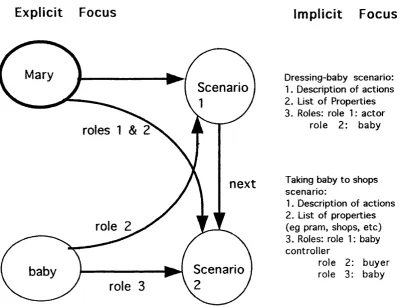
E n ta ilm e n ts a sso cia te d with verbs provide more complicated and interesting cases. As I noted before, Sanford & Garrod (1981:104) suggest that the verb ‘dress’ logically entails ‘put on clothes’, and therefore, there is no extra processing needed by the reader to comprehend an utterance such as (27a) as compared with (27b):
(27) a. Mary dressed the baby. The clothes were made of pink wool.
b. Mary put clothes on the baby. The clothes were made of pink wool.
will need some argument to decide whether ‘the clothes' counts as an explicitly mentioned antecedent - in which case it cannot be a case of bridging by my definition - or whether it counts as an implicit/inferred antecedent. In the latter case, my definition of bridging should be able to accommodate it. In any case, example (27a) should be distinguished from an example such as (2), where there is no logical entailment between ‘walking’ and ‘the park’. In example (2), what is involved is not a logical e n ta ilm e n t derived from word meaning, but general encyclopaedic knowledge which tells you that it is possible to go for a walk in a park. As for how entailments are represented and processed psychologically, and whether they are part of explicit or implicit content, I must leave it for further study. Meanwhile, I would like to emphasise th a t, at least theoretically, entailments and bridging implicatures should be differentiated.
Finally, let me look at the difference between the follow ing:
(28) I went into a room. A window was open. (29) I went into a room. The window was open.
In (2 8 ), ‘window’ is associated with the indefinite article whereas in (29), it is associated with the definite article. What is interesting here is that with an assumption such as ‘a room has windows’ very easily available from general knowledge, the overall interpretations of (28) and (29) look very similar: both communicate that there was a window in the room the speaker went into and it was open.
representation of a window into his mental representation, which may be the antecedent for subsequent references. On the other hand, in (29), a particular window is being picked out and referred to by this very utterance, and the hearer is required to make a bridging implicature such as ‘there was a window in the room speaker went into’, in order for the reference to succeed. In other words, in (28), it is not necessary to search for an antecedent, whereas in (29), it is, and for this, the bridging implicature is vital.
However, the question of why ‘a window’ in (28) can be interpreted as a window in the room mentioned in the previous sentence still needs to be answered. Parallel remarks, of course, apply to (29). Thus, despite their semantic differences, (28) and (2 9 ) have some common elements in their pragmatic interpretation.
5. Overview o f the Thesis
In the first chapter, I have given a brief overview of past studies of bridging and some of the main issues to which this thesis aims to give some answers. In addition, a definition of bridging implicature has been proposed, which is itself the answer to one of the main issues introduced in this chapter.
The second chapter summarises the central claims of relevance theory. This brief outline describes how the criterion of consistency with the principle of relevance explains various phenomena in communication, which are not discussed in the rest of the thesis.
The third, fourth and fifth chapters form the main body of the thesis. The third chapter takes up the topic of accessibility of candidate referents. Past studies on the subject are surveyed, which provide extensive evidence th at the accessibility of candidate referents is indeed a crucial factor affecting the hearer’s choice of referent. Accounts offering such evidence, represented by Sidner and Erku & Gundel, ^ are assessed in detail: examples introduced in the chapter suggest that such accounts cannot satisfactorily explain the overall mechanism of bridging in te rp re ta tio n . The final part of the chapter demonstrates th at a relevance-theoretic account, which sees the accessibility of candidate referents as merely one of many factors affecting the overall interpretation of bridging cases, offers a better explanation.
utterance interpretation, which assumes that situationally organised information is merely a part of the whole information available to the hearer, works better.
The fifth chapter investigates factors which affect the acceptability of bridging cases, and explains why some are judged acceptable and others less so. Six accounts, representing different criteria for acceptability, are chosen for assessment: tw o propose a truth-based criterion; one is based on accessibility of candidate referents; one invokes both truth and accessibility; one invokes truth and coherence. Each account is tested against various types of examples on which I have conducted questionnaires designed to examine what affects subjects’ choices of referent and judgements of acceptability; the results of these questionnaires are used as evidence to support or disprove predictions made by the competing accounts. It is argued that none of the accounts discussed in this chapter s a tis fa c to rily explains s u b je c ts ’ choices of referent and judgements of acceptability, and that a relevance-theoretic account based on the criterion of consistency with the principle of relevance offers a better explanation for the results of the questionnaires.
Chapter 2 Relevance Theory
1. B ackground 1.0. In tr o d u c tio n
Relevance theory (Sperber & Wilson 1986, 1987; Blakemore 1992) is a pragmatic theory which shares a basic assumption with the Gricean approach: that verbal communication involves not only encoding and decoding, but also, more crucially, the drawing of inferences, in which contextual assumptions play an important role. However, Sperber & Wilson differ from Grice in th e ir claim th a t the principles governing in fe re n tia l communication have their source in some facts about human cognition: humans typically pay attention to the most relevant phenomena available, construct the most relevant possible representations of these phenomena, and process these representations in a context that maximises their relevance.
The consequence o f this claim for the theory of communication is significant: a communicator, by the very act of claiming a hearer’ s a tte n tio n , com m unicates th a t the information he is offering is relevant enough to be worth the hearer’s attention. In other words, utterances automatically create expectations of relevance.
In this chapter, I will outline some of the central notions of relevance theory, which will be applied in later chapters to provide an account of bridging reference. This chapter makes little claim to originality, and merely summarises existing research.
1.1. Relevance Theory and the Code Model
which is different from those adopted by all previous theories of communication. It is radically different from the still widely popular ‘code model’ , typically represented by the semiotic approach to communication. It is also different, though in a much more subtle way, from the Gricean approach.
Let me first illustrate how relevance theory differs from the narrowest interpretation of the code model, in which the only messages that can be communicated are those that are linguistically encoded. Consider the following examples:
(1) Mary bought his articles. (2) That’s too long.
The code model, understood in this very strict way, assumes that an addressee can only recover ‘linguistically encoded meaning’ from an utterance. Hence, it predicts that what an addressee can recover as a meaning of (1) might be ‘Mary bought someone (male)’s articles’. Similarly, an addressee of (2) might recover a meaning such as ‘A certain object (non-animate) is too long for something’. Clearly, this is too poor a description of verbal understanding. Let me point out what is crucially missing from this picture. One characteristic of linguistic meaning is that it does not assign actual referents to referring expressions. To interpret (1), in addition to recovering its linguistic meaning, an addressee has to identify who ‘Mary’ is, and what ‘his articles’ are; in (2), she has to identify what ‘th a t’ is intended to refer to. Furthermore, in (1), the word ‘articles’ is ambiguous and an addressee has to decide whether it means ‘things’ or ‘papers’ . In addition, the phrase ‘his articles’ is vague: it can mean ‘papers he has w ritte n ’, ‘papers he is trying to sell’, ‘papers he is editing’, ‘papers about him’, and so on. Similarly, in (2), the meaning of ‘too long’ is vague and an addressee has to clarify what it is too long for.
(3) a. Do you fancy that Italian restaurant on the High Street?
b. I have eaten pasta three times this week.
Example (3) raises a different kind of problem from those mentioned above. Although (3b) would most naturally be interpreted as an answer to (3a), within the framework of the code model as defined above, it is impossible to explain how (3b) can be interpreted as an appropriate answer to (3a), since this goes beyond what is linguistically encoded.
In reality, an exchange such as (3) is quite common, and intuitively, (3b) can be interpreted as a negative answer to (3a). It is crucial for a theory of communication to explain why exchanges such as (3) are possible, or even sometimes preferred, and on this, the code model has nothing to offer.
A natural extension of the code model would be to argue that the linguistic code described above should be supplemented by some form of pragmatic code, which should yield an appropriate interpretation for each utterance in context. The problem is that no such code has ever been shown to exist. Moreover, Sperber & Wilson (1986) have argued that no such code co u ld exist. According to them, part of the utterance- interpretation process involves choosing an appropriate context, i.e. an appropriate set of contextual assumptions against which to interpret it. If they are right, the context is not fixed independently of the utterance-interpretation process, as the code model assumes, but has instead to be chosen as part of that process. Yet the idea that the context itself could be chosen by means of a code has never been seriously defended. In that case, the code model itself is inadequate in principle.
interpretation that go beyond the linguistically encoded meaning. Phenomena such as reference assignment and disambiguation clearly belong to this domain, and they are considered to be ‘pragmatic’ phenomena. Identification of intended implications, as in (3) above, and identification of the intended context (or intended set of contextual assumptions), are further pragmatic phenomena. The question is, if the code model is wrong, how should these pragmatic phenomena be explained?
Relevance theory is part of a tradition created by philosophers such as Grice, Lewis and Strawson, in which communication has been described not as a process of encoding and decoding, but as ‘a process of inferential recognition of the communicator’s intentions’ (Sperber & Wilson ibid.: 9). This view is fundamentally different from the code model. It claims that beyond the linguistic meaning of an utterance there is another layer of meaning which might be called ‘speaker’s meaning’ or ‘intended meaning’ , identification of which is the goal of the interpretation process. As Sperber & Wilson put it:
Verbal communication is a complex form of
communication. Linguistic coding and decoding is involved, but the linguistic meaning of an uttered sentence falls short of encoding what the speaker means: it merely helps the audience infer what she means. The output of decoding is correctly treated by the audience as a piece of evidence about the communicator’s intentions. In other words, a coding-decoding process is subservient to a Gricean inferential process (Sperber & Wilson ibid.: 27).
these last include, for example, the time and place of utterance, the identity of the speaker, the speaker’s intentions, and so on. As a result, it is possible for utterances of the same sentence to be interpreted differently in different situations. Sperber & Wilson argue that an adequate theory of communication should be a theory of utterance interpretation, rather than a theory of sentence meaning, which was advocated by followers of code model, narrowly understood.
Relevance theory distinguishes three aspects of utterance meaning: 1. what is said; 2. what is implied; 3. what attitude is communicated. In each case, it is the speakers intentions that the hearer aims to identify. In this section, I will illustrate the first two of these. The first aspect of utterance meaning, ‘what is said’, is called the ‘prepositional form ’ in relevance theory. According to Sperber & Wilson, the prepositional form of an utterance goes beyond the encoded linguistic meaning and encapsulates the truth-conditional content of the utterance. Recall our examples (1) and (2). The linguistic meaning (i.e. sentence meaning) of (1) and (2) leaves unspecified crucial pieces of information such as who is ‘Mary’, what are ‘ his articles’ in (1), and what is ‘th a t’ in (2), and so on. The prepositional form of an utterance of these sentences will have all the intended referents identified and ambiguous elements disam biguated. Thus, the prepositional forms of particular utterances of (1) and (2) might look as follows:
( ! ’) Mary Edwards bought papers written by Yukio Mishima at Dillons on November 7, 1982.
(2’) Two weeks is too long as a holiday for a Japanese worker.
expression and choose the intended disambiguation from among several possible interpretations? Sperber & Wilson argue that in addition to decoding of linguistic inform ation, various inferences play a crucial role in recovering prepositional form. I will discuss this in more detail in section 3.1.
Now let's consider the second aspect of utterance meaning, namely, ‘what is implied'. Our example (3) is a case in point:
(3) a. Do you fancy that Italian restaurant on the High Street?
b. I have eaten pasta three times this week.
Let's suppose the prepositional form of (3) is the following:
(3a') Does Jane fancy Spaghetti Junction on Teddington High Street on the evening of September 16th 1994? (3b’) Jane has eaten pasta three times in the week which
includes September 16th 1994.
Intuitively, even after assigning reference, (3b) does not make sense on its own as an answer to (3a). What the hearer naturally does in cases like this is to infer what is implied. In the case of (3b), the hearer's choice of implied interpretation will most likely be the following:
(4) a. If one has eaten pasta three times in a week, one will not choose to eat pasta again within the same week.
b. Therefore, Jane doesn't fancy Spaghetti Junction.
1.2. Relevance Theory and Grice
Sperber & Wilson and Grice share the basic assumption th a t communication is an inferential a c tiv ity involving identification of the intended interpretation. However, the differences between the two are significant - they differ particularly in how the possible interpretations of an utterance are evaluated and accepted or rejected.
Grice claims that conversation is a co-operative activity governed by the Co-operative principle and maxims:
Co-operative principle
Make your conversational contribution such as is required, at the stage at which it occurs, by the accepted purpose or direction of the talk exchange in which you are engaged (Grice 1975: 45)
Maxims of quantity
1 Make your contribution as informative as is required. 2 Do not make your contribution more informative than
is required.
Maxims of aualitv
Supermaxim: Try to make your contribution one that is true.
1 Do not say what you believe to be false.
2 Do not say that for which you lack adequate evidence.
Maxim of relation Be relevant.
Maxims of manner
Supermaxim: Be perspicuous.
2 Avoid ambiguity.
3 Be brief (avoid unnecessary prolixity). 4 Be orderly.
Grice’s biggest contribution to the study of communication is his claim that utterance interpretation is^matter of hypothesis formation and evaluation. His co-operative principle and maxims are indeed the standards by which hypotheses about the intended in te rp re ta tio n are evaluated. In Grice’s framework, the interpretation which satisfies the co-operative principle and maxims should be confirmed and accepted as the one intended. Implicatures are then the beliefs that have to be attributed to the speaker in order to preserve the assumption that the Co operative Principle and maxims (or at least the Co-operative principle) have been obeyed.