www.orientjchem.org
An International Open Access, Peer Reviewed Research Journal
2019, Vol. 35, No.(1): Pg. 337-342
This is an Open Access article licensed under a Creative Commons license: Attribution 4.0 International (CC- BY). Published by Oriental Scientific Publishing Company © 2018
Viscosity and Density Studies of Drugs in Aqueous Solution
and in Aqueous Threonine Solution at 298.15 K
HANAA G. ATTIYA
1, ZAINAb A. H. AL-DULAIMY
2*, KAwTHER AHMED SADIq
3,
and MAIDA HAMEED SALEEM4
1,2,3,4Department of Chemistry, College of Education for Pure Science-Ibn-Al-Haitham, University of Baghdad-Baghdad, Iraq.
*Corresponding author E-mails: [email protected]
http://dx.doi.org/10.13005/ojc/350141
(Received: September 25, 2018; Accepted: November 30, 2018)
AbSTRACT
Viscosities (η) and densities (ρ) of atenolol and propranolol hydrochloride in water and in concentrations (0.05 M) and (0.1 M) aqueous solution of threonine have been used to reform different important thermodynamic parameters like apparent molal volumes fv partial molal volumes at infinite dilution fvo, transfer volume fvo(tr), the slop S
v, Gibbs free energy of activation for viscous flow of solution
ΔG*1,2 and the B-coefficient have been calculated using Jones-Dole equation. These thermodynamic parameters have been predicted in terms of solute-solute and solute-solvent interaction.
Keywords: L-Threonine, Atenolol, Propranolol hydrochloride, Viscosity, Density.
INTRODUCTION
Drug work in human body is known as pharmacodynamics. The efficiency of a drug depends on its bioavailability1. The general reason of low oral bioavailability is due to low solubility of drug molecules. Sometimes, low aqueous soluble drugs require high dosages for the coveted action. Low water solubility of drugs is a serious problem for generic developments. Solubility of most drugs is having poor aqueous. Therefore, the raise of drug solubility and its oral bioavailability is a difficult function for drug evaluation process. Sometimes, some carrier molecules are added to the drugs to increase the solubility2. Numerous of works related
therapy to relive symptoms, get better indulgence, and an antiarrhythmic to useful check heartbeat and infections. Atenolol is also used in management of alcohol with drawl, in worry states, headache prophylaxis, increased of metabolism, and tremble9. The drug is formal in Indian pharmacopoeia10. Isopropyl amino-3-(1-naphthyloxy) propan-2-ol hydrochloride, is known chemically propranolol hydrochloride, is a widely used non-cardio selective beta-adrenergic antagonist and been used for myocardial infarction, arrhythmia, angina pectoris, hypertension, migraine and anxiety11. Threonine a polar side chains and exhibits good solubility in water, the nature of solute-solute and solute-solute-solvent interactions have been discussed in terms of the values of fv, fvo, Sv and beta-coefficient. Thermodynamic parameters play an important role in detecting the various types of interactions occurring in solution. These are useful in illustrating the nature and effect of solute in solvent, intermolecular interactions and permeation of drug across biological membranes.
RESULT AND DISCUSSION
The apparent molal volume (fv) is calculated using the following equation12,13,14.
fv= (1)
Where ρ and ρo are the densities of solution and solvent respectively, M is molecular weight of solute and (m) is the molality of solution, m is calculated using the following relation:
(2)
Where (C) is the molar concentration. As the plots of fv against the molal concentration (m) were linear in the studied concentration range, standard partial molar volume fvo was obtained from
the Masson equation15.
fv= fvo + S
v,m (3)
Where fvo is the partial molal volume at
infinite dilution which gives information about solute hydrophobicity also a measure of solute-solvent interaction. Sv is slop indicating solute-solute interaction. The Gibbs free energy of activation for viscous flow of solution at a given temperature and composition was measure by basing transition theory is given by equation16.
(4)
Where h is planks constant, NA is Avogadro's number, R is the gas constant and T is the absolute temperature. Volume of mole solution, 1,2 obtained from the following relation.
(5)
Where M2 and M1 are the molecular weight for solute and solvent respectively.
The viscosity measurements have been analyzed in terms of Jones-Dole equation17.
(6)
Where η and ηo are the viscosities of solution and solvent respectively and C is the molarity of solution, using Jones-Dole equation, was
H3C CH
OH C H COO NH3 Threonine (Thr.)
M= 119 g.mol-1 O
OH H NH
Cl H
Propranolol hydrochloride M= 295.8 g.mol-1
O HN
H2N
O
OH
CH3
CH3
Atenalol M= 266.3 g.mol-1
ExpERIMENTAL
Amino acid L-threonine obtained from Fluka company is stock solution and used without any further treatment. Atenolol and propranolol hydrochloride were supplied by the state company for drugs industry were medical appliances Samarra Iraq. The viscosity (η) was determined using assuspended-level ubbelohode viscometer described by findly, in a bath controlled to ± 0.01 K for all measurements. Vibrating tube with digital anton parr densimeter (DMA 60/602) according to Shukla et al., in a thermostated bath controlled to ± 0.01 K used to measure densities for all solution.
o
calculated viscosity beta-coefficients. The value of B depends upon the nature of solute-solvent interaction which is specific for solute-solvent system and the size of solute. The standard partial molar volume of transfer was obtained from the following relation18.
fvo (tr)= fvo (in aqueous threonine)- fvo (in water) (7)
The values of fvo(tr) and Sv are listed in Table
7 and 8. The values of fvo(tr) of drugs in mixed liquids
(threonine + water) are higher than those in aqueous solution, fvo(tr) are positive for all solutions studied
and Sv are positive which indicates ion-ion interaction is greater than post-micellar region. The beta-coefficients measure the shape effects, the size as well as the structural effect induced by solute-solvent interaction. It can be seen from Tables (1-6) that all the viscosity B-coefficients for drugs are positive, this may be understanding in expressing of the solute-solvent interaction.
Table 1: Molarity, molality, density, viscosity, apparent molal volume, Gibbs free energy of activation for viscous flow, relative viscosity and parameters of Jones-Dole coefficients of atenolol in aqueous solution at 298.15 K
C (mol. L-1) M (mol. Kg-1) ρ (gm. cm-3) η(cp) fv(cm3. mol-1) ΔG* (J. mol-1) η
r Jones-Dole beta-coefficient
0.0000 0.0000 0.99705 0.89039 - - - 2.7846
0.005 0.0050198 0.99733 0.95941 200.89778 61005 1.07752 0.006 0.0060244 0.99744 0.962627 201.90081 61014 1.08113 0.007 0.0070308 0.9975 0.969056 202.61638 61031 1.08835 0.008 0.0080368 0.99755 0.97455 204.406406 61045 1.09452 0.009 0.0090435 0.99759 0.97874 206.91372 61057 1.09923 0.01 0.0100506 0.99763 0.98042 208.919201 61061 1.10111 0.02 0.020038 0.9981 1.00655 214.15282 61131 1.13046 0.03 0.03029 0.99843 1.031864 220.9535 61198 1.15889 0.04 0.040492 0.99857 1.05174 228.97696 61252 1.18121 0.05 0.050744 0.99865 1.07546 234.99362 61313 1.20785
Table 2: Molarity, molality, density, viscosity, apparent molal volume, Gibbs free energy of activation for viscous flow, relative viscosity and parameters of Jones-Dole coefficients of propranolol hydrochloride in aqueous
solution at 298.15 K
C (mol. L-1) M (mol. Kg-1) ρ (gm. cm-3) η(cp) fv (cm3. mol-1) ΔG* (J. mol-1) η
r Jones-Dole beta-coefficient
0.0000 0.0000 0.99705 0.89039 - - - 3.5047
0.005 0.0050204 0.99742 1.03175 224.96221 61186 1.15876 0.006 0.0060259 0.99748 1.034838 224.8014 61194 1.16223 0.007 0.007032 0.99755 1.04481 225.04145 61218 1.17343 0.008 0.0080382 0.99761 1.051738 226.47684 61235 1.18121 0.009 0.009045 0.99767 1.05554 227.58442 61244 1.18548 0.01 0.0100527 0.99772 1.058166 229.48006 61251 1.18843 0.02 0.020155 0.99823 1.089348 237.50229 61329 1.22345 0.03 0.030042 0.99859 1.1144481 244.73276 61391 1.25164 0.04 0.040535 0.99864 1.150704 256.80856 61477 1.29236 0.05 0.05082 0.99872 1.179206 263.17909 61545 1.32437
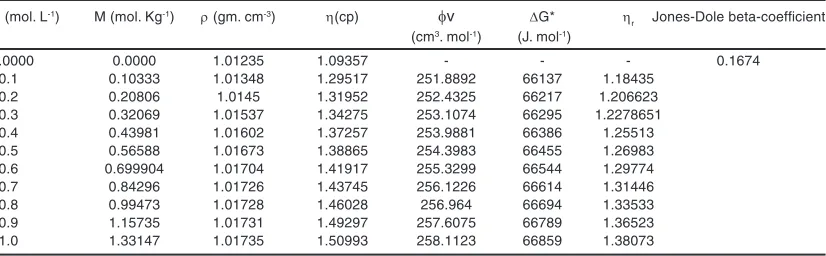
Table 3: Molarity, molality, density, viscosity, apparent molal volume, Gibbs free energy of activation for viscous flow, relative viscosity and parameters of Jones-Dole coefficients of atenolol in (0.05 M) aqueous
solution of threonine at 298.15 K
C (mol. L-1) M (mol. Kg-1) ρ (gm. cm-3) η(cp) fv ΔG* η
r Jones-Dole beta-coefficient
(cm3. mol-1) (J. mol-1)
0.0000 0.0000 1.01235 1.09357 - - - 0.1674
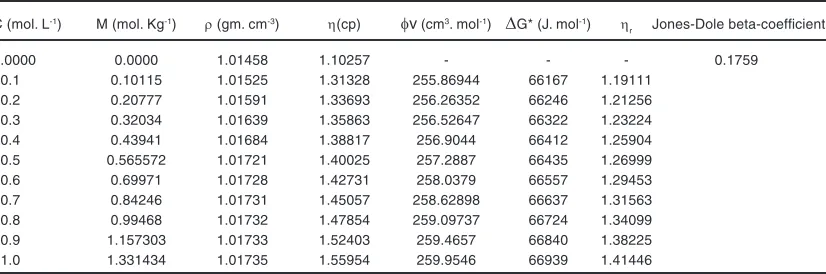
Table 4: Molarity, molality, density, viscosity, apparent molal volume, Gibbs free energy of activation for viscous flow, relative viscosity and parameters of Jones-Dole coefficients of atenolol in (0.1 M) aqueous
solution of threonine at 298.15 K
C (mol. L-1) M (mol. Kg-1) ρ (gm. cm-3) η(cp) fv (cm3. mol-1) ΔG* (J. mol-1) η
r Jones-Dole beta-coefficient
0.0000 0.0000 1.01458 1.10257 - - - 0.1759
0.1 0.10115 1.01525 1.31328 255.86944 66167 1.19111 0.2 0.20777 1.01591 1.33693 256.26352 66246 1.21256 0.3 0.32034 1.01639 1.35863 256.52647 66322 1.23224 0.4 0.43941 1.01684 1.38817 256.9044 66412 1.25904 0.5 0.565572 1.01721 1.40025 257.2887 66435 1.26999 0.6 0.69971 1.01728 1.42731 258.0379 66557 1.29453 0.7 0.84246 1.01731 1.45057 258.62898 66637 1.31563 0.8 0.99468 1.01732 1.47854 259.09737 66724 1.34099 0.9 1.157303 1.01733 1.52403 259.4657 66840 1.38225 1.0 1.331434 1.01735 1.55954 259.9546 66939 1.41446
Table 5: Molarity, molality, density, viscosity, apparent molal volume, Gibbs free energy of activation for viscous flow, relative viscosity and parameters of Jones-Dole coefficients of propranolol hydrochloride in
(0.05 M) aqueous solution of threonine at 298 .15 K
C (mol. L-1) M (mol. Kg-1) ρ (gm. cm-3) η(cp) (cm3. mol-1) fv ΔG* (J. mol-1) η
r Jones-Dole beta-coefficient
0.0000 0.0000 1.01674 1.11425 - - - 0.2137
0.1 0.100985 1.01983 1.33918 260.53875 65943 1.20187 0.2 0.207551 1.02278 1.36556 261.227123 66078 1.22554 0.3 0.320202 1.02565 1.40066 261.72403 66128 1.25704 0.4 0.439614 1.02821 1.41347 262.727004 66184 1.26854 0.5 0.56655 1.03044 1.45717 263.98106 66305 1.30776 0.6 0.70165 1.03261 1.4932 264.91539 66407 1.34009 0.7 0.84589 1.03459 1.50444 265.84971 66468 1.35018 0.8 0.999713 1.03641 1.56044 266.5829 66598 1.40044 0.9 1.165999 1.03809 1.58841 267.60016 66691 1.42554 1.0 1.34447 1.03959 1.64204 268.45699 66819 1.47367
Table 6: Molarity, molality, density, viscosity, apparent molal volume, Gibbs free energy of activation for viscous flow, relative viscosity and parameters of Jones-Dole coefficients of propranolol hydrochloride in
(0.1M) aqueous solution of threonine at 298.15 K
C (mol. L-1) M (mol. kg-1) ρ (gm. cm-3) η(cp) fv (cm3. mol-1) ΔG* (J. mol-1) η
r Jones-Dole beta-coefficient
0.0000 0.0000 1.01824 1.13057 - - - 0.2321
0.1 0.10089 1.02071 1.39121 266.24253 65999 1.23054 0.2 0.20749 1.02305 1.40741 266.88177 66066 1.24487 0.3 0.32037 1.02515 1.43717 267.88028 66157 1.27119 0.4 0.44019 1.02701 1.46598 268.9692 66247 1.29667 0.5 0.56767 1.02869 1.49854 269.97606 66343 1.32547 0.6 0.70371 1.03011 1.52109 271.07243 66424 1.34542 0.7 0.84935 1.03122 1.60653 272.27648 66646 1.42099 0.8 0.99446 1.03221 1.6393 273.35163 66697 1.44998 0.9 1.173617 1.03308 1.67062 274.30782 66794 1.47768 1.0 1.356134 1.03319 1.69098 275.81896 66903 1.49569
Table 7: Limiting, partial molal volume, slop and partial molal volume of transfer at infinite dilution of atenolol at 298.15 K
Conc. fvo S
v fvo(tr) (cm3. mol-1)
0% 198.8 732.13
-0.05 M 251.48 5.2735 52.68
0.1 M 255.49 3.467 56.68
Table 8: Limiting, partial molal volume, slop and partial molal volume of transfer at infinite dilution
of propranolol hydrochloride at 298.15 K
Conc. fvo S
v fvo(tr)(cm3. mol-1)
0% 219.32 881.41
-0.05 M 259.94 6.6078 40.62
Fig. 1. plots of fv versus (m) for () propranolol hydrochloride and (♦) atenolol in aqueous solution at 298.15 K
Fig. 2. plots of fv versus (m) for (x) propranolol hydrochloride, () atenolol in 0.05 M threonine and (♦) propranolol hydrochloride, ( ) atenolol in 0.1 M threonine
Fig. 3. plots of ηr versus ( c ) for (♦) propranolol hydrochloride
and () atenolol in aqueous solution at 298.15 K
Fig. 4. plots of ηr versus (c) for (x) propranolol hydrochloride,
( ) atenolol in 0.05 M threonine and (♦) propranolol hydrochloride, () atenolol in 0.1 M threonine
at 298.15 K
CONCLUSION
The density and viscosity of atenolol and propranolol hydrochloride in water and in concentrations (0.05 M and 0.1 M) aqueous solution of threonine are measured. Different thermodynamics parameters such as fvo, fvo(tr),
ΔG* and viscosity beta-coefficient are calculated, the results show the existence of strong solute-solvent interactions.
ACKNOwLEDGMENT
Author wants to show her gratitude to the University for their assistance in this work.
Conflict of interest
On behalf of all coauthors, I certify that all of the materials in this manuscript have no financial interest or non-financial interest with any organization, person, or any entity.
REFERENCES
1. Vemula, V. R.; Lagishetty, V.; Lingala, S. International Journal of Pharmaceutical Sciences Review and Research., 2010, 5(1), 41-51. 2. Joshi, H. A.; Dyade, D. K.; Patil, R. N.
Indo American Journal of Pharmaceutical Research., 2012, 2(11), 1387-1392.
3. Kumar, H.; Kaur, K. Journal of molecular Liquids., 2012, 173, 130-136.
4. Dhondge, S. S.; Zoadape, S. P.; Parwate, D. V.
Journal of Chemical Thermodynamics., 2012,
48, 207-212.
5. Ryshetti, S.; Gupta, A.; Tangeda, S. J.; Gardas, R. L. Journal of Chemical Thermodynamics.,
2014, 77, 123-130.
8. The Merck Index: An Encycolopedia of Chemicals, Drugs and Biologicals, Merch and Co., Whitehouse Station, NJ, USA, 1989, 11th edition.
9. Hegde, R. N.; Kumara Swamy, B. E.; Sherigara, B. S.; Nandibewoors, S. T. International Journal of Electrochemical Science., 2008. 3(3), 302-314. 10. Indian Pharmacopoeia, Ministry of Health
and Family, Welfare Government of India, Newdelh, 4th edition, 1996.
11. British Pharmacopoeia, 30th edition, London,
1993, 55(58), 370-554.
12. Kar kowiak, J.; Jour nal of Chemical Thermodynamics., 2011, 43, 882-894.
13. Brahman, D.; Sinha, B. Journal of Chemical and Engineering Data., 2011, 56, 3073-3082. 14. Brahman, D.; Sinha, B. Journal of Chemical
Thermodynamics., 2014, 68, 260-269. 15. Masson, D. D. Philosophical Magazine., 1929,
8, 218-235.
16. Feakins, D.; Freemantle, D. J.; Lawrence, K. J. Chem. Soc. Faraday Trans., 1974, 1, 795. 17. Jones, G.; Dole, M. J. Am. Chem. Soc., 1929,
51, 2950-2964.
18. Sinha, B.; Sarkar, A.; Roy, P. K.; Brahman, D. International Journal of Thermodynamics.,