SRef-ID: 1684-9981/nhess/2005-5-679 European Geosciences Union
© 2005 Author(s). This work is licensed under a Creative Commons License.
and Earth
System Sciences
Probabilistic seismic hazard map for Romania as a basis for a new
building code
L. Ardeleanu1, G. Leydecker2, K.-P. Bonjer3, H. Busche2, D. Kaiser2, and T. Schmitt2
1National Institute for Earth Physics, Bucharest, Romania
2Institute for Geosciences and Natural Resources, Hannover, Germany 3Geophysical Institute of University of Karlsruhe, Karlsruhe, Germany
Received: 28 June 2005 – Revised: 29 July 2005 – Accepted: 23 August 2005 – Published: 19 September 2005 Part of Special Issue “Seismic hazard evaluation, precursory phenomena and seismo electromagnetics”
Abstract. A seismic hazard map proposed as part of a new
building code for Romania is presented here on basis of the recommendations in EUROCODE 8.
Seismic source zones within an area of about 200 km around Romania were constructed considering seismicity, neotectonics and geological development. The probabilis-tic seismic hazard assessment in terms of intensities is per-formed following Cornell (1968) with the program EQRISK (see Mc Guire, 1976), modified by us for use of intensities.
To cope with the irregular isoseismals of the Vrancea in-termediate depth earthquakes a factoris introduced to the attenuation law (K¨ovesligethy, 1907). Using detailed macro-seismic maps of three earthquakes is calculated by fit-ting the attenuation law to observed intensities, i.e. to local ground conditions. Strong local variation ofis avoided by a gridding of 0.5◦ in longitude and 0.25◦ in latitude. The contribution of the Vrancea intermediate depth zone to the seismic hazard at each grid point is computed with the corre-sponding representative. A seismogenic depth of 120 km is assumed.
The final seismic hazard is the combination of both contri-butions, of zones with crustal earthquakes and of the Vrancea intermediate depth earthquakes zone. Calculations are done for a recurrence period of 95, 475 and 10 000 years. All maps show the dominating effects of the intermediate depth earth-quakes in the Vrancea zone, also for the capital Bucharest.
1 Introduction
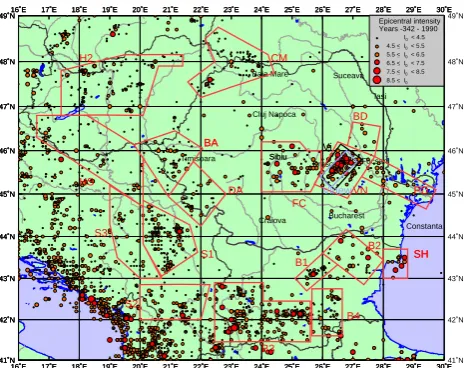
In Romania there are several significant areas of seismicity (Fig. 1) with earthquakes at normal depths (less than 60 km) as well as intermediate depth (60–180 km). The most active
Correspondence to: L. Ardeleanu
zones are in the western part of Romania near the city of Timisoara (BA, DA), in the central part near Sibiu (FC) and in the north western part at Baia Mare (CM). Romania’s high level of seismic hazard is mostly governed by events of the Vrancea region at the Eastern Carpathian arc bend.
To our knowledge the present study is the first seismic haz-ard assessment in terms of macroseismic intensities for Ro-mania. Probabilistic seismic hazard maps in terms of hor-izontal peak ground acceleration were published by Mus-son (2000), M¨antyniemi et al. (2003) and Marmureanu et al. (2004). Musson (2000) presented maps for the Pannonian Basin (including Romania) for return periods of 100, 475, 1000 and 3000 years. For earthquakes in the intermediate depth Vrancea seismic zone he used three different atten-uation models depending on the direction from the source. M¨antyniemi et al. (2003) mapped for a return period of 475 years the specific seismic hazard for the Vrancea seismic zone using depth- and azimuth-dependent attenuation func-tions. On the other hand Marmureanu et al. (2004) solely investigated the seismic hazard from crustal earthquakes. A deterministic approach was used by Radulian et al. (2000) by computing synthetic seismograms.
A seismic hazard map proposed as part of a new building code of Romania based on EUROCODE 8 (EC 8) is pre-sented here in terms of macroseismic intensities. As recom-mended in EC 8 two maps are calculated: for a probability of exceedance of 10% in 50 years (recurrence period of 475 years) and a probability of exceedance of 10% in 10 years (recurrence period of 95 years).
2 Probabilistic Seismic Hazard Assessment (PSHA) and
treatment of the crustal earthquake zones
16˚E 16˚E 17˚E 17˚E 18˚E 18˚E 19˚E 19˚E 20˚E 20˚E 21˚E 21˚E 22˚E 22˚E 23˚E 23˚E 24˚E 24˚E 25˚E 25˚E 26˚E 26˚E 27˚E 27˚E 28˚E 28˚E 29˚E 29˚E 30˚E 30˚E 41˚N 41˚N 42˚N 42˚N 43˚N 43˚N 44˚N 44˚N 45˚N 45˚N 46˚N 46˚N 47˚N 47˚N 48˚N 48˚N 49˚N 49˚N 16˚E 16˚E 17˚E 17˚E 18˚E 18˚E 19˚E 19˚E 20˚E 20˚E 21˚E 21˚E 22˚E 22˚E 23˚E 23˚E 24˚E 24˚E 25˚E 25˚E 26˚E 26˚E 27˚E 27˚E 28˚E 28˚E 29˚E 29˚E 30˚E 30˚E 41˚N 42˚N 43˚N 44˚N 45˚N 46˚N 47˚N 48˚N 49˚N 16˚E 16˚E 17˚E 17˚E 18˚E 18˚E 19˚E 19˚E 20˚E 20˚E 21˚E 21˚E 22˚E 22˚E 23˚E 23˚E 24˚E 24˚E 25˚E 25˚E 26˚E 26˚E 27˚E 27˚E 28˚E 28˚E 29˚E 29˚E 30˚E 30˚E 41˚N 42˚N 43˚N 44˚N 45˚N 46˚N 47˚N 48˚N 49˚N Bucharest Iasi Cluj Napoca Timisoara Craiova Focsani Constanta Suceava Baia Mare Brasov Sibiu Sibiu H2 HS S3 S2 B3 B4 B1 B2 SH SH PD VN BD FC S1 DA BA BA CM Vi Vinew
Years -342 - 1990 Epicentral intensity
I0 < 4.5 4.5 < I0 < 5.5 5.5 < I0 < 6.5 6.5 < I0 < 7.5 7.5 < I0 < 8.5 8.5 < I0
_ _ _ _ _
Fig. 1. Epicenter map (Shebalin et al., 1998) with the seismic source
zones. Codes refer to Table 1.
seismic source zones in an area of about 200 km around the territory of Romania are shown in Fig. 1. The boundaries of these zones were chosen to reflect the seismicity adequately regarding tectonic units and lithospheric structure as well as the suggested zonations given by Musson (2000), Radulian et al. (2000), Bala et al. (2003) and Marmureanu et al. (2004).
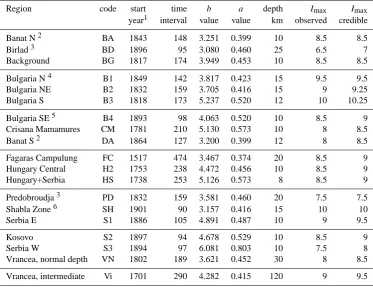
As a Poisson distribution is assumed earthquakes have to be independent events. In case of more than one earthquake within 10 days and 50 km distance only the strongest event is used for the statistics; the others are declared as statisti-cal dependent (pre- and aftershocks) and eliminated from the catalogue. The beginning of the time period for statistical purposes is chosen according to the assumed completeness of the catalogue for events greater than the lowest intensity value used in statistics. The intensity frequency parameters aandbfor each zone (Table 1) are calculated with Eq. (1).
logN (I )=a+bIepic. (1)
N (I )is the cumulative number of earthquakes;Iepic. is the epic. intensity.
The maximum credible earthquake for each zone is es-timated (Table 1) with respect to seismicity, frequency of earthquakes, maximum observed intensity and quality of his-torical documents.
Some seismic regions display few and disperse seismicity. They are treated in a special way (see Table 1) to calculate the intensity frequency statistic. All earthquakes excluding those of the designed sources are assigned to the ”background seis-micity”. The seismogenic depth of a region is defined where maximum of energy is released.
The seismicity within the Vrancea region consists of two depth horizons: normal deep (less than 60 km) and interme-diate deep (60–180 km) events. Due to extremely irregular isoseismals of the intermediate depth earthquakes their ef-fects on the seismic hazard have to be treated separately.
The probabilistic seismic hazard for Romania is computed with EQRISK developed by McGuire (1976). It is based
20˚E 20˚E 21˚E 21˚E 22˚E 22˚E 23˚E 23˚E 24˚E 24˚E 25˚E 25˚E 26˚E 26˚E 27˚E 27˚E 28˚E 28˚E 29˚E 29˚E 30˚E 30˚E 44˚N 45˚N 46˚N 47˚N 48˚N 7.5 5.5 6.5 6.5 6.5 6.5 6.5 6.5 7.5 7.5 5.5 6.5 7.5 8.5 9.5 10.5 20˚E 20˚E 21˚E 21˚E 22˚E 22˚E 23˚E 23˚E 24˚E 24˚E 25˚E 25˚E 26˚E 26˚E 27˚E 27˚E 28˚E 28˚E 29˚E 29˚E 30˚E 30˚E 44˚N 45˚N 46˚N 47˚N 48˚N 20˚E 20˚E 21˚E 21˚E 22˚E 22˚E 23˚E 23˚E 24˚E 24˚E 25˚E 25˚E 26˚E 26˚E 27˚E 27˚E 28˚E 28˚E 29˚E 29˚E 30˚E 30˚E 44˚N 45˚N 46˚N 47˚N
48˚N 475 a
NZ Bucharest Iasi Cluj Napoca Timisoara Craiova Focsani Constanta Suceava Baia Mare Brasov Sibiu Sibiu
Fig. 2. Seismic hazard from source zones of normal depth for a
recurrence period of 475 years; colours represent the intensities in MSK.
on the probabilistic approach of Cornell (1968). We im-plemented the intensity attenuation function of Sponheuer (1960) based on K¨ovesligethy (1907).
Isite=Iepic.−3 log(r/ h)−1.3α∗(r−h) (2) ris the hypocentral distance (km);his the depth (km); and αis the absorption coefficient, here 0.002 km−1.
For a hazard curve at a site EQRISK cuts all source re-gions into finite ring segments with their statistical parame-ters. Then the site intensities caused by earthquakes of each segment are calculated assuming a standard deviation of half an intensity. The sum of all contributions from all regions finally leads to the annual probability of exceedance at each grid point of the hazard map. These calculations are done for all points between 43.5◦N to 48.5◦N and 20.0◦E to 30.0◦E every 0.1◦in latitude and 0.2◦in longitude. Figure 2 shows the seismic hazard for Romania due to the earthquakes of normal depths only.
3 Vrancea intermediate depth earthquake zone
Macroseismic and early instrumental data have shown that the seismicity in the Vrancea zone is dominated by interme-diate depth events located in a well defined volume. The epicentral area is confined to about 40×80 km. Most earth-quakes occur at depths between 60 km and 180 km within an almost vertical column (e.g. Radu, 1974; Fuchs et al., 1979; Oncescu et al., 1999).
Shallower and deeper events were also recorded, however are less frequent and have only small to moderate magni-tudes. Vrancea seismicity is further characterized by pro-nounced background activity which delineates the rupture area of the strong earthquakes (e.g. Oncescu and Bonjer, 1997).
Table 1. Parameters of intensity-frequency relations and input-parameters for seismic hazard calculation. Thea- andb-values are estimated using full intensity values. Half intensity values are added to the next higher intensity class. This enlarges the number of events in each class, which improves the statistical stability and is also more conservative.
Region code start time b a depth Imax Imax
year1 interval value value km observed credible
Banat N2 BA 1843 148 3.251 0.399 10 8.5 8.5
Birlad3 BD 1896 95 3.080 0.460 25 6.5 7
Background BG 1817 174 3.949 0.453 10 8.5 8.5
Bulgaria N4 B1 1849 142 3.817 0.423 15 9.5 9.5
Bulgaria NE B2 1832 159 3.705 0.416 15 9 9.25
Bulgaria S B3 1818 173 5.237 0.520 12 10 10.25
Bulgaria SE5 B4 1893 98 4.063 0.520 10 8.5 9
Crisana Mamamures CM 1781 210 5.130 0.573 10 8 8.5
Banat S2 DA 1864 127 3.200 0.399 12 8 8.5
Fagaras Campulung FC 1517 474 3.467 0.374 20 8.5 9
Hungary Central H2 1753 238 4.472 0.456 10 8.5 9
Hungary+Serbia HS 1738 253 5.126 0.573 8 8.5 9
Predobroudja3 PD 1832 159 3.581 0.460 20 7.5 7.5
Shabla Zone6 SH 1901 90 3.157 0.416 15 10 10
Serbia E S1 1886 105 4.891 0.487 10 9 9.5
Kosovo S2 1897 94 4.678 0.529 10 8.5 9
Serbia W S3 1894 97 6.081 0.803 10 7.5 8
Vrancea, normal depth VN 1802 189 3.621 0.452 30 8 8.5
Vrancea, intermediate Vi 1701 290 4.282 0.415 120 9 9.5
1End year for all regions is 1990; usually, only events with intensities of 5.5 or more are considered.
2For the two regions DA and BA, the events are added and a common intensity-frequency statistic is done, resulting in the sameb-value.
Thea-value is computed: for region BA using the cumulative number of events with intensity 7.0 MSK and more; for region DA using the
cumulative number of events with intensity 6.0 MSK and more.
3For the two regions BD and PD, the events are added and a common intensity-frequency statistic is done, resulting in the sameb-value.
Thea-value for each region is computed, using the cumulative number of events with intensity 5.0 and more.
4The regression curve in the cumulative intensity-frequency relation for region B1 is calculated without the single event with intensity 9.5
MSK for statistical reasons; then the strongest event has an intensity of 8.0 MSK.
5For region B4 theb-value of B3 is taken. Thea-value for region B4 is computed using the cumulative number of events with intensity 5.0
MSK and more.
6For region SH theb-value of B2 is taken. Thea-value for region SH is computed using the cumulative number of events with intensity 6.0
MSK and more.
were injured and 32 500 residential and 763 industrial units were destroyed or seriously damaged, according to official data (e.g. Sandi, 2001).
With the deployment of modern seismic networks in the past decades, the accuracy of hypocenter locations increased considerably (e.g. Oncescu et al., 1999). In particular, Joint Hypocenter Determinations (JHD) showed that the Vrancea seismogenic zone has a two-dimensional geometry rather than a three-dimensional one (Oncescu, 1984; Oncescu and Trifu, 1987; Trifu et al., 1992; Oncescu and Bonjer, 1997). Recent analyses of the travel time data of the K2-network (Bonjer et al., 2000) reveal further details of the fine struc-ture of the geometry of the Vrancea focal zone (Bonjer et
al., 2005). The zone of seismic activity has a total width of about 20 km. It broadens from about 25 km at depths of 60 km to about 60 km at depths of 160 km. The earthquakes are located on two parallel planes (see blue and red circles in Figs. 3 and 4), separated by less than 10 km. The stars represent fore- and mainshock of 17 October 2005 sequence (Bonjer et al., 2005, Radulian et al., 2005).
Fig. 3. JHD locations of the seismicity in the time period 1996–
2003 at the South-Eastern Carpathian Arc bend (Bonjer et al., 2005). Blue and red circles: Vrancea intermediate depth quakes at two parallel active planes. Black crosses: crustal earth-quakes. Large yellow star: epicenter of the event of 27 October 2004. Small yellow star: epicenter of the largest earthquake occur-ring in 2004 prior to 27 October (27 September, Mw=4.7).
Tri-angles and squares: seismic stations. V istat. zone for statistics,
V icomp.zone for computation of seismic hazard.
Fig. 4. Depth distribution of the earthquakes of Fig. 3 on two
per-pendicular, vertical cross sections in Vrancea area (for earthquakes between 1996 and 2003), striking N30W and N60E, respectively. Note the almost vertical plunge of the seismic activity on two par-allel planes (left figure). Symbols and colours as in Fig. 3.
4 Treatment of Vrancea intermediate depth zone
Isoseismals of shallow earthquakes are almost circular shaped which is required to fulfil the assumed attenuation law of Sponheuer (1960). In contrast to them the isoseis-mals of earthquakes of intermediate depths are quite irregu-lar shaped (Fig. 5). Observed intensities of the earthquakes of 4 March 1977 (Radu and Polonic, 1982), 30 August 1986 (Radu, personal communication) and 30 May 1990 (Radu and Utale, 1990) decrease in north western directions in
20˚E 20˚E
21˚E 21˚E
22˚E 22˚E
23˚E 23˚E
24˚E 24˚E
25˚E 25˚E
26˚E 26˚E
27˚E 27˚E
28˚E 28˚E
29˚E 29˚E
30˚E 30˚E
44˚N 44˚N
45˚N 45˚N
46˚N 46˚N
47˚N 47˚N
48˚N 48˚N
20˚E 20˚E
21˚E 21˚E
22˚E 22˚E
23˚E 23˚E
24˚E 24˚E
25˚E 25˚E
26˚E 26˚E
27˚E 27˚E
28˚E 28˚E
29˚E 29˚E
30˚E 30˚E
44˚N 45˚N 46˚N 47˚N 48˚N
20˚E 20˚E
21˚E 21˚E
22˚E 22˚E
23˚E 23˚E
24˚E 24˚E
25˚E 25˚E
26˚E 26˚E
27˚E 27˚E
28˚E 28˚E
29˚E 29˚E
30˚E 30˚E
44˚N 45˚N 46˚N 47˚N 48˚N
Bucharest Iasi
Cluj Napoca
Timisoara
Craiova
Focsani
Constanta Suceava
Baia Mare
Brasov Sibiu
Sibiu
IV
V VI
VI VII
VIII
I0 = IV MSK
I0 = V MSK I0 = VI MSK
I0 = VII MSK
I0 = VIII MSK
observed intensities
Fig. 5. Macroseismic field of the earthquake from 4 March 1977
(Radu and Polonic, 1982) with epicentral intensity I0=VIII-IX
MSK andh=94 km.
20˚E 20˚E
21˚E 21˚E
22˚E 22˚E
23˚E 23˚E
24˚E 24˚E
25˚E 25˚E
26˚E 26˚E
27˚E 27˚E
28˚E 28˚E
29˚E 29˚E
30˚E 30˚E
44˚N 45˚N 46˚N 47˚N 48˚N
5.5
5.5
5.5
6.5
6.5
6.5
6.5
6.5
7.5
7.5
7.5
7.5
7.5 7.5
7.5
8.5
8.5
5.5 6.5 7.5 8.5 9.5 10.5
20˚E 20˚E
21˚E 21˚E
22˚E 22˚E
23˚E 23˚E
24˚E 24˚E
25˚E 25˚E
26˚E 26˚E
27˚E 27˚E
28˚E 28˚E
29˚E 29˚E
30˚E 30˚E
44˚N 45˚N 46˚N 47˚N 48˚N
20˚E 20˚E
21˚E 21˚E
22˚E 22˚E
23˚E 23˚E
24˚E 24˚E
25˚E 25˚E
26˚E 26˚E
27˚E 27˚E
28˚E 28˚E
29˚E 29˚E
30˚E 30˚E
44˚N 45˚N 46˚N 47˚N
48˚N 475 a
120km Vi
Bucharest Iasi Cluj Napoca
Timisoara
Craiova
Focsani
Constanta Suceava
Baia Mare
Brasov Sibiu Sibiu
Fig. 6. Seismic hazard from Vrancea events of intermediate depth
for a recurrence period of 475 years; colours represent intensities in MSK.
shorter distances than in north eastern and south western di-rections. Teleseismic tomography detected lower seismic ve-locities about 100 km northwest of Vrancea in an intermedi-ate depth range of 70–110 km (Martin et al., 20041). How-ever, the phenomenon of the irregular shape of isoseismals of Vrancea intermediate depth earthquakes is still not ex-plained.
As the attenuation law does not consider spatial differ-ences in damping, a new empirical approach is chosen to take the directionality of attenuation into account. A factoris introduced to the attenuation law in Eq. (2):
Isite=Iepic.−3 log(r/ h)−1.3α∗(r−h) (3) Using detailed macroseismic maps of the three strong Vrancea intermediate depth earthquakes is calculated
1Martin, M., Wenzel, F., and the CALIXTO Working Group:
20˚E 20˚E 21˚E 21˚E 22˚E 22˚E 23˚E 23˚E 24˚E 24˚E 25˚E 25˚E 26˚E 26˚E 27˚E 27˚E 28˚E 28˚E 29˚E 29˚E 30˚E 30˚E 44˚N 45˚N 46˚N 47˚N 48˚N 7.5 6.5 6.5 6.5 6.5 6.5 7.5 7.5 7.5 7.5 7.5 7.5 8.5 8.5 5.5 6.5 7.5 8.5 9.5 10.5 20˚E 20˚E 21˚E 21˚E 22˚E 22˚E 23˚E 23˚E 24˚E 24˚E 25˚E 25˚E 26˚E 26˚E 27˚E 27˚E 28˚E 28˚E 29˚E 29˚E 30˚E 30˚E 44˚N 45˚N 46˚N 47˚N 48˚N 20˚E 20˚E 21˚E 21˚E 22˚E 22˚E 23˚E 23˚E 24˚E 24˚E 25˚E 25˚E 26˚E 26˚E 27˚E 27˚E 28˚E 28˚E 29˚E 29˚E 30˚E 30˚E 44˚N 45˚N 46˚N 47˚N
48˚N 475 a
120km All Bucharest Iasi Cluj Napoca Timisoara Craiova Focsani Constanta Suceava Baia Mare Brasov Sibiu Sibiu
Fig. 7. Seismic hazard from all source zones for a recurrence period
of 475 years; colours represent intensities in MSK.
20˚E 20˚E 21˚E 21˚E 22˚E 22˚E 23˚E 23˚E 24˚E 24˚E 25˚E 25˚E 26˚E 26˚E 27˚E 27˚E 28˚E 28˚E 29˚E 29˚E 30˚E 30˚E 44˚N 45˚N 46˚N 47˚N 48˚N 5.5 5.5 5.5 6.5 6.5 6.5 6.5 6.5 6.5 7.5 7.5 7.5 5.5 6.5 7.5 8.5 9.5 10.5 20˚E 20˚E 21˚E 21˚E 22˚E 22˚E 23˚E 23˚E 24˚E 24˚E 25˚E 25˚E 26˚E 26˚E 27˚E 27˚E 28˚E 28˚E 29˚E 29˚E 30˚E 30˚E 44˚N 45˚N 46˚N 47˚N 48˚N 20˚E 20˚E 21˚E 21˚E 22˚E 22˚E 23˚E 23˚E 24˚E 24˚E 25˚E 25˚E 26˚E 26˚E 27˚E 27˚E 28˚E 28˚E 29˚E 29˚E 30˚E 30˚E 44˚N 45˚N 46˚N 47˚N
48˚N 95 a
120km All Bucharest Iasi Cluj Napoca Timisoara Craiova Focsani Constanta Suceava Baia Mare Brasov Sibiu Sibiu
Fig. 8. Seismic hazard from all source zones for a recurrence period
of 95 years; colours represent intensities in MSK.
for each observation. For simplification α is fixed to 0.001 km−1. Strong local variations ofare avoided by cal-culation mean values inside grid cells of 0.56◦in longitude
and 0.25◦in latitude, separately for each event. The median
is taken to combine all three grids. Intensities for rectangles without observations have been 2D-interpolated respectively extrapolated.
Using the assignedvalues for each point of observation, the seismic hazard of the Vrancea Intermediate Depth Zone (V i) is calculated in the same way as for the crustal zones. A seismogenic depth of 120 km is assumed forV i source zone. Figure 6 shows intensities for a recurrence period of 475 years.
5 Results
The final seismic hazard map for a recurrence period of 475 years in Fig. 7 is a combination of the map for source zones of normal depth (Fig. 2) and that for Vrancea intermediate depth zone (Fig. 6). Macroseismic observations for inter-mediate depth earthquakes are only available for Romania. Therefore our seismic hazard assessment is only valid for the Romanian territory. 20˚E 20˚E 21˚E 21˚E 22˚E 22˚E 23˚E 23˚E 24˚E 24˚E 25˚E 25˚E 26˚E 26˚E 27˚E 27˚E 28˚E 28˚E 29˚E 29˚E 30˚E 30˚E 44˚N 45˚N 46˚N 47˚N 48˚N 7.5 7.5 7.5 7.5 7.5 7.5 8.5 8.5 8.5 8.5 8.5 8.5 8.5 8.5 8.5 9.5 9.5 8.5 5.5 6.5 7.5 8.5 9.5 10.5 20˚E 20˚E 21˚E 21˚E 22˚E 22˚E 23˚E 23˚E 24˚E 24˚E 25˚E 25˚E 26˚E 26˚E 27˚E 27˚E 28˚E 28˚E 29˚E 29˚E 30˚E 30˚E 44˚N 45˚N 46˚N 47˚N 48˚N 20˚E 20˚E 21˚E 21˚E 22˚E 22˚E 23˚E 23˚E 24˚E 24˚E 25˚E 25˚E 26˚E 26˚E 27˚E 27˚E 28˚E 28˚E 29˚E 29˚E 30˚E 30˚E 44˚N 45˚N 46˚N 47˚N
48˚N 10,000 a
120km All Bucharest Iasi Cluj Napoca Timisoara Craiova Focsani Constanta Suceava Baia Mare Brasov Sibiu Sibiu
Fig. 9. Seismic hazard from all source zones for a recurrence period
of 10 000 years; colours represent intensities in MSK.
annual probability of exceedance 101 102 103
1047 8 9 10
Intensity MSK 10 10 10 10 -1 -2 -3 -4
Fig. 10. Seismic hazard curve for Bucharest.
The intermediate depth earthquakes of the Vrancea Zone occur at depths of about 60 km to 180 km. To estimate the depths’ influence, we calculated hazard maps for 95 km as well as for 150 km. The difference of the intensity values of both maps are in most cases less than half an intensity.
Acknowledgements. We thank K.-G. Hinzen for his concise review and helpful remarks.
Edited by: P. F. Biagi
Reviewed by: K.-G. Hinzen and another referee
References
Bala, A., Radulian, M., and Popescu, E.: Earthquake distribution and their focal mechanism in correlation with the active tectonic zones of Romania, J. Geodyn., 36, 129–145, 2003.
Bonjer, K.-P., Oncescu, L., Rizescu, M., Enescu, D., Driad, L., Radulian, M., Ionescu, M., and Moldoveanu, T.: Source-and Site-Parameters of the 28 April 1999 intermediate-depth VRANCEA Earthquake: First results from the new K2-network in Romania, XXVII General Assembly of the European Seis-mological Commission, Lisbon, Book of Abstracts and Papers, SSA-2-13-O, 53, 2000.
Bonjer, K.-P., Ionescu, C., Sokolov, V., Radulian, M., Grecu, B., Popa, M., and E. Popescu: Source parameters and ground mo-tion pattern of the 27 October 2004 intermediate depth Vrancea earthquake, EGU General Assembly 2005, EGU05-A-07538, Vi-enna, 2005.
Cornell, C. A.: Engineering seismic risk analysis, Bull. Seism. Soc. Am., 58, 1583–1606, 1968.
EUROCODE 8: Design of structures for the earthquake resistance. Part 1: General rules, seismic actions and rules for buildings, Draft no. 6, Ref. No: prEN 1998-1:200X, European Committee for Standardisation, Central Secretariat: rue de Strassart 36, B-1050 Brussels, 2003.
Fuchs, K., Bonjer, K.-P., Bock, G., Cornea, I., Radu, C., Enescu, D., Jianu, D., Nourescu, A., Merkler, G., Moldoveanu, T., and G. Tudorache: The Romanian earthquake of 4 March 1977, II. Aftershocks and migration of seismic activity, Tectonophysics, 53, 225–247, 1979.
K¨ovesligethy von, R.: Seismischer St¨arkegrad und Intensit¨at der Beben, Gerlands Beitr¨age zur Geophysik, Band VIII, Leipzig, 1907.
M¨antyniemi, P., Marza, V. I., Kijko, A., and Retief, P.: A New Probabilistic Seismic Hazard Analysis for the Vrancea (Roma-nia) Seismogenic Zone, Nat. Hazards, 29, 371–385, 2003. Marmureanu, G., Popescu, E., Popa M., Moldovan, A. I., Placinta,
A. O., and Ralulian, M.: Seismic Zoning Characterization For The Seismic Hazard Assessment In South-Eastern Romania Ter-ritory, Acta Geod. Geoph. Hung., 39, 259–274, 2004.
McGuire, R. K.: FORTRAN Computer Program for Seismic Risk Analysis, US Department of the Interior Geological Survey, Open-File Report, 76–67, 1976.
Musson, R. M. W.: Generalized Seismic Hazard Maps for the Pan-nonian Basin Using Probabilistic Methods, Pure Appl. Geophys., 157, 147–169, 2000.
Oncescu, M.-C.: Deep structure of Vrancea Region, Romania, in-ferred from simultaneous inversion for hypocenters and 3-D ve-locity structure, Ann. Geophys., 2, 23–28, 1984.
Oncescu, M. C. and Trifu, C.-I.: Depth variation of the moment ten-sor axes in Vrancea (Romania) seismic region, Ann. Geophys., 5B, 149–154, 1987.
Oncescu, M.-C. and Bonjer, K.-P.: A note on the depth recurrence and strain release of large Vrancea earthquakes, Tectonophysics, 272, 291–302, 1997.
Oncescu, M.-C., Marza, V. I., Rizescu, M., and Popa, M.: The Ro-manian earthquake catalogue between 1984–1997, in: Vrancea earthquakes: tectonics, hazard and risk mitigation, edited by: Wenzel, F., Lungo, D., and Novack, O., Kluwer Academic Pub-lishers, Dordrecht, 43–47, 1999.
Radu, C.: Contribution ´a l’ ´etude de la sismicit´e de la Roumanie et comparison avec la sismicit´e de sud-est de la France, Ph.D. thesis, Universit´e Strasbourg, France, 404 pp., 1974.
Radu C. and Polonic, G.: Characteristics of the 4 March 1977 seis-mic event, in: The Romanian earthquake of 4 March (in Roma-nian), 1977, edited by: Balan, St., Cristescu, V., and Cornea, I., Academy Publishing House, Bucharest, 100–136, 1982. Radu. C. and Utale, A.: Vrancea earthquake of 30 May 1990,
Inten-sity distribution, Contract CFP/IFA 30.86.3/1990 (in Romanian), IV, A2, 1990.
Radulian, M., Vaccari, F., Mandrescu, N., Panza, G. F., and Moldoveanu, C. L.: Seismic Hazard of Romania: Determinis-tic Approach, Pure Appl. Geophys.. 157, 221–247, 2000. Radulian, M., Bonjer, K.-P., Popescu, E., Pantea, A., Popa, M.,
Ionescu, C., Grecu, B., and Constantin, A.: The 27 Octo-ber 2004 Vrancea (Romania) earthquake, Orfeus Newsletter, in press, 2005.
Sandi, H.: Obstacles to earthquake risk reduction encountered in Romania, in: Earthquake hazard and countermeasures for exist-ing fragile buildexist-ings, edited by: Lungu, D. and Saito, T., 261– 266, 2001.
Shebalin, N. V., Leydecker, G., Mokrushina, N. G., Tatevossian, R. E., Erteleva, O. O., and Vassiliev, V. Yu.: Earthquake Cata-logue for Central and Southeastern Europe, European Commis-sion, Report No. ETNU CT 93 - 0087, Brussels, http://www.bgr. de/quakecat, 1998.
Sponheuer, W.: Methoden zur Herdtiefenbestimmung in der
Makroseismik. (Methods for depths estimation in macroseismic), Freiberger Forschungs-Hefte C 88, 117 pp., Akademie Verlag Berlin, 1960..