309
Tuning Of A Pd-Pi Controller Used With An
Integrating Plus Time Delay Process
Galal A. Hassaan
Abstract: Integral time delayed processes require more attention in selecting reasonable controllers associated with them because they are a class of nonlinear processes . In this work, the PD-PI controller is examined to investigate its replacement to the classical PID controller. This research work has proven that the PD-PI results in a better performance for the closed-loop control system incorporating the PD-PI controller and an integrator plus delay time process. The time delay effect is compensated using 2nd order Pade approximation. The controller is tuned by minimizing the sum of square of error (ISE) of the control system using MATLAB. The MATLAB optimization toolbox is used assuming that the tuning problem is an unconstrained one. The result was producing a step response of the controlled process without any maximum percentage overshoot or maximum percentage undershoot. The performance of the control system using an PD-PI controller using the present tuning technique is compared with that using a PIDF controller tuned by Zhang and others in 1999.
Keywords: PD-PI Controller, Integrating plus Time Delay Process, Controller Tuning, Control System Performance. ————————————————————
1. INTRODUCTION
Integrating plus time delayed process is difficult to control than any un-delayed stable process. This is simply because of the delayed characteristic of the system is compensated in the analysis by using polynomials in the Laplace operator s which means increasing the order of the closed-loop control system. This of course has its impact on the control system stability and performance. The PD-PI controller is one of the next generation of PID controllers where research and application is required to investigate its effectiveness compared with PID controllers when controlling such processes. Poulin, Pomerleau, Desbiens and Hodouin (1996) described the design of an auto-tuning and adaptive SISO PID controller to control stable and unstable zeros, processes with an integrator, unstable processes and standard aperiodic processes [1]. Zhang, Xu and Sun (1999) presented a PIDF controller design method for integrating processes with time delay and time constant. They developed an optimization method based on using the H∞ performance criterion [2]. Lee, Lee and Park (2000) proposed a method for PID controller tuning based on process models for integrating and unstable processes with time delay giving better closed-loop performance [3]. Huzmezan, Gough, Dumont and Kovac (2002) described the application of an industrial controller designed to handle integrating type processes with long dead times and long time constants [4]. Arvanitis, Syrkos, Stellas and Sigrimis (2003) designed and tuned PDF controllers to control integrator plus dead time processes in terms of robustness. Their technique offered larger parametric stability margins than other tuning methods [5].
AbdelFattah, Gesraha and Hanafy (2004) developed a controller characterized by its robustness against modeling errors and its high disturbance rejection capability for integrating processes with time delay [6]. Ou, Tang, Gu and Zhang (2005) considered the problem of stabilizing integral plants with time delay using PID controllers and the practical single-parameter PID controllers [7]. Matijevic and Stojic (2006) proposed a structure for the Smith predictor based on IMPACT structure for control with long dead time. They set the controller parameters in order to achieve robust stability and performance [8]. Camacho, Rojas and Garcia-Gabin (2007) presented a combined approach of predictive structures with sliding mode control for performance and robustness improvement. They applied the structures to processes approximated by a first-order plus time delay or an integral first-order plus time delay [9]. Shamsuzzoha and Lee (2008) proposed a design technique for an IMC-PID controller for two integrating processes with time delay. They used a 2DOF control structure to eliminate the overshoot in the setpoint response and compared their tuning technique with other techniques for the same processes [10]. Saravanakumar and Wahidabanu (2009) proposed a modified Smith predictor for controlling higher-order proceses with integral action and long dead time. They used an I-PD controller where the integral control was in the forward path and the proportional and derivative control were in the feedback [11]. Ruscio (2010) presented analytical results of PI controller tuning based on integrator plus time delay models. They developed analytical relations between the PI controller parameters and the time delay error parameter in a way to obtain modified Ziegler-Nichols parameters with increased robustness margins [12]. Rao, Rao and Stee (2011) proposed a design for PID controllers based on integral model control principles, direct synthesis method and stability analysis method for pure integrating process with time delay. They compared the performance of the proposed controllers with the controllers designed by some other methods [13]. Alfaro and Vilanova (2012) proposed a robust tuning method of 2DOF PI controllers for integrating controlled processes. Their work was based on the use of a model-reference optimization procedure with servo and regularity closed-loop transfer functions targets [14]. Huba (2013) outlined the performance achievable under PI control using the performance portrait method. He used an IAE cost function of the set point and disturbance _______________________
Galal A. Hassaan
responses applying shape related constraints [15]. Sandaram and Padhy (2013) proposed a genetic algorithm based PI-PD controller for improving network utilization in TCP/IP networks. They used the ISTE criterion to tune the parameters of the PI-PD controller [16]. Shariati, Taghirad and Fatehi (2014) presented a neutral system approach for the design of a H∞ controller for input delay systems with uncertain time-invariant delay. Delay-dependent sufficient conditions for the existence of a H∞ PD and PI controllers in the presence of uncertain delay were derived in terms of matrix inequalities [17]. Brun et. al. (2014) studied the design of a control system for the fuel syst H∞em of a turbojet. They selected multi-loop strategy based on PID, finding which strategy was the best suitable [18]. Hassaan (2014) studied the tuning of a PI-PD controller used with first-order delayed processes with delays up to 16 seconds [19].
2. ANALYSIS
Process: Integrating models exist in hydraulic control systems used in position control applications [20-24] . Usually, it is associated with delay time due to the transportation of fluid from the source to the output element. A specific integrating plus time delay used by Chren and Fruehauf has the transfer function [25]:
Gp(s) = (0.2/s) e-7.4s (1)
Using the second-order Pade approximation, the time-delay term in Eq.1 is replaced by [26]:
e-Ts = (-2Ts + 6) / (T2s2 + 4Ts + 6) (2)
Combining Eqs.1 and 2 for T = 7.4 gives:
Gp(s) = (-2.96s + 1.2) / (54.76s3 + 29.6s2 + 6s (3)
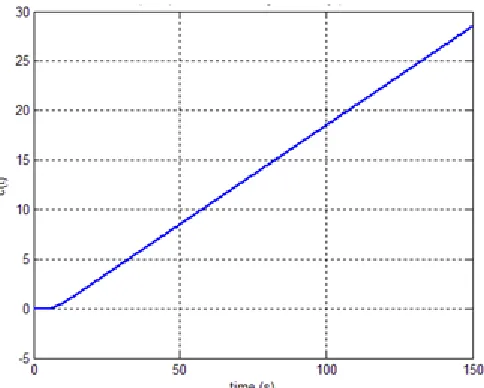
The process transfer function of Eq.1 represents an unstable process. That is it will not converge to a specific steady-state value when tested by a step input. Fig.1 shows a typical time response of this process to a unit step input as generated by MATLAB.
Figure1. Process time response to a unit step input.
Controller:
The controller used in this study is a proportional+derivative (PD) - proportional + integral (PI) controller. In this controller, The PD and PI parts of the controller are connected in series. The input to the PD part is the system error, while the input of the PI part is the output of the PD part [27]. The block diagram of the closed-loop control system incorporating the PD-PI controller is shown in Fig.2 [27].
Controller
Figure 2 PD-PI controlled process.
The controller transfer function is, Gc(s) is:
Gc(s) = (1/s) [KpcKds2 + (Kpc + KiKd)s + Ki] (4)
Where: Kpc = Proportional gain Ki = Integral gain Kd = Derivative gain
i.e. the controller has 3 parameters to be identified to control the process and produce a satisfactory performance.
Control System Transfer Function:
The controller and process are cascaded in the forward path of the unity feedback control system. The open-loop tfansfer function of the control system is obtained using Eqs.3 and 4 as:
G(s)=(b0s3+b1s2+b2s+b3)/(54.76s4+29.6s3+6s2) (5)
Where: b0 = -2.96KpcKd
b1 = 1.2KpcKd – 2.9Kpc – 2.9KiKd b2 = 1.2Kpc + 1.2KiKd – 2.96Ki b3= 1.2Ki
The cloded-loop transfer function of the system, M(s) is:
M(s)=(b0s3+b1s2+b2s+b3)/(a0s4+a1s3+a2s2+as+c4) (6)
Where:
a0 = 54.76 a1 = b0 + 29.6 a2 = b1 + 6 a3 = b2 a4 = b3
System Step Response:
311
3. CONTROLLER TUNING
The sum of square of error (ISE) is used an objective function, F of the optimization process. Thus:
F = ∫ [c(t) – css]2 dt (7)
where css = steady state response of the system = 1 for a unit step input. The performance of the control system is judged using three time-based specifications:
(a) Maximum percentage overshoot, OSmax (b) Maximum percentage undershoot, USmax (c) Settling time, Ts
Tuning Results:
The MATLAB command "fminunc" is used to minimize the optimization objective function given by Eq.6 without any parameters or functional constraints [29]. The results are as follows:
Proportional gain: Kpc = 0.12459
Integral gain: Ki = 0
Derivative gain: Kd = 1.00246
The time response of the closed-loop control system to a unit step input is shown in Fig.2.
Fig.2 Step response of the PD-PI controlled integrating time-delayed process.
The control system does not show any oscillation, but it is relatively slow. It has the performance parameters:
- Maximum percentage overshoot: 0 - Maximum percentage undershoot: 0
- Settling time: 106.5s
4. COMPARISON WITH PIDF CONTROLLER
Zhang, Xu and Sun used a PIDF controller to control the same process defined by Eq.1 with different tuning technique. Their results are compared with the present work using a PD-PI controller in Fig.3.
Fig.3 Step response of the PD-PI and PIDF controlled integrating process.
The performance parameters of the control system using the PD-PI controller and the PIDF controller by Zhang et al. are compared in Table 1.
Characteristics PD-PI (present)
PIDF
(Zhang et al.)
OS (%) 0 50
US (%) 0 0
Ts (s) 106.5 63
5. CONCLUSIONS
- Second-order Pade approximation was used to deal with the process delay.
- The integrating plus time delay process was completely unstable.
- It was possible to produce a step time response without any overshoot or undershoot.
- The settling time using the PD-PI controller was greater than that associated with the PIDF controller tuned by Zhang et al.
- The overshoot using the PIDF controller tuned by Zhang et al was 50 % compared with zero in the present work.
REFERENCES
[1] E. Poulin, A. Pomerleau, A. Desbiens and D. Hodoun, "Development and evaluation of an auto-tuning and adaptive PID controller", Automatica, Vol.32, No.1, 1996, pp.71-82.
[2] W. Zhang, X. Xu and Y. Sun, "Quantitative performance design for integrating processes with time delay", ibid, Vol.35, 1999, pp.719-723.
[3] Y. Lee, J. Lee and S. Park, ―PID controller tuning for integrating and unstable processes with time delay‖, Chemical Engineering Science, Vol.55, 2000, pp.3481-3493.
solution", Control Engineering Practice, Vol.10, 2002, pp.1153-1161.
[5] K. Arvanitis, G. Syrkos, I. Stellas and N. Sigrimis, "Controller tuning for integrating processes with time delay, Part II: Robustness analysis under structured parametric uncertainty", 11th IEEE Mediterranean Conference on Control and Automation, Rodos, Greece, June 28-30, 2003.
[6] H. AbdelFattah, A. Gersaha and A. Hanafy, "Control of integrating dead time processes with long time delay", Proceedings of the American Control Conference, Boston, Massachusetts, June 30-July 2, 2004, pp.4966-4971.
[7] L. Ou, Y. Tang, D. Gu and W. Zhang, "Stability analysis of PID controllers for integral processes with time delay", American Control Conference, Prtland, OR, USA, June 8-10, 2005, pp.4247-4252.
[8] M. Matijevic and M. Stojic, "The robust controller design for processes with dead times", Mechanics, Automatic Control and Robotics, Vol.5, No.17, 2006, pp.131-144.
[9] O. Camacho, R. Rojas W. Garcia-Gabin, "Some long time delay sliding mode control approaches", ISA Transactions, Vol.46, 2007, pp.95-101.
[10] M. Shamsuzzoha and M. Lee, "PID controller design for integrating processes with time delay", Korean J. Chemical Engineering, Vol.25, No.4, 2008, pp.637-645.
[11] G. Saravanakumar and R. Wahidabanu, "Control of integrating process with dead time using auto-tuning approach", Barazilian J. of Chemical Engineering, Vol.26, No.1, 2009.
[12] D. Ruscio, ―On tuning PI controllers for integrating plus time delay systems‖, Modeling, Identification & Control, Vol.31, No.4, 2010, pp.145-164.
[13] C. Rao, A. Rao and R. Sree, "Design of PID controllers for pure integrator systems with time delay", Int. J. of Applied Science and Engineering, Vol.9, No.4, 2011, pp.241-260.
[14] V. Alfaro and R. Vilanova, "Model reference robust tuning of 2DOF PI controllers for integrating processes", 20th Mediterranean Conference on Control and Automation, Barcelona, Spain, July 3-6, 2012, pp.1073-1078.
[15] M. Huba, "Performance measures, performance limits and optimal PI control for the IPDT plant", J. of Process Control, Vol.23, No.4, 2013, pp.500-515.
[16] R, Sundaram and P. Padhy, "GA-based PI-PD controller for TCP routers", International Journal for
Machine Learning and Computing, Vol.3, No.4, August 2013, pp.361-364.
[17] A. Shariati, H. Taghirad and A. Fatehi, "A neutral system approach to H∞ PD/PI design of processes with uncertain input delay", Journal of Process Control, Vol.24, No.3, March 2014, pp.144-157.
[18] L. Brun, E. Godoy, D. Beauvois, G. Pache and R. Neguera, "Modeling and analysis of a turbojet fuel system", I nternational Journal of Computer Theory and Engineering, Vol.6. No.3, June 2014, pp.260-266.
[19] G.A. Hassaan,‖Tuning of a PD–PI controller used with first-order –delayed processes", International Journal of Engineering Research and Technology, Vol.3, No.4, 2014, pp.2751-2755.
[20] Zulfatman and M. Rahmat, "Application of self tuning fuzzy PID controller on industrial hydraulic actuator using system identification approach", Int. J. of Smart Sensing and Intelligent Systems, Vol.2, No.2, June 2009, pp.246-261.
[21] N. Nedic, V. Filipovic and L. Dubonjic, "Design of controllers with fixed order for hydraulic control system with long transmission line", FME Transactions, Vol.38, 2010, pp.79-86.
[22] M. Rahmat and others, "Modeling and controller design of an industrial hydraulic actuator system in presence of friction and leakage", Int. J. of Physical Sciences, Vol.6, No.14, July 2011, pp.3502-3517.
[23] M. Choux, G. Hovland and M. Blanke, "Cascade controller including back sloping for hydraulic mechanical systems", Proceedings of the IFAC Workshop on Automatic Control in Offshore Oil and Gas Production, Norwegian University of Science and Technology, Norway, May 31-June 1, 2012, pp.310-315.
[24] J. Michel, M. Rahmat, N. AbdulWahab and W. Lai, "Feedforward linear quadratic controller design for an industrial electro-hydraulic actuator system with servovalve", Int. J. of Smart Sensing and Intelligent Systems, Vol.6, No.1, February 2013, pp.154-170.
[25] I. Chren and P. Fruehauf, "Consider IMC tuning to improve controller performance", Chemical Engineering Progress, Vol.10, 1990, pp.33-41.
[26] M. Vajta, ―Some remarks on Pade approximations‖, 3rd TEMPUS INTCOM Symposium, September 9-14, Hungary, 2000.
313 [28] R. Dukkipati, "Analysis and design of control
systems using MATLAB", New Age Science, 2009..
[29] P. Venkataraman, "Applied optimization with MATLAB programming", J. Wiley & Sons, 2009.
BIOGRAPHY
Prof. Galal Ali Hassaan:
- Emeritus professor of System Dynamics and Automatic Control, Faculty of Engineering, Cairo University, EGYPT.
- Research in Automatic Control,
Mechanical Vibrations and