© 2017 IJSRST | Volume 3 | Issue 8 | Print ISSN: 2395-6011 | Online ISSN: 2395-602X Themed Section: Science and Technology
Future Scope of RFID Technology and Advantages & Applications
Yatinkumar J Patel
Assistant Professor, Electrical Department, KJIT, Vadodara, Gujarat, India
ABSTRACT
RFID is basically a Radio frequency identification which contributions in automatic identification of physical products by radio waves. Nowadays RFID is frequently used as a medium for several tasks including vehicle security system, handling supply chains, tracking product, supporting automated checkout. Most of the countries are using RFID technology in their private and public sectors. The usage of RFID is limited by safety concerns and delays in regulation. The paper provides a general idea of current stage of the art in the RFID technology. The paper also discusses on the current and imagined fields of application, as well as advantages and disadvantages of use.
Keywords: RFID, Radio Frequency Identification, Electronic, Sensor Networks.
I.
INTRODUCTION
In current years, radio frequency identification technology has enthused from obscurity into mainstream applications that help speed the handling of manufactured goods and materials. RFID (Radio Frequency Identification) enables identification from a distance, and unlike earlier bar-code technology, it does so without requiring a line of sight. RFID tags support a larger set of unique IDs than bar codes and can incorporate additional data such as manufacturer, product type, and even measure environmental factors such as temperature. Furthermore, RFID systems can discern many different tags located in the same general area without human assistance. In contrast, consider a supermarket checkout counter, where you must orient each bar-coded item toward a reader before scanning it. So why has it taken over 50 years for this technology to become main stream? The primary reason is cost. For electronic identification technologies to compete with the rock-bottom pricing of printed symbols, they must either be equally low-cost or provide enough added value for an organization to recover the cost elsewhere. RFID isn’t as cheap as traditional labelling technologies, but it does offer added value and is now at a critical price point that could enable its large-scale adoption for managing consumer retail goods. Here, we introduce the principles of RFID, discuss its primary technologies and applications, and review the challenges organizations will face in deploying this technology.
RFID is used to automatic data capture allowing contact less identification of objects using radio frequency.
RFID compared to BAR CODES
Similarly - a support tool to automate processes and to improve operations management.
Reduces labour, eliminates human errors.
Puts a wealth of data at your fingertips. Different, in that:
Tags can be embedded and hidden with no need for line-of-sight. They can be read through wood, plastic, cardboard, any material except metal. Tags can reprogrammed on-the-fly.
II.
RFID EVOLUTION
RFID technology has passed through many phases over the last few decades. The technology has been used in tracking delivery of goods, in courier services and in baggage handling. Other applications includes automatic toll payments, departmental access control in large buildings, personal and vehicle control in a particular area, security of items which shouldn‟t leave the area, equipment tracking in engineering firms, hospital filing systems, etc.
Period Developments
1940 - 50 RFID (Long range systems) was first
used during World War II to identify rival aeroplanes.
1950 - 60 Early explorations of RFID technology,
laboratory experiments.
1960 - 70 Development of the theory of RFID,
field trials begin, the first RFID companies Sensormatic & Checkpoint were founded, first Electronic Article Surveillance (EAS) is released to counter theft.
1970 - 80 Explosion of RFID development, Tests
of RFID accelerate, very early adopter implementations of RFID, RCA &
Fairchild publish "Electronic ID
System", New York and New Jersey Port Authority test electronic toll applications
1980 -90 Commercial applications for RFID enter
the mainstream, Applications emerge in transport, industrial, personnel access and animal tagging, Toll roads world-wide are equipped with RFID
1990 - 2000 RFID becomes a part of everyday life,
RFID widely deployed in toll collection,
animal tagging and personal
identification Emergence of initial RF open standards, MIT founds the Auto-ID Centre
2000 - 2010 RFID explosion continues, First CPG /
Retailer auto ID pilots launched, Gillette buys 500 million tags from Alien Tech., Wal-Mart, Tesco and the US Department of Defense announce supplier mandates, The MIT Auto-ID center became the global in charge of promoting the EPC (Electronic Product Code) standard.
III.
PRINCIPLES OF RFID
Numerous types of RFID exist, but at the maximum level, we can divide RFID devices into two classes: active and passive. Active tags require a power source— they’re either connected to a powered substructure or use energy stored in an integrated battery. In the latter case, a tag’s lifetime is limited by the stored energy, balanced against the number of read operations the device must undergo. One example of an active tag is the transponder attached to an aircraft that identifies its national origin.
Passive RFID is of interest because the tags don’t require batteries or maintenance. The tags also have an unlimited operational life and are small enough to fit into a practical adhesive label. A passive tag consists of three parts: an antenna, a semi- conductor chip attached to the antenna, and some form of encapsulation. The tag reader is responsible for powering and communicating with a tag. The tag antenna captures energy and transfers the tag’s ID (the tag’s chip coordinates this process). The encapsulation maintains the tag’s integrity and protects the antenna and chip from environmental conditions or reagents. Two fundamentally different RFID design approaches exist for transferring power from the reader to the tag: magnetic induction and electromagnetic (EM) wave capture. These two designs take advantage of the EM properties associated with an RF antenna—the near field and the far field.
Both can transfer enough power to a remote tag to sustain its operation—typically between 10 μW and 1 mW, depending on the tag type. (For comparison, the nominal power an Intel XScale processor consumes is approximately 500 mW, and an Intel Pentium 4 consumes up to 50 W.)
Through various modulation techniques, near- and far-field-based signals can also transmit and receive data
IV.
WORKING
A basic RFID system consists of three components:
An antenna or coil
A transceiver (with decoder)
A transponder (RF tag) electronically programmed with unique information
Figure 1. Working Principle
There are two types of transponders, which correlate to the two major types of RFID tags.
Passive transponders and RFID tags have no energy source of their own, relying on the energy given off by the reader for the power to respond. Cheaper, passive RFID tags are the most likely to be used for consumer goods.
An active transponder or tag has an internal power source, which it uses to generate a signal in response to a reader.
Active transponders are more expensive than passive ones.
They can communicate over miles like ordinary radio communications. They are commonly used in navigation systems for commercial and private aircraft.
There are many uses of this technology around us today, although they are often invisible to users. You may find that you are already carrying and using a RFID tag, or even several. At its most basic level, RFID is a wireless link to uniquely identify objects or people. It is sometimes called dedicated short range communication (DSRC). RFID systems include electronic devices called transponders or tags, and reader electronics to communicate with the tags. These systems communicate via radio signals that carry data either unidirectional or bidirectional. As the shown in fig 3, when a transponder enters a read zone, its data is captured by the reader and can then be transferred through standard interfaces to a host computer, printer, or programmable logic controller for storage or action.[2].
The antenna emits radio signals to activate the tag and to read and write data to it.
The reader emits radio waves in ranges of anywhere from one inch to 100 feet or more, depending upon its power output and the radio frequency used. When an RFID tag passes through the electromagnetic zone, it detects the reader's activation signal.
The reader decodes the data encoded in the tag's integrated circuit (silicon chip) and the data is passed to the host computer for processing.
The purpose of an RFID system is to enable data to be transmitted by a portable device, called a tag, which is read by an RFID reader and processed according to the needs of a particular application. The data transmitted by the tag may provide identification or location information, or specifics about the product tagged, such as price, colour, date of purchase, etc. RFID technology has been used by thousands of companies for a decade or more. . RFID quickly gained attention because of its ability to track moving objects. As the technology is refined, more pervasive - and invasive – uses for RFID tags are in the works.
A typical RFID tag consists of a microchip attached to a radio antenna mounted on a substrate. The chip can store as much as 2 kilobytes of data. To retrieve the data stored on an RFID tag, you need a reader. A typical reader is a device that has one or more antennas that emit radio waves and receive signals back from the tag. The reader then passes the information in digital form to a computer system. Once a link is established with a unique ID on an item, the automation of an assortment of processes ensures.
Classification of RFID tags
By design and technology
Passive Also called „pure passive‟,
„reflective‟ or „beam powered‟ Obtains operating power from the reader
the reader sends electromagnetic waves that induce current in the tag‟s antenna, the tag reflects the RF
signal transmitted and adds
information by modulating the reflected signal
Semi-passive Uses a battery to maintain memory in the tag or power the electronics that enable the tag to modulate the reflected signal
Communicates in the same method, as the other passive tags
Active Powered by an internal battery, used
to run the microchip‟s circuitry and to broadcast a signal to the reader Generally ensures a longer read range than passive tags
More expensive than passive tags (because usually tags are read/write) the batteries must be replaced periodically
By the tag’s memory type
Class 0 Read Only, preprogrammed passive
tag
Class 1 Write Once, Read Many (WORM)
passive tag
Class 2 Passive Read-Write tags that can be written to at any point in the supply chain
Class 3 Read-Write with onboard sensors
capable of recording parameters like temperature, pressure, and motion; can be Semi-passive or active
Class 4 Read-Write active tags with integrated transmitters; can communicate with other tags and readers
Class 5 Similar to Class 4 tags but with additional functionality; can provide
power to other tags and communicate with devices other than readers
By the method of wireless signal used for communication between the tag and reader
Induction Close proximity electromagnetic, or inductive coupling - near field
Generally use LF and HF frequency bands Propagation Propagating electromagnetic waves - far
field
Operate in the UHF and microwaves frequency bands
Classification of RFID readers
By design and technology used
Read Only reads data from the tag
Usually a micro-controller-based unit with a wound output coil, peak detector hardware, comparators, and firmware designed to transmit energy to a tag and read information back from it by detecting the backscatter modulation
Different types for different protocols, frequencies and standards exist
Read/write Reads and writes data from/on the tag
By fixation of the device
Stationary The device is attached in a fixed way, for example at the entrance gate, respectively at the exit gate of products
Mobile ,qThe reader is a handy, movable
Description Low Frequency High Frequency Ultra-High Frequency
Microwave
Frequency range
125-134 KHz 13.56 MHz 850-950 MHz 2.45 or 5.8 GHz
Tag type Passive Passive Active and passive Active and passive
Read range 0 - 0.5m < 1.5 m Active Passive Active Passive
3-10m > 10m 3-10m > 10m
Tag size Larger Larger Smaller Smaller
Data transfer rate
Slow Medium Fast Fastest
Ability to read near metal or wet surface
Best Better Worse Worst
Tag cost High Lower than LF tags Lowest High
Typical application
Livestock tracking, Beer Kegs, Auto Key & Lock, Library Books
Item level
tracking, Airline baggage, Building access
Supply chain
tracking , Warehouse management,
Case, pallet, truck and trailer tracking
Electronic toll
collection, Railroad monitoring
Advantage Work well around
liquids and metals,
global standards, no radiation /
reflection problems
Larger memory,
global standards, tolerant of fluids and metals
Longer read range,
write extensive
amount of data,
lower cost readers,
high data
transmission rates (read more tags at one time)
Longer read range potential, growing commercial use
Disadvantage Very short read range, limited memory, low data transmission rate (read very few tags at
one time), high
production cost,
impractical for
warehouse operations
High read rate
compared to LF, low data transmission rate (read fewer tags at one time) does not work near metal
Very high tag cost,
complex software
may be necessary, does not work in moist environments
Complex systems development,
Most expensive
V.
ADVANTAGES OF RFID
RFID has many advantages over barcodes, but barcodes have become a standard in many industries for many worthwhile reasons. Depending on the application, either system will have its strengths and weaknesses. When it comes time for you to make a decision between either system, keep the initial and recurring costs in mind, as well as the potential return on your investments. In years past, implementing a full-scale RFID system was cost prohibitive for small to mid-size companies,
Tag detection not requiring human intervention reduces employment costs and eliminates human errors from data collection,
As no line-of-sight is required, tag placement is less constrained,
RFID tags have a longer read range than, e. g., barcodes,
Tags can have read/write memory capability, while barcodes do not,
An RFID tag can store large amounts of data additionally to a unique identifier,
Unique item identification is easier to implement with RFID than with barcodes,
Its ability to identify items individually rather than generically.
Tags are less sensitive to adverse conditions (dust, chemicals, physical damage etc.),
Many tags can be read simultaneously,
RFID tags can be combined with sensors,
Automatic reading at several places reduces time lags and inaccuracies in an inventory,
Tags can locally store additional information; such distributed data storage may increase fault tolerance of the entire system,
Reduces inventory control and provisioning costs,
Reduces warranty claim processing costs.
VI.
APPLICATION
RFID applications in the public sector.
IT Asset Tracking
Institutions with large IT assets with numerous data centres.
Race Timing
Registering race start and end timings for individuals in a marathon type race
Individuals wear a chest number containing passive tags which are read by antennae placed alongside the track.
Rush error, lap count errors and accidents at start time are avoided
E-Passport
Pioneer: Malaysia(1998)visual data page, travel history
Norway( 2005), Japan, EU, UK, Australia, US, Serbia
Transportation Payments
Gurgaon, Noida: Tollway
Mumbai: Integrated transport buses and local trains
United States: Chicago Transit Authority’s Card for Metro, Metra, CTA buses & PACE buses fare payments (2002)
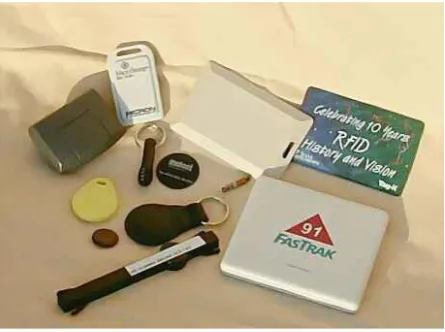
Animal tracking tags, inserted beneath the skin, can be rice sized.
Tags can be screw shaped to identify trees or wooden items.
Credit card shaped for use in access applications. The antitheft hard plastic tags attached to
merchandise in stores are also RFID tags.
Heavy-duty 120 by 100 by 50 millimetre
rectangular transponders are used to track shipping containers, or heavy machinery, trucks, and railroad cars.
Zombie RFID tag,
A tag that can be temporarily deactivated when it leaves the store.
The process would work like this: you bring your purchase up to the register, the RFID scanner reads the item, you pay for it and as you leave the store, you pass a special device that sends a signal to the RFID tag to "die." That is, it is no longer readable.
The "zombie" element comes in when you bring an item back to the store. A special device especially made for that kind of tag "reanimates" the RFID tag, allowing the item to re-enter the supply chain.
VII.
CONCLUSION
inventory control systems, and it’s only a matter of time before the component costs fall low enough to make RFID an attractive economic proposition. Furthermore, extensive engineering efforts are under way to overcome current technical limitations and to build accurate and reliable tag reading systems. We might also start to see economic pressure from the larger distributors to modify product packaging and its associated materials to more effectively integrate RFID. Finally, at this delicate stage, while major corporations are trialing the technology, media reaction and outspoken privacy groups can influence the rules by which we use the technology. RFID’s potential benefits are large, and we’re sure to see many novel applications n the future—some of which we can’t even begin to imagine. The components that go into RFID readers and tags are simple radio communications, but their smaller size and broad deployment enhance the power of the technology and raise concerns about the privacy effects of RFID deployment. These concerns are often premised on unlikely assumptions about where the technology will go and how it will be used.
VIII.
REFERENCES
[1]. Mandeep Kaur, Manjeet Sandhu, Neeraj Mohan and Parvinder S. Sandhu RFID Technology Principles, Advantages, Limitations & Its Applications, IJCEE, Vol.3, No.1, February, 2011 1793-8163.
[2]. T. Kindberg et al., ―People, Places, and Things: Web Presence of the Real World,‖ ACM Mobile Networks & Applications J., 2002, pp. 365–376. [3]. R. Singel, ―American Passports to GetvChipped,‖
Wired News, 19 Oct.
2004;vwww.wired.com/news/privacy/0,1848,v654 12,00.html.
[4]. Dibyendu Bikash Datta, Radio Frequency
Identification Technology: An Overview of its
Components, Principles and
Applications.(IJSETR), Volume 5, Issue 2, February 2016