IJSRR, 7(4) Oct. – Dec., 2018 Page 2438
Research article Available online www.ijsrr.org
ISSN: 2279–0543
International Journal of Scientific Research and Reviews
Micro-Finance and Social Development Banking In India, With Special
Reference To West Bengal: Alternative Or Complementary?
Sushovan Hazra
Department of economics Rampurhat college, Rampurhat, Birbhum, West Bengal 731224 Email: [email protected], Phone: 7602260371
ABSTRACT:
After bank nationalization, the social and developmental orientation of the banking sector has changed the direction of traditional rural credit network. To help the small and marginal farmers, bank introduced priority sector lending to boost agricultural development as well as to lessen the dependence of the rural poor on informal exploitative system. Cooperative banks, scheduled commercial banks and Regional Rural Banks (RRBs) in combined played important role to fulfill above purposes. But this banking system could not have covered a large section of people especially the weaker sections of the people. Besides, the system was not flexible enough to fulfill the social and developmental goals. Therefore, policy makers introduced microfinance as a replacement of social and developmental banking as an effective alternative to the earlier system. They claimed, it would have a more positive impact on socio-economic condition particularly on poverty alleviation. But, this study shows neither the microcredit system could have achieved the target to fulfill the vacuum created due to the withdrawal of the social and development banking as part of financial sector reforms nor it played role in terms of poverty alleviation as it happened in case of institutional banking.
Both primary and secondary sources of data and information have been used in this study. Primary data has been collected from the household survey of two villages. Regarding secondary data, different governmental publications, RBI publications, NABARD reports and books and journals have been consulted.
KEYWORDS:
Micro-credit, social-development banking, rural, agriculture.*Corresponding author
Sushovan Hazra
Associate professor
Department of economics Rampurhat college
Rampurhat, Birbhum, West Bengal 731224
IJSRR, 7(4) Oct. – Dec., 2018 Page 2439
INTRODUCTION
In 1991 when financial reforms had been initiated in India a reversal of policy hitherto
followed in case of banking particularly rural banking occurred. Reversal in two ways, namely, the
new policy was directed first of all towards minimizing the government in the financial sector. And,
secondly, financing agriculture and rural development ceased to be treated as priority lending further.
The emphasis of the earlier social banking was financing agriculture, and, displacing the informal
sector from its powerful position in rural credit market. In the post reforms period policy makers
started to encourage microcredit to fill up the gap left by the formal credit sector.
Chilumuri1 opined that, Indian banking sector has emerged as one of the strongest drivers of
India‟s Economic Growth. The non-viability and poor recovery performance of existing rural credit
institutions, their failure to deal with income-poor borrowers in a sustainable way and inaccessibility
of these institutions to the poor are stated to be major disadvantages of the existing system,
Rangarajan2 argued.Microcredit institutions are seen as being able to rectify these weaknesses.
Microcredit is the very small loans (microloans) to the unemployed, to the poor entrepreneurs
and to others living in poverty and is not bankable [Wikipedia, 2007]. These individuals lack
collaterals. Therefore, they are not worthy for getting bank credit. Microcredit is a part of
microfinance, and includes savings. It was beginning in its modern incarnation as a pilot projects
with ACCION and Md. Yunus in the mid-1970s. The United Nations declared 2005 the International
Year of Microcredit.
According to Ramchandran and Swaminathan3,rural households need credit for a variety of
reasons. They borrow loans for consumption purposes as well as for investment purposes in
agricultural activities. Agricultural activities in India are seasonal in nature. Households, particularly
landless labourers and marginal farmers need credit to combat seasonal fluctuations for their
livelihood and agricultural activities.
Women have become the focus of majority of the microcredit institutions. Women are
believed to be more dedicated to the family affairs than the men do. Besides, giving responsibility to
the women raises their empowerment, socio-economic status and entrepreneurship ability.
OBJECTIVE OF THE STUDY
The objective of the study is, first of all, to verify whether microcredit could have at all
fulfilled the gap/ vacuum created due to the withdrawal of the public sector banking network,
especially after the withdrawal of the subsidized priority sector lending. And secondly, to study the
impact of microcredit on the socio-economic condition of the rural poor in India with special
IJSRR, 7(4) Oct. – Dec., 2018 Page 2440
METHODOLOGY
To fulfill the above objective, as methodology, both secondary and primary sources of data
had been used. Primary data collected from two villages of Birbhum district of West Bengal by
household level survey with the help of a well-structured questionnaire. Selection of the district of
Birbhum has been made keeping in mind the agrarian characteristics of the district and both the
villages belong to same agro-climatic zone. Besides, the demographic composition is mixed in nature
in terms of religion and cast. The sample has been chosen randomly from the population of the
villages, whose primary source of income come from agriculture. In case of secondary data, books
journals, bulletins, government reports etc. have been consulted.
MICROCREDIT IN INDIA
In India, the microfinance network has grown under two different system of patronage of
state and non-statal agencies, Nair4 pointed out.The SHG-linkage programme monitored by
NABARD has the patronage of state and institutional banking system, in the one hand. A parallel
system is working patronized by non-statal private agencies, on the other. Women and poor are the
target population of both of the organizations.
Microcredit programmes, in India, are largely monitored by NABARD, the apex bank for
agriculture and rural development established in 1982. But, in rest of the world, NGO
(Non-Government Organizations) -organized microcredit network is followed. In Bangladesh, Grameen
Bank model is followed.Under the model, NGOs form &develop Self-Help Groups (SHGs) and
provide credit to them.
SHG-Bank Linkage Programme
In India, microfinance schemes operate within an organized financial structure where
NABARD plays the key role in the promotion and development of the SHGs. It refinances at special
rates the SHGs and other financial institutions also. The beginning was made with NABARD‟s pilot
project in Karnataka (1986-87) of linking SHGs with formal banks mediating through NGOs,Nair
said. The main objective of the SHG-Bank Linkage Programme is to provide thrift linked credit
support to the members of SHGs. The target populations of the SHGs are the poor and the women.
Poor households were without access to any formal credit institution. Equally they felt it difficult to
save with the formal banks, Shylendra5 observed.
But, the problemthat is crucial in this regard of the durability of microfinance systemso far,
the poverty alleviation is a great concern. Infusions of cash in any area are bound to have some effect
on the poverty-stricken borrowers. But this does not necessarily mean that the effect will be
IJSRR, 7(4) Oct. – Dec., 2018 Page 2441 form.As on March 2002;SHG advances form only o.15 per cent of outstanding priority sector loans
and 0.51 per cent of the accounts of scheduled commercial banks. Besides, Nair argued, there is no
concrete evidence to prove that cash infusion through microcredit network automatically leads to
livelihood diversification without the insistence of MFI for onlendingto productive purposes. Bhalla6
noticed,“a serious problem with the SHGs isthat the members charge each other 24-36 % for
intra-group lending. This leads to self-exploitationand reduces the potential employment opportunities”.
Formation of Self-Help Groups
Satish7 stated that, an SHG, both by definition and in practice is a group of individual members who come together for a common collective purpose. SHGs comprise individual members
coming from more or less homogeneous group of population of the same village, community or even
neighborhood, and know each other. The group pools their savings on a regular basis to form a
collective fund. This fund is advanced as credit to the members within the group itself. Naturally, the
basis of the SHG is mutual trust. Once the initial trust is established individual members can be
advanced credit from the common fund.
Now, when the groups have taken an operating shape, then a SHG functions through a
repeated rotation of their own savings converted to mutual credit. Then the SHG is introduced to the
banks. This completes the cycle of SHG and microfinance. SHGs are inculcating banking habits in
rural people, especially the women, Verma8 explored.
INSTITUTIONAL BANKING AND RURAL CREDIT -BEFORE AND AFTER
FINANCIAL SECTOR REFORMS
Keeping the objective of the study in mind when analyzing the role of microfinance in Indian
economy let us see what role social and development banking played in Indian economy especially
for agricultural development (more than half of the national population still depends on this sector)
and poverty reduction. Rao9 mentioned that, there are three sources of formal credit – cooperatives,
scheduled commercial banks and regional rural banks.
Prior to the introduction of social and development banking, rural development was a
neglected chapter in banking industries as such. Agriculture and rural development were not an
important agenda in banking. But, after bank nationalization of 1969 and the introduction of social
land development banking the approach and priority got a radical change in favour of hitherto
neglected sector of agriculture and rural development. The post-nationalization era saw a sea-change
IJSRR, 7(4) Oct. – Dec., 2018 Page 2442 with commercial banks, Regional Rural Banks (RRBs) and cooperative institutions extended the
operation in wide range of rural areas, hitherto unattended.
Providing financial services to rural household especially credit has been apriority agenda for
the state since independence. Credit can help farmers to move on to a higher production level,
Narayanan11opined.The report of the All India Rural Credit survey ,1950s was a landmark because it
suggested the state to take part actively in the cooperatives.Sriram12 commented that, the decade of
1970s following bank nationalization in 1969 was marked by directed lending. The target of 40 per
cent was set by RBI for priority sector lending of which 18 per cent for agriculture alone. The
priority sector comprises agriculture and small and medium scale enterprises.
After bank nationalization of 1969, the country witnessed a growth in the rural banking
structure, which in terms of „both geographical spread and functional reach was unparallel in the
financial history of the World‟,Shetty13 argued.
Now, let us see the expansion and coverage of social and development banking, before and after
the bank reforms, in terms of some „indicators.
1. Growth of bank offices:
Table 1: The share of rural bank offices in total bank offices (%)
Years 1969 1972 1990 1998 2002
Share 17.6 36 58.2 50 47.8
Source: S.L.Shetty (1997), cited in Ramchandran&Swaminathan (2005).
From the table it is seen that after bank nationalization the share of rural bank offices has
been increased considerably. But,Ramchandran& Swaminathan showed, after the initiation of
reforms process 2,723 bank offices were closed between March 1994 and March 2000. According to
Shetty, economic reforms may affect other future policies of rural development even SHG-bank
linkageprogramme.
2. Credit and deposit ratio:
After bank nationalization there was an expansion both in deposit and credit in the rural
branches and overall banking sector. The share of „rural deposits‟ doubled in 1970s, from 6.5 per
cent in 1972 to 12.6 per cent in 1980 reaching peak at 1990-91 with 15.5 per cent rural deposits in
aggregate deposits. It fell in 1990s.
It was a same picture in case of credit outstanding. It increased after nationalization and
continued in 1980s until it started declining in the 1980s. It declined from 15 per cent in 1987 and
1988 to 11.2 per cent in March 1990 and 10.2 per cent in 2002, Ramchandran and Swaminathan
IJSRR, 7(4) Oct. – Dec., 2018 Page 2443 As a natural fall-out of the above trend in deposit and credit scenario, credit-deposit ratio
which is an important indicator of the role of banking sector plays for rural development fell in the
rural branches. It rose after 1969, and reached its peak in 1984 and remained above 60 per cent up to
1991. In 1990s, it fell sharply.
3. Share of ‘priority sector’ in gross credit outstanding of scheduled commercial banks
Table 2: Share of ‘priority sector’ in gross credit outstanding of all scheduled commercial banks, India, 1969 to
1999 (per cent)
Years 1969 1984 1986 1990 1991 1996 2001
Share 14.0 38.1 41.0 40.7 37.7 32.8 34.4
Source. S.L. Shetty (1997), cited in Ramchandran and Swaminathan, (2005)
The flow of credit to the „priority sector‟ i.e. to agriculture and small and medium industries
expanded from 1969 and onwards. It reached the target of 40 per cent set by the RBI, and more than
achieved in1986 and 1988. It started to decline after that, and touching the target in 1991 it continued
to fail after that.
Ramchandran & Swaminathan further showed that, it again achieved the target of 40 per
cent, but that is due the redefinition of „priority sector‟ which included advances to newly created
infrastructure funds, to non-banking financial companies and to food-processing industries, and even
multinationals like Pepsi, Kellogg‟s, Hindustan Lever, ConAgra etc.
4. Supply of bank credit to the rural poor:
Commercial banks were directed by RBI to provide credit to the underprivileged section of
the rural population. Under priority sector lending, „weaker sections‟ were defined as small and
marginal farmers, agricultural labourers, and scheduled caste and scheduled tribe households.
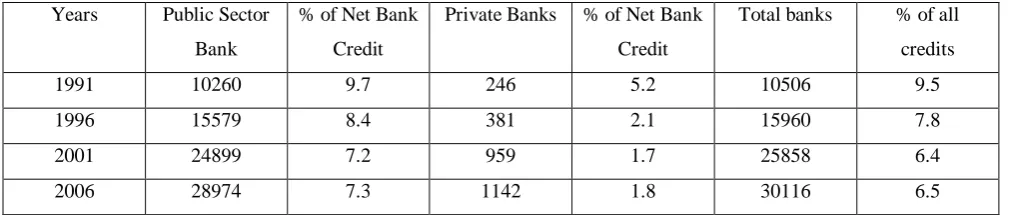
Commercial banks failed to meet 10 per cent fixed for this category after 1991. Rather the gap
widened over the years, Chavan14 claimed.
Table 3: Commercial bank credit to ‘weaker sections in India, 1991-2002(Rs. crore at current prices)
Years Public Sector
Bank
% of Net Bank
Credit
Private Banks % of Net Bank
Credit
Total banks % of all
credits
1991 10260 9.7 246 5.2 10506 9.5
1996 15579 8.4 381 2.1 15960 7.8
2001 24899 7.2 959 1.7 25858 6.4
2006 28974 7.3 1142 1.8 30116 6.5
Source: RBI, Statistical Tables Relating to Banks in India, various issues, RBI (1997, 2002c); cited in Pallavi Chavan
IJSRR, 7(4) Oct. – Dec., 2018 Page 2444 5. Integrated Rural Development Programme
Policy-makers identified a host of problems in rural financial market, and an attempt was
made to resolve those problems through targeting, providing subsidies and applying governmental
control, Satish15 said. Mookherjee and Lahiri16 are of the opinion that, priority lending initiative aims to make credit available to farmers at relatively low interest rates.
The Integrated Rural Development Programme launched in the late seventies of the last
century in India covered a considerable section of the rural poor. As a result of this program, first of
all, access to the institutional banking for the poorer people could have been materialized to a large
extent. Small and marginal farmers could have undertaken agricultural activities in their small and
tiny farms and earned their livelihood. Agricultural production in India increased manifold in the
1980s.The small and marginal farmers could have also availed a part of the high cost new
technology. Though the complain of non-repayment of loan is an issue cannot be ignored totally.
Table 4: Number of beneficiaries and credit disbursed under IRDP, India1980-98(Beneficiaries in lakhs, amount
in Rs. crore at constant prices)
Years No. of Index of no. of
Beneficiaries
Credit Disbursed Index of Credit
Disbursed
1980 27 77.1 893 32.0
1982 35 100.0 2789 100.0
1986 37 105.0 2818 101.0
1987 42 120.0 3142 112.7
1990 29 82.9 2527 90.6
1995 21 60.0 1430 51.3
1998 13 37.1 1112 39.9
Source: CSO (2002), RBI, Report on Trend and Progress of Banking in India, various issues, cited in Pallavi Chavan
(2005).
Indexes above mentioned are (1982=100)
Note: Credit figures have been deflated using GDP deflated with the base year of 1993-94.
The credit advances from commercial banks, showed in the above Table, declined during
1990s, after a steady upward rising trend in 1980s. It reached a peak in1987at Rs.3, 142crores, and
declined thereafter to Rs.1, 112crores in 1998. After this, the scheme was closed down. There was
IJSRR, 7(4) Oct. – Dec., 2018 Page 2445 6. Direct Advances of commercial banks to marginal, small and allCultivators, in India
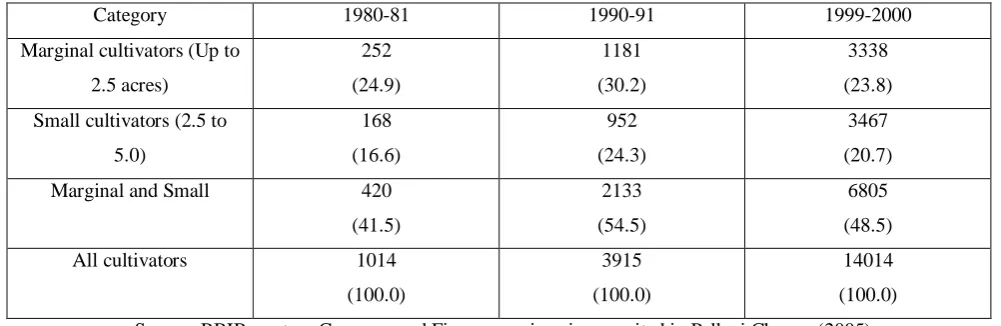
Table 5: Direct advances (short term and medium term) of commercial banks to marginal, small and all
cultivators, in India, 1980-81 to 1999-2000(Rs. crore at current prices)
Category 1980-81 1990-91 1999-2000
Marginal cultivators (Up to
2.5 acres)
252
(24.9)
1181
(30.2)
3338
(23.8)
Small cultivators (2.5 to
5.0)
168
(16.6)
952
(24.3)
3467
(20.7)
Marginal and Small 420
(41.5)
2133
(54.5)
6805
(48.5)
All cultivators 1014
(100.0)
3915
(100.0)
14014
(100.0)
Source: RBIReport on Currency and Finance, various issues, cited in Pallavi Chavan (2005).
Agricultural credit to marginal and small farmers also declined after the initiation of reforms
process in the bank sector. Decline in the share of the marginal farmers is sharper than the decline in
case of the small farmers, Chavan observed on the basis of RBI report.
Therefore, in terms of all the indicators discussed above it can be concluded-
a. After bank nationalization of 1969, the introduction of social and development banking
contributed a lot to expand its geographical area of functioning in a wider scale in terms of
share of population it covered, and both share of deposit creation and credit advancement.
b. Through directed lending with the target set by the RBI it included agriculture and small and
medium industries uncovered before in the bank functioning in modern India.
c. The introduction of a new concept of „priority lending‟ with subsidy in its composition has
helped through different wage-employment and self-employment scheme to create
employment and generate income.
d. The banks turned to be very trustworthy institutionsto the people and became a symbol of
national pride. Even the poorer people could have accessed banking services through the
social and development banking.
e. After the introduction of reforms in the financial sector, all the indicators mentioned above
have been in a declining trend with different rates.
f. The whole banking sector became market-driven profit-oriented concern losing its social
character.
But, to agree with the above conclusion regarding formal banking sectors in India does not
mean that the system was flawless. The very first and foremost criticism against social and
IJSRR, 7(4) Oct. – Dec., 2018 Page 2446 part of the weaker sections of population is still out of the coverage of formal banking. The
advancement of agricultural credit has not been “inclusive” in the true sense of the term as the share
of the marginal and small farmers in the agricultural credits disbursed has declined. Even they are
not aware of the benefit of this interventionist system. They feel that banks are not for the poor
people, rather for the rich people only.
Naturally, the question arises what are the remedies to make social and development banking
more fruitful and pro-poor. The answer to this question prescribed by neo-liberal thinkers/policy
makers is microfinance. This is a market –oriented philosophical manifestation of financial policy. In
the liberalizing world view, the policy-makers claim, deregulation and withdrawal of subsidies in the
agricultural sector are the scientific way to achieve the desired price movements, Sen17categorically
stated that. They are of the opinion that social justice is a matter should not be attempted to be
tackled by the financial instruments. Rather, it is the fiscal instrument that can be used to solve it
[Rangarajan,1996]. Financial sector should function in a market-driven structure. In the name of
externalization of the cost of banking and minimizing the non-performing assets (NPA) of the social
banking framework microfinance is the only viable alternative prescribed by the policy makers in
India prescribed microfinance to be the right instrument and can play role of an alternative to the
earlier social and developmental banking.
Performance of microcredit in India
There are no comprehensive estimates available of the outreach of the microfinance sector to
the poor, from the available estimates it is projected that 80 per cent of the clients are without any
formal savings, and 91 per cent without formal credit. Nearly 77 per cent of the clients are in the
rural sector. The SHGs linked to bank has increased from just 500 in the early 1990s to over 8,
00,000 by 2004, above 80 lakhs households,Basu& Srivastava18 showed.
According to Chavan and Birajdar19, microfinance has spread in India in an impressive pace.
The number of SHGs increased in India from637 in1994 to 22.4 lakh by 2006. Simultaneously, bank
credit to SHGs has increased in a considerable magnitude. This includes commercial banks, Regional
Rural Banks and cooperative banks.
But, in spite of its expansion, there are observations made about the scale and spread of
microfinance in India, Chavan and Birajdar cited in their article. First of all, microfinance remains a
minuscule portion of total bank credit. To understand the small scale of finance to SHGs is to
mention that total cumulative credit disbursed through SHGs programme right from its inception in
1992 to 2006 by commercial banks, RRBs and cooperative banks formed only 6 per cent of total
agricultural credit disbursed in the year of 2005-06 by these institutions together. Let us see their
IJSRR, 7(4) Oct. – Dec., 2018 Page 2447
Table6: Cumulative number and amount of credit to SHGs in India(Amount in Rs. lakh)
Year Cumulative number of SHGs Cumulative amount of bank credit
1994 637 80
2006 22385655 113975400
Source: NABARD (2006), Nanda (1995), cited in Chavan and Birajdar (2009)
Note: Figures for 1994 pertain only to 11 States, where the pilot project of SHG-bank linkage was implemented.
Table 7: Cumulative number of and amount of credit to SHGs, by agency(Amount in Rs. crore)
Agency Cumulative number of SHGs Cumulative amount of credit
Commercial banks 1188040
(53.1)
698745
(61.3)
1.1 Public sector bank 1141570
(51.0)
643968
(56.5)
1.2 Private sector banks 46470
(2.1)
54777
(4.8)
2. Regional Rural Banks 740024
(33.1)
332215
(29.1)
3. Cooperative banks 310501
(13.9)
108795
(9.5)
All banks 2238565
(100)
1139754
(100)
Source: NABARD (2006), cited in Chavan and Birajdar (2009)
Note: Figures in brackets indicate percentage in total.
Secondly, credit to SHGs had an extremely small share in total credit and total loan accounts.
There is a falling tendency in these shares during the period from 2002 to 2007 (Table: 3).
Table 8: Percentage share of credit outstanding to SHGs in total credit outstanding of scheduled commercial banks (including RRBs)
Year Amount of
Credit outstanding to SHGs (in Rs.
crore)
Total credit outstanding to SHGs (in Rs. crore)
Number of loan accounts for SHGs
Total loan accounts
2002 41321 (1.8) 2258529 290904 (0.5) 483280 2007 81156 (0.8) 10094629 53034408 (0.3) 166820470
Source: Basic Statistical Returns, various issues.
Notes: 1. Figures in brackets indicate percentage share of accounts/amount toSHGs in total accounts/amount.
The third point is that, there is a significant concentration in favour of southern region of the
country. More than half of the SHGs were located in this region and about three fourth of the bank
IJSRR, 7(4) Oct. – Dec., 2018 Page 2448
Table 9: Cumulative number of and amount of bank credit to SHGs, by Regions, 2006
Region Cumulative number of SHGs Cumulative amount of bank credit
Northern region 133097
(5.9)
39859 (3.5)
North-Eastern Region 625171
(2.8)
6570 (1.5)
Eastern Region 394351
(17.8)
93542 (8.2)
Central Region 267915
(12.0)
80501 (7.1)
Western Region 166254
(7.4)
52514 (4.6)
Southern Region 1214491
(54.3)
856759 (75.2)
India 22385665
(100.0)
1139754 (100.0) Source: NABARD (2006). Cited in, Chavan and Birajdar, 2009
Notes: 1. Figures in brackets indicate percentage share in total for India
The region-wise classification of States follows from the NABARD publication
Though southern region has greater concentration of microfinance possibly because there
exists a well- developed banking infrastructure in that region but it further reinforces the existing
regional inequality between regions in the development of infrastructure, Chavan &Birajdar pointed
out.
Finally, as microfinance is claimed to be essentially driven towards including the poorer
section of the population into the bankingnetwork. The concentration of microfinance is highest in
the southern region and smallest in the central region. As an SHG normally is made of 15 members
and 60 percent of SHGs have members from families belonging to the Below Poverty Line (BPL)
category (NCAER, 2008), one- third of the population belonging to the southern region is covered by
SHGs.
Table 10: Cumulative number of bank credit to SHGs per person below poverty line, 2005
Region Cumulative no. of SHGs per
thousand persons below poverty line
Cumulative no. of SHGs per person below poverty line
(Rs.‟ 000)
Northern region 8 24
North-Eastern region 10 28
Eastern region 5 13
Central region 3 10
Western region 5 16
Southern region 36 252
Note: Figure for population below poverty line is taken from NSSO for the year 2004-05. Source: NABARD (2006), GOI (2007), cited in Chavan and Birajdar (2009).
On the basis of the above tables and analysis using secondary data, there are some findings
let us mention in the following. First, microfinance in spite of its expansion has remained a
minuscule of India. After a decade and half since its inception in the form of SHG-Bank linkage
IJSRR, 7(4) Oct. – Dec., 2018 Page 2449 advanced by the scheduled commercial banks. Secondly, the data show that the percentage share of
bank credit accounts held by SHGs in India has a falling trend. Thirdly, the spread of micro finance
has considerable regional bias in favour of Southern region.
MICROCREDIT IN WEST BENGAL
West Bengal a state with high population density compared to the other states and national
average. It has passed through a series of land- reforms measures, and has decentralized its state
power up to a considerable extent through a three-tier panchayat system. „Operation Barga‟ has
given the ultimate tiller the right to till the land and thus a social security. Of the ceiling surplus land
acquired and distributed among the landless or marginal farmers (known as „Patta‟) in India, nearly
40 per cent of it is only from West Bengal. The pro-poor state intervention has had a positive impact
on the rural poor, Bhattacharyya20claimed from his primary level observation. These „Bargas‟ and „Pattas‟ entitlement acted as the collaterals for bank loans. As a result, a huge amount of subsidized
credit has been channelized to the poor villagers in West Bengal,Bhattacharyya21observed.
The rural landless labourers and the marginal farmers, having land through the land reforms process,
need credit as working capital for agricultural activities. In the late seventies and early eighties of the
last century, due to the introduction of priority sector lending with subsidy, the weaker sections of
rural India got credit to an extent not refutable. The scheme like IRDP (Integrated Rural
Development Programme) was initiated, a scheme for the creation of permanent income bearing
assets among the poor through the allocation of subsidized credit. But, agricultural loans to this
section were not adequate in volume. Besides, with the decline in the priority sector lending and
subsidized credit inflows after the bank reforms the erstwhile process of rural credit expansion
programme was jeopardized to a major extent. Informal sector, especially input traders, are still very
important source of credit, Dev & Rajeev22 noticed. Moreover, in recent years, agriculture is losing its attraction and has turned out to be a non-profiteering sector. The cost of production is increasing,
in the one hand, and the prices of the agricultural produce are decreasing, on the other. Naturally,
income and mandays creation has been slashed down in the rural sector. Population in the
unorganized sector has been struggling for employment which was shrinking day by day in India,
and West Bengal is no exception.To fill-up this gap between the obligatory responsibility and
achievement, the then Left Front Government in West Bengal has undertaken the microfinance
arrangement, in a full-fledged manner in spite of its market-oriented character, Bhattacharyya
IJSRR, 7(4) Oct. – Dec., 2018 Page 2450 Stage of microfinance movement in West Bengal
According to Roy et all23, the SHG movement in West Bengal is still at a nascent stage with
limited institutional development. Even though West Bengal has the second number of SHGs (11%
of total SHGs in India), but it is far behind Andhra Pradesh (35% of total SHGs in the country). The
average loan size is one of the lowest in the country at Rs. 3,450 per member and Rs. 43,000 per
group.
The government of West Bengal has taken an active part in the SHG-bank linkage
programme from its very inception in the state. The programme has been covered under the SGSY
scheme comprising below poverty line (BPL) households. These SHGs get fund from the District
Rural Development Authorities of the state government and banks with cash credit facility. The
Swarnajayanti Gram Swarojgar Yojana (SGSY) was launched as an integrated programme for
self-employment of the poor with effect from April 1, 1999 [wiki 2007].
MFI in West Bengal
There are NGO-based microfinance institutions (MFIs) like Bandhan, Arohan, Sahara
Utsarga Welfare Society (SUWS)and SaharaUttarayan, Vllage Financial Services Pvt. Ltd. (VFSPL)
etc. in West Bengal. Sometimes, clients like MFI loans because the repayment mode is fixed weekly
installment.
Share of Modern Agencies in Credit Outstanding:The SHG-Bank linkage programme
(SHG-BLP) with policy support from Reserve Bank of India and NABARD has completed 25 years of its
activities. Apart from that,there has been emergence of Microfinance Institutions. But, from the
following Table it will be seen that, in West Bengal, still 49.3 per cent of the total credit outstanding
comes from the informal agencies.
Table 11: Shares of Traditional and Modern Institutional Agencies in Total Credit Outstanding
Credit Agency Formal Agencies Informal
Agencies
Traditional Modern Others
All India 51.1 4.2 0.7 44.0
West Bengal 38.7 10.8 1.2 49.3
Telangana 24.0 7.3 0.4 68.3
Tamil Nadu 54.9 4.1 2.5 38.5
Odisha 52.3 4.7 0.4 42.6
Karnataka 43.5 8.3 0.1 49.6
Andhra Pradesh 33.7 6.8 8.3 49.7
Source: Compiled from NSS Report No. 577;Household Indebtedness in India, cited in NABARD Repot (2016-17).
Therefore, from information put forward by the government agency like NABARD, entrusted
for rural development, and, apex authority for organizing and monitoring SHG-Bank linkage
programme, it can be said that SHG-Bank linkage programme of microfinance has not been
IJSRR, 7(4) Oct. – Dec., 2018 Page 2451 dependence on the exploitative informal sector of credit. Therefore, the tall claims of the neo liberal
policy-makers about the effectiveness of microfinance both about its coverage and being
alternativeness of social and development banking has become a myth rather than a reality.
Village level primary survey findings
I have undertaken village level primary survey in two villages in Birbhum district of West
Bengal. One is Shitalgram of Nalhati-2 Block, and the other one is Lalitakundu of Rampurhat-2
Block. From each village 100 households have been surveyed through structured questionnaire
containing both quantitative and qualitative information. When analyzing the collected data about the
sectoral distribution of the credit/loan and functioning of the SHGs of both the villages following
information have been derived.
Out of total 100 households of the village Shitalgram 30 households had received bank loans
(from Syndicate bank, situated in the village) and 55 households have received informal loans. Of
the 55 loanee from the informal sector 14 households have taken loan from the landlords, 26 from
professional money lenders, 10 from traders, and 4 from relatives and friends and other sources. In
case of the village Lalitakundu, out of 100 households only 3 of them have received bank loans and
85 of them have taken informal sector loans. Of this 85 loanee householdsonly 1 household has taken
loan from the landlords, 40 from professional money lenders, 55 from traders, and 6 households from
the sources of relatives and friends and other sources. In Shitalgram, out of total 100households 42
households are members of self-help groups. But, in Lalitakundu, out of 100 households surveyed,
only 32 are members of self-help groups.
Table 12: Loans taken by households from different sources
Village households
Total number of Banks (formal sector) Informal sector SHG
Shitalgram 100 33 55 42
Lalitakundu 100 3 85 25
Source: Primary level village survey, 2014-15
Both, in Shitalgram and Lalitakundu, professional money lenders and traders are predominant
as sources of credit either in money terms or in terms of kind or both. Sometimes, households take
loan both from professional money lenders and traders, normally for different purposes. People take
loan from money lenders to meet social obligations like marriage of their daughters, house building
or repairing, medical purposes etc. They take consumer goods as well as inputs like fertilize,
pesticide etc. from traders with the conventional norms that when (normally after harvest) they
would accrue some money they would pay the unpaid amount or at least a part of it, obviously with
the consent of the village traders. The basis of these transactions is the mutual personal acquaintance.
Relatives and friends of the poor villagers are normally not so much solvent that the households
IJSRR, 7(4) Oct. – Dec., 2018 Page 2452 Significantly, taking loan from landowners is not a dominant picture in the village level in West
Bengal. This may be due to the predominantly temporary nature of sharecropping in agrarian
economy of the state, or, the tenant preferably does not want to enter into the commitment of
working the same owner in other season of the year because there are alternative sources of income
like MGNREA, non-agricultural job such as construction worker or working in big cities etc.
Table 13: Members of SHGs taking traditional informal sector loans
Village Number of SHG members Out of them taking informal loan
Shitalgram 42 28
Lalitakundu 32 25
Source: Primary level village survey, 2014-15.
From the above Table it is seen that even the SHG members are taking informal sector loans
for their survival. This implies that SHG-Bank Linkage Programme cannot make a member
household economically independent enough that he/she does not have to depend on informal sector
financially. Besides, where majority of the households surveyed depend on informal sector loan,
number of households having membership of SHGs are less than half (42 in case of Shitalgram and
32 in case of Lalitakundu).
Therefore, from the above analysis of data from primary village level survey it is beyond
doubt that the informal sector has very wide and strong presence still in the agrarian economy of
West Bengal. Micro credit movement (as it is called) could not have replaced the presence of
traditional informal sector agents like professional money lenders and traders in the rural credit
market in West Bengal. The role it has played is microscopic compared to the requirement and
possibilities in the state. Ultimately, it is the poor people who suffer.
Purpose-wise the following picture has been noticed. In case of Shitalgram, of the 55 loanee
households from the informal sector number of loan taken for consumption purposes is 33 and for
social (and/or ritual) purposes is 11. Only 9 households havetaken loan for investment purposes,
mainly in agriculture, and 2 for other purposes. In the other village, i. e. in Lalitakundu, out of total
85 number of households taken informal loans, 64 of them have taken for consumption puposes, 10
of them to meet social obligation. Again, only 9 households have taken loans for investment
purposes, and 2 for other purposes.
SHG scenario in West Bengal in the grass-root level
From the village survey it is found that out of 100 households from each village 42
households and 34 households respectively from the villages Shitalgram and Lalitakundu are the
members of SHGs. The members of SHGs have deposited their money with their SHGs, and against
those deposits have taken loans. But, almost all the groups or members baring a few have not taken
initiative to produce any tangible product to sell to make themselves truly self-reliant. Majority of the
IJSRR, 7(4) Oct. – Dec., 2018 Page 2453 other consumption purposes. Avery few members have purchased calves. Majority of the SHGs are
either non-functioning or already wiped away. A few of them are in a moribund stage. Therefore,
from the primary survey of households of the two villages of two different Blocks of Birbhum
district, the tall and much campaigned claims of the policy makers regarding the strength of
microfinance have been falsified. Perhaps people do not think microfinance to be an instrument of
making themselves free from the bondage of poverty. They treat microcredit as an instrument of
earning immediate short-term money. There is neither any repayment pressure from the part of the
monitors of the programmeeven nor are the members motivated for production.
CONCLUSION
From both the secondary data and the primary field survey information, it can be concluded
that the poor recovery logic of social and development banking is not tenable for the introduction of
microcredit in West Bengal as well as in India. Besides, the volume of credit in SHG-bank linkage
programme is so small that the members who take loan from their SHGs do not attempt to take any
initiative for organizing any productive unit. The SHGs in the rural areas are framed by the client
members not with the target of lifting them above poverty-line. Naturally, impression that is created
isthat the policy of micro credit extension through SHG-Bank Linkage Programme is just to
externalize and privatize the responsibility of institutional banking to the market-driven microfinance
network whatever may be the outcome in terms of poverty eradication and/or creation of livelihood
earning.
Therefore, microfinance is not an effective substitute to the social and development banking.
At the most it can be a remote complementary tool to the bank credit system to reach to the poor
without its convincing role as a poverty alleviation tool.
POLICY IMPLICATION
As a policy implication, it can be said, social and development banking should be restored
with some correctional measures. Defaulters of loan particularly those evade large volume of loan
repayment should be dealt with a strict banking and legal provisions. Priority sector lending should
be reconstituted with redefining the definition of the priority sector such that only capital-poor
people are covered in this head. Otherwise, financially solvent entrepreneurs or persons will get the
opportunity to exploit the banking facilities and the whole purpose of priority lending will get
jeopardized. Banking norms of getting loan should be more flexible and simpler especially for the
weaker section of the population. It should be given attention that requirement of collateral does not
pose any major hindrance for getting loan, particularly small loans. Incentives (like interest
IJSRR, 7(4) Oct. – Dec., 2018 Page 2454 clauses of the loan such that the debtor gets interested for timely or early repayment of the loan. If
people are scared of approaching banks as they do not know the formalities to compile with and
fill-up the loan forms, bank should employ/engage staff to assist people to successfully satisfy the
formalities. Bank should create an atmosphere and culture so that people feel the institution as
his/her own, and it is his/her responsibility to keep it alive, vibrant and efficient.
REFERENCES:
1. Chilurmuni, Srinivasa Rao. Impact of Globalization on Scheduled Commercial Banks with
Reference to Agriculture sector. IOSR Journal of Humanities and Social Science (IOSR –
JHSS).2013; 9(1): 05-10
2. ChatterjeeBiswajit (eds). Economic Liberalization in India:Allied Publishers, in collaboration
with DSA Centre for Regional Economic Studies; Dept. of Economics, Jadavpur University,
Calcultta; 1998: -51-63
3. Ramchandran, V. K. &Madhura Swaminathan. Financial Liberalization and Rural Banking in
India. Agrarian Studies 2006; 2.
4. Nair, Tara S. The Transforming World of Indian Microfinance. Economic and Political
Weekly. 2005; Special Issue on Microfinance
5. Shylendra, H.S. Microfinance Bill: Missing the Forest for the Trees. EPW.2007;XIII:
527-228
6. Bhalla, G.S. Indian agriculture since independence. national book trust: Delhi;2007; 169
7. Satish P. Mainstreaming of Indian Microfinance. Economic and Political Weekly; 2005;
Special Issue on Microfinance
8. Varman, P. Mahendra, Impact of self-help groups on Formal Banking Habits. EPW. 2005;
special issue on Microfinance
9. Rao, Chirala Sankar. Class, Cast Differences in Access to Agricultural Credit in India. EPW.
2018; III
10.Patel, Harsad and Pithadia. Vijay, Impact of Globalization on Indian Banking Sector.
ABHINAV. 2013; II:39-46
11.Narayanan, Sudha. Productivity of Agricultural Credit in India. Working Paper No. WP –
2015 -01 Indira Gandhi Institute of Development Research. 2015
12.Sriram, M.S. Microfinance and state: Exploring Areas and Structures of Collaboration. EPW.
IJSRR, 7(4) Oct. – Dec., 2018 Page 2455 13.Shetty, S. L. Rapporteur‟s Report on Working and Impact of Rural Self-Help Groups and
Other Forms of Micro financing. Indian Journal of Agricultural Economics. July- September:
1997;569(3): 580-604.
14.Chavan. Pallavi. Banking Sector Liberalization and the Growth and Regional Distribution of
Rural Banking 2005, V. K. Ramchandran edit. Financial Liberalization and Rural Credit.
15.Satish, P. Rural Finance: Role of State and State-Owned Institutes. EPW. 2004; XXXIX: 12
16.Mookherjee, Dilip and Lahiri, Amartya. Transforming Indian Agriculture: The Role of Credit
Policy [online]. 2015 [cited 2015 December 14]. Available
from:https://www.ideasforindia.in/topics/agriculture/transforming-indian-agriculture-the-role-of-credit-policy.html,
17.Robb Peter (eds). Meaning of Agriculture, Essays in South Asian History & Economics.
Oxford University Press: London1996; 313-331
18.Basu P and Srivastava. Exploring possibilities: Microfinance rural credit access for the poor
in india. EPW. 2005; special issue on Microfinance
19.Chavan and Birajdar. Microfinance and Financial Inclusion of Women: An Evaluation. RBI
Bulletin. 2009
20.Bhattacharyya, S. Capitalist Development, Peasant Differentiation and the State: Survey
findings from West Bengal. The Journal of Peasant Studies. 2001;24:95-126
21.Bhattacharyya. Sudipta.Interest rates, collateral and (de-) interlinkage: a micro-study of rural
credit in West Bengal. Cambridge Journal of Economics. 2005; 29: 3
22.Dev S. and Rajeev M. Banking on Baniyan for credit. EPW. 2007; XLII; 4: 280-283
23.Roy, Srivastava, Chakravorty& Mehta. Access to Credit in West Bengal: Post Microfinance