Ripken Products: A Case For Learning
Activity-Based Costing
Daniel J. Jones, Assumption College, USA
ABSTRACT
This case enables cost accounting students to understand two important and related topics: design flaws inherent in traditional absorption costing systems and the fundamentals of activity-based costing (ABC). The focused approach requires only one class session to cover both topics. Ripken Products, a fictional manufacturer, uses absorption costing to cost its products. The company allocates manufacturing overhead using a budgeted manufacturing overhead rate based on direct labor cost. The company president decides to discontinue a product with a reported zero gross profit. A student intern suggests that the company could improve the accuracy of its costing for individual products if it assigned manufacturing overhead using activity-based costing. Students learn to calculate product costs using ABC, and then they explore reasons for significant differences between ABC costs and the company’s reported costs. Students discover the logical flaws of allocating overhead costs arbitrarily using traditional absorption costing methods. They also learn why assigning overhead costs based on traceable consumption of resources leads to more accurate product costing.
Keywords: Activity-Based Costing; Product Costing; Absorption Costing; Cost Allocation; Cost Assignment
RIPKEN PRODUCTS
“For years, I have been telling you that your cost accounting system is broken. I have had it with your numbers, Ed. I never trusted them. You will be sorry that you made this decision, Paul. Now I must get back to my people on the plant floor.” With these words, Production V.P., Rick Dempsey stormed out of the weekly Thursday meeting of the Ripken Products senior management team.
t the meeting, owner and CEO Paul Richards announced the decision to eliminate the Delete product from the company’s product line. Since its founding six years earlier, Ripken Products manufactured all of its four products in its Towson, Maryland plant. After assessing profitability of each product based upon the analysis prepared by company controller, Ed Murray, Richards decided to eliminate its Delete product two days earlier. He announced his decision at the meeting with the company’s five senior managers:
Ed Murray, Controller
Rick Dempsey, VP of Production L. Rod Hendricks, VP of Marketing Jim Palmer, VP of Human Resources Ruth George, Sales Manager
Ripken Products produces four chemical eradicators: Abolish, Banish, Cancel, and Delete. Within the company, they are referred to as products A, B, C, & D. The company uses normal absorption costing to account for its manufacturing costs. Ripken’s costing system charges manufacturing overhead costs to these products using direct labor dollars as an allocation base. The company’s 2013 manufacturing budget included the following amounts:
direct material costs of $900,000 direct labor costs of $840,000
manufacturing overhead of $1,680,000
Based upon its estimated 2013 manufacturing costs, the company’s budgeted manufacturing overhead rate for 2013 was $2.00 of manufacturing overhead per $1.00 of direct labor, (or simply “2.00”) as calculated below.
Budgeted Mfg. Overhead Rate = Estimated Manufacturing Overhead for 2013 = $1,680,000 = 2.00 Estimated Direct Labor Cost for 2013 $840,000
Table 1 presents the company’s 2013 budgeted manufacturing costs, by product and in total. To allocate the total budgeted manufacturing overhead of $1,680,000 to individual products, the direct labor cost for each product is multiplied by 2.00.
Table 1: 2013 Estimated Manufacturing Costs (using absorption costing)
A B C D Total
Direct Material Cost Direct Labor Cost Manufacturing Overhead
$90,000 84,000 168,000
$90,000 84,000 168,000
$180,000 168,000 336,000
$540,000 504,000 1,008,000
$900,000 840,000 1,680,000 Total Manufacturing Cost $342,000 $342,000 $684,000 $2,052,000 $3,420,000
Units Produced 342,000 342,000 684,000 684,000
Cost per Unit $1.00/unit $1.00/unit $1.00/unit $3.00/unit
The company’s 2013 pro forma income statement is presented in Table 2. There was no inventory on December 31, 2012 and it plans to have no inventory of any product on December 31, 2013.
Table 2: 2013 Pro Forma Income Statement
A B C D Total
Sales
Cost of Goods Sold
$410,400 342,000
$376,200 342,000
$957,600 684,000
$2,052,000 2,052,000
$3,796,200 3,420,000 Gross Profit
Operating Expenses
$68,400 $34,200 $273,600 0 $376,200
320,000
Profit Before Taxes $56,200
Because of constraints on the AB-19 machine, the company can produce a total of 684,000 units of Abolish and Banish, in any combination. For example, the company can produce 683,000 Abolish units and 1,000 Banish units. Similarly, the CD-25 machine can produce a total of 1,368,000 Cancel and Delete units. Because of this and because the prices of all products are determined by “the market,” L. Rod Hendricks, Marketing VP, had been advocating for elimination of products Banish and Delete.
In conversations with Controller Ed Murray over the years, Rick Dempsey had expressed his dissatisfaction with the timeliness, usefulness and accuracy of the Accounting Department’s monthly manufacturing control reports. In recent months, Dempsey used almost no information in these reports to make decisions regarding managing production in the plant. In prior conversations, Murray explained that the monthly reports reflected traditional costing practices that were described in the three Cost Accounting text books that he gave to Dempsey in 2011. During several contentious debates, Murray reminded Dempsey that he was both a Certified Public Accountant (C.P.A.) and a Certified Management Accountant (C.M.A.).
Rick Dempsey asked Robin Brooks to explain ABC to him, and Robin took the next hour to do so. At the end of the discussion, he asked her to calculate product costs for the four products using ABC. When she estimated that it would take her about two weeks to complete the assignment, Dempsey asked if they could work together to do the work within three days. She agreed to work overtime to try to meet the deadline.
One day later, Robin Brooks presented Rick Dempsey with the information in Table 3. The table identifies the six manufacturing overhead categories and their associated costs. Together, they comprise total budgeted manufacturing overhead costs for 2013.
Table 3: Estimated Manufacturing Overhead (2013) Purchasing
Machine setups for production runs Material movements
Machine depreciation Facility rent
Other manufacturing overhead
$72,000 92,500 36,000 840,000 480,000 159,500
Total $1,680,000
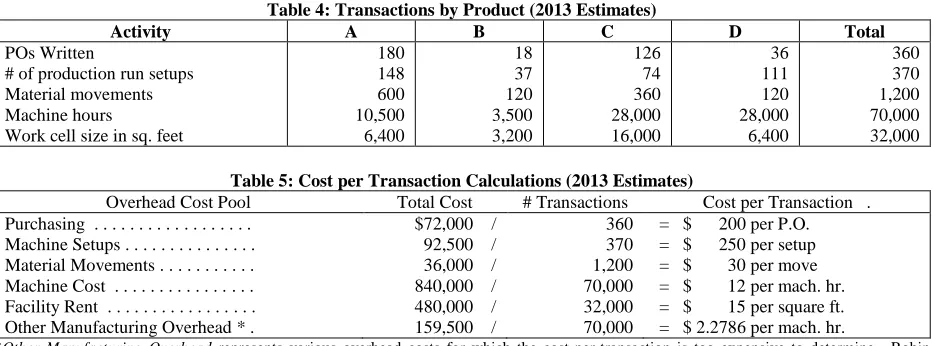
Working together over the next two days, Dempsey and Brooks compiled and organized the information in Tables 4 & 5 regarding the company’s transactions and cost drivers
Table 4: Transactions by Product (2013 Estimates)
Activity A B C D Total
POs Written
# of production run setups Material movements Machine hours
Work cell size in sq. feet
180 148 600 10,500 6,400 18 37 120 3,500 3,200 126 74 360 28,000 16,000 36 111 120 28,000 6,400 360 370 1,200 70,000 32,000
Table 5: Cost per Transaction Calculations (2013 Estimates)
Overhead Cost Pool Total Cost # Transactions Cost per Transaction . Purchasing . . .
Machine Setups . . . Material Movements . . . Machine Cost . . . Facility Rent . . . Other Manufacturing Overhead * .
$72,000 / 92,500 / 36,000 / 840,000 / 480,000 / 159,500 /
360 370 1,200 70,000 32,000 70,000
= $ 200 per P.O. = $ 250 per setup = $ 30 per move = $ 12 per mach. hr. = $ 15 per square ft. = $ 2.2786 per mach. hr.
*Other Manufacturing Overhead represents various overhead costs for which the cost-per-transaction is too expensive to determine. Robin thought it best to allocate these costs (9.5% of total overhead) on a machine-hour basis.
As they reviewed this information at 5:30 on Thursday evening, Dempsey and Brooks expressed their mutual concerns about the unit product costs in Table 2. Each felt that there were distortions in the company’s unit production costs of $1.00 for A, B, and C, and $3.00 for D. They decided to work for another two hours in order to see if they could identify the ABC unit costs for these four products by using the information that they compiled over the last three days.
Realizing that they had to redistribute the $1,680,000 of total manufacturing overhead cost to the four products, Dempsey and Brooks put aside Table 6 until they were able to reassign these costs.
Table 6: 2013 Estimated Manufacturing Costs (using Activity-based Costing [ABC])
A B C D Total
Direct Material Cost Direct Labor Cost
Manufacturing Overhead
$90,000 84,000
$90,000 84,000
$180,000 168,000
$540,000 504,000
$900,000 840,000 1,680,000
Total Manufacturing Cost $3,420,000
Units Produced 342,000 342,000 684,000 684,000
Total Mfg. Cost per Unit
Robin handed a copy of Table 7 to Rick Dempsey and kept a copy for herself. They agreed that he would assign the costs for purchasing, machine setups, and material movements, and that she would do the same for the other three cost pools. They were enthusiastic regarding this endeavor.
Table 7: Manufacturing Overhead Cost Assignment for 2013 (Using ABC)
Overhead Cost Pool Cost per Activity A B C D Total
Purchasing Machine Setups Material Movements Machine Cost Facility Rent
Other Manuf. Overhead
200 250 30 12 15 2.2786
$72,000 92,500 36,000 840,000 480,000 159,500
Total Manuf. Overhead $1,680,000
Required:
1. Complete Table 7 to determine total manufacturing overhead by product using ABC. 2. Complete Table 6 to determine total manufacturing cost by product using ABC.
3. Identify which products are profitable if the company used ABC. Based on your answer, do you agree with the decision to discontinue the Delete product?
4. How would you advise Rick Dempsey to explain this information to CEO Paul Richards, Controller Ed Murray, and other members of the senior management team? Explain what activity-based costing is, and a brief explanation regarding how ABC improves the accuracy of reported cost of individual products compared to Ripken’s absorption costing system.
AUTHOR INFORMATION
Daniel J. Jones, CPA, MBA, is Associate Professor of Accounting at Assumption College, USA. He teaches financial accounting, cost accounting, and personal finance courses. His primary research interest is teaching and learning accounting. E-mail: [email protected]
REFERENCES
1. Bruns, W. J., Jr. (1997 revised). Destin Brass Products Co. (Harvard Business School Case No. 9-190-089). 2. Kaplan, R. S. (1998). Classic Pen Co.: Developing an ABC Model. (Harvard Business School Product
#198117-PDF-ENG).
3. Kaplan, R. S., & Cooper, R. (1998). Cost and effect: using integrated cost systems to drive profitability and performance. Boston, MA: Harvard Business School Press.
TEACHING NOTE
Course and Audience
This case is appropriate for an undergraduate or graduate cost accounting or managerial accounting course. The author uses it during the course transition from traditional absorption costing (and its perils) to ABC concepts and practices.
After covering traditional management accounting topics in the first 70% of the course, the author devotes the remainder of the course to challenging conventional thinking regarding traditional managerial cost accounting and exposing its pitfalls. He explains to students that he expects them to learn to be agents of change and innovation in their professional careers. The author introduces this second phase of the course with a discussion of Ford Worthy’s “Accounting Bores You, Wake Up!” followed by the Ripken Products case.
Students must realize the importance of reading the case and attempting to solve it before coming to class. If they do so, this focused case minimizes the amount of class time required to explain both the pitfalls of absorption costing and ABC fundamentals.
The author uses the class questions to guide class discussion. Others may prefer to ask students to answer some or all of the questions as a written assignment to be turned in for grading. The discussion format works well when the professor uses student responses to complete the Table 7 worksheet on a whiteboard, transparency, or computer projection.
The author also uses the case in seminars and workshops for accountants, managers, and other professionals.
Learning Objectives
This case enables students to learn the following points:
Traditional absorption costing can trigger dysfunctional decisions.
ABC is a costing system that assigns costs to products (or other cost objects) based on traceable consumption of resources.
ABC provides new insights regarding product costs and product profitability.
ABC cost assignment is an improvement on traditional costing that arbitrarily allocates overhead costs to products.
ABC challenges conventional wisdom that manufacturing overhead costs are always “indirect” costs. They will learn methods of calculating ABC costs.
Answer Guide and Solution Handout
The first three case questions are:
Complete Table 7 to determine total manufacturing overhead by product using ABC. Complete Table 6 to determine total manufacturing cost by product using ABC.
Identify which products are profitable if the company used ABC. Based on your answer, do you agree with the decision to discontinue the Delete product?
RIPKEN PRODUCTS
SOLUTION HANDOUT FOR QUESTIONS 1, 2, & 3
Question 1:
Table 7: (completed): Worksheet for Question 1
Manufacturing Overhead Cost Assignment for 2013 (using Activity-based Costing [ABC])
Overhead Cost Pool Cost per Activity A B C D Total
Purchasing Machine Setups Material Movements Machine Cost Facility Rent Other Mfg. Overhead
200 250 30 12 15 2.2786 36,000 37,000 18,000 126,000 96,000 23,925 3,600 9,250 3,600 42,000 48,000 7,975 25,200 18,500 10,800 336,000 240,000 63,800 7,200 27,750 3,600 336,000 96,000 63,800 $72,000 92,500 36,000 840,000 480,000 159,500 Total Budgeted O’head $ 336,925 $114,425 $694,300 $534,350 $1,680,000
Question 2:
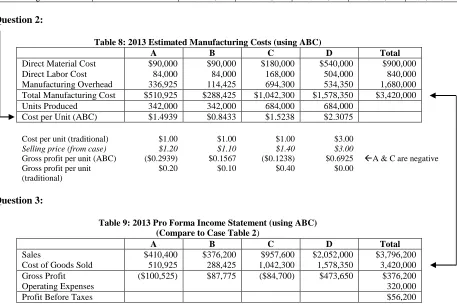
Table 8: 2013 Estimated Manufacturing Costs (using ABC)
A B C D Total
Direct Material Cost Direct Labor Cost Manufacturing Overhead $90,000 84,000 336,925 $90,000 84,000 114,425 $180,000 168,000 694,300 $540,000 504,000 534,350 $900,000 840,000 1,680,000 Total Manufacturing Cost $510,925 $288,425 $1,042,300 $1,578,350 $3,420,000 Units Produced 342,000 342,000 684,000 684,000
Cost per Unit (ABC) $1.4939 $0.8433 $1.5238 $2.3075
Cost per unit (traditional) $1.00 $1.00 $1.00 $3.00
Selling price (from case) $1.20 $1.10 $1.40 $3.00
Gross profit per unit (ABC) ($0.2939) $0.1567 ($0.1238) $0.6925 A & C are negative Gross profit per unit
(traditional)
$0.20 $0.10 $0.40 $0.00
Question 3:
Table 9: 2013 Pro Forma Income Statement (using ABC) (Compare to Case Table 2)
A B C D Total
Sales
Cost of Goods Sold
$410,400 510,925 $376,200 288,425 $957,600 1,042,300 $2,052,000 1,578,350 $3,796,200 3,420,000 Gross Profit Operating Expenses
($100,525) $87,775 ($84,700) $473,650 $376,200 320,000
Profit Before Taxes $56,200
Using ABC, Product D (Delete) is the Ripken’s most profitable product. It should not be discontinued. The only other profitable product is Product B (Banish). Product A and Product C are not profitable.
Question 4:
Classroom discussion points regarding Question 4 are presented below:
Content and formats in Solution Handout for Questions 1, 2, & 3 are useful for communicating relevant information to managers.
ABC is a costing system that many companies use as an alternative to traditional normal (actual or standard) absorption costing.
Costing for direct materials and direct labor are treated the same under absorption costing and ABC. The difference between absorption costing and ABC is in the treatment of manufacturing overhead costs. Regarding accuracy of reported costs in the question:
o A company that uses traditional normal costing establishes a companywide cost “pool” for manufacturing overhead, or a single cost pool for each department, and arbitrarily allocates those costs arbitrarily and incorrectly to objects (products in the case) using a budgeted manufacturing overhead rate.
o A company that adopts ABC establishes multiple cost pools, and then causally assigns these costs to cost objects (products in the case) based upon traceable consumption of costs (resources), as students do in the Ripken Products case.
ABC tracing of overhead cost pools to products (or other cost objects) is an acknowledgment that many overhead costs can be assigned to products based on consumption of resources. This is similar to the assignment of direct materials and direct labor, although it is not as accurate.
The following example enables managers to understand the fundamental errors inherent in traditional normal costing systems. If a machine is leased for the purpose of manufacturing only one product, ABC will assign all of the lease cost to that product only. Normal costing erroneously spreads the lease cost to all products.
Companies that use normal costing often carry individual product costs to several decimal places. ABC adopters frequently observe that that the number to the left of the decimal is wrong for some products in their normal costing calculations.
The arbitrary allocations in traditional absorption systems can lead to dysfunctional decisions, such as discontinuing Product D (Delete) in this case.
Companies may use ABC information as the basis for adjusting product selling prices. This may be difficult if customers determine prices in competitive markets.
Most companies realize that ABC provides approximations of costs, and most of them believe that ABC costs are more accurate than normal absorption-based costs.
Many companies who use ABC for profitability analysis choose to use absorption costing for financial reporting on their income statements and balance sheets. Absorption costing systems require less effort and cost. In addition, they usually provide allocations of total manufacturing costs between inventories and cost of goods sold expenses in the financial statements that are not materially different than corresponding ABC amounts.
Full product costs include both variable and fixed costs. Because costs are not categorized as variable or fixed in this case, contribution margin analysis cannot be performed without additional information.
EXTENSIONS AND LIMITATIONS OF ABC CONCEPTS AND METHODS
Extensions of ABC include:
Similar to its use in costing products, ABC can be applied to costing services. In addition, some organizations use ABC methods to assign SG&A (selling, general, and administrative) costs.
In addition to determining profitability of products and product lines, ABC methods can be used to assess customer profitability.
Limitations of absorption costing and ABC include:
Some overhead costs are difficult to assign to products, even in ABC systems. The president’s salary and other business sustaining costs are common examples. For this reason, users realize that ABC costs are not precise representations.
ABC systems are commonly expensive to design and implement.
RELEVANT LITERATURE