Method to Improve Surveillance
abstract
This article describes a multistate population-based surveillance system for monitoring sudden unexpected infant deaths (SUIDs) known as the SUID Case Registry pilot program. The pilot program represents collab-oration between the Centers for Disease Control and Prevention and the National Center for Child Death Review (NCCDR), which is funded by the Health Resources and Services Administration. The SUID Case Registry builds on existing child death review system activities and protocols. The objectives of the SUID Case Registry are to collect accurate and consis-tent population-based data about the circumstances and events as-sociated with SUID cases, to improve the completeness and quality of SUID case investigations, and to use a decision-making algorithm with standardized definitions to categorize SUID cases. States who participate in the pilot program commit to review all SUID cases in their state by using their multidisciplinary state and local child death review teams. These teams request and review data from death scene investigators, medical examiners and coroners, law enforcement, social services, pe-diatric and obstetric providers, and public health per usual, but as part of the pilot program, supplement their SUID case reviews by discussing ad-ditional medical, environmental, and behavioral factors, and entering this data using the NCCDR Web-based Case Reporting System. This new sur-veillance system aims to improve knowledge of factors surrounding SUID events and improve investigation practices. The surveillance system will allow researchers and program planners to create prevention strategies and interventions, ultimately reducing SUIDs and injury-related infant deaths.Pediatrics 2012;129:e486–e493
AUTHORS:Carrie K. Shapiro-Mendoza, PhD, MPH,aLena T. Camperlengo, RN, MPH, DrPH(c),,bShin Y. Kim, MPH,aand Theresa Covington, MPHb
aDivision of Reproductive Health, National Center for Chronic
Disease Prevention and Health Promotion, Centers for Disease Control and Prevention, Atlanta, Georgia; andbNational Center for Child Death Review, Michigan Public Health Institute, Okemos, Michigan
KEY WORDS
SIDS, SUID, child death review, surveillance, infant mortality, infant injury
ABBREVIATIONS
CDC—Centers for Disease Control and Prevention CDR—Child Death Review
NCCDR—National Center for Child Death Review NVDRS—National Violent Death Reporting System SIDS—sudden infant death syndrome
SUID—sudden unexpected infant death
SUID-CR—Sudden Unexpected Infant Death Case Registry Dr Shapiro-Mendoza and Ms Camperlengo as primary authors, contributed substantially to the conception and design, acquisition of data, analysis and interpretation of data. They drafted the article and revised it critically for important intellectual content; and soughtfinal approval of the version to be published. Ms Kim and Ms Covington, as co-authors, contributed substantially to the conception and design, acquisition of data, analysis and interpretation of data. They assisted in drafting the article and revised it critically for important intellectual content; and assisted in thefinal approval of the version to be published.
Thefindings and conclusions in this report are those of the author(s) and do not necessarily represent the official position of the Centers for Disease Control and Prevention.
www.pediatrics.org/cgi/doi/10.1542/peds.2011-0854
doi:10.1542/peds.2011-0854
Accepted for publication Oct 7, 2011
Address correspondence to Carrie Shapiro-Mendoza, PhD, MPH, Maternal and Infant Health Branch, Division of Reproductive Health, Centers for Disease Control and Prevention, Mailstop K-23, 4770 Buford Highway, NE, Atlanta, GA 30341-3717. E-mail: [email protected]
PEDIATRICS (ISSN Numbers: Print, 0031-4005; Online, 1098-4275).
Copyright © 2012 by the American Academy of Pediatrics
INTRODUCTION
Recently, attention has focused on three particular causes of sudden unexpected infant death (SUID): sudden infant death syndrome (SIDS), unknown cause, and accidental suffocation and strangulation in bed. We define SUID as the death of a previously healthy infant,365 days old without an obvious cause before a medicolegal investigation. These SUIDs accounted for about 4000 US infant deaths in 2007, with 2323 classified on US death certificates as SIDS, 1058 as unknown causes, and 588 as acciden-tal suffocation or strangulation in a sleep environment.1Determination of
the cause of SUID can vary on the basis of available scene investigation evidence and the diagnostic practices of certifiers.2,3 Many SUIDs are
asso-ciated with unsafe sleep environments. To accurately determine the cause of death for SUID, the medical examiner or coroner needs a thorough scene inves-tigation, detailed clinical history, and autopsy findings.4 Several pathologic
markers have been proposed, but currently no reliable marker exists at autopsy to distinguish a suffocation death from SIDS.2
Although SIDS declined by∼50% during the 1990s, a less dramatic decline has been observed in recent years.5–7This
less dramatic decline is likely explained by increasing rates of infant deaths classified as “accidental suffocation” and “unknown cause.”5 Certifiers
ap-pear to be moving away from attribut-ing the cause of death to SIDS and favoring other determinations, such as “unknown cause” and “accidental suf-focation.”6Reasons for this diagnostic
shift are unknown, but may be a result of stricter adherence to SIDS definitions, improved availability of death scene in-vestigation data, and influence from lo-cal and child death review teams.4,6With
increased attention on sleep-related suffocation deaths that are potentially preventable, accurate and reliable
surveillance estimates that are based on standardized reporting and
classi-fication practices are essential for ac-curate and consistent monitoring of SUID trends and are critical for devel-oping effective prevention messages and other interventions.
Currently, vital statistics data are the primary source for monitoring US trends and characterizing circum-stances surrounding SIDS and other SUIDs. However, death certificates are limited in their ability to fully describe the circumstances surrounding SUID events, and thus cannot provide suffi -cient data to inform policy and program decisions.6,8The new SUID Case
Regis-try (SUID-CR) complements surveil-lance of SUID using death certificates by providing more detailed data about case investigationfindings so that the medical, environmental, and behav-ioral factors associated with SUID can be described in greater detail. These additional descriptive data will allow the application of standardized defi -nitions developed especially for the new SUID-CR to categorize SUID cases. This categorization system groups SUID cases that have similar charac-teristics. Grouping injury-related SUID cases can guide prevention activities. For example, if a number of suffocation deaths that have resulted from hazards in the sleep environment are identified by using the SUID-CR categories, Child Death Review (CDR) teams and other program planners can use this new information to improve their injury prevention messages, especially those aimed at promoting safe sleep. The SUID-CR will also categorize deaths by availability of investigation data, which is needed to quantify the number of unexplained infant deaths in which a case investigation is missing or incomplete. This new knowledge can be used to focus efforts aimed at im-proving the thoroughness of SUID case investigations.
METHODS
SUID-CR Objectives
The objectives of the SUID-CR are to col-lect accurate and consistent population-based data about the circumstances and events surrounding SUID cases, to improve the completeness and quality of SUID case investigations, and to categorize SUID cases by the use of a decision-making algorithm with stan-dardized definitions. This categoriza-tion system will not only allow improved monitoring of SUID trends, but will also assist program planners and policy makers with identifying tar-geted strategies to reduce potentially preventable infant deaths.
CDR and the SUID-CR
To assess the practicality of collecting more detailed medical history, scene investigation and autopsy data for SUID cases, the Centers for Disease Control and Prevention (CDC) conducted a fea-sibility study during 2007 and 2008. Seven states that were already contributing to the National Violent Death Reporting System (NVDRS) participated. The NVDRS collects data on violent deaths from a variety of sources, including death cer-tificates, police reports, medical exam-iner and coroner reports, and crime laboratories.9 Many of these sources
would be essential to a SUID surveil-lance system. For the feasibility study, state NVDRS coordinators identified SUID cases and used CDC’s Sudden Unexplained Infant Death Investigation Reporting Form to abstract extant data from medical examiner and coroner reports from 2005 to 2006 that were available to NVDRS and considered critical for SUID case investigations.10
tidisciplinary teams, the CDR system already identifies and reviews SUID cases through collaborations with medical examiners and coroners, law enforcement, as well as social services and public health representatives. This collaboration allows CDR teams to ac-cess medical examiner and coroner reports that a comprehensive SUID surveillance system would require. The use of the CDR system for SUID surveil-lance would prevent the duplication of efforts and provide data for population-based SUID surveillance. In addition, enhancing the CDR system could im-prove the quality and comprehensive-ness of collected SUID data and improve team activities aimed at SUID prevention.
In response to the feasibility study, CDC convened 2 national meetings with experts to collect ideas and suggestions for developing a national SUID surveil-lance system. In March and July 2008, experts in medicolegal death investiga-tion, injury surveillance, SUID and injury prevention, epidemiology, and pediat-rics met in Atlanta, Georgia. The first meeting focused on developing a pro-gram model that addressed information
flow and organizational structure. The second meeting identified specific questions that SUID surveillance could answer, such as determining the extent to which unsafe sleep environments play a role in infant deaths. After these meetings, CDC identified the National Center for Child Death Review (NCCDR), which is funded by the Health Resources and Services Administration, and the NCCDR’s Web-based data collection tool, the Case Reporting System, as the most efficient system to integrate SUID-specific variables for SUID surveillance. This new surveillance system is now referred to as the SUID-CR. The name is based on pref-erences voiced by parents who experi-enced the loss of an infant from SIDS.
conduct a comprehensive, multidisci-plinary review of infant and child deaths; to better understand how and why children die; and to use thefindings to take action to prevent future deaths, thereby improving the health and safety of all children.11,12 State-mandated or
-enabled CDR teams currently function in 49 states, all of which already review sudden infant deaths, such as SIDS, as part of their review process. Thirty-seven of the states have local review teams, whereas 12 states review deaths only at the state level.13State and local
teams in 39 states were using the NCCDR Web-based Case Reporting System on a voluntary basis as of December 2011.14
Through a competitive CDC proposal process, 13 states expressed interest in a SUID-CR system by submitting a posal to participate in the pilot pro-gram. An objective review committee at CDC scored state proposals based on an ability to demonstrate timely identifi -cation, notification and review of SUID cases, and evidence of access to med-ical examiner and coroner records in-cluding reports from autopsies, death scene investigations,first responders, law enforcement, social services, and public health and medical providers. The committee also considered the annual number of SUID cases expected in the state and representation of ra-cially, ethnically, and geographically diverse populations. To maintain uni-formity in data-reviewing and -entry procedures, the states in the pilot program have agreed to follow NCCDR and CDC SUID-CR protocols. CDC awarded funding to 5 states— Colorado, Georgia, Michigan, New Jersey, and New Mexico—in August 2009. State public health personnel implement child death review based on state mandates and may include teams that are state-only, regional or county, or a combination of these types. CDC
in New Mexico to 200 cases in Georgia.
Funded states received specialized training at CDC to learn about the program model and SUID-specific var-iable definitions and data sources. The grantees conducted their own state and local trainings for their respective child death review teams. During the first year of the pilot program, each state received a 2 to 3 days on-site, one-on-one technical assistance from a 2-person team consisting of a CDC and a NCCDR representative that included an observation of a SUID review fol-lowed by feedback. Monthly conference calls provide an opportunity for the states to discuss barriers to data col-lection, provide progress updates, and share strategies. Grantees keep com-munication logs to document any
dif-ficulties encountered by local, regional, or state teams. Also, grantees identified their first year strengths and chal-lenges during a technical assistance meeting at CDC. At the CDC meeting, grantees worked with CDC and other SIDS and SUID experts to develop plans for improvement.
The SUID-CR Pilot Program
rely on vital statistics, the SUID-CR includes data on the circumstances and factors associated with an unex-pected infant death, as well as informa-tion about the comprehensiveness of death scene investigations and autopsies conducted. These data are captured in the updated Case Report System, the data collection tool for the SUID-CR.
SUID-CR Variables
In implementing the SUID-CR, CDC and NCCDR reviewed existing variables in the NCCDR Case Reporting System and
created or modified existing SUID-specific variables to address signifi -cant questions identified by researchers, program directors, and policy makers. As part of its collaboration with CDC, the NCCDR has added or modified these SUID-specific variables in its updated NCCDR Case Report and Web-based Case Reporting System.
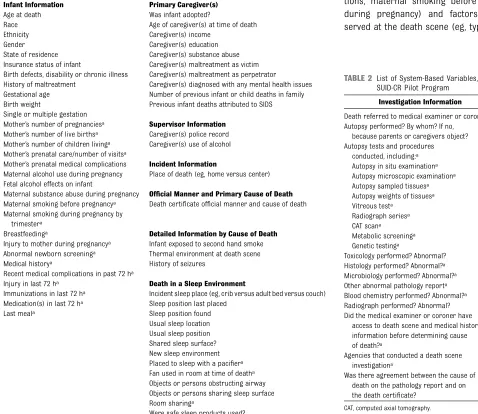
These variables can be divided into two types: individual-based (Table 1) and system-based variables (Table 2). Variables with information about the circumstances and events leading to
or associated with a SUID case are the individual-based variables. Alternatively, variables that contain information about the components and completeness of a case investigation, including scene in-vestigation, autopsy, and medical re-cords review, are the system-based variables.
Individual-Based Variables
Individual-based variables provide a detailed description of the environ-mental, behavioral, and medical char-acteristics surrounding each SUID case. Examples of individual-based variables include infant and maternal health status factors (eg, infant immuniza-tions, maternal smoking before and during pregnancy) and factors ob-served at the death scene (eg, type of TABLE 1 List of Individual-Based Variables, SUID-CR Pilot Program
Infant Information Primary Caregiver(s)
Age at death Was infant adopted?
Race Age of caregiver(s) at time of death
Ethnicity Caregiver(s) income
Gender Caregiver(s) education
State of residence Caregiver(s) substance abuse Insurance status of infant Caregiver(s) maltreatment as victim Birth defects, disability or chronic illness Caregiver(s) maltreatment as perpetrator
History of maltreatment Caregiver(s) diagnosed with any mental health issues Gestational age Number of previous infant or child deaths in family Birth weight Previous infant deaths attributed to SIDS Single or multiple gestation
Mother’s number of pregnanciesa Supervisor Information
Mother’s number of live birthsa Caregiver(s) police record
Mother’s number of children livinga Caregiver(s) use of alcohol
Mother’s prenatal care/number of visitsa
Mother’s prenatal medical complications Incident Information
Maternal alcohol use during pregnancy Place of death (eg, home versus center) Fetal alcohol effects on infant
Maternal substance abuse during pregnancy Official Manner and Primary Cause of Death
Maternal smoking before pregnancya Death certificate official manner and cause of death
Maternal smoking during pregnancy by trimestera
Breastfeedinga Detailed Information by Cause of Death
Injury to mother during pregnancya Infant exposed to second hand smoke
Abnormal newborn screeninga Thermal environment at death scene
Medical historya History of seizures
Recent medical complications in past 72 ha
Injury in last 72 ha Death in a Sleep Environment
Immunizations in last 72 ha Incident sleep place (eg, crib versus adult bed versus couch)
Medication(s) in last 72 ha Sleep position last placed
Last meala Sleep position found
Usual sleep location Usual sleep position Shared sleep surface? New sleep environment Placed to sleep with a pacifiera
Fan used in room at time of deatha
Objects or persons obstructing airway Objects or persons sharing sleep surface Room sharinga
Were safe sleep products used?
aDenotes a new variable added for states in the SUID-CR Pilot Program Case Registry pilot program only.
TABLE 2 List of System-Based Variables, SUID-CR Pilot Program
Investigation Information
Death referred to medical examiner or coroner? Autopsy performed? By whom? If no,
because parents or caregivers object? Autopsy tests and procedures
conducted, including:a
Autopsy in situ examinationa
Autopsy microscopic examinationa
Autopsy sampled tissuesa
Autopsy weights of tissuesa
Vitreous testa
Radiograph seriesa
CAT scana
Metabolic screeninga
Genetic testinga
Toxicology performed? Abnormal? Histology performed? Abnormal?a
Microbiology performed? Abnormal?a
Other abnormal pathology reporta
Blood chemistry performed? Abnormal?a
Radiograph performed? Abnormal? Did the medical examiner or coroner have
access to death scene and medical history information before determining cause of death?a
Agencies that conducted a death scene investigationa
Was there agreement between the cause of death on the pathology report and on the death certificate?
CAT, computed axial tomography.
aDenotes a new variable added for states in the SUID-CR
System-Based Variables
The system-based variables are used to assess the comprehensiveness of the case investigation, including details about the death scene investigation and autopsy (Table 2). CDR teams ascertain whether death certifiers had important scene investigation (eg, scene re-creation by using a doll) and medical history data available before determining cause of death. In addition, teams list the com-ponents of each SUID autopsy.
Program Model
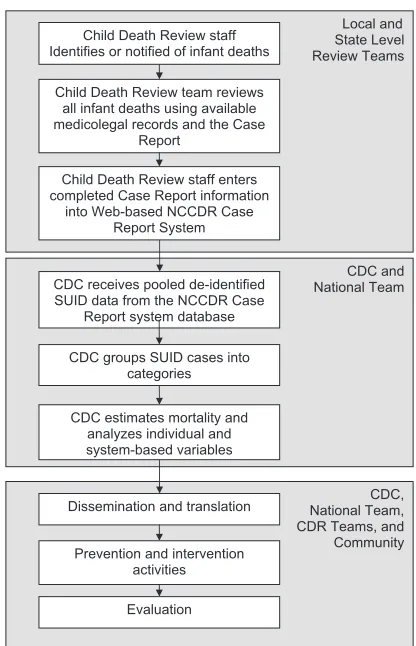
The program model for the SUID-CR demonstrates how information will
flow from local to state to national levels, beginning with case notification and identification and ending with
fi
adapts solutions to identified issues in implementations.
Case Identification and Notification
SUID cases are identified from any infant deaths referred to a medical examiner or coroner office for inves-tigation. CDR teams are notified of infant deaths through a variety of mechanisms. Ideally, teams are
noti-fied by phone or electronically from the medical examiner’s or coroner’s office when an infant death occurs. State vital statistics offices often pro-vide quarterly reports to CDR teams identifying infant and child deaths. In addition, some teams scan obituaries as a supplemental method for case identification.
protocols, CDR teams participating in the SUID-CR continue to collect case information from medicolegal and so-cial service and public health records for their review of infant deaths. During a SUID case review, teams discuss the case and address the SUID-specific questions in the Case Report. Ideally, reviews occur monthly at the local level.15The goal for the SUID-CR is to
review each SUID case within 90 days of identification. Some states in the pilot program have set up special commit-tees to review only infant deaths.
More detailed review and discussion of the components of the death scene in-vestigation and autopsy for each case is the major difference between a SUID case review and a nonpilot program SUID case review. The SUID-CR funded states have received specialized train-ing in identifytrain-ing factors that may have or probably contributed to an infant’s death. The child death review teams in the seven funded states almost always make recommendations to not only improve death investigations and au-topsies but to develop strategies that will prevent similar infant deaths.
Data Entry
Before the SUID-CR was implemented, state CDR teams voluntarily entered data into the Web-based NCCDR Case Reporting System after the review meeting as resources allowed. As part of the cooperative agreement, states in the SUID-CR pilot program now use the NCCDR Case Reporting System to enter data for every SUID case reviewed.
Pooled Data Set
States participating in the SUID-CR have agreed to share their SUID data with NCCDR and CDC to create a pooled data set. Twice a year, CDC receives de-identified information and data for all SUID cases entered into the NCCDR Case
FIGURE 1
Reporting System by states in the pilot program.
Categorization
In collaboration with partners who have expertise as researchers and clinicians in SIDS and SUID, CDC will group SUID cases into categories by using a decision-making algorithm developed specifically for the pilot surveillance system. This algorithm considers the thoroughness of the case investigation as well as the presence of individual and systems var-iables to categorize cases into explained and unexplained categories. Importantly, these categories were created to distin-guish accidental suffocation deaths by mechanism of death (eg, suffocation prone and face down in soft bedding versus strangulation by entrapment be-tween a mattress and wall).
Data Analysis
By using the pooled data set, CDC will estimate mortality rates of specific SUID categories and analyze individual-based variables to describe characteristics as-sociated with these categories. System-based variables will be used to evaluate SUID case investigation practices.
Dissemination and Translation
Although many state and local CDR teams already make recommendations and action plans on the basis of their
findings, the SUID-CR model calls for teams to identify and discuss factors that likely contributed to each infant’s death and identify areas to target for prevention activities at their review meetings. CDR teams also discuss and make recommendations to improve the scene investigation and the au-topsy, which in turn assists key stake-holders in identifying opportunities to improve SUID case investigations and possibly identify resources to facilitate more extensive investigations. CDC will synthesize the aggregated state recom-mendations. These recommendations,
as well as other SUID-CR updates, will be communicated to participating states and partners in e-mail updates at least semiannually. In addition, CDC will write surveillance summaries and evaluation reports and disseminate this informa-tion through presentainforma-tions at profes-sional conferences and trainings, and through peer-reviewed literature, as well.
Prevention and Intervention Activities
Because an important objective of SUID surveillance is to use public health action to reduce infant mortality, CDC and states will educate program plan-ners and policy makers about SUID surveillance findings and recommen-dations. Because surveillance findings will identify unsafe sleep practices that are related to injury, thesefindings and recommendations can be used to inform prevention activities and public health messages aimed at reducing potentially preventable infant deaths. Otherfi nd-ings can point to interventions to en-hance death scene investigations and autopsies.
Evaluation
SUID-CR pilot states implement ongoing process and monitoring activities that focus on improving the timeliness of case review; quality of data; and par-ticipation of law enforcement, medical examiners, and coroners in case reviews. States report on their prog-ress quarterly. These quarterly reports include an evaluation of the timeliness of case identification, review and identification of SUID-specific variables with.20% missing or unknown data, and documentation of plans for im-provement. States also report their strategies to improve participation of medicolegal representatives at team reviews. After the 3-year pilot program, CDC and NCCDR plan to evaluate the SUID-CR’s ability to monitor SUID trends
and characteristics accurately, re-liably, and efficiently.16
Progress to Date
The SUID-CR pilot program was designed to be an iterative process for both the grantees and the CDC, with inherent procedures for identifying ways to im-prove the data quality and the efficiency and timeliness of the system. The 3-year pilot program includes an ongoing process for evaluation and correction. The process evaluation not only helps document successes, but also
identi-fies areas in need of change, and as such areas are identified, changes are made and documented.
Currently, the program is in its third year and several successes and chal-lenges have been identified. From January 1, 2010 through June 30, 2011, state grantees successfully identified .835 SUID cases. For 2010, 610 cases were identified, 548 reviewed, and 374 were considered complete. By tracking the number of cases identified and reviewed for each state, we have evi-dence that grantees are meeting or exceeding the number of cases expected yearly in their states, thus demonstrating the ability of states to conduct population-based SUID surveillance. By monitoring cases as they go through review, data entry and quality assurance process, we have identified delays at the time of data entry. Grantees had initially focused efforts on identifying and reviewing cases within 90 days, but now are also ad-dressing time lags in data entry.
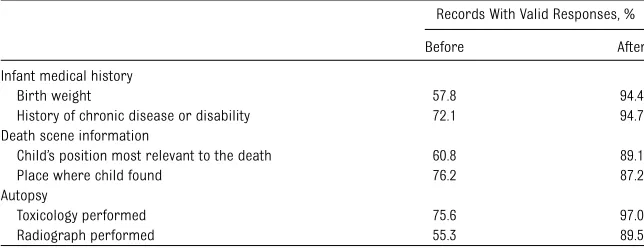
Grantees have enhanced their capacity to bring infant death investigation and autopsy information to case reviews. This is evident by improvements in completeness of variables related to the infant’s medical history, autopsy and death scene investigation before and after the implementation of the SUID-CR (Table 3). A variable was con-sidered “complete” if it had no un-known or missing responses.
SUID cases reviews, but also the data quality for all child death reviews. This was accomplished through improved communication with the medicolegal professionals involved in infant and child death investigation.
Ongoing feedback and monitoring of progress has led to several other pro-gram improvements. One improvement was creating a modified version of the Case Report (launched in March 2011) which improved question clarity and incorporated additional questions about the components of the death scene investigation and cause-of-death deter-mination. Review teams are concen-trating efforts to examine not only what was discovered during cases investiga-tions, but also how these investigations were accomplished. This represents a shift in how these teams functioned previously and offers local opportunities to improve the quality and/or compre-hensiveness of infant death investigation.
CONCLUSIONS
Built on state-based CDR programs, the SUID-CR pilot program aims to generate valid, reliable, and timely population-based public health surveillance and programmatic data for SUID. Access to comprehensive data that describe the medical, environmental, and behavioral factors associated with SUID cases will
leading to infant sleep-related deaths and create prevention strategies, ulti-mately preventing many infant deaths. Grantees have also developed and implemented a robust continuous quality improvement system and invigorated the CDR system by improving data col-lection and review for all childhood deaths. Moreover, states can use SUID-CR surveillance data for program plan-ning and evaluation as well as modifying public health practice and policy for state injury prevention and maternal and child health programs.
ACKNOWLEDGMENTS
We thank the numerous individuals and organizations for their contributions in the development of the SUID-CR. Many private and public multidisciplinary partners and experts came together at information-gathering sessions to strategize the components and logistics of the SUID-CR, ensuring that the case registry would meet the needs of com-munities, researchers, and prevention specialists. The following is a list of attendees of the information-gathering meetings: Keisha Adams (South Carolina SUID Case Registry Feasibility Study); Patricia Adem (CDC); Mary Adkins (Pro-ject Impact); Bob Anderson (National Center for Health Statistics); Tiffany Lauren Baird (Public Health Prevention Specialist Fellow); Tai Baker (Public
fi
Barradas (CDC); Connie Bish (CDC); Martha Boisseau (CDC); Carol Bruce (CDC); Stephanie Bryn (Maternal and Child Health Bureau); Kathleen Buckley (National Fetal and Infant Mortality Re-view Program); Robert Campbell (Pe-diatric Cardiologist, Emory Egleston Children’s Hospital); Lena Camperlengo (CDC); John Carter (Georgia SUID Case Registry Feasibility Study); Shauntrelle Chappell (Public Health Prevention Spe-cialist Fellow); Ed Chao (Council for State and Territorial Epidemiologists); Susan Chu (CDC); Douglas Cook (CDC); Theresa Covington (National Center for Child Death Review); Laura Crandall (Sudden Unexpected Death in Children Program); Terry W. Davis (CDC); Deborah Dee (CDC); Carolyn Drews-Botsch (Emory University, Rollins School of Public Health); Wes Duke (CDC); Alison Ellison (Project S.A.V.E.); Sandra Frank (Association of SIDS and Infant Mortal-ity Programs); Leroy Frazier, Jr. (CDC); Kathleen Graham (National SIDS and Infant Death Program Support); Holly Hackman (Massachusetts SUID Case Reg-istry Feasibility Study); Randy Hanzlick (Medical Examiner, Fulton County); Fern Hauck (American Academy of Pediatrics/University of Virginia); Hilary Heishman (Public Health Prevention Specialist Fellow); Wendy Jacobs (CJ Foundation for SIDS); Matt Johnson (Public Health Prevention Specialist Fel-low); James S. Kemp (Washington Uni-versity School of Medicine); Shin Kim (CDC); Dmitry Kissin (CDC); Rachel Kossover (Public Health Prevention Spe-cialist Fellow); Nancy Kuchar (Public Health Prevention Specialist Fellow); Eve Lackritz (CDC); Garland Land (Na-tional Association for Public Health Statistics and Information Systems); Sarah Lathrop (New Mexico SUID Case Registry Feasibility Study); Rebecca Leeb (CDC); John Lehnherr (CDC); Cynthia Line (Philadelphia SUID Review Team); Debra TABLE 3 Comparison of Selected Variables Collected By Child Death Review Teams Before (2007–
2009) and After (2010) the Implementation of the SUID-CR Pilot Program
Records With Valid Responses, %
Before After
Infant medical history
Birth weight 57.8 94.4
History of chronic disease or disability 72.1 94.7
Death scene information
Child’s position most relevant to the death 60.8 89.1
Place where child found 76.2 87.2
Autopsy
Toxicology performed 75.6 97.0
Lookabill (Georgia Adoption Unit); Jessica Luginbuhl (Public Health Prevention Spe-cialist Fellow); Marian MacDorman (Na-tional Center for Health Statistics); Susan Manning (Massachusetts MCH Epi As-signee); Betty McIntire (American SIDS Institute); Angela D. Mickalide (Home Safety Council); Rachel Moon (American Academy of Pediatrics/Children’s Na-tional Medical Center); Sarah O’Leary
(Public Health Prevention Specialist Fellow); Mary Overpeck (National Center for Child Death Review); Eva Patillo (Geor-gia Child Fatality Review); Joann Petrini (March of Dimes- PeriStats); Susan Potts (Florida SIDS Coordinator); Arleymah Raheem (Georgia Child Fatality Review); Roger Rochat (Emory University, Rollins School of Public Health); Ann Marie Schmitz (CDC); Carrie Shapiro-Mendoza
(CDC); Candi Smith (Maryland SUID Case Registry Feasibility Study); Jason Stamm (Go Beyond Productions); Melissa Trzepacz (Massachusetts SUID Case Registry Feasibility Study); Myra Tucker (CDC); Sabrina Walsh (Kentucky SUID Case Registry Feasibility Study); Darlisha Williams (Public Health Prevention Spe-cialist Fellow); Janis Winogradsky (CDC); Gregory Wyatt (Coroner, Sacramento, CA).
REFERENCES
1. Centers for Disease Control and Prevention, National Center for Health Statistics. Com-pressed Mortality File 1999-2007. CDC WONDER On-line Database, compiled from Compressed Mortality File 1999-2007 Series 20 No. 2M, 2010. Available at: http://wonder.cdc.gov/cmf-icd10. html. Accessed September 12, 2011
2. Krous HF, Haas EA, Masoumi H, Chadwick AE, Stanley C. A comparison of pulmonary intra-alveolar hemorrhage in cases of sudden infant death due to SIDS in a safe sleep environment or to suffocation.Forensic Sci Int. 2007;172(1):56–62
3. Landi K, Gutierrez C, Sampson B, et al. In-vestigation of the sudden death of infants: a multicenter analysis.Pediatr Dev Pathol. 2005;8(6):630–638
4. Willinger M, James LS, Catz C. Defining the sudden infant death syndrome (SIDS): deliberations of an expert panel convened by the National Institute of Child Health and Human Development.Pediatr Pathol. 1991; 11(5):677–684
5. Shapiro-Mendoza CK, Tomashek KM, Ander-son RN, Wingo J. Recent national trends in sudden, unexpected infant deaths: more evidence supporting a change in classifi ca-tion or reporting.Am J Epidemiol. 2006;163 (8):762–769
6. Shapiro-Mendoza CK, Kimball M, Tomashek KM, Anderson RN, Blanding S. US infant mortality trends attributable to acci-dental suffocation and strangulation in bed from 1984 through 2004: are rates increasing? Pediatrics. 2009;123(2):533– 539
7. Malloy MH, MacDorman M. Changes in the classification of sudden unexpected infant deaths: United States, 1992-2001. Pediat-rics. 2005;115(5):1247–1253
8. Shapiro-Mendoza CK, Kim SY, Chu SY, Kahn E, Anderson RN. Using death certificates to characterize sudden infant death syn-drome (SIDS): opportunities and limita-tions.J Pediatr. 2010;156(1):38–43
9. Paulozzi LJ, Mercy J, Frazier L, Jr,Annest JL Centers for Disease Control and Prevention. CDC’s National Violent Death Reporting Sys-tem: background and methodology.Inj Prev. 2004;10(1):47–52
10. CDC. How to Use the Sudden Unexplained Infant Death Investigation Reporting Form (SUIDI RF) Web site. Sudden Unexplained Infant Death Investigation Reporting Form (SUIDIRF): A Guide for Investigators. Available at: www.cdc.gov/sids/SUIDHowtoUseForm. htm. Updated February 2010. Accessed May 7, 2010
11. Webster RA, Schnitzer PG, Jenny C, Ewigman BG, Alario AJ. Child death review. The state of the nation. Am J Prev Med. 2003;25(1): 58–64
12. Onwuachi-Saunders C, Forjuoh SN, West P, Brooks C. Child death reviews: a gold mine for injury prevention and control.Inj Prev. 1999;5(4):276–279
13. The National Center for Child Death Review. In: Covington T, Foster V, Rich S, eds. A Program Manual for Child Death Review. Okemos, MI: The National Center for Child Death Review; 2005
14. State spotlights. National MCH Center for Child Death Review. Available at: www. childdeathreview.org/state.htm. Accessed December 13, 2011
15. Kairys SW, Alexander RC, Block RW, et al; American Academy of Pediatrics. Committee on Child Abuse and Neglect and Committee on Community Health Services. Investigation and review of unexpected infant and child deaths. Pediatrics. 1999;104(5 pt 1):1158– 1160
16. German RR, Lee LM, Horan JM, et al. Updated guidelines for evaluating public health sur-veillance systems: recommendations from the Guidelines Working Group. MMWR Recomm Rep.2001;50(RR-13):1–35; quiz CE1–7
DOI: 10.1542/peds.2011-0854 originally published online January 9, 2012;
2012;129;e486
Pediatrics
Covington
Services
Updated Information &
http://pediatrics.aappublications.org/content/129/2/e486
including high resolution figures, can be found at:
References
http://pediatrics.aappublications.org/content/129/2/e486#BIBL
This article cites 11 articles, 5 of which you can access for free at:
Subspecialty Collections
http://www.aappublications.org/cgi/collection/sids_sub
SIDS
sub
http://www.aappublications.org/cgi/collection/fetus:newborn_infant_
Fetus/Newborn Infant following collection(s):
This article, along with others on similar topics, appears in the
Permissions & Licensing
http://www.aappublications.org/site/misc/Permissions.xhtml
in its entirety can be found online at:
Information about reproducing this article in parts (figures, tables) or
Reprints
http://www.aappublications.org/site/misc/reprints.xhtml
DOI: 10.1542/peds.2011-0854 originally published online January 9, 2012;
2012;129;e486
Pediatrics
Covington
Carrie K. Shapiro-Mendoza, Lena T. Camperlengo, Shin Y. Kim and Theresa
Surveillance
The Sudden Unexpected Infant Death Case Registry: A Method to Improve
http://pediatrics.aappublications.org/content/129/2/e486
located on the World Wide Web at:
The online version of this article, along with updated information and services, is
by the American Academy of Pediatrics. All rights reserved. Print ISSN: 1073-0397.