Journal of Information Literacy
ISSN 1750-5968
Volume 13 Issue 2
December 2019
Article
Ilett, D. 2019. First-generation students’ information literacy in everyday contexts. Journal of Information Literacy, 13(2), pp. 73–91.
http://dx.doi.org/10.11645/13.2.2675
This work is licensed under a Creative Commons Attribution-ShareAlike 4.0 International License. Copyright for the article content resides with the authors, and copyright for the publication layout resides with the Chartered Institute of Library and Information Professionals, Information Literacy Group. These Copyright holders have agreed that this article should be available on Open Access and licensed under a Creative Commons Attribution ShareAlike licence.
"By ‘open access’ to this literature, we mean its free availability on the public internet, permitting any users to read, download, copy, distribute, print, search, or link to the full texts of these articles, crawl them for indexing, pass them as data to software, or use them for any other lawful purpose, without financial, legal, or technical barriers other than those inseparable from gaining access to the internet itself. The only constraint on reproduction and distribution, and the only role for copyright in this domain, should be to give authors control over the integrity of their work and the right to be properly acknowledged and cited.”
First-generation students’ information literacy in
everyday contexts
Darren Ilett, Assistant Professor and Information Literacy Librarian,
University of Northern Colorado. Email: [email protected]
Abstract
Historically, much of the Library and Information Science (LIS) literature on first-generation students (FGS) framed them using deficit thinking, emphasising what they lacked to be successful in higher education. In contrast, recent scholarship has turned to asset-based pedagogies, shifting the focus onto the strengths that FGS bring to college. Further, LIS research on FGS has examined how students engage with information solely in academic contexts, such as completing research papers or navigating higher education procedures. The current study contributes to the discussion of asset-based pedagogies by using a funds of knowledge approach to explore the ways in which FGS at a mid-sized university in the US engage with information, and it expands the scope of inquiry to several everyday contexts, including students’ households, workplaces, and communities. The findings reveal a variety of funds of knowledge concerning participants’ information literacy (IL) and lay the foundation for IL instruction that meets FGS where they are, thus serving them more equitably.
Keywords
academic libraries; asset-based pedagogies; deficit thinking; first-generation students; funds of knowledge; information literacy; information literacy instruction; US
1. Introduction
They are not like regular college students. They enrol part-time, live with their families, and do not take part in campus life. Their family and work commitments are obstacles to success. To do well in college, they must turn against what they know from their homes and communities (Tyckoson, 2000). They avoid the library and librarians. They do not want to learn and instead expect quick, easy answers (Wagner, 1988). They are unprepared for college-level research. They perform poorly in their coursework, and, sooner or later, they fail and drop out (Haras & McEvoy, 2007; Tsai, 2012).
These are a compilation of negative assumptions that appear in the Library and Information Science (LIS) literature on first-generation college students (FGS). Certainly, LIS research seeks to understand the needs of FGS with the goal of serving them better. However,
influenced by previous research and bleak statistics regarding retention and graduation rates, such negative views place the onus of improvement and adjustment to the norms and
FGS can be a difficult group to define. Research has formulated eighteen varying definitions (Nguyen & Nguyen, 2018, p.153). The current study uses the US federal guidelines, which define FGS as those students whose parents did not earn a four-year baccalaureate degree (Higher Education Act, 1965). Following this definition, one estimate found that 58% of students in US postsecondary institutions qualified as FGS (Redford & Hoyer, 2017, p.5). In higher education research in the US, the FGS label often signifies educational disadvantage generally, serving as a stand-in for students with low socioeconomic backgrounds (Folk, 2018, p.660) and students of colour (Sharpe, 2017).
As a librarian who recently took on a newly conceived position dedicated to working with FGS support programmes, I found the negative beliefs in LIS literature troubling. They reduced FGS to a stereotype of failure and did not correspond to my experience with students. The FGS I worked with indeed faced both systemic and personal challenges, but they were generally engaged with coursework, intellectually curious, and active in student organisations. They had written research papers previously and were working to improve their skills. Their families were generally a source of support rather than an obstacle to higher education. Having been an FGS myself and currently working with an FGS population of around 40%, I did not view FGS as an exception or a problem to be solved, but, rather, simply as the students with whom I worked.
In response to the trend of deficit thinking in LIS literature, I undertook an exploratory research project in which I interviewed FGS at a mid-sized university in the US and learned more about the ways they engaged with information in everyday situations, in order to answer the following research question:
How do first-generation college students engage with information in their everyday lives?
The findings presented here highlight the rich and varied skills, understandings, and dispositions that FGS bring to college regarding the information literacy (IL) acquired and developed in their everyday lives. The everyday IL of FGS is an area neglected by previous research and a possible source for innovative instruction that would build on students’ assets rather than assuming their shortcomings.
2. Literature review
The following literature review frames the current study by touching on the LIS literature on FGS, deficit thinking, and funds of knowledge as an alternative model. This review offers
representative examples for each of these areas. It focuses particularly on LIS studies of FGS in the US, where the current study was conducted. To gather LIS sources on FGS, I conducted searches in the databases Library & Information Science Source and Library and Information Science Abstracts using the keywords ‘first-generation students’ and ‘first-generation college students’. For a more extensive, critical review of the LIS literature on FGS, see Ilett (2019).
2.1 LIS literature on FGS
The LIS literature focusing on FGS can be divided into two broad categories: research studies and reports on library initiatives. The predominant concern of LIS research studies on FGS has been how students complete research papers as part of their coursework (Folk, 2018; Logan & Pickard, 2012; Pickard & Logan, 2013; Tsai, 2012; Tsai & Kim, 2012). These studies
academic contexts beyond coursework, such as advising and navigating higher education procedures (Brinkman, Gibson, & Presnell, 2013; Torres, Reiser, LePeau, Davis, & Ruder, 2006). However, LIS research has not yet investigated how FGS engage with information in everyday situations outside of higher education contexts, an area the current study addresses.
The second type of LIS literature on FGS – reports on instruction and service – typically describes initiatives to serve FGS undertaken in conjunction with various campus units, including FGS support programmes (Parker, 2017; Scripa, Lener, Gittens, & Stovall, 2012), bridge programmes that facilitate the transition to college (Barrett, Ghezzi, & Satterfield, 2015; Haras & McEvoy, 2007), and academic courses and departments (Obst & Eshleman, 2015; Yee, 2007). Such reports occasionally contain information about the assessment of instruction and services (Dempsey & Jagman, 2016; Klein, 2007). However, there is little dialogue between LIS researchers concerned with FGS and practising library educators.
2.2 Deficit thinking
A common feature of LIS literature on FGS – and higher education research on FGS generally – is deficit thinking, that is, an emphasis on what they lack in order to be successful in college. LIS researchers and librarians often view FGS as exceptional, that is, as different to traditional students, who are (often tacitly) understood as white, middle-class, English-speaking, and continuing-generation students (Montiel-Overall, Nuñez, & Reyes-Escudero, 2016). LIS literature on FGS frequently enumerates their purported shortcomings and challenges (Brinkman, Gibson, & Presnell, 2013; Haras & McEvoy, 2007; Tsai, 2012; Tyckoson, 2000). Similarly, terms such as ‘at-risk’ represent FGS as a problem that must be solved (Barrett, Ghezzi, & Satterfield, 2015; Haras & McEvoy, 2007; Hassig, 2004).
The consequence of this view is that LIS literature tends to view FGS as the problem and therefore accommodates them within existing education structures, while those structures remain unchallenged. However, as Valencia (2010) argues, students are not inherently at risk of failure; rather, it is the education system that puts them at risk. Deficit thinking prevents
librarians and LIS scholars from recognising our complicity in an education system that sets up minoritised students to fail, including students of colour, those from lower socioeconomic backgrounds, learners of English, and FGS (Valencia, 2010). Our field thus helps perpetuate achievement gaps (Folk, 2019). Higher education systems were not designed for minoritised students, which leads to inappropriate, confusing, and inhospitable environments (Montiel-Overall, Nuñez, & Reyes-Escudero, 2016). Deficit thinking also results in low expectations for students’ performance and prevents recognition of their strengths (Heinbach, Fiedler, Mitola, & Pattni, 2019). This approach has limited the ability of librarians to design instruction and services that fit the needs of minoritised students, including FGS.
2.3 Asset-based approaches
An alternative to deficit thinking is the funds of knowledge approach, an asset-based pedagogy. With roots in anthropology and elementary education, the term funds of knowledge refers to ‘those historically developed and accumulated strategies (skills, abilities, ideas, practices) or bodies of knowledge that are essential to a household’s functioning and well-being’ (González et al., 2005, pp.91-92). Working with elementary school children’s families in Latinx
aim of the current study particularly well, which was to discover students’ engagement with information outside of contexts of coursework and higher education procedures in order to transform them.
LIS scholars have also begun to critique deficit thinking. Krutkowski (2017) found that the use of strengths-based pedagogies and critical literacy disrupted the focus on underrepresented
students’ purported problems and trained it instead on their possibilities. Similarly, Tewell (2018) argued for the usefulness of critical IL in combating deficit thinking. Folk (2019) contended that an approach combining critical social theory and equity-based pedagogy could address the achievement gaps of students of colour and those from lower socioeconomic backgrounds. Turning to FGS specifically, Morrison (2017) used Critical Race Methodology and
autoethnography to foreground the counter-stories of FGS of colour regarding their experiences in higher education and IL. Arch and Gilman (2019) suggested that it is libraries that should change by building on the strengths of FGS, rather than expecting them to adapt to library culture and procedures. Folk (2018) explored the ways in which FGS complete research papers and found that students who drew from their funds of knowledge were more intrinsically
motivated. In their examination of transfer students’ experiences, Heinbach, Fiedler, Mitola, and Pattni (2019) used a strengths-based model. Similarly, Terrile (in press) employed critical pedagogies to combat deficit thinking in serving community college students. This trend aligns with the aim of the current study to identify and build on students’ strengths through the use of funds of knowledge as an asset-based pedagogy.
3. Methods
This exploratory study was guided by a social constructivist or interpretive framework, which ‘assumes that reality is socially constructed; that is, there is no single, observable reality’
(Merriam & Tisdell, 2016, p.9). The goal was therefore not to ‘find’ knowledge, but to construct it together with research participants, ‘to make sense of (or interpret) the meanings others have about the world’ (Creswell & Poth, 2018, p.24). Further, the fact that constructivist approaches ‘focus on the specific contexts in which people live and work in order to understand the
historical and cultural settings of the participants’ fit particularly well with this study, as it aimed to understand how FGS engage with information in their everyday lives (Creswell & Poth, 2018, p.24). The focus was on participants’ understandings of the specific contexts in which they spend their everyday lives and engage with information. Meaning emerged through
conversation using a loose interview guide (please see Appendix A). However, the
conversations often went in directions unanticipated in the guide. Though I did begin the study with the theory of funds of knowledge in mind, the theory is not prescriptive. Instead, it urges researchers to stay attentive to the knowledge and skills participants already possess. In the interviews and subsequent interpretation of the data, my own background as an FGS and as a librarian who works closely with FGS impacted the study, in that I was keen to discuss
participants’ practices and dispositions as assets rather than to identify possible deficits. Though I share the FGS identity with participants, there are several identities we do not share, particularly in terms of gender and race/ethnicity. Most participants were female and
Latina/Hispanic, and I identify as male and white. This fact may have obscured from me issues that I do not experience given my privileged identities. However, I attempted to remain alert to such differences in identity and experience, particularly as they related to racism, sexism, and homophobia.
3.1 Participants
descriptions and reflections of FGS about how they engage with information in everyday contexts. I sought participants within the context of my work as the liaison librarian for Student Support Services (SSS) and McNair Scholars, both of which are federally funded TRIO
programmes designed to support students who are first-generation and low-income (US Department of Education, 2019). I visited their courses and programme offices to distribute copies of the research study description and consent form. My primary selection criterion was that participants be undergraduate college students whose parents had not earned a four-year degree. A secondary criterion was that they be at least eighteen years of age so that they could provide consent to participate in the study.
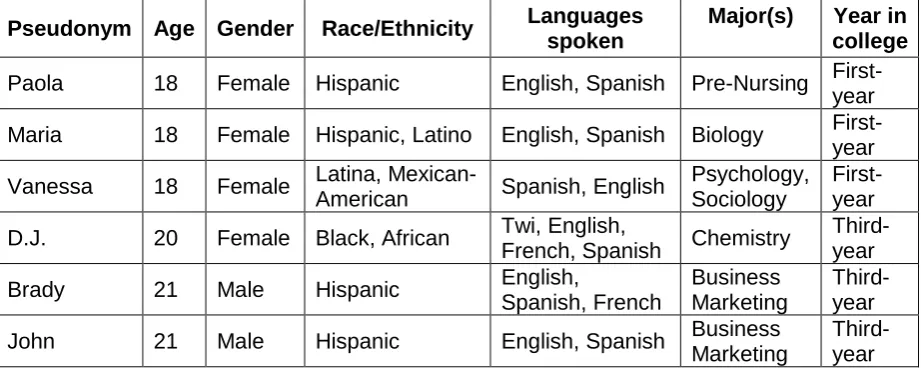
A total of six participants volunteered for one-on-one interviews. All students self-identified as the first in their family to earn a four-year degree, and all were full-time students who
participated in the SSS programme. One participant, D.J., also participated in the McNair Scholars programme. The following table provides participants’ demographic information. The information provided here is unedited and appears exactly as each participant phrased that information during the interview.
Table 1: Participant demographics
Pseudonym Age Gender Race/Ethnicity Languages
spoken
Major(s) Year in college
Paola 18 Female Hispanic English, Spanish Pre-Nursing First-year
Maria 18 Female Hispanic, Latino English, Spanish Biology First-year
Vanessa 18 Female Latina,
Mexican-American Spanish, English
Psychology, Sociology
First-year
D.J. 20 Female Black, African Twi, English,
French, Spanish Chemistry
Third-year
Brady 21 Male Hispanic English,
Spanish, French
Business Marketing
Third-year
John 21 Male Hispanic English, Spanish Business Marketing
Third-year
The demographics of the participants reflected the general demographics of the TRIO students on campus, the majority of whom identified as female and Latinx and/or Hispanic.
3.2 Data collection
The interviews took place in a university library study room during the 2017-2018 academic year. Though I did not offer participants a monetary incentive for participation, I did offer them a snack and beverage of their choice from the coffee cart located in the library as a sign of
Unlike an observation in a natural setting, the demonstration and observation of technology use served primarily as elicitation techniques for further conversation. As students used their laptop or smartphone, I asked them to describe what they were doing and the reasons for the choices they were making. The semi-structured interview style and use of elicitation techniques allowed participants’ understandings of their engagement with information to emerge through dialogue (Merriam & Tisdell, 2016).
3.3 Data analysis
Soon after conducting the interviews, I used the Voice Recorder app to generate automatic transcriptions of the recordings, which I then corrected as necessary. Due to the relatively small amount of data, I coded transcripts manually, as Saldaña (2009) suggests for smaller data sets, moving back and forth between Microsoft Word and paper – where I kept a list of codes and their interconnections – rather than using coding software (p.22). In the first round, I employed descriptive coding in order to ‘assign basic labels to data to provide an inventory of their topics’ (Saldaña, 2009, p.66). In the second round, I applied pattern coding to develop meta-codes to aggregate similarly coded data (Saldaña, 2009, p.150). The meta-codes that emerged from this process had to do with the contexts of participants’ engagement with information: household, work, community, and academia. In choosing which passages to analyse more closely for publication, I sought a variety of contexts and funds of knowledge related to IL from many participants. After data analysis, I shared a draft of the article with the participants. Five of the six participants responded, and those five agreed that the participant descriptions were correct and that the findings accurately depicted their engagement with information.
3.4 Limitations
A limitation of the study resulted from the convenience sampling method. All participants took part in at least one TRIO programme with which I worked. It could be that such students benefitted from the additional advising, instruction, and support the programmes offer, were more motivated or remained more open to feedback and self-critique than FGS who do not choose to participate in such programmes. A related limitation stems from my work with these participants as a guest instructor in their courses and/ or in the context of events for FGS. I may have viewed their knowledge, skills, and experience in a more favourable manner than if participants had been unknown to me. Further, students may have provided answers that they believed would please me as a librarian and faculty member affiliated with their TRIO programmes. This also relates to the power differential in our relationship, as the participants probably viewed me as an authority figure. As mentioned previously, my identities as male and white differed from participants’ identities, most of whom identified as female and all of whom identified as people of colour. These differences may have influenced such aspects of the study as my line of questioning, participants’ responses, our interactions, and the data analysis. Regarding the data analysis, the fact that there was only one coder of the interview transcripts presented the potential for coding bias. Finally, the small sample size and qualitative research design limit the generalisability of the findings. However, based on the description of the research setting and participants, readers may judge the relevance of the findings for their own contexts and populations.
4. Findings
related to IL, and to present findings from as many participants as possible. At the end of each vignette, I highlight implications for library practice, particularly IL instruction.
4.1 Household contexts
The first set of funds of knowledge has to do with household and family contexts: shopping for fabric and accessing the news.
4.1.1 Paola on finding fabric to make curtains
Paola related how she helped her mother find flower-printed fabric to sew curtains for their kitchen. Her mother was already familiar with one retail store that might sell such fabric, but she needed Paola’s assistance in searching for other options online. This detail highlights the continued significance of the digital divide – which often manifests itself along generational lines, both within the general US population and among Hispanics (Pew Research Center, 2016, 2017) – and the manifold effects it has on people’s everyday lives. Paola first consulted with her aunts to learn what they knew, but they told her to ‘just Google it’. Paola did so and successfully found other stores, two of which she and her mother then visited. Regarding the examination of various fabrics in person, Paola related that, My mom would touch them and see them, how much was it and how much we need and then once we knew, we called someone over and they gave us a…the fabric. In choosing fabric, they considered such factors as texture, appearance, and price. Paola emphasised the importance of seeing and feeling the fabrics and then trying out samples at home.
Another element of Paola’s account was her use of both English and Spanish. In explaining the context of information seeking, she said, Cause she wanted to make, uh…, then paused, looked at the window, and continued, …a cortina [curtain]? Paola used linguistic resources, including code switching and the pragmatic move of probing my understanding of Spanish, to
communicate the story. In addition, it was evident from Paola’s narrative that she drew from a range of linguistic resources from both Spanish and English at all stages of her engagement with information, from searching for stores online to interacting with her family and store employees.
Taken as a whole, Paola’s account brought several features of everyday IL into relief: that engagement with information takes place within social contexts and is intertwined with interpersonal transactions in the family as well as both digital and brick-and-mortar
marketplaces; that today’s FGS are generally adept at the use of technology for engaging with information and often assist older generations; that online tools complement but do not replace physical, tactile forms of information; and that people draw on all their various funds of
knowledge – technological, social, economic, and linguistic – in their engagement with information. Formal IL instruction should identify and build on students’ experiences using information outside of educational contexts. Further, Paola’s case shows that FGS do not necessarily require extensive training in using technology for searching, which could free up time during instruction sessions for higher level learning.
4.1.2 Brady on accessing the news
overwhelming: With TV, you’re just kind of full frontal; you kind of have to listen to it all the way to find out what a news report is about. Television is either turned on or off. For this reason, Brady avoided watching the news on television with his parents. In contrast, social media platforms and news apps offered enhanced control through multiple settings options and modes of interactivity. Brady pointed out that when friends post about a news topic on social media, you can kind of guess what it’s about and you don’t necessarily have to watch the video to get it, but then you watch a little bit and then you either understand it or you don’t. After reading friends’ post or a headline, he could choose whether to follow a link to read more or to watch a related video. Brady stated his intention to still be informed but have that distance barrier of control offered by social media and news apps.
Brady was acutely aware of the effects of various technologies on his ability to access and process information and thus remain informed about and engaged in political and social developments. It follows from Brady’s observations that affect plays a pivotal role in engaging with information. Both the content of instructional materials and the modes of communication can impact students’ ability to learn. That is not to say that instructors should avoid controversial or emotionally charged topics. Rather, it is crucial to be aware of and sensitive to how such topics and various media can affect students. Knowing as much as we can about their lives using a funds of knowledge approach is one way of doing so.
4.2 Career contexts
The second set of contexts concerned participants’ current workplaces and the careers they wished to pursue after graduation. Two examples were working as a lifeguard and swim instructor and pursuing a career as a pharmacist.
4.2.1 Maria on working as a lifeguard and swim instructor
Maria described how she engaged with information as a lifeguard and swim instructor. She reported how she turned to people as information sources to pursue career advancement and professional development. After working for some time as a lifeguard, Maria approached her supervisor to learn about becoming a swim instructor as well. She later underwent the training and job shadowing required for the hiring process. Besides people, Maria also used online information resources for professional development purposes, including videos about teaching children to swim. These helped Maria to develop her own instructional style.
In detailing her use of information from people and from the Internet, Maria displayed a clear sense of matching information sources with information needs. She generally trusted
information from people she knew more readily than information obtained online, which she claimed had some things that are way off. However, Maria also described how the information she accessed online could only prove useful when tested in practice, such as techniques for improving her ability to carry weight while treading water. She argued that, It’s a lot about mindset, I guess, if it’s reliable because you have to tell yourself you can do it in order to do it. Reliability in this context depended on her understanding and active use of the information to inform her physical practice at work. Affective factors such as confidence and self-efficacy were also pivotal. Maria’s experiences in career advancement and professional development
illustrate that people engage with information in the workplace in ways that are highly situated, social, practical, and embodied (Lloyd, 2010).
instruction, namely the role of the body. In contrast with the predominant emphasis on written texts in higher education, IL instruction could recognise the body as a ‘site of knowledge’, thus validating students’ funds of knowledge, including those based on practical, corporeal
experience (Lloyd, 2010, p.165).
4.2.2 D.J. on becoming a pharmacist
D.J. addressed engaging with information to pursue her future career choice. She described pursuing multiple channels of information to learn about graduate programmes in pharmacy. These channels included searching online for rankings of universities and pharmacy
departments, consulting university and department websites to determine admission
requirements, watching videos made by students about the admissions process, meeting with faculty and advisors to discuss her plans, and networking with practising professionals online and in person. D.J. reported that she organised the information about various pharmacy programmes into lists so that she could compare their entrance requirements and also posted the lists in her workspace to maintain motivation.
This multifaceted, resourceful, and goal-oriented approach proved typical of D.J.’s engagement with information. In discussing the efforts she had made toward her career objective, D.J. spoke passionately about the need to overcome obstacles through persistence and flexibility. She observed that people tend to give up when they hear the word ‘no’, yet D.J. argued that:
Sometimes you hear “no” because you need to take a different path to where you’re going. […] It doesn’t mean that you’re not good enough or anything. It’s just that your strength is not there yet, so you just need to work a little harder or you just need to work a little different.
D.J. went on to describe how she planned to pursue her goal of becoming a pharmacist whether or not she was accepted to pharmacy school by seeking information about other options such as internships or volunteer opportunities. From her perspective, obstacles and adversity brought about innovative thinking and creative solutions.
D.J. displayed multiple practices in her engagement with career-related information that could tie in with formal IL instruction, including an awareness of multiple channels of information, strategies to stay motivated in searching for information, and creative thinking to overcome obstacles. Instructors could draw on the strategies and habits of mind FGS have already developed and apply them to college-level research.
4.3 Community contexts
The third set of contexts had to do with participants’ communities, in particular the ways in which their racial, ethnic, and sexual identities connected or separated them from others and how their engagement with information impacted those connections.
4.3.1 Vanessa on learning about Latinx history
After attending events at the Latinx cultural centre on campus, Vanessa told of hearing about historical figures and concepts relating to cultural groups and social justice movements that were unfamiliar to her. She then wrote down questions that she wanted to answer before searching for information online. Vanessa related that I write down questions because
sometimes, even me writing it, I get confused in my own writing. Further, she noted that I don’t even know what I’m looking for anymore, so I have to start off with questions. This practice of writing questions based on gaps in her knowledge helped Vanessa organise her thoughts and guided her information seeking.
significance of historical figures and terms, such as César Chávez and Chicano, because they were connected to her own developing identities and because they played a role in the social networks she was joining. Vanessa’s engagement with information showed that information is neither neutral nor separated from social and political contexts.
It is significant that Vanessa was exposed to this information in the context of a Latinx cultural centre on campus, that is, outside of formal curricula. Her coursework, then, failed to connect her learning with her identities. When IL is tied to students’ (emerging) identities, they can draw on what they already know and have experience of and thus start from a place of strength. Further, IL instructors can capitalise on students’ current IL knowledge and skills, rather than focussing on a perceived deficit. For instance, Vanessa confessed that she sometimes got confused and forgot what she was looking for. However, she had already devised a strategy of writing down questions to guide her searching and writing. Emphasising the growth students show and building on that growth, rather than a perceived lack, can help students stay motivated and achieve more.
4.3.2 Brady on coming out
In describing his use of social media and news apps, Brady discussed sexuality as another facet of identity and community. Having recently come out as gay, he noted that, especially now, my sexuality is really important to me; it just took me a long time to get used to it and […] to accept. At this transitional stage, Brady stressed the integral role social media had played in understanding his own identity and joining a community. He argued that:
It’s not like there’s some certain guide or manual that shows you how to automatically be the person you’ve wanted to be. […] You think there’s something like that because you see people and they’re just being happy, and they’re living their lives, right? But they’re in the same boat as you. They’re just trying to figure it out. […] I think it’s really cool to see other people and see how they’re dealing with their whole situation.
Reading social media posts about well-known gay figures such as television celebrity Karamo Brown and Olympic figure skater Adam Rippon provided Brady with role models for navigating his identity as a gay man. Yet social media served not only as a way for Brady to learn about other people’s lives, but also to try out different forms of expression himself. He related that his social media presence kind of accentuates that, not overly, […] cause you’re just being yourself, […] and it kind of exudes your sexuality. On the other hand, he shared that I don’t necessarily go out of my way to say things, to […] push things onto people. Brady’s hesitation in asserting his sexual identity online was a result, at least in part, of his awareness of the power of social media. He claimed that, You have the ability to make a Tweet or something like that and it can go viral because people respond to it, right? People adhere to it. People think it’s important. Brady was thus aware of both the personal power of social media for exploring identity and connecting with others but also of the public nature, potential reach, and consequences of such platforms.
4.4 Academic contexts
Participants also discussed their impressions of academic contexts, including access to higher education and the comparison of academia with the rest of their lives.
4.4.1 D.J., Vanessa, and Maria on access to higher education
D.J. told of her experiences in predominantly white education settings and of the possibility of studying to become a pharmacist at a historically Black university:
I know it’s okay to be in an environment where you’re different, but you don’t want to be in an environment where you’re too different and where you’re trying to fit in, where you don’t know what’s going on. That’s why I want to go to Howard because that’s a Black community school. […] I’m from Africa, so I came here about seven years ago. […] Ever since I got here, I’ve never actually been surrounded by Black students. […] So me going to Howard, I’m getting exposed to the community that I have never been exposed to. I love that idea and I really love that if I get into that school.
The information that D.J. sought about graduate programmes was related to many aspects of her life as a prospective graduate student: an exciting anticipated sense of belonging in a community of Black scholars, the geographical location of the university and distance from her family, the prestige of the programme and university as they related to future employment prospects, the cost, and the entry requirements. D.J.’s description highlighted that her information seeking and use were integrated with her identities, including those of Black
woman, migrant, college student, researcher, and aspiring professional. Further, her comments highlight the predominantly white contexts of many institutions of higher education and the underrepresentation of students of colour and women there, particularly in STEM fields (Pew Research Center, 2018). D.J. succeeded in coursework and research despite being immersed in education environments in which she may have felt too different, had to try to fit in, and [didn’t] know what’s going on.
Maria also discussed exclusion from higher education. She pointed out that, on the one hand, she sought information from her family or work supervisor on general or personal topics such as what to do after a car accident or how to advance at work. On the other hand, she turned to people that are more…more background in the specific topic, such as professors, when conducting research. To explain the reason for this, she stated: I know that my family won’t be able to help me out because for the simple fact that none of them have gone to college. Maria’s comments demonstrate an awareness of systems of exclusion in higher education, but they also hint at an internalised notion that lived experience outside academia has no relevance for
completing college coursework.
Similarly, Vanessa found that her courses were not designed for FGS. She reported frustration in completing research assignments, particularly when required to distinguish between similar types of sources, such as peer-reviewed articles and chapters from edited scholarly books. She argued that, being first-gen., it’s hard; the library information is not in us ‘cause we are learning this by ourselves. To address this obstacle, Vanessa sought help from her instructor and a librarian to learn about the differences among source types. She reported that high school had not prepared her for college-level coursework and that her college courses included little or no IL instruction, resulting in her having to figure out the hidden curriculum of IL and research on her own.
Participants’ comments provide insight into the ways education systems fail to serve the needs of FGS, particularly students of colour. By assuming that students possess the knowledge and experience necessary to complete college-level research and by maintaining a rigid
the resourcefulness and self-advocacy that characterise their approach to learning. They recognise systems of exclusion and find ways to succeed despite them, including seeking learning environments with scholars who share their identities and asking for help when
necessary. IL educators and researchers could help address the barriers to higher education by identifying the ways in which library procedures, spaces, collections, and curricula contribute to the exclusion of underrepresented students such as FGS.
4.4.2 John, Vanessa, and Brady on comparing everyday and academic contexts When asked to compare their engagement with information in everyday life with the IL
knowledge and skills they had learned in college, several students argued that they took more care in using information for their courses. On this difference, John argued that everyday and academic information literacy were completely different: If you’re writing a research paper, you want something that’s valid and something that’s gonna be reliable in the sense that it’s
actually…there’s some research behind it to back up your claims. He went on to say that for my everyday search, looking at something on Google should be enough. Similarly, Vanessa argued that, if it’s for me, I really don’t care if it’s .com or if it’s biased.
These attitudes have two consequences for understanding students’ IL. On the positive side, students recognised that context and purpose had an impact on their information choices. More troublingly, though, their comments underscored a disconnect between their everyday lives and the IL skills and knowledge introduced in formal instruction. IL learning in college appeared to have had little impact on students’ everyday engagement with information. In fact, Brady stressed this disconnect by arguing that what he learned in college was temporary and ultimately irrelevant for the rest of his life:
With your personal life and your personal situations, you pay more attention to it. […] It pertains more to you in the end. […] I love school, […] but there’s a certain part where you stop going to school, right? You graduate, you get your job or whatever, but life keeps going. […] [College] matters, but it doesn’t matter after the fact.
Participants felt that education was important, but they made a clear distinction between their engagement with information in their everyday lives and in academic contexts. Further, they emphasised that what they learned in college had little to do with the rest of their lives. IL
instruction that actively seeks to identify and build on students’ funds of knowledge could help to address this gap, in that it could make explicit the connections between what they already know and are able to do and the IL knowledge and skills they learn in formal education settings.
5. Discussion
The aim of this study was to shift the focus away from deficit thinking regarding the performance of FGS within the narrow context of completing research papers and to consider instead what FGS already know and are able to do with information in other areas of their lives. The funds of knowledge approach recognises and respects them as human beings who navigate the world and engage with information in many contexts. This departs from the usual practices in LIS of framing FGS solely in their role as students and of assuming they are deficient in the
development of a set of predetermined skills required to complete a research paper.
identified as FGS. In such situations, one cannot assume anything about the students except that their parents did not earn a four-year degree. Beginning with negative assumptions – influenced by LIS literature, statistics on FGS, and deficit thinking – can impact how we interact with students, our expectations of their abilities, and the types of learning experiences we facilitate for them. Further, FGS identity intersects with students’ other identities. FGS vary according to such factors as race, gender, sexuality, disability, and class. FGS status therefore should not be considered in isolation (Nguyen & Nguyen, 2018).
Approaching FGS from a funds of knowledge perspective can serve as a positive alternative to deficit thinking and lay the foundation for reimagined IL instruction. Such an approach meets students where they are instead of measuring them against a standard, purportedly neutral yardstick that may have little to do with their experience and goals. In addition, it builds on what students already know and respects what they bring to college as a worthy foundation for further learning. In my work with FGS, I have used a variety of lessons, activities, and strategies in this vein, including:
private online questionnaires about students’ interests, hobbies, employment, previous research experience, and triggering topics that I should avoid in class;
reflective writing on their strengths and challenges as researchers;
short, formative assessments to determine students’ previous knowledge;
explanations of jargon related to libraries and college generally;
opportunities to contribute anonymously in class;
collaborative assignments in which members can take on different roles;
discussion of systems of exclusion in academia, research, and publishing;
reflection on various types and sources of authority beyond academic credentials;
encouraging students to pursue social justice topics related to their experiences and identities and
collaborative creation of course expectations and assignment rubrics.
This study also revealed that participants did not recognise the relevance of what they learned in IL instruction outside the classroom. To remedy this, IL curricula could draw more explicitly on students’ funds of knowledge, making it easier for them to recognise how they could apply IL learning to other contexts. Further, librarians could prepare students to engage with information beyond the college classroom, particularly in the workplace (Forster, 2017). Though discussions of IL mention lifelong learning, there remains a gap between IL instruction and the workplace (Head, 2017). IL instruction within disciplinary contexts could include discussion of how a practising professional engages with information in the field. Further, librarians could pair with internship programmes or campus career centres to help prepare students for the IL knowledge and skills expected of them in the workplace.
6. Conclusion
In this study, FGS shared a rich variety of funds of knowledge concerning their IL in everyday contexts. Participants indicated that they engaged with information not just in their courses, but in their lives generally, including in the contexts of their homes and families, workplaces and career seeking, and communities and identities. All participants were skilled in the use of technology, and some helped bridge the digital divide for their families. Nevertheless, their engagement with information online did not replace, but rather complemented, experiences in the physical world. Further, participants described IL as social, contextual, embodied, and practical (Lloyd, 2010). In fact, their engagement with information impacted their exploration and understanding of their multiple identities, including race, ethnicity, and sexuality as well as other roles, such as family member, student, researcher, worker, aspiring professional, and member of various communities. When engaging with information, students drew on their linguistic resources, primarily from English but also from the other languages they used in their homes, communities, and on campus. Participants also demonstrated dispositions that helped them succeed in coursework and beyond, such as persistence, flexibility, curiosity, and scepticism.
In reflecting on my work with students and reviewing the LIS literature on FGS, I found a
growing trend in the field that attempts to leverage asset-based pedagogies, including the funds of knowledge approach, to combat deficit thinking and to serve FGS and other minoritised students more equitably. This study was conducted in that spirit. It revealed that FGS engage with information in many contexts, that they do so in complex and successful ways, and that they bring the wealth of funds of knowledge related to IL that they have gained in their lives with them to college. As Morrison (2017) concluded, ‘if there must be academic intervention
References
Arch, X., & Gilman, I. (2019). First principles: Designing services for first-generation students. College & Research Libraries, 80(7), 996-1012. Available at:
https://crl.acrl.org/index.php/crl/article/view/23615
Barrett, L., Ghezzi, R., & Satterfield, J. (2015). Jay Gatsby goes to college: Engaging at-risk students. Reference & User Services Quarterly, 55(1), 11–17. Available at:
https://journals.ala.org/index.php/rusq/article/view/5792
Brinkman, S., Gibson, K., & Presnell, J. (2013). When the helicopters are silent: The information seeking strategies of first-generation college students. In D. M. Mueller (Ed.), Imagine, innovate, inspire: Proceedings of the ACRL 2013 conference (pp.643–650). Chicago, IL: Association of College and Research Libraries. Available at:
http://www.ala.org/acrl/sites/ala.org.acrl/files/content/conferences/confsandpreconfs/2013/paper s/BrinkmanGibsonPresnell_When.pdf
Creswell, J. W., & Poth, C. N. (2018). Qualitative inquiry and research design: Choosing among five approaches (4th ed.). Los Angeles, CA: Sage.
Dempsey, P. R., & Jagman, H. (2016). “I felt like such a freshman”: First-year students crossing the library threshold. portal: Libraries and the Academy, 16(1), 89–107. Available at:
https://doi.org/10.1353/pla.2016.0011
Folk, A. L. (2018). Drawing on students’ funds of knowledge: Using identity and lived experience to join the conversation in research assignments. Journal of Information Literacy, 12(2), 44–59. Available at: https://doi.org/10.11645/12.2.2468
Folk, A. L. (2019). Reframing information literacy as academic cultural capital: A critical and equity-based foundation for practice, assessment, and scholarship. College & Research Libraries, 80(5), 658–673. Available at: https://doi.org/10.5860/crl.80.5.658
Forster, E. (2017). Information literacy and the workplace: New concepts, new perspectives? In E. Forster (Ed.), Information literacy in the workplace (pp.1–9). London, England: Facet.
González, N., Moll, L., Tenery, M. F., Rivera, A., Rendón, P., Gonzales, R., & Amanti, C. (2005). Funds of knowledge for teaching in Latino households. In N. González, L. C. Moll, & C. Amanti (Eds.), Funds of knowledge: Theorizing practices in households, communities, and classrooms (pp.89–111). Mahwah, NJ: Erlbaum.
Griffin, K. M., Lahman, M. K. E., & Opitz, M. F. (2016). Shoulder-to-shoulder research with children: Methodological and ethical considerations. Journal of Early Childhood Research, 14(1), 18–27. Available at: https://journals.sagepub.com/doi/10.1177/1476718X14523747 https://doi.org/10.1177/1476718X14523747
Haras, C., & McEvoy, S. L. (2007). Making the bridge: Testing a library workshop for a summer bridge learning community. Research Strategies, 20(4), 257–270. Available at:
Hassig, S. (2004). Their first encounter: How to encourage at-risk students' return to the library. Community & Junior College Libraries, 12(1), 45–55. Available at:
https://www.tandfonline.com/doi/abs/10.1300/J107v12n01_08 https://doi.org/10.1300/J107v12n01_08
Head, A. J. (2017). Posing the million-dollar question: What happens after graduation? Journal of Information Literacy, 11(1), 80–90. Available at: http://dx.doi.org/10.11645/11.1.2186
Heinbach, C., Fiedler, B. P., Mitola, R., & Pattni, E. (2019, February 6). Dismantling deficit thinking: A strengths-based inquiry into the experiences of transfer students in and out of academic libraries. In the Library with the Lead Pipe. Available at:
http://www.inthelibrarywiththeleadpipe.org/2019/dismantling-deficit-thinking/
Higher Education Act of 1965, 1998 Higher Education Act Amendments, 402A 20 U.S.C. § 1070a-11, Available at: https://www2.ed.gov/about/offices/list/ope/trio/triohea.pdf
Ilett, D. (2019). A critical review of LIS literature on first-generation students. portal: Libraries and the Academy, 19(1), 177–196. Available at: https://doi.org/10.1353/pla.2019.0009
Klein, L. (2007). Reducing library anxiety through career explorations at Eastern Kentucky. In L. Hardesty (Ed.), The role of the library in the first college year (pp.217–222). Columbia: National Resource Center for the First-Year Experience & Students in Transition, University of South Carolina.
Krutkowski, S. (2017). A strengths-based approach to widening participation students in higher education. Reference Services Review, 45(2), 227–241. Available at:
https://doi.org/10.1108/RSR-10-2016-0070
Lahman, M. K. E. (2018). Ethics in social science research: Becoming culturally responsive. Los Angeles, CA: Sage.
Lloyd, A. (2010). Information literacy landscapes: Information literacy in education, workplace and everyday contexts. Oxford, England: Chandos. Available at: https://doi.org/10.1016/B978-1-84334-507-7.50009-4
Logan, F., & Pickard, E. (2012). First-generation college students: A sketch of their research process. In L. M. Duke & A. D. Asher (Eds.), College libraries and student culture: What we now know (pp.109–125). Chicago, IL: American Library Association.
Long, D. (2011). Latino students’ perceptions of the academic library. The Journal of Academic Librarianship, 37(6), 504–511. Available at: https://doi.org/10.1016/j.acalib.2011.07.007
Merriam, S. B., & Tisdell, E. J. (2016). Qualitative research: A guide to design and implementation (4th ed.). San Francisco, CA: Jossey-Bass.
Montiel-Overall, P., Nuñez, A. V., & Reyes-Escudero, V. (2016). Latinos in libraries, museums, and archives: Cultural competence in action! An asset-based approach. Lanham, MD: Rowman & Littlefield.
Morrison, K. L. (2017). Informed asset-based pedagogy: Coming correct, counter-stories from an information literacy classroom. Library Trends, 66(2), 176–218. Available at:
Neurohr, K. A., & Bailey, L. E. (2017). First-generation undergraduate students and library spaces: A case study. In S. E. Montgomery (Ed.), Assessing library space for learning (pp.167– 182). Lanham, MD: Rowman & Littlefield.
Nguyen, T., & Nguyen, B. M. D. (2018). Is the “First-generation student” term useful for understanding inequality? The role of intersectionality in illuminating the implications of an accepted—yet unchallenged—term. Review of Research in Education, 42(1), 146–176. Available at: https://doi.org/10.3102/0091732x18759280
Obst, J., & Eshleman, J. (2015). Librarians and students: Making the connections. In T. A. Swanson & H. Jagman (Eds.), Not just where to click: Teaching students how to think about information (pp.293–309). Chicago, IL: Association of College and Research Libraries.
Parker, A. (2017). Academic libraries and vulnerable student populations: A new model of embedded librarianship for first-generation university students. The Political Librarian, 3(1), 26– 31. Available at: https://openscholarship.wustl.edu/pollib/vol3/iss1/9
Pew Research Center. (2016). Internet use among Hispanics. Available at: https://www.pewhispanic.org/2016/07/20/1-internet-use-among-hispanics/
Pew Research Center. (2017). Internet use by age. Available at: https://www.pewinternet.org/chart/internet-use-by-age/
Pew Research Center. (2018). Diversity in the STEM workforce varies widely across jobs. Available at: https://www.pewsocialtrends.org/2018/01/09/diversity-in-the-stem-workforce-varies-widely-across-jobs/
Pickard, E., & Logan, F. (2013). The research process and the library: First-generation college seniors vs. freshmen. College & Research Libraries, 74(4), 399–415. Available at:
https://doi.org/10.5860/crl-348
Redford, J., & Hoyer, K. M. (2017). First-generation and continuing-generation college students: A comparison of high school and postsecondary experiences. United States Department of Education’s National Center for Education Statistics. Available at:
https://nces.ed.gov/pubs2018/2018009.pdf
Rios-Aguilar, C., & Kiyama, J. M. (2018). Introduction: The need for a funds of knowledge approach in higher education contexts. In J. M. Kiyama & C. Rios-Aguilar (Eds.), Funds of knowledge in higher education: Honoring students’ cultural experiences and resources as strengths (pp.3–6). New York, NY: Routledge.
Saldaña, J. (2009). The coding manual for qualitative researchers. Los Angeles, CA: Sage.
Scripa, A. J., Lener, E. F., Gittens, C. B., & Stovall, C. (2012). The McNair Scholars Program at Virginia Tech: A unique model of librarian mentoring. Virginia Libraries, 58(3), 10–12. Available at: https://doi.org/10.21061/valib.v58i3.1224
Terrile, V. C. (2019). Critical pedagogies to combat the deficit model in community college libraries: A perspective. The Journal of Academic Librarianship, 45(5), (unpag.) Available at: https://doi.org/10.1016/j.acalib.2019.02.003
Tewell, E. (2018). The practice and promise of critical information literacy: Academic librarians’ involvement in critical library instruction. College & Research Libraries, 79(1), 10–34. Available at: https://doi.org/10.5860/crl.79.1.10
Torres, V., Reiser, A., LePeau, L., Davis, L., & Ruder, J. (2006). A model of first-generation Latino/a college students’ approach to seeking academic information. NACADA Journal, 26(2), 65–70. Available at: https://doi.org/10.12930/0271-9517-26.2.65
Tsai, T.-I. (2012). Coursework-related information horizons of first-generation college students. Information Research, 17(4). Available at:
http://www.informationr.net/ir/17-4/paper542.html#.Wp28kGaZOV4
Tsai, T.-I., & Kim, K.-S. (2012). First-generation college students’ information seeking: Their personality traits and source use behavior in coursework-related context. Proceedings of the American Society for Information Science and Technology, 49(1), 1–5. Available at:
https://doi.org/10.1002/meet.14504901259
Tyckoson, D. A. (2000). Library service for the first-generation college student. In T. E. Jacobson & H. C. Williams (Eds.), Teaching the new library to today's users: Reaching international, minority, senior citizens, gay/lesbian, first generation, at-risk, graduate and returning students, and distance learners (pp.89–105). New York, NY: Neal-Schuman.
U.S. Department of Education. (2019). Federal TRIO Programs – Home Page. Available at: https://www2.ed.gov/about/offices/list/ope/trio/index.html
Valencia, R. R. (2010). Dismantling contemporary deficit thinking: Educational thought and practice. New York, NY: Routledge.
Wagner, C. A. (with A. S. Kappner). (1988). The academic library and the non-traditional student. In P. S. Breivik, & R. Wedgeworth (Eds.), Libraries and the search for academic excellence (pp.43–56). Metuchen, NJ: Scarecrow Press.
Yee, J. G. (2007). Librarians as matchmakers: Connecting seniors in their capstone semester. Reference Services Review, 35(2), 257–264. Available at:
Appendix A: Interview Guide
1. What’s something fun or memorable you’ve done this semester?
2. What is a situation in your everyday personal life when you need information? (For example, hobbies, movies, music, work, health, nutrition, exercise, political or social issue, etc.)
3. When you need information on that topic, how do you find information? Possible sources: people, social media, Internet, podcasts, print sources, radio, TV, etc.
4. How can you tell if what you have found is relevant and reliable?
5. How do you keep or organise things you find?
6. How do you share them with other people?
7. How do you create your own information?
8. How do you feel about your ability to use information?
9. Please show me how you look for and use information, based on the example you provided at the beginning of the interview. Describe what you’re doing as you do it.
10. Would you be willing to show me an assignment from a class where you needed to use sources and tell me about how you worked with information in that assignment?
11. How do your everyday personal information searching habits relate to how you use information for classes? How similar or different are they?
12. How do you feel about your ability to find and use sources for your classes?