Journal of Information Literacy
ISSN 1750-5968
Volume 12 Issue 2
December 2018
Project report
Ingalls, D. 2018. Beyond databases: Information literacy instruction for
undergraduate students of dietetics.
Journal of Information Literacy
, 12(2), pp.98–
112.
http://dx.doi.org/10.11645/12.2.2344
This work is licensed under a Creative Commons Attribution-ShareAlike 4.0 International License.
Copyright for the article content resides with the authors, and copyright for the publication layout resides with the Chartered Institute of Library and Information Professionals, Information Literacy Group. These Copyright holders have agreed that this article should be available on Open Access and licensed under a Creative Commons Attribution ShareAlike licence.
"By ‘open access’ to this literature, we mean its free availability on the public internet, permitting any users to read, download, copy, distribute, print, search, or link to the full texts of these articles, crawl them for indexing, pass them as data to software, or use them for any other lawful purpose, without financial, legal, or technical barriers other than those inseparable from gaining access to the internet itself. The only constraint on reproduction and distribution, and the only role for copyright in this domain, should be to give authors control over the integrity of their work and the right to be properly acknowledged and cited.”
Ingalls, D. 2018. 2018 Journal of Information Literacy, 12(2). 98 http://dx.doi.org/10.11645/12.2.2344
Beyond databases: Information literacy instruction for
undergraduate students of dietetics
Dana Ingalls, Liaison Librarian, McGill University. Email:
[email protected]
Abstract
Students majoring in Dietetics have somewhat different information literacy (IL) requirements than do students in other disciplines. To meet this need, an IL workshop tailored for them, incorporating the IL Framework for Higher Education, was offered in two successive years, and pre- and post- assessment was conducted. Data from the assessment showed is the workshop to be successful in increasing students’ knowledge of and ability to apply IL skills, as scores rose significantly in both years’ cohorts. This study presents a novel approach to IL instruction for a specific user group and discusses how to integrate the Framework into undergraduate instruction.
Keywords
embedded librarianship; evidence-based practice; Framework for Information Literacy for Higher Education; information literacy; instructional design; library instruction; post-assessment; pre-assessment
1. Introduction
When teaching information literacy (IL), the first thing a teaching librarian should keep in mind is, of course, the information needs of his or her students. The information needs of a first-year undergraduate will differ somewhat in both range and depth from those of a graduate-level university student, but the majority of the resources they need will be scholarly. Knowing this, when I first became embedded in an undergraduate-level Dietetics & Nutrition course, I assumed that a strong focus on scholarly information would meet the students’ information needs, so I designed the workshop accordingly. However, after the first session of the
workshop, I noted an unusual number of questions from students about finding and evaluating
popular resources, a topic that, in my previous experience with other student groups, had rarely arisen. To understand the reason for these questions, I dug deeper into the course, examining the syllabus, readings, and assignment list in greater depth. I discovered that the answer lay in the unique nature of the students’ programme. This group of students are all Dietetics majors, a course of study that leads directly to a career as a registered dietitian. This course, NUTR-208: Professional Practice Stage 1A, is required for the major and is dedicated to preparing them for their first professional internship (stage is the French word for internship and is generally used at McGill rather than the English term). These students require a knowledge of popular
resources because they are training to be a nutrition resource for the public, and as such they must be able to locate and evaluate resources written for laypeople.
Ingalls, D. 2018. 2018 Journal of Information Literacy, 12(2). 99 http://dx.doi.org/10.11645/12.2.2344
activities to facilitate active learning. I also used several frames of the Association of College and Research Libraries (ACRL)’s Framework for IL for Higher Education (2015), as well as the older IL Competency Standards for Higher Education (2000) for reasons that will be discussed below. A pre- and post-test was administered for assessment purposes. Using the data I gathered, I can conclude that I have created an effective method for educating this particular group of students.
2. Literature review
As Dietetics majors, the students in this class spend considerable time, beginning in their second year, in clinical settings as well as in the classroom. In this way, Dietetics students have some similarities to students in other health fields, such as nursing, but which require an
advanced degree (in Canada, the practice of Dietetics requires only a Bachelor’s degree). While there are similarities between Dietetics and these other health-based areas, I found the
literature on IL instruction in these fields to be mostly inapplicable to the teaching of my Dietetics students. Much of the literature on this topic focuses on supporting the teaching of evidence-based medicine (EBM), which is ‘the integration of best research evidence with clinical expertise and patient values’ (Straus, 2011. p.1). This is considered to be an important IL skill for medical practitioners and is commonly taught to medical and nursing students (Cullen, Clark, & Esson, 2011; Holloway, Nesbit, Bordley, & Noyes, 2004), but I do not consider it to be applicable to these students at this stage in their education. EBM is generally taught to graduate students in areas of medicine where they will be responsible for diagnosing and prescribing treatment for patients, which are not generally components of the practice of Dietetics. I instead chose to follow the students’ lead, based on the questions I was receiving in class: expand the training on evaluating resources, especially popular resources.
While considering what approach to take in presenting this session, I was interested in using the ACRL’s Framework for IL for Higher Education (2015), as I, like most teaching librarians, had been hearing and reading a great deal about the Framework in recent years. Intended to replace the Standards (ACRL, 2000), the Framework is an intentionally flexible document, each
Frame able to stand on its own and expressly avoiding prescriptivism or standards; it is designed with the expectation that librarian educators will ‘deploy these frames to best fit their own situation, including designing learning outcomes’ (ACRL, 2015, p.2). This philosophical and somewhat abstract approach to IL has generated considerable concern that the Framework’s
concepts may be too nebulous for students, especially undergraduates early in their university education (Burgess, 2015; Mays, 2016). There are indications that students can, given enough time and training, successfully engage with the Framework’s language and ideas (Scott, 2017a,
2017b). The key here is time; the Framework appears to work best in credit IL courses
(Jacobson & Gibson, 2015) rather than one-shots. However, it was clear to me that the ideas in the Framework, specifically those surrounding authority, the value of information, and
information creation as a community process (ACRL, 2015) were important ideas to convey to the students in this group. Although considered controversial by some (Swanson, 2015), precedent exists for the use of what may be called an integrated model: using the solid
architecture of the ACRL’s earlier IL Competency Standards for Higher Education (2000), and building in the relevant Frames (Franzen & Bannon, 2016). The exact nature of the integrated presentation I developed will be discussed later in this paper.
Ingalls, D. 2018. 2018 Journal of Information Literacy, 12(2). 100 http://dx.doi.org/10.11645/12.2.2344
students to practise the skills being taught. I felt that this was a suboptimal approach, as the literature is clear that the efficacy of active learning techniques outpaces a lecture-based approach (Hanz & Lange, 2013; Johnson & Barrett, 2017; Prince, 2004). I therefore created a variety of activities, from questions built into the lecture to group work sessions and integrated them into the workshop.
After creating this carefully designed workshop, I wanted to be able to assess its effectiveness, and to have data to inform revisions to the workshop after the first year. Assessment in library instruction tends to focus on two types of information: student satisfaction with library services, and students’ library skills as affected by exposure to library instruction (Portmann & Roush, 2004). While the former can be useful in developing, evaluating and modifying broad library programmes, it does not provide the type of data necessary to ‘summarize or document student learning as the result of exposure to library instruction’ (Portmann & Roush, 2004) and was thus not useful for my purpose. The limited nature of the one shot IL instructional session makes it difficult to assess the long-term effects of the instruction on student learning (Spievak & Hayes-Bohanan, 2013; Wong, Chan, & Chu, 2006); however, an assessment of students’ skills before the workshop and immediately after was feasible. This pre- and post-test evaluation (Bryan & Karshmer, 2013; Hufford, 2010; Swoger, 2011) would provide useful data on their baseline level of IL before the workshop, and their grasp of the concepts and mastery of the skills after.
3. Background
In McGill University’s School of Human Nutrition, students majoring in Dietetics (a course of study that leads directly to a career as a registered dietitian) are required to take NUTR-208: Professional Practice Stage 1A in the first semester of their second year. This course is an essential introduction to the professional practice of dietetics, preparing students for a practical internship (or stage) in a hospital or other clinical environment. The course emphasises the information students will need in clinical practice, such as ‘ethics, policies and procedures; federal and provincial policies in food and nutrition; dietetic practice in the hospital environment; practice competencies in dietetics…’ (McGill University, 2017). The coursework focuses on training students in the skills they will need in clinical practice, but also requires them to conduct a literature search and create an annotated bibliography on a topic of their choice. Thus, the course content is a mix of practical and scholarly work, in contrast to the focus on scholarly work and research in most of the courses in which I teach IL.
In both 2016 and 2017, the course consisted of 48 students. All were second-year undergraduate Dietetics majors. Most had not received any library instruction previously, although a few (three in the first cohort, one in the second) had attended an orientation tour of the library during the first week of classes. Attendance at the library workshop is mandatory for students in NUTR-208. The workshop is held during one of the class lab periods and taught in the library’s classroom, which is equipped with both a podium and sufficient desktop computers for each student to use for activities (although many students prefer to bring their own laptops). The workshop lasts a total of two and a half hours, with about an hour and 45 minutes devoted to lecture and hands-on learning, with the remaining time used for administering the quizzes.
4. Developing the workshop
4.1 Unique information needs
In many ways, these student-practitioners had the information needs and requirement for information competencies common to other undergraduate students. As students, they needed to be able to create a research question, find scholarly articles, write a literature review, and properly cite their work, all standard undergraduate-level academic work. However, as
Ingalls, D. 2018. 2018 Journal of Information Literacy, 12(2). 101 http://dx.doi.org/10.11645/12.2.2344
to them (at least in comparison to other groups I teach regularly). They needed a greater
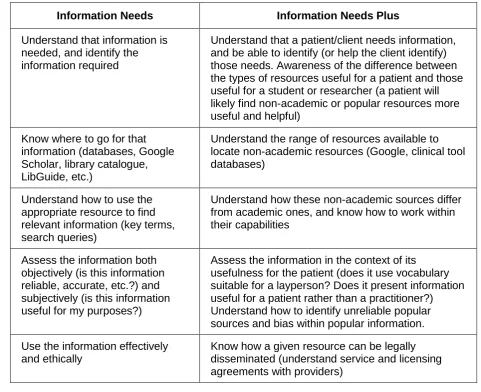
understanding of non-academic or popular information, as well as a rather librarian-like ability to understand the information that a patient might need and provide that information for them. For the purpose of distinguishing these special requirements, I refer to them as ‘Information Needs Plus’.
Table 1: Information needs
Information Needs Information Needs Plus
Understand that information is needed, and identify the information required
Understand that a patient/client needs information, and be able to identify (or help the client identify) those needs. Awareness of the difference between the types of resources useful for a patient and those useful for a student or researcher (a patient will likely find non-academic or popular resources more useful and helpful)
Know where to go for that information (databases, Google Scholar, library catalogue, LibGuide, etc.)
Understand the range of resources available to locate non-academic resources (Google, clinical tool databases)
Understand how to use the appropriate resource to find relevant information (key terms, search queries)
Understand how these non-academic sources differ from academic ones, and know how to work within their capabilities
Assess the information both objectively (is this information reliable, accurate, etc.?) and subjectively (is this information useful for my purposes?)
Assess the information in the context of its usefulness for the patient (does it use vocabulary suitable for a layperson? Does it present information useful for a patient rather than a practitioner?) Understand how to identify unreliable popular sources and bias within popular information.
Use the information effectively and ethically
Know how a given resource can be legally disseminated (understand service and licensing agreements with providers)
4.2 Using an integrated model
While I was considering what approach to take in restructuring this workshop, I was inspired by the Framework’s open, philosophical attitude towards IL. It assumes a more active, thoughtful
way of thinking about and teaching IL, ‘evolving instruction from a point-and-click database demo style to an engaged and interactive IL discussion with students’ (Burgess, 2015, p.2). At the same time, my experience with teaching IL to undergraduates told me that they strongly need to be taught the how of library research skills-databases, keywords, Boolean operators, those hard skills that, while implied in the Framework, are not specifically discussed. That the
Framework, as a practical document, does suffer from its heavily philosophical approach to IL instruction (Bombaro, 2016; Wilkinson, 2014).
The solution I settled upon: use the ACRL’s IL Competency Standards for Higher Education
Ingalls, D. 2018. 2018 Journal of Information Literacy, 12(2). 102 http://dx.doi.org/10.11645/12.2.2344
those skills, and give the students a deeper understanding of why they are important. The decision to use the Standards, which were officially rescinded in June 2016 (ACRL, 2016) is seen by some as a poor choice. They argue that the Standards artificially compartmentalise the concept of IL, reducing it to a simple quantitative rubric that does not allow students to think freely about information (Jacobs, 2008) and any use of them undermines the value of the
Framework (Swanson, 2015). However, others contend that the two can in fact work together, allowing for a flexible, complementary pedagogical approach (Jackman & Weiner, 2017; Wilkinson, 2016), or that the Standards can serve as a ‘bridge’ to greater IL for students
(Franzen & Bannon, 2016). Having made this decision, I used the five Standards (ACRL, 2000), language somewhat modified, as the five sections of the workshop:
1. Identify the information you need 2. Access the necessary information 3. Evaluate information
4. Apply information effectively
5. Use information legally and ethically
I used this structure to organise the flow of the workshop, with the skills and information
necessary to achieve each competency organised into the appropriate category. In order to give the students a solid understanding of how the information and skills presented can be applied, I used the process of doing a literature search and annotated bibliography, mirroring the
assignment the students will be expected to complete as part of the course.
4.3 Applying the
Framework
Built into the content were several of the frames. There are six of these that make up the
Framework, and while they make up a cohesive document when taken together, each frame
can also stand on its own. Educators may choose to focus on one or more frames as they apply to the topic they are teaching; I find this flexibility to be one of the merits of the Framework over the Standards. I chose to focus on frames one, three and five: ‘Authority is Constructed and
Contextual’, ‘Information Has Value’, and ‘Scholarship as Conversation’ (ACRL, 2015).
4.3.1 Authority is constructed and contextual
Information resources reflect their creators’ expertise and credibility and are evaluated based on the information need and the context in which the information will be used. Authority is
constructed in that various communities may recognise different types of authority. It is contextual in that the information need may help to determine the level of authority required (ACRL, 2015).
This frame is particularly relevant to students in a practitioner-based field such as Dietetics. Information in this field emerges from all types of authority, from a Dietetics student conducting research to registered dietitians with a Bachelor’s degree to a university professor with a Ph.D. in Dietetics and Nutrition. In my experience with university students I have found that they often believe that any information not produced by an academic is unacceptable for their purposes, and that information found online (except in a database or other library resource) is
automatically not to be trusted. Based on the responses to question four on the pre-test (see Appendix 1), the students in this group also believed this. While information should certainly be approached with a critical eye, this applies to all information resources, not only online ones, and the idea that only information produced by academics and found via the library is too narrow for these students. They are likely to need ‘popular’, non-academic sources in their clinical work, and many of these resources may be found online, outside of a library database.
Ingalls, D. 2018. 2018 Journal of Information Literacy, 12(2). 103 http://dx.doi.org/10.11645/12.2.2344
understand the context of information, both the context in which it is produced and that in which it is used. An information source (such as, for example, a blog post written by a registered dietitian) is most likely not appropriate for an academic paper but may be useful for a dietician’s patient. I used this Frame to help students understand and think about information in a broader way than they may be accustomed to: information is not only the published work of scholars and researchers, it may be the work of many different kinds of people, presented in many different formats. In the lecture, I gave examples of several different types of work, both popular and scholarly, from a variety of sources (a journal article, a magazine article, a book, a blog post). We examined them as a class, decided through discussion whether these resources were objectively accurate (looking for author, citation, problematic bias), and then thought of contexts in which each might be useful. Using these examples and having the students discuss them allowed students to encounter and identify a wide variety of authorities and recognise the range of contexts in which they could be valuable.
4.3.2 Information has value
Information possesses several dimensions of value, including as a commodity, as a means of education, as a means to influence, and as a means of negotiating and understanding the world. Legal and socioeconomic interests influence information production and dissemination (ACRL, 2015).
This group of students is likely to be involved in disseminating information, providing resources to their future patients, so they have the need to understand information as a commodity especially in the context of our information economy. At the beginning of our discussion on this topic, several students expressed the belief that if it’s online, it’s effectively free information. Their definition of online included anything they could get with a computer and a functional internet connection, including library resources. With this information in mind, we discussed the differences between information accessible to all, such as much information available using common search engines, and information that may be online but is not freely accessible to all, such as articles from databases to which the university has a subscription. As students, they have full access to both types of information, but as practitioners they cannot freely give all of it to their patients due to copyright laws and subscriber agreements. Having learned the
distinction, students were given the tools to identify what type of information they are looking at, and if they may share it with people outside the university, such as their future patients. This is also a good context in which to introduce students to the concept of Open Access: how it affects both the commodification of information in a broader sense, and how it changes the status of information to allow it to be shared more freely, which is relevant to the students’ practice.
The idea of information’s value both as a commodity and as intellectual property is also used to frame the discussion of ethical use of information and citation. Students understand that they must cite information used when writing papers, but they may not understand exactly how (the rules of citation style must be taught) or why. They tend to see citation as nothing more than a time-consuming exercise that must be accomplished to avoid being disciplined for academic misconduct. The context of this frame allowed me to reframe citation as an issue of ethical importance rather than merely a slog through the minutiae of citation rules. Understanding the
why of citation provides the context students need to be open to learning the how.
4.3.3 Scholarship as conversation
Communities of scholars, researchers, or professionals engage in sustained discourse with new insights and discoveries occurring over time as a result of varied perspectives and
interpretations. (ACRL, 2015)
Ingalls, D. 2018. 2018 Journal of Information Literacy, 12(2). 104 http://dx.doi.org/10.11645/12.2.2344
briefly presented the case of coeliac disease, discussing how centuries of research,
observations, and data-sharing between medical practitioners and researchers slowly lead to an understanding of the cause of the disease. Then, in keeping with the discursive focus of this frame, I asked students to think of past or current hotly debated issues in the field of Dietetics. Students brought up the role of saturated fats in heart disease, the efficacy of the keto diet, non-coeliac gluten intolerance, and nutrigenomics, among other topics, and we discussed the ways different communities have had impact on the development of these topics. This discussion helped the students frame research and scholarly progress as multifaceted with many different participants, rather than a linear process done by a singular group.
With this context, students were receptive to seeing themselves as part of the information system instead of as observers to it. They usually see themselves solely as the latter as students; I used this frame to discuss how in doing their coursework, they are also contributing to the scholarly conversation. I have no way of knowing if this reframing of the topic resonated particularly with any of them but discussing their work in class as part of the greater information production system presents them with a new way of seeing their work as undergraduates and potentially also as professionals.
4.4 Active learning
I built activities into each section of the workshop, giving students the opportunity to engage actively with their learning, rather than keeping it to a simple lecture format. Active learning is a teaching technique I have wanted to incorporate into more of my workshops, but in the majority of my course-integrated one-shots I simply do not have the time (most professors are willing to give up 45-60 minutes of class time, rarely more). While this session was scheduled for one hour when I first began teaching it, by the time of this revision I had developed a good rapport with the professor who teaches the class, and she was enthusiastic about expanding the session to two hours. With this generous extra time, I was able to build in a variety of activities.
In the first section of the workshop, after demonstrating the process of creating a search query, I gave the students a new topic and had them build a search query in pairs. I gave them 10 minutes to do this, then had a few of the students share with the class. This activity allowed them to practise the skills they had just seen demonstrated and receive feedback immediately. In Section Two, I gave the class several titles one at a time and had them find the items using our catalogue. The first student to correctly identify the item’s location, format and call number received a reward (candy) – I have found that this small extra incentive is highly effective in encouraging class participation. In Section Three, I broke the class into four groups and gave each group four resources (different resources for each group) and asked them to evaluate them using the CRAAP test (Currency, Relevancy, Authority, Accuracy and Purpose; Meriam Library, 2010). Each group then shared their evaluations with the rest of the class and explained their reasoning. In Section Four, I asked the students to use those same resources and identify the context, if any, in which they would apply them. In Section Five, I had the groups return to the resources from Section Three and decide if any of them could be given to clinical patients, as a way to put into practice their understanding of the legality and ethics of each source.
5. Analysis
Both the 2016 and 2017 cohort consisted of 48 students. Pre- and post- workshop quizzes were given to all students during the workshop, and all students in both cohorts completed both quizzes. The pre-test was administered at the beginning of the workshop and consisted of ten true or false and multiple-choice questions (see appendix 1). The post-test, which was
Ingalls, D. 2018. 2018 Journal of Information Literacy, 12(2). 105 http://dx.doi.org/10.11645/12.2.2344
that it was the question, rather than the students, that was the problem). In the second year, I rewrote the question, and this time the comprehension problem did not present itself, as the majority of the students were able to answer it correctly. Other than this modification, the post-test questions remained the same in 2017.
Figure 1: 2016 cohort scores
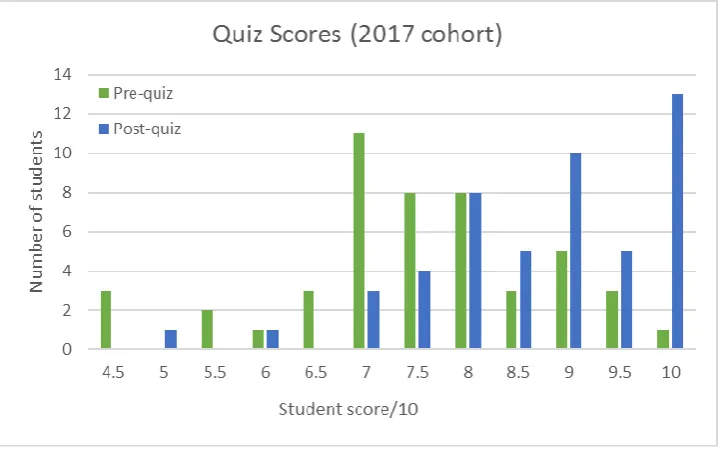
Figure 2: 2017 cohort scores
Ingalls, D. 2018. 2018 Journal of Information Literacy, 12(2). 106 http://dx.doi.org/10.11645/12.2.2344
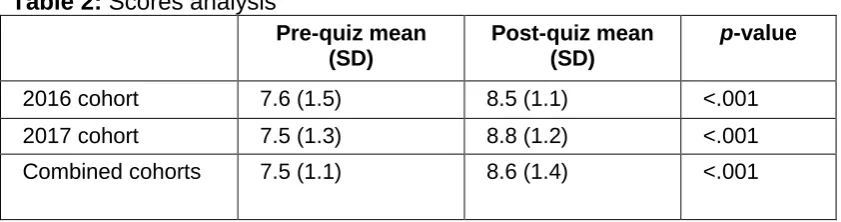
Table 2: Scores analysis
Pre-quiz mean (SD)
Post-quiz mean (SD)
p-value
2016 cohort 7.6 (1.5) 8.5 (1.1) <.001
2017 cohort 7.5 (1.3) 8.8 (1.2) <.001
Combined cohorts 7.5 (1.1) 8.6 (1.4) <.001
In 2016, the first year, the average pre-test score was 7.6 (margin of error .4), the average post-test score was 8.5 (margin of error .6). Second year scores were similar: the pre-post-test average was 7.45(margin of error .4), and the post-test average was 8.8 (margin of error .6). To account for the issue on the 2016 post-test, I threw out the scores for question two and did not take them into account when calculating the average score, as this would skew the data. With this factor accounted for, the average pre- and post-test scores were similar in both years, and both data sets show a statistically significant increase in scores between pre- and post-test. This would indicate that the instruction was effective and that the students were able to apply the skills they had learned in class in a controlled classroom setting. It is to be hoped that this will allow them to use this knowledge in their class assignments and in their upcoming internship.
6. Limitations
There were a number of limits in this study relating to the method (especially the available data) that they must be specifically addressed. In particular, the lack of data on the workshop prior to the redesign makes comparison between the two impossible. This was an issue I considered when beginning my work on this study; however, at the time I conceived of the study, it would have been necessary to teach the unchanged workshop to that year’s incoming students, gather the relevant data, then proceed with the redesign. I felt that, given the quite unique nature of these students’ information needs, that intentionally offering a group of students a workshop unsuited to their requirements would contravene one of the most important duties I have as a teaching librarian: to offer the best possible IL instruction, suited to their needs. Unfortunately, this would mean that the study’s purpose would also shift somewhat. Rather than a comparison between two workshops differing in both content and instructional method, I would instead measure the impact of a specially tailored workshop on students’ learning prior to and after they completed the workshop.
Another, limitation inhibiting a true 1-to-1 controlled comparison, is the fact that the pre- and post-tests were not identical. Both covered the same information but asked different questions. However, they did effectively serve the purpose for which they were designed; that is, to measure students’ understanding of the topics as a whole. Given these limitations, these data, as well all the data in this study, should be taken as indicators that the pedagogical methods used in the workshop were effective for this group of students, but cannot be applied to other scenarios, nor extrapolated from to draw broader conclusions as with data collected under better circumstances.
Conclusion
Ingalls, D. 2018. 2018 Journal of Information Literacy, 12(2). 107 http://dx.doi.org/10.11645/12.2.2344
References
Association of College and Research Libraries (2000). Information literacy competency standards for higher education. Available at:
http://www.ala.org/acrl/sites/ala.org.acrl/files/content/standards/standards.pdf. [Accessed November 2 2017]
Association of College and Research Libraries (2015). Framework for information literacy for higher education. Available at: http://www.ala.org/acrl/standards/ilframework. [Accessed October 20 2017]
Association of College and Research Libraries (2016). ACRL board takes action on information literacy standards. Available at: http://www.acrl.ala.org/acrlinsider/archives/12126. [Accessed October 27 2017]
Bombaro, C. (2016). The Framework is elitist. Reference Services Review, 44(4), 552–563. https://doi.org/10.1108/RSR-08-2016-0052
Bryan, J. E., & Karshmer, E. (2013). Assessment in the one-shot session: Using pre-and post-tests to measure innovative instructional strategies among first-year students. College & Research Libraries, 74(6), 574–586. https://doi.org/10.5860/crl12-369
Burgess, C. (2015). Teaching students, not standards: The new ACRL information literacy framework and threshold crossings for instructors. Partnership: The Canadian Journal of Library and Information Practice and Research, 10(1), 1.
https://doi.org/10.21083/partnership.v10i1.3440
Cullen, R., Clark, M., & Esson, R. (2011). Evidence‐based information‐seeking skills of junior doctors entering the workforce: an evaluation of the impact of information literacy training during pre‐clinical years. Health Information & Libraries Journal, 28(2), 119–129.
https://doi.org/10.1111/j.1471-1842.2011.00933.x
Franzen, S., & Bannon, C. M. (2016). Merging information literacy and evidence-based practice in an undergraduate health sciences curriculum map. Communications in Information Literacy, 10(2), 245. https://doi.org/10.15760/comminfolit.2016.10.2.26
Hanz, K., & Lange, J. (2013). Using student questions to direct information literacy workshops.
Reference Services Review, 41(3), 532–546. https://doi.org/10.1108/RSR-03-2013-0016
Holloway, R., Nesbit, K., Bordley, D., & Noyes, K. (2004). Teaching and evaluating first and second year medical students' practice of evidence‐based medicine. Medical Education, 38(8),
868–878. https://doi.org/10.1111/j.1365-2929.2004.01817.x
Hufford, J. R. (2010). What are they learning? Pre-and post-assessment surveys for LIBR 1100, introduction to library research. College & Research Libraries, 71(2), 139–158.
https://doi.org/10.5860/0710139
Jackman, L. W., & Weiner, S. A. (2017). The rescinding of the ACRL 2000 Information Literacy Competency Standards for Higher Education–Really?? College & Undergraduate Libraries, 24(1), 117–119. https://doi.org/10.1080/10691316.2016.1217811
Jacobs, H. L. (2008). Information literacy and reflective pedagogical praxis. The Journal of
Ingalls, D. 2018. 2018 Journal of Information Literacy, 12(2). 108 http://dx.doi.org/10.11645/12.2.2344
Jacobson, T. E., & Gibson, C. (2015). First thoughts on implementing the Framework for Information Literacy. Communications in Information Literacy, 9(2), 102.
https://doi.org/10.15760/comminfolit.2015.9.2.187
Johnson, H. A., & Barrett, L. (2017). Your teaching strategy matters: how engagement impacts application in health information literacy instruction. Journal of the Medical Library Association: JMLA, 105(1), 44.
Mays, D. A. (2016). Using ACRL's framework to support the evolving needs of today's college students. College & Undergraduate Libraries, 23(4), 353–362.
https://doi.org/10.1080/10691316.2015.1068720
McGill University (2017). NUTR 208 professional practice stage 1A. In McGill University eCalendar, Programs, Courses & University Regulations Fall 2017–Summer 2018.
Meriam Library (2010). Evaluating information: Applying the CRAAP test. Availble at:
https://www.csuchico.edu/lins/handouts/eval_websites.pdf. [Accessed January 10 2018]
Portmann, C. A., & Roush, A. J. (2004). Assessing the effects of library instruction. The Journal of Academic Librarianship, 30(6), 461–465. https://doi.org/10.1016/j.acalib.2004.07.004
Prince, M. (2004). Does active learning work? A review of the research. Journal of engineering education, 93(3), 223–231. https://doi.org/10.1002/j.2168-9830.2004.tb00809.x
Scott, R. E. (2017a). Part 1. If we frame it, they will respond: Undergraduate student responses to the Framework for Information Literacy for Higher Education. The Reference Librarian, 58(1),
1–18. https://doi.org/10.1080/02763877.2016.1196470
Scott, R. E. (2017b). Part 2. If we frame it, they will respond: Student responses to the
Framework for Information Literacy for Higher Education. The Reference Librarian, 58(1), 19–
32. https://doi.org/10.1080/02763877.2016.1196471
Spievak, E. R., & Hayes-Bohanan, P. (2013). Just enough of a good thing: Indications of long-term efficacy in one-shot library instruction. The Journal of Academic Librarianship, 39(6), 488–
499. https://doi.org/10.1016/j.acalib.2013.08.013
Straus, S. E. (2011). Evidence-based medicine: how to practice and teach it. Edinburgh: Elsevier Churchill Livingstone.
Swanson, T. (2015). The IL Standards and IL Framework cannot co-exist. Available at:
http://tametheweb.com/2015/01/12/the-il-standards-and-il-framework-cannot-co-exist-by-ttw-contributor-troy-swanson/ [Accessed April 27 2018]
Swoger, B. J. (2011). Closing the assessment loop using pre-and post-assessment. Reference Services Review, 39(2), 244–259. https://doi.org/10.1108/00907321111135475
Wilkinson, L. (2014). The problem with threshold concepts. Available at:
https://senseandreference.wordpress.com/2014/06/19/the-problem-with-threshold-concepts/.
[Accessed April 27 2018]
Wilkinson, L. (2016). Framework or Standards? It doesn’t matter. Available at:
Ingalls, D. 2018. 2018 Journal of Information Literacy, 12(2). 109 http://dx.doi.org/10.11645/12.2.2344
Wong, G., Chan, D., & Chu, S. (2006). Assessing the enduring impact of library instruction programs. The Journal of Academic Librarianship, 32(4), 384–395.
https://doi.org/10.1016/j.acalib.2006.03.010
Appendices
Appendix 1:
Pre-class quizNAME:
STUDENT ID:
Pre-Class Quiz
1. If you are looking for introductory, background information on a topic, which source of information would be most useful to you?
a. An academic journal
b. A subject-specific encyclopedia
c. A multidisciplinary database
d. A newspaper article
2. Which of the following is NOT a characteristic of a scholarly source?
a. It contains both in-text citations and a reference list
b. It has been peer-reviewed
c. It uses terminology and jargon specific to the field of study it discusses
d. It contains advertisements
3. If you wish to find information about the latest research on a topic, where would you look?
a. Wikipedia
b. An academic journal
c. A newspaper
d. A textbook
4. True or false: Information found on the Internet cannot be cited in a research paper.
5. If you want to know if the [XXX] Library has a particular book, where do you go?
a. Google
b. The Library catalogue
c. A database from the Library website
d. A Library subject guide
Ingalls, D. 2018. 2018 Journal of Information Literacy, 12(2). 110 http://dx.doi.org/10.11645/12.2.2344
7. While creating a search query, you are looking for synonyms or related terms for your keywords. Where do you go to find these?
a. Google Scholar
b. An article database
c. A thesaurus (subject-specific or standard)
d. A journal article
8. Boolean operators are used to combine keywords in a search. Which of these is NOT a Boolean operator?
a. BUT
b. OR
c. AND
d. NOT
9. You have three keywords: FOLATE, WOMEN, PREGNANCY. Which Boolean operator do you use to ensure that all three of these keywords will appear in your search results?
a. BUT
b. OR
c. AND
d. NOT
10. When are you required to cite your sources?
a. When quoting directly from another work
b. When using a graphic, drawing or photograph from another work
c. When paraphrasing another’s writing
Ingalls, D. 2018. 2018 Journal of Information Literacy, 12(2). 111 http://dx.doi.org/10.11645/12.2.2344
Appendix 2:
Post-class quiz NAME:STUDENT ID:
Post-Class Quiz
1. True or false: When formulating a research topic, it is better to choose a very broad topic.
2. You are looking for very basic background information on the topic of gluten-free food. Which of these resources would you go to first?
a. Mandala, I., & Kapsokefalou, M. (2011). Gluten-free bread: sensory, physicochemical and nutritional aspects. In Preedy, V.R., Watson, R.R., & Patel, V.B (Eds.), Flour and breads and their fortification in health and disease prevention (pp. 161–169). Amsterdam: Academic.
b. Stevens, L., & Rashid, M. (January 01, 2008). Gluten-free and regular foods: a cost
comparison. Canadian Journal of Dietetic Practice and Research : A Publication of Dietitians of Canada = Revue Canadienne De La Pratique Et De La Recherche En Diététique : Une
Publication Des Diététistes Du Canada, 69(3), 147-50.
c. Bender, D.A. (2008). Gluten-free foods. In Benders’ dictionary of nutrition and food
technology (pp. 218). Boca Raton, FL: CRC Press.
d. Arendt, E., & Dal, B. F. (2008). Gluten-free cereal products and beverages. Amsterdam: Academic.1
3. Imagine you are writing a paper on the following topic: “Economic issues associated with a gluten-free diet for patients with coeliac disease”. Create a concept table in the space below, using keywords and at least one synonym or related term for each keyword.
4. Using the keywords and synonyms from Question 3 above, create a search query using Boolean operators, truncation, wildcards, phrase searching, and nesting, as appropriate.
5. Of these databases, which is NOT a good resource for Dietetics and Nutrition articles?
a. Web of Science
b. JSTOR
c. FSTA Direct
d. Scopus
6. You’re looking for the following book in the [XXX] Library collections: “Real Life with Celiac Disease: Troubleshooting and Thriving Gluten Free”, by Melinda Dennis & Daniel A Leffler. At which [XXX] branch library is it available, and what is its call number?
1 In the first year, Question 2 was as follows: “You have four resources (a-d) on the topic of gluten-free
Ingalls, D. 2018. 2018 Journal of Information Literacy, 12(2). 112 http://dx.doi.org/10.11645/12.2.2344
7. Take a look at the attached article, “Pitcher Plan Enzymes Digest Gluten in Mouse Model”. Would you cite this article in your paper?
a. Yes, because it links to a study published in the reputable journal Nature
b. No, because I think the author is trying to sell a product to me
c. Yes, because it is recently published
d. No, because as a popular article it is not a suitable source for an academic science paper
8. In which circumstance is it NOT necessary to cite a source?
a. When paraphrasing from another work
b. When using data you collected
c. There is no circumstance in which it is not necessary
d. When using a picture you found online
9. True or false: It is both legal AND ethical to download a copy of an article from a [XXX] library database.
10. Which of the following is a correctly formatted APA citation?
a. Panagiotou, Stamatina, and Kontogianni, Meropi. (2016). A cost comparison between gluten-free and conventional foods. Clinical Nutrition ESPEN, 13(2).
doi:10.1016/j.clnesp.2016.03.008
b. Panagiotou, S., & Kontogianni, M., 2016. A cost comparison between gluten-free and conventional foods. Clinical Nutrition ESPEN, volume 13, issue 2.
doi:10.1016/j.clnesp.2016.03.008
c. Panagiotou, S., & Kontogianni, M. (2016). A cost comparison between gluten-free and conventional foods. Clinical Nutrition ESPEN, 13(2). doi:10.1016/j.clnesp.2016.03.008 d. Panagiotou, S., & Kontogianni, M. (2016). A Cost Comparison Between Gluten-Free and