INTRODUCTION
Nowadays, the problem of salinization of wa-ter is very common in Ukraine due to natural and anthropogenic factors, and industrial regions suf-fer the most. The high level of mineralization is occurred due to the presence of coal, iron ore and uranium mines. Great contribution to the salinity of water objects is made by the discharge of mine water, saline wastewater, water from cooling sys-tems and brine infiltration of many slime storages (Buzylo et al., 2018; Liu et al., 2019). Unfortu-nately, modern methods of saline water treatment do not solve the problem, but only aggravate the situation in densely populated areas with well-developed industry (Gomelya et al., 2016).
The solution to this problem is the intro-duction of innovative complex water desalina-tion technologies at the utilities and industrial
enterprises (Kinnunen et al., 2017). It will helps to use water that has an increased mineralization, which will ensure a significant reduction of dis-charges of mineralized sewage and will lead to improvement of the quality of groundwater.
Membrane technologies have high efficien-cy and can be used at different stages of water treatment (Amaya-Vías et al., 2019), as well as together with other methods of purification (Kim et al., 2018).
In regions with a lack of fresh water, mem-brane technologies are widely used to desalinate highly mineralized waters (Haan et al. 2018).
Depending on the quality of the water and the requirements for the treated water, only mem-brane separation methods can be used for water treatment and wastewater treatment in a techno-logically grounded combination (Ambiado et al., 2017; Karakulski et al., 2006).
Accepted: 2019.07.30 Available online: 2019.08.05
Volume 20, Issue 8, September 2019, pages 107–113 https://doi.org/10.12911/22998993/110767
Innovative Approach in Creation of Integrated Technology
of Desalination of Mineralized Water
Inna Trus
1*, Iaroslav Radovenchyk
1, Vita Halysh
1,2, Margarita Skiba
3,
Inna Vasylenko
3, Viсtoria Vorobyova
4, Hlushko Olena
1, Ludmila Sirenko
11 Department of Ecology and Technology of Plant Polymers, Faculty of Chemical Engineering, Igor Sikorsky
Kyiv Polytechnic Institute, Peremogy Avenu 37/4, 03056 Kyiv, Ukraine
2 Laboratory of Kinetics and Mechanisms of Chemical Transformations on the Surface of Solids, Department of
Physico-Chemistry of Carbon Nanomaterials, O.O. Chuiko Institute of Surface Chemistry, National Academy of Sciences of Ukraine, General Naumov St. 17, 03164 Kyiv, Ukraine
3 Department of inorganic substances and Ecology, Faculty of Inorganic Substances, Ukrainian State
Chemical-Engineering University, Gagarin Ave. 8, 49005 Dnipro, Ukraine
4 Department of Physical Chemistry, Faculty of Chemical Technology, National Technical University of Ukraine
“Igor Sikorsky Kyiv Polytechnic Institute”, Peremogy Avenu 37/4, 03056 Kyiv, Ukraine * Corresponding author’s e-mail: [email protected]
ABSTRACT
In this study, the optimum parameters of membrane desalinization of model solutions were determined and the required efficiency was achieved. Methods for stabilizing treatment of water before barometric desalination were developed to improve the efficiency of membranes. Methods of reagent processing of concentrates after baromet -ric water were proposed to create a low-waste technologies for demineralization of water. It was shown that the precipitate can be used as an additive for cements and a sulfate activator for slag-portland cement.
The aim of this research work was to study the processes of desalination of mineralized wa-ters, processing of formed concentrates, to de-velop the methods of utilization of sediments in the composition of building materials for the cre-ation of innovative technologies of desalincre-ation of mineralized waters for ecologically safe water use systems.
MATERIALS AND METHODS
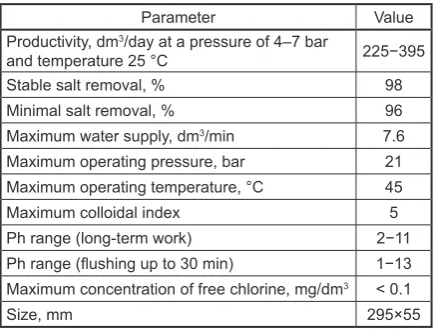
In this work, water desalination was stud-ied using cartridges with low-pressure reverse osmosis membrane Filmtec TW30–1812–50 and the properties of the membrane is described in Table 1.
The model solution was used through experi-ments (hardness – 9.0 mg-eqv/dm-3, alkalinity
– 5.0 mg-eqv/dm-3, SO2−
4 – 13.0 mg-eqv/dm-3,
Cl- – 3.5 mg-eqv/dm 3, рН = 8.9). After filtering
the solution through the weakly acid cationite Dowex MAС-3 in acid form, it had the follow-ing characteristics: hardness – 3.5 mg-eqv/dm-3,
acidity – 0.6 mg-eqv/dm-3, Cl- – 3.5 mg-eqv/dm-3,
SO2−
4 – 13.0 mg-eqv/dm-3, рН = 3.5.
For desalination of water, samples of 10 dm3
were used. The degree of selection of permeate was changed from 10 to 90%. The concentrations of chlorides, sulfates, hardness and alkalinity were determined in initial solutions and in perme-ates. The selectivity and productivity of the mem-brane were calculated (Gomelya et al., 2014).
Reagent water purification methods were used to soften and purify water model so-lution (SO2−
4 – 29.0 mg-eqv/dm-3,
hard-ness – 21.5 mg-eqv/dm-3, Са2+ – 1.8 mg-eqv/dm-3,
Mg2+ – 19.7 mg-eqv/dm-3, Cl- – 2.7 mg-eqv/dm-3,
alkalinity – 19.0 mg-eqv/dm-3) from sulfates by
the treatment with lime and 2/3 of hydroxychlo-ride of aluminum with the formation and of cal-cium sulfoaluminate.
Water was treated with the calculated amount of lime and coagulant at stirring, the precipitate was separated in 3 hours, and filtrate was used to determine the content of sulfates, chlorides, alka-linity and pH.
The degree of softening (Z, %) and the degree of removal of sulfates from water (A) were calcu-lated by the formulas:
2 4 2 4, 1 f SO f 100
i SO i
H С Z A H С (1)
where: Hi, 2 4 .i
SO
С − – initial hardness and
concen-tration of sulfates, respectively;
Hf, 2
4 f
SO
С − –hardness and concentration of sulfates in purified water, respectively. In order to prevent the sediment deposition on membranes in barometric methods, it is neces-sary to provide an effective stabilizing treatment of water. An effective lighting and discoloration of water is important at baromembrane water purification. Therefore, to reduce the load on the reverse osmosis membrane, increase the process productivity, increase the period of operation of reverse osmosis membranes, we proposed to conduct pre-treatment with the application of ul-trafiltration membranes to purify water from sus-pended solids.
In the work, the effect of the mechanical wa-ter purification on the productivity and selectivity of the reverse osmosis membrane of low pressure Filmtec TW30−1812−50 was determined.
RESULTS AND DISCUSSION
The membrane Filmtec TW-30–1812–50 pro-vides en effective water desalting at pressures up to 1 MPa (in this case, P = 0.3 MPa) with high process efficiency. Despite the fact that through a cassette with a reverse osmosis membrane only 10 dm3 of model solution was passed, its
pre-lighting significantly influenced the productivity of the membrane. During filtering an increase in membrane productivity on 12–20% is observed.
The efficiency of removal of chlorides, sul-fates and ions of hardness from water slightly Table 1. Properties of the reverse osmosis membrane
Filmtec TW30−1812−50
Parameter Value
Productivity, dm3/day at a pressure of 4–7 bar
and temperature 25 °С 225−395
Stable salt removal, % 98
Minimal salt removal, % 96
Maximum water supply, dm3/min 7.6
Maximum operating pressure, bar 21
Maximum operating temperature, °С 45
Maximum colloidal index 5
Ph range (long-term work) 2−11
Ph range (flushing up to 30 min) 1−13
Maximum concentration of free chlorine, mg/dm3 < 0.1
depends on the pre-purification of water. When desalting the model solution, the highest residual concentrations of chlorides were fixed in the per-meate. The residual concentrations of sulfates and hardness ions were rather low. The content of ions in concentrates was determined by their initial concentration and the effectiveness of detention on the membrane.
In concentrates, the increase in concentra-tions of all caconcentra-tions and anions that were con-trolled in this process were observed. The high-est concentrations correspond to hardness ions and to sulfates.
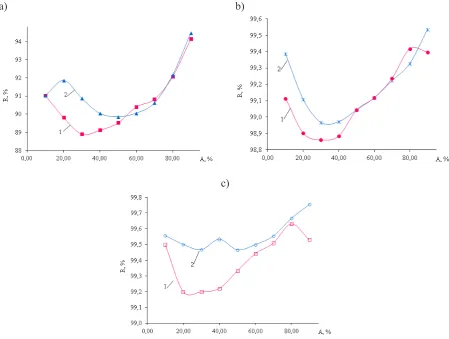
Since the efficiency of water purification from any ions depends not only on the residual concen-trations of ions, but also on their initial concentra-tion, then the efficiency of the water purification process from any ions is better to evaluate by the values of the membrane selectivity (Fig. 1).
During filtering, the Filmtec TW30–1812–50 membrane was characterized by the lowest se-lectivity of 89–95% in relation to chlorides; the selectivity towards sulfates and ions of hardness reached the values 98.8 – 99.7%.
Thus, initial lighting of water leads to a de-crease in water turbidity from 0.5 to 0.1 mg/dm3
and to increase in membrane productivity up to 1.2–2.0 times.
Another complicated problem of reverse-os-mosis water purification is its preparation before membrane treatments. During treatment of water with membrane technologies, there is a problem of formation of deposits on the membranes, re-sulting in a decrease in the flow of filtrate and
increased transmembrane pressure (Gryta et al., 2008). Therefore, along with effective lighting and discoloration, the problem of its stabilization to prevent sediment deposition on membranes is acute. The main reason for deposition of sediments is the deposition of calcium carbonate on the sur-face of the membrane. For this purpose corrosion inhibitors (Shmandiy et al., 2017; Gomelya et al., 2017) and water treatment on ion-exchange filters (Trokhymenko et al., 2017) can be used.
In the application of weakly acid cationite Dowex MAС-3 in the H+ form there is a decrease
in the alkalinity of water is observed (Gomelya et al., 2014). In this case, the alkalinity of water decreased to zero values, and the pH reached 3.9; and such water can not lead to the formation of carbonate deposits on the membrane.
In the work, the effect of stabilizing treatment of water on weakly acidic cake Dowex MAС-3 in the H+ form on the efficiency of water
desalina-tion in a reverse osmosis membrane Filmtec TW 30–1812–50 was determined. The model solution after filtration through weakly acidic cake Dowex MAС-3 in acid form had the following charac-teristics: hardness – 3.5 mg-eqv/dm-3, acidity –
0 mg-eqv/dm-3, Сl- – 3.5 mg-eqv/dm-3, SO2−
4 –
13.0 mg-eqv/dm-3, pH = 3.9.
The results of the evaluation of the productiv-ity of the reverse osmosis membrane are shown in Figure 3.
As can be seen from Fig. 3, the productivity of the membrane at a working pressure of 0,30 MPa a little depends on the pH of the solution. Acidification of the solution with partial softening
improves the productivity of the reverse osmosis membrane. It happens primarily due to the par-tial demineralization of the solution on the ion exchange filter and due to the absence of carbon-ate deposits on the membrane. During filtering of 10 dm3 of water, there is no significant
deposi-tion of sediments on the membrane, so the effect of the pH of the medium on the performance is insignificant. At longer tests and larger volumes of water, the membrane’s productivity after stabi-lization treatment of water will stay high during the time of use.
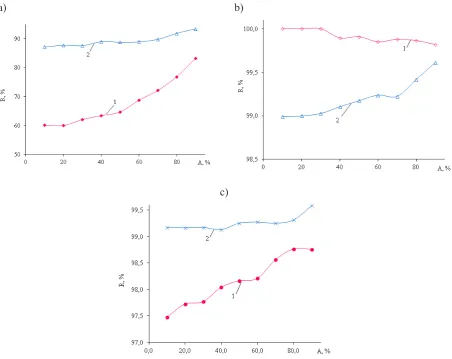
However, the selectivity of the membrane depends on the pre-treatment of water on cation exchanges. As can be seen from Fig. 4, as the pH of the medium was decreased, a slight increase in the selectivity of the membrane by sulfates and a significant decrease in its selectivity by chlorides was observed. Acidification of water leads to a decrease in the selectivity of the reverse osmosis membrane by chlorides by 10–30%. The selec-tivity of the membrane practically does not de-pend on working pressure and stays high towards
sulfates and ions of hardness (98–99%), regard-less of the pH and degree of selection of permeate. The effectiveness of water purification can also be evaluate by the residual concentrations of chlorides, sulfates and hardness ions in per-meates and their content in concentrate. One of the main problems of water purification is the recycling concentrate. It should be noted that in all cases concentrates, which formed, together with sulfates (≈ 100.0 mg-eqv/dm-3) also contain
significant concentrations of ions of hardness (33.0–80.0 mg-eqv/dm-3). For today, there are
no economically feasible methods for the pro-cessing of concentrates, and their preservation in the sludge lead to deterioration of environmental situation. Therefore, it is necessary to develop the technological processes of their processing.
Among the promising methods, which is used to soften water solutions and to remove sulfates from them, the reagent method can be accented. The advantage of the method in comparison with ion exchange, baromembrane processes, distilla-tion, electrodialysis is that it allows the remove
a) b)
c)
a) b)
c)
Figure 4. Dependence of the selectivity of the reverse osmosis membrane to-wards chlorides (a), sulfates (b), ions of hardness (c) on the degree of selection of
per-meate during desalination of solutions (pH = 8.6 (1), pH = 3.9 (2))
Figure 3. Dependence of the productivity of the reverse osmosis membrane on the de-gree of selection of permeate during desalting the filtrate after the cation filter Dowex
sulfates from water in the form of a slightly soluble precipitate, while in other cases waste is formed in the form of salt solutions. In addition, the advantages of this method include the cheap-ness and simplicity of operation and equipment.
Iron (Parsons and Daniels, 1999) and alumi-num coagulants (Prakash et al., 2003) are quite commonly spread. Processes of water treatment with lime and aluminum-contain coagulants are based on precipitation of calcium hydroxysul-fonaluminate (3CaO·Al2O3·3CaSO4·31H2O).
It is important to study the processes of de-mineralization of concentrates formed by reverse osmosis purification of mineralized waters, de-termine the conditions for effective softening of these solutions and purification from sulfates in the integrated treatment with lime and aluminum coagulants under the conditions of the least sec-ondary contamination with chloride anions. When using aluminum coagulants, the consumption of reagents increases in proportion to the content of sulfates in water. An increase in the consump-tion of coagulants is undesirable because of their high cost, increased costs of water purification. Therefore, in this case, the solution was treated only with lime (Ostovar and Amiri, 2013). The residual sulfate content is reduced ~ 20 ÷ 30 mg-eqv/dm-3, hardness up to ~ 10 ÷ 40 mg-eqv/dm-3
(Gomelya et al., 2017; Gomelya et al., 2014). Purification of concentrates was carried out by processing of samples with lime and alumi-num coagulant during mixing. Efficiency of water purification from sulfates, as well as the effective-ness of its softening, depends on the consumption of lime and coagulant, and on their ratio. In order
to purify the solution (SO2−
4 – 29.0 mg-eqv/dm-3;
hardness – 21.5 mg-eqv/dm-3; Са2+ – 1.8 mg-eqv/dm-3;
Mg2+ – 19.7 mg-eqv/dm-3; Cl- – 2.7 mg-eqv/dm-3;
alkalinity – 190 mg-eqv/dm-3) the lime and 2/3
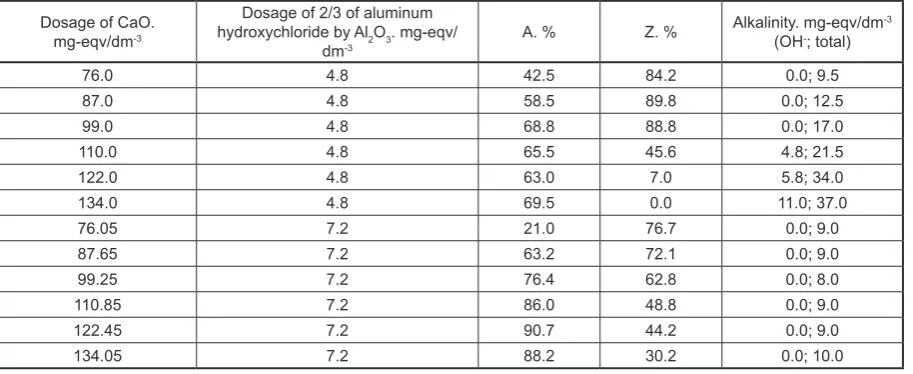
aluminum hydroxychloride was used (Table 2). The application of these reagents is less than the stoichiometric amount is not feasible, since there is no effective softening of the solution and the degree of removal of sulfates is quite low. At a dose of coagulant of 4.8 mg-eqv/dm-3, with an
increase in the consumption of lime from 76.0 to 134.0 mg-eqv/dm-3, there is an increase in the
ef-ficiency of purification from sulfates is observed. A similar situation occurs with an increase in the dose of 2/3 aluminum hydroxychloride to 7.2 mg-eqv/dm-3. At the same time, it is possible to reduce
the concentration of sulfates to 2.7 mg-eqv/dm-3.
The residual alkalinity of water increases with the increase in the consumption of lime, but de-creases with increasing dose of coagulant, which contributes to acidification of water.
Experimental data confirm that the precipi-tates formed as a result of water purification can be found to be used as part of cement as an exten-sible additive for cement and as an activator for curing slag-portland cement, as a substitute for natural gypsum stone and additive-accelerator in the composition of concrete (Trus et al., 2017).
CONCLUSIONS
1. The optimal parameters of membrane desalini-zation of solutions providing high water qual-ity were determined in the work. The methods
Table 2. Dependence of the efficiency of softening and removal of sulfate from solution on the consumption of lime and 2/3 of aluminum hydroxychloride
Dosage of СаО. mg-eqv/dm-3
Dosage of 2/3 of aluminum hydroxychloride by Al2О3. mg-eqv/
dm-3 A. % Z. %
Alkalinity. mg-eqv/dm-3
(ОН-; total)
76.0 4.8 42.5 84.2 0.0; 9.5
87.0 4.8 58.5 89.8 0.0; 12.5
99.0 4.8 68.8 88.8 0.0; 17.0
110.0 4.8 65.5 45.6 4.8; 21.5
122.0 4.8 63.0 7.0 5.8; 34.0
134.0 4.8 69.5 0.0 11.0; 37.0
76.05 7.2 21.0 76.7 0.0; 9.0
87.65 7.2 63.2 72.1 0.0; 9.0
99.25 7.2 76.4 62.8 0.0; 8.0
110.85 7.2 86.0 48.8 0.0; 9.0
122.45 7.2 90.7 44.2 0.0; 9.0
of stabilization treatment of water befor baro-metric desalination was developed to increase the efficiency of the productivity and the op-eration time of the membranes.
2. Methods of reagent processing of concentrates after barometric water purification for the cre-ation of low-waste technologies for demineral-ization of water were developed.
3. It was shown that the precipitate formed after reagent softening of water using aluminum-cooled coagulants can be used in the in the composition of building materials.
4. The developed technologies of integrated pro-cessing of mineralized waters allow ones to cre-ate low-waste technologies of desalting wcre-aters with complete processing of formed sediments.
REFERENCES
1. Buzylo V., Pavlychenko A., Savelieva T., Bo-rysovska O. 2018. Ecological aspects of managing the stressed-deformed state of the mountain massif during the development of multiple coal layers. Pa-per presented at the E3S Web of Conferences, 60. 2. Liu D., Edraki M., Malekizadeh A., Schenk P. M.,
Berry L. 2019. Introducing the hydrate gel mem-brane technology for filtration of mine tailings. Minerals Engineering, 135, 1–8.
3. Gomelya M., Hrabitchenko V., Trohymennko A., Shablij T. 2016. Research into ion exchange soften-ing of highly mineralized waters. Eastern-European Journal of Enterprise Technologies, 4(10–82), 4–9. 4. Kinnunen P., Kyllönen H., Kaartinen T., Mäkinen
J., Heikkinen J., Miettinen V. 2018. Sulphate re-moval from mine water with chemical, biological and membrane technologies. Water Science and Technology, (1), 194–205.
5. Amaya-Vías D., Tataru L., Herce-Sesa B., López-López J. A., López-López-Ramírez J. A. 2019. Metals removal from acid mine drainage (tinto river, SW spain) by water gap and air gap membrane distil-lation. Journal of Membrane Science, 582, 20–29. 6. Kim J. E., Phuntsho S., Chekli L., Choi J. Y., Shon
H. K. 2018. Environmental and economic assess-ment of hybrid FO-RO/NF system with selected inorganic draw solutes for the treatment of mine impaired water. Desalination, 429, 96–104. 7. Haan T. Y., Shah M., Chun H. K., Mohammad
A. W. 2018. A study on membrane technology for surface water treatment: Synthesis, character-ization and performance test. Membrane Water Treatment, 9(2), 69–77.
8. Ambiado K., Bustos C., Schwarz A., Bórquez R.
2017. Membrane technology applied to acid mine drainage from copper mining. Water Science and Technology, 75(3), 705–715.
9. Gomelya M. D., Trus I. M., Radovenchyk I. V. 2014. Influence of stabilizing water treatment on weak acid cation exchange resin in acidic form on quality of mine water nanofiltration desalination. Naukovyi Visnyk Natsionalnoho Hirnychoho Uni-versytetu, (5), 100–105.
10. Shmandiy V., Bezdeneznych L., Kharlamova O., Svjatenko A., Malovanyy M., Petrushka K. Polyu-zhyn, I. 2017. Methods of salt content stabilization in circulating water supply systems. Chemistry and Chemical Technology, 11(2), 242–246.
11. Gomelya N. D., Shabliy T. A., Trohymenko A. G., Shuryberko M. M. 2017. New inhibitors of corro-sion and depositions of sediments for water circu-lation systems. Journal of Water Chemistry and Technology, 39(2), 92–96.
12. Trokhymenko G., Gomelya M. 2017. Development of low waste technology of water purification from copper ions. Chemistry and Chemical Technology, 11(3), 372–377.
13. Gomelya N. D., Trus I. N., Nosacheva Y. V. 2014. Water purification of sulfates by liming when add -ing reagents contain-ing aluminum. Journal of Wa-ter Chemistry and Technology, 36(2), 70–74. 14. Gomelya M., Trus I., Shabliy T. 2014. Application
of aluminium coagulants for the removal of sul-phate from mine water. Chemistry and Chemical Technology, 8(2), 197–203.
15. Trus I. M., Fleisher H. Y., Tokarchuk V. V., Gome-lya M. D., Vorobyova V. I. 2017. Utilization of the residues obtained during the process of purification of mineral mine water as a component of binding materials. Voprosy Khimii i Khimicheskoi Tekh-nologii, (6), 104–109.
16. Ostovar M., Amiri M. 2013. A novel eco-friendly technique for efficient control of lime water soften -ing process. Water Environment Research, 85(12), 2285–2293.
17. Gryta M. 2008. Chemical pretreatment of feed water for membrane distillation. Chemical Papers, 62(6), 100–105.
18. Karakulski K., Gryta M., Sasim M. 2006. Produc-tion of process water using integrated membrane processes. Chemical Papers, 60(6), 416–421. 19. Prakash P., Sengupta A. K. 2003. Selective
coagu-lant recovery from water treatment pcoagu-lant residuals using donnan membrane process. Environmental Science and Technology, 37(19), 4468–4474. 20. Parsons S.A., Daniels S.J. 1999. The use of recovered