Demand for Energy Efficient, Eco-Friendly
Environment, Applications and Sustainable
Development
Abdeen Mustafa Omer
Energy Research Institute (ERI), Nottingham, United Kingdom
Corresponding author email: [email protected]
ABSTRACT: Energy conservation is a key goal of the world economy and will continue to be the one in future. The most effective way to reduce energy demand is to use energy more efficiently. People relay upon oil for primary energy and this for a few more decades. Other orthodox sources may be more enduring, but are not without serious disadvantages. Power from natural resources has always had great appeal. Coal is plentiful, though there is concern about despoliation in winning it and pollution in burning it. Nuclear power has been developed with remarkable timeliness, but is not universally welcomed, construction of the plant is energy-intensive and there is concern about the disposal of its long-lived active wastes. Barrels of oil, lumps of coal, even uranium come from nature but the possibilities of almost limitless power from the atmosphere and the oceans seem to have special attraction. The wind machine provided an early way of developing motive power. The massive increases in fuel prices over the last years have however, made any scheme not requiring fuel appear to be more attractive and to be worth reinvestigation. In considering the atmosphere and the oceans as energy sources the four main contenders are wind power, wave power, tidal and power from ocean thermal gradients. The renewable energy resources are particularly suited for the provision of rural power supplies and a major advantage is that equipment such as flat plate solar driers, greenhouses, wind machines, etc., can be constructed using local resources and without the advantage results from the feasibility of local maintenance and the general encouragement such local manufacture gives to the build up of small scale rural based industry. This article gives some examples of small-scale energy converters, nevertheless it should be noted that small conventional i.e., engines are currently the major source of power in rural areas and will continue to be so for a long time to come. There is a need for some further development to suit local conditions, to minimise spares holdings, to maximise interchangeability both of engine parts and of the engine application. The renewable energy resources are particularly suited for the provision of rural power supplies and a major advantage is that equipment such as flat plate solar driers, wind machines, etc. can be constructed using local resources and without the advantage results from the feasibility of local maintenance and the general encouragement such local manufacture gives to the build up of small scale rural based industry. The key factors to reducing and controlling CO2, which is the
major contributor to global warming, are the use of alternative approaches to energy generation and the exploration of how these alternatives are used today and may be used in the future as green energy sources. Emphasis should be placed on full local manufacture. This article discusses the potential for such integrated systems in the stationary and portable power market in response to the critical need for a cleaner energy technology. Throughout the theme several issues relating to renewable energies, environment and sustainable development are examined from both current and future perspectives.
Keywords: Renewable energy technologies, energy efficiency, sustainable development, emissions, environment.
INTRODUCTION
363 million kilowatts to 750 million kilowatts by 2020. The world’s energy consumption today is estimated to 22 billion kWh per year, 53 billion kWh by 2020. Such ever-increasing demand could place significant strain on the current energy infrastructure and potentially damage world environmental health by CO, CO2, SO2, NOx effluent
gas emissions and global warming. Achieving solutions to environmental problems that we face today requires long-term potential actions for sustainable development. In this regards, renewable energy resources appear to be the one of the most efficient and effective solutions since the intimate relationship between renewable energy and sustainable development. More rational use of energy is an important bridge to help transition from today’s fossil fuel dominated world to a world powered by non-polluting fuels and advanced technologies such as photovoltaic (PV) and fuel cells (FC) [WEO, 1995].
An approach is needed to integrate renewable energies in a way to meet high building performance. However, because renewable energy sources are stochastic and geographically diffuse, their ability to match demand is determined by adoption of one of the following two approaches [EUO, 2000]: the utilisation of a capture area greater than that occupied by the community to be supplied, or the reduction of the community’s energy demands to a level commensurate with the locally available renewable resources.
For a northern European climate, which is characterised by an average annual solar irradiance of 150 Wm-2, the mean power production from a photovoltaic component of 13% conversion efficiency is approximately 20 Wm-2. For an average wind speed of 5 ms-1, the power produced by a micro wind turbine will be of a similar order of magnitude, though with a different profile shape. In the UK, for example, a typical office building will have a demand in the order of 300 kWhm-2yr-1. This translates into approximately 50 Wm-2 of façade, which is twice as much as the available renewable energies [DETR,1994]. Thus, the aim is to utilise energy efficiency measures in order to reduce the overall energy consumption and adjust the demand profiles to be met by renewable energies. For instance, this approach can be applied to greenhouses, which use solar energy to provide indoor environmental quality. The greenhouse effect is one result of the differing properties of heat radiation when it is generated at different temperatures. Objects inside the greenhouse, or any other building, such as plants, re-radiate the heat or absorb it. Because the objects inside the greenhouse are at a lower temperature than the sun, the re-radiated heat is of longer wavelengths, and cannot penetrate the glass. This re-radiated heat is trapped and causes the temperature inside the greenhouse to rise. Note that the atmosphere surrounding the earth, also, behaves as a large greenhouse around the world. Changes to the gases in the atmosphere, such as increased carbon dioxide content from the burning of fossil fuels, can act like a layer of glass and reduce the quantity of heat that the planet earth would otherwise radiate back into space. This particular greenhouse effect, therefore, contributes to global warming. The application of greenhouses for plants growth can be considered one of the measures in the success of solving this problem. Maximising the efficiency gained from a greenhouse can be achieved using various approaches, employing different techniques that could be applied at the design, construction and operational stages. The development of greenhouses could be a solution to farming industry and food security.
Energy security, economic growth and environment protection are the national energy policy drivers of any country of the world. As world populations grow, many faster than the average 2%, the need for more and more energy is exacerbated (Figure 1). Enhanced lifestyle and energy demand rise together and the wealthy industrialised economics, which contain 25% of the world’s population, consume 75% of the world’s energy supply. The world’s energy consumption today is estimated to 22 billion kWh per year. About 6.6 billion metric tons carbon equivalent of greenhouse gas (GHG) emission are released in the atmosphere to meet this energy demand [Boset al., 1994]. Approximately 80% is due to carbon emissions from the combustion of energy fuels. At the current rate of usage, taking into consideration population increases and higher consumption of energy by developing countries, oil resources, natural gas and uranium will be depleted within a few decades. As for coal, it may take two centuries or so.
Figure 1. Annual and estimated world population and energy demand Million of barrels per day of oil equivalent (MBDOE)
0 5000 10000 15000 20000 25000
1940 1960 1980 2000 2020 2040 2060 2080 2100
Year
Wo
rld
po
pu
latio
n (mi
llio
n)
0 5000 10000 15000 20000 25000
Ener
gy
and
electrici
ty dem
and
(M
BDOE
)
Technological progress has dramatically changed the world in a variety of ways. It has, however, also led to developments e.g., environmental problems, which threaten man and nature. Build-up of carbon dioxide and other GHGs is leading to global warming with unpredictable but potentially catastrophic consequences. When fossil fuels burn, they emit toxic pollutants that damage the environment and people’s health with over 700,000 deaths resulting each year, according to the World Bank review of 2000. At the current rate of usage, taking into consideration population increases and higher consumption of energy by developing countries, oil resources, natural gas and uranium will be depleted within a few decades, as shown in Figures 2, and 3. As for coal, it may take two centuries or so. One must therefore endeavour to take precautions today for a viable world for coming generations.
Figure 2. World oil productions in the next 10-20 years
Figure 3. Volume of oil discovered worldwide
Research into future alternatives has been and still being conducted aiming to solve the complex problems of this recent time e.g., rising energy requirements of a rapidly and constantly growing world population and global environmental pollution. Therefore, options for a long-term and environmentally friendly energy supply have to be developed leading to the use of renewable sources (water, sun, wind, biomass, geothermal, hydrogen) and fuel cells. Renewables could shield a nation from the negative effect in the energy supply, price and related environment concerns. Hydrogen for fuel cells and the sun for PV have been considered for many years as a likely and eventual substitute for oil, gas, coal and uranium. They are the most abundant elements in the universe. The use of solar energy or PVs for the everyday electricity needs has distinct advantages: avoid consuming resources and degrading the environment through polluting emissions, oil spills and toxic by-products. A one-kilowatt PV system producing 150 kWh each month prevents 75 kg of fossil fuel from being mined. 150 kg of CO2 from entering the atmosphere and keeps 473 litres of water from being
consumed. Electricity from fuel cells can be used in the same way as grid power: to run appliances and light bulbs and even to power cars since each gallon of gasoline produced and used in an internal combustion engine releases roughly 12 kg of CO2, a GHS that contributes to global warming.
1
10
100
1920 1930 1940 1950 1960 1970 1980 1990 2000 2010 2020
Year
G
iga barrels/
year USA
West Europe
East Europe/Asia
Middle East Rest of the world
0 50 100 150 200 250 300
1940 1950 1960 1970 1980 1990 2000
Year
Billion of
bar
People, Power and Pollution
Over millions of years ago plants covered the earth, converting the energy of sunlight into living tissue, some of which was buried in the depths of the earth to produce deposits of coal, oil and natural gas. The past few decades, however, have experienced many valuable uses for these complex chemical substances, manufacturing from them plastics, textiles, fertiliser and the various end products of the petrochemical industry. Indeed, each decade sees increasing uses for these products. Renewable energy is the term used to describe a wide range of naturally occurring, replenishing energy sources. Coal, oil and gas, which will certainly be of great value to future generations, as they are to ours, are non-renewable natural resources. The rapid depletion of non-renewable fossil resources need not continue. This is particularly true now as it is, or soon will be, technically and economically feasible to supply all of man’s needs from the most abundant energy source of all, the sun. The sunlight is not only inexhaustible, but, moreover, it is the only energy source, which is completely non-polluting.
Industry’s use of fossil fuels has been blamed for warming the climate. When coal, gas and oil are burnt, they release harmful gases, which trap heat in the atmosphere and cause global warming. However, there has been an ongoing debate on this subject, as scientists have struggled to distinguish between changes, which are human induced, and those, which could be put down to natural climate variability. Nevertheless, industrialised countries have the highest emission levels, and must shoulder the greatest responsibility for global warming. However, action must also be taken by developing countries to avoid future increases in emission levels as their economies develop and populations grows, as clearly captured by the Kyoto Protocol [Boset al., 1994]. Notably, human activities that emit carbon dioxide (CO2), the most significant contributor to
potential climate change, occur primarily from fossil fuel production. Consequently, efforts to control CO2
emissions could have serious, negative consequences for economic growth, employment, investment, trade and the standard of living of individuals everywhere.
Scientifically, it is difficult to predict the relationship between global temperature and GHG concentrations. The climate system contains many processes that will change if warming occurs. Critical processes include heat transfer by winds and tides, the hydrological cycle involving evaporation, precipitation, runoff and groundwater and the formation of clouds, snow, and ice, all of which display enormous natural variability.
The equipment and infrastructure for energy supply and use are designed with long lifetimes, and the premature turnover of capital stock involves significant costs. Economic benefits occur if capital stock is replaced with more efficient equipment in step with its normal replacement cycle. Likewise, if opportunities to reduce future emissions are taken in a timely manner, they should be less costly. Such a flexible approach would allow society to take account of evolving scientific and technological knowledge, while gaining experience in designing policies to address climate change.
The World Summit on Sustainable Development in Johannesburg in 2002 committed itself to ‘‘encourage and promote the development of renewable energy sources to accelerate the shift towards sustainable consumption and production’’. Accordingly, it aimed at breaking the link between resource use and productivity. This can be achieved by the following:
Trying to ensure economic growth doesn’t cause environmental pollution. Improving resource efficiency.
Examining the whole life-cycle of a product.
Enabling consumers to receive more information on products and services.
Examining how taxes, voluntary agreements, subsidies, regulation and information campaigns, can best stimulate innovation and investment to provide cleaner technology.
Therefore, the use of renewable energy sources and the rational use of energy, in general, are the fundamental inputs for any responsible energy policy. However, the energy sector is encountering difficulties because increased production and consumption levels entail higher levels of pollution and eventually climate change, with possibly disastrous consequences. At the same time, it is important to secure energy at an acceptable cost in order to avoid negative impacts on economic growth. To date, renewable energy contributes as much as 20% of the global energy supplies worldwide [DEFRA, 2002]. Over two thirds of this comes from biomass use, mostly in developing countries, some of it unsustainable. Yet, the potential for energy from sustainable technologies is huge. On the technological side, renewables have an obvious role to play. In general, there is no problem in terms of the technical potential of renewables to deliver energy. Moreover, there are very good opportunities for RETs to play an important role in reducing emissions of GHGs into the atmosphere, certainly far more than have been exploited so far. However, there are still some technical issues to address in order to cope with the intermittency of some renewables, particularly wind and solar. Yet, the biggest problem with relying on renewables to deliver the necessary cuts in GHG emissions is more to do with politics and policy issues than with technical ones [DEFRA, 2002]. For example, the single most important step governments could take to promote and increase the use of renewables is to improve access for renewables to the energy market. This access to the market needs to be under favourable conditions and, possibly, under favourable economic rates as well. One move that could help, or at least justify, better market access would be to acknowledge that there are environmental costs associated with other energy supply options and that these costs are not currently internalised within the market price of electricity or fuels. This could make a significant difference, particularly if appropriate subsidies were applied to renewable energy in recognition of the environmental benefits it offers. Similarly, cutting energy consumption through end-use efficiency is absolutely essential. This suggests that issues of end-use consumption of energy will have to come into the discussion in the foreseeable future [Levine and Hirose, 1995]. However, RETs have the benefit of being environmentally benign when developed in a sensitive and appropriate way with the full involvement of local communities. In addition, they are diverse, secure, locally based and abundant. In spite of the enormous potential and the multiple benefits, the contribution from renewable energy still lags behind the ambitious claims for it due to the initially high development costs, concerns about local impacts, lack of research funding and poor institutional and economic arrangements [IPCC, 2001].
Hence, an approach is needed to integrate renewable energies in a way that meets high building performance requirements. However, because renewable energy sources are stochastic and geographically diffuse, their ability to match demand is determined by adoption of one of the following two approaches [Parikn et al., 1999]: the utilisation of a capture area greater than that occupied by the community to be supplied, or the reduction of the community’s energy demands to a level commensurate with the locally available renewable resources.
Energy and Population Growth
Urban areas throughout the world have increased in size during recent decades. About 50% of the world’s population and approximately 7.6% in more developed countries are urban dwellers [UNIDO, 1997]. Even though there is evidence to suggest that in many ‘advanced’ industrialised countries there has been a reversal in the rural-to-urban shift of populations, virtually all population growth expected between 2000 and 2030 will be concentrated in urban areas of the world. With an expected annual growth of 1.8%, the world’s urban population will double in 38 years [UNIDO, 1997].
With increasing urbanisation in the world, cities are growing in number, population and complexity. At present, 2% of the world’s land surface is covered by cities, yet the people living in them consume 75% of the resources consumed by mankind [WRI, 1994]. Indeed, the ecological footprint of cities is many times larger than the areas they physically occupy. Economic and social imperatives often dictate that cities must become more concentrated, making it necessary to increase the density to accommodate the people, to reduce the cost of public services, and to achieve required social cohesiveness. The reality of modern urbanisation inevitably leads to higher densities than in traditional settlements and this trend is particularly notable in developing countries.
situation will be to enthuse people to use renewable energy resources, there are many practical difficulties, which need to be tackled. The people groups who are using the non-commercial energy resources, like urban communities, are now becoming more demanding and wish to have commercial energy resources made available for their use. This is attributed to the increased awareness, improved literacy level and changing culture [WRI, 1994]. The quality of life practiced by people is usually represented as being proportional to the per capita energy use of that particular country. It is not surprising that people want to improve their quality of life. Consequently, it is expected that the demand for commercial energy resources will increase at a greater rate in the years to come [WRI, 1994]. Because of this emerging situation, the policy makers are left with two options: either to concentrate on renewable energy resources and have them as substitutes for commercial energy resources or to have a dual approach in which renewable energy resources will contribute to meet a significant portion of the demand whereas the conventional commercial energy resources would be used with caution whenever necessary. Even though the first option is the ideal one, the second approach will be more appropriate for a smooth transition [WRI, 1994].
Energy and Environmental Problems
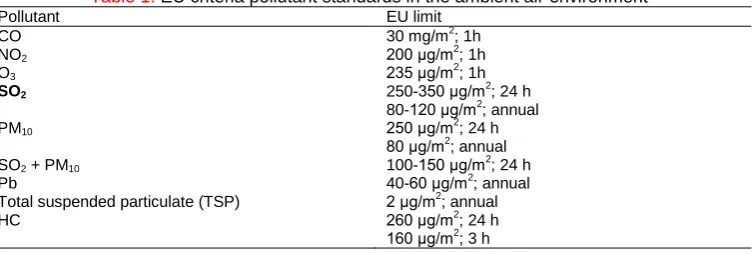
Technological progress has dramatically changed the world in a variety of ways. It has, however, also led to developments of environmental problems, which threaten man and nature. During the past two decades the risk and reality of environmental degradation have become more apparent. Growing evidence of environmental problems is due to a combination of several factors since the environmental impact of human activities has grown dramatically because of the sheer increase of world population, consumption, industrial activity, etc. throughout the 1970s most environmental analysis and legal control instruments concentrated on conventional effluent gas pollutants such as SO2, NOx, CO2, particulates, and CO (Table 1). Recently,
environmental concerns has extended to the control of micro or hazardous air pollutants, which are usually toxic chemical substances and harmful in small doses, as well to that of globally significant pollutants such as CO2.
Aside from advances in environmental science, developments in industrial processes and structures have led to new environmental problems. For example, in the energy sector, major shifts to the road transport of industrial goods and to individual travel by cars has led to an increase in road traffic and hence a shift in attention paid to the effects and sources of NOx and volatile organic compound (VOC) emissions. Environmental problems span
a continuously growing range of pollutants, hazards and ecosystem degradation over wider areas.
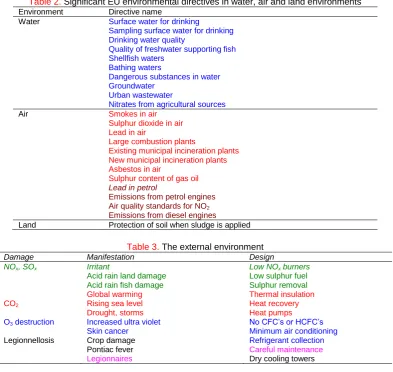
The main areas of environmental problems are: major environmental accidents, water pollution, maritime pollution, land use and sitting impact, radiation and radioactivity, solid waste disposal, hazardous air pollutants, ambient air quality, acid rain, stratospheric ozone depletion and global warming (greenhouse effect, global climatic change) (Table 2).
Table 1. EU criteria pollutant standards in the ambient air environment
Pollutant EU limit
CO NO2
O3
SO2
PM10
SO2 + PM10
Pb
Total suspended particulate (TSP) HC
30 mg/m2; 1h 200 μg/m2
; 1h 235 μg/m2; 1h
250-350 μg/m2; 24 h
80-120 μg/m2
; annual 250 μg/m2
; 24 h 80 μg/m2
; annual 100-150 μg/m2
; 24 h 40-60 μg/m2
; annual 2 μg/m2
; annual 260 μg/m2
; 24 h 160 μg/m2
; 3 h
The four more important types of harm from man’s activities are global warming gases, ozone destroying gases, gaseous pollutants and microbiological hazards (Table 3). The earth is some 30oC warmer due to the presence of gases but the global temperature is rising. This could lead to the sea level rising at the rate of 60 mm each decade with the growing risk of flooding in low-lying areas (Figure 4). At the United Nations Earth Summit at Rio in June 1992 some 153 countries agreed to pursue sustainable development [Boulet, 1987]. A main aim was to reduce emission of carbon dioxide and other GHGs. Reduction of energy use in buildings is a major role in achieving this. Carbon dioxide targets are proposed to encourage designers to look at low energy designs and energy sources.
Problems with energy supply and use are related not only to global warming that is taking place, due to effluent gas emission mainly CO2, but also to such environmental concerns as air pollution, acid precipitation,
Table 2. Significant EU environmental directives in water, air and land environments
Environment Directive name
Water Surface water for drinking
Sampling surface water for drinking Drinking water quality
Quality of freshwater supporting fish Shellfish waters
Bathing waters
Dangerous substances in water Groundwater
Urban wastewater
Nitrates from agricultural sources
Air Smokes in air
Sulphur dioxide in air Lead in air
Large combustion plants
Existing municipal incineration plants New municipal incineration plants Asbestos in air
Sulphur content of gas oil
Lead in petrol
Emissions from petrol engines
Air quality standards for NO2
Emissions from diesel engines
Land Protection of soil when sludge is applied
Table 3. The external environment
Damage Manifestation Design
NOx, SOx
CO2
O3 destruction
Legionnellosis
Irritant
Acid rain land damage Acid rain fish damage Global warming Rising sea level Drought, storms
Increased ultra violet Skin cancer
Crop damage Pontiac fever
Legionnaires
Low NOx burners Low sulphur fuel Sulphur removal Thermal insulation Heat recovery Heat pumps
No CFC’s or HCFC’s Minimum air conditioning Refrigerant collection Careful maintenance
Dry cooling towers
Table 4. Global emissions of the top fourteen nations by total CO2 volume (billion of tons)
Rank Nation CO2 Rank Nation CO2 Rank Nation CO2
1 2 3 4 USA Russia China Japan 1.36 0.98 0.69 0.30 6 7 8 9 India UK Canada Italy 0.19 0.16 0.11 0.11 11 12 13 14 Mexico Poland S. Africa S. Korea 0.09 0.08 0.08 0.07
During the past century, global surface temperatures have increased at a rate near 0.6oC/century and the average temperature of the Atlantic, Pacific and Indian oceans (covering 72% of the earth surface) have risen by 0.06oC since 1995. Global temperatures in 2001 were 0.52oC above the long-term 1880-2000 average (the 1880-2000 annually averaged combined land and ocean temperature is 13.9oC). Also, according to the USA Department of Energy, world emissions of carbon are expected to increase by 54% above 1990 levels by 2015 making the earth likely to warm 1.7-4.9oC over the period 1990-2100, as shown in Figure 5. Such observation and others demonstrate that interests will likely increase regarding energy related environment concerns and that energy is one of the main factors that must be considered in discussions of sustainable development.
Environmental Transformations
maintaining the quality of the newly privatised resources as a shorthand. Society has to meet the freshwater demands of its population and its industry by extracting water from the regional water resources that are provided by the natural environment (lakes, rivers, aquifers, etc.). These water resources are renewable but potentially destructible resources. While moderate amounts of human water extractions from a given regional water system can be sustained for indefinite periods. Excessive extractions will change the geographical and climatic conditions supporting the water cycle and will diminish the regenerative capacity of the regional water system, thereby reducing the potential for future withdrawals. Typically, recovery from any such resource degradation will be very slow and difficult, if not impossible; resource degradation is partially irreversible [Erreygers,1996].
To make sustainable water extraction economically viable, the sustainable policy has to break even (all costs are covered by revenues) while unsustainable policy has to be unprofitable (costs exceed revenues):
(1+r) vt-1 = 5yt + vt (1)
Where: r is the interest rate, t=year, y is the revenue.
(1+r) vt-1 > 105yt (2)
(1+r) vt-1 < [105/ (105-5)] vt (3)
The term [105/ 5)] is to define the natural productivity factor of the water resource as (1+g) = [105/ (105-5)]; g is the natural productivity rate.
Rate g will be close to zero if the sustainable extraction level is much smaller than the unsustainable level. Using g, the equation can be as follows:
vt > (1+r)/ (1+g) vt-1 (4)
Regulatory measures that prevent resource owners from adopting certain unsustainable extraction policies are a necessary pre-condition for the effective operation of a privatised natural resource sector. Unregulated water privatisation would result in an inflationary dynamics whose distributional effects would threaten the long-term viability of the economy. This inflationary dynamics is not due to any form of market imperfection but is a natural consequence of the competitive arbitrage behaviour of unregulated private resource owners.
Figure 4. Change in global sea level
Figure 5. Global mean temperature changes over the period of 1990-2100 and 1990-2030 20
0
0 10 0
CONCLUSIONS
Many cities around the world are facing the problem of increasing urban density and energy demand. As cities represent a significant source of growth in global energy demand, their energy use, associated environmental impacts, and demand for transport services create great pressure to global energy resources. Low energy design of urban environment and buildings in densely populated areas requires consideration of a wide range of factors, including urban setting, transport planning, energy system design, and architectural and engineering details. It is found that densification of towns could have both positive and negative effects on the total energy demand. With suitable urban and building design details, population should and could be accommodated with minimum worsening of the environmental quality.
Energy efficiency brings health, productivity, safety, comfort and savings to homeowners, as well as local and global environmental benefits. The use of renewable energy resources could play an important role in this context, especially with regard to responsible and sustainable development. It represents an excellent opportunity to offer a higher standard of living to local people and will save local and regional resources. Implementation of greenhouses offers a chance for maintenance and repair services. It is expected that the pace of implementation will increase and the quality of work improve in addition to building the capacity of the private and district staff in contracting procedures. The financial accountability is important and should be made transparent.
REFERENCES
WEO (World Energy Outlook). 1995. International Energy Agency. OECD (Organisation for Economic Cooperation and Development) Publications. 2 rueAndre Pascal. Paris. France.
EUO (Energy use in offices). 2000. Energy Consumption Guide 19 (ECG019). Energy efficiency best practice programme. UK Government. DETR (UK Department of the Environment, Transport and the Regions). 1994.Best practice programme-introduction to energy efficiency in
buildings.
Bos E, My T, Vu E, Bulatao R. 1994. World population projection: 1994-95. Edition, published for the World Bank by the John Hopkins University Press. Baltimore and London.
DEFRA (Department of Energy, Food and Rural Affairs). 2002. Sustainable Development and Environment. UK.
Levine M, Hirose M. 1995. Energy efficiency improvement utilising high technology: an assessment of energy use in industry and buildings. Report and Case Studies. London: World Energy Council.
IPCC (International Panel on Climate Change). 2001. Climate change 2001 (3 volumes). United Nations International Panel on Climate Change. Cambridge University Press. UK.
Parikn J, Smith K, Laxmi V. 1999. Indoor air pollution: a reflection on gender bias. Economic and Political Weekly.
UNIDO (United Nations Industrial Development Programme). 1997. Changing courses sustainable industrial development, as a response to agenda 21. Vienna.
WRI (World Resource Institute). 1994. World Resources: A guide to the Global Environment. People and the Environment. Washington. USA.
Boulet T. 1987.Controlling air movement: a manual for architects and builders. McGraw-Hill, p.85-138, New York: USA.