Vol. 5 Issue 4, April - 2019
The Effect Of Excavation And Loading On The
Strength Reduction Factor Of Slopes
Seyed Vahab Hosseini1, Vahid Hosseinitoudeshki2, Mohammad Hossein noori Gheidari3
1Department of Civil Engineering٫ Zanjan Branch٫ Islamic Azad University٫ Zanjan٫ Iran
2Department of Civil Engineering٫ Zanjan Branch٫ Islamic Azad University٫ Zanjan٫ Iran
Corresponding e-mail address: [email protected]
3Department of Civil Engineering٫ Zanjan Branch٫ Islamic Azad University٫ Zanjan٫ Iran
Abstract— Stability of slopes is related to the
strength reduction factor (SRF) that determine by weakening the soil or rock in stages in an elastic-plastic finite element analysis until the slope fails. It accomplish via lowering of the shear strength envelope by a factor until it cut the Mohr circle showing stresses in the slopes. In this paper, the effect of excavation and loading on the strength reduction factor (SRF) of slopes is investigated by the modeling of rock slopes with different dips using the Phase2 software. The different excavations and loadings was done in three parts of up, middle and down of dolomitic rock slopes and in each case the strength reduction factor (SRF) of slopes has been determined. The obtained results show that excavation and loading in various parts of slopes has different effects on the strength reduction factor (SRF) of slopes. The most effect of excavation and loading in decreasing of the strength reduction factor (SRF) is relevant to down parts of slopes. Cause of decline the strength reduction factor (SRF) is getting bigger of the Mohr circle. Due to excavation in the slopes, the amount of minimum stress will decrease and due to loading on the slopes, the amount of maximum stress will increase that in both cases the Mohr circle showing stresses in the slopes will be bigger and the shear strength envelope faster cut it.
Keywords— Rock slopes; Strength Reduction Factor (SRF); Excavation; Loading; Phase2
1.INTRODUCTION
The stability of the slopes is always of superior importance in the design of rock slopes, roads and open pits structures. A great variety of numerical analyses such as finite element and distinct element methods are performed with development of many kinds of numerical programs on the geotechnical problems. A number of methods are being used for the assessment of slope stability [1, 2, 3].
Slope stability analysis can be done by the finite element method (FEM). One of the most popular techniques for performing FEM slope analysis is the shear strength reduction (SSR) approach [4]. In this manner that is applied for Generalized Hock-Brown criterion [5], the shear strength envelope of rocks
systematically reduce by a factor of safety (Fig. 1), and compute FEM models of the slope until deformations are unacceptably large or solutions do not converge. In the fact, lowering of the shear strength envelope is until it cut the Mohr circle showing stress values in the slope.
In the strength reduction approach, the soil or rock strength is dummy reduced, and so there is a need to redistribute the stresses. This can be done by the stress redistribution algorithm, and so this option can be indirectly used to do a strength reduction stability analysis.
The strength reduction factor (SRF) is defined as:
cf
c
f
SRF
tan
tan
Where
f
andcf
are the effective stress strength parameters at failure, or the reduced strength. The strength reduction method usually uses the same SRF for all material and for all strength parameters, so that the stability factor reduces to one number in the end.Fig. 1. The shear strength envelope for a Generalized Hoek-Brown criterion is reduced by a factor F (After [5])
2. GEOMECHANICAL PARAMETERS OF DOLOMITIC ROCKS
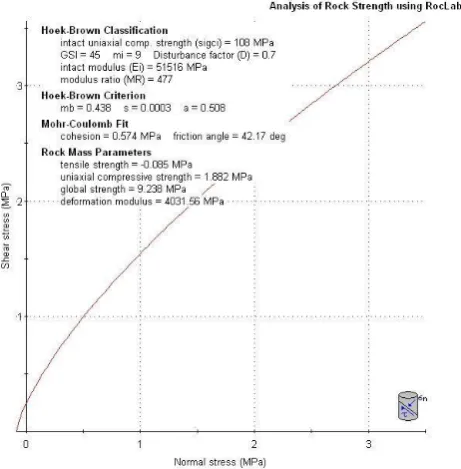
In this study, the geomechanical parameters of the jointed dolomitic rock masses in Taham-Chavarzagh road, located in the Zanjan province, were obtained by using Roclab software [6]. These parameters are obtained based on The Hoek-Brown failure criterion and it is presented in Fig. 2.
Fig.2. The geomechanical parameters of dolomitic rock mass
3.MODELING OF ROCK SLOPES
To study the effect of excavation and loading on the strength reduction factor (SRF), slopes with dips of 30, 45, 60, and 75 degrees in the jointed dolomitic rock masses were modeled (Fig. 3). The Veneziano joint network model is used for numerical analysis (Fig. 3) and this model is based on a Poisson line process. It adapts the Poisson process to generate joints of finite length [7].
Fig. 3. The models of slopes with dips of 30 degrees (a), 45 degrees (b), 60 degrees (c) and 75 degrees (d), the Veneziano joint network is also shown
By run the made models, the critical strength reduction factor (SRF) of slopes was obtained. The respective quantity has been obtained for the slope of 30 degrees as 4.23, for the slope of 45 degrees as 2.8, for 60 degrees as 2.08 and for slope of 75 degrees as 1.55 respectively.
Fig. 4. The excavation on the middle of 45 degree slope (the critical SRF is equal to 1.82)
Vol. 5 Issue 4, April - 2019
Fig. 5. The diagram shows the amounts of SRF versus the excavation percentage on the slope with dip of 30 degree
Fig. 6. The diagram shows the amounts of SRF versus the excavation percentage on the slope with dip of 45 degree
Fig. 7. The diagram shows the amounts of SRF versus the excavation percentage on the slope with dip of 60 degree
As the above diagrams show, in all of the slopes by excavation, the amount of critical strength reduction factor (SRF) has decreased. Also, the above diagrams show that by increasing dip of slopes, the location of excavation in slopes has a great effect on the reduction of SRF so that, in the slopes with dip of 30 degrees, excavation in all three parts of the slope shall have a same effect. But in the slopes with angle of 60 and 75 degrees, excavation in down part of slopes has the most effect on the reduction of SRF.
Fig. 8. The diagram shows the amounts of SRF versus the excavation percentage on the slope with dip of 75 degree
For excavation on the slopes, the amount of minimum stress will decrease and the Mohr circle showing stresses in the slopes will be bigger and the shear strength envelope faster cut it (Fig. 9).
Fig. 9. Schematic view of enlarging the Mohr circle due to reduce the minimum stress as a result of excavation on the slopes
In order to studying the effect of loading on the critical strength reduction factor (SRF) of slopes, the loads with different values are applied in three parts of slopes (up, middle, and down) (for example, as Fig. 10) and in each case the critical strength reduction factor (SRF) of slopes are obtained and shown in Figs. 11 to 14. For normalizing the loads on slopes, the loads are divided by the vertical stresses in slopes and the normal values of loads are obtained.
angle of 75 degrees, loading on the middle and down of slope has the most effect on the reduction of SRF.
Because loading on the slopes, the amount of maximum stress will increase and the Mohr circle showing stresses in the slopes will be bigger and the shear strength envelope faster cut it (Fig. 15).
Fig. 10. The loading on the middle of 45 degrees slope (the critical SRF is equal to 0.91)
Fig. 11. The diagram shows the amounts of SRF versus the ratio the loads to vertical stress on the slope with dip of 30 degrees
Fig. 12. The diagram shows the amounts of SRF versus the ratio the loads to vertical stress on the slope with dip of 45 degrees.
Fig. 13. The diagram shows the amounts of SRF versus the ratio the loads to vertical stress on the slope with dip of 60 degrees
Fig. 14. The diagram shows the amounts of SRF versus the ratio the loads to vertical stress on the slope with dip of 75 degrees
Fig. 15. Schematic view of enlarging the Mohr circle due to increase the maximum stress as a result of loading on the slopes
4.CONCLUSIONS
In this research that with aim to analysis of the effect of excavation and loading on different parts of slopes is done the following results are obtained:
Vol. 5 Issue 4, April - 2019 - The excavation and loading on different parts
of the slopes has left a different effect on the reduction of SRF.
- With increasing dip of slopes, the excavation and loading on the down part of the slopes has the most effect on the reduction of SRF.
- Due to excavation in the slopes, the amount of minimum stress will decrease and the Mohr circle showing stresses in the slopes will be bigger and this will decline the strength reduction factor (SRF).
- Due to loading on the slopes, the amount of maximum stress will increase and the Mohr circle showing stresses in the slopes will be bigger and this will decline the strength reduction factor (SRF).
REFERENCES
[1] Crosta, G.B., Imposimato, S. and Roddeman, D.G. 2003. Numerical modelling of large landslides stability and run out, Natural Hazards and Earth System Sciences, 3, 523– 528.
[2] Bhasin, R. and Kaynia, A.M. 2004. Static and dynamic simulation of a700-m high rock slope in western Norway, Engineering Geology, 71, 213–226.
[3] Eberhardt, E., Stead, D. and Coggan, J.S. 2004. Numerical analysis of initiation and progressive failure in natural rock slopes—the1991 Randa rockslides, Rock Mechanics and Mining Sciences, 41, 69–87.
[4] Griffiths, D.V. and Lane, P.A. 1999. Slope Stability Analysis by Finite Elements, Geotechnique, 49(3), 387-403.
[5] Hammah, R.E., Yacoub, T.E. and Corkum, B.C. 2005. The Shear Strength Reduction Method for the Generalized Hoek-Brown Criterion, ARMA/USRMS 05-810.
[6] Hoek, E., Carranza-Torres, C. and Corkum, B. 2002. Hoek–Brown Failure Criterion- Edition, Rocscience.