Hadoop Integrating with Oracle Data Warehouse and Data Mining
Nodar MOMTSELIDZE* Alex KUKSIN**
Abstract
Various industry verticals are seeing vast amounts of data that are stored on file systems. This article describes an integration of Hadoop cluster HDFS files with Oracle database in order to create Data Warehouse and implement Data Mining solutions. We will provide examples of predefined cluster ETL map/reduce algorithms for loading Oracle database and describe different Hadoop
architectures for ETL processing. Keywords: hadoop, oracle
I.Summary
• Distributed processing of large data sets • Distributed File System (HDFS), MapReduce • Hive – A Big Scale Data Warehouse
• ORACLE’s Big Data Appliance • Data Mining
• Analytics with R language
• Using this technologies in “Telco” project
II. Distributed File Systems
Demand to distributed File Systems [1]
1. Storing files of huge size (hundred Tb. Or Petabites); 2. Transmissivity-open/close,read/write distributed files
3. Soft dimensional squeezing (add clusters) 4. Reliability
III. Before MapReduce:
Before Apache Hadoop technology, it was difficult to • Dimensional squeezing scale data processing • Managing hundreds or thousands of processors • Managing parallelization and distribution • I/O Scheduling
• Status and monitoring • Fault/crash tolerance
MapReduce technology provides all of these, easily!
IV. Map / Reduce
How does it solve our previously mentioned problems? Hadoop [2] is a popular open-source map-reduce imple-mentation, which is being used as an alternative to store and process extremely large data sets on commodity hardware.
MapReduce is highly scalable and can be used across many computers.
Many small machines can be used to process jobs that nor-mally could not be processed by a large machine.
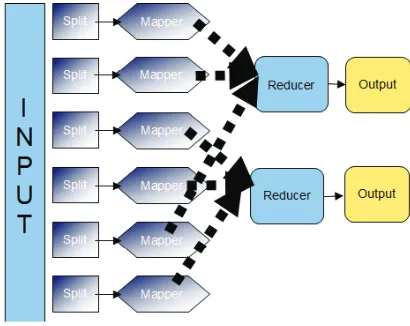
Map: input record (key, value)
Reduce: (key, {v1, ..., vn}) output record
Figure 1: Hadoop a big scale data structure.
Figure2: Map/Reduce Process.
V. Hive – A Big Scale Data Warehouse
Data Warehousing Tool on Top of Hadoop:
Hive [3], an open-source data warehousing solution built on top of Hadoop.
Hive supports queries expressed in a SQL-like declarative language - HiveQL, which are compiled into map-reduce jobs executed on Hadoop.
In addition, HiveQL supports custom map-reduce scripts to be plugged into queries. The language includes a type system with support for tables containing primitive types, collections like arrays and maps, and nested compositions of the same.
Hive consists of three parts:
• Metastore over Hadoop • Libraries for (De)Serialization • Query Engine(HQL)
The Metastore acts as the system catalog for Hive. It stores all the information about the tables, their partitions, the sche-mas, the columns and their types, the table locations etc.
Hive can take an implementation of the SerDe java inter-face provided by the user and associate it to a table or partition. As a result, custom data formats can easily be interpreted and queried from.
Each dependent task is only executed if all of its
prereq-uisites have been executed. A map/reduce task first serializes its part of the plan into a plan.xml file. This file is then added
to the job cache for the task and instances of ExecMapper and ExecReducers are spawned using Hadoop.
Similar to traditional databases, Hive stores data in tables, where each table consists of a number of rows, and each row
consists of a specified number of columns. Each column has an
associated type. The type is either a primitive type or a complex type. Currently, the following primitive types are supported:
• Integers – bigint(8 bytes), int(4 bytes), smallint(2 bytes),
tinyint(1 byte). All integer types are signed.
• Floating point numbers – float(single precision), • double(double precision)
• String
Hive also natively supports the following complex types:
• Associative arrays – map<key-type, value-type> • Lists – list<element-type>
• Structs – struct<file-name: field-type, ... >
Example:
CREATE TABLE t1(st string, fl float,
li list<map<string, struct<p1:int, p2:int>>); SELECT t1.a1 as c1, t2.b1 as c2
FROM t1 JOIN t2 ON (t1.st = t2.st2);
HiveQL has extensions to support analysis expressed as map-reduce programs by users and in the programming lan-guage of their choice.
FROM (
MAP doctext USING ‘python wc_mapper.py’
AS (word, cnt) FROM docs
CLUSTER BY word ) a
REDUCE word, cnt USING ‘python wc_reduce.py’;
You can use java, python and other lang. for map/reduce
VI. Hive – HQL Approach
GROUP BY: as key in MapWHERE: calculates in Map. For main fields recommended
create partitioning. For historical values generally partitioning by time_key.
SUM/AVG as value in Map
SUM/AVG: final value is calculating in Reduce
JOIN: Reduce or Map
HAVING: is filtering in the final step in Reduce
VII. Why HDFS → Oracle [4]
Hadoop provides a massively parallel architecture to pro-cess information from huge volumes of unstructured and semi-structured content.
Data have to be analyzed from BI tools usually using re-lational databases powered by analytical functions and Data Mining options.
The critical data should be accessible between different systems and easy enabled for any analytical needs.
VIII. Different range of requirements
Scheduled bulk data loading from hadoop to the data ware-house
Streaming hot hadoop data from databases
Accessing HDFS data for map/reduce directly from data-base, BI systems or OLTP applications
Using RDBMS based repository for HADOOP metadata
IX. Native HDFS Oracle Connectors
Oracle Loader for Hadoop
OLH loads data from Hadoop to Oracle Database. It runs as a MapReduce job on Hadoop to partition, sort, and convert
the data into an Oracle-ready format, offloading to Hadoop the
processing that is typically done using database CPUs. The data is then loaded to the database by the Oracle Loader for Hadoop job (online mode) or written to HDFS as Oracle Data
Pump files for load or access later (offline mode) with Oracle
Direct Connector for HDFS. Oracle Loader for Hadoop even-ly distributes the load across Hadoop reducer tasks, handling skew in input data that could otherwise cause bottlenecks.
Oracle Direct Connector for Hadoop Distributed File Sys-tem (HDFS)
ODC for HDFS is a connector for high speed access to data on HDFS from Oracle Database. With this connector SQL in the database can be used to directly query data on HDFS.
The data can be text files or Oracle Data Pump files generated
by Oracle Loader for Hadoop. The connector can also be used to load the data into the database with SQL, if the application requires.
The connectors can be used together or separately.
X. Oracle Loadr for Hadoop
Oracle Loader for Hadoop performs the following pre-processing on the data:
Convert the data into Oracle data types
Partition the data according to the partitioning scheme of the target table, and
Optionally sort the data within each partition
Oracle Loader for Hadoop uses the efficient direct path
load mechanism, with minimal additional processing in the da-tabase.
the load across Hadoop reducer tasks so that a node does not become a bottleneck because it is loading more data than the others are.
Oracle Loader for Hadoop has online and offline load op -tions. In the online load option, the data is both pre-processed and loaded into the database as part of the Oracle Loader for Hadoop job. Each reduce task makes a connection to Oracle Database, loading into the database in parallel. The database has to be available during the execution of Oracle Loader for Hadoop.
XI. Oracle Direct connectors for HDFS
Oracle Direct Connector for HDFS allows Oracle
Data-base to access files on HDFS via external tables. External ta
-bles allow data in files that are outside the database to be que -ried and, with Oracle Direct Connector for HDFS, these can be
files on HDFS. The files can be text files or Oracle Data Pump formatted files created by Oracle Loader for Hadoop. External
tables can be queried like any other table, so the data becomes accessible through SQL in Oracle Database. The data can be queried and joined with other tables in the database, and used for in-database analysis.
Text files on HDFS can be directly read by Oracle Direct Connector for HDFS. Data formats other than text files can be
pre-processed by Oracle Loader for Hadoop into Oracle Data
Pump files so that Oracle Direct Connector for HDFS can read
them.
The data can also be loaded into the data base using SQL. Loading into the database is helpful if the data will be accessed frequently, and is required if the data has to be updated by the database.
XII. Oracle Data Integrator Application Adapter
for Hadoop
The Oracle Data Integrator Application Adapter for Ha-doop enables data integration developers to integrate and trans-form data easily within Hadoop using Oracle Data Integrator.
Employing familiar and easy-to-use tools and preconfigured
knowledge modules, the adapter provides the following capa-bilities:
Loading data into Hadoop from the local file system and
HDFS.
Performing validation and transformation of data within Hadoop.
Loading processed data from Hadoop to Oracle Database for further processing and generating reports.
Typical processing in Hadoop includes data validation and transformations that are programmed as MapReduce jobs. De-signing and implementing a MapReduce job requires expert programming knowledge. However, using Oracle Data Inte-grator and the Oracle Data InteInte-grator Application Adapter for
Hadoop, it’s not needed to write MapReduce jobs. Oracle Data
Integrator uses Hive and the Hive Query Language (HiveQL), a SQL-like language for implementing MapReduce jobs. The Oracle Data Integrator graphical user interface enhancing the
developer’s experience and productivity while enabling them
to create Hadoop integrations.
XIII. Oracle R connector for Hadoop
Oracle R Connector for Hadoop is an R package that pro-vides transparent access to Hadoop and to data stored in HDFS.
R Connector for Hadoop provides users of the open-source statistical environment R with the ability to analyze data stored in HDFS, and to scalably run R models against large volumes of data.
R Connector for Hadoop enables users to write mapper and reducer functions in R and execute them on the Hadoop Clus-ter through R. In addition, users can easily transition R scripts from test environments to production. Hadoop-based R pro-grams can be deployed on a Hadoop cluster without needing to know Hadoop internals, the Hadoop or HDFS command line interfaces, or IT infrastructure. R Connector for Hadoop can optionally be used together with the Oracle Advanced ics Option for Oracle Database. The Oracle Advanced Analyt-ics Option enables R users to transparently work with database resident data without having to learn SQL or database concepts but with R computations executing directly in-database.
XIV. Using FUSE
HDFS files are not directly accessible through the normal
operating system, but there is a way to access HDFS data using File system in Userspace.
Using one of the FUSE drivers and mounting HDFS on the database instance, even on every instance in case of using
a RAC database, HDFS files can be easily accessed using the
External Table infrastructure.
External tables present data stored in a file system in a ta -ble format and can be used in SQL queries transparently. Ex-ternal tables could be used to access data stored in HDFS (the Hadoop File System) from inside the Oracle database through FUSE and execute all desired operations in parallel directly from the external tables.
Sqoop is a tool designed to transfer data between Hadoop and relational databases. You can use Sqoop to import data from a relational database management system (RDBMS) such as MySQL or Oracle into the Hadoop Distributed File System (HDFS), transform the data in Hadoop MapReduce, and then export the data back into an RDBMS.
XV. Apache Sqoop Software
Sqoop automates most of this process, relying on the data-base to describe the schema for the data to be imported. Sqoop uses MapReduce to import and export the data, which provides parallel operation as well as fault tolerance.
Sqoop reads the table row-by-row into HDFS. The output
of this import process is a set of files containing a copy of the
imported table. The import process is performed in parallel.
By this, the output will be in multiple files. These files may be delimited text files (for example, with commas or tabs sepa
-rating each field), or binary Avro or SequenceFiles containing
serialized record data.
Sqoop’s export process will read a set of delimited text files from HDFS in parallel, parse them into records, and insert
XVI. Quest Data connector for Oracle and
Hadoop
Quest Data Connector for Oracle and Hadoop is an op-tional plugin to Sqoop.
Quest Data Connector for Oracle and Hadoop accepts re-sponsibility for the following Sqoop Job types:
] Import jobs that are Non-Incremental. ] Export jobs
] Quest Data Connector for Oracle and Hadoop does not accept responsibility for other Sqoop job types. For example, Quest Data Connector for Oracle and Hadoop does not accept eval jobs etc.
Quest Data Connector for Oracle and Hadoop accepts re-sponsibility for those Sqoop Jobs with the following attributes:
] Oracle-relatedl Table-Based — Jobs where the table
ar-gument is used and the specified object is a table.
XVII. Data Mining
Generally, data mining (sometimes called data or knowl-edge discovery) is the computer-assisted process of digging through and analyzing enormous sets of data and then extract-ing the meanextract-ing of the data. Data minextract-ing tools predict behav-iors and future trends, allowing businesses to make proactive, knowledge-driven decisions. Data mining tools can answer business questions that traditionally were too time consuming
to resolve. They scour databases for hidden patterns, finding
predictive information that experts may miss because it lies outside their expectations.
XVIII. Analytics with R Language
R is an integrated suite of software facilities for data manipulation, calculation and graphical display. Among other things it has
• an effective data handling and storage facility,
• a suite of operators for calculations on arrays, in particular matrices,
• a large, coherent, integrated collection of intermediate tools for data analysis,
• graphical facilities for data analysis and display either directly at the computer or on hardcopy, and
• a well-developed, simple and effective programming language (called `S’) which includes conditionals, loops, user defined
recursive functions and input and output facilities. (Indeed most of the system supplied functions are themselves written in the S language.)
XIX. Telco Use Case
Is there influence of Service Quality (SQ) (voice, SMS, MMS, MBB, …) on churn? For which segments of subscribers, for
which services, on which SQ problem levels? What is the high-level estimation of potential of protected revenue through SQ opti-mization?
Our solution:
• Drill down to identify areas for SQ optimization with high potential:
o For what subscribers? For what Services?
o What SQ problems from what current level to what target level should be improved? Where?
o We should proceed to consider SQ input to business cases only for those network optimization initiatives, which influ
-ence the areas for SQ optimization with high potential identified at this step (Figure3).
• Estimate churn reduction effect caused by expected SQ change while making decisions on concrete network optimizations which influence the identified areas for SQ optimization with high potential network optimizations: modernization / capacity expan -sion / capacity distribution policies change
• Evaluate churn reduction effect caused by actual SQ change after performing concrete network optimizations • Estimation of the analysis outcomes is illustrated on the following diagram:
References
[1]http://lib.custis.ru/Apache_Hadoop_(Владимир Климонтович_на_ADD-2010)
[2] Apache Hadoop. Available at http://wiki.apache.org/hadoop [3] Apache Hive. Available at http://hive.apache.org/