[Epub ahead of print]
Trigeminal neuralgia: bibliometric analysis
of the fifty top-cited articles in the period
2000-2016.
Yasmany Fornaris-Cedeño,1,2 Ibraín Enrique Corrales-Reyes3,4& Caridad de Jesús Pérez-Martínez.1,2
Affiliations: 1Universidad de Ciencias Médicas
de La Habana, Cuba. 2School of Medical Sciences
Manuel Fajardo, La Habana, Cuba.3Universidad
de Ciencias Médicas de Granma, Cuba.
4Stomatology Clinic of Specialties Manuel de
Jesús Cedeño Infante. Bayamo, Cuba.
Corresponding author: Yasmany Fornaris-Cedeño. Universidad de Ciencias Médicas School of Medical Sciences Manuel Fajardo. La Habana, Cuba. Phone: (53) 52069164. E-mail: [email protected]
Abstract: Objective: To analyze the fifty top-cited articles on trigeminal neuralgia during the period 2000-2016. Methods: A bibliometric study using Harzing's Publish or Perish 5 software and Google Scholar as the database was performed. The term used in the search was "trigeminal neuralgia." A list was generated with the 50 top-cited articles in the period 2000-2016 and variables of interest were studied. Results: The articles received 12316 citations with a mean of 724.47 and 246.32 citations per year and per articles, respectively. The article with the highest mean number of citations/year (48.57) was published by Cruccu et al., in 2010. The articles had an h index of 48 and were published in 24 scientific journals. The journals with the highest number of articles were
Neurology and Journal of Neurosurgery, with 7 articles each (14%). A prevalence of North American authorship was observed (n=14; 28.0%). Original articles (n=26; 52.0%) and papers written by six authors (n=12; 24.0%) were also the most prevalent. The highest number of articles by a binomial international collaboration was from Austria-Italy (n=3; 6.00%). The most researched topics were related to updates in specific treatments for trigeminal neuralgia and neuropathic pain in general. Conclusions: The most cited article was published in 2010 in the European Journal of Neurology. Articles published in the years 2001 and 2002 received the highest number of citations. The most relevant scientific collaborations were observed between Italian and Austrian researchers.
Keywords: trigeminal neuralgia; publications; bibliometric analysis
INTRODUCTION.
Trigeminal neuralgia (TN) is an acute, paroxysmal, painful disorder, sometimes described as causing burning or electric-shock like1 pain in
the area innervated by the fifth cranial nerve, most commonly in the second and third branches.2 Its annual prevalence is 4.3 individuals
per hundred thousand,3 and the mean age of occurrence is over 50
years, although cases have also been reported in younger patients. This pathology has been classified as one of the worst causes of suffering due to pain, accounting for 89% of facial pain.4
TN mainly affects women with a female/male ratio of 2:1.1 It occurs on the right side in 60% of the cases, 39% on the left side, and it is bilateral in 1% of cases.4 Although the etiopathogenetic mechanisms
of TN have not been fully uncovered,5 the literature identifies
neurovascular compression in the vertebrobasilar complex, evidenced in imaging studies, as the most accepted theory.2,6
Conflict of interests: The authors declare no conflict of interests.
Ethics approval: All the authors took part in the development of the study.
Funding: None.
Authors’ contributions: The manuscript was carried out, written, and approved in collaboration with all authors.
Acknowledgements: None.
Cite as: Fornaris-Cedeño Y, Corrales-Reyes IE & Pérez-Martínez CJ. Trigeminal neuralgia: bibliometric analysis of the fifty top-cited articles in the period 2000-2016. J Oral Res 2018; 7(7):305-314.
doi:10.17126/joralres.2018.065
Receipt: 05/07/2018 Revised: 07/23/2018
[Epub ahead of print]
Diagnosis is mainly based on the personal and clinicalhistory of the patient. Exploration must necessarily include an assessment of facial sensitivity and facial muscles, as well as the performance of cranial magnetic resonance imaging to rule out the presence of intracranial tumors. Regarding its treatment, various therapeutic strategies have been proposed and pharmacological treatment is used as a first line of action.1,7 Surgical
treatment includes multiple variants and is generally reserved for patients who do not respond positively to pharmacotherapy.1,2,5,8,9
The magnitude of the clinical and psychological disorders caused by TN has encouraged research and fostered publications, both of which increase every year. Taking into account that bibliometric studies have become a useful tool to asses the current and the future state of a specific field of science, and the fact that no references have been found in the literature regarding the bibliometric status of studies on TN, the present research was carried out with the aim of analyzing the 50 most cited articles on trigeminal neuralgia published during the period 2000-2016.
MATERIALS AND METHODS.
Type of study, unit of analysis and bibliometric indicators A bibliometric analysis of the 50 top-cited articles on trigeminal neuralgia published during the period 2000-2016 was carried out. The following bibliometric indicators were studied: year of publication, total number of articles, citations, average number of citations per year, average number of citations per article, average number of citations per author, average number of citations per author and per year, average number of articles per author, h index, h5 index, g index, contemporary h index (hc), individual h index (hI), normalized hI index, AWCR index, AW index, AWCRpA index, e index, hm index, annual hI index, h amplitude, g amplitude , annual collaboration index, journals, impact factor, authors' affiliation, and article type.
The h index10 considers the number of articles and the
number of citations they receive. It consists of ordering the works of an author in decreasing fashion by virtue of the citations received for each work. At the moment in which the rank (position in the list) exceeds or equals the value of the citation, the h index is obtained. This means that
the author has h works with at least h citations, i.e., an author has an "h" index if he/she has "h" articles that have been cited at least "h" times. The h5 index is the h index of articles published in the last five full years.
The g index11 is that in which the square root of the
sum of the citations is the largest number in descending order of citations. The contemporary h index10 takes into
account the time of the published article and its citations. To calculate the hI12 index, the h index is divided by the
average number of co-authors that one author has. To obtain the normalized hI index,12 the citations of each
article that contribute to the h index are selected and divided by the number of co-authors of that article and the resulting h index is calculated.
The AWCR13 index consists of the proportion of
citations based on the age of the article. It measures all citations adjusted by the age of each document that the traditional h index includes. It is an average number of the citations where each document is divided by the number of years of the article and is calculated as the square root of all the citations.
The AW14,15 index is defined as the square root of the
AWCR index to allow for a comparison with the h index. It approaches the h index if the citation rate (mean) remains more or less constant over the years. The e index15 is the
square root of the sum of the citations of the articles included in the h index. The hm index12 divides the article
among the authors and takes into account the number of complete citations, and the resulting h index is calculated. The annual hI index analyzes the annual impact of the journal. The annual collaboration index was calculated as the quotient between the sum of the number of authors per article and the number of articles published.
Procedures, data collection and management, and statistical analysis
Bibliometric indicators were calculated using the Harzing's Publish or Perish 5 software16 taking Google
[Epub ahead of print]
Indicators ValuesArticles 50
Total citations 12316
Years of publication 17
Citations/year 724.47 Citations/articles 246.32 Citations/authors 4491.35 Citations/authors/year 264.19 Articles/author 17.93
h Index 48
g Index 50
hc Index 50
hI Index 12.87
Standardized hI index 39
AWCR 1136.64
AW Index 33.71
AWCRpA 398.95
e Index 99.78
hm Index 17.93
Annual hl Index 2.29
h Coverage 100
g Coverage 100
No. Country n %
1 United States 14 28.0
2 United Kingdom 9 18.0
3 France 6 12.0
4 Italy 3 6.0
5 Denmark 2 4.0
6 Israel 2 4.0
7 Germany 2 4.0
8 Austria 1 2.0
9 Turkey 1 2.0
10 Taiwan 1 2.0
11 Egypt 1 2.0
12 Switzerland 1 2.0
13 England 1 2.0
14 Netherlands 1 2.0
15 Thailand 1 2.0
16 Sweden 1 2.0
17 Australia 1 2.0
18 China 1 2.0
19 Canada 1 2.0
Total 50 100
Six studies were excluded because they were book chapters. The values of the impact factor in 2 years for 2016 were obtained from the annual report of the Journal
Citation Report® (JCR). The data obtained were exported to a database (MS Excel, Microsoft Corp., USA) in which the statistical analysis was performed.
2000
Articles 2 5 8 3 4 3 2 2 6 4 3 7 1 1 1 1 1
Citations 543 2057 2411 762 1192 1105 503 353 1446 652 657 337 88 69 85 31 25
Collaboration index 6 2.8 2.25 5 5.5 5 5 3.5 4.83 6.25 11.33 4.33 7 10 2 2 6
0 0
500 2
1000 4
1500 6
2000 8
2500 10
3000 12
2008
2004 2012
2002 2006 2010 2014
2001 2003 2005 2007 2009 2011 2013 2015 2016
Figure 1. Annual distribution of articles, citations and collaboration index.
Table 1. Annual distribution of articles, citations and collaboration index.
Table 4. Distribution of articles by country.
[Epub ahead of print]
N o A rt ic le s Cit at io ns Cit at io ns /y ea r 1 Cr uc cu G , e t a l. E FN S g ui de lines on n
eu ro -p at hi c p ai n a ss es sm en t: r ev is ed 2 009 . E
ur J N
eu ro l. 2 01 0; 17 (8 ):1 01 0-18 . 34 0 48 .5 7 2 W iff en P J, e t a l. A nt ic on vu ls an t d rug s f or a cut e a nd c hr on ic p ai n. C oc hr an e D at ab as e S ys t R ev . 2 00 5; 3. 53 6 44 .6 7 3 Cr uc cu G , e t a l. A A N -E FN S g ui de lin
es on t
rige m -in al n eu ra lg ia m an age m en t. E
ur J N
eu ro l. 2 00 8; 15 (1 0) :10 13 -2 8. 35 2 39 .11 4 Lo ve S , C oa kh am H B. T rige m in al n eu ra lg ia : p at ho lo gy a nd p at ho ge ne sis . B ra in . 2 00 1;1 24 (1 2) :2 34 7-60 . 609 38 .0 6 5 Gr on se th G , e t a l. P ra ct ic e p ar am et er : t he d ia gno s-tic e va lu at ion a nd t re at m en
t of t
rige m in al n eu ra lg ia ( an e vi de nc e-ba se d r ev ie w ). 33 2 36 .8 9 Re por
t of t
he Q ua lit y S ta nd ar ds S ub com m itt
ee of t
he A m er ic an A ca de m
y of N
eu ro lo gy a nd t he E ur op ea n F ede ra
tion of N
eu ro lo gi ca l So ci et ie s. N eu ro lo gy . 2 00 8; 71 (1 5) :11 83 -9 0. 6 Ro ga w sk i MA , L ös ch er W . T he n eu robi olo
gy of a
nt ie pi le pt ic d rug s f or t he t re at m en
t of non
epi le pt ic c on di tion s. 42 2 32 .4 6 N at ur e M ed ic in e. 2 00 4;1 0( 7) :6 85 -9 2. 7 Se rp el l M G ,N eu rop at hi c P ai n S tu dy Gr ou p. Ga ba pe nt in i n n eu rop at hi c p ai n s yn dr om es
: a r
an dom iz ed , dou ble -b lin d, p la ce bo -c on tr ol le d 43 4 28 .9 3 tr ia l. P ai n. 2 00 2; 99 (3 ):5 57 -6 6. 8 Za kr ze w sk a J M , L in sk ey M E. T rige m in al n eu ra lg ia . B r M ed J . 2 01 4; 34 8( 9) :4 74 . 85 28 .3 3 9 Ka np ol at Y , e t a l. P er cut an eou s c on tr ol le d r ad iof re que nc y t rige m in al r hiz ot om y f or t he t re at m en
t of i
di op at hi c 45 2 28 .2 5 tr ig em in al n eu ral gi a: 2 5-ye ar e xp er ien ce w ith 1 60 0 p at ien ts . N eu ros ur ger y. 2 00 1; 48 (3 ):5 24 -3 4. 10 Yu an R Y, e t a l. B ot ul in um t ox in f or d ia be tic n eu rop at hi c p ai
n. A r
an dom iz ed dou ble -b lin d c ro ss ov er t ria l. N eu ro lo gy . 2 009 ;7 2( 17) :14 73 -1 47 8. 20 5 25 .6 3 11 H al l G C , e t a l. E pi de m io lo gy a nd t re at m en
t of n
eu rop at hi c p ai n: t he U K pr im ar y c ar e p er sp ec tiv e. P ai n. 2 00 6; 1 22 (1 ):1 56 -6 2. 27 8 25 .2 7 12 Kh ed r E M , e t a l. L ong -la st ing a nt alg ic e ffe ct
s of d
ai
ly s
es
si
on
s of r
ep et itiv e t ra ns cr an ia l m ag ne tic s tim ul at ion i n c en tr al a nd p er ip he ra l 30 2 25 .17 neu ro pa th ic p ai n. J N eu ro l N eu ros ur g P sy ch ia tr y. 2 00 5; 76 (6 ):8 33 -8 . 13 Ré gi s J , e t a l. L ong -t er m s af et y a nd e ffic ac
y of Ga
m m a K nif e s ur ge ry i n c la ss ic al t rige m in al n eu ra lg ia
: a 4
97 -p at ie nt h is tor ic al c ohor t s tu dy . 25 25 .0 0 J N eu ros ur g. 2 01 6; 12 4( 4) :10 79 -8 7. 14 Ta tli M , e t a l. V ar iou s s ur gi ca l m od al iti es f or t rige m in al n eu ra lg ia : l ite ra tu re s tu
dy of r
es pe ct iv e long -t er m out com es . 21 9 24 .3 3 A cta N eu ro ch iru rg ic a. 2 00 8; 15 0( 3) :2 43 -5 5. 15 At ta l N , e t a l. N eu rop at hi c p ai n: a re t he re d is tinc t s ub ty pe s de pe nd
ing on t
he e
tio
lo
gy or a
na tom ic al le si on ? P ai n. 2 00 8; 13 8( 2) :3 43 -5 3. 21 7 24 .11 16 Lop ez B C , e t a l. S ys te m at ic r ev ie
w of a
bl at iv e n eu ro su rg ic al t ec hn iq ue s f or t he t re at m en
t of t
rige m in al n eu ra lg ia . N eu ro su rge ry . 31 3 24 .0 8 20 04 ;5 4(4) :9 73 -8 3. 17 Ko opm an JS , e t a l. I nc ide nc
e of f
ac ia l p ai n i n t he ge ne ra l p op ul at ion . P ai n. 2 009 ;14 7( 1) :12 2-7. 19 1 23 .8 8 18 Je ns en T S. A nt ic on vu ls an ts i n n eu rop at hi c p ai n: r at ion ale a nd c lin ic al e vi de nc e. E
ur J P
ai n. 2 00 2; 6( SA ):6 1-8. 35 5 23 .6 7 19 Ta ss an ee ya ku l W , e t a l. A ss oc ia tion b et w ee n H LA -B * 1 50 2 a nd c ar ba m az epi ne -in duc ed s ev er e c ut an eou s 16 3 23 .2 9 ad ve rs e d rug r ea ct ion s i
n a T
ha i p op ul at ion . E pi le ps ia . 2 01 0; 51 (5 ):9 26 -3 0. 20 Ly on s M K. D ee p br ai n s tim ul at ion : c ur re nt a nd f ut ur e c lin ic al a pp lic at ion s. M ay o C lin ic P ro ce ed ing s. 2 01 1; 86 (7) : 6 62 -7 2. 13 5 22 .5 21 Ös te rb er g A , e t a l. C en tr al p ai n i n m ul tip le s cle ro sis : pr ev ale nc e a nd c lin ic al c ha ra ct er is tic s. E
ur J P
ai n. 2 00 5; 9( 5) :5 31 -5 31 . 26 7 22 .2 5 22 Kon dz io lk a D , e t a l. Ga m m a k nif e s te re ot ac tic r ad io su rge ry f or i di op at hi c t rige m in al n eu ra lg ia
. J N
eu ro su rg . 2 01 0; 11 2( 4) :7 58 -6 5. 154 22 .0 0 23 Ba ck on ja M M . U
se of a
nt ic on vu ls an ts f or t re at m en
t of n
eu rop at hi c p ai n. N eu ro lo gy . 2 00 2; 59 (5 s upp l 2 ):S 14 -S 17 33 0 22 .0 0 24 Ka lk an is S N , e t a l. M ic ro va sc ul ar de com pr es si on s ur ge ry i n t he U ni te d S ta te s, 1 99 6 t o 2 00 0: m or ta lit y r at es , 30 0 21 .4 3 m or bi di ty r at es , a nd t he e ffe ct
s of ho
spi ta l a nd s ur ge on v ol um es . N eu ro su rge ry . 2 00 3; 52 (6 ):1 25 1-62 . s 25 N ur m ik ko T J, E ld ridge P R. T rige m in al n eu ra lg ia : p at hop hys io lo gy , d ia gno sis a nd c ur re nt t re at m en t. B
r J A
na es th . 34 0 21 .2 5 20 01 ;8 7( 1) :11 7-32 . 26 Ei se nb er g E , e t a l. L am ot rig in e r ed uc es p ai nf ul d ia be tic n eu ro pa th
y. A r
an dom iz ed , c on tr ol le d s tu dy . N eu ro lo gy . 33 6 21 .0 0 20 01 ;5 7( 3) :505 -9 . Tab le 2 . Po si tion
ing of a
[Epub ahead of print]
27 Ré gi s J , e t a l. P ro sp ec tiv e c on tr ol le d t rial of g
am -m a k nif e s ur ge ry f or e ss en tia l t rige m in al n eu ra lg ia
. J N
eu ro su rg . 22 5 20 .4 5 20 06 ; 1 04 (6 ):9 13 -2 4. 28 M ae sa w a S , e t a l. C lin ic al out com es a ft er s te -r eo ta ct ic r ad io su rg er y f or i di op at hi c t rige m in al n eu ra lg ia
. J N
eu ro su rg . 32 0 20 .0 0 20 01 ;9 4( 1) :14 -20 . 29 D ev or M , e t a l. P at hop hys io lo
gy of t
rige m in al n eu ra lg ia : t he i gn iti on h yp ot he sis . C
lin J P
ai n. 2 00 2; 18 (1 ):4 -1 3. 29 7 19 .8 0 30 Ly tt on W W . C om put er m ode lli
ng of e
pi le ps y. N at ur e N eu ro sc i. 2 00 8; 9( 8) :6 26 -3 7. 16 9 18 .7 8 31 Po llo ck B E, e t a l. S te re ot ac tic r ad io su rge ry f or i di op at hi c t rige m in al n eu ra lg ia
. J N
eu ro su rg . 2 00 2; 9 7( 2) :3 47 -5 3. 27 9 18 .6 0 32 Be nn et t M I, S im ps on K H G . Ga ba pe nt in i n t he t re at m en
t of n
eu rop at hi c p ai n. P al lia tiv e M ed ic in e. 2 00 4;1 8( 1) :5 -1 1. 24 1 18 .54 33 Si ndou M , e t a l. M ic ro va sc ul ar de com pr es si on f or pr im ar y t rige m in al n eu ra lg ia : long -t er m e ffe ct iv en es s a nd 18 5 18 .5 0 pr og no st ic f ac tor s i
n a s
er
ie
s of 3
62 c on se cut iv e p at ie nt s wi th c le ar -c ut n eu ro va sc ul ar c on fli ct
s who u
nde rw en t p ur e de com pr es si on . Jo ur nal o f N eu ros ur ger y. 2 00 7;1 07 (6 ):1 14 4– 53 . 34 Gu st in S M , e t a l. D iff er en t p ai n, d iff er en t br ai n: t ha la m ic a na tom y i n n eu rop at hi c a nd non -n eu rop at hi c c hr on ic pa in s yn dr om es
. J N
eu ro sc i. 109 18 .17 20 11 ;3 1( 16 ):5 95 6-64 . 35 W u C J, e t a l. B ot ul in um t ox in t yp
e A f
or t he t re at m en
t of t
rige m in al n eu ra lg ia : r es ul ts f
rom a r
an dom iz ed , 88 17 .6 0 dou ble -b lin d, p la ce bo -c on tr ol le d t ria l. C ep ha la lg ia . 2 01 2; 32 (6 ):4 43 -5 0. 36 C am po s-Be ni te z M , K au fm an n A M . N eu ro va sc ul ar c om pr es si on fi nd ing s i n h em ifa ci al s pa sm
. J N
eu ro su rg . 2 00 8; 109 (3 ):4 16 -2 0. 15 7 17 .4 37 O be rm an n M , e t a l. Gr ay m at te r v ol um e r ed uc tion r efl ec ts c hr on ic p ai n i n t rige m in al n eu ra lg ia . N eu ro im age . 2 01 3; 74 (1 ):3 52 -3 58 . 69 17 . 38 Bu rc hi el K
J. A n
ew c la ss ifi ca tion f or f ac ia l p ai n. N eu ro su rge ry . 2 00 3; 53 (5 ):1 16 4-7. 23 6 16 .8 6 39 Si ndou M , e t a l. A na tom ic al ob se rv at ion s d ur ing m ic ro va sc ul ar de com pr es si on f or i di op at hi c t rige m in al n eu ra lg ia 25 2 16 .8 0 (wi th c or re la tion s b et w ee n t op og ra ph
y of p
ai
n a
nd s
ite of t
he n eu ro va sc ul ar c on fli ct ). P ro sp ec tiv e s tu dy i
n a s
er
ie
s of 5
79 p at ie nt s. A ct a N eu ro chir ur gi ca . 2 00 2; 14 4( 1) :1-13 . 40 Be nn et to L , e t a l. T rige m in al n eu ra lg ia a nd i ts m an age m en t. B r M ed J . 2 00 7; 33 4( 75 86 ):2 01 -5 . 16 8 16 .8 0 41 Ro ge rs C L, e t a l. Ga m m a k nif e r ad io su rge ry f or t ri-ge m in al n eu ra lg ia : t he i ni tia l e xp er ie nc
e of T
he B ar ro w N eu ro lo gi ca l I ns tit ut e. 28 3 16 .6 5 In
t J Ra
di at O nc ol B io l P hys . 2 00 0; 47 (4 ):1 01 3-9. 42 Fr ey nh age n R , B en ne tt M I. D ia gno sis a nd m an age m en
t of n
eu rop at hi c p ai n. B r M ed J . 2 009 ;3 39 :3 00 2 13 3 16 .6 3 43 So la ro C , e t a l. T he pr ev ale nc
e of p
ai n i n m ul tip le s cle ro sis
. A m
ul tic en te r c ro ss -s ec tion al s tu dy . N eu ro lo gy . 2 00 4; 63 (5 ):9 19 -9 21 . 21 6 16 .6 44 Si m ps on D M , e t a l. L am ot rig in e f or H IV -a ss oc ia te d p ai nf ul s en sor y n eu rop at hi es
. A p
la ce bo -c on tr ol le d t ria l. N eu ro lo gy . 2 00 3; 60 (9 ):1 50 8-14 . 22 6 16 .14 45 Si nd ru pS H , J en se n T S. P ha rm ac ot he ra
py of t
rige m in al n eu ra lg ia . C lin ic al J ou rn
al of P
ai n. 2 00 2; 18 (1 ):2 2-27 . 24 2 16 .13 46 M on ta no N , e t a l. A dv anc es i n d ia gno sis a nd t re at m en
t of t
rige m in al n eu ra lg ia . T he ra pe ut ic s a nd C lin ic al R isk M an age m en t. 2 01 5;1 1:2 89 -9 9. 31 15 .5 0 47 Za kr ze w sk a J M , M cM ill an R . T rige m in al n eu ra lg ia : t he d ia gno sis a nd m an age m en
t of t
hi s e xc ruc ia ting a nd p oor ly u nde rs to od f ac ia l p ai n. 93 15 .5 0 Po st gr ad M ed J . 2 01 1; 87 (1 02 8) :4 10 -6 . 48 Le fa uc he ur J P, e t a l. M ot or c or te x s tim ul at ion f or t he t re at m en
t of r
ef ra ct or y p er ip he ra l n eu ro pa th ic p ai n. B ra in . 2 009 ;13 2( 6) :14 63 -7 1. 12 3 15 .3 8 49 Si m ps on D M , e t a
l. A p
la ce bo -c on tr ol le d t ria
l of l
am ot rig in e f or p ai nf ul H IV -a ss oc ia te d n eu rop at hy . N eu ro lo gy . 2 00 0; 54 (1 1) :2 11 5-9. 26 0 15 .2 9 50 Sa m ii M , e t a l. M ic ro va sc ul ar de com pr es si on t o t re at h em ifa ci al s pa sm : long -t er m r es ul ts f
or a c
on se cut iv e s er ie
s of 1
[Epub ahead of print]
Journal h5 Index IF 2016* Country Articles Citations Mean+SD
Neurology 112 7.592 United States 7 1905 272.14 ± 59.08
J Neurosurg 66 4.059 United States 7 1345 192.14 ± 96.31
Neurosurgery 56 4.889 United States 5 1523 304.6 ± 91.31
Pain 74 5.445 United States 4 1120 280.0 ±108.95
British Medical Journal 154 20.785 England 3 386 128.67 ±41.67
Eur J Neurol 49 3.988 England 2 692 346.0 ±8.49
Brain 99 10.292 England 2 732 366.0 ±343.65
Acta Neurochirurgica 36 1.881 Austria 2 471 235.5±23.33
Clin J Pain 43 3.492 United States 2 539 269.5±38.89
Eur J Pain 42 3.019 England 2 622 346.0 ±8.49
Cochrane Database Syst Rev 148 6.124 United States 1 536
Nature Medicine 168 29.886 United States 1 422
-British Journal of Anaesthesia 79 6.238 United King-dom 1 340
-J Neurol Neurosurg Psychiatry 76 7.349 England 1 302
Int J Radiat Oncol Biol Phys 75 5.133 United States 1 283
-Palliative Medicine 48 4.220 England 1 241
-Nature Reviews Neuroscience 123 28.880 United King-dom 1 169
-Epilepsia 73 5.295 United States 1 163
-Mayo Clinic Proceedings 71 6.686 United States 1 135
-J Neurosci 113 5.988 United States 1 109
-Postgrad Med J 42 1.874 England 1 93
-Cephalalgia 44 3.609 Norway 1 88
-Neuroimage 120 5.835 United States 1 69
-Ther Clin Risk Manag 34 2.200 New Zealand 1 31
-Total - - - 50 12316 246.32 ± 121.06
Table 3. Distribution of articles according to journals and the impact they reach.
Figure 2. Scientific collaboration networks at country level.
*: This indicator corresponds to the impact factor of 2 years in 2016 according to the annual report of the Journal Citation Report®.
1 collaboration Legend
2 collaboration 3 collaboration United States
Germany
France
Switzerland
Austria
Finland
United Kingdom Taiwan
Spain Turkey Italy
[Epub ahead of print]
RESULTS.
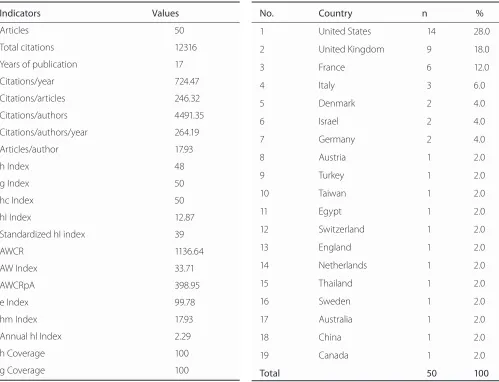
Table 1 shows the bibliometric indicators of the articles, which received 12316 citations with a mean of 724.47; 246.32; 4491.35 and 264.19 citations per year, by articles, by authors and by authors per year respectively, and which have an h index of 48 and a g index of 50.
The mean annual publication was 2.94±1.98. The largest number of articles was published in 2002 and 2008, (n=8, 16.00% and n=6, 12.00%, respectively). The mean number of annual citations was 724.47±711.47. The maximum value of the collaboration index was reached in 2010 and the minimum in 2014 and 2015 (11.33 and 2.0, respectively); the annual mean of this indicator was approximately of 5.28±2.52. (Figure 1)
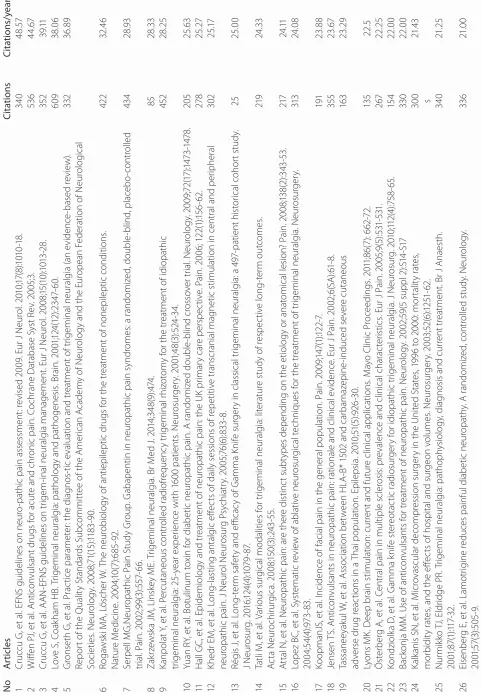
The relationship of articles ordered in descending fashion by the mean of citations/year is shown in table 2. Citations ranged from 25 to 609; only six articles (12.00%) received fewer than 100 citations, with a mean value of 239.90±113.67. The most cited article received 340 citations with a mean of 48.57 citations per year since its publication in 2010 in the European Journal of Neurology.
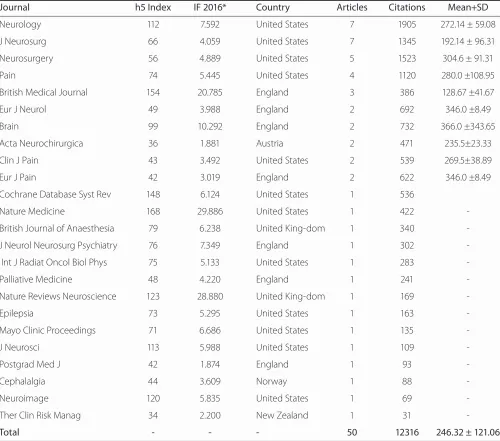
The articles were published in 24 journals indexed in Web of Science with a mean impact factor of 7.698±7.661. Neurology and Journal of Neurosurgery were the publications with the highest number of articles, with 7 (14.0%) each. They reached mean values of citations±standard deviation of 272.14±59.08, and 192.14±96.31, respectively. Following Neurology and
Journal of Neurosurgery, come the journals Neurosurgery
with five articles (1523 citations and a mean of 304.6±91.31), and Pain with four articles (1120 citations and a mean of 280.0±108.95). (Table 3)
Six was the most common number of authors per paper (n=12, 24.0%). Eleven articles (22.0%) had seven authors and 10 (20.0%) had two authors. An equal number of papers were published with one, three and four authors (n=5, 10.00%). There were two articles (4.0%) with five authors. Original articles were more prevalent (n=26; 52.0%), followed by review articles (n=22; 44.0%), and short communications (n=2; 4.0%).
Figure 2 shows scientific cooperation networks at country level. The articles were published by researchers
from 13 countries. The binomial Austria-Italy contri-buted the most articles (n=3; 6.00%) as a result of international collaboration. The most researched topics were related to the update of treatments for specific trigeminal neuralgia and for neuropathic pain in general.
DISCUSSION.
The analysis of citations is a powerful bibliometric tool that reflects the influence of an article, or a group of them, in an area of knowledge. The number of citations received by a publication is an important measure of its impact within the scientific community. The argument is that the influence of an article, in general, is directly proportional to the times it has been cited. This type of studies allows researchers to develop a monitoring system of the evolution of the thematic areas in their field and the establishment of research strategies. In addition, bibliometric studies are usually employed by journals to attract documents with a high citation potential.17,18
The characterization of the most cited articles helps to identify the most significant fields within the most general thematic study areas, the highly relevant contributions and their main trends.19 Contrasting
these with the different historical contexts and the processes through which the studies emerge contri-butes to formulating strategies for the improvement of science. In recent years, there has been an increase in the number of documents that follow this methodology in the field of health.17,20-24 Some topics were: diabetes,20
hypertension,21 osteoporosis,22 pain,23 ameloblastoma,24
and aortic dissection,17 among others, but until the
date this search was performed, none was found on trigeminal neuralgia, which is why the present research was conducted.
[Epub ahead of print]
research, as well as being published in open access sites.The latter considerably increases their visibility and tendency to be cited very recently.
The impact factor (IF) is of great importance for both journals and authors. Being an indicator of quality, the most cited journals tend to attract more and better publications. In addition, authors able to produce high quality articles send their manuscripts to high IF journals in order to gain greater visibility.17,26-27 The present
study strengthens this idea because all the journals that contributed articles to the top list are considered of relative high impact, as they have an IF above 1.0.
Several studies show a significant direct relationship between the numerical value of IF and the total citations received by the articles.17 This may be due to other
criteria that influence the possibilities of citing studies, such as their presence in highly specialized journals and accessibility to the full-text article, which in many cases is affected by the monetary costs associated with obtaining the document.
The journals that contributed the most articles to the top-50 were Neurology and Journal of Neurosurgery
(JoN). Articles are subjected to peer review processes in both journals, which guarantee their quality. Both journals allow their readers to access all their infor-mation free of charge and have high IFs (over 4.0), and both are the result of the publication of important groups of North American scientists in the field of neurology, such as: the American Academy of Neurology
in the case of Neurology and, in the case of the Journal of Neurosurgery (JoN), The Journal of Neurosurgery Publishing Group (JNSPG), which belongs to the
American Association of Neurological Surgeons. JoN is the most cited journal in neurosurgery, according to the JCR of Thomson Reuters in 2016.
All the articles were published in English. One of the main reasons for this is that English is considered the scientific language par excellence. On many occasions, despite not being the main language of the researchers, it is “borrowed" for the dissemination of their research findings and achievements.27
Documents with an US affiliation were the most prevalent, similar to the findings of Jifang Hui et al.,28
in a study of the most cited articles in the area of
ortho-dontics. The prevalence of articles of North American origin is mainly due to the significant funding of research projects, as well as the great community of researchers that this nation hosts. This is widely known within the scientific community, and in many occasions such an affiliation is used as a quality criterion at the moment of selecting the materials to be cited by the research community.
The prevalence of studies that focused on the updating of treatments for specific TN and neuropathic pain was noteworthy. The main characteristic of TN is the presence of pain that becomes "unbearable." This is described as one of the most severe forms of manifestation of this symptom, and it constantly generates studies aimed at updating its treatment.29 In
many occasions, there is reluctance to trying variants of treatment because there is no improvement of the symptomatology, consequently, patients begin to suffer from psychiatric disorders.30 These factors cause
disability and should be taken into account when dealing with this disease, as it significantly affects the patients’ ability to work and damages their relationships with members of their families or with the community in general.
The longer a manuscript has been published, the greater the number of citations it can reach. It is well known that an article tends to be cited one or two years after its publication date and reaches its maximum citation peak between seven and ten years after that date.31 This may explain the lower number of articles in the last years of the study period; although taking the mean number of annual citations as a selection criterion minimized the effect of this variable.
Original studies were more prevalent, a finding that is similar to that reported by Corrales-Reyes et al.,24
and Yaohong Wuet et al.,33 However, it contrasts with
the results reported in a study conducted on the most influential articles in the area of Urology in Turkey,33
in which case reports were more prevalent. This in turn was similar to the findings reported by Jifang Hui
et al.,28 when analyzing the most cited articles in the
literature in the field of orthodontics.
[Epub ahead of print]
of their generalizing nature, in the subject understudy, the slight prevalence of original articles is well explained. In general, the morpho-physiopathology of TN is appropriately described, so current efforts in this field of knowledge are mainly aimed at the search for improvements in neuropathic pain, as the most severe symptom of this condition. This clearly explains the tendency to cite the documents that deal with new evidence in this field.
Articles with four or more authors were more prevalent (60% of the total). The collaboration of two or more authors for the development of a study leads to the creation of work groups that tend to evolve and become true entities generating knowledge in a specific field of science.24 As such, generation of knowledge is
achieved with greater solidity and stronger foundations. All this based on the points of view and experiences of more than one person, as it is not always the case that the experience of a single researcher is in agreement with the vision of all others.
A total of 13 countries collaborated in the elaboration of the articles featuring in the top of the list. Numerous studies34-36 show a direct relationship between the
papers that involved international collaboration and the visibility achieved in the international scientific community. All of these analyses took into account their citation trend. In general, the collaboration between authors, institutions and countries contributes to the exchange of ideas and the division of tasks. This expands the possibilities of establishing new approaches and having access to the necessary resources to solve new research problems.
The strength of the study is that the Harzing's Publish or Perish 5 software was used16 taking Academic Google
(AG) as database. This has proved to be an effective tool to identify the most cited articles. In addition, it
has a larger field of analysis than other databases in terms of the number of citations and their origins37 for
the preparation of the top-cited list.
Despite this, it is valid to raise some questions that can be considered limitations of the present research. The selected period of study may constitute a limitation for some articles that due to their prestige could have been taken into account for the top. Another important limitation is that in the methodology used for the elaboration of this type of study, the citations received by the documents are taken as a central parameter of quality for the selection, without taking into account different factors that may influence them, such as: country of origin and the journal in which it was published, among others. In addition, the effects of self-citations on the final placement or positioning of the articles were not evaluated.
It is necessary to clarify that the contribution of an article to a field of knowledge cannot be evaluated only from the point of view of the quantification of the citations it has received, other assessments would have to be made to complement these results.
CONCLUSION.
The most cited article was published in 2010 in
the European Journal of Neurology. The articles were published in 24 scientific journals, with Neurology and Journal of Neurosurgery being the publications with the largest number of papers. There was a predominance of US authorship, as well as original articles. The articles published in the years 2001 and 2002 received the highest number of citations. The most relevant scientific collaborations were observed between Italian and Austrian researchers. The most researched topics were related to the update of treatments for specific trigeminal neuralgia and neuropathic pain in general.
REFERENCES.
1. Yang YJ, Hu L, Xia YP, Jiang CY, Miao C, Yang CQ,
Yuan M, Wang L. Resveratrol suppresses glial activation and alleviates trigeminal neuralgia via activation of AMPK. J Neuroinflammation. 2016;13(1):84.
2. Manzoni GC, Torelli P. Epidemiology of typical and atypical craniofacial neuralgias. Neurol Sci. 2005;26(SUPPL. 2):65–7. 3. Posso IP, Palmeira CCA, Vieira EBM. Epidemiology of neuropathic pain. Rev Dor São Paulo. 2016;17(Suppl 1):S11–4.
4. Love S, Coakham HB. Trigeminal neuralgia: pathology and
pathogenesis. Brain. 2001;124(Pt 12):2347–60.
5. Costa GMF, Leite CMA. Trigeminal neuralgia: peripheral and central mechanisms. Rev Dor São Paulo. 2015;16(4):297–301.
6. Revuelta-Gutiérrez R, Navarro-Bonnet J, Molina-Choez
D, Flores-Rivera JJ, Martínez-Manrique JJ, Martínez-Anda JJ. Descompresión microvascular en neuralgia del trigémino y esclerosis múltiple. Arch Neurocien. 2015;20(1):95–8.
[Epub ahead of print]
con toxina botulínica. A propósito de un caso. Rev Soc Esp Dolor.2016;23(1):45–52.
8. Zhou X, Liu Y, Yue Z, Luan D, Zhang H, Han J.
Comparison of nerve combing and percutaneous radiofrequency thermocoagulation in the treatment for idiopathic trigeminal neuralgia. Braz J Otorhinolaryngol. 2016;82(5):574–9.
9. Du Y, Yang D, Dong X, Du Q, Wang H, Yu W. Percutaneous
balloon compression (PBC) of trigeminal ganglion for recurrent trigeminal neuralgia after microvascular decompression (MVD) Ir J Med Sci. 2015;184(4):745–51.
10. Hirsch JE. An index to quantify an individual's scientific research output. Proc Natl Acad Sci U S A. 2005;102(46):16569–72. 11. Egghe L, Rousseau R. An informetric model for the Hirsch-index. Scientometrics. 2006;69:121–9.
12. Jin BH. The AR-index: Complementing the h-index. ISSI
Newsletter. 2007;3(1):6.
13. Cárdenas-de Baños L, Bencomo-García D,
Sánchez-Aldereguía S, Fundora-Mirabal JA, Dorta-Contreras AJ. Producción científica y visibilidad de la Cátedra de Comunicación Científica de la Universidad de Ciencias Médicas de Habana. Rev Haban Cienc Méd. 2016;15(6):979–991.
14. Schreiber M. To share the fame in a fair way, hm modifies h for multi-authored manuscripts. New J Phys. 2008;10(040201):1–8. 15. Zhang CT. The e-index, complementing the h-index for excess citations. PLoS One. 2009;4(5):e5429.
16. Publish or Perish. London: Middlesex University: Harzing. com; 2016. Feb 6, [updated 2018 Aug 11]. [cited 2006 Jun 03]. [Internet] Available from:https://harzing.com/resources/publish-or-perish .
17. Lai P, Liu YH, Xue JH, He -C, Qiu YQ. The 100
most-cited articles on aortic dissection. BMC Cardiovasc Disord. 2017;17(1):30.
18. Pu QH, Lyu QJ, Liu H, Fan KH. Bibliometric analysis of the top-cited articles on islet transplantation. Medicine. 2017;96(44):e8247. 19. Dong F, Fan M, Jia Z. Fifty top-cited fracture articles from China: a systematic review and bibliometric analysis. J Orthop Surg Res. 2016;11(1):71.
20. Shuaib W, Costa JL. Anatomy of success: 100 most cited articles in diabetes research. Ther Adv Endocrinol Metab. 2015;6(4):163–73.
21. Oh YS, Galis ZS. Anatomy of success: the top 100 cited
scientific reports focused on hypertension research. Hypertension. 2014;63(4):641–7.
22. Holzer LA, Leithner A, Holzer G. The most cited papers in osteoporosis and related research. J Osteoporos. 2015;2015:638934.
23. Chuang KY, Ho YS. A bibliometric analysis on top-cited
articles in pain research. Pain Med. 2014;15(5):732–44.
24. Corrales-Reyes IE, Reyes-Pérez JJ. Análisis bibliométrico de los 100 artículos sobre ameloblastomas más citados. Período 2000-2016. Educ Med. 2017:[Epub ahead of print].
25. Dávalos-Sotelo R. Una forma de evaluar el impacto de la investigación científica. Madera bosques. 2015;21(spe Xalapa):7–16. 26. Peralta González M, Frías Guzmán M, Chaviano, O. Criterios, clasificaciones y tendencias de los indicadores bibliométricos en la evaluación de la ciencia. Rev Cubana Inf Cienc Salud. 2015;26(3):290–309.
27. de Pablos Coello JM, Tuñez Lopez JM, Mateos Martín C. El idioma, como vehículo de la comunicación científica: análisis de la visibilidad e impacto de la investigación a través de la bibliometría de Google. Estud Mensaje Periodís. 2015;21(1):283–98.
28. Hui J, Han Z, Geng G, Yan W, Shao P. The 100 top-cited
articles in orthodontics from 1975 to 2011. Angle Orthod. 2013;83(3):491–9.
29. Montano N, Conforti G, Di Bonaventura R, Meglio M,
Fernandez E, Papacci F. Advances in diagnosis and treatment of trigeminal neuralgia. Ther Clin Risk Manag. 2015;11:289–99.
30. Wu TH, Hu LY, Lu T, Chen PM, Chen HJ, Shen CC, Wen CH.
Risk of psychiatric disorders following trigeminal neuralgia: a nationwide population-based retrospective cohort study. J Headache Pain. 2015;16:64.
31. Marx W, Schier H, Wanitschek M. Citation analysis using online databases: Feasibilities and shortcomings. Scientometrics. 2001;52(1):59–82.
32. Wu Y, Zhao Y, Lin L, Lu Z, Guo Z, Li X, Chen R, Ma H. Fifty top-cited spine articles from mainland China: A citation analysis. J Int Med Res. 2018;46(2):773–84.
33. İpekçi T, Yüksel M, Tunçkıran A. Top cited articles in urology from Turkey. Turk J Urol. 2017;43(1):62–7.
34. Alonso-Arroyo A, Tannuri de Oliveira EF, Cabrini-Grácio MC, Pandiella A, Benavent RA. Un análisis bibliométrico en el área de la Medicina: colaboración científica entre Brasil y España (2002-2011) Investig Bibl. 2016;30(69):205–299.
35. Ávila-Toscano JH, Marenco-Escuderos A, Madariaga-Orozco C. Indicadores bibliométricos, redes de coautorías y colaboración institucional en revistas colombianas de psicología. Av Psicol Latinoam. 2014;32(1):67–82.
36. Zazo ÁF, Ardines S, Castro E. Redes de colaboración de las unidades de investigación de la Universidad de Panamá:investigación, desarrollo e innovación. REDES: Revista Hispana para el Análisis de Redes Sociales. 2015;26(2):84–117.