INTRODUCTION
The photovoltaic effect has been known for almost two hundred years. However, it was not been used for power purposes until the end of the first half of the 20th century. The process of the development of such a technology seems to be relatively long but the increase of conventional fuel prices and the increasing care for the natural environment have enforced a growth of popular
-ity of alternative solutions of energy acquiring. At the end of the 20th century and the begin
-ning of the 21st century, the silicon era contrib
-uted to a technological progress. The demand for electricity increased. Households started being equipped with electrically powered devices. The production processes of silicon semi-conductor elements started being applied also in the pro
-duction of photovoltaic cells [American Physi
-cal Society, 2009]. Photovoltaics, just like wind energy, is presently a very dynamically develop
-ing technology. It is widely applied not only in a form of large photovoltaic farms (power stations),
as independent systems are becoming more and more common. The Sun energy rapidly enters our reality from small garden lamps, through traf
-fic lights, to electrically powered space stations. Similarly as in the case of each new technology, discussions whether such alternative sources of energy will replace the conventional sources in the future have ensued. Such issues concern above all efficiency and cost-effectiveness. It seems that just like wind, the solar energy is for free but the investment costs often obscure the fact that it is also a clean energy.
PHOTOVOLTAIC PANELS
A solar cell is a basic element of the photo
-voltaic system which creates a source of constant voltage in participation with the Sun. Grouped and combined, the cells create photovoltaic mod
-ules. Such modules, after being connected with one another, form photovoltaic panels (PV gen
-erators). The photovoltaic cells may be presently
Accepted: 2019.11.30 Available online: 2019.12.20 Volume 21, Issue 1, January 2020, pages 20–28
https://doi.org/10.12911/22998993/113471
Analysis of Energy Yields from Selected Types of Photovoltaic Panels
Sławomir Rabczak
1*, Danuta Proszak-Miąsik
11 Department of Heat Engineering and Air-Conditioning, Rzeszów University of Technology,
al. Powstańców Warszawy 12, 35-084 Rzeszów, Poland * Corresponding author‘s e-mail: [email protected]
ABSTRACT
This paper presents the results of the conducted analysis on the on-grid photovoltaic installations designed for a single-family house by applying three different technologies (monocrystalline, polycrystalline and thin-film mod
-ules), compared to a simulation of the off-grid polycrystalline technology. As a result of the analysis conducted, the differences between the on-grid and off-grid systems could be determined. The simulation was made on the basis of the PV SOL program which allowed performing calculations concerning monthly and yearly yields during the period of 25 years, taking into account the average degradation of efficiency at 0.8% monthly. Additinoally, a return rate on investment was determined for different types of the analysed installations, taking into account an increase of electricity prices at 2.5% annually and a fixed subscriber’s fee (assumed as 38 euro monthly). Energy density (amount of energy acquired from 1m2 of the installation) and the amount of energy necessary to be pur
-chased additionally from the electricity supplier to fully cover the demand for electricity for the analysed building were analysed as well.
divided into 3 groups which are called genera
-tions [Góralczyk, Tytko, 2015].
The first generation cells are based on the technology of crystalline silicon. Theoretical
-ly, silicon is an element available in unlimited amounts. It is the second most common ele
-ment in the world and it appears both in a clear form and in chemical compounds. Such cells are made by applying monocrystalline or polycrys
-talline technologies and they are most common (constitute approx. 89% of the market) [Adeeb,. Farhan, Al-Salaymeh, 2019]. The first generation technologies are so called thick-film technolo
-gies. The monocrystalline silicon (mono-Si) cells manufactured by applying this technology, may be distinguished by a characteristic consistent dark-blue colour and bevelled or rounded edges. Optimisation of silicon wafer surfaces is carried out through the Czochralski process (the silicon acquired from this process has a form of a cylin
-der which is then cut into separate wafers). Such a process is relatively expensive on a large scale but its advantage is that the silicon used for the production of such cells may come from waste products, for example a part of a silicon bar which is too contaminated for the production of transis
-tor systems. The panels manufactured by apply
-ing such a technology are sensitive especially to the upper spectrum of visible and infra-red ra
-diation. Unfortunately, such panels are also very susceptible to a temperature rise which results in the decrease of their efficiency. Monocrystallines are obtained most often through crystallisation of melted fluid, as described in the Bridgman tech
-nique, the Czocharski process and zone melting [American Physical Society, 2009]. Approx. 80% of monocrystallines are manufactured through the Czocharski process. In Poland, the produc
-tion of polycrystalline silicon is presently the cheapest. The panels applying such a technology may be distinguished by characteristic pattern of flakes/scales and a blue colour. They are made by welding and cooling smaller silicon crystals [Góralczyk, Tytko, 2015]. The subsequent pro
-duction stages of polycrystalline plates are very complex and include, inter alia: grinding (which allows to reveal the crystalline structure), apply
-ing electrodes metalised by us-ing screen print-ing and applying an anti-reflective coating which in
-creases the amount of the light absorbed [Adeeb,. Farhan, Al-Salaymeh, 2019]. They are sensitive to the lower range of visible light, especially to blue light. The tendency towards the production
of increasingly larger polycrystalline cells can be observed. This allows to lower the production costs of such modules (the number of cells form
-ing the module is smaller), but then in the pro
-cess of designing the remaining elements of the installation, it is necessary to take into account higher values of amperage and of cell operation temperature.
The next generation of photovoltaic cells are the thin-film cells. In such a technology, the layer of the active semi-conductor is even a hundred times thinner than it is in first generation cells and has a thickness of approx. a few micrometers. A reduction of semi-conductor wear ensures a fa
-vourable relation of price to power [Hoa Thanh Nguyen, Nguyen, Thi Lan, 2019]. An additional advantage of such a technology is that the ready-made product is a thin foil which is suitable for light structures. Presently, three types of thin-film cells are used: amorphous silicon cells, cadmium telluride cells and cells from copper indium sel
-enide and copper indium gallium sel-enide [Klug
-mann-Radziemska, 2014]. Amorphous cells are a technology based on forming very thin layers of silicon on the surface, for example of glass. Then a ready photovoltaic panel is created, be
-cause no particular cells may be isolated. During their production there is no material loss result
-ing from cutt-ing. Therefore, the production costs are evidently lower than in the case of the first generation cells. Additionally, a temperature rise improves the cell efficiency but it should be re
-membered that after irradiation, the efficiency stabilises at a lower level (even down to 35% of the initial value) [Szymański, 2013]. They are usually used to power small devices.
The third generation PV cells are employed in many technologies. They are based on non-toxic, generally available materials and, there
-fore, their production time is relatively short and production costs are relatively low. However, the difference is that they do not cooperate with clas
-sical semi-conductors and their efficiency is very low. The third generation cells are thin, very light and flexible. Additionally, they are totally recy
-clable. The third generation cells include the cells from organic materials. Organic PV cells consist of: separate layers, solid organic materials and a mixture of organic materials. They are built in a form of a donor-acceptor heterojunction. A strong electric field appears at the junction of two differ
-ent materials (as a result of the difference in elec
efficiency is approx. 10% and is almost half of the efficiency of silicon cells, but their production is cheaper. The simplicity of the production pro
-cess is the main advantage of such a technology, which allows for production on a mass scale. In the process, a layer of semi-conductive polymers (in a form of printing) is placed on a plastic base. The next third generation cell is a dye-sensitised cell. The performance of this type of cells is based on a reversible photochemical process. Light ab
-sorption and charge transfer are divided between its various elements. The dye which participates in light absorption does not transfer charges. Such a cell consists of two glass plates. Each of them is covered on one side with a transparent and con
-ductive layer of tin and indigo oxide or tin oxide or tin dioxide. Additionally, the cell front plate is covered with a thin layer of platinum. Between the glass plates, there is a layer of titanium diox
-ide which is a porous membrane of a great surface. It is saturated with electrolyte (solution of iodine and potassium iodide in ethylene glycol) and con
-ducts the electric current. It is also a carrier of organic dye molecules. Such cells are sensibilised with dyes and, thus, the colour sensitivity of light-sensitive layers is changed. Consequently, the sen
-sibility of reagents to solar radiation is changed. Their efficiency is low and amounts to approx. 2.5%, but –taking into account other organic and non-organic materials – it is the most promising technology [Klugmann-Radziemska, 2014]].
ON-GRID AND OFF-GRID INSTALLATIONS
Independent photovoltaic systems, i.e. sys
-tems which operate to meet the needs for power
of the installation in which they operate, can be divided into on-grid and off-grid. The on-grid in
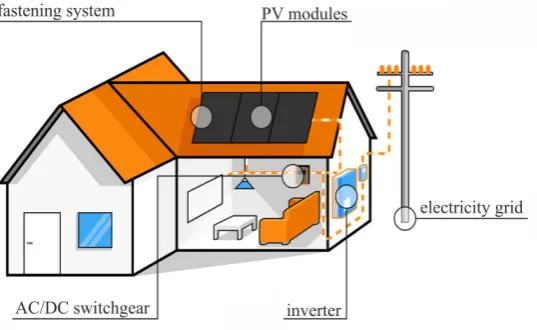
-stallation consists of PV panels, structural wiring and DC/AC inverter having a function of syncho
-nisation with the 230 V grid of the supplier. The systems connected to the power grid (on-grid) are most popular, but their application is quite limited. It results from the necessity to connect the installation to the power grid. They may be divided into distributed or centralised sys
-tems [Adeeb, Farhan, Al-Salaymeh, 2019]. The distributed systems include private single-family house roofs, school roofs and panels integrated with façades. The centralised systems include power stations (wind farms), multi-family build
-ings (community of owners) and noise barriers. The off-grid installations are also called iso
-lated installations and they differ in that they use an energy storage which allows them to oper
-ate both synchronised with the grid and as com
-pletely independent systems. The design of such a complicated variant is different due to the ap
-plication of a more complex inverter. Energy storages are usually connected to an inverter in parallel through dedicated control electronics, consisting in a charge system and a safety unit. The contemporary energy storages use lithium and polymer packages or lithium and ionic cells which makes them more susceptible to failures when the charging voltage or output current are exceeded. Independent installations consist of a charging regulator, battery, voltage regulator and a PV generator [Adeeb, Farhan, Al-Salaymeh, 2019]. Presently, the price of such energy stor
-ages can be twice higher than the price of the re
-maining part of the installation, so mainly such a solution is mainly applied by the people caring
about power independence. However, the off-grid systems have a limited lifetime and a decrease of energy storage capacity should also be taken into account. After several years, a regeneration or repair of the energy storage may be necessary, which may significantly affect the profitability of the whole investment. However, the surveys on the application of graphene for building batteries give hopes that in the future, the off-grid systems will operate longer and, thus, will become cost-effective for consumers.
The isolated (off-grid) systems have a wider application than the on-grid systems. Owing to their independence of the power grid, they are used in the places where power grid cables do not reach or where mobility counts. They may be divided into three main groups. The first group includes individual applications such as: inter
-nal panels (for example calculators, electronic weights, clocks, watches, electric tools, mobile phones) and external panels (for examples char
-gers, fountains, torches, garden lights, highlight
-ed house numbers, car ventilation, boats, yachts). The second group are industrial applications such as: telecommunication, road traffic, railroad or maritime signalling, noticeboards, navigation lights, cathodic protection, supervisory control, mountain hotels and restaurants, medical cool
-ers. The third group are the solutions which are used far away from the places of residence (with
-out access to the grid). Such a group includes: street lighting, solar house systems, rural sources of power, battery charging, water purification, irrigation, street lamps and schools [Klugmann-Radziemska, 2014].
ANALYSIS OF ENERGY YIELDS FOR
SELECTED TYPES OF PV PANELS
The simulations of energy yields for PV pan
-els were performed for a single-family building with panels installed on the roof. The building is located in the city of Rzeszów, Poland. The simu
-lation included 4 variants and took into account 3 different technologies of photovoltaic cells. The aim of the conducted analysis was to compare en
-ergy efficiency and cost-effectiveness of the so
-lutions applied. Monocrytalline, polycrystalline and thin-film cells made in the on-grid system were taken for the analysis and also a simulation for polycrystalline cells operating in the off-grid system was shown. As a result of the simulation performed on the basis of the PV SOL program, the yields from the photovoltaic installation and forecast yields in subsequent years of installation operation were determined (taking into account the average yearly degradation at 0.8%). Addi
-tionally, the balance between the sold energy and the energy bought from the energy supplier as well as a table showing the time of return on in
-vestment (taking into account the average yearly increase of energy prices at 2.5% annually) were presented. It was assumed that the single-family building is located in Rzeszów on a plot of 568 m2
in area, with a roof area of 188 m2. The angle of
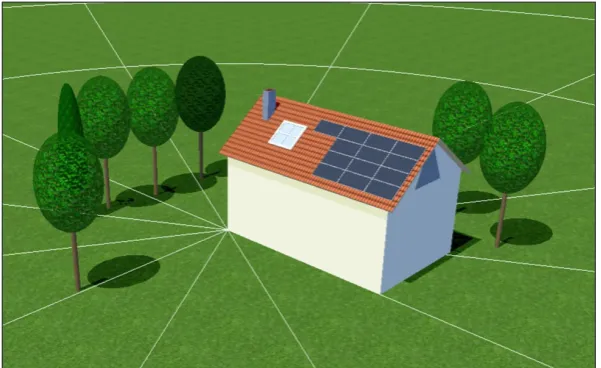
inclination of the roof is 37° and its azimuth is 180°.Figure 2 presents a visualisation of the ana
-lysed building made in the PV SOL program. It should be stressed that owing to the possi
-bility to model the surroundings and the building itself, the path of the shadow moving on each day
during a year can be determined and, consequent
-ly, the average shading for each particular module for each individual investment can be calculated. The distance between modules is determined on the basis of the longitude and latitude, building/ structure orientation, angle of inclination and shading elements. In the described case, the mini
-mum distance between the modules is 1.3 m and for such a distance, the degree of shading of the modules is below 1% annually. For the modules located on the roof, the distance between the modules is 2 cm. It results from the applied sys
-tem structure.
An installation with an annual consumption of electricity at 3000 kWh was assumed for cal
-culation. According to B. Szymański, approx. 1.25 kWh of PV installation power should be taken per each consumed 1000 kWh of energy annually [6]. In this paper 1.40 kW of installa
-tion power was assumed per each 1000 kWh to compensate for the wear of the installation during the period of 25 years. The program generates a report which shows an annual energy surplus to be used, including 20% fee for the power plant. If such a value is positive, it is not necessary to buy more energy. A negative value shows the need to buy the energy from the supplier. The amount of additional energy which must be bought annually from the supplier was indicated as a module from the annual negative surplus. It was assumed that the fixed fees are 160 PLN/year and the energy price is 0.13 EUR/kWh. The energy price increase was assumed to be 2.5% annually. Thus, a yearly cost of additional energy to be bought during the period of 25 years was calculated. The return rate was calculated on the basis of the product cata
-logue prices and yearly energy cost.
Simulation for On-Grid Monocrystalline Installation
In the analysed case, 13 monocrystalline mod
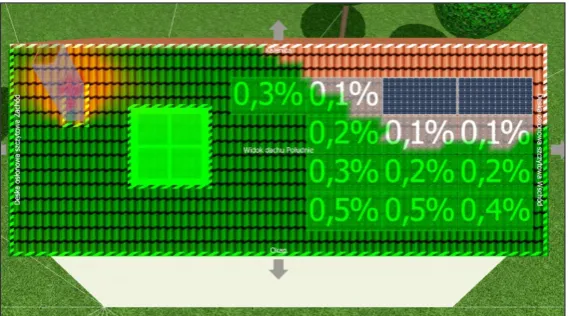
-ules with the dimensions of 1960×992×40 mm and a total power of 4.1 kW were used. Figure 3 presents the simulation of building roof shading as a value determined for the whole year. From the simulation it appears that in the presented ar
-eas for which the percentage values were given (and where the monocrystalline panels have been fixed), the shading is no more than 0.5% annually, which is a very good result. Figure 4 shows the results obtained from the simulation of monthly energy yields in the first year of using the photo
-voltaic installation.
During the first year, it is possible to have a yield of 3759 kWh. Taking into consideration the panel efficiency decrease during the period of 25 years, the installation efficiency will reach al
-most 17.5% lower value, i.e. 3100 kWh annually. Table 1 displays the annual amounts of energy yields and surpluses for the analysed building, assuming that the demand for electricity is 3000 kWh. It should be noted that with the passage of time, more energy must be purchased from the supplier due to the the negative surpluses of elec
-tricity which occur in the simulation of the mono
-crystalline panel.
An average gross market price of 4.2 kW installation on the designed photovoltaic mono
-crystalline panel was assumed to be approx. 4 589 euro. Adding the costs of panel assembly and tak
-ing into account the electricity costs which would be incurred when using the monocrystalline pan
-els and comparing them with the electricity costs incurred in the same period (Table 2) the profits from using the installation can be determined.
They amount to 3 749 euro over the period of 25 years of using it. It should be emphasised that in this case the installation will pay for itself after almost 11 years of use.
Simulation variants
In a similar way, the simulations for the pho
-tovoltaic systems based on the on-grid and off-grid polycrystalline and thin-film panels were performed. In each case, the systems provide the total power of 4.20 kW. While using polycrystal
-line cells, 14 panels of 1960×992×40 mm were applied. A yearly energy yield in this case is 3 866 kWh in the first year of operation and it is almost 3% higher than the yield acquired in the case of monocrystalline panels. It is also possible to obtain higher energy production throughout a year compared to monocrystalline panels but that does not translate into a shorter return on invest
-ment period. An advantage of such a solution in
-volves slightly lower investment costs and higher savings of 7 815 euro, which is not a significant difference compared to the installation based on monocrystalline cells.
The next variant of the simulation was using 33 thin-film panels of 1 190×789.5×7.3 mm. In the case of the off-grid installation, the option based on polycrystalline cells was taken into ac
-count. In such a case, a significant difference in the investment costs exist due to the necessity to store the electricity by using batteries, the price of which constitutes a substantial part of the to
-tal costs of the ins-tallation, amounting to approx. 15 845 euro. It should be noted that it is a sum that exceeds the value which should be paid for elec
-tricity coming directly from the supplier, without using a photovoltaic installation. This results in a very significant, almost twofold, increase of
the period of return on investment, which raises a serious question about the cost-effectiveness of using these types of installations and about using the off-grid installations in general, apart from situations in which they must be used due to lack of other possibilities.
Fig. 4. Monthly energy yields from monocrystalline panels in the first year of use
Table 1. Summary of annual energy yields, surplus and energy required to be purchased from the supplier
Year Auuual energy yiekl (kWh) A umiał energy sur plus (kWh)
Arnouut of energy to be purchased front
tlie supplier (kWh)
1 3759,0 7,2 0,00
2 3728,9 -16,9 16,88
3 3699,1 -40,7 40,74
4 3669,5 -64,4 64,42
5 3640,1 -87,9 87,90
6 3611,0 -111,2 111,20
7 3582,1 -134,3 134,31
8 3553,5 -157,2 157,23
9 3525,0 -180,0 179,98
10 3496,8 -202,5 202,54
11 3468,9 -224,9 224,92
12 3441,1 -247,1 247,12
13 3413,6 -269,1 269,14
14 3386,3 -291,0 290,99
15 3359,2 -312,7 312,66
16 3332,3 -334,2 334,16
17 3305,6 -355,5 355,48
18 3279,2 -376,6 376,64
19 3253,0 -397,6 397,63
20 3226,9 -418,4 418,45
21 3201,1 -439,1 439,10
77 3175,5 -459,6 459,59
23 3150,1 -479,9 479,91
24 3124,9 -500,1 500,07
When comparing the discussed variants of installations for the single-family building, one should start from the price of purchase and assem
-bly of photovoltaic panels and necessary equip
-ment. While comparing the costs of the on-grid photovoltaic installation, it has been determined that an average price of panels and their assembly is between 4 400 and 4 700 euro. The polycrystal
-line panels are the cheapest solution and the thin-film panels are most expensive. It should be also noted that there are price differences with various sellers and prices for the same installation may differ even by a few thousands PLN. The evident difference in prices concerns the off-grid instal
-lations, which was presented in Figure 5. When deciding about a type of photovoltaic cell tech
-nology, the price oscillates at a similar level. The price of an off-grid installation is higher due to the necessity to purchase the equipment for ac
-cumulating electricity which often exceeds the price of panels. While considering the prices, the difference in the return of PV installation costs should be mentioned. The situation is similar as in the case of assembly costs. Assuming a con
-stant increase of energy prices and a lack of the necessity to exchange or repair a given installa
-tion, irrespective of the selected types of cells, the cost return is between 10th and 11th year of
installation operation. In the case of an off-grid installation, such a cost would not be returned until 24 years of installation operation. However, it should be added that the devices such as bat
-teries require operating costs and their periodical exchange is necessary (every 10 years). Thus, the calculations were carried out underpurely theo
-retical conditions in which the whole installation will operate without breakdown for 25 years and the consumer will not have the possibility to buy additional energy from the grid.
While analysing the monthly yields of each installation it can be said that they are quite simi
-lar. Minimally higher yields may be noted in the case of the on-grid polycrystalline and thin-film modules. However, there are no modules which would show evidently higher efficiency.
Taking into account the installation degra
-dation which is approx. 20% after 25 years, it should be decided which installation will operate in a more efficient way after the elapse of such a period. It is best noticeable when observing the amount of additional energy which should be bought annually from the supplier to meet the demand for electrical energy of the building – see Figure 6.
The greatest additional amounts of energy should be bought from the electrical grid in the case of installing monocrystalline modules and thin-film modules. After 25 years of installation operation, the sum will reach more than 500 kWh, i.e. approx. 1/6 of the assumed demand (assuming a constant demand for all the years). What should be noted about the installation with polycrystal
-line modules is that it is not necessary to buy ad
-ditional energy until after 5 years of operation,
Fig. 5. Installation costs depending on the technology chosen
Table 2. Profit from the use of a photovoltaic system with monocrystalline panels over a period of 25 years
Total cost of photovoltaic installation
and electricity 6 819 euro
Total cost of electricity without
photovoltaic installation 14 169 euro
which translates directly to savings and signifi
-cantly improves the cost-effectiveness of the in
-stallation compared to the remaining solutions. In the case of using polycrystalline modules for 25 years, it is possible to have profits which in
-clude a reduced demand for additional electrical energy of 1 785 kWh. The simulation for the off-grid installation does not show an additional de
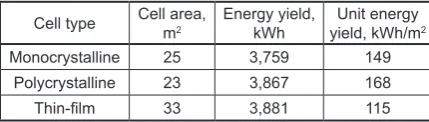
-mand for electrical energy. Additionally, a change of energy density is noticeable depending on the technology, reaching up to 30%. Such a parame
-ter may have a significant meaning where the area with a high factor of insolation is small. It should be remembered that typical photovoltaic installa
-tions are selected by taking the profitability index as the optimisation point.
Taking into account the analysed building, the roof surface from the southern side turned out to be sufficient to meet the demand for electrical energy, irrespective of the technology of applied cells. However, if there are any obstacles such as windows, chimneys, such a comparison of tech
-nologies is of crucial importance. The thin-film modules require the largest surface but when us
-ing polycrystalline modules, the roof surface cov
-ered with PV panels can be reduced by 31.5%,
which gives very great possibilities as for the lo
-cation of panels on the building roof in a conve
-nient and not shaded place.
CONCLUSIONS
Taking into consideration all the elements of the analysis it may be definitely stated that the off-grid installation is least cost-effective. The price for assembling such an installation is even three times higher than for an on-grid installation. It re
-sults mainly from a high price of batteries, which are necessary in such types of installations. How
-ever, they may not be a totally useless and un
-profitable system. They have a wide application in the places where it is not possible to connect to the power grid. Their additional advantage is that the consumer may use the whole produced energy and not only 80% of the yield like in the case of the on-grid installation (20% is a fee for the pow
-er plant). Such a diff-erence is visible when it is necessary to buy additional energy from the grid after the first year of on-grid installation operation (for polycrystalline cells – after four years). In the case of the off-grid installation, such a need does not exist and for 25 years, on average, the con
-sumer produces more energy than he uses. More
-over, in the case of the off-grid installation there are no fixed fees which would be imposed by the electrical energy seller. Nevertheless, such an in
-stallation will not pay for itself earlier than after 24 years (assuming that the system operates with
-out breakdowns). Thus, this is a system which is more attractive for the consumers who would like Fig. 6 The amount of electricity required to be purchased from the supplier
Table 3. Unit energy yield for selected PV modules for 4.2 kW installed power
Cell type Cell area, m2 Energy yield, kWh yield, kWh/mUnit energy 2
Monocrystalline 25 3,759 149
Polycrystalline 23 3,867 168
to be more independent of the electrical energy suppliers or live in difficult conditions where it is not possible to have an electrical connection.
In the case of the on-grid installation, there are no evident differences. Each of the analysed technologies for an installation as small as a single-family building has a similar effect. The difference in installation costs is relatively small but the highest yield is observed for the cheap
-est and for the most expensive technologies out of the three analysed ones. However, taking into account the price and yield calculated per 1m2
of PV panels, the technology of polycrystalline panels is the most cost-effective investment. They are the cheapest ones among the analysed ones and they make the highest benefits, not only in terms of electricity but also finances. Interest
-ingly, after the first year of monocrystalline and thin-firm installation operation, it is necessary to buy additional electricity from the grid. In this regard, the polycrystalline modules turned out to be most profitable as such a necessity does not exist in their case for the first 4 years. Photovol
-taic installations are a solution which is more and more frequently used in Europe, not only due to the environmental protection but also due to the economical reasons. The EU subsidies are also very popular. They significantly decrease the in
-vestment costs which still constitute a relatively high expense for an average household.
There are many photovoltaic cell technolo
-gies available on the market. Silicon (monocrys
-talline and polycrys-talline) cells have been used most frequently for years. Newer technologies are more expensive, but they do not always go hand in hand with an increase of efficiency. It should be also stressed that the thin-film technologies are used in lightweight applications (such as boats, cars, drones), in which a weight of the installation and adjustment of the installation to the shape of the surface (due to their flexibility) play an impor
-tant role. For small photovoltaic installations, the
choice of technology will not be very significant. The differences between them are minimal both in terms of installation costs and annual yields. However, when taking into account the energy density and return on investment, polycrystalline panels turn out to be an optimal solution. The in
-vestment cost is the main point of deliberations on whether photovoltaics is a real alternative for the traditional sources of energy acquisition. Howev
-er, it should be remembered that the leading aim of alternative sources of energy are not financial aspects but minimisation of carbon dioxide emis
-sion to the atmosphere. If it is possible to produce clean energy and there are suitable conditions for that to occur, it is worth remembering about fu
-ture generations.
REFERENCES
1. American Physical Society, April 25, 1954: Bell Labs demonstrates the first practical silicon solar cell. APS News 2009, 18(4).
2. Góralczyk I., Tytko R., 2015. Photovoltaics devices, photovoltaic and electrical installations (in Polish). 2nd Edition, Kraków.
3. Adeeb J,. Farhan A., Al-Salaymeh A. 2019. Tem
-perature effect on performance of different solar cell technologies. Journal of Ecological Engineer
-ing, 20(5), 249–254.
4. Hoa Thanh Nguyen H.T., Nguyen L., Thi Lan P.D. 2019. Optimization of Copper Removal by Photo
-voltaic Electrocoagulation from Aqueous Solution Using Response Surface Methodology Towards Sustainable Development. Journal of Ecological Engineering, 20(7), 103–111.
5. Klugmann-Radziemska E., 2014. Postępy foto
-woltaiki – aktualne technologie produkcji ogniw. Czysta Energia, 5(143), 40–42.
6. Szymański B. 2013. Small photovoltaic installation (in Polish). GLOB Energia, Kraków.