Resumen: El edentulismo se presenta como una alteración irreversible y crónica, que genera consecuencias en el sistema estomatognático, por lo cual es necesario conocer su prevalencia para priorizar intervenciones de salud bucal preventivas y de rehabilitación. Objetivo: Determinar la prevalencia de edentulismo parcial según la clasificación de Kennedy y Applegate en pacientes atendidos en la Clínica Odontológica de la Universidad San Martín de Porres - Filial Lambayeque, en los años 2016 y 2017. Material y Método: Se diseñó un estudio descriptivo, retrospectivo y transversal, con 321 historias clínicas que pasaron previamente por un control de calidad que incluyó un proceso de calibración (k=0.86). Para estimar la prevalencia de edentulismo en cada maxilar y de acuerdo al género, fueron aplicados los criterios y reglas de kennedy y Applegate, utilizando tablas de distribución de frecuencias con resultados porcentuales. Resultados: La mayor prevalencia de edentulismo parcial para maxilar superior corresponde a la Clase III con 42,4%, siguiendo en orden descendente la Clase I con 34.6% y la Clase II con 16.5%. En el maxilar inferior, la más prevalente fue la Clase I con 42,4%, continuando la Clase III con 36.4% y la Clase II con 15.6%. De acuerdo a género, resultaron más prevalentes la Clase III y la Clase I tanto para mujeres como para hombres. Conclusiones: Las clases III y I fueron las más prevalentes en el maxilar superior, tanto para género masculino como femenino; mientras que en el maxilar inferior, fueron las clases I y III las más prevalentes también para ambos géneros.
Palabras Clave: Salud bucal; arcada edéntula; prevalencia; epidemiología.
Abstract: Introduction: Edentulism is an irreversible chronic condition that seriously affects the stomatognathic system. Consequently, determining its prevalence may contribute to prioritize preventive and rehabilitative oral health interventions. Objective: To determine the prevalence of partial edentulism according to the Kennedy and Applegate classification in patients attending the Dental Clinic at Universidad San Martín de Porres - Lambayeque Campus, Peru, in the years 2016 and 2017. Materials and methods: A descriptive, retrospective and cross-sectional study was designed. The study comprised 321 clinical records that previously underwent a quality control stage, which included a calibration process (k=0.86). The criteria and rules proposed by Kennedy and Applegate were applied to estimate the prevalence of edentulism in each jaw according to sex; tables of frequency distribution containing percentage results were used. Results: The highest prevalence of partial edentulism in the upper jaw corresponded to Class III (42.4%), followed by Class I (34.6%), and Class II (16.5%). In the lower jaw, the most prevalent were Class I (42.4%), Class III (36.4%), and Class II (15.6%). According to sex, Class III and Class I were the most prevalent in both females and males. Conclusion: Class III and I were the most prevalent in the upper jaw in both females and males; while in the lower jaw, Classes I and III were the most prevalent for both sexes.
Keywords:Oral health; partial edentulous jaw; prevalence; epidemiology.
Rubén Chumpitaz Durand.1 Maribel Lecca Gonzalez.1 Cristy Diaz Torres.1
Prevalencia de edentulismo parcial según Kennedy y Applegate en pacientes de la clínica odontológica de una universidad de Lambayeque-Perú.
Prevalence of partial edentulism according to
Kennedy and Applegate in patients treated at a
university dental clinic in Lambayeque-Peru.
Affiliations: 1Universidad de San Martín
de Porres, Chiclayo - Peru.
Cite as:
Chumpitaz Durand R, Lecca Gonzalez M & Diaz Torres C. Prevalence of partial edentulism according to Kennedy and Applegate in patients treated at a university dental clinic in Lambayeque-Peru. J Oral Res 2019; 8(3):236-243.
Doi:10.17126/joralres.2019.035
Corresponding author:Rubén Chumpitaz Durand. Avda. Los Milanos 520. San Isidro, Lima, Perú. Phone: (001) 2203044. E-mail: [email protected]
INTRODUCTION.
Edentulism is an oral heath condition consisting of the partial or total loss of teeth.1 It is preventable but when it occurs, it may become irreversible and enter a chronic state. The condition may eventually alter the anatomical-functional integrity of the stomatognathic system. Among the Latin American countries, Peru has been shown to have a high rate of tooth loss.3 In the Peruvian population endentulism has become a stigma with important socio-economic and cultural implications, which evidences the lack of preventive healthcare habits. The latter is even more evident in vulnerable populations with poor or unequal access to oral health care,2-4 which is why preventive stomatology should be implemented as a public health policy.3
The etiology of tooth loss is attributed to different reasons, mainly to dental caries, periodontal disease, teeth treated with root canal therapy, trauma, or as a consequence of systemic diseases such as diabetes.1,2 Regarding factors associated with edentulism, some authors have found a relationship between edentulism and poor oral hygiene, advanced age and low frequency of visits to the dentist.5 Other authors have also reported an association with low socioeconomic level and poor quality of life.3,6 In this regard, some studies have concluded that edentulism is a risk factor for an unfavorable quality of life in dimensions associated with wellbeing, physical, emotional and social health.7 These conclusions are supported by the World Health Organization, which considers oral health as an essential element of general health and quality of life.2
The consequences of partial edentulism are really severe and cause deficiencies in phonetic, aesthetic and masticatory functions, which result in a poor diet, usually compromising the nutritional status of the patient.1,6 It is also necessary to point out a series of complications that occur in the remaining teeth, such as angulations, migrations, gyroversions, extrusions and intrusions, conditions that further aggravate occlusion issues.4,8 In more severe cases, damage to the neuromuscular component may occur, as well as dysfunction of the temporomandibular joint and facial cranial disharmony.2,8 Edentulism may also cause low self-esteem, depression, anxiety and stress.4,6,8
According to the criteria of Edward Kennedy and in agreement with Applegate, the following classification was considered:
Class I: bilateral posterior edentulous areas and permanence of anterior teeth. Class II: unilateral edentulous zone due to the absence of posterior teeth.
Class III: partial posterior edentulous area and presence of teeth anterior and posterior to that area.
Class IV: anterior edentulous area on both sides of the midline. Class V: presence of only two molars unilaterally.
Class VI: presence of only two central incisors. Classes I, II, II and IV may show variations due to the absence of other teeth.8
In previous studies of partially edentulous arches based on this classification, dental surgeons of Universidad Peruana Cayetano Heredia, evaluated 168 adults from Ventanilla, Callao, Peru. They identified a higher prevalence of Class III edentulism in both jaws,1 unlike results reported by the dental surgeon Susy Tantas in 2016, in a study conducted on 105 older adults of the "Hospital Nacional Arzobispo Loayza" in Lima, in which Class I accounted for the highest prevalence of edentulism in both upper and lower jaw.4
However, due to the lack of similar studies conducted in Chiclayo - Lambayeque, the contribution of this study as an epidemiological research will allow the generation of a baseline regarding the prevalence of edentulism in this northern region of Peru. The aim is to determine the specific trend so that the needs for stomatological treatment can be properly identified. As the study was applied in the field of university professional training, it may result in paying more attention to preventive interventions in general and to the development of practical oral rehabilitation skills in particular. As a social contribution, due to the identification of edentulism in a large population, it will be necessary to report the results to the Ministry of Health, Dental College of Peru, universities and other institutions involved in oral health, to engage them in promoting preventive health programs.
Healthy policies and educational interventions should reach those high-risk groups, to teach the great importance of having healthy teeth; to educate these groups on how to care for their oral health, in order to prevent cavities and other oral diseases.
MATERIALS AND METHODS.
This is an epidemiological study of prevalence, with a descriptive, retrospective and cross-sectional design, based on data related to missing teeth collected from the odontograms of the patients’ clinical histories.
From a population of 1941 clinical histories of patients treated during 2016 and 2017, at the Dental Clinic of Universidad San Martín de Porres, Chiclayo Campus, in the Lambayeque Region, Peru, a sample of 321 histories was obtained, of which 162 were from the year 2016, and 159 from 2017. The proportion formula for known populations was used, with a confidence level of 95%, p=q=0.5, and an error of 0.05.
Inclusion criteria consisted of correctly registered and reviewed medical histories. Quality control was performed by three dental surgeons, who underwent a previous calibration process (k=0.86). Patients of both sexes with permanent dentition were selected. Clinical histories of total edentulous patients and medical records from years previous to 2016 and 2017 were excluded from the study. Permission to access the medical records was previously granted by the authorities of the School of Dentistry at Universidad San Martín de Porres. Data were collected during the months of January, February and March 2018. The study was carried out in the
university facilities during working hours at the dental clinic between 8a.m. and 9p.m.
Medical histories were reviewed after a simple random and probabilistic selection. Although unintended, all the selected clinical histories corresponded to patients residing in the Lambayeque area.
In addition to registering the information concerning the prevalence of the different classes of edentulism, an inventory of the permanent missing teeth was made, with the aim of keeping a record of the teeth in need of prosthetic rehabilitation. The main researcher was responsible for all the data collection process. Criteria and rules proposed by Kennedy and Applegate were applied and used in the classification and creation of the database.
This study complied with the Helsinki Declaration. Authorization was granted by the Bioethics Commission and the Research Unit at Universidad San Martín de Porres, Rectoral Resolution No.518-2017-CU-R-USMP. Regarding the processing, analysis and interpretation of data, descriptive statistics tools were used to organize and tabulate the data regarding prevalence. Percentage results were determined from frequency distribution tables with their respective graphs, using the statistical program SPSS version 22.
Per
cen
tag
e %
Per
cen
tag
e %
50 50
40 40
30 30
20 20
10 10
0 0
2.18% 2.18%
Total edentulous
Total edentulous
Class I Class I
Upper jaw Upper jaw
Class II Class III Class IV Class V Class VI Class II Class III Class IV Class V Class VI
1.56% 1.87% 0.93% 2.49% 0.62% 0.31%
34.58%
42.37%
16.51% 15.58%
42.37%
36.45% Figure 1. Prevalence of partial edentulism in the upper jaw
according to the Kennedy and Applegate classification in patients treated at the Dental Clinic of Universidad San Martín
de Porres - North Campus, in the years 2016 and 2017.
Figure 2. Prevalence of partial edentulism in the lower jaw according to the Kennedy and Applegate classification
Co
un
t
Co
un
t
60
80
50
40
60
30
20
40
10
20
0 0
Total edentulous
Total edentulous
Class I Class I
Upper jaw Upper jaw
Male Female Male Female
Class II Class III Class IV Class V Class VI Class II Class III Class IV Class V Class VI
3 2
67
29 16
1 2 4 4 21
45
2 2 1
4 5
69 71
66
34
19
68 68
3 4 2
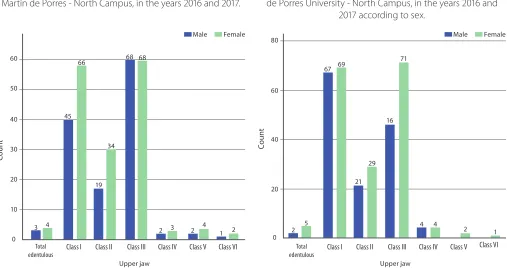
Figure 3. Prevalence of partial edentulism in upper jaw according to the Kennedy and Applegate classification in patients treated at the Dental Clinic of Universidad San Martín de Porres - North Campus, in the years 2016 and 2017.
Figure 4. Prevalence of partial edentulism in the lower jaw according to the Kennedy and Applegate classification in patients treated at the Dental Clinic of Universidad San Martín
de Porres University - North Campus, in the years 2016 and 2017 according to sex.
Table 1. Prevalence of partial edentulism in the upper jaw according to the Kennedy and Applegate classification in patients treated at the Dental Clinic of Universidad San Martín de Porres (USMP) - North Campus, Peru, in the years 2016 and 2017.
Table 2. Prevalence of partial edentulism in the lower jaw according to the Kennedy and Applegate classification in patients treated at the Dental Clinic of Universidad San Martín de Porres - North Campus, in the years 2016 and 2017.
Partial Edentulism Frequency Percentage
Class I 111 34.6
Class II 53 16.5
Class III 136 42.4
Class IV 5 1.6
Class V 6 1.9
Class VI 3 0.9
Total Edentulism in a single Arch 7 2.2
Total 321 100.0
Partial Edentulism Frequency Percentage
Class I 136 42.4
Class II 50 15.6
Class III 117 36.4
Class IV 8 2.5
Class V 2 0.6
Class VI 1 0.3
Total Edentulism in a single Arch 7 2.2
Partial Edentulism Male Female Total
n % n % n %
Class I 45 32.1% 66 36.5% 111 34.6%
Class II 19 13.6% 34 18.8% 53 16.5%
Class III 68 48.6% 68 37.6% 136 42.4%
Class IV 2 1.4% 3 1.7% 5 1.6%
Class V 2 1.4% 4 2.2% 6 1.9%
Class VI 1 0.7% 2 1.1% 3 0.9%
Total edentulism in a single arch 3 2.1% 4 2.2% 7 2.2%
Total 140 100.0% 181 100.0% 321 100.0%
Partial Edentulism Male Female Total
n % n % n %
Class I 67 47.9% 69 38.1% 136 42.4%
Class II 21 15.0% 29 16.0% 50 15.6%
Class III 46 32.9% 71 39.2% 117 36.4%
Class IV 4 2.9% 4 2.2% 8 2.5%
Class V 0 0.0% 2 1.1% 2 0.6%
Class VI 0 0.0% 1 0.6% 1 0.3%
TEA 2 1.4% 5 2.8% 7 2.2%
Total 140 100.0% 181 100.0% 321 100.0%
Table 3. Prevalence of partial edentulism in upper jaw according to the Kennedy and Applegate classification in patients treated at the Dental Clinic of Universidad San Martín de Porres University - North Campus, in the years 2016 and 2017 according to sex.
Table 4. Prevalence of partial edentulism in upper jaw according to the Kennedy and Applegate classification in patients treated at the Dental Clinic of Universidad San Martín de Porres University - North Campus, in the years 2016 and 2017 according to sex.
Table 5. Frequency of missing teeth in edentulous patients treated at the Dental Clinic of Universidad San Martín de Porres - North Campus, in the years 2016 and 2017.
Missing tooth
2016 - 2017 1.7 1.6 1.5 1.4 1.3 1.2 1.1 2.1 2.2 2.3 2.4 2.5 2.6 2.7
n 125 146 87 69 18 43 27 24 39 25 78 101 173 144
% 38.94 45.48 27.10 21.50 5.61 13.40 8.41 7.48 12.15 7.79 24.30 31.46 53.89 44.86
2016 - 2017 3.7 3.6 3.5 3.4 3.3 3.2 3.1 4.1 4.2 4.3 4.4 4.5 4.6 4.7
n 217 258 64 49 12 11 7 6 7 5 24 42 184 165
% 67.60 80.37 19.94 15.26 3.74 3.43 2.18 1.87 2.18 1.56 7.48 13.08 57.32 51.40
RESULTS.
After evaluating the 321 patients treated at the Dental Clinic of Universidad San Martín de Porres, a higher prevalence of partial edentulism Class I, II and III in general was noted, in comparison to Class III, V and VI, which show a low prevalence in this study population. (Table 1 and Table 2, and Figure 1 and Figure 2)
In these findings, it was determined that the highest prevalence of partial edentulism according to the Kennedy and Applegate classification for the upper jaw corresponded to Class III (42.4%), followed by Class I (34.6%), and Class II (16.5 %). (Table 1)
Class IV, V and VI. (Figure 1)
In the case of the lower jaw, a higher prevalence of Class I was observed (42.4%), followed by Class III (36.4%), and Class II (15.6%). (Table 2)
As in the upper jaw, a low prevalence of Class IV, V and VI was observed. (Figure 2)
It should be noted that for both upper and lower jaws, some cases of total edentulism were identified, but in only one arch, however due to its low frequency, its prevalence was minimal.
Regarding the prevalence of partial edentulism in the upper jaw according to sex, it was observed that Class III was more prevalent in males (48.6%), followed by Class I (32.1%). The highest prevalence observed in females corresponded to Class III and Class I, with 37.6% and 36.5%, respectively. (Table 3 and Figure 3)
Results regarding partial edentulism in the lower jaw according to sex showed that Class I had a higher prevalence in males (47.9%), followed by Class III (32.9%). In females, Class I had highest prevalence (39.2%), followed very closely by Class III (38.1%). (Table 4 and Figure 4)
Regarding the frequency of missing teeth, a greater prevalence can be observed in the left inferior hemiarch, followed by the upper left hemiarch and the lower right and upper hemiarches. Of the 321 partial edentulous patients, 80.37% had absence of the first lower left molar, in 67.60% the second lower left molar was absent, followed by the first right lower molar (57.32%), and the first upper left molar (53.89%). In general, a greater percentage of absence of the first and second permanent molars was observed. Premolars and anterior teeth showed a lower frequency. (Table 5)
Consequently, these results show that higher prevalence of edentulism corresponded to Class I, II and III, in posterior teeth, as it is the case of first and second permanent molars.
DISCUSSION.
According to an official report issued by the Ministry of Health of Peru, the average of decayed, missing and filled teeth in permanent dentition for 12-year-old subjects at national level was 3.67.
Taking into account these data Martins et al.,9
suggested that regarding caries the tendency gets worse as age increases. In a context in which stomatological interventions are focused mainly on the treatment of diseases and not on their prevention, the high prevalence of caries and periodontal diseases results in tooth loss at an early age. Villena3 points out that this situation leads to increasingly expensive and invasive treatments. Due to the high prevalence of oral diseases, the National Institute of Health of Peru, through the General Office of Research and Technology Transfer, has considered oral health as one of the national priorities of health research for the period 2015-2021.10 As such, and in agreement with Manrique11 it is necessary to consider public health stomatology in all its dimensions as a research priority area. It should be noted that within the oral health status in the Peruvian population, the loss of teeth at an early age is very worrying.3
In this regard, previous studies have shown that there is a trend towards an increase in the number of edentulous people as age increases,8,12,13 evidencing the high prevalence of periodontal disease and caries, the loss of teeth, the number of teeth needing to be extracted, and in general, the deterioration of oral health in older adults.14-16 Some authors, such as Cardoso et al.,17 point out that edentulism will increase at an alarming rate by the year 2040.
The findings of the present study show that the highest prevalence of missing teeth in the upper jaw corresponded to Class III (42.4%), followed by Class I (34.6%), and Class II (16.5%). In the lower jaw, the highest prevalence of edentulism corresponded to Class (42.4%), followed by Class III (36.4%), and Class II (15.6%).
These results coincide with a study carried out by Carrasco et al.18 In their study 88 adult subjects were assessed at the health services on the Butachauques and Tac islands in 2013, finding that according to the Kennedy classification, Class III was more prevalent in the upper jaw, and Class I and III were the most prevalent in the mandibular arch. Similar results with respect to the upper jaw were reported in 2013 by Gonzales et al.,19 who, when reviewing 130 clinical records of the training dental clinic at Universidad Peruana Cayetano Heredia, determined a higher prevalence of Class III in both jaws.
evaluating 168 adult individuals of the "El Golfo" Human Settlement in Ventanilla, Callao province, Peru, concluded that Kennedy's Class III was the most prevalent in the upper jaw. In the lower jaw, a higher prevalence of Class III was also observed, which does not coincide with the findings of the present study. Similarly, Vanegas et al.,6 in a study conducted in 2016 in 378 adult patients treated at the University Hospital of Cuenca, Ecuador, found that Class III was also the most prevalent in both jaws.
Regarding the lower jaw, the present study also coincided with the research conducted in 2016 by the dental surgeon Susy Tantas.4 Tantas assessed a sample of 105 patients treated at the Department of Geriatrics at the "Hospital Nacional Arzobispo Loayza" in Lima, finding a higher prevalence of Kennedy Class I in the mandible (69.2%). Regarding the upper jaw, her results do not agree with the present study, as she reported that the highest prevalence was also Class I.
Regarding the prevalence of partial edentulism in the present study according to sex, Class III and Class I were more prevalent for both males and females. These findings do not agree with the study conducted by Dau et al.,8 in the period 2014-2016.
They studied a sample of 53 patients treated at the Postgraduate Clinic of Universidad de Guayaquil, Ecuador, and concluded that there was a higher prevalence of Kennedy Class I in female patients and Class IV in males, followed by Class II and Class III in women and men, respectively.
The high prevalence of partial edentulism highlights the need to continue concentrating efforts and resources in improving the different levels of preventive intervention. These results show how culture-based approaches in
oral health20 and oral health rights,21 are far from being consolidated, due to the complexity of social, cultural, and economic factors, as well as aspects related with the lack of public policies, especially those that should promote a culture of preventive health. As Villena3 pointed out this should be done from different fields of interest in dental research.
According to Contreras22 it is fundamental to prioritize health promotion interventions, through effective policies and strategies for health education at the population level, accompanying these measures and initiatives with greater commitment on the part of the competent political authorities, so that in the medium and long term a favorable impact on the oral health conditions can be achieved in the different stages of life.
CONCLUSION.
According to the Kennedy and Applegate classification of edentulism, Class III and I were the most prevalent in the upper jaw for both males and females. In the lower jaw, Class I and III were the most prevalent in both sexes. In addition, the first and second permanent molars proved to be the most frequently missing teeth.
Conflict of interests: The authors declare no conflicts
of interest.
Ethics approval: Authorization was granted by the
Bioethics Commission and the Research Unit at Universidad San Martín de Porres, Rectoral Resolution No. 518 - 2017 - CU - R - USMP.
Funding: This study was self-financed.
Authors’ contributions: All authors carried out the
entire review.
Acknowledgements: None.
REFERENCES.
1. Gutiérrez VL, León RA, Castillo DE. Edentulismo y
necesidad de tratamiento protésico en adultos de ámbito urbano marginal. Rev Estomatol Herediana. 2015;25(3):179-86.
2. Luengas MI, Sáenz LP, Tenorio G, Garcilazo A, Díaz MA.
Aspectos sociales y biológicos del edentulismo en México: un problema visible de las inequidades en salud. Revista de Ciencias Clínicas. Elsevier. 2015;16(2):29-36.
3. Villena R. Estrategias sanitarias del Ministerio de Salud (MINSA): Análisis y discusión desde una perspectiva de la investigación odontológica. KIRU. 2016;13(2):185-8.
4. Tantas SI. Edentulismo parcial o total, y la calidad de vida en pacientes adultos mayores del Departamento de Geriatría del Hospital Nacional Arzobispo Loayza, 2016. [Tesis] Universidad Nacional Mayor de San Marcos. 2017.
5. Eustaquio-Raga MV, Montiel-Company JM,
Almerich-Silla JM. Factors associated with edentulousness in an elderly population in Valencia. Gac Sanit. 2013;27(2):123-7.
6. Vanegas E, Villavicencio E, Alvarado O, Ordóñez P.
Ecuador 2016. Rev Estomatol Herediana. 2016;26(4):215-21. 7. More K, Rivas C, Chumpitaz R. Calidad de vida en relación a experiencia de caries en pacientes de la Clínica Odontológica de la Universidad San Martín de Porres de Chiclayo. KIRU. 2015;12(2):37-42.
8. Dau R, Ortiz E, Mazzini F, Ubilla W, Egas JL, Rodríguez K. Análisis de la prevalencia de la clasificación de Kennedy en pacientes parcialmente desdentados. Rev Cient Univ Odontol Dominic. 2016;3(2)19-26.
9. Paiva SM, Vidigal AE, Abanto J, Cabrera A, Refugio R,
Masoli C, Echevarría S, Mongelos M, Guerra M, Amado A. Epidemiología de la caries dental en América Latina. Revista de Odontopediatría Latinoamericana. 2014;4(2).
10. MINSA. Prioridades Nacionales de Investigación en
Salud 2015-2021. Resumen Ejecutivo. Lima: Instituto Nacional de Salud. Oficina General de Investigación y Transferencia Tecnológica; 2017.
11. Manrique J. Salud pública estomatológica. Rev Estomatol Herediana. 2016;26(4):203-5.
12. Fernandez M, Medina C, Márquez M, Vera S, Ascencio
A, Minaya M. Edentulismo en adultos de Pachuca, México: Aspectos sociodemográficos y socioeconómicos. Rev Clin Periodoncia Implantol Rehabil Oral. 2016;9(1):59-65.
13. Arteaga O, Urzúa I, Espinoza I, Muñoz A, Mendoza C.
Prevalencia de caries y pérdida de dientes en población de 65 a 74 años de Santiago, Chile. Rev Clin Periodoncia Implantol Rehábil Oral. 2009;2(3);161-6.
14. Mendes Carneiro SDR, De Souza CM, Rocha GA, Ramalho
ALJ, Saintrain MVL, Lima DLF. Prevalência de edentulismo e situação periodontal em idosos atendidos no curso de
Odontologia da Universidade de Fortaleza (UNIFOR). Braz J Periodontol. 2013;23(2):07-10
15. Almirón PA, Denis SE, Morales A, Britez E, Macchi AA,
Maidana JA, Palacios F, Pérez NM, Ferreira MI, Sanabria D,Avalos D. Condiciones de salud oral en ancianos del club geriátrico “Abue-Club” en Paraguay. Universidad del Pacífico Privada de Asunción. Mem Inst Investig Cienc Salud. 2016;14(1):32-9
16. González C, Rosete J, Huitzil E. Frecuencia de edentulismo en la Clínica de Odontología de la Universidad Popular Autónoma del Estado de Puebla en el periodo 2010 al 2014. Rev Tame 2016;5(14):489-92.
17. Cardoso M, Balducci I, Telles D, Lourenço SJV & Nogueira NJ. Edentulismo no Brasil: tendências, projeções e expectativas até 2040. Ciênc. saúde coletiva. 2016,21(4):1239-46.
18. Carrasco F, Vergara C. Prevalencia de edentulismo parcial y total en islas Butachauques y Tac, Quemchi, Chile 2013. Rev Chil Salud Pública. 2014;18(3):257-62.
19. Gonzáles GM, Chávez B, Manrique J, Hidalgo I. Prevalencia del estado periodontal de pacientes portadores de prótesis parcial removible tratados en una clínica dental privada. Rev. Estomatol Herediana. 2013;23(4):200-5.
20. Lugo E, García L, Gross C, Casas S, Sotomayor F. The
culture in oral health as current problem of the society. Rev MEDISAN. 2013;17(4):677
21. Rueda G, Albuquerque A. La salud bucal como derecho