A Note on Global Bipartite Domination in Graphs
Latheesh Kumar A. R.
aand Anil Kumar V.
b∗ aDepartment of Mathematics, St. Mary’s College, Sulthan bathery, Wayanad, Kerala, India 673 592.bDepartment of Mathematics, University of Calicut, Malappuram, Kerala, India 673 635.
Abstract
In this paper we introduce the concept of the global bipartite domination number γgb(G) of a connected
bipartite graph G and study some of its general properties. Moreover we determine the global bipartite domination number of certain classes of graphs.
Keywords: Domination, global bipartite domination, global bipartite domination number.
2010 MSC:05C69 2012 MJM. All rights reserved.c
1
Introduction
In this paper we consider simple, connected and bipartite graphs. All notations and definitions not given here can be found in [1, 3]. Agraphis an ordered pairG = (V(G),E(G)), whereV(G)is a finite nonempty set andE(G)is a collection of 2- point subsets ofV. The setsV(G)andE(G)are the vertex set and edge set ofG
respectively. Thedegreeof a vertexvinGis the number of edges incident atv. The set of all neighbors ofvis theopen neighborhoodofv, denoted byN(v). LetPn, Cn, KnandKm,ndenote path, cycle, complete graph and
complete bipartite graph respectively. The sudivision of the graphGis the graphS(G)obtained fromGby subdividing each edge ofG. The coronaG◦K1ofGis the graph obtained fromGby adding a pendant edge to each vertex ofG. A setA⊆V(G)of vertices in a graphG= (V,E)is called adominating set, if every vertex
v ∈ Vis either an element of Aor adjacent to an element ofA. Thedomination numberγ(G)of a graphGis the minimum cardinality of a dominating set inG.
2
Main results
We introduce a new concept, namely,Global Bipartite Dominating Setof a simple bipartite graph. Then we define the global bipartite domination number ofG.
Definition 2.1. Let G be a connected bipartite graph with bipartition(X,Y),with|X|=m and|Y| =n.The relative complement of G in Km,ndenoted byG is the graph obtained by deleting all edges of G from Kb m,n(i.e.,Km,n\G).A global
bipartite dominating set (GBDS) of G is a set S of vertices of G such that it dominates G and its relative complementGb.
The global bipartite domination number,γgb(G)is the minimum cardinality of a global bipartite dominating set of G.
Theorem 2.1. For any connected spanning subgraph G of Km,n,γ(G)≤γgb(G)≤m+n.
Proof. A global bipartite dominating set ofGis a dominating set of Gand so γ(G) ≤ γgb(G). The set of all
vertices ofGis clearly a GBDS ofGso,γgb(G)≤m+n. Thereforeγ(G)≤γgb(G)≤m+n.
∗Corresponding author
Remark 2.1. The bounds in Theorem 2.1 are sharp. For the complete bipartite graph G=Km,n, γgb(Km,n) =m+n.
For P4, γ(P4) =γgb(P4) =2.So Km,nhas the largest possible GBD number. Also the bounds in Theorem 2.1 are strict.
For the graph K2,3−e, γ(K2,3−e) =2andγgb(K2,3−e) =4.
Theorem 2.2. If G and G does not contain isolated vertices, thenb γgb(G) ≤ min{m,n},where G is a spanning
subgraph of Km,n.
Proof. Let(X,Y)be the bipartition ofGwith|X| = m ≤ |Y| = n. SinceGandGbdoes not contain isolated vertices,Xis a G.B.D.S. ofG. Thereforeγgb(G)≤m.
Theorem 2.3. For any positive integers m and n, γgb(Km,n) =m+n.
Proof. LetGbe a complete bipartite graph with partitionsXandY. Thenuv ∈ E(G) for everyu ∈ Xand
v ∈Y. LetGbdenotes the relative complement ofGinKm,n. ThenGbcontainsm+nisolated vertices. Hence every global bipartite dominating set ofGmust contain all vertices ofGband soγgb(G) ≥ slantm+n. Now
V(G)is a global bipartite dominating set ofG. Henceγgb(G) =m+n.
Theorem 2.4. For a spanning subgraph G of Km,n,a vertex v is in every global bipartite dominating set of G if and
only if v is an isolated vertex inGb.
Proof. If|V(G)| ≤ 3, the proof is trivial. So let|V(G)| > 3. Ifv is an isolated vertex inGb, thenvis in every global bipartite dominating set ofG. Conversely ifvis not an isolated vertex inGb, then there exist atleast two verticesuandwsuch thatuis adjacent tovinGandwis adjacent tovinGb. SoV(G)\ {v}is a global bipartite dominating set ofG.
Theorem 2.5. Let G be a connected bipartite graph with partite sets X and Y.Let S=V1∪V2be a GBDS of G, where
V1⊆X and V2⊆Y. Then if V1=φ,then V2=Y and if V2=φ,then V1=X.
Proof. LetS=V1∪V2, whereV1⊆XandV2⊆Y. IfV1=φ, thenS⊆Y. SinceGis bipartite, the vertices inY are not adjacent and soS⊇Y. ThereforeS=V2=Y. Similarly, we can prove that ifV2=φthenV1=X.
Theorem 2.6. Let(X,Y)be the bipartition of a connected graph G. Then X is a GBDS of G if and only if|N(y)| <
|X|, ∀y∈Y.
Proof. LetXbe a GBDS ofG. If possible assume that there exists a vertexy∈Ysuch that|N(y)| =|X|. Then
yis an isolated vertex inGb, contradiction to the fact thatXis a GBDS ofG. Conversely, sinceGis connected,
Xis dominating set ofG. So it is sufficient to show thatXdominatesGbalso. Lety∈Y, thenN(y)is a proper subset ofX. Soyis adjacent to at least one vertex ofXinGb. This completes the proof.
Theorem 2.7. Let G be a connected sub graph of Km,n. Thenγgb(G) =m+n−1if and only if G∼=Km,n−e.
Proof. LetG ∼= Km,n−e. wheree = uv ∈ E(Km,n). Souv ∈/ E(G)and henceuv ∈ E(Gb). SinceGbcontains
m+n−2 isolated vertices, every global bipartite dominating set ofGcontains all vertices ofV(G)− {u,v}
and at least one ofuandv. Thus
γgb(G)≥m+n−1 (2.1)
SinceV(G)− {u}is a GBDS ofG, it follows that
γgb(G)≤m+n−1 (2.2)
Thus by (1) and (2)we obtainγgb(G) =m+n−1.
Conversely assume thatγgb(G) =m+n−1. To proveG∼=Km,n−e. We observe thatγgb(Km,n) =m+nand
γgb(Km,n−e) =m+n−1. LetGbe a proper subgraph ofKm,n−econtainingm+nvertices. ThenGbcontains atmostm+n−3 isolated vertices. In that caseGbcontains a pathuvw. ThenV(G)− {u,w}is a GBDS ofG. So γgb(G)≤m+n−2. This completes the proof.
Theorem 2.8. Let G be a graph with bipartition(X,Y). If G has aγ-set S=V1∪V2, where V1⊆X and V2⊆Y then
S is aγgb-set of G if and only if
\
x∈V1
N(x)⊆V2and
\
y∈V2
Proof. Let \
x∈V1
N(x)⊆V2and
\
y∈V2
N(y)⊆V1. SinceSis aγ- set ofG, it suffices to show thatSdominates the
relative compliment ofG. Letu∈X. Ifu∈ \
y∈V2
N(y), thenu∈V1. Ifu∈/ \
y∈V2
N(y)thenuis adjacent to atleast
one vertex ofV2inGb. Similarly, we can prove that ifv ∈ Ythenv ∈ V2orvis adjacent to atleast one vertex ofV1inGb. Conversely, letSdominates Gb. Letx be an arbitrary vertex inX. If x∈
\
y∈V2
N(y), then inGb,x is
not adjacent to any vertex ofV2. SinceSdominatesGb, we can deduce thatx ∈ V1. Ifx∈/
\
y∈V2
N(y), then xis
adjacent to atleast one element ofV2inGb. Hence the proof.
Corollary 1. Let G be a connected bipartite graph with n vertices, n≥4.Thenγgb(G◦K1) =n,where G◦K1denotes
the corona of the graphs G and K1.
Proof. IfG∼=K1,n, the proof is trivial. Otherwise, let(X,Y)be the bipartition ofG◦K1. LetS=V1∪V2, where
V1⊆XandV2⊆Y, be the set of all pendant vertices ofG◦K1. ClearlySisγ-set ofG◦K1. Also
\
x∈V1
N(x) =φ
and \
y∈V2
N(y) =φ. Therefore the proof follows immediately from theorem 2.8.
Corollary 2. For n≥10, γgb(Pn) =γ(Pn) =dn3e.
Proof. LetV(Pn) ={1, 2, 3, . . . ,n}. ThenX={x:xis even,x ≤n},Y={y:yis odd,y≤n}is the bipartition
ofPn. LetS1={i:i≡1(mod3),i ≤n}andS2={i:i+1≡0(mod3),i≤n}. Then eitherS1orS2is aγ-set ofPn. Also fori=1, 2,
\
x∈Si∩X
N(x) =φand
\
y∈Si∩Y
N(y) =φ. Thus the proof follows from theorem 2.8.
Corollary 3. For an even integer n≥10, γgb(Cn) =γ(Cn) =dn3e.
Proof. The proof is exactly similar to corollary 2.
Theorem 2.9. For any two positive integers a and b with a < b,there exists a graph G such that γ(G) = a and γgb(G) =b.
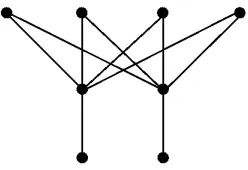
Proof. Consider the graphKb−a,a, with partite setsW={w1,w2, . . . ,wb−a}andU={u1,u2, . . . ,ua}. LetGbe
the graph obtained fromKb−a,aby adding new verticesv1,v2, . . . ,vaand joinviwithuifori= 1, 2, . . . ,a. Let
Sbe a dominating set ofG. Since for eachi, viis adjacent touionly,|S| ≥a. NowUis a dominating set ofG.
So|S| ≤a. Henceγ(G) =a. InGb, the verticesw1,w2, . . . ,wb−aare isolated. SoWis a subset of everyγgb-set ofG. Therefore the set{u1,u2, . . . ,ua,w1,w2, . . . ,wb−a}is aγgb-set ofG. Henceγgb(G) =b.
Figure 1: GraphGwithγ=2 andγgb=6
Lemma 2.1. If G is an r-regular connected bipartite graph with bipartition(X,Y)then|X|=|Y|.
Proof. Each edge inGcontributes exactly one to the degree sumsr|X|andr|Y|. Thereforer|X|=r|Y|=|E| ⇒ |X|=|Y|.
Proof. SinceGisn−1 regular,Gbhasncomponents and all of them areP2. Soγ(Gb) =n. Then by theorem 2.8, we can find aγ-set ofGbsuch that it dominatesGalso. Thereforeγgb(G) =n.
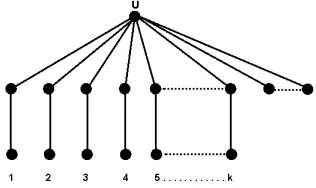
Theorem 2.11. Let G be a healthy spider with2n+1vertices, thenγgb(G) =n+1.
Proof. LetSbe aγ-set ofG, then|S| =nandu ∈/S(see Figure 2). SoSdominates all vertices exceptuinGb. SoS∪ {u}is aγgb-set ofG. This completes the proof.
Figure 2: Healthy Spider
Theorem 2.12. If G is a wounded spider with n+k+1vertices, thenγgb(G) =k+1.
Proof. Observe thatγ(G) =k+1. Also the setS={1, 2, 3, . . . ,k,u}is aγgb-set ofG(see Figure 3).
Figure 3: Wounded Spider
Theorem 2.13. γgb(Bn) =4,where Bnis the book graph on2n+1vertices.
Proof. Let the vertices of Bn be labelled as shown in figure 4. Then
X={v,u1,u2, . . . ,un}, Y={u,v1,v2, . . . ,vn}is the bipartition ofBn. Clearly the set{u,v}is theγ-set ofBn.
Also{u,v,u1,v1}is aγ-set ofBcn. Thereforeγgb(Bn) =4.
Theorem 2.14. γgb(S(Kn)) =n,where S(Kn)is the subdivision of the complete graph Kn.
Proof. LetXbe the set of all old vertices andYbe the set of all new vertices ofS(Kn). Then(X,Y)is a bipartition
ofS(Kn). InS(Kn), the degree of each vertex inXisn−1 and the degree of each vertex inYis 2. We construct
aγ-set ofS(Kn)as follows: LetS ⊆ Xsuch that|S| = n−2. ThenS dominates all but one vertexuinY.
Also N(u) = {x,y}and X−S = {x,y}. SoS∪ {u}is aγ-set ofS(Kn). SinceS∪ {u}does not dominate x
andy inGb, this set is not aγgb-set. SoS∪ {u,v}, wherev ∈/ N(x)∪N(y), is aγgb-set ofS(Kn). Therefore
γgb(S(Kn)) =n.
References
[1] R. Balakrishnan and K. Ranganathan,A Textbook of Graph theory, Springer, 2012.
[2] E.J. Cockayne, R.M. Dawes and S.T. Hedetniemi, Total Domination in Graphs,Networks10 :211-219, 1980.
[3] F. Harary,Graph theory, Addison-Wesley, Reading, MA,1972.
[4] T.W. Haynes, S.T. Hedetniemi and P. J. Slater,Fundamentals of Domination in Graphs, Marcel Dekker, New York, 1998.
[5] T.W. Haynes, S.T. Hedetniemi and P. J. Slater,Domination in Graphs: Advanced Topics, Marcel Dekker, New York, 1998.
[6] Michael A. Henning and Anders Yeo,Total Domination in Graphs, Springer, New York, 2013.
[7] V.R. Kuli and B.Janakiram, The total global domination number of a graph.Indian Journal of Pure and Applied Mathematics27(1996):537-542.
[8] E. Sampathkumar, The global domination number of a graph,J. Math. Phys.Sci, 23:377-385, (1989).
Received: November 24, 2015;Accepted: April 15, 2016
UNIVERSITY PRESS