The International Journal of Digital Curation
Volume 8, Issue 1 | 2013
Competencies Required for Digital Curation: An Analysis of Job
Advertisements
Jeonghyun Kim, Edward Warga and William E. Moen, College of Information,
University of North Texas
Abstract
With digital curation’s increasingly important role in the fast-paced and data-intensive information environment, there is a need to identify a set of competencies for professionals in this growing field. As part of a curriculum development project funded by the U.S. Institute of Museum and Library Services, a total of 173 job advertisements posted between October 2011 and April 2012 were collected from various sources to take into account varying types of professionals in the field of digital curation across North America. Position title, institution types and location, educational background, experience, knowledge and skills, and duties were examined and analyzed. The results of the analysis show that digital curation jobs are characterized by a complex interplay of various skills and knowledge. The findings of this study present emerging requirements for a qualified workforce in the field of digital curation.
Introduction
The term “digital curation” was first used in 2001 as a title for a seminar on digital archives, libraries and eScience in which various communities came together to discuss the urgent challenges of improving the long-term management of, and preservation of access to, digital information. Since then, the concept of digital
curation has evolved and been extended in use for “all activities involved in managing data from planning its creation, best practice in digitization and documentation, and ensuring its availability and suitability for discovery and re-use in the future” (Abbott, 2008). Other definitions include functions for adding value through data curation processes, i.e: “Digital curation involves maintaining, preserving and adding value to digital research data throughout its lifecycle” (Digital Curation Centre, n.d.). The field of digital curation, which intersects with a variety of problems and domains from cultural heritage collections to eScience and data science, has rapidly evolved in response to new challenges and exciting opportunities.
Within the field of digital curation there has been an increased interest in providing long-term preservation and access to research data, specifically in the context of data-intensive science and the emerging problems of data deluge. This trend has led to the development of policies and processes governing the retention and preservation of data, the ability to ensure security, and enabled the appropriate sharing and publication of data. In the United States, the Office of Management and Budget (OMB) issued final regulations to revise the OMB Circular A-1101 to make certain federally funded research data comply with the Freedom of Information Act requirements. Government funding agencies have since implemented the OMB requirements to ensure public access to research data in various ways. For example, in 2003 the National Institutes of Health (NIH) announced a policy supporting data sharing; researchers applying for $500,000 or more in direct costs in any one year are required to include a data sharing plan or state why data sharing is not possible (NIH, 2003). More recently, the National Science Foundation (NSF) announced its requirement for a two-page data
management plan with every NSF proposal.2 Similar efforts are underway around the world. In the United Kingdom, the Research Councils UK (RCUK) issued a set of Common Principles on Research Data Policy in 2011, which provides a framework for individual research council policies on data.3 These policies push for data to be made openly available with as few restrictions as possible in a timely and responsible manner. In addition, the Economic and Social Research Council (ESRC) and Natural Environment Research Council (NERC) began implementing requirements for data management plans in April 2011 and August 2012, respectively.45
In light of such trends, the changing role of libraries for dealing with research data and the emerging practice of digital curation in libraries have been explored and discussed in both scholarly and professional literature (e.g., Gold, 2007; Hahn, Lowry,
1 OMB Circular A-110: http://www.whitehouse.gov/omb/circulars_a110/
2 NSF data management plan requirements: http://www.nsf.gov/eng/general/dmp.jsp
3 RCUK common principles on data policy: http://www.rcuk.ac.uk/research/Pages/DataPolicy.aspx 4 ESRC research data policy: http://www.esrc.ac.uk/about-esrc/information/data-policy.aspx 5 Guidance notes for the NERC data policy:
Lynch & Shulenberger, 2009; Newton, Miller & Bracke, 2011; Swan & Brown, 2008; Walters & Skinner, 2011). One dominant theme in the discussion is that the
fundamental role of the library needs to expand to incorporate functions related to organizing and manipulating data and datasets. This includes, for example, providing archiving and preservation services for data within the institution through institutional repositories (Swan & Brown, 2008). In fact, curation, which involves various
activities that can help facilitate discovery, access, dissemination and archiving of information, is what librarians or archivists have done for hundreds of years. This implies that the similar skill sets used in traditional library work may be beneficial to curation work involving digital data and information.
However, researchers have noticed gaps in academic libraries, particularly a need for appropriately trained information professionals to act on opportunities for
supporting curation activities (Soehner, Steeves & Ward, 2010). Reports such as
Harnessing the power of digital data for science and society (National Science and Technology Council, 2009) have asserted that individuals in information disciplines should be given incentives to obtain additional education and training to enable their effective participation in the digital dimension. Some recent articles also have
identified a compelling need for targeted education and training of librarians and other information professionals if libraries are to succeed in the areas of digital curation and data management (e.g., Ogburn, 2010; Heidorn, 2011).
Given this context, articulating the specific competencies, such as the knowledge, skills and abilities required to perform a broad range of digital curation functions, is an excellent basis for designing an educational and professional framework to train digital curators. The job analysis reported here was carried out as part of the digital curation curriculum development for the Information: Curate, Archive, Manage, and Preserve (iCAMP) project at the University of North Texas. The analysis aims to identify competencies required by the broad range of professionals working in the digital curation field.
Emerging Skill Sets for Digital Curation
As digital curation emerged as a new practice, the need for practitioners in the field of digital curation also has risen. Tibbo, Hank and Lee’s (2008) survey of digital curation professionals supports this: 69% of the survey respondents reported that a digital curation job had been posted at their institutions within the preceding year. While position titles vary (e.g., digital curator, data curator, data manager, eScience
professional, etc.), new jobs related to digital curation are being created. However, as Swan and Brown (2008) noted, there is not yet a set of common or agreed upon titles in the field and the demarcation among roles may be blurred.
As such, the skill sets needed by those who work with digital content in the context of curation or the broader context of digital libraries are widely discussed. Choi and Rasmussen (2009), verified that staffing needs and required qualifications have shifted toward a focus on digital collections, services, and technology applications in
digital materials produced by their institutions’ communities. Through a literature analysis, they identified six areas of knowledge and skills:
1. Understanding software,
2. Project planning and management, 3. Collection definition,
4. Metadata guidance, 5. Submission review, 6. Author training.
It is interesting to compare those six areas with the list of skills and capabilities needed for digital archiving proposed by Cunningham (2008). That list includes record keeping theory and practice, system design and implementation, metadata regimes, risk assessment, auditing and compliance assessment, preparing a business case, and so forth. The University of North Carolina (UNC) DigCCur project’s approach is quite comprehensive compared to others; they attempted to identify the knowledge and competencies to be addressed in a curriculum. A “Matrix of Digital Curation Knowledge and Skills” was developed based on data from numerous sources including surveys and interviews with domain experts. The matrix elaborates six dimensions:
1. Mandates, values, and principles; 2. Functions and skills;
3. Professional, disciplinary, or institutional/organizational context; 4. Type of resource;
5. Prerequisite knowledge;
6. Transition point in the information continuum (Lee, Tibbo, & Schaefer, 2007).
As more attention is paid to curation of scientific and other research data in academic libraries, there has been more interest in identifying core skills for research data management. It is interesting to note that Pryor and Donnelly (2009) defined different skills needed by the different players in research data management: data managers, data creators, data librarians, and data scientists. In addition, several studies have attempted to analyze emerging job characteristics using various methods. Cragin and her colleagues (2009) examined data curation job postings to investigate the educational background and skills needed for data curation, and to characterize the data curation employment landscape. Stanton, Kim, Oakleaf and Lankes (2011) conducted individual interviews and focus groups with science and engineering researchers to explore the needs of scientific researchers. Their analysis provided insight into the capabilities needed by “eScience professionals.” The capabilities were summarized by three major areas: data management, communications between
including interoperability, markup, database design and metadata, as well as project management, as important skills.
There are great opportunities to train new information professionals for this evolving area and to offer continuing education and training for librarians and other professionals already on the job; knowledgeable and skilled professionals for research libraries are needed to contribute to these new and developing areas. The Association of Research Libraries workshop, New collaborative relationships: The role of
academic libraries in the digital data universe, recommends support for training initiatives to ensure that information and library professionals and scientists can work more credibly and knowledgeably on data curation, management and preservation (Friedlander & Alder, 2006). To respond to such recommendations, a number of library and information science schools in North America recognized the educational and professional context in which digital curation programs need to be developed and delivered. There have been a number of initiatives related to digital curation capacity building, including UNC’s DigCCur, University of Illinois’ Data Curation Education Program (DCEP), University of Tennessee’s Data Curation Education in Research Center (DCERC), and Syracuse University’s eScience. Recently, Harris-Pierce and Liu (2012) and Keralis (2012) reported an increase in the number of schools offering courses and certification programs in digital curation.
Methodology
Data Collection
As digital information and information technology permeate almost all activities of libraries and information centers, there has been considerable interest in understanding new professional qualifications and competencies for those who work in the field. As such, a number of studies have attempted to trace changes in the job market and explore skills and knowledge required by employers (e.g., Choi & Rasmussen, 2009; Grimes & Grimes, 2008; Han & Hswe, 2010; Kennan, Cole, Willard & Wilson, 2006). Those studies employed job advertisement analysis; job advertisements can act as relatively accessible indicators of the competencies required by employers in the field.
In this study, we monitored several online sources and searched for advertised position postings from October 2011 to April 2012 to identify job advertisements in the field of digital curation. To ensure representation of all regions of North America, we monitored the following sources: American Library Association’s JobLIST6, Association of Research Libraries’ Job Announcements7, Special Libraries Association’s Career Center8, LIS Jobs9, and Digital Curation Exchange10. The
primary search terms used to locate relevant job postings were any derivative forms of curate, preserve, archive and manage (e.g., curation, curator, preserve, preservation, archiving, archivist, management, manager, etc.). A second set of search terms was
6 American Library Association’s JobLIST: http://joblist.ala.org
7 Association of Research Libraries’ Job Announcements: http://www.arl.org/resources/careers 8 Special Libraries Association’s Career Center: http://careercenter.sla.org
9 LIS Jobs: http://www.lisjobs.com
used in combination with the primary terms to narrow search results; those terms were any derivative forms of digital, data and information (e.g., digital content, digital object, digital asset, digital information, digital collection, digital material, digital data, research data, and scientific data, etc.). A total of 173 job advertisements were collected for analysis.
Data Analysis
To determine the frequencies and patterns of occurrence of specific job characteristics and requirements, we analyzed the data set of 173 job advertisements, focusing on six aspects: position title, institution, degree, experience, knowledge/skills/abilities, and duties.
NVivo, a qualitative analysis software tool, was used to code and analyse the job descriptions. A pair of researchers developed the coding scheme used to categorize the data for further analysis. Codes were assigned to label specific sections of the job descriptions. To ensure the reliability of the coding process, inter-coder reliability was assessed; the assessment resulted in an agreement rate of 96%, suggesting that the coding scheme and its use was robust and reliable.
Results
Position Title
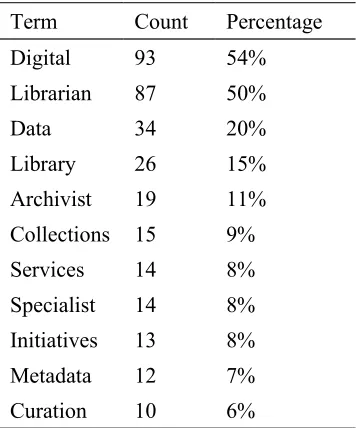
Position titles had many variations (see Table 1). The term “digital” occurred most often in position titles (93 out of 173), followed by “librarian” (87), “data” (34), “library” (26), and “archivist” (19).
Only 14% of positions (24) had administrator titles. The titles included the Director of Curation Services, Associate Director of Digital Initiatives, Head of Metadata Creation, Digital Repository Manager, and Digital Library Content Manager.
Term Count Percentage Digital 93 54% Librarian 87 50% Data 34 20% Library 26 15% Archivist 19 11% Collections 15 9% Services 14 8% Specialist 14 8% Initiatives 13 8% Metadata 12 7% Curation 10 6%
Types and Location of Institution
The job advertisements included in this study originated from institutions in the United States and Canada. Jobs in 36 states and two provinces were represented; institutions in Massachusetts posted the highest number of job advertisements (16 out of 173), followed by California (15), Indiana (11), Virginia (10), Illinois (9), New York (9), Texas (9), Pennsylvania (9), Michigan (8), Georgia (7), and North Carolina (6).
Academic libraries constituted 87% (151) of the job advertisements. Only two positions were found in a public library and a museum, respectively. Opportunities for digital curation employment outside the library setting exist; nine positions were located in government and nonprofit agencies, and six positions in the private sector, including health care and technology companies.
Education
Eighty-nine percent (154 out of 173) of job advertisements included statements about required or preferred educational background. Most positions (147) required or preferred a master’s degree, while some required only a bachelor’s degree (21). A Ph.D. degree was required to qualify for a limited number of positions (9).
An ALA-accredited master’s degree was referenced in 75% (130) of the advertisements. In addition, 26% (45) listed an equivalent degree as acceptable in place of or in addition to the ALA-accredited master’s degree. Among them, eleven positions preferred or required a degree in a science or engineering discipline, nine in computer science, eight in arts and humanities, and seven in social sciences. The remainder that required a master’s degree did not specify a particular discipline; some referred to a “related or relevant advanced degree,” while others included a more encompassing phrase “relevant data-intensive discipline.”
Experience
Sixty-one percent of the job advertisements (105 out of 173) expected applicants to have certain work experiences. These were often described broadly as experience working in a library or archive setting. Examples of those experience-related phrases included “experience working in an academic library”; “professional archival
experience”; and “research library work experience.”
Figure 1. Years of work experience required in the advertisements.
Knowledge, Skills and Abilities
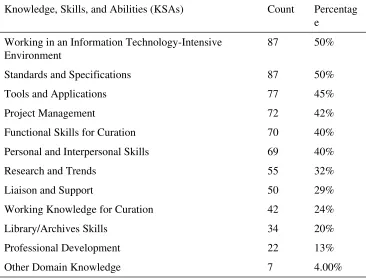
Based on the requirements for the positions, we categorized the knowledge, skills and abilities (KSAs) expected for professionals in digital curation into 12 areas (see Table 2).
Knowledge, Skills, and Abilities (KSAs) Count Percentag
e Working in an Information TechnologyIntensive
Environment 87 50%
Standards and Specifications 87 50%
Tools and Applications 77 45%
Project Management 72 42%
Functional Skills for Curation 70 40%
Personal and Interpersonal Skills 69 40%
Research and Trends 55 32%
Liaison and Support 50 29%
Working Knowledge for Curation 42 24%
Library/Archives Skills 34 20%
Professional Development 22 13%
Other Domain Knowledge 7 4.00%
Table 2. Knowledge, skills and abilities in the advertisements.
multiple operating systems, including UNIX/Linux; programming and scripting languages such as Java, PHP, and Perl; HTML and other Web-related markup languages; XML and XSLT; relational databases including MySQL and Oracle; and desktop productivity software and advanced graphics software.
The technical, organizational, and procedural standards and specifications area appeared in the same number of job advertisements (87). Familiarity with and knowledge of various metadata standards, such as MARC, Dublin Core, METS, MODS and PREMIS, were mentioned in 45 job advertisements. Other standards and specifications included semantic web, linked data and other standards related to digital preservation, such as ISO16363: 2012 Audit and Certification of Trusted Digital Repositories.
Knowledge of and proficiency using the tools and applications that support
preservation, curation and management of digital content were required in 45% of job advertisements (77). Job advertisements specifically mentioned digital repository platforms such as DSpace, Fedora, CONTENTdm and Digital Commons; archival data management systems, such as Archivists’ Toolkit; digital content
creation/transformation tools; research data analysis tools, such as SPSS, SAS and NVivo; other integrated library systems, such as Voyager and Horizon; and open-source content management software, such as Drupal.
Along with tools and applications, functional skills for curation were noted in about 40% of job advertisements (70). Functional skills refer to practices, methods,
procedures and techniques for various curation activities, including selection, creation, preservation and management. Specifically, these skills include creating and editing various types of digital objects, as well as digitization, creating metadata, managing repositories and implementing preservation practices.
About one quarter of the job advertisements (42) specified working knowledge of curation, which refers to understanding concepts, principles, issues and technical challenges related to digital curation. This knowledge is important since the professional should be able to translate it into actions or apply it to appropriate functions in digital curation. Knowledge includes various media formats, curation workflows, data management principles, repository architecture, search and retrieval technology, preservation strategies, applicable provisions of copyright laws, and academic/research policies and procedures related to data management.
Job advertisements in the field of digital curation highlighted that project
management skills are increasingly in demand. Project management, which refers to knowledge and skills related to planning, coordinating and implementing effective projects, including supervising other staff members and writing grants, was mentioned in 42% of job advertisements (72). Thirty-two percent (55) of the advertisements indicated that digital curation professionals should possess demonstrable knowledge and experience with emerging technologies and practices, reflected in the KSA category of Research and Trends.
work. They were reflected in phrases such as “excellent communication skills”, “strong analytical skills”, “multi-tasking ability”, “independent judgment”, “leadership”, and so forth.
Other areas of KSAs noted in the advertisements included liaison and support (50), library/archive-relevant skills (34), professional development (22), and other domain knowledge (7).
Duties
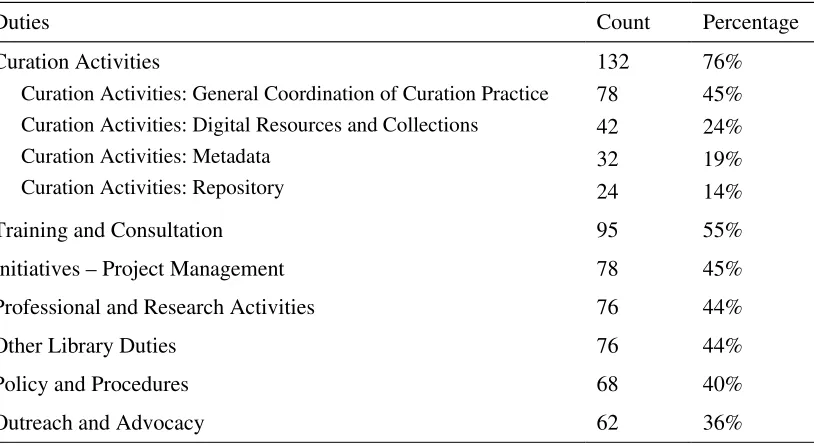
Based on the required and preferred functions, tasks and work actions performed in these positions, we categorized the duties for digital curation professionals into seven areas (see Table 3).
Duties Count Percentage
Curation Activities
Curation Activities: General Coordination of Curation Practice Curation Activities: Digital Resources and Collections
Curation Activities: Metadata Curation Activities: Repository
132 78 42 32 24
76% 45% 24% 19% 14%
Training and Consultation 95 55%
Initiatives – Project Management 78 45%
Professional and Research Activities 76 44%
Other Library Duties 76 44%
Policy and Procedures 68 40%
Outreach and Advocacy 62 36%
Table 3. Duties in the advertisements.
Seventy-six percent of the advertisements (132 out of 173) listed duties in the area of curation activity. The area of curation activity was then distributed across four sub-categories: coordinating curation practice, activities concerning resources and collections, metadata activities, and repository-centered activities. Forty-five percent of advertisements (78) referred to a coordination of curation practice, which often involves planning, managing and evaluating the curation activities. Examples of this included “planning and coordination in the selection, archiving, access, curation and preservation of digitized and born-digital materials”; “take the lead role in the
creation, maintenance and stewardship of digital collections and repository systems”; and “develop, organize and preserve digital collections, create and maintain metadata, and facilitate use of digital objects.” The remainder of the advertisements cited
Project management tasks were identified in 45% of the job advertisements (78). Professionals in these jobs need to direct a digital project or initiative that their institutions are involved in, and they are often expected to play an active role in defining, managing and assessing goals, timelines, budgets, staff, and other resources for the project. These duties include preparing grant proposals for funding support and working with external and internal collaborators, including internal developers who are directly supervised and external developers from other labs and partners.
Policy and procedure work was included in 39% of the advertisements (68). Defining and documenting procedures, including workflows and strategies, is a critical task needed for day-to-day curation operations. Likewise, a policy that is implemented through procedures provides a basis for consistent decision-making in curation activities. Policy and procedure implications in the job advertisements included decisions on content type, file formats, metadata and storage, as well as the processes of selection, content creation, quality control and digital preservation.
In more than half of the collected advertisements (95), the training and consultation component was explicitly described as part of the job. Many positions in academic libraries are expected to assist and advise faculty with the development of data management plans. They are also expected to develop training for faculty in the proper management of data and provide technical support for data analysis tools. In a similar context, outreach and advocacy is another area in which digital curation professionals need to contribute. Thirty-six percent of advertisements (62) described outreach and advocacy activities, including publicizing and promoting programs, services and resources by serving as a liaison to vendors, users and staff; developing promotional materials and activities; and establishing collaborative networks and relationships with faculty, staff, university administrators and librarians in other departments.
Professional and research activities are required to stay updated on new
technologies, equipment and processes. Keeping abreast of emerging trends in digital scholarship, including digital and web publishing, digital preservation and data mining, is also needed. Forty-four percent of the advertisements (76) listed
professional and research activities as expected duties; participation in professional workshops and writing articles were listed as professional and research activities. The same number of job advertisements (76) mentioned other library duties, such as reference work, cataloging, web page maintenance and other administrative responsibilities.
Discussions and Conclusions
We found the level of detail in the advertisements quite variable in terms of
knowledge, skills, abilities and duties. The variability may be yet another reflection of this still-developing field and the unsettledness of who will assume responsibilities for the broad range of challenges the evolving field of digital curation presents. Such variability is also reflected in position titles. Alternatively, this variety could be caused by the distribution of curation tasks across different positions in various institutions. That is, the curation activities are not position-specific but may be required of several different positions depending on how the institution organizes itself.
Additionally, digital curation activities are performed in different institutions, and there is a need for professionals with such competencies in different sectors. For instance, we collected most of the data from the academic library sector. The high number of job advertisements collected from academic libraries could be due to several factors. Firstly, many of the job site sources we consulted are library-centric and provide searchable listings of job openings for library positions. Secondly, there is currently no common vocabulary for digital curation. The terminology for digital curation is not yet stable, and the predefined set of search terms used in this study could have limited our ability to capture all relevant job postings related to digital curation. Thirdly, there has been a growing need for data services and curation
activities in academic and research libraries. The demand for these needs in academic libraries has received extensive attention in the recent literature (e.g., Choudhury, 2008; Hswe & Furlough, 2011; Lage, Losoff & Maness, 2011; Lyon, 2012; Walton, 2010). In a sense, the results of our study may give a better picture of digital curation opportunities at academic libraries than other industries. However, our results show that there are digital curation positions available in many areas of the public and private sectors, including museums, research centers and hospitals.
This paper reports several interesting observations on the qualifications as well as duties required for digital curation. Not surprisingly, the significant reference to skills for working in an information technology-intensive environment, as well as specific tools and applications for digital curation, was found in many job descriptions. This result aligns with Tibbo, Hank and Lee’s (2008) survey study that found both practical skills and technical skills are important competencies to consider when evaluating digital curation job applicants. Monitoring new technologies, tools and techniques, which is the foundation for increasing a professional’s relevance in this arena, is also a required responsibility.
Policies and procedures for the appraisal, acquisition, description, storage,
preservation and discovery of digital materials are important building blocks. Lee and Tibbo (2011) supported this need in their discussion on the nature of digital curation. Digital curation professionals must consider various policies and procedures when acquiring, managing and providing access to materials. Furthermore, they often need to develop new policies and procedures when established policies and procedures do not address emerging needs and issues.
The appearance of required domain knowledge in specialized academic disciplines, including science, engineering and history, indicates that digital curation professionals in the field may require certain domain knowledge dependent on the types of
resources or data being managed. Curation practice often depends on domain knowledge to address “significant issues relating to size, numbers of objects,
practices, standards and incentives” (Rusbridge, 2007). The requirement or preference for master’s degrees in fields other than library and information science also supports such posted competency. In some cases, the job title of data scientist has applied to domain experts who happen to be working in data management and curation
capacities. Stanton, Palmer, Blake and Allard (2012) described a data scientist model that may or may not include deep domain knowledge as a primary characteristic. They proposed what they call the model of a T-shaped professional, who has broad
knowledge across subject areas in data science (i.e., data curation,
analytics/visualization/presentation and networks/infrastructure) with deep expertise in one area. Further, they acknowledged the importance of domain knowledge by asserting that the T-shaped model can be extended to an I-shaped model, which “would encompass a broad understanding of techniques across data science; a deep specialization in curation, analytics, or infrastructure; and a general level of
knowledge of at least one application domain.”
Liaison and instruction skills were frequently mentioned in the position descriptions, which indicates that these professionals often provide specialized research consultations and instruction/reference services for faculty and students. Furthermore, they need to develop outreach activities to promote resources and services in assigned subject areas. Newton, Miller, and Bracke (2011) stated that institutional data-collection librarians, with their functions in campus data
management, should interact with researchers and their projects at several points along the data lifecycle. This role was also expressed by Walters and Skinner (2011) who stressed that research librarians should occupy new roles as teachers and instructional partners.
This paper has distilled information found in a set of job advertisements and presented competencies needed to perform essential job functions in digital curation. The qualifications and other requirements reported in this paper confirm and add to the list of competencies previously published in the literature. We believe that this list of competencies serves as the starting point for a variety of workforce development activities for employers as they address pressing curation issues, while positioning their institutions for the future. They also serve as a critical set of competencies for developing educational and training programs that prepare students for the field of digital curation.
As stated previously, this job advertisement analysis was undertaken as part of our digital curation curriculum development project, the iCAMP Project. As a point of departure for the project, we assumed that our courses would be competency based. To do that, we reviewed the literature for existing competency lists (e.g, Lee, Tibbo & Schaefer, 2007) and then compiled a list that would be specifically addressed by the courses we planned to develop. This job advertisement analysis provided updated information for this fast-evolving area of practice. As a result, we have developed our first version of a set of iCAMP competencies, defined as: knowledge, skills, abilities, and attitudes to carry out a wide range of professional functions in support of digital curation responsibilities.
We organized the competencies into the following categories:
audiences, including users, creators, managers, researchers and collaborators.
Curating and preserving content competency: This competency is required to understand and carry out a range of activities as defined in the digital curation lifecycle model, including the creation, acquisition, management, representation, access, organization, transformation and preservation of digital content.
Curation technologies competency: This competency is required to identify, use, and develop tools and applications to support digital curation activities. The context of this competency is the information technology infrastructure, including the tools and applications deployed to support digital curation.
Environmental scanning competency: This competency is required to identify and use resources to stay current and on the leading edge
regarding trends, technologies and practices that affect professional work and capabilities within the field of digital curation.
Management, planning and evaluation competency: This competency is required for planning, coordinating, implementing, and assessing programs, projects and services related to digital curation.
Services competency: This competency is required to identify, understand and build services to respond to a community’s and/or institution’s digital curation needs.
Systems, models and modeling competency: This competency is required for high-level, abstract thinking about and critical analysis of complex systems, workflows and conceptual models related to digital curation.
As different groups evolve their specific lists of competencies, we can identify commonalities among them. We can begin to consider a new objective:
collaboratively develop a set of core competencies for digital curation. Such a list can begin to more formally define this emerging discipline and area of practice. In some ways, this area may continue to be led by practitioners as much as by researchers. Therefore, studies that analyze job advertisements will continue to be important to ensure that educators will be preparing professionals with the competencies needed.
It is important to note that our study has some limitations. As our sample of job advertisements was collected for a relatively short period of time, the results of this study might be limited. Further study of additional job advertisements from a larger corpus is needed to confirm the findings, which includes non-library-based job sources. Such studies would strengthen the findings and provide additional, finer detail concerning digital curation competencies; expanding geographic coverage would also strengthen and augment this dataset. Furthermore, future studies need to be complemented with other research strategies, such as survey or interview of
Acknowledgements
This paper presents findings from the iCAMP project, funded by a generous grant from the U.S. Institute of Museum and Library Services, Librarians for the 21st Century Program, RE-05-11-0073-11, with additional support from the University of North Texas, College of Information and UNT Libraries.
References
Abbott, D. (2008). What is digital curation? Retrieved from
http://www.dcc.ac.uk/resources/briefing-papers/introduction-curation/what-digital -curation
Allard, S., Mack, T.R. & Feltner-Reichert, M. (2005). The librarian’s role in
institutional repositories: A content analysis of the literature. Reference Services Review, 33(3), 325-336. doi:10.1108/00907320510611357
Choi, Y. & Rasmussen, E. (2009). What qualifications and skills are important for digital librarian positions in academic libraries: A job advertisement analysis. The Journal of Academic Librarianship, 35(5), 457-467.
doi:10.1016/j.acalib.2009.06.003
Choudhury, G.S. (2008). Case study in data curation at John Hopkins University.
Library Trends, 57(2), 211-220. doi:10.1353/lib.0.0028
Cragin, M.H., Palmer, L., Varvel Jr., V.E., Collie, A. & Dolan, M.A. (2009).
Analyzing data curation job descriptions. Poster presented at the 5th International Digital Curation Conference. Retrieved from
https://www.ideals.illinois.edu/handle/2142/14544
Cunningham, A. (2008). Digital curation/digital archiving: A view from the National Archives of Australia. American Archivist, 71(2), 530-534.
Digital Curation Centre. (n.d.). What is digital curation? Retrieved from http://www.dcc.ac.uk/digital-curation/what-digital-curation
Friedlander, A. & Alder, P. (2006). To stand the test of time: Long-term stewardship of digital data sets in science and engineering. A report to the National Science Foundation from the ARL workshop on New collaborative relationships: The role of academic libraries in the digital data universe. Retrieved from
http://www.eric.ed.gov/PDFS/ED528649.pdf
Gold, A. (2007). Cyberinfrastructure, data, and libraries, Part 2. Libraries and the data challenge: Roles and actions for libraries. D-Lib magazine, 13(9/10).
doi:10.1045/july20september-gold-pt2
Hahn, K., Lowry, C., Lynch, C. & Shulenberger, D. (2009). The university’s role in the dissemination of research and scholarship – A call to action. Retrieved from http://www.aau.edu/WorkArea/showcontent.aspx?id=8924
Han, M. & Hswe, P. (2010). The evolving role of the metadata librarian: Competencies found in job descriptions. Library Resources and Technical Services, 54(3), 129-141. doi:10.5860/lrts.54n3.129
Harris-Pierce, R.L. & Liu, Y.Q. (2012). Is data curation education at library and information science schools in North America adequate? New Library World, 113(11/12), 598-613. doi:10.1108/03074801211282957
Heidorn, P.B. (2011). The emerging role of libraries in data curation and e-science.
Journal of Library Administration, 51(7), 662-672. doi:10.1080/01930826.2011.601269
Hswe, P. & Furlough, M.J. (2011). Responding to the call to curate: Digital curation in practice at Penn State University. International Journal of Digital Curation, 6(2), 195-208. doi:10.2218/ijdc.v6i2.196
Kennan, M.A., Cole, F., Willard, P., Wilson, C. & Marion, L. (2006). Changing workplace demands: What job ads tell us. Aslib Proceedings, 58(3), 179-196. doi:10.1108/00012530610677228
Keralis, S.D.C. (2012). Data curation education: A snapshot. In L. Jahnke, A. Asher & S.D.C. Keralis (Eds.) The problem of data. Washington, DC: Council on Library and Information Resources.
Lage, K., Losoff, B. & Maness, J. (2011). Receptivity to library involvement in scientific data curation: A case study at the University of Colorado Boulder.
Portal: Libraries and the Academy, 11(4), 915-937. doi:10.1353/pla.2011.0049
Lee, C.A., Tibbo, H.R. & Schaefer, J. (2007). Defining what digital curators do and what they need to know: The DigCCurr project. Paper presented at the 7th
ACM/IEEE-CS Joint Conference on Digital Libraries (JCDL), Vancouver, British Columbia, Canada.
Lee, C.A. & Tibbo, H. (2011). Where’s the archivist in digital curation? Exploring the possibilities through a matrix of knowledge and skills. Archivaria, 72, 123-168.
Lynch, C. (2005). Where do we go from here? The next decade for digital libraries.
D-Lib Magazine, 11(7/8). doi:10.1045/july2005-lynch
Lyon, L. (2012). The informatics transform: Re-engineering libraries for the data decade. International Journal of Digital Curation, 7(1), 126-138.
Munoz, T., Varvel, V., Renear, A.H., Trainor, K. & Dolan, M. (2011). Tasks vs. roles: A center perspective on data curation needs in the Humanities. Paper presented at the Digital Humanities 2011, Palo Alto, CA.
National Science and Technology Council. (2009). Harnessing the power of digital data for science and society: Report of the interagency working group on digital data to the Committee on Science of the National Science and Technology Council. Washington, DC: National Science and Technology Council. Retrieved from
http://www.whitehouse.gov/files/documents/ostp/opengov_inbox/harnessing_pow er_web.pdf
Newton, M.P., Miller, C.C. & Bracke, M.S. (2011). Librarian roles in institutional repository data set collecting: Outcomes of a research library task force.
Collection Management, 36(1), 53-67. doi:10.1080/01462679.2011.530546
NIH. (2003). Final NIH statement on sharing research data. Retrieved from http://grants.nih.gov/grants/guide/notice-files/not-od-03-032.html
Ogburn, J.L. (2010). The imperative for data curation. Portal: Libraries & the Academy, 10(2), 241-246. doi:10.1353/pla.0.0100
Pryor, G. & Donnelly, M. (2009). Skilling up to do data: Whose role, whose responsibility, whose career? International Journal of Digital Curation, 4(2), 158-170. doi:10.2218/ijdc.v4i2.105
Rusbridge, C. (2007). Create, curate, re-use: The expanding life course of digital research data. Paper presented at EDUCAUSE, Australasia.
Soehner, C., Steeves, C. & Ward, J. (2010). E-Science and data support services: A study of ARL member institutions. Washington, DC: Association of Research Libraries. Retrieved from
http://www.arl.org/storage/documents/publications/escience-report-2010.pdf
Stanton, J.M., Kim, Y., Oakleaf, M. & Lankes, R.D. (2011). Education for eScience professionals: Job analysis, curriculum guidance, and program considerations.
Journal of Education for Library and Information Science, 52(2), 79-94.
Stanton, J.M., Palmer, C.L., Blake, C. & Allard, S. (2012). Interdisciplinary data science education. In N. Xiao & L. R. McEwen (Eds.), Special issues in data management (ACS Symposium Series, Vol. 1110). Washington, DC: American Chemical Society.
Swan, A. & Brown, S. (2008). The skills, role and career structure of data scientists and curators: An assessment of current practice and future needs. A report to the Joint Information Systems Committee (JISC). Retrieved from
Tibbo, H., Hank, C. & Lee, C.A. (2008). Challenges, curricula, and competencies: Researcher and practitioner perspectives for informing the development of a digital curation curriculum. Paper presented at the IS&T Archiving Conference. Bern, Switzerland.
Walters, T. & Skinner, K. (2011). New roles for new times: Digital curation for
preservation. Washington, DC: Association of Research Libraries. Retrieved from http://www.arl.org/rtl/plan/nrnt/